Question bank

Q&A: practice questions with answers

Search questions on any topic. Filter by exam category, exam, subject and topic, try the question, then open the answer and explanation.

Courses – airGurukul

20,719 questions found.

Q10681.
Find the duration (in years) in which ₹1,200 will amount to ₹2,220 at a rate of 20% per annum simple interest.
वह अवधि (वर्षों में) ज्ञात कीजिए जिसमें ₹1,200 की राशि 20% वार्षिक साधारण ब्याज की दर से ₹2,220 हो जाएगी।
  1. A6.25
  2. B3.25
  3. C4.25
  4. D5.25
Show answer

Concept: SI=P×R×T100.

  1. SI =2220−1200=1020
  2. 1020=1200×20×T100=240T
  3. T=1020240=4.25 years

Trick: Interest per year =20% of 1200 =240; 1020÷240=4.25.

Answer: (C) 4.25

अवधारणा: SI=P×R×T100।

  1. साधारण ब्याज =2220−1200=1020
  2. 1020=1200×20×T100=240T
  3. T=1020240=4.25 वर्ष

ट्रिक: प्रति वर्ष ब्याज =1200 का 20%=240; 1020÷240=4.25।

उत्तर: (C) 4.25

RRB NTPC Graduate CBT 1MathematicsSimple interest – timeRRB NTPC Graduate CBT 1 2024 · 6 Jun Shift 2 →
Q10682.
The marked price of a bed is ₹1,600, which is 25% above the cost price. It is sold at a discount of 16% on the marked price. Find the profit percentage.
एक पलंग का अंकित मूल्य ₹1,600 है, जो क्रय मूल्य से 25% अधिक है। इसे अंकित मूल्य पर 16% की छूट पर बेचा जाता है। लाभ प्रतिशत ज्ञात कीजिए।
  1. A5%
  2. B4%
  3. C6%
  4. D7%
Show answer

Concept: MP=CP×125100 and SP=MP×84100.

  1. CP=1600×100125=1280 (₹).
  2. SP=1600×84100=1344 (₹).
  3. Profit%=1344−12801280×100=641280×100=5%.

Trick: Net effect: 1.25×0.84=1.05 → 5% profit directly.

Answer: (A) 5%

अवधारणा: MP=CP×125100 तथा SP=MP×84100।

  1. CP=1600×100125=1280 (₹)।
  2. SP=1600×84100=1344 (₹)।
  3. लाभ%=1344−12801280×100=641280×100=5%।

ट्रिक: शुद्ध प्रभाव: 1.25×0.84=1.05 → सीधे 5% लाभ।

उत्तर: (A) 5%

RRB NTPC Graduate CBT 1MathematicsProfit and discountRRB NTPC Graduate CBT 1 2024 · 6 Jun Shift 2 →
Q10683.
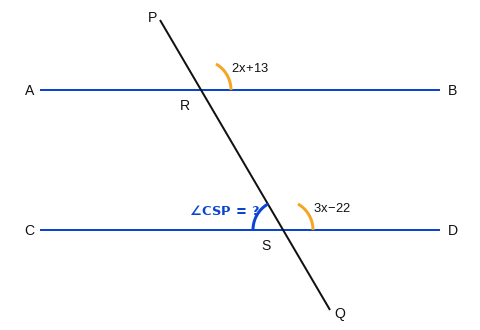
Let AB and CD be two parallel lines and PQ be a transversal such that PQ intersects AB at the point R and CD at the point S, respectively. If ∠BRP = (2x + 13)° and ∠DSP = (3x − 22)°, then find ∠CSP.
मान लीजिए AB और CD दो समांतर रेखाएँ हैं और PQ एक तिर्यक रेखा है, जो AB को बिंदु R पर और CD को बिंदु S पर क्रमशः प्रतिच्छेद करती है। यदि ∠BRP = (2x + 13)° और ∠DSP = (3x − 22)° है, तो ∠CSP ज्ञात कीजिए।
  1. A105°
  2. B95°
  3. C97°
  4. D83°
Show answer

Concept: ∠BRP and ∠DSP are corresponding angles, so they are equal; ∠CSP and ∠DSP form a linear pair.

  1. 2x+13=3x−22⇒x=35.
  2. ∠DSP=3(35)−22=83∘.
  3. ∠CSP=180∘−83∘=97∘.

Trick: Corresponding angles equal; angles on a straight line add to 180∘.

Answer: (C) 97∘

अवधारणा: ∠BRP और ∠DSP संगत कोण (corresponding angles) हैं, अतः बराबर; ∠CSP और ∠DSP रैखिक युग्म बनाते हैं।

  1. 2x+13=3x−22⇒x=35।
  2. ∠DSP=3(35)−22=83∘।
  3. ∠CSP=180∘−83∘=97∘।

ट्रिक: संगत कोण बराबर; सरल रेखा पर कोणों का योग 180∘।

उत्तर: (C) 97∘

RRB NTPC Graduate CBT 1MathematicsParallel lines and transversalRRB NTPC Graduate CBT 1 2024 · 6 Jun Shift 2 →
Q10684.
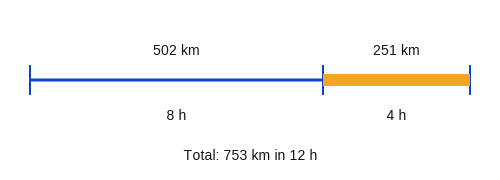
A man has to cover a distance of 753 km in 12 hours. If he covers two-third of this distance in 23 of the time, then what should his speed (in km/hr) be to cover the remaining distance in the time left?
एक व्यक्ति को 12 घंटे में 753 km की दूरी तय करनी है। यदि वह इस दूरी का दो-तिहाई भाग 23 समय में तय करता है, तो शेष दूरी को बचे हुए समय में तय करने के लिए उसकी चाल (km/hr में) कितनी होनी चाहिए?
  1. A41.8
  2. B31.3
  3. C52.25
  4. D62.75
Show answer

Concept: Speed=DistanceTime.

  1. Distance covered =23×753=502km in 23×12=8 hours.
  2. Remaining distance =753−502=251km; time left =12−8=4 hours.
  3. Required speed =2514=62.75km/h.

Trick: Remaining 13 distance in 13 time → speed =75312=62.75 (same average).

Answer: (D) 62.75

अवधारणा: चाल=दूरीसमय।

  1. तय दूरी =23×753=502km, समय =23×12=8 घंटे।
  2. शेष दूरी =753−502=251km; शेष समय =12−8=4 घंटे।
  3. आवश्यक चाल =2514=62.75km/h।

ट्रिक: शेष 13 दूरी, शेष 13 समय में → चाल =75312=62.75।

उत्तर: (D) 62.75

RRB NTPC Graduate CBT 1MathematicsSpeed, time and distanceRRB NTPC Graduate CBT 1 2024 · 6 Jun Shift 2 →
Q10685.
Manjit’s salary is ₹10,000 per month. He spends ₹6,000 on house rent and ₹3,000 on bills, and the rest of the amount is his monthly savings. Find his savings (in ₹) in a year, if in the month of his birthday, he spent all his monthly savings on birthday
celebrations.
मनजीत का वेतन ₹10,000 प्रति माह है। वह ₹6,000 मकान किराए पर और ₹3,000 बिलों पर खर्च करता है, और शेष राशि उसकी मासिक बचत है। एक वर्ष में उसकी बचत (₹ में) ज्ञात कीजिए, यदि अपने जन्मदिन वाले महीने में उसने अपनी पूरी मासिक बचत जन्मदिन के
समारोह पर खर्च कर दी।
  1. A10,000
  2. B12,000
  3. C9,000
  4. D11,000
Show answer

Concept: Monthly saving = Income − Expenditure.

  1. Monthly saving =10000−(6000+3000)=1000 (₹).
  2. In the birthday month the saving is spent, so savings occur in only 12−1=11 months.
  3. Yearly saving =11×1000=11000 (₹).

Trick: Just subtract one month’s saving from 12 months’ saving: 12000−1000.

Answer: (D) 11,000

अवधारणा: मासिक बचत = आय − व्यय।

  1. मासिक बचत =10000−(6000+3000)=1000 (₹)।
  2. जन्मदिन वाले महीने की बचत खर्च हो गई, अतः बचत केवल 12−1=11 महीनों में।
  3. वार्षिक बचत =11×1000=11000 (₹)।

ट्रिक: 12 महीनों की बचत में से एक महीने की बचत घटाएँ: 12000−1000।

उत्तर: (D) 11,000

RRB NTPC Graduate CBT 1MathematicsSavingsRRB NTPC Graduate CBT 1 2024 · 6 Jun Shift 2 →
Q10686.
Which of the following numbers is divisible by 41?
निम्नलिखित में से कौन-सी संख्या 41 से विभाज्य है?
  1. A7995
  2. B7431
  3. C8537
  4. D7889
Show answer

Concept: Divide each option by 41 (or use multiples of 41).

  1. 41×195=7995 ✓ (since 41×200=8200 and 8200−205=7995).
  2. 7431=41×181+10; 8537=41×208+9; 7889=41×192+17 – not divisible.

Trick: Use a near round multiple: 41×200=8200, then subtract multiples of 41 (205=41×5).

Answer: (A) 7995

अवधारणा: हर विकल्प को 41 से भाग दें (या 41 के गुणज प्रयोग करें)।

  1. 41×195=7995 ✓ (क्योंकि 41×200=8200 और 8200−205=7995)।
  2. 7431=41×181+10; 8537=41×208+9; 7889=41×192+17 – विभाज्य नहीं।

ट्रिक: पास का गोल गुणज लें: 41×200=8200, फिर 41 के गुणज घटाएँ (205=41×5)।

उत्तर: (A) 7995

RRB NTPC Graduate CBT 1MathematicsDivisibilityRRB NTPC Graduate CBT 1 2024 · 6 Jun Shift 2 →
Q10687.
The area of a rectangle increases by 8 m2 if its length is increased by 5 m and breadth is decreased by 7 m. If the length is decreased by 5 m and breadth is increased by 8 m, then its area increases by 33 m2. What is the perimeter of the original rectangle (in m)?
यदि किसी आयत की लंबाई 5 m बढ़ा दी जाए और चौड़ाई 7 m कम कर दी जाए, तो उसका क्षेत्रफल 8 m2 बढ़ जाता है। यदि लंबाई 5 m कम कर दी जाए और चौड़ाई 8 m बढ़ा दी जाए, तो उसका क्षेत्रफल 33 m2 बढ़ जाता है। मूल आयत का परिमाप (m में) कितना है?
  1. A575
  2. B576
  3. C573
  4. D574
Show answer

Concept: Let length =l, breadth =b; form two equations from the area changes.

  1. (l+5)(b−7)=lb+8⇒−7l+5b=43.
  2. (l−5)(b+8)=lb+33⇒8l−5b=73.
  3. Adding: l=116; then 5b=43+812=855⇒b=171.
  4. Perimeter =2(116+171)=574m.

Trick: The 5b terms have opposite signs – just add the equations.

Answer: (D) 574

अवधारणा: माना लंबाई =l, चौड़ाई =b; क्षेत्रफल में बदलाव से दो समीकरण बनाएँ।

  1. (l+5)(b−7)=lb+8⇒−7l+5b=43।
  2. (l−5)(b+8)=lb+33⇒8l−5b=73।
  3. जोड़ने पर: l=116; फिर 5b=43+812=855⇒b=171।
  4. परिमाप =2(116+171)=574m।

ट्रिक: 5b के चिह्न विपरीत हैं – सीधे दोनों समीकरण जोड़ दें।

उत्तर: (D) 574

RRB NTPC Graduate CBT 1MathematicsMensuration – rectangleRRB NTPC Graduate CBT 1 2024 · 6 Jun Shift 2 →
Q10688.
Mr. W travelled 370 km, 390 km and 720 km at speeds of 37 km/hr, 5 km/hr and 8 km/hr, respectively. Find his average speed in km/hr.
श्री W ने 370 km, 390 km और 720 km की दूरी क्रमशः 37 km/hr, 5 km/hr और 8 km/hr की चाल से तय की। km/hr में उसकी औसत चाल ज्ञात कीजिए।
  1. A92189
  2. B93089
  3. C82789
  4. D82889
Show answer

Concept: Average speed=Total distanceTotal time.

  1. Times: 37037=10 h, 3905=78 h, 7208=90 h; total =178 h.
  2. Total distance =370+390+720=1480km.
  3. Average speed =1480178=74089=82889km/h.

Trick: Never average the speeds; always total distance ÷ total time.

Answer: (D) 82889

अवधारणा: औसत चाल=कुल दूरीकुल समय।

  1. समय: 37037=10 घंटे, 3905=78 घंटे, 7208=90 घंटे; कुल =178 घंटे।
  2. कुल दूरी =370+390+720=1480km।
  3. औसत चाल =1480178=74089=82889km/h।

ट्रिक: चालों का सीधा औसत कभी न लें; हमेशा कुल दूरी ÷ कुल समय।

उत्तर: (D) 82889

RRB NTPC Graduate CBT 1MathematicsAverage speedRRB NTPC Graduate CBT 1 2024 · 6 Jun Shift 2 →
Q10689.
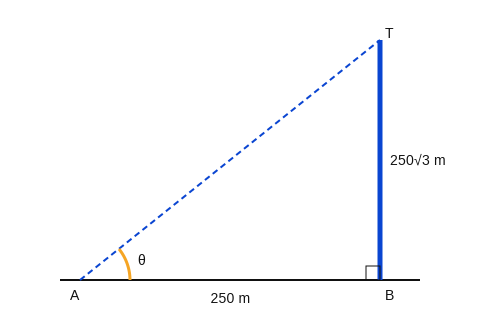
Find the angle of elevation of the top of a 2503 m high tower, from a point which is 250 m away from its foot.
एक 2503 m ऊँची मीनार के शीर्ष का, उसके पाद से 250 m दूर स्थित एक बिंदु से उन्नयन कोण ज्ञात कीजिए।
  1. A75∘
  2. B60∘
  3. C45∘
  4. D30∘
Show answer

Concept: tanθ=HeightBase.

  1. Height =2503m, base =250m.
  2. tanθ=2503250=3.
  3. tan60∘=3⇒θ=60∘.

Trick: Height =3× base → 60∘; base =3× height → 30∘.

Answer: (B) 60∘

अवधारणा: tanθ=ऊँचाईआधार।

  1. ऊँचाई =2503m, आधार =250m।
  2. tanθ=2503250=3।
  3. tan60∘=3⇒θ=60∘।

ट्रिक: ऊँचाई =3× आधार → 60∘; आधार =3× ऊँचाई → 30∘।

उत्तर: (B) 60∘

RRB NTPC Graduate CBT 1MathematicsHeights and distancesRRB NTPC Graduate CBT 1 2024 · 6 Jun Shift 2 →
Q10690.
On selling a wardrobe at ₹3,437, the value of gain is 75% more than the value of loss incurred on selling it at ₹3,338. In order to gain 50%, find the selling price (in ₹).
एक अलमारी को ₹3,437 में बेचने पर प्राप्त लाभ की राशि, उसे ₹3,338 में बेचने पर हुई हानि की राशि से 75% अधिक है। 50% लाभ प्राप्त करने के लिए विक्रय मूल्य (₹ में) ज्ञात कीजिए।
  1. A5,061
  2. B5,058
  3. C5,062
  4. D5,059
Show answer

Concept: Let cost price =C. Gain at ₹3,437 is 75% more than loss at ₹3,338.

  1. 3437−C=175100(C−3338).
  2. 4(3437−C)=7(C−3338)⇒13748+23366=11C⇒C=3711411=3374 (₹).
  3. For 50% gain: SP=3374×150100=5061 (₹).

Trick: 75% more means ratio gain : loss =7:4, so CP divides 3338 and 3437 in 4:7: 3338+411×99=3374.

Answer: (A) 5,061

अवधारणा: माना क्रय मूल्य =C। ₹3,437 पर लाभ, ₹3,338 पर हानि से 75% अधिक है।

  1. 3437−C=175100(C−3338)।
  2. 4(3437−C)=7(C−3338)⇒13748+23366=11C⇒C=3711411=3374 (₹)।
  3. 50% लाभ के लिए: SP=3374×150100=5061 (₹)।

ट्रिक: 75% अधिक = लाभ : हानि =7:4; अतः C=3338+411×99=3374।

उत्तर: (A) 5,061

RRB NTPC Graduate CBT 1MathematicsProfit and lossRRB NTPC Graduate CBT 1 2024 · 6 Jun Shift 2 →
Q10691.
Factorise the polynomial x4− 10x2+ 22 into product of two quadratic polynomials.
बहुपद x4− 10x2+ 22 का दो द्विघात बहुपदों के गुणनफल के रूप में गुणनखंड कीजिए।
  1. A(x2−4+3)(x2−4−3)
  2. B(x2−3+3)(x2−3−3)
  3. C(x2−2+3)(x2−2−3)
  4. D(x2−5+3)(x2−5−3)
Show answer

Concept: Complete the square in x2 and use a2−b2=(a+b)(a−b).

  1. x4−10x2+22=(x2−5)2−25+22=(x2−5)2−3.
  2. =(x2−5)2−(3)2.
  3. =(x2−5+3)(x2−5−3).

Trick: Check: the constants multiply to 25−3=22 and add to −10 ✓.

Answer: (D) (x2−5+3)(x2−5−3)

अवधारणा: x2 में पूर्ण वर्ग बनाएँ और a2−b2=(a+b)(a−b) लगाएँ।

  1. x4−10x2+22=(x2−5)2−25+22=(x2−5)2−3।
  2. =(x2−5)2−(3)2।
  3. =(x2−5+3)(x2−5−3)।

ट्रिक: जाँच: अचरों का गुणनफल 25−3=22 और योग −10 ✓।

उत्तर: (D) (x2−5+3)(x2−5−3)

RRB NTPC Graduate CBT 1MathematicsAlgebra – factorisationRRB NTPC Graduate CBT 1 2024 · 6 Jun Shift 2 →
Q10692.
Pipe A can fill a tank in 18 minutes, while pipe B can empty the completely filled tank in 27 minutes. Initially, pipe A is opened and after 6 minutes pipe B is also opened. In how much time (in minutes) will the remaining tank be filled completely?
पाइप A एक टंकी को 18 मिनट में भर सकता है, जबकि पाइप B पूरी भरी हुई टंकी को 27 मिनट में खाली कर सकता है। प्रारंभ में पाइप A खोला जाता है और 6 मिनट बाद पाइप B भी खोल दिया जाता है। शेष टंकी कितने समय (मिनट में) में पूरी तरह भर जाएगी?
  1. A36
  2. B32
  3. C35
  4. D21
Show answer

Concept: Work done = rate × time; an emptying pipe has negative rate.

  1. In 6 minutes A fills 618=13 of the tank; remaining =23.
  2. Net rate of A and B =118−127=3−254=154 per minute.
  3. Time =23÷154=36 minutes.

Trick: LCM method: tank =54 units; A =+3, B =−2, net +1/min; after 6 min, 54−18=36 units → 36 min.

Answer: (A) 36

अवधारणा: कार्य = दर × समय; खाली करने वाले पाइप की दर ऋणात्मक होती है।

  1. 6 मिनट में A टंकी का 618=13 भाग भरता है; शेष =23।
  2. A और B की शुद्ध दर =118−127=3−254=154 प्रति मिनट।
  3. समय =23÷154=36 मिनट।

ट्रिक: LCM विधि: टंकी =54 इकाई; A =+3, B =−2, शुद्ध +1/मिनट; 6 मिनट बाद 54−18=36 इकाई → 36 मिनट।

उत्तर: (A) 36

RRB NTPC Graduate CBT 1MathematicsPipes and cisternsRRB NTPC Graduate CBT 1 2024 · 6 Jun Shift 2 →
Q10693.
2% of 50% of a number is what percentage of that number?
किसी संख्या के 50% का 2%, उस संख्या का कितना प्रतिशत है?
  1. A100%
  2. B0.1%
  3. C1%
  4. D52%
Show answer

Concept: Successive percentages multiply.

  1. 2% of 50% of N=2100×50100×N=N100.
  2. N100 is 1% of N.

Trick: 2×50=100, and 100100=1%.

Answer: (C) 1%

अवधारणा: क्रमागत प्रतिशत आपस में गुणा होते हैं।

  1. N का 50% का 2%=2100×50100×N=N100।
  2. N100, N का 1% है।

ट्रिक: 2×50=100, और 100100=1%।

उत्तर: (C) 1%

RRB NTPC Graduate CBT 1MathematicsPercentageRRB NTPC Graduate CBT 1 2024 · 6 Jun Shift 2 →
Q10694.
The mode of the observations 4, 3, 8, 7, 3, 7, 3, 1, 1, 3, 8, 3, 3, 5 and 3 is:
प्रेक्षणों 4, 3, 8, 7, 3, 7, 3, 1, 1, 3, 8, 3, 3, 5 और 3 का बहुलक है:
  1. A4
  2. B7
  3. C3
  4. D8
Show answer

Concept: Mode = the observation that occurs most often.

  1. Frequencies: 1 → 2, 3 → 7, 4 → 1, 5 → 1, 7 → 2, 8 → 2.
  2. 3 occurs most often (7 times).

Trick: Tally just the repeated values; no calculation needed.

Answer: (C) 3

अवधारणा: बहुलक (Mode) = सबसे अधिक बार आने वाला प्रेक्षण।

  1. बारंबारता: 1 → 2, 3 → 7, 4 → 1, 5 → 1, 7 → 2, 8 → 2।
  2. 3 सबसे अधिक (7 बार) आता है।

ट्रिक: केवल दोहराए गए मान गिनें; कोई गणना नहीं।

उत्तर: (C) 3

RRB NTPC Graduate CBT 1MathematicsStatistics – modeRRB NTPC Graduate CBT 1 2024 · 6 Jun Shift 2 →
Q10695.
The mode and median of a data set is 89.7 and 32, respectively. What is the mean of the data set? (Use empirical formula.)
एक आँकड़ा समुच्चय का बहुलक और माध्यिका क्रमशः 89.7 और 32 है। आँकड़ा समुच्चय का माध्य क्या है? (आनुभविक सूत्र का प्रयोग कीजिए।)
  1. A2.6
  2. B11.26
  3. C5.9
  4. D3.15
Show answer

Concept: Empirical formula: Mode=3Median−2Mean.

  1. 89.7=3(32)−2Mean=96−2Mean.
  2. 2Mean=96−89.7=6.3.
  3. Mean=3.15.

Trick: Remember “3 Median − 2 Mean” – the coefficients 3 and 2 go with median and mean.

Answer: (D) 3.15

अवधारणा: आनुभविक सूत्र: बहुलक=3माध्यिका−2माध्य।

  1. 89.7=3(32)−2माध्य=96−2माध्य।
  2. 2माध्य=96−89.7=6.3।
  3. माध्य=3.15।

ट्रिक: “3 माध्यिका − 2 माध्य” याद रखें।

उत्तर: (D) 3.15

RRB NTPC Graduate CBT 1MathematicsStatistics – empirical relationRRB NTPC Graduate CBT 1 2024 · 6 Jun Shift 2 →
Q10696.
Based on the English alphabetical order, three of the following four letter-cluster pairs are alike in a certain way and thus form a group. Which letter-cluster pair DOES NOT belong to that group? (Note: The odd one out is not based on the number of
consonants/vowels or their position in the letter cluster)
अंग्रेज़ी वर्णमाला क्रम के आधार पर, निम्नलिखित चार अक्षर-समूह युग्मों में से तीन किसी निश्चित प्रकार से एकसमान हैं और इस प्रकार एक समूह बनाते हैं। कौन-सा अक्षर-समूह युग्म उस समूह से संबंधित नहीं है? (ध्यान दें: असंगत अक्षर-समूह, उस अक्षर-समूह में
व्यंजनों/स्वरों की संख्या या उनके स्थान पर आधारित नहीं है)
  1. APK - MJ
  2. BNO - IJ
  3. CFG - AB
  4. DJK - EF
Show answer

Concept: Compare each letter of the first cluster with the corresponding letter of the second using alphabet positions.

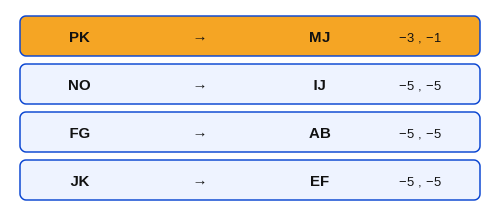
  1. NO → IJ: N(14)−5=I(9), O(15)−5=J(10) → −5,−5.
  2. FG → AB and JK → EF also follow −5,−5.
  3. PK → MJ: P(16)−3=M(13), K(11)−1=J(10) → −3,−1, a different pattern.

Trick: Consecutive letters (NO, FG, JK) going back 5 give consecutive letters again; PK is not even a consecutive pair.

Answer: (A) PK - MJ

अवधारणा: पहले समूह के प्रत्येक अक्षर की तुलना दूसरे समूह के संगत अक्षर से वर्णमाला स्थान द्वारा करें।

  1. NO → IJ: N(14)−5=I(9), O(15)−5=J(10) → −5,−5।
  2. FG → AB और JK → EF भी −5,−5 नियम मानते हैं।
  3. PK → MJ: P(16)−3=M(13), K(11)−1=J(10) → −3,−1, नियम अलग है।

ट्रिक: NO, FG, JK लगातार अक्षर हैं और 5 पीछे जाने पर फिर लगातार अक्षर मिलते हैं; PK लगातार युग्म ही नहीं है।

उत्तर: (A) PK - MJ

RRB NTPC Graduate CBT 1General Intelligence and ReasoningLetter-cluster pairs (odd one out)RRB NTPC Graduate CBT 1 2024 · 6 Jun Shift 2 →
Q10697.
What should come in place of the question mark (?) in the given series based on the English alphabetical order?
LJQ NLS PNU RPW ?
अंग्रेज़ी वर्णमाला क्रम के आधार पर दी गई शृंखला में प्रश्न चिह्न (?) के स्थान पर क्या आना चाहिए?
LJQ NLS PNU RPW ?
  1. ATRZ
  2. BTRY
  3. CTSZ
  4. DTSY
Show answer

Concept: Check each letter position of the clusters separately.

  1. 1st letters: L, N, P, R → +2 each → T
  2. 2nd letters: J, L, N, P → +2 each → R
  3. 3rd letters: Q, S, U, W → +2 each → Y

Trick: All three positions move +2: RPW → TRY.

Answer: (B) TRY

अवधारणा: प्रत्येक समूह के अक्षरों की स्थिति अलग-अलग जाँचें।

  1. पहले अक्षर: L, N, P, R → हर बार +2 → T
  2. दूसरे अक्षर: J, L, N, P → +2 → R
  3. तीसरे अक्षर: Q, S, U, W → +2 → Y

ट्रिक: तीनों स्थान +2 बढ़ते हैं: RPW → TRY।

उत्तर: (B) TRY

RRB NTPC Graduate CBT 1General Intelligence and ReasoningLetter seriesRRB NTPC Graduate CBT 1 2024 · 6 Jun Shift 2 →
Q10698.
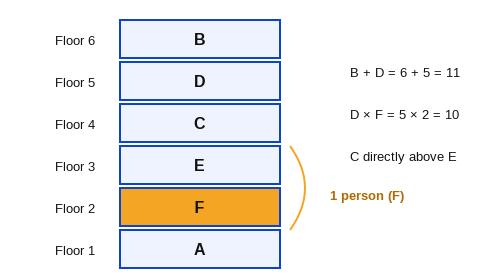
A, B, C, D, E and F live on six different floors of the same building. The lowermost floor in the building is numbered 1, the floor above it, number 2 and so on till the topmost floor is numbered 6. The product of floors on which D and F live is 10. C lives
immediately above E. The sum of floors on which B and D live is 11. How many people live between A and E?
A, B, C, D, E और F एक ही इमारत की छह अलग-अलग मंज़िलों पर रहते हैं। इमारत की सबसे निचली मंज़िल की संख्या 1 है, उसके ऊपर वाली मंज़िल की संख्या 2 है और इसी प्रकार सबसे ऊपरी मंज़िल की संख्या 6 है। D और F जिन मंज़िलों पर रहते हैं, उनकी संख्याओं का गुणनफल 10 है। C,
E के ठीक ऊपर रहता है। B और D जिन मंज़िलों पर रहते हैं, उनकी संख्याओं का योग 11 है। A और E के बीच कितने व्यक्ति रहते हैं?
  1. A3
  2. B1
  3. C2
  4. D4
Show answer

Concept: Fix the definite clues (product and sum) first, then place the remaining people.

  1. D × F = 10 → floors {2, 5}.
  2. B + D = 11 with D ∈ {2, 5} → D = 5, B = 6 (D = 2 would need B = 9). So F = 2.
  3. Floors left: 1, 3, 4. C immediately above E → E = 3, C = 4; A = 1.
  4. Between A (1) and E (3): only F → 1 person.

Trick: Sum 11 on a 6-floor building forces the pair (5, 6) at once.

Answer: (B) 1

अवधारणा: पहले निश्चित संकेत (गुणनफल और योग) लगाएँ, फिर बाकी लोगों को रखें।

  1. D × F = 10 → मंज़िल {2, 5}।
  2. B + D = 11, D ∈ {2, 5} → D = 5, B = 6 (D = 2 पर B = 9 संभव नहीं)। अतः F = 2।
  3. बची मंज़िलें: 1, 3, 4। C ठीक E के ऊपर → E = 3, C = 4; A = 1।
  4. A (1) और E (3) के बीच केवल F → 1 व्यक्ति।

ट्रिक: 6 मंज़िलों में योग 11 केवल (5, 6) से बनता है।

उत्तर: (B) 1

RRB NTPC Graduate CBT 1General Intelligence and ReasoningFloor puzzleRRB NTPC Graduate CBT 1 2024 · 6 Jun Shift 2 →
Q10699.
Refer to the following number and symbol series and answer the question that follows. Counting to be done from left to right only. All numbers are single-digit numbers. (Left) 5 $ 5 % 8 7 * 5 % & 8 @ 2 6 2 £ 3 8 1 & 5 6 (Right)
How many such numbers are there each of which is immediately preceded by a number and also immediately followed by a number?
निम्नलिखित संख्या और प्रतीक शृंखला का संदर्भ लीजिए और नीचे दिए गए प्रश्न का उत्तर दीजिए। गिनती केवल बाएँ से दाएँ की जानी है। सभी संख्याएँ एक-अंकीय संख्याएँ हैं। (बाएँ) 5 $ 5 % 8 7 * 5 % & 8 @ 2 6 2 £ 3 8 1 & 5 6 (दाएँ)
ऐसी कितनी संख्याएँ हैं जिनमें से प्रत्येक के ठीक पहले एक संख्या है और ठीक बाद भी एक संख्या है?
  1. A2
  2. B3
  3. C4
  4. D7
Show answer

Concept: Look for the pattern Number–Number–Number and count the middle numbers.

  1. Series: 5 $ 5 % 8 7 * 5 % & 8 @ 2 6 2 £ 3 8 1 & 5 6
  2. ‘2 6 2’ → 6 qualifies.
  3. ‘3 8 1’ → 8 qualifies.
  4. No other number has numbers on both sides (e.g. 8 7 * fails, 5 6 is at the end).

Trick: Scan only runs of three or more consecutive digits: ‘262’ and ‘381’ – each gives one middle number.

Answer: (A) 2

अवधारणा: संख्या–संख्या–संख्या पैटर्न खोजें और बीच वाली संख्याएँ गिनें।

  1. श्रृंखला: 5 $ 5 % 8 7 * 5 % & 8 @ 2 6 2 £ 3 8 1 & 5 6
  2. ‘2 6 2’ → 6 मान्य।
  3. ‘3 8 1’ → 8 मान्य।
  4. किसी अन्य संख्या के दोनों ओर संख्या नहीं है (जैसे 8 7 * नहीं, 5 6 अंत में है)।

ट्रिक: केवल लगातार तीन या अधिक अंकों के समूह देखें: ‘262’ और ‘381’ – प्रत्येक से एक बीच वाली संख्या।

उत्तर: (A) 2

RRB NTPC Graduate CBT 1General Intelligence and ReasoningNumber-symbol seriesRRB NTPC Graduate CBT 1 2024 · 6 Jun Shift 2 →
Q10700.
In a certain code language, ‘GATE’ is coded as ‘4628’ and ‘TURN’ is coded as ‘3567’. What is the code for ‘T’ in the given code language?
एक निश्चित कूट भाषा में, ‘GATE’ को ‘4628’ और ‘TURN’ को ‘3567’ के रूप में कूटबद्ध किया जाता है। दी गई कूट भाषा में ‘T’ का कूट क्या है?
  1. A4
  2. B6
  3. C3
  4. D2
Show answer

Concept: A letter common to both words must take the digit common to both codes.

  1. GATE and TURN share only the letter T.
  2. Codes 4628 and 3567 share only the digit 6.
  3. So T = 6.

Trick: Common letter ↔ common digit.

Answer: (B) 6

अवधारणा: दोनों शब्दों में उभयनिष्ठ अक्षर का कोड दोनों कोडों में उभयनिष्ठ अंक होगा।

  1. GATE और TURN में केवल T उभयनिष्ठ है।
  2. 4628 और 3567 में केवल 6 उभयनिष्ठ है।
  3. अतः T = 6।

ट्रिक: उभयनिष्ठ अक्षर ↔ उभयनिष्ठ अंक।

उत्तर: (B) 6

RRB NTPC Graduate CBT 1General Intelligence and ReasoningCoding-decoding (common letter)RRB NTPC Graduate CBT 1 2024 · 6 Jun Shift 2 →