Question bank

Q&A: practice questions with answers

Search questions on any topic. Filter by exam category, exam, subject and topic, try the question, then open the answer and explanation.

Courses – airGurukul

20,719 questions found.

Q10701.
Select the number from among the given options that can replace the question mark (?) in the following series.
139 136 131 124 115 ? 91
दिए गए विकल्पों में से वह संख्या चुनिए जो निम्नलिखित शृंखला में प्रश्न चिह्न (?) को प्रतिस्थापित कर सके।
139 136 131 124 115 ? 91
  1. A106
  2. B109
  3. C104
  4. D101
Show answer

Concept: Find the differences between consecutive terms.
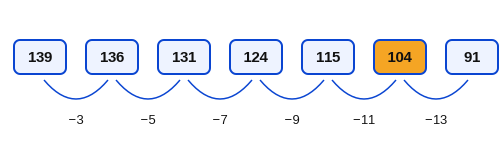
  1. 139−3=136, 136−5=131, 131−7=124, 124−9=115
  2. Next: 115−11=104
  3. Check: 104−13=91 ✔

Trick: Subtract consecutive odd numbers 3, 5, 7, 9, 11, 13.

Answer: (C) 104

अवधारणा: क्रमागत पदों का अंतर निकालें।

  1. 139−3=136, 136−5=131, 131−7=124, 124−9=115
  2. अगला: 115−11=104
  3. जाँच: 104−13=91 ✔

ट्रिक: क्रमागत विषम संख्याएँ 3, 5, 7, 9, 11, 13 घटाई जा रही हैं।

उत्तर: (C) 104
RRB NTPC Graduate CBT 1General Intelligence and ReasoningNumber seriesRRB NTPC Graduate CBT 1 2024 · 6 Jun Shift 2 →
Q10702.
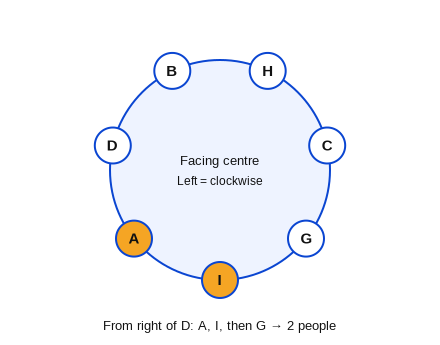
A, B, C, D, G, H, and I are sitting around a circular table facing the centre.
B sits third to the left of I. G sits second to the left of H. Only I sits between A and G. C is not an immediate neighbor of B. How many people sit between D and G when counted from the right of D?
A, B, C, D, G, H और I एक वृत्ताकार मेज़ के चारों ओर केंद्र की ओर मुख करके बैठे हैं।
B, I के बाएँ से तीसरे स्थान पर बैठा है। G, H के बाएँ से दूसरे स्थान पर बैठा है। A और G के बीच केवल I बैठा है। C, B का निकटतम पड़ोसी नहीं है। D के दाएँ से गिनने पर D और G के बीच कितने व्यक्ति बैठे हैं?
  1. AFourचार
  2. BOneएक
  3. CTwoदो
  4. DThreeतीन
Show answer

Concept: Facing the centre: left = clockwise, right = anticlockwise. 7 people → 7 seats.

  1. Fix I. B is third to the left of I.
  2. Only I between A and G → A and G are the two neighbours of I.
  3. G second to the left of H: if G were on I’s left, H would sit on I’s right, clashing with A. So A is on I’s left, G on I’s right, H two seats to G’s right.
  4. Two seats remain next to B; C is not B’s neighbour, so C sits beside H and G, and D sits between A and B.
  5. From D going right (anticlockwise): A, I, then G → 2 people.

Trick: Place the ‘only X between’ pair around X first; it fixes most seats.

Answer: (C) Two

अवधारणा: केंद्र की ओर मुख: बायाँ = दक्षिणावर्त (clockwise), दायाँ = वामावर्त। 7 लोग → 7 सीटें।

  1. I को स्थिर करें। B, I के बाएँ तीसरे स्थान पर।
  2. A और G के बीच केवल I → A और G, I के दोनों पड़ोसी हैं।
  3. G, H के बाएँ दूसरे स्थान पर: यदि G, I के बाएँ हो तो H, I के दाएँ आएगा और A से टकराएगा। अतः A, I के बाएँ, G, I के दाएँ, और H, G से दो स्थान दाएँ।
  4. B के पास दो सीटें बचीं; C, B का पड़ोसी नहीं, अतः C, H और G के बीच, D, A और B के बीच।
  5. D से दाएँ गिनें: A, I, फिर G → 2 व्यक्ति।

ट्रिक: ‘केवल X बीच में’ वाले युग्म को पहले X के दोनों ओर रखें; अधिकांश सीटें तय हो जाती हैं।

उत्तर: (C) Two

RRB NTPC Graduate CBT 1General Intelligence and ReasoningCircular seating arrangementRRB NTPC Graduate CBT 1 2024 · 6 Jun Shift 2 →
Q10703.
Below are given two sets of numbers. In each set of numbers, a certain mathematical operation on the first number results in the second number. Similarly, a certain mathematical operation on the second number results in the third number and so on. Which of the given options follows the same set of operations as in the question? (NOTE – A two/three-digit number cannot be broken into individual digits for operations, e.g. if 37 is followed by 10, the operation cannot be 3+7 as a two-digit number cannot be broken into individual digits.)
14 - 15 - 20 - 40 ; 19 - 20 - 25 - 50
नीचे संख्याओं के दो समुच्चय दिए गए हैं। संख्याओं के प्रत्येक समुच्चय में, पहली संख्या पर एक निश्चित गणितीय संक्रिया करने से दूसरी संख्या प्राप्त होती है। इसी प्रकार, दूसरी संख्या पर एक निश्चित गणितीय संक्रिया करने से तीसरी संख्या प्राप्त होती है और इसी प्रकार आगे भी। दिए गए विकल्पों में से कौन-सा विकल्प प्रश्न में दिए गए संक्रियाओं के समान समुच्चय का अनुसरण करता है? (ध्यान दें – संक्रियाओं के लिए किसी दो/तीन-अंकीय संख्या को अलग-अलग अंकों में विभाजित नहीं किया जा सकता, उदाहरणार्थ, यदि 37 के बाद 10 आता है, तो संक्रिया 3+7 नहीं हो सकती क्योंकि दो-अंकीय संख्या को अलग-अलग अंकों में विभाजित नहीं किया जा सकता।)
14 - 15 - 20 - 40 ; 19 - 20 - 25 - 50
  1. A8 - 10 - 15 - 30
  2. B3 - 4 - 9 - 14
  3. C7 - 9 - 18 - 20
  4. D5 - 6 - 11 - 22
Show answer

Concept: Find the chain of operations in the given sets and test each option.

  1. 14→15(+1)→20(+5)→40(×2)
  2. 19→20(+1)→25(+5)→50(×2)
  3. Option (D): 5→6(+1)→11(+5)→22(×2) ✔
  4. (A) starts with +2, (B) ends with +5, (C) starts with +2 – all fail.

Trick: Last term = double the third term; only 11 → 22 satisfies this.

Answer: (D) 5 - 6 - 11 - 22

अवधारणा: दिए गए समूहों में संक्रियाओं की श्रृंखला खोजें और विकल्प जाँचें।

  1. 14→15(+1)→20(+5)→40(×2)
  2. 19→20(+1)→25(+5)→50(×2)
  3. विकल्प (D): 5→6(+1)→11(+5)→22(×2) ✔
  4. (A) +2 से शुरू, (B) +5 पर खत्म, (C) +2 से शुरू – सब असफल।

ट्रिक: अंतिम पद = तीसरे पद का दुगुना; केवल 11 → 22 यह पूरा करता है।

उत्तर: (D) 5 - 6 - 11 - 22

RRB NTPC Graduate CBT 1General Intelligence and ReasoningNumber set operationsRRB NTPC Graduate CBT 1 2024 · 6 Jun Shift 2 →
Q10704.
In a certain code language, ‘BLUE’ is coded as ‘4628’ and ‘LOAD’ is coded as ‘3567’. What is the code for ‘L’ in the given code language?
एक निश्चित कूट भाषा में, ‘BLUE’ को ‘4628’ और ‘LOAD’ को ‘3567’ के रूप में कूटबद्ध किया जाता है। दी गई कूट भाषा में ‘L’ का कूट क्या है?
  1. A3
  2. B6
  3. C7
  4. D8
Show answer

Concept: A letter common to both words takes the digit common to both codes.

  1. BLUE and LOAD share only L.
  2. 4628 and 3567 share only 6.
  3. So L = 6.

Trick: Common letter ↔ common digit.

Answer: (B) 6

अवधारणा: दोनों शब्दों के उभयनिष्ठ अक्षर का कोड दोनों कोडों का उभयनिष्ठ अंक होता है।

  1. BLUE और LOAD में केवल L उभयनिष्ठ है।
  2. 4628 और 3567 में केवल 6 उभयनिष्ठ है।
  3. अतः L = 6।

ट्रिक: उभयनिष्ठ अक्षर ↔ उभयनिष्ठ अंक।

उत्तर: (B) 6

RRB NTPC Graduate CBT 1General Intelligence and ReasoningCoding-decoding (common letter)RRB NTPC Graduate CBT 1 2024 · 6 Jun Shift 2 →
Q10705.
Refer to the following number and symbol series and answer the question that follows. Counting to be done from left to right only. All numbers are single-digit numbers. (Left) @ $ & 7 7 @ 5 7 & & 4 1 9 3 $ 7 8 & 7 € € 1 (Right)
How many such symbols are there each of which is immediately preceded by a number and also immediately followed by a symbol?
निम्नलिखित संख्या और प्रतीक शृंखला का संदर्भ लीजिए और नीचे दिए गए प्रश्न का उत्तर दीजिए। गिनती केवल बाएँ से दाएँ की जानी है। सभी संख्याएँ एक-अंकीय संख्याएँ हैं। (बाएँ) @ $ & 7 7 @ 5 7 & & 4 1 9 3 $ 7 8 & 7 € € 1 (दाएँ)
ऐसे कितने प्रतीक हैं जिनमें से प्रत्येक के ठीक पहले एक संख्या है और ठीक बाद एक प्रतीक है?
  1. A5
  2. B4
  3. C2
  4. D3
Show answer

Concept: Look for the pattern Number–Symbol–Symbol.

  1. Series: @ $ & 7 7 @ 5 7 & & 4 1 9 3 $ 7 8 & 7 € € 1
  2. ‘7 & &’ → qualifies.
  3. ‘7 € €’ → qualifies.
  4. Others fail: ‘7 @ 5’, ‘3 $ 7’, ‘8 & 7’ are followed by numbers.

Trick: Locate pairs of adjacent symbols (& &, € €) and check the element just before the first one.

Answer: (C) 2

अवधारणा: संख्या–प्रतीक–प्रतीक पैटर्न खोजें।

  1. श्रृंखला: @ $ & 7 7 @ 5 7 & & 4 1 9 3 $ 7 8 & 7 € € 1
  2. ‘7 & &’ → मान्य।
  3. ‘7 € €’ → मान्य।
  4. बाकी नहीं: ‘7 @ 5’, ‘3 $ 7’, ‘8 & 7’ के बाद संख्या है।

ट्रिक: लगातार दो प्रतीक (& &, € €) खोजें और पहले प्रतीक से ठीक पहले वाला तत्व देखें।

उत्तर: (C) 2

RRB NTPC Graduate CBT 1General Intelligence and ReasoningNumber-symbol seriesRRB NTPC Graduate CBT 1 2024 · 6 Jun Shift 2 →
Q10706.
Which of the following letter-number clusters will replace the question mark (?) in the given series to make it logically complete?
GKO 11, IMQ 13, KOS 15, MQU 17, ?
निम्नलिखित में से कौन-सा अक्षर-संख्या समूह दी गई शृंखला में प्रश्न चिह्न (?) को प्रतिस्थापित करके उसे तार्किक रूप से पूर्ण करेगा?
GKO 11, IMQ 13, KOS 15, MQU 17, ?
  1. AOSW 19
  2. BNQS 21
  3. CORT 21
  4. DNTZ 19
Show answer

Concept: Track the letter cluster and the number separately.

  1. Each letter moves +2: G→I→K→M→O, K→M→O→Q→S, O→Q→S→U→W
  2. Numbers: 11, 13, 15, 17 → +2 → 19
  3. Next term: OSW 19

Trick: Inside each cluster letters also differ by 4 (G, K, O); O, S, W fits.

Answer: (A) OSW 19

अवधारणा: अक्षर समूह और संख्या को अलग-अलग देखें।

  1. हर अक्षर +2: G→I→K→M→O, K→M→O→Q→S, O→Q→S→U→W
  2. संख्याएँ: 11, 13, 15, 17 → +2 → 19
  3. अगला पद: OSW 19

ट्रिक: हर समूह के अंदर भी अक्षरों में 4 का अंतर है (G, K, O); O, S, W सही बैठता है।

उत्तर: (A) OSW 19

RRB NTPC Graduate CBT 1General Intelligence and ReasoningLetter-number seriesRRB NTPC Graduate CBT 1 2024 · 6 Jun Shift 2 →
Q10707.
If ‘A’ stands for ‘×’, ‘B’ stands for ‘−’, ‘C’ stands for ‘+’, and ‘D’ stands for ‘÷’, then the resultant of which of the following will be 9?
यदि ‘A’ का अर्थ ‘×’ है, ‘B’ का अर्थ ‘−’ है, ‘C’ का अर्थ ‘+’ है और ‘D’ का अर्थ ‘÷’ है, तो निम्नलिखित में से किसका परिणाम 9 होगा?
  1. A8 B 3 A 10 C 2 D 5
  2. B8 B 3 C 10 A 2 D 5
  3. C8 A 3 C 10 B 2 D 5
  4. D8 C 3 B 10 A 2 D 5
Show answer

Concept: Replace letters (A = ×, B = −, C = +, D = ÷) and apply BODMAS.

  1. (B): 8−3+10×2÷5=8−3+4=9 ✔
  2. (A): 8−3×10+2÷5=−21.6
  3. (C): 8×3+10−2÷5=33.6; (D): 8+3−10×2÷5=7

Trick: Look for the option where the ‘×2÷5’ part acts on 10 (gives 4) and the rest gives 5: 8−3=5.

Answer: (B) 8 B 3 C 10 A 2 D 5

अवधारणा: अक्षर बदलें (A = ×, B = −, C = +, D = ÷) और BODMAS लगाएँ।

  1. (B): 8−3+10×2÷5=8−3+4=9 ✔
  2. (A): 8−3×10+2÷5=−21.6
  3. (C): 8×3+10−2÷5=33.6; (D): 8+3−10×2÷5=7

ट्रिक: वह विकल्प खोजें जहाँ ‘×2÷5’ 10 पर लगे (4 मिले) और शेष 5 दे: 8−3=5।

उत्तर: (B) 8 B 3 C 10 A 2 D 5

RRB NTPC Graduate CBT 1General Intelligence and ReasoningMathematical operationsRRB NTPC Graduate CBT 1 2024 · 6 Jun Shift 2 →
Q10708.
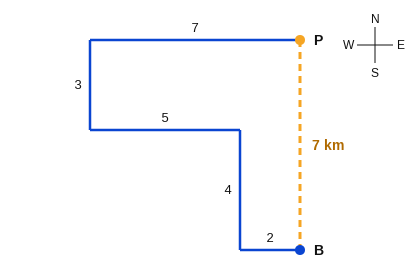
Tanveer starts from Point B and drives 2 km towards west. He then takes a right turn, drives 4 km, turns left and drives 5 km. He then takes a right turn and drives 3 km. He takes a final right turn, drives 7 km and stops at Point P. How far (shortest distance) and towards which direction should he drive in order to reach Point B again (all turns are 90° turns only unless specified)?
तनवीर बिंदु B से चलना शुरू करता है और पश्चिम की ओर 2 km ड्राइव करता है। फिर वह दाएँ मुड़ता है, 4 km ड्राइव करता है, बाएँ मुड़ता है और 5 km ड्राइव करता है। फिर वह दाएँ मुड़ता है और 3 km ड्राइव करता है। वह अंतिम बार दाएँ मुड़ता है, 7 km ड्राइव करता है और बिंदु P पर रुक जाता है। बिंदु B पर पुनः पहुँचने के लिए उसे कितनी दूरी (न्यूनतम दूरी) और किस दिशा में ड्राइव करना चाहिए (जब तक निर्दिष्ट न हो, सभी मोड़ केवल 90° के हैं)?
  1. A5 km south5 km दक्षिण
  2. B7 km south7 km दक्षिण
  3. C6 km south6 km दक्षिण
  4. D4 km south4 km दक्षिण
Show answer

Concept: Track each move as coordinates (East +x, North +y) starting from B (0,0).

  1. West 2 → (−2,0); right turn = North 4 → (−2,4)
  2. Left = West 5 → (−7,4); right = North 3 → (−7,7)
  3. Right = East 7 → P (0,7)
  4. P is 7 km directly north of B, so he must drive 7 km south.

Trick: Net E–W: −2−5+7=0; net N–S: 4+3=7 north → return 7 km south.

Answer: (B) 7 km south

अवधारणा: B (0,0) से हर चाल को निर्देशांक (पूर्व +x, उत्तर +y) में लिखें।

  1. पश्चिम 2 → (−2,0); दाएँ = उत्तर 4 → (−2,4)
  2. बाएँ = पश्चिम 5 → (−7,4); दाएँ = उत्तर 3 → (−7,7)
  3. दाएँ = पूर्व 7 → P (0,7)
  4. P, B के ठीक 7 km उत्तर में है, अतः 7 km दक्षिण जाना होगा।

ट्रिक: शुद्ध पूर्व–पश्चिम: −2−5+7=0; उत्तर–दक्षिण: 4+3=7 उत्तर → 7 km दक्षिण।

उत्तर: (B) 7 km south

RRB NTPC Graduate CBT 1General Intelligence and ReasoningDirection and distanceRRB NTPC Graduate CBT 1 2024 · 6 Jun Shift 2 →
Q10709.
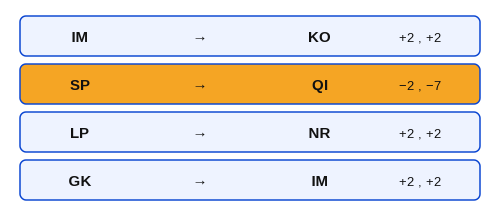
Based on the English alphabetical order, three of the following four letter-cluster pairs are alike in a certain way and thus form a group. Which letter-cluster pair DOES NOT belong to that group?
(Note: The odd one out is not based on the number of consonants/vowels or their position in the letter-cluster.)
अंग्रेज़ी वर्णमाला क्रम के आधार पर, निम्नलिखित चार अक्षर-समूह युग्मों में से तीन किसी निश्चित प्रकार से एकसमान हैं और इस प्रकार एक समूह बनाते हैं। कौन-सा अक्षर-समूह युग्म उस समूह से संबंधित नहीं है?
(ध्यान दें: असंगत अक्षर-समूह, उस अक्षर-समूह में व्यंजनों/स्वरों की संख्या या उनके स्थान पर आधारित नहीं है।)
  1. AIM - KO
  2. BSP - QI
  3. CLP - NR
  4. DGK - IM
Show answer

Concept: Compare each letter of the first cluster with the corresponding letter of the second.

  1. IM → KO: +2,+2; LP → NR: +2,+2; GK → IM: +2,+2
  2. SP → QI: S(19)−2=Q(17), P(16)−7=I(9) → −2,−7
  3. SP – QI breaks the pattern.

Trick: In the three alike pairs both clusters have a gap of 4 (I_M, L_P, G_K); SP goes backwards.

Answer: (B) SP - QI

अवधारणा: पहले समूह के प्रत्येक अक्षर की तुलना दूसरे समूह के संगत अक्षर से करें।

  1. IM → KO: +2,+2; LP → NR: +2,+2; GK → IM: +2,+2
  2. SP → QI: S(19)−2=Q(17), P(16)−7=I(9) → −2,−7
  3. SP – QI नियम तोड़ता है।

ट्रिक: समान तीनों युग्मों में अक्षरों के बीच 4 का अंतर है (I_M, L_P, G_K); SP उल्टा है।

उत्तर: (B) SP - QI

RRB NTPC Graduate CBT 1General Intelligence and ReasoningLetter-cluster pairs (odd one out)RRB NTPC Graduate CBT 1 2024 · 6 Jun Shift 2 →
Q10710.
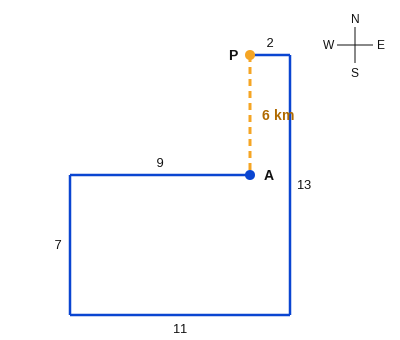
Raju starts from point A and drives 9 km towards the west. He then takes a left turn, drives 7 km, turns left and drives 11 km. He then takes a left turn and drives 13 km. He takes a final left turn, drives 2 km and stops at point P. How far (shortest distance) and towards which direction should he drive in order to reach point A again? (All turns are 90 degree turns only unless specified.)
राजू बिंदु A से चलना शुरू करता है और पश्चिम की ओर 9 km ड्राइव करता है। फिर वह बाएँ मुड़ता है, 7 km ड्राइव करता है, बाएँ मुड़ता है और 11 km ड्राइव करता है। फिर वह बाएँ मुड़ता है और 13 km ड्राइव करता है। वह अंतिम बार बाएँ मुड़ता है, 2 km ड्राइव करता है और बिंदु P पर रुक जाता है। बिंदु A पर पुनः पहुँचने के लिए उसे कितनी दूरी (न्यूनतम दूरी) और किस दिशा में ड्राइव करना चाहिए? (जब तक निर्दिष्ट न हो, सभी मोड़ केवल 90 डिग्री के हैं।)
  1. A5 km to the northउत्तर की ओर 5 km
  2. B6 km to the southदक्षिण की ओर 6 km
  3. C5 km to the southदक्षिण की ओर 5 km
  4. D6 km to the northउत्तर की ओर 6 km
Show answer

Concept: Track each move as coordinates (East +x, North +y) starting from A (0,0).

  1. West 9 → (−9,0); left = South 7 → (−9,−7)
  2. Left = East 11 → (2,−7); left = North 13 → (2,6)
  3. Left = West 2 → P (0,6)
  4. P is 6 km north of A, so he must drive 6 km south.

Trick: Net E–W: −9+11−2=0; net N–S: −7+13=6 north → return 6 km south.

Answer: (B) 6 km to the south

अवधारणा: A (0,0) से हर चाल को निर्देशांक (पूर्व +x, उत्तर +y) में लिखें।

  1. पश्चिम 9 → (−9,0); बाएँ = दक्षिण 7 → (−9,−7)
  2. बाएँ = पूर्व 11 → (2,−7); बाएँ = उत्तर 13 → (2,6)
  3. बाएँ = पश्चिम 2 → P (0,6)
  4. P, A के 6 km उत्तर में है, अतः 6 km दक्षिण जाना होगा।

ट्रिक: शुद्ध पूर्व–पश्चिम: −9+11−2=0; उत्तर–दक्षिण: −7+13=6 उत्तर → 6 km दक्षिण।

उत्तर: (B) 6 km to the south

RRB NTPC Graduate CBT 1General Intelligence and ReasoningDirection and distanceRRB NTPC Graduate CBT 1 2024 · 6 Jun Shift 2 →
Q10711.
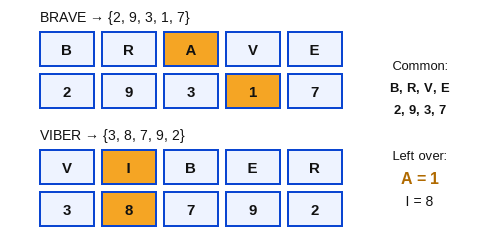
In a certain code language, ‘BRAVE’ is coded as ‘29317’ and ‘VIBER’ is coded as ‘38792’. What is the code for ‘A’ in the given code language?
एक निश्चित कूट भाषा में, ‘BRAVE’ को ‘29317’ और ‘VIBER’ को ‘38792’ के रूप में कूटबद्ध किया जाता है। दी गई कूट भाषा में ‘A’ का कूट क्या है?
  1. A7
  2. B2
  3. C1
  4. D9
Show answer

Concept: Codes are not in letter order: match common letters with common digits.

  1. BRAVE → {2, 9, 3, 1, 7}; VIBER → {3, 8, 7, 9, 2}
  2. Common letters B, R, V, E ↔ common digits 2, 9, 3, 7.
  3. The letter left in BRAVE is A and the digit left is 1 → A = 1.

Trick: Leftover letter ↔ leftover digit.

Answer: (C) 1

अवधारणा: कोड अक्षरों के क्रम में नहीं हैं: उभयनिष्ठ अक्षरों को उभयनिष्ठ अंकों से मिलाएँ।

  1. BRAVE → {2, 9, 3, 1, 7}; VIBER → {3, 8, 7, 9, 2}
  2. उभयनिष्ठ अक्षर B, R, V, E ↔ उभयनिष्ठ अंक 2, 9, 3, 7।
  3. BRAVE में बचा अक्षर A और बचा अंक 1 → A = 1।

ट्रिक: बचा अक्षर ↔ बचा अंक।

उत्तर: (C) 1

RRB NTPC Graduate CBT 1General Intelligence and ReasoningCoding-decoding (letter-digit sets)RRB NTPC Graduate CBT 1 2024 · 6 Jun Shift 2 →
Q10712.
GV 14 is related to LS 5 in a certain way. In the same way, HQ 5 is related to MN -4. To which of the given options is MG 0 related, following the same logic?
GV 14 एक निश्चित प्रकार से LS 5 से संबंधित है। उसी प्रकार, HQ 5, MN -4 से संबंधित है। समान तर्क का अनुसरण करते हुए, MG 0 दिए गए विकल्पों में से किससे संबंधित है?
  1. ANY -6
  2. BRD -9
  3. CBG -7
  4. DHR -3
Show answer

Concept: Find the shift applied to each letter and to the number.

  1. GV 14 → LS 5: G(7)+5=L(12), V(22)−3=S(19), 14−9=5.
  2. Check HQ 5 → MN −4: H+5=M, Q−3=N, 5−9=−4 ✓.
  3. MG 0: M(13)+5=R(18), G(7)−3=D(4), 0−9=−9 → RD −9.

Trick: Rule: first letter +5, second letter −3, number −9.

Answer: (B) RD -9

अवधारणा: हर अक्षर और संख्या में होने वाला बदलाव ज्ञात करें।

  1. GV 14 → LS 5: G(7)+5=L(12), V(22)−3=S(19), 14−9=5।
  2. जाँच HQ 5 → MN −4: H+5=M, Q−3=N, 5−9=−4 ✓।
  3. MG 0: M(13)+5=R(18), G(7)−3=D(4), 0−9=−9 → RD −9।

ट्रिक: नियम: पहला अक्षर +5, दूसरा अक्षर −3, संख्या −9।

उत्तर: (B) RD -9

RRB NTPC Graduate CBT 1General Intelligence and ReasoningAnalogy – letters and numbersRRB NTPC Graduate CBT 1 2024 · 6 Jun Shift 2 →
Q10713.
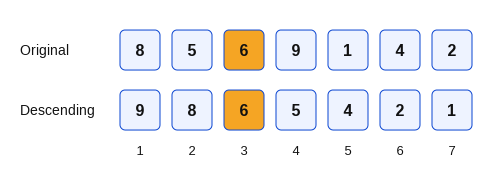
Each of the digits in the number 8569142 is arranged in the descending order from left to right. The position(s) of how many digits will remain unchanged in the new number thus formed as compared to that in the original number?
संख्या 8569142 के प्रत्येक अंक को बाएँ से दाएँ अवरोही क्रम में व्यवस्थित किया जाता है। इस प्रकार बनी नई संख्या में, मूल संख्या की तुलना में कितने अंकों का स्थान अपरिवर्तित रहेगा?
  1. AThreeतीन
  2. BFourचार
  3. CTwoदो
  4. DOneएक
Show answer

Concept: Arrange digits in descending order and compare place by place.

  1. Original: 8 5 6 9 1 4 2.
  2. Descending: 9 8 6 5 4 2 1.
  3. Only the 3rd place (digit 6) is the same in both numbers.

Trick: Write both numbers one below the other and tick matching columns.

Answer: (D) One

अवधारणा: अंकों को घटते क्रम में लिखें और स्थान-दर-स्थान तुलना करें।

  1. मूल संख्या: 8 5 6 9 1 4 2।
  2. घटता क्रम: 9 8 6 5 4 2 1।
  3. केवल तीसरे स्थान का अंक (6) दोनों में समान है।

ट्रिक: दोनों संख्याओं को एक के नीचे एक लिखकर मेल खाते कॉलम पर निशान लगाएँ।

उत्तर: (D) एक

RRB NTPC Graduate CBT 1General Intelligence and ReasoningDigit arrangementRRB NTPC Graduate CBT 1 2024 · 6 Jun Shift 2 →
Q10714.
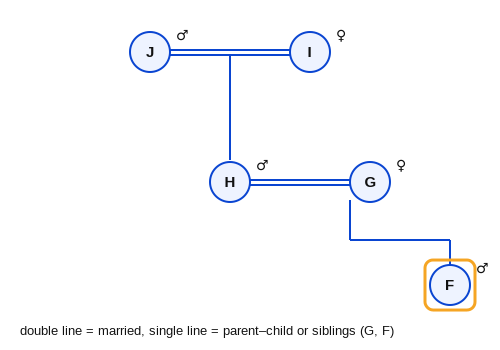
​F is the brother of G.
G is the wife of H.
H is the son of I.
I is the wife of J.
How is F related to J?
​F, G का भाई है।
G, H की पत्नी है।
H, I का पुत्र है।
I, J की पत्नी है।
F का J से क्या संबंध है?
  1. AFatherपिता
  2. BSon's wife's brotherपुत्र की पत्नी का भाई
  3. CSonपुत्र
  4. DSon's wife's fatherपुत्र की पत्नी का पिता
Show answer

Concept: Draw the family tree step by step.

  1. I is the wife of J and H is the son of I → H is the son of J.
  2. G is the wife of H → G is J’s son’s wife (daughter-in-law).
  3. F is the brother of G → F is J’s son’s wife’s brother.

Trick: Trace the chain from J: son (H) → son’s wife (G) → her brother (F).

Answer: (B) Son's wife's brother

अवधारणा: चरणबद्ध रूप से वंश-वृक्ष बनाएँ।

  1. I, J की पत्नी है और H, I का पुत्र है → H, J का पुत्र है।
  2. G, H की पत्नी है → G, J के पुत्र की पत्नी (बहू) है।
  3. F, G का भाई है → F, J के पुत्र की पत्नी का भाई है।

ट्रिक: J से शुरू करें: पुत्र (H) → पुत्र की पत्नी (G) → उसका भाई (F)।

उत्तर: (B) पुत्र की पत्नी का भाई

RRB NTPC Graduate CBT 1General Intelligence and ReasoningBlood relationRRB NTPC Graduate CBT 1 2024 · 6 Jun Shift 2 →
Q10715.
This question is based on the five, three-digit numbers given below.
(Left) 910 316 525 204 303 (Right)
(Example: 697 – First digit = 6, second digit = 9 and third digit = 7)
(NOTE: All operations to be done from left to right.)
What will be the resultant if the first digit of the highest number is added to the second digit of the lowest number?
यह प्रश्न नीचे दी गई पाँच, तीन-अंकीय संख्याओं पर आधारित है।
(बाएँ) 910 316 525 204 303 (दाएँ)
(उदाहरण: 697 – पहला अंक = 6, दूसरा अंक = 9 और तीसरा अंक = 7)
(ध्यान दें: सभी संक्रियाएँ बाएँ से दाएँ की जानी हैं।)
यदि सबसे बड़ी संख्या के पहले अंक को सबसे छोटी संख्या के दूसरे अंक में जोड़ा जाए, तो परिणाम क्या होगा?
  1. A9
  2. B12
  3. C8
  4. D10
Show answer

Concept: Identify the highest and lowest numbers first, then pick the required digits.

  1. Numbers: 910, 316, 525, 204, 303.
  2. Highest = 910 → first digit = 9; lowest = 204 → second digit = 0.
  3. 9+0=9.

Trick: Sort once (204 < 303 < 316 < 525 < 910) and read digits carefully.

Answer: (A) 9

अवधारणा: पहले सबसे बड़ी और सबसे छोटी संख्या पहचानें, फिर आवश्यक अंक लें।

  1. संख्याएँ: 910, 316, 525, 204, 303।
  2. सबसे बड़ी = 910 → पहला अंक = 9; सबसे छोटी = 204 → दूसरा अंक = 0।
  3. 9+0=9।

ट्रिक: एक बार क्रम में लगाएँ (204 < 303 < 316 < 525 < 910) और अंक ध्यान से पढ़ें।

उत्तर: (A) 9

RRB NTPC Graduate CBT 1General Intelligence and ReasoningNumber operationsRRB NTPC Graduate CBT 1 2024 · 6 Jun Shift 2 →
Q10716.
RWKA is related to TULZ in a certain way based on the English alphabetical order. In the same way, VSMY is related to XQNX. To which of the given options is ZOOW related, following the same logic?
अंग्रेज़ी वर्णमाला क्रम के आधार पर RWKA एक निश्चित प्रकार से TULZ से संबंधित है। उसी प्रकार, VSMY, XQNX से संबंधित है। समान तर्क का अनुसरण करते हुए, ZOOW दिए गए विकल्पों में से किससे संबंधित है?
  1. ABMPV
  2. BCLQU
  3. CALOV
  4. DCNPW
Show answer

Concept: Find the position change of each letter.

  1. RWKA → TULZ: R+2=T, W−2=U, K+1=L, A−1=Z.
  2. Check VSMY → XQNX: V+2, S−2, M+1, Y−1 ✓.
  3. ZOOW: Z+2=B, O−2=M, O+1=P, W−1=V → BMPV.

Trick: Pattern +2,−2,+1,−1; after Z comes A again (circular).

Answer: (A) BMPV

अवधारणा: हर अक्षर के स्थान में परिवर्तन ज्ञात करें।

  1. RWKA → TULZ: R+2=T, W−2=U, K+1=L, A−1=Z।
  2. जाँच VSMY → XQNX: V+2, S−2, M+1, Y−1 ✓।
  3. ZOOW: Z+2=B, O−2=M, O+1=P, W−1=V → BMPV।

ट्रिक: पैटर्न +2,−2,+1,−1; Z के बाद फिर A आता है (चक्रीय)।

उत्तर: (A) BMPV

RRB NTPC Graduate CBT 1General Intelligence and ReasoningLetter analogyRRB NTPC Graduate CBT 1 2024 · 6 Jun Shift 2 →
Q10717.
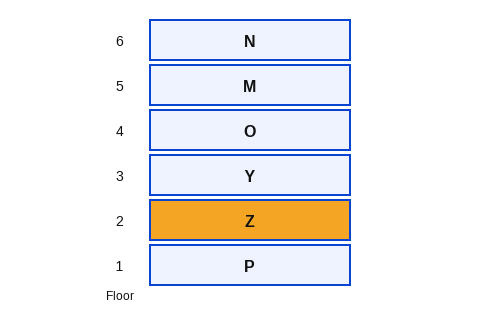
M, N, O, P, Y and Z live on six different floors of the same building. The lowermost floor in the building is numbered 1, the floor above it, number 2 and so on till the topmost floor is numbered 6. O lives on floor numbered 4. Only two people live between O and P. Only M lives between O and N. Y lives immediately below O. Who lives on floor numbered 2?
M, N, O, P, Y और Z एक ही इमारत की छह अलग-अलग मंज़िलों पर रहते हैं। इमारत की सबसे निचली मंज़िल की संख्या 1 है, उसके ऊपर वाली मंज़िल की संख्या 2 है और इसी प्रकार सबसे ऊपरी मंज़िल की संख्या 6 है। O मंज़िल संख्या 4 पर रहता है। O और P के बीच केवल दो व्यक्ति रहते हैं। O और N के बीच केवल M रहता है। Y, O के ठीक नीचे रहता है। मंज़िल संख्या 2 पर कौन रहता है?
  1. AN
  2. BZ
  3. CM
  4. DY
Show answer

Concept: Fix the definite positions first, then place the others.

  1. O = 4 and Y is immediately below O → Y = 3.
  2. Two people between O and P → P = 1 (floor 7 does not exist).
  3. Only M between O and N → M = 5, N = 6 (M cannot be 3 as Y is there).
  4. The remaining person Z lives on floor 2.

Trick: Start with the person whose floor is given, then use “immediately” clues.

Answer: (B) Z

अवधारणा: पहले निश्चित स्थान तय करें, फिर बाकी को रखें।

  1. O = 4 और Y ठीक O के नीचे → Y = 3।
  2. O और P के बीच दो व्यक्ति → P = 1 (7वीं मंज़िल नहीं है)।
  3. O और N के बीच केवल M → M = 5, N = 6 (M = 3 संभव नहीं, वहाँ Y है)।
  4. बचा हुआ Z मंज़िल 2 पर रहता है।

ट्रिक: जिसकी मंज़िल दी है उससे शुरू करें, फिर “ठीक नीचे/ऊपर” वाले संकेत लगाएँ।

उत्तर: (B) Z

RRB NTPC Graduate CBT 1General Intelligence and ReasoningFloor puzzleRRB NTPC Graduate CBT 1 2024 · 6 Jun Shift 2 →
Q10718.
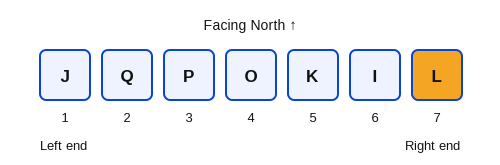
Seven people, I, J, K, L, O, P and Q are sitting in a row, facing north. Only J sits to the left of Q. Only four people sit between J and I. Only O sits between P and K and P is not an immediate neighbour of I. Who sits at the extreme right end of the row?
सात व्यक्ति, I, J, K, L, O, P और Q एक पंक्ति में उत्तर की ओर मुख करके बैठे हैं। Q के बाईं ओर केवल J बैठा है। J और I के बीच केवल चार व्यक्ति बैठे हैं। P और K के बीच केवल O बैठा है और P, I का निकटतम पड़ोसी नहीं है। पंक्ति के सबसे दाएँ छोर पर कौन बैठा है?
  1. AO
  2. BK
  3. CL
  4. DI
Show answer

Concept: Seven seats in a row facing north: left to right = 1 to 7.

  1. Only J is to the left of Q → J = 1, Q = 2.
  2. Four people between J and I → I = 6.
  3. Only O between P and K, and P not next to I → P = 3, O = 4, K = 5.
  4. Remaining L sits at 7, the extreme right end.

Trick: “Only X to the left of Y” immediately fixes both at positions 1 and 2.

Answer: (C) L

अवधारणा: उत्तर की ओर मुख किए सात सीटें: बाएँ से दाएँ = 1 से 7।

  1. Q के बाईं ओर केवल J → J = 1, Q = 2।
  2. J और I के बीच चार व्यक्ति → I = 6।
  3. P और K के बीच केवल O, और P, I का पड़ोसी नहीं → P = 3, O = 4, K = 5।
  4. बचा हुआ L स्थान 7 पर, अर्थात दाएँ सिरे पर।

ट्रिक: “Y के बाईं ओर केवल X” से दोनों तुरंत 1 और 2 पर तय हो जाते हैं।

उत्तर: (C) L

RRB NTPC Graduate CBT 1General Intelligence and ReasoningLinear seating arrangementRRB NTPC Graduate CBT 1 2024 · 6 Jun Shift 2 →
Q10719.
Select the pair that follows the same pattern as that followed by the two sets of pairs given below. Both pairs follow the same pattern.
ZIL : ARO
GRZ : TIA
उस युग्म का चयन कीजिए जो उसी पैटर्न का अनुसरण करता है जिसका अनुसरण नीचे दिए गए युग्मों के दो समुच्चय करते हैं। दोनों युग्म समान पैटर्न का अनुसरण करते हैं।
ZIL : ARO
GRZ : TIA
  1. AJPE : QJT
  2. BMAP : NZJ
  3. CLOT : OKG
  4. DXMS : CNH
Show answer

Concept: Opposite letter pairs: positions add up to 27 (A–Z, B–Y, …).

  1. ZIL → ARO: Z↔A, I↔R, L↔O (each letter replaced by its opposite).
  2. GRZ → TIA: G↔T, R↔I, Z↔A ✓.
  3. XMS → CNH: X↔C, M↔N, S↔H ✓. Others fail (e.g. J↔Q, but P↔K not J).

Trick: Opposite of a letter =27− its position.

Answer: (D) XMS : CNH

अवधारणा: विपरीत अक्षर युग्म: स्थानों का योग 27 (A–Z, B–Y, …)।

  1. ZIL → ARO: Z↔A, I↔R, L↔O (हर अक्षर अपने विपरीत से बदला)।
  2. GRZ → TIA: G↔T, R↔I, Z↔A ✓।
  3. XMS → CNH: X↔C, M↔N, S↔H ✓। अन्य विकल्प नहीं मिलते (जैसे P का विपरीत K है, J नहीं)।

ट्रिक: किसी अक्षर का विपरीत =27− उसका स्थान।

उत्तर: (D) XMS : CNH

RRB NTPC Graduate CBT 1General Intelligence and ReasoningOpposite lettersRRB NTPC Graduate CBT 1 2024 · 6 Jun Shift 2 →
Q10720.
Piyush ranked 24th from the top and 55th from the bottom in his class. How many students are there in his class?
पीयूष अपनी कक्षा में ऊपर से 24वें और नीचे से 55वें स्थान पर है। उसकी कक्षा में कितने विद्यार्थी हैं?
  1. A79
  2. B77
  3. C78
  4. D76
Show answer

Concept: Total = rank from top + rank from bottom − 1.

  1. Total =24+55−1.
  2. Total =78 students.

Trick: Subtract 1 because the person is counted twice.

Answer: (C) 78

अवधारणा: कुल = ऊपर से रैंक + नीचे से रैंक − 1।

  1. कुल =24+55−1।
  2. कुल =78 छात्र।

ट्रिक: 1 घटाएँ क्योंकि वही व्यक्ति दो बार गिना गया।

उत्तर: (C) 78

RRB NTPC Graduate CBT 1General Intelligence and ReasoningRankingRRB NTPC Graduate CBT 1 2024 · 6 Jun Shift 2 →