Question bank

Q&A: practice questions with answers

Search questions on any topic. Filter by exam category, exam, subject and topic, try the question, then open the answer and explanation.

Courses – airGurukul

20,719 questions found.

Q11001.
P, Q, R, S, T, U and V are sitting around a circular table facing the centre. Only one person sits between R and T when counted from the left of T. Q sits third to the right of P. U sits third to the left of V. Q sits to the immediate right of U. S is not an immediate neighbour of U. How many people sit between S and T when counted from the right of S?
P, Q, R, S, T, U और V एक वृत्ताकार मेज़ के चारों ओर केंद्र की ओर मुख करके बैठे हैं। T के बाएँ से गिनने पर R और T के बीच केवल एक व्यक्ति बैठा है। Q, P के दाएँ से तीसरे स्थान पर बैठा है। U, V के बाएँ से तीसरे स्थान पर बैठा है। Q, U के ठीक दाएँ बैठा है। S, U का निकटतम पड़ोसी नहीं है। S के दाएँ से गिनने पर S और T के बीच कितने व्यक्ति बैठे हैं?
  1. A4
  2. B2
  3. C3
  4. D1
Show answer

Concept: Facing the centre: right = anticlockwise, left = clockwise.
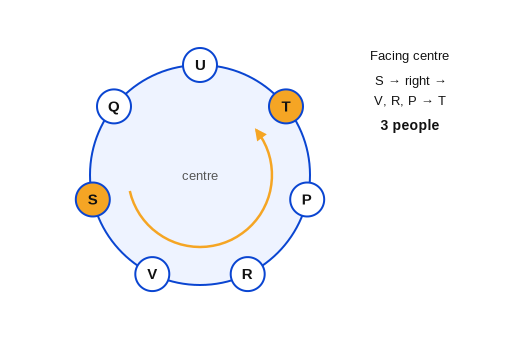
  1. U fixed; Q is immediate right of U; P is 3rd to the left of Q (Q 3rd right of P); V is 3rd to the right of U.
  2. Remaining 3 seats for R, S, T. R is 2nd to the left of T; S not next to U → T next to U, then R, then S.
  3. Order (clockwise): U, T, P, R, V, S, Q.
  4. From S going right: V, R, P, then T → 3 people.

Trick: Fix the person with most links (U) first.

Answer: (C) 3

अवधारणा: केंद्र की ओर मुख: दायाँ = वामावर्त (anticlockwise), बायाँ = दक्षिणावर्त (clockwise)।

  1. U निश्चित; Q, U के तुरंत दाएँ; P, Q के बाएँ तीसरा; V, U के दाएँ तीसरा।
  2. बची 3 सीटें R, S, T की। R, T के बाएँ दूसरा; S, U का पड़ोसी नहीं → T, U के पास, फिर R, फिर S।
  3. क्रम (clockwise): U, T, P, R, V, S, Q.
  4. S के दाएँ से: V, R, P, फिर T → 3 व्यक्ति।

ट्रिक: सबसे अधिक संबंध वाले व्यक्ति (U) को पहले रखें।

उत्तर: (C) 3
RRB NTPC Graduate CBT 1General Intelligence and ReasoningCircular Seating ArrangementRRB NTPC Graduate CBT 1 2024 · 5 Jun Shift 2 →
Q11002.
If 2 is added to each even digit and 1 is subtracted from each odd digit in the number 6154932, how many digits will appear more than once in the new number thus formed?
यदि संख्या 6154932 में प्रत्येक सम अंक में 2 जोड़ा जाए और प्रत्येक विषम अंक में से 1 घटाया जाए, तो इस प्रकार बनी नई संख्या में कितने अंक एक से अधिक बार आएँगे?
  1. AThreeतीन
  2. BFourचार
  3. CTwoदो
  4. DOneएक
Show answer

Concept: Change each digit separately: even + 2, odd − 1.

  1. 6→8, 1→0, 5→4, 4→6, 9→8, 3→2, 2→4
  2. New number: 8046824
  3. 8 appears twice, 4 appears twice; 0, 6, 2 once → two digits.

Trick: Write the new number fully, then tally.

Answer: (C) Two

अवधारणा: हर अंक अलग से बदलें: सम + 2, विषम − 1।

  1. 6→8, 1→0, 5→4, 4→6, 9→8, 3→2, 2→4
  2. नई संख्या: 8046824
  3. 8 दो बार, 4 दो बार; 0, 6, 2 एक बार → दो अंक।

ट्रिक: नई संख्या पूरी लिखें, फिर गिनें।

उत्तर: (C) Two

RRB NTPC Graduate CBT 1General Intelligence and ReasoningDigit OperationsRRB NTPC Graduate CBT 1 2024 · 5 Jun Shift 2 →
Q11003.
Which of the following letter-clusters should replace # and % so that the pattern and relationship followed between the letter-cluster pair on the left side of :: is the same as that on the right side of :: ?
# : LPR :: PSV : %
निम्नलिखित में से कौन-से अक्षर-समूह # और % को प्रतिस्थापित करने चाहिए, ताकि :: के बाईं ओर के अक्षर-समूह युग्म के बीच का पैटर्न और संबंध वही हो जो :: के दाईं ओर है?
# : LPR :: PSV : %
  1. A# = HNT, % = TUT
  2. B# = HMR, % = TVW
  3. C# = FNR, % = RVM
  4. D# = FMP, % = RUY
Show answer

Concept: Find the shift from # to LPR and apply the same shift to PSV.

  1. (A) HNT → LPR: H+4=L, N+2=P, T−2=R → (+4, +2, −2).
  2. PSV → P+4=T, S+2=U, V−2=T = TUT ✓.

Trick: Check the left pair for each option; keep the one whose shifts also give a listed %.

Answer: (A) # = HNT, % = TUT

अवधारणा: # से LPR तक का खिसकाव निकालकर PSV पर लगाएँ।

  1. (A) HNT → LPR: H+4=L, N+2=P, T−2=R → (+4, +2, −2)।
  2. PSV → P+4=T, S+2=U, V−2=T = TUT ✓.

ट्रिक: हर विकल्प का बायाँ जोड़ा जाँचें; जिसका % भी मिले वही सही।

उत्तर: (A) # = HNT, % = TUT

RRB NTPC Graduate CBT 1General Intelligence and ReasoningLetter AnalogyRRB NTPC Graduate CBT 1 2024 · 5 Jun Shift 2 →
Q11004.
Which of the following letter-clusters should replace # and % so that the pattern and relationship followed between the letter-cluster pair on the left side of :: is the same as that on the right side of ::?
# : AND :: RWX : %
निम्नलिखित में से कौन-से अक्षर-समूह # और % को प्रतिस्थापित करने चाहिए, ताकि :: के बाईं ओर के अक्षर-समूह युग्म के बीच का पैटर्न और संबंध वही हो जो :: के दाईं ओर है?
# : AND :: RWX : %
  1. A# = UTZ, % = OZV
  2. B# = OZV, % = LCT
  3. C# = XQB, % = UTZ
  4. D# = LCT, % = XQB
Show answer

Concept: Find the shift from # to AND and apply it to RWX.

  1. (C) XQB → AND: X+3=A (wrap-around), Q−3=N, B+2=D → (+3, −3, +2).
  2. RWX → R+3=U, W−3=T, X+2=Z = UTZ ✓.

Trick: Remember wrap-around: X → Y → Z → A.

Answer: (C) # = XQB, % = UTZ

अवधारणा: # से AND तक का खिसकाव निकालकर RWX पर लगाएँ।

  1. (C) XQB → AND: X+3=A (Z के बाद फिर A), Q−3=N, B+2=D → (+3, −3, +2)।
  2. RWX → R+3=U, W−3=T, X+2=Z = UTZ ✓.

ट्रिक: चक्रीय क्रम याद रखें: X → Y → Z → A।

उत्तर: (C) # = XQB, % = UTZ

RRB NTPC Graduate CBT 1General Intelligence and ReasoningLetter AnalogyRRB NTPC Graduate CBT 1 2024 · 5 Jun Shift 2 →
Q11005.
Select the triad that follows the same pattern as that followed by the two triads given below. Both triads follow the same pattern.
EL-GN-IK
GN-IP-KM
उस त्रयी का चयन कीजिए जो नीचे दी गई दो त्रयियों के समान पैटर्न का अनुसरण करती है। दोनों त्रयी एक ही पैटर्न का अनुसरण करती हैं।
EL-GN-IK
GN-IP-KM
  1. AJP-KR-MQ
  2. BIP-KR-MQ
  3. CIP-KR-MO
  4. DJP-KS-MQ
Show answer

Concept: Check each letter position separately.

  1. EL-GN-IK: E→G→I (+2, +2); L→N (+2), N→K (−3).
  2. GN-IP-KM: same rule.
  3. IP-KR-MO: I→K→M; P→R (+2), R→O (−3) ✓.

Trick: Option (B) gives MQ – the second letter must be R−3 = O, not Q.

Answer: (C) IP-KR-MO

अवधारणा: हर स्थान के अक्षर अलग जाँचें।

  1. EL-GN-IK: E→G→I (+2, +2); L→N (+2), N→K (−3)।
  2. GN-IP-KM: वही नियम।
  3. IP-KR-MO: I→K→M; P→R (+2), R→O (−3) ✓.

ट्रिक: (B) में MQ है – दूसरा अक्षर R−3 = O होना चाहिए, Q नहीं।

उत्तर: (C) IP-KR-MO

RRB NTPC Graduate CBT 1General Intelligence and ReasoningLetter TriadsRRB NTPC Graduate CBT 1 2024 · 5 Jun Shift 2 →
Q11006.
This question is based on the words given below.
(Left) ACT BUS CAR DAD (Right)
In each of the words, each vowel is changed to the letter immediately following it in the English alphabetical order and each consonant is changed to the letter immediately preceding in the English alphabetical order. In how many letter clusters thus formed, will no vowel appear?
यह प्रश्न नीचे दिए गए शब्दों पर आधारित है।
(बाएँ) ACT BUS CAR DAD (दाएँ)
प्रत्येक शब्द में, प्रत्येक स्वर को अंग्रेज़ी वर्णमाला क्रम में उसके ठीक बाद वाले अक्षर से बदल दिया जाता है और प्रत्येक व्यंजन को अंग्रेज़ी वर्णमाला क्रम में उसके ठीक पहले वाले अक्षर से बदल दिया जाता है। इस प्रकार बने कितने अक्षर-समूहों में कोई स्वर नहीं आएगा?
  1. AOneएक
  2. BTwoदो
  3. CNoneएक भी नहीं
  4. DThreeतीन
Show answer

Concept: Vowel → next letter; consonant → previous letter.

  1. ACT → B B S (no vowel)
  2. BUS → A V R (A is a vowel)
  3. CAR → B B Q (no vowel); DAD → C B C (no vowel)
  4. So 3 clusters have no vowel.

Trick: A consonant B becomes vowel A – watch for B → A.

Answer: (D) Three

अवधारणा: स्वर → अगला अक्षर; व्यंजन → पिछला अक्षर।

  1. ACT → B B S (कोई स्वर नहीं)
  2. BUS → A V R (A स्वर है)
  3. CAR → B B Q (कोई स्वर नहीं); DAD → C B C (कोई स्वर नहीं)
  4. अतः 3 समूहों में स्वर नहीं।

ट्रिक: व्यंजन B बदलकर स्वर A बनता है – B → A पर ध्यान दें।

उत्तर: (D) Three

RRB NTPC Graduate CBT 1General Intelligence and ReasoningLetter Coding – VowelsRRB NTPC Graduate CBT 1 2024 · 5 Jun Shift 2 →
Q11007.
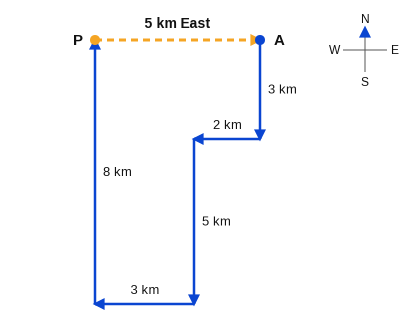
Uday starts from Point A and drives 3 km towards south. He then takes a right turn, drives 2 km, turns left and drives 5 km. He then takes a right turn and drives 3 km. He takes a final right turn, drives 8 km and stops at Point P. How far (shortest distance) and towards which direction should he drive in order to reach Point A again (all turns are 90° turns only unless specified)?
उदय बिंदु A से चलना शुरू करता है और दक्षिण की ओर 3 km गाड़ी चलाता है। फिर वह दाएँ मुड़ता है, 2 km गाड़ी चलाता है, बाएँ मुड़ता है और 5 km गाड़ी चलाता है। फिर वह दाएँ मुड़ता है और 3 km गाड़ी चलाता है। वह अंतिम बार दाएँ मुड़ता है, 8 km गाड़ी चलाता है और बिंदु P पर रुक जाता है। बिंदु A पर फिर से पहुँचने के लिए उसे कितनी दूर (न्यूनतम दूरी) और किस दिशा में गाड़ी चलानी चाहिए (जब तक निर्दिष्ट न हो, सभी मोड़ केवल 90° के हैं)?
  1. A3 km; East3 km; पूर्व
  2. B5 km; West5 km; पश्चिम
  3. C4 km; East4 km; पूर्व
  4. D5 km; East5 km; पूर्व
Show answer

Concept: Track every turn on a sketch (A at origin).

  1. 3 km S; right → West 2 km; left → South 5 km; right → West 3 km; right → North 8 km.
  2. Vertical: −3−5+8=0 → P is level with A.
  3. Horizontal: 2+3=5 km West of A → go 5 km East.

Trick: Net N–S = 0 means the answer is purely East/West.

Answer: (D) 5 km; East

अवधारणा: हर मोड़ को चित्र पर अंकित करें (A मूल बिंदु)।

  1. 3 km दक्षिण; दाएँ → पश्चिम 2 km; बाएँ → दक्षिण 5 km; दाएँ → पश्चिम 3 km; दाएँ → उत्तर 8 km।
  2. ऊर्ध्वाधर: −3−5+8=0 → P, A की सीध में।
  3. क्षैतिज: 2+3=5 km पश्चिम → A तक 5 km पूर्व जाना होगा।

ट्रिक: उत्तर–दक्षिण का शुद्ध योग 0 हो तो उत्तर केवल पूर्व/पश्चिम।

उत्तर: (D) 5 km; East

RRB NTPC Graduate CBT 1General Intelligence and ReasoningDirection and DistanceRRB NTPC Graduate CBT 1 2024 · 5 Jun Shift 2 →
Q11008.
What will come in place of the question mark (?) in the following equation, if ‘+’ and ‘−’ are interchanged and ‘×’ and ‘÷’ are interchanged?
63 ÷ 12 − 98 × 7 + 35 = ?
यदि ‘+’ और ‘−’ को आपस में बदल दिया जाए तथा ‘×’ और ‘÷’ को आपस में बदल दिया जाए, तो निम्नलिखित समीकरण में प्रश्न चिह्न (?) के स्थान पर क्या आएगा?
63 ÷ 12 − 98 × 7 + 35 = ?
  1. A742
  2. B735
  3. C745
  4. D736
Show answer

Concept: Swap + ↔ − and × ↔ ÷, then use BODMAS.

  1. 63×12+98÷7−35
  2. 756+14−35=735

Trick: Rewrite the whole expression first, then solve.

Answer: (B) 735

अवधारणा: + ↔ − और × ↔ ÷ बदलें, फिर BODMAS।

  1. 63×12+98÷7−35
  2. 756+14−35=735

ट्रिक: पहले पूरा व्यंजक दोबारा लिखें, फिर हल करें।

उत्तर: (B) 735

RRB NTPC Graduate CBT 1General Intelligence and ReasoningMathematical Operations – InterchangeRRB NTPC Graduate CBT 1 2024 · 5 Jun Shift 2 →
Q11009.
Read the given statements and conclusions carefully. Assuming that the information given in the statements is true, even if it appears to be at variance with commonly known facts, decide which of the given conclusion(s) logically follow(s) from the statements.
Statements:
All cars are buses.
All buses are trucks.
Some buses are ships.
Conclusions:
(I) Some ships are cars.
(II) All trucks are cars.
दिए गए कथनों और निष्कर्षों को ध्यानपूर्वक पढ़िए। यह मानते हुए कि कथनों में दी गई जानकारी सत्य है, भले ही वह सामान्य रूप से ज्ञात तथ्यों से भिन्न प्रतीत होती हो, निर्णय लीजिए कि दिए गए निष्कर्षों में से कौन-सा/से निष्कर्ष तार्किक रूप से कथनों का अनुसरण करता है/करते हैं।
कथन:
सभी कारें, बसें हैं।
सभी बसें, ट्रक हैं।
कुछ बसें, जहाज़ हैं।
निष्कर्ष:
(I) कुछ जहाज़, कारें हैं।
(II) सभी ट्रक, कारें हैं।
  1. ANeither conclusion (I) nor (II) follows.न तो निष्कर्ष (I) और न ही (II) अनुसरण करता है।
  2. BOnly conclusion (I) follows.केवल निष्कर्ष (I) अनुसरण करता है।
  3. CBoth conclusions (I) and (II) follow.निष्कर्ष (I) और (II) दोनों अनुसरण करते हैं।
  4. DOnly conclusion (II) follows.केवल निष्कर्ष (II) अनुसरण करता है।
Show answer

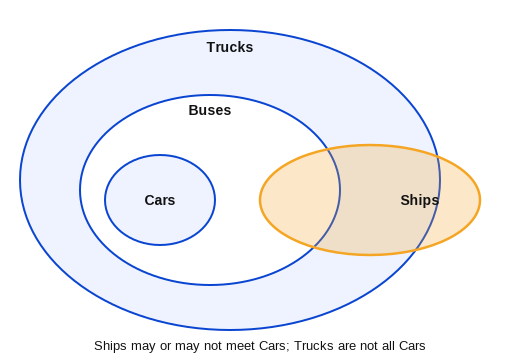
Concept: Draw the least-overlap Venn diagram and test each conclusion.

  1. Cars ⊂ Buses ⊂ Trucks; Ships overlap only some Buses.
  2. (I) Ships may touch Buses outside Cars → "Some ships are cars" not certain.
  3. (II) Trucks are larger than Cars → "All trucks are cars" false.

Trick: "All A are B" never gives "All B are A".

Answer: (A) Neither conclusion (I) nor (II) follows.

अवधारणा: न्यूनतम-अतिव्यापन वाला वेन आरेख बनाकर हर निष्कर्ष जाँचें।

  1. Cars ⊂ Buses ⊂ Trucks; Ships केवल कुछ Buses से मिलते हैं।
  2. (I) Ships, Cars के बाहर वाले Buses से मिल सकते हैं → "कुछ ships, cars हैं" निश्चित नहीं।
  3. (II) Trucks, Cars से बड़ा समूह → "सभी trucks, cars हैं" गलत।

ट्रिक: "सभी A, B हैं" से कभी "सभी B, A हैं" नहीं निकलता।

उत्तर: (A) Neither conclusion (I) nor (II) follows.

RRB NTPC Graduate CBT 1General Intelligence and ReasoningSyllogismRRB NTPC Graduate CBT 1 2024 · 5 Jun Shift 2 →
Q11010.
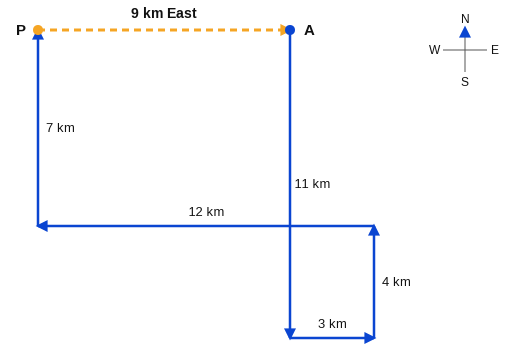
Sunil starts from Point A and drives 11 km towards the south. He then takes a left turn, drives 3 km, turns left and drives 4 km. He then takes a left turn and drives 12 km. He takes a final right turn, drives 7 km and stops at Point P. How far (shortest distance) and towards which direction should he drive in order to reach Point A again? (All turns are 90 degree turns only unless specified.)
सुनील बिंदु A से चलना शुरू करता है और दक्षिण की ओर 11 km गाड़ी चलाता है। फिर वह बाएँ मुड़ता है, 3 km गाड़ी चलाता है, बाएँ मुड़ता है और 4 km गाड़ी चलाता है। फिर वह बाएँ मुड़ता है और 12 km गाड़ी चलाता है। वह अंतिम बार दाएँ मुड़ता है, 7 km गाड़ी चलाता है और बिंदु P पर रुक जाता है। बिंदु A पर फिर से पहुँचने के लिए उसे कितनी दूर (न्यूनतम दूरी) और किस दिशा में गाड़ी चलानी चाहिए? (जब तक निर्दिष्ट न हो, सभी मोड़ केवल 90 डिग्री के हैं।)
  1. A8 km to the eastपूर्व की ओर 8 km
  2. B9 km to the westपश्चिम की ओर 9 km
  3. C7 km to the eastपूर्व की ओर 7 km
  4. D9 km to the eastपूर्व की ओर 9 km
Show answer

Concept: Plot each leg with A at origin.

  1. 11 km S; left → East 3 km; left → North 4 km; left → West 12 km; right → North 7 km.
  2. Vertical: −11+4+7=0 → P is level with A.
  3. Horizontal: 3−12=−9 → P is 9 km West of A → drive 9 km East.

Trick: Facing South, a left turn means East.

Answer: (D) 9 km to the east

अवधारणा: A को मूल बिंदु मानकर हर चरण अंकित करें।

  1. 11 km दक्षिण; बाएँ → पूर्व 3 km; बाएँ → उत्तर 4 km; बाएँ → पश्चिम 12 km; दाएँ → उत्तर 7 km।
  2. ऊर्ध्वाधर: −11+4+7=0 → P, A की सीध में।
  3. क्षैतिज: 3−12=−9 → P, A से 9 km पश्चिम → 9 km पूर्व जाना होगा।

ट्रिक: दक्षिण की ओर मुख हो तो बायाँ मोड़ = पूर्व।

उत्तर: (D) 9 km to the east

RRB NTPC Graduate CBT 1General Intelligence and ReasoningDirection and DistanceRRB NTPC Graduate CBT 1 2024 · 5 Jun Shift 2 →
Q11011.
What should come in place of the question mark (?) in the given series based on the English alphabetical order?
VCJ RYF NUB JQX ?
अंग्रेज़ी वर्णमाला क्रम के आधार पर दी गई श्रृंखला में प्रश्न चिह्न (?) के स्थान पर क्या आना चाहिए?
VCJ RYF NUB JQX ?
  1. AFTM
  2. BFNT
  3. CFMT
  4. DFTN
Show answer

Concept: Track each letter position separately.

  1. 1st letters: V, R, N, J → −4 each → F
  2. 2nd letters: C, Y, U, Q → −4 each → M
  3. 3rd letters: J, F, B, X → −4 each → T

Trick: All three positions move −4 (with wrap-around B → X).

Answer: (C) FMT

अवधारणा: हर स्थान के अक्षर अलग देखें।

  1. पहले अक्षर: V, R, N, J → हर बार −4 → F
  2. दूसरे अक्षर: C, Y, U, Q → −4 → M
  3. तीसरे अक्षर: J, F, B, X → −4 → T

ट्रिक: तीनों स्थान −4 (चक्रीय, B → X)।

उत्तर: (C) FMT

RRB NTPC Graduate CBT 1General Intelligence and ReasoningLetter SeriesRRB NTPC Graduate CBT 1 2024 · 5 Jun Shift 2 →
Q11012.
Each of C, D, E, F, S, T and U has an exam on a different day of a week starting from Monday and ending on Sunday of the same week. Only two people have the exam before T. Only one person has the exam after D. Only three people have the exam between T and F. Only one person has the exam between E and C. U has the exam immediately before E. Who among the following has the exam on Friday?
C, D, E, F, S, T और U में से प्रत्येक की परीक्षा एक ही सप्ताह के सोमवार से शुरू होकर रविवार को समाप्त होने वाले सप्ताह के अलग-अलग दिन है। T से पहले केवल दो व्यक्तियों की परीक्षा है। D के बाद केवल एक व्यक्ति की परीक्षा है। T और F के बीच केवल तीन व्यक्तियों की परीक्षा है। E और C के बीच केवल एक व्यक्ति की परीक्षा है। U की परीक्षा E से ठीक पहले है। निम्नलिखित में से किसकी परीक्षा शुक्रवार को है?
  1. AE
  2. BU
  3. CT
  4. DS
Show answer

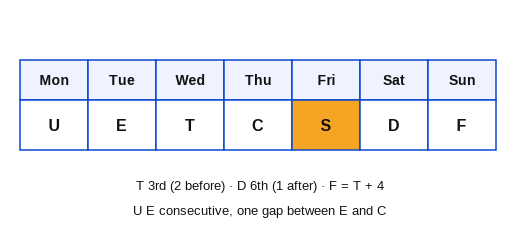
Concept: Mon–Sun = days 1–7; place the fixed clues first.

  1. Two before T → T = Wed (3). One after D → D = Sat (6). Three between T and F → F = Sun (7).
  2. Left: Mon, Tue, Thu, Fri for C, E, S, U. U just before E and one gap between E and C → U = Mon, E = Tue, C = Thu.
  3. S = Fri.

Trick: Start with clues giving exact positions ("only two before", "only one after").

Answer: (D) S

अवधारणा: सोम–रवि = दिन 1–7; पहले निश्चित संकेत लगाएँ।

  1. T से पहले दो → T = बुध (3)। D के बाद एक → D = शनि (6)। T और F के बीच तीन → F = रवि (7)।
  2. शेष: सोम, मंगल, गुरु, शुक्र – C, E, S, U के लिए। U, E से ठीक पहले और E–C के बीच एक → U = सोम, E = मंगल, C = गुरु।
  3. S = शुक्रवार।

ट्रिक: सटीक स्थान देने वाले संकेत ("केवल दो पहले", "केवल एक बाद") से शुरू करें।

उत्तर: (D) S

RRB NTPC Graduate CBT 1General Intelligence and ReasoningScheduling PuzzleRRB NTPC Graduate CBT 1 2024 · 5 Jun Shift 2 →
Q11013.
In a certain code language,
A + B means ‘A is the mother of B’,
A − B means ‘A is the brother of B’,
A × B means ‘A is the wife of B’ and
A ÷ B means ‘A is the father of B’.
How is M related to Q if ‘M + N − O ÷ P × Q’?
एक निश्चित कूट भाषा में,
A + B का अर्थ है ‘A, B की माता है’,
A − B का अर्थ है ‘A, B का भाई है’,
A × B का अर्थ है ‘A, B की पत्नी है’ और
A ÷ B का अर्थ है ‘A, B का पिता है’।
यदि ‘M + N − O ÷ P × Q’ है, तो M, Q से किस प्रकार संबंधित है?
  1. AWife's father's motherपत्नी के पिता की माता
  2. B​Wife's mother's motherपत्नी की माता की माता
  3. CWife's mother's sisterपत्नी की माता की बहन
  4. DWife's father's sisterपत्नी के पिता की बहन
Show answer

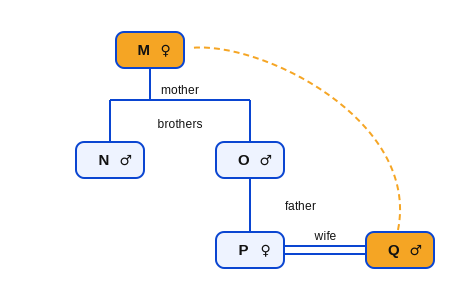
Concept: Decode each symbol one link at a time and build a family tree from M to Q.

  1. M + N: M is the mother of N.
  2. N − O: N is the brother of O, so M is also the mother of O.
  3. O ÷ P: O is the father of P, so M is P's father's mother.
  4. P × Q: P is the wife of Q, so P is Q's wife.
  5. Hence M is Q's wife's father's mother.

Trick: Read the chain from Q backwards: Q → wife (P) → father (O) → mother (M).

Answer: (A) Wife's father's mother

अवधारणा: हर चिह्न का अर्थ एक-एक करके लगाएँ और M से Q तक family tree बनाएँ।

  1. M + N: M, N की माँ है।
  2. N − O: N, O का भाई है, अतः M, O की भी माँ है।
  3. O ÷ P: O, P का पिता है, अतः M, P के पिता की माँ है।
  4. P × Q: P, Q की पत्नी है।
  5. अतः M, Q की पत्नी के पिता की माँ है।

ट्रिक: Q से पीछे की ओर पढ़ें: Q → पत्नी (P) → पिता (O) → माँ (M)।

उत्तर: (A) Wife's father's mother

RRB NTPC Graduate CBT 1General Intelligence and ReasoningCoded Blood RelationsRRB NTPC Graduate CBT 1 2024 · 5 Jun Shift 2 →
Q11014.
In a certain code language, ‘pizza base queen’ is coded as ‘du su qw’ and ‘pig queen wave’ is coded as ‘ic fv su’. How is ‘queen’ coded in the given language?
एक निश्चित कूट भाषा में, ‘pizza base queen’ को ‘du su qw’ के रूप में और ‘pig queen wave’ को ‘ic fv su’ के रूप में कूटबद्ध किया जाता है। दी गई भाषा में ‘queen’ को किस प्रकार कूटबद्ध किया जाता है?
  1. Aic
  2. Bsu
  3. Cdu
  4. Dqw
Show answer

Concept: A word common to two sentences takes the code common to both coded sentences.

  1. Sentence 1: pizza base queen → du su qw.
  2. Sentence 2: pig queen wave → ic fv su.
  3. Common word = queen; common code = su.

Trick: Match common word with common code – no need to decode the other words.

Answer: (B) su

अवधारणा: दो वाक्यों में उभयनिष्ठ शब्द का कोड, दोनों कोडों में उभयनिष्ठ कोड होता है।

  1. वाक्य 1: pizza base queen → du su qw।
  2. वाक्य 2: pig queen wave → ic fv su।
  3. उभयनिष्ठ शब्द = queen; उभयनिष्ठ कोड = su।

ट्रिक: उभयनिष्ठ शब्द ↔ उभयनिष्ठ कोड – बाकी शब्द decode करने की ज़रूरत नहीं।

उत्तर: (B) su

RRB NTPC Graduate CBT 1General Intelligence and ReasoningCoding–Decoding (Common Word)RRB NTPC Graduate CBT 1 2024 · 5 Jun Shift 2 →
Q11015.
If '+' means '−', '−' means '×', '×' means '÷' and '÷' means '+', then what will come in place of the question mark (?) in the following equation?
502 ÷ 78 + 2 − 258 × 2 = ?
यदि '+' का अर्थ '−', '−' का अर्थ '×', '×' का अर्थ '÷' और '÷' का अर्थ '+' है, तो निम्नलिखित समीकरण में प्रश्न चिह्न (?) के स्थान पर क्या आएगा?
502 ÷ 78 + 2 − 258 × 2 = ?
  1. A124
  2. B74562
  3. C322
  4. D560
Show answer

Concept: Replace each sign as instructed, then solve using BODMAS.

  1. Given: 502÷78+2−258×2.
  2. After replacing: 502+78−2×258÷2.
  3. 2×258÷2=258.
  4. 502+78−258=322.

Trick: A number multiplied and divided by the same value (×2 ÷2) cancels out – just compute 580−258.

Answer: (C) 322

अवधारणा: निर्देश अनुसार चिह्न बदलें, फिर BODMAS से हल करें।

  1. दिया है: 502÷78+2−258×2।
  2. बदलने पर: 502+78−2×258÷2।
  3. 2×258÷2=258।
  4. 502+78−258=322।

ट्रिक: ×2 और ÷2 आपस में कट जाते हैं – सीधे 580−258 करें।

उत्तर: (C) 322

RRB NTPC Graduate CBT 1General Intelligence and ReasoningMathematical Operations (Symbol Substitution)RRB NTPC Graduate CBT 1 2024 · 5 Jun Shift 2 →
Q11016.
This question is based on the five, three-digit numbers given below.
(Left) 956 521 251 156 335 (Right)
(Example: 697 – First digit = 6, second digit = 9 and third digit = 7)
(NOTE: All operations to be done from left to right.)
What will be the resultant if the second digit of the highest number is added to the first digit of the lowest number?
यह प्रश्न नीचे दी गई तीन अंकों वाली पाँच संख्याओं पर आधारित है।
(बाएँ) 956 521 251 156 335 (दाएँ)
(उदाहरण: 697 – पहला अंक = 6, दूसरा अंक = 9 और तीसरा अंक = 7)
(ध्यान दें: सभी संक्रियाएँ बाएँ से दाएँ की जानी हैं।)
यदि सबसे बड़ी संख्या के दूसरे अंक को सबसे छोटी संख्या के पहले अंक में जोड़ा जाए, तो परिणाम क्या होगा?
  1. A5
  2. B6
  3. C7
  4. D9
Show answer

Concept: Identify the highest and lowest numbers, then pick the required digits.

  1. Numbers: 956, 521, 251, 156, 335.
  2. Highest = 956 → second digit = 5.
  3. Lowest = 156 → first digit = 1.
  4. Sum =5+1=6.

Trick: Compare hundreds digits first: 9 is highest, 1 is lowest.

Answer: (B) 6

अवधारणा: सबसे बड़ी और सबसे छोटी संख्या पहचानें, फिर वांछित अंक लें।

  1. संख्याएँ: 956, 521, 251, 156, 335।
  2. सबसे बड़ी = 956 → दूसरा अंक = 5।
  3. सबसे छोटी = 156 → पहला अंक = 1।
  4. योग =5+1=6।

ट्रिक: पहले सैकड़े का अंक देखें: 9 सबसे बड़ा, 1 सबसे छोटा।

उत्तर: (B) 6

RRB NTPC Graduate CBT 1General Intelligence and ReasoningNumber Puzzle – DigitsRRB NTPC Graduate CBT 1 2024 · 5 Jun Shift 2 →
Q11017.
This question is based on the words given below.
(Left) DIE CUP BOX ASK (Right)
In each of the words, each vowel is changed to the letter immediately following it in the English alphabetical order and each consonant is changed to the letter immediately preceding in the English alphabetical order. In how many letter clusters thus formed, will no vowel appear?
यह प्रश्न नीचे दिए गए शब्दों पर आधारित है।
(बाएँ) DIE CUP BOX ASK (दाएँ)
प्रत्येक शब्द में, प्रत्येक स्वर को अंग्रेज़ी वर्णमाला क्रम में उसके ठीक बाद वाले अक्षर से बदल दिया जाता है और प्रत्येक व्यंजन को अंग्रेज़ी वर्णमाला क्रम में उसके ठीक पहले वाले अक्षर से बदल दिया जाता है। इस प्रकार बने कितने अक्षर-समूहों में कोई स्वर नहीं आएगा?
  1. ATwoदो
  2. BThreeतीन
  3. CNoneएक भी नहीं
  4. DOneएक
Show answer

Concept: Vowel → next letter; consonant → previous letter. Then check each new cluster for A, E, I, O, U.

  1. DIE → C J F (no vowel).
  2. CUP → B V O (has O).
  3. BOX → A P W (has A).
  4. ASK → B R J (no vowel).
  5. Clusters without a vowel: CJF and BRJ = two.

Trick: A consonant moved back becomes a vowel only if it is B, F, J, P or V; a vowel moved forward never stays a vowel.

Answer: (A) Two

अवधारणा: स्वर → अगला अक्षर; व्यंजन → पिछला अक्षर। फिर हर नए समूह में A, E, I, O, U देखें।

  1. DIE → C J F (कोई स्वर नहीं)।
  2. CUP → B V O (O है)।
  3. BOX → A P W (A है)।
  4. ASK → B R J (कोई स्वर नहीं)।
  5. बिना स्वर वाले समूह: CJF और BRJ = दो।

ट्रिक: पीछे जाने पर व्यंजन स्वर तभी बनेगा जब वह B, F, J, P या V हो; आगे जाने पर स्वर कभी स्वर नहीं रहता।

उत्तर: (A) Two

RRB NTPC Graduate CBT 1General Intelligence and ReasoningLetter Coding – Vowel/Consonant RuleRRB NTPC Graduate CBT 1 2024 · 5 Jun Shift 2 →
Q11018.
Below are given two sets of numbers. In each set of numbers, a certain mathematical operation on the first number results in the second number. Similarly, a certain mathematical operation on the second number results in the third number and so on. Which of the given options follows the same set of operations as in the question? (NOTE – A two/three-digit number cannot be broken into individual digits for operations, e.g. if 37 is followed by 10, the operation cannot be 3+7 as a two-digit number cannot be broken into individual digits.)
3 - 5 - 10 - 12 ; 8 - 10 - 20 - 22
नीचे संख्याओं के दो समुच्चय दिए गए हैं। संख्याओं के प्रत्येक समुच्चय में, पहली संख्या पर एक निश्चित गणितीय संक्रिया करने पर दूसरी संख्या प्राप्त होती है। इसी प्रकार, दूसरी संख्या पर एक निश्चित गणितीय संक्रिया करने पर तीसरी संख्या प्राप्त होती है और इसी प्रकार आगे भी। दिए गए विकल्पों में से कौन-सा विकल्प प्रश्न के समान संक्रियाओं के समुच्चय का अनुसरण करता है? (ध्यान दें – संक्रियाओं के लिए दो/तीन अंकों वाली संख्या को अलग-अलग अंकों में विभाजित नहीं किया जा सकता, उदाहरण के लिए यदि 37 के बाद 10 आता है, तो संक्रिया 3+7 नहीं हो सकती क्योंकि दो अंकों वाली संख्या को अलग-अलग अंकों में विभाजित नहीं किया जा सकता।)
3 - 5 - 10 - 12 ; 8 - 10 - 20 - 22
  1. A6 - 10 - 12 - 24
  2. B18 - 20 - 40 - 42
  3. C28 - 30 - 60 - 64
  4. D4 - 6 - 12 - 24
Show answer

Concept: Find the operation chain in the given sets and test each option.

  1. 3→5 (+2), 5→10 (×2), 10→12 (+2).
  2. 8→10 (+2), 10→20 (×2), 20→22 (+2).
  3. Option B: 18→20 (+2), 20→40 (×2), 40→42 (+2) ✓.
  4. Others fail: A starts with +4, C ends +4, D starts +2 then ×2, ×2.

Trick: Pattern +2, ×2, +2 – the last number is always 2 more than the third.

Answer: (B) 18 - 20 - 40 - 42

अवधारणा: दिए गए सेटों में संक्रियाओं का क्रम पहचानें और हर विकल्प जाँचें।

  1. 3→5 (+2), 5→10 (×2), 10→12 (+2)।
  2. 8→10 (+2), 10→20 (×2), 20→22 (+2)।
  3. विकल्प B: 18→20 (+2), 20→40 (×2), 40→42 (+2) ✓।
  4. बाकी गलत: A में पहले +4, C में अंत में +4, D में ×2, ×2।

ट्रिक: पैटर्न +2, ×2, +2 – अंतिम संख्या तीसरी से हमेशा 2 अधिक।

उत्तर: (B) 18 - 20 - 40 - 42

RRB NTPC Graduate CBT 1General Intelligence and ReasoningNumber Series – Operation PatternRRB NTPC Graduate CBT 1 2024 · 5 Jun Shift 2 →
Q11019.
What should come in place of the question mark (?) in the given series?
802 800 796 790 782 ?
दी गई श्रृंखला में प्रश्न चिह्न (?) के स्थान पर क्या आना चाहिए?
802 800 796 790 782 ?
  1. A776
  2. B774
  3. C772
  4. D770
Show answer

Concept: Check the differences between consecutive terms.

  1. 802−800=2, 800−796=4, 796−790=6, 790−782=8.
  2. The differences increase by 2, so the next difference is 10.
  3. 782−10=772.

Trick: Subtract consecutive even numbers: −2, −4, −6, −8, −10.

Answer: (C) 772

अवधारणा: क्रमागत पदों के बीच का अंतर देखें।

  1. 802−800=2, 800−796=4, 796−790=6, 790−782=8।
  2. अंतर 2-2 से बढ़ रहे हैं, अगला अंतर 10।
  3. 782−10=772।

ट्रिक: क्रमागत सम संख्याएँ घटाएँ: −2, −4, −6, −8, −10।

उत्तर: (C) 772

RRB NTPC Graduate CBT 1General Intelligence and ReasoningNumber Series – DifferencesRRB NTPC Graduate CBT 1 2024 · 5 Jun Shift 2 →
Q11020.
Based on the English alphabetical order, three of the following four letter-clusters are alike in a certain way and thus form a group. Which letter-cluster DOES NOT belong to that group?
(Note: The odd one out is not based on the number of consonants/vowels or their position in the letter-cluster.)
अंग्रेज़ी वर्णमाला क्रम के आधार पर, निम्नलिखित चार अक्षर-समूहों में से तीन किसी निश्चित प्रकार से एकसमान हैं और इस प्रकार एक समूह बनाते हैं। कौन-सा अक्षर-समूह उस समूह से संबंधित नहीं है?
(ध्यान दें: असंगत अक्षर-समूह, उस अक्षर-समूह में व्यंजनों/स्वरों की संख्या या उनके स्थान पर आधारित नहीं है।)
  1. ADAX
  2. BKGE
  3. CSOM
  4. DWSQ
Show answer

Concept: Compare the backward gaps between letters using positions (A = 1 … Z = 26).

  1. KGE: K(11) → G(7) = −4, G(7) → E(5) = −2.
  2. SOM: S(19) → O(15) = −4, O(15) → M(13) = −2.
  3. WSQ: W(23) → S(19) = −4, S(19) → Q(17) = −2.
  4. DAX: D(4) → A(1) = −3, A → X = −3 (cyclic). Pattern differs.

Trick: Three clusters follow −4, −2; the odd one is DAX.

Answer: (A) DAX

अवधारणा: अक्षरों की स्थिति (A = 1 … Z = 26) से पीछे जाने का अंतर तुलना करें।

  1. KGE: K(11) → G(7) = −4, G(7) → E(5) = −2।
  2. SOM: S(19) → O(15) = −4, O(15) → M(13) = −2।
  3. WSQ: W(23) → S(19) = −4, S(19) → Q(17) = −2।
  4. DAX: D(4) → A(1) = −3, A → X = −3 (चक्रीय)। पैटर्न अलग है।

ट्रिक: तीन समूहों में −4, −2; विषम DAX है।

उत्तर: (A) DAX

RRB NTPC Graduate CBT 1General Intelligence and ReasoningOdd One Out – Letter ClustersRRB NTPC Graduate CBT 1 2024 · 5 Jun Shift 2 →