Question bank

Q&A: practice questions with answers

Search questions on any topic. Filter by exam category, exam, subject and topic, try the question, then open the answer and explanation.

Courses – airGurukul

20,719 questions found.

Q11081.
When x is added to each of 30, 15, 21 and 11, then the numbers so obtained, in this order, are in proportion. Then, if 6x : y :: y : (3x-9), and y > 0, what is the value of y?
जब 30, 15, 21 और 11 में से प्रत्येक में x जोड़ा जाता है, तो इस प्रकार प्राप्त संख्याएँ, इसी क्रम में, समानुपात में होती हैं। तब, यदि 6x : y :: y : (3x-9), और y > 0 है, तो y का मान क्या है?
  1. A18
  2. B24
  3. C10
  4. D37
Show answer

Concept: If a:b::c:d then ad=bc; for mean proportion y2=ac.

  1. (30+x)(11+x)=(15+x)(21+x) ⇒ 330+41x=315+36x ⇒ x=−3
  2. Then 6x=−18 and 3x−9=−18.
  3. y2=(−18)×(−18)=324 ⇒ y=18 (since y>0).

Trick: Check: 27,12,18,8 give 2712=188=2.25 ✓.

Answer: (A) 18

अवधारणा: यदि a:b::c:d तो ad=bc; मध्यानुपाती के लिए y2=ac।

  1. (30+x)(11+x)=(15+x)(21+x) ⇒ 330+41x=315+36x ⇒ x=−3
  2. तब 6x=−18 और 3x−9=−18।
  3. y2=(−18)×(−18)=324 ⇒ y=18 (क्योंकि y>0)।

ट्रिक: जाँच: 27,12,18,8 में 2712=188=2.25 ✓।

उत्तर: (A) 18

RRB NTPC Graduate CBT 1MathematicsProportionRRB NTPC Graduate CBT 1 2024 · 5 Jun Shift 1 →
Q11082.
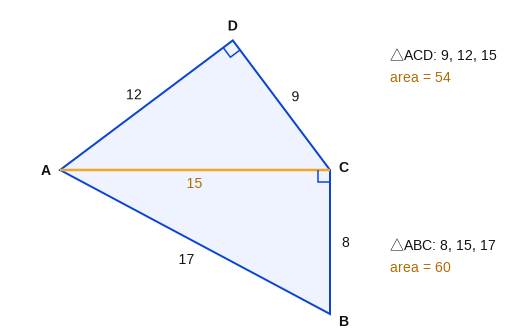
In quadrilateral ABCD, AB = 17 cm, BC = 8 cm, CD = 9 cm, AD = 12 cm, and AC = 15 cm. What is the area (in cm2) of the quadrilateral?
चतुर्भुज ABCD में, AB = 17 cm, BC = 8 cm, CD = 9 cm, AD = 12 cm, और AC = 15 cm है। चतुर्भुज का क्षेत्रफल (cm2 में) क्या है?
  1. A105
  2. B114
  3. C118
  4. D121
Show answer

Concept: Diagonal AC splits ABCD into two triangles; both turn out to be right-angled (Pythagorean triplets).

  1. △ABC: 82+152=289=172 → right angle at C, area =12×8×15=60
  2. △ACD: 92+122=225=152 → right angle at D, area =12×9×12=54
  3. Area of ABCD =60+54=114cm2

Trick: Spot triplets 8-15-17 and 9-12-15 (3-4-5 × 3) – no Heron needed.

Answer: (B) 114

अवधारणा: विकर्ण AC चतुर्भुज को दो त्रिभुजों में बाँटता है; दोनों समकोण त्रिभुज हैं (पाइथागोरस त्रिक)।

  1. △ABC: 82+152=289=172 → C पर समकोण, क्षेत्रफल =12×8×15=60
  2. △ACD: 92+122=225=152 → D पर समकोण, क्षेत्रफल =12×9×12=54
  3. ABCD का क्षेत्रफल =60+54=114cm2

ट्रिक: त्रिक 8-15-17 और 9-12-15 (3-4-5 का 3 गुना) पहचानें – हीरोन सूत्र की ज़रूरत नहीं।

उत्तर: (B) 114

RRB NTPC Graduate CBT 1MathematicsArea of quadrilateralRRB NTPC Graduate CBT 1 2024 · 5 Jun Shift 1 →
Q11083.
Find the duration (in years) in which ₹1,200 will amount to ₹2,280 at a rate of 4% per annum simple interest.
वह अवधि (वर्षों में) ज्ञात कीजिए जिसमें ₹1,200 की राशि 4% वार्षिक साधारण ब्याज की दर से ₹2,280 हो जाएगी।
  1. A22.5
  2. B21.5
  3. C23.5
  4. D24.5
Show answer

Concept: SI=P×R×T100

  1. SI=2280−1200=₹1080
  2. 1080=1200×4×T100=48T
  3. T=108048=22.5 years

Trick: Interest per year =4% of 1200 =48; divide total interest by 48.

Answer: (A) 22.5

अवधारणा: SI=P×R×T100

  1. SI=2280−1200=₹1080
  2. 1080=1200×4×T100=48T
  3. T=108048=22.5 वर्ष

ट्रिक: एक वर्ष का ब्याज =1200 का 4%=48; कुल ब्याज को 48 से भाग दें।

उत्तर: (A) 22.5

RRB NTPC Graduate CBT 1MathematicsSimple interestRRB NTPC Graduate CBT 1 2024 · 5 Jun Shift 1 →
Q11084.
A vendor bought lemons at 7 for ₹1. How many lemons must he sell for ₹1 to gain 75%?
एक विक्रेता ने ₹1 में 7 की दर से नींबू खरीदे। 75% लाभ प्राप्त करने के लिए उसे ₹1 में कितने नींबू बेचने चाहिए?
  1. A8
  2. B4
  3. C5
  4. D6
Show answer

Concept: SP=CP×100+gain%100

  1. CP of 1 lemon =₹17
  2. SP of 1 lemon =17×175100=₹14
  3. Lemons sold for ₹1 =4

Trick: For ₹1 both ways: lemons sold =7×100175=4.

Answer: (B) 4

अवधारणा: विक्रय मूल्य=क्रय मूल्य×100+लाभ%100

  1. 1 नींबू का क्रय मूल्य =₹17
  2. 1 नींबू का विक्रय मूल्य =17×175100=₹14
  3. ₹1 में बेचने हैं =4 नींबू

ट्रिक: दोनों ओर ₹1 हो तो: नींबू =7×100175=4।

उत्तर: (B) 4

RRB NTPC Graduate CBT 1MathematicsProfit and lossRRB NTPC Graduate CBT 1 2024 · 5 Jun Shift 1 →
Q11085.
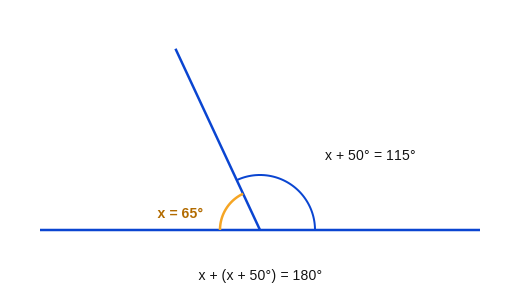
The larger of two supplementary angles is 50° more than the smaller one. The smaller angle (in degree) is:
दो संपूरक कोणों में से बड़ा कोण, छोटे कोण से 50° अधिक है। छोटा कोण (डिग्री में) है:
  1. A65°
  2. B67°
  3. C56°
  4. D75°
Show answer

Concept: Supplementary angles add up to 180∘.

  1. Let smaller =x, larger =x+50∘
  2. 2x+50∘=180∘ ⇒ x=65∘
  3. Larger =115∘ (check: 65+115=180)

Trick: Smaller =180−502=65∘.

Answer: (A) 65∘

अवधारणा: संपूरक कोणों का योग 180∘ होता है।

  1. छोटा कोण =x, बड़ा =x+50∘
  2. 2x+50∘=180∘ ⇒ x=65∘
  3. बड़ा =115∘ (जाँच: 65+115=180)

ट्रिक: छोटा =180−502=65∘।

उत्तर: (A) 65∘

RRB NTPC Graduate CBT 1MathematicsLines and anglesRRB NTPC Graduate CBT 1 2024 · 5 Jun Shift 1 →
Q11086.
If 7.5 : 19.5 :: 16 : x, find the value of x.
यदि 7.5 : 19.5 :: 16 : x है, तो x का मान ज्ञात कीजिए।
  1. A39.4
  2. B41.1
  3. C41.6
  4. D45.1
Show answer

Concept: In a:b::c:d, product of extremes = product of means: ad=bc.

  1. 7.5×x=19.5×16
  2. x=3127.5=41.6

Trick: 19.57.5=2.6, so x=16×2.6=41.6.

Answer: (C) 41.6

अवधारणा: a:b::c:d में बाह्य पदों का गुणनफल = मध्य पदों का गुणनफल: ad=bc।

  1. 7.5×x=19.5×16
  2. x=3127.5=41.6

ट्रिक: 19.57.5=2.6, अतः x=16×2.6=41.6।

उत्तर: (C) 41.6

RRB NTPC Graduate CBT 1MathematicsProportionRRB NTPC Graduate CBT 1 2024 · 5 Jun Shift 1 →
Q11087.
The simplified value of 127 - 7 x (17 + 6) + 93 is:
127 - 7 x (17 + 6) + 93 का सरलीकृत मान है:
  1. A59
  2. B57
  3. C62
  4. D51
Show answer

Concept: BODMAS: bracket → multiplication → addition/subtraction.

  1. 17+6=23
  2. 7×23=161
  3. 127−161+93=220−161=59

Trick: Add the positive terms together first: 127 + 93 = 220.

Answer: (A) 59

अवधारणा: BODMAS: कोष्ठक → गुणा → जोड़/घटाव।

  1. 17+6=23
  2. 7×23=161
  3. 127−161+93=220−161=59

ट्रिक: पहले धनात्मक पद जोड़ें: 127 + 93 = 220।

उत्तर: (A) 59

RRB NTPC Graduate CBT 1MathematicsSimplification (BODMAS)RRB NTPC Graduate CBT 1 2024 · 5 Jun Shift 1 →
Q11088.
Pipe A can fill a tank in 18 minutes, while pipe B can empty the completely filled tank in 20 minutes. Initially, pipe A is opened and after 6 minutes pipe B is also opened. In how much time (in minutes) will the remaining tank be filled completely?
पाइप A एक टंकी को 18 मिनट में भर सकता है, जबकि पाइप B पूरी भरी हुई टंकी को 20 मिनट में खाली कर सकता है। आरंभ में, पाइप A को खोला जाता है और 6 मिनट बाद पाइप B को भी खोल दिया जाता है। शेष टंकी कितने समय (मिनट में) में पूरी भर जाएगी?
  1. A120
  2. B137
  3. C107
  4. D127
Show answer

Concept: Work done = rate × time; an emptying pipe has a negative rate.

  1. In 6 min A fills 618=13; remaining =23
  2. Net rate =118−120=10−9180=1180 per min
  3. Time =23×180=120 min

Trick: LCM method: tank =180 units, A =+10, B =−9, net =1 unit/min; remaining 120 units → 120 min.

Answer: (A) 120

अवधारणा: काम = दर × समय; खाली करने वाले पाइप की दर ऋणात्मक।

  1. 6 मिनट में A भरता है 618=13; शेष =23
  2. शुद्ध दर =118−120=10−9180=1180 प्रति मिनट
  3. समय =23×180=120 मिनट

ट्रिक: LCM विधि: टंकी =180 इकाई, A =+10, B =−9, शुद्ध =1 इकाई/मिनट; शेष 120 इकाई → 120 मिनट।

उत्तर: (A) 120

RRB NTPC Graduate CBT 1MathematicsPipes and cisternsRRB NTPC Graduate CBT 1 2024 · 5 Jun Shift 1 →
Q11089.
Simplify (2x − 5y)2 + (5x + 2y)2 + (2x + 5y)(2x − 5y).
(2x − 5y)2 + (5x + 2y)2 + (2x + 5y)(2x − 5y) को सरल कीजिए।
  1. A34x2 − 4y2
  2. B−34x2 + 4y2
  3. C−33x2 − 4y2
  4. D33x2 + 4y2
Show answer

Concept: Use (a±b)2=a2±2ab+b2 and (a+b)(a−b)=a2−b2.

  1. (2x−5y)2=4x2−20xy+25y2
  2. (5x+2y)2=25x2+20xy+4y2
  3. (2x+5y)(2x−5y)=4x2−25y2
  4. Sum =33x2+4y2 (the xy terms and 25y2 cancel)

Trick: Put x=y=1: 9+49−21=37, and only 33+4=37 matches.

Answer: (D) 33x2+4y2

अवधारणा: (a±b)2=a2±2ab+b2 और (a+b)(a−b)=a2−b2 का प्रयोग करें।

  1. (2x−5y)2=4x2−20xy+25y2
  2. (5x+2y)2=25x2+20xy+4y2
  3. (2x+5y)(2x−5y)=4x2−25y2
  4. योग =33x2+4y2 (xy पद और 25y2 कट जाते हैं)

ट्रिक: x=y=1 रखें: 9+49−21=37, केवल 33+4=37 मेल खाता है।

उत्तर: (D) 33x2+4y2

RRB NTPC Graduate CBT 1MathematicsAlgebraic identitiesRRB NTPC Graduate CBT 1 2024 · 5 Jun Shift 1 →
Q11090.
If the ratio of two numbers is 5 : 3 and the product of their LCM and their HCF is 135, then the sum of the reciprocals of the LCM and the HCF is:
यदि दो संख्याओं का अनुपात 5 : 3 है और उनके LCM तथा HCF का गुणनफल 135 है, तो LCM और HCF के व्युत्क्रमों का योग है:
  1. A1645
  2. B1685
  3. C1661
  4. D1673
Show answer

Concept: For two numbers, LCM×HCF= product of the numbers.

  1. Numbers =5k and 3k (5, 3 co-prime) ⇒ HCF =k, LCM =15k
  2. 15k×k=135 ⇒ k2=9 ⇒ k=3; LCM =45, HCF =3
  3. 145+13=1+1545=1645

Trick: Sum of reciprocals =LCM+HCFLCM×HCF=48135=1645.

Answer: (A) 1645

अवधारणा: दो संख्याओं के लिए LCM×HCF= संख्याओं का गुणनफल।

  1. संख्याएँ =5k और 3k ⇒ HCF =k, LCM =15k
  2. 15k×k=135 ⇒ k2=9 ⇒ k=3; LCM =45, HCF =3
  3. 145+13=1+1545=1645

ट्रिक: व्युत्क्रमों का योग =LCM+HCFLCM×HCF=48135=1645।

उत्तर: (A) 1645

RRB NTPC Graduate CBT 1MathematicsHCF and LCMRRB NTPC Graduate CBT 1 2024 · 5 Jun Shift 1 →
Q11091.
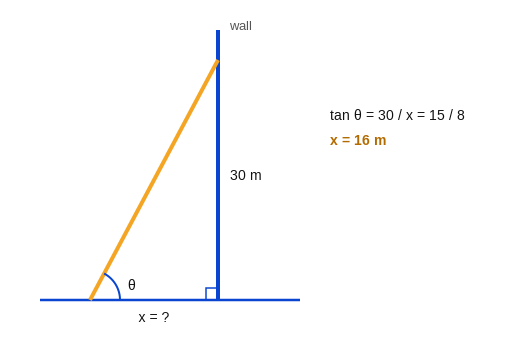
A ladder leaning against a wall makes an angle θ with the horizontal ground such that tanθ=158. If the height of the top of the ladder from the wall is 30 m, find the distance (in m) of the foot of the ladder from the wall.
दीवार के सहारे टिकी एक सीढ़ी क्षैतिज भूमि के साथ θ कोण बनाती है, इस प्रकार कि tanθ=158 है। यदि सीढ़ी के शीर्ष की दीवार पर ऊँचाई 30 m है, तो दीवार से सीढ़ी के पाद की दूरी (m में) ज्ञात कीजिए।
  1. A18
  2. B16
  3. C14
  4. D20
Show answer

Concept: In the right triangle formed by ladder, wall and ground: tanθ=heightbase.

  1. Height on the wall =30 m, base =x
  2. tanθ=30x=158
  3. x=30×815=16 m

Trick: 15→30 means scale ×2, so base 8→16.

Answer: (B) 16

अवधारणा: सीढ़ी, दीवार और ज़मीन से बने समकोण त्रिभुज में: tanθ=ऊँचाईआधार।

  1. दीवार पर ऊँचाई =30 m, आधार =x
  2. tanθ=30x=158
  3. x=30×815=16 m

ट्रिक: 15→30 यानी 2 गुना, अतः आधार 8→16।

उत्तर: (B) 16

RRB NTPC Graduate CBT 1MathematicsHeights and distancesRRB NTPC Graduate CBT 1 2024 · 5 Jun Shift 1 →
Q11092.
A man has to cover a distance of 519 km in 7 hours. If he covers two-third of this distance in 57 of the time, then what should his speed (in km/hr) be to cover the remaining distance in the time left?
एक व्यक्ति को 519 km की दूरी 7 घंटे में तय करनी है। यदि वह इस दूरी का दो-तिहाई भाग 57 समय में तय करता है, तो शेष दूरी को शेष समय में तय करने के लिए उसकी चाल (km/hr में) कितनी होनी चाहिए?
  1. A86.5
  2. B46.5
  3. C66.5
  4. D34.5
Show answer

Concept: Speed =distancetime for the remaining part.

  1. Covered =23×519=346 km in 57×7=5 h
  2. Remaining distance =519−346=173 km; time left =7−5=2 h
  3. Speed =1732=86.5km/h

Trick: Remaining =13 of 519 =173 km in 2 h.

Answer: (A) 86.5

अवधारणा: बचे भाग के लिए चाल=दूरीसमय।

  1. तय दूरी =23×519=346 km, समय 57×7=5 घंटे
  2. शेष दूरी =519−346=173 km; शेष समय =7−5=2 घंटे
  3. चाल =1732=86.5km/h

ट्रिक: शेष =519 का 13=173 km, 2 घंटे में।

उत्तर: (A) 86.5

RRB NTPC Graduate CBT 1MathematicsSpeed, time and distanceRRB NTPC Graduate CBT 1 2024 · 5 Jun Shift 1 →
Q11093.
The median of the observations 76, 83, 30, 11, 81, 52, 18, 34, 84, 35 and 27 is:
प्रेक्षणों 76, 83, 30, 11, 81, 52, 18, 34, 84, 35 और 27 की माध्यिका है:
  1. A30
  2. B35
  3. C52
  4. D34
Show answer

Concept: For n (odd) observations in order, median =(n+12)th value.

  1. Ascending order: 11, 18, 27, 30, 34, 35, 52, 76, 81, 83, 84
  2. n=11 ⇒ median =6th value =35

Trick: Always sort first – the 6th value of the unsorted list (52) is the trap.

Answer: (B) 35

अवधारणा: n (विषम) प्रेक्षणों के लिए क्रम में रखने पर माध्यिका =(n+12)वाँ मान।

  1. आरोही क्रम: 11, 18, 27, 30, 34, 35, 52, 76, 81, 83, 84
  2. n=11 ⇒ माध्यिका =6वाँ मान =35

ट्रिक: पहले क्रम में लगाएँ – बिना क्रम का 6वाँ मान (52) जाल है।

उत्तर: (B) 35

RRB NTPC Graduate CBT 1MathematicsMedianRRB NTPC Graduate CBT 1 2024 · 5 Jun Shift 1 →
Q11094.
The mode and median of a data set is 28.4 and 88, respectively. What is the mean of the data set? (Use empirical formula.)
किसी आँकड़ा समुच्चय का बहुलक और माध्यिका क्रमशः 28.4 और 88 हैं। आँकड़ा समुच्चय का माध्य क्या है? (आनुभविक सूत्र का प्रयोग कीजिए।)
  1. A114.2
  2. B119.2
  3. C117.8
  4. D127.7
Show answer

Concept: Empirical relation: Mode=3Median−2Mean.

  1. 28.4=3×88−2Mean=264−2Mean
  2. 2Mean=264−28.4=235.6
  3. Mean=117.8

Trick: Mean =3Median−Mode2.

Answer: (C) 117.8

अवधारणा: आनुभविक संबंध: बहुलक=3माध्यिका−2माध्य।

  1. 28.4=3×88−2माध्य=264−2माध्य
  2. 2माध्य=264−28.4=235.6
  3. माध्य=117.8

ट्रिक: माध्य=3माध्यिका−बहुलक2।

उत्तर: (C) 117.8

RRB NTPC Graduate CBT 1MathematicsMean, median, modeRRB NTPC Graduate CBT 1 2024 · 5 Jun Shift 1 →
Q11095.
The marked price of a bed is ₹517, which is 30% above the cost price. If the profit percent is 2%. Find the discount percentage. (rounded off to two decimal places)
एक पलंग का अंकित मूल्य ₹517 है, जो क्रय मूल्य से 30% अधिक है। यदि लाभ प्रतिशत 2% है, तो छूट प्रतिशत ज्ञात कीजिए। (दो दशमलव स्थानों तक पूर्णांकित)
  1. A18.57%
  2. B24.06%
  3. C20.36%
  4. D21.54%
Show answer

Concept: Take CP =100; then MP and SP follow from the given percentages.

  1. CP =100 ⇒ MP =130 (30% above CP)
  2. Profit 2% ⇒ SP =102
  3. Discount =130−102=28; Discount%=28130×100≈21.54%

Trick: The ₹517 is not needed: 30−2130×100.

Answer: (D) 21.54%

अवधारणा: क्रय मूल्य =100 मानें; फिर अंकित मूल्य और विक्रय मूल्य निकालें।

  1. क्रय मूल्य =100 ⇒ अंकित मूल्य =130
  2. 2% लाभ ⇒ विक्रय मूल्य =102
  3. बट्टा =130−102=28; बट्टा%=28130×100≈21.54%

ट्रिक: ₹517 की आवश्यकता नहीं: 30−2130×100।

उत्तर: (D) 21.54%

RRB NTPC Graduate CBT 1MathematicsDiscount and profitRRB NTPC Graduate CBT 1 2024 · 5 Jun Shift 1 →
Q11096.
If ‘+’ means ‘−’, ‘−’ means ‘×’, ‘×’ means ‘÷’ and ‘÷’ means ‘+’, then what will come in place of the question mark (?) in the following equation?
32 ÷ 14 + 16 – 8 × 4 = ?
यदि ‘+’ का अर्थ ‘−’, ‘−’ का अर्थ ‘×’, ‘×’ का अर्थ ‘÷’ और ‘÷’ का अर्थ ‘+’ है, तो निम्नलिखित समीकरण में प्रश्न चिह्न (?) के स्थान पर क्या आएगा?
32 ÷ 14 + 16 – 8 × 4 = ?
  1. A14
  2. B18
  3. C16
  4. D22
Show answer

Concept: Replace each sign by its meaning, then solve using BODMAS.

  1. Given: 32÷14+16−8×4
  2. Replace (÷→+, +→−, −→×, ×→÷): 32+14−16×8÷4
  3. 16×8÷4=32, so 32+14−32=14

Trick: Write the new expression first, then apply BODMAS – never solve before replacing signs.

Answer: (A) 14

अवधारणा: प्रत्येक चिह्न को उसके अर्थ से बदलें, फिर BODMAS लगाएँ।

  1. दिया है: 32÷14+16−8×4
  2. चिह्न बदलने पर: 32+14−16×8÷4
  3. 16×8÷4=32, अतः 32+14−32=14

ट्रिक: पहले पूरा नया व्यंजक लिखें, फिर BODMAS लगाएँ।

उत्तर: (A) 14

RRB NTPC Graduate CBT 1General Intelligence and ReasoningMathematical OperationsRRB NTPC Graduate CBT 1 2024 · 5 Jun Shift 1 →
Q11097.
Refer to the following number and symbol series and answer the question that follows. Counting to be done from left to right only. All numbers are single-digit numbers. (Left) # * £ 3 9 € # % £ 1 % £ 8 8 1 4 9 % 5 8 & 7 (Right)
How many such numbers are there each of which is immediately preceded by a symbol and also immediately followed by a symbol?
निम्नलिखित संख्या और प्रतीक श्रृंखला का संदर्भ लीजिए और आगे दिए गए प्रश्न का उत्तर दीजिए। गिनती केवल बाएँ से दाएँ की जानी है। सभी संख्याएँ एक-अंकीय संख्याएँ हैं। (बाएँ) # * £ 3 9 € # % £ 1 % £ 8 8 1 4 9 % 5 8 & 7 (दाएँ)
ऐसी कितनी संख्याएँ हैं जिनमें से प्रत्येक के ठीक पहले एक प्रतीक है और ठीक बाद भी एक प्रतीक है?
  1. A2
  2. B3
  3. C1
  4. D4
Show answer

Concept: Check every digit: the term just before it AND the term just after it must both be symbols.

  1. Series: # * £ 3 9 € # % £ 1 % £ 8 8 1 4 9 % 5 8 & 7
  2. Pattern needed: symbol – number – symbol.
  3. £ 1 % is the only such group (3 is followed by 9; 5 is followed by 8; 8 is preceded by 5; 7 is at the end).

Trick: Scan only the digits and look left/right of each – it is faster than scanning symbols.

Answer: (C) 1

अवधारणा: हर अंक के ठीक पहले और ठीक बाद वाला पद – दोनों प्रतीक होने चाहिए।

  1. श्रृंखला: # * £ 3 9 € # % £ 1 % £ 8 8 1 4 9 % 5 8 & 7
  2. आवश्यक पैटर्न: प्रतीक – अंक – प्रतीक।
  3. केवल £ 1 % ऐसा समूह है (3 के बाद 9 है; 5 के बाद 8; 7 अंत में है)।

ट्रिक: केवल अंकों को देखें और उनके दाएँ-बाएँ जाँचें।

उत्तर: (C) 1

RRB NTPC Graduate CBT 1General Intelligence and ReasoningNumber-Symbol SeriesRRB NTPC Graduate CBT 1 2024 · 5 Jun Shift 1 →
Q11098.
What will come in the place of the question mark (?) in the following equation, if ‘+’ and ‘−‘ are interchanged and ‘×’ and ‘÷’ are interchanged?
38 ÷ 21 + 436 × 4 − 73 = ?
यदि ‘+’ और ‘−‘ को आपस में बदल दिया जाए तथा ‘×’ और ‘÷’ को आपस में बदल दिया जाए, तो निम्नलिखित समीकरण में प्रश्न चिह्न (?) के स्थान पर क्या आएगा?
38 ÷ 21 + 436 × 4 − 73 = ?
  1. A761
  2. B762
  3. C764
  4. D763
Show answer

Concept: Interchange + ↔ − and × ↔ ÷, then apply BODMAS.

  1. Given: 38÷21+436×4−73
  2. After interchange: 38×21−436÷4+73
  3. =798−109+73=762

Trick: Do the swap carefully sign by sign; then BODMAS.

Answer: (B) 762

अवधारणा: + ↔ − तथा × ↔ ÷ बदलें, फिर BODMAS लगाएँ।

  1. दिया है: 38÷21+436×4−73
  2. बदलने पर: 38×21−436÷4+73
  3. =798−109+73=762

ट्रिक: चिह्न एक-एक कर बदलें, फिर BODMAS।

उत्तर: (B) 762

RRB NTPC Graduate CBT 1General Intelligence and ReasoningMathematical OperationsRRB NTPC Graduate CBT 1 2024 · 5 Jun Shift 1 →
Q11099.
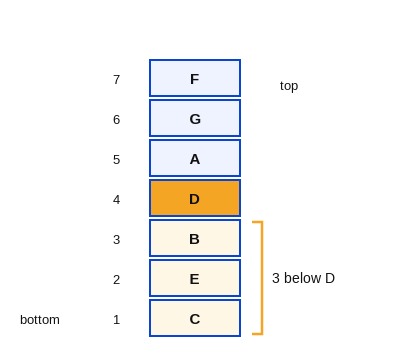
Seven boxes, A, B, C, D, E, F and G, are kept one over the other but not necessarily in the same order. No box is kept above F. Only three boxes are kept between F and B. Only one box is kept between G and D. D is kept immediately above B. Only four boxes are kept between G and C. A is kept in some place above E. How many boxes are kept below D?
सात बक्से, A, B, C, D, E, F और G, एक के ऊपर एक रखे हुए हैं, परंतु आवश्यक नहीं कि इसी क्रम में हों। F के ऊपर कोई बक्सा नहीं रखा है। F और B के बीच केवल तीन बक्से रखे हैं। G और D के बीच केवल एक बक्सा रखा है। D, B के ठीक ऊपर रखा है। G और C के बीच केवल चार बक्से रखे हैं। A, E के ऊपर किसी स्थान पर रखा है। D के नीचे कितने बक्से रखे हैं?
  1. A1
  2. B4
  3. C3
  4. D2
Show answer

Concept: Number positions 1 (bottom) to 7 (top) and place the fixed clues first.

  1. No box above F ⇒ F = 7. Three boxes between F and B ⇒ B = 3. D immediately above B ⇒ D = 4.
  2. One box between G and D ⇒ G = 2 or 6. Four boxes between G and C: G = 2 gives C = 7 (taken), so G = 6, C = 1.
  3. A above E in the remaining places 2 and 5 ⇒ A = 5, E = 2.
  4. Order (bottom→top): C, E, B, D, A, G, F ⇒ boxes below D = C, E, B = 3.

Trick: Start with the "top/bottom" clue – it fixes one box exactly and the rest follow.

Answer: (C) 3

अवधारणा: स्थान 1 (नीचे) से 7 (ऊपर) तक मानें और पहले निश्चित सूचनाएँ लगाएँ।

  1. F के ऊपर कोई बॉक्स नहीं ⇒ F = 7। F और B के बीच तीन ⇒ B = 3। D, B के ठीक ऊपर ⇒ D = 4।
  2. G और D के बीच एक ⇒ G = 2 या 6। G और C के बीच चार: G = 2 से C = 7 (भरा), अतः G = 6, C = 1।
  3. शेष स्थान 2 व 5 में A, E के ऊपर ⇒ A = 5, E = 2।
  4. क्रम (नीचे→ऊपर): C, E, B, D, A, G, F ⇒ D के नीचे 3 बॉक्स।

ट्रिक: "सबसे ऊपर/नीचे" वाली सूचना से शुरू करें।

उत्तर: (C) 3

RRB NTPC Graduate CBT 1General Intelligence and ReasoningPuzzle – Box ArrangementRRB NTPC Graduate CBT 1 2024 · 5 Jun Shift 1 →
Q11100.
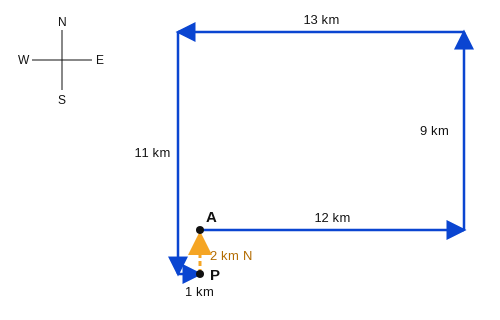
Sundar starts from point A and drives 12 km towards the east. He then takes a left turn, drives 9 km, turns left and drives 13 km. He then takes a left turn and drives 11 km. He takes a final left turn, drives 1 km and stops at point P. How far (shortest distance) and towards which direction should he drive in order to reach point A again? (All turns are 90 degree turns only unless specified.)
सुंदर बिंदु A से चलना शुरू करता है और पूर्व की ओर 12 km गाड़ी चलाता है। फिर वह बाएँ मुड़ता है, 9 km गाड़ी चलाता है, बाएँ मुड़ता है और 13 km गाड़ी चलाता है। फिर वह बाएँ मुड़ता है और 11 km गाड़ी चलाता है। वह अंतिम बार बाएँ मुड़ता है, 1 km गाड़ी चलाता है और बिंदु P पर रुक जाता है। पुनः बिंदु A पर पहुँचने के लिए उसे कितनी दूरी (न्यूनतम दूरी) और किस दिशा में गाड़ी चलानी चाहिए? (जब तक निर्दिष्ट न किया जाए, सभी मोड़ केवल 90 डिग्री के मोड़ हैं।)
  1. A2 km to the southदक्षिण की ओर 2 km
  2. B1 km to the northउत्तर की ओर 1 km
  3. C2 km to the northउत्तर की ओर 2 km
  4. D1 km to the southदक्षिण की ओर 1 km
Show answer

Concept: Take A as origin (0, 0); east = +x, north = +y. A left turn from east is north, from north is west, and so on.

  1. 12 km east → (12, 0); left, 9 km north → (12, 9).
  2. Left, 13 km west → (−1, 9); left, 11 km south → (−1, −2).
  3. Left, 1 km east → P = (0, −2).
  4. P is 2 km directly south of A, so he must drive 2 km north.

Trick: Net east-west: 12 − 13 + 1 = 0; net north-south: 9 − 11 = −2 (south) ⇒ go 2 km north.

Answer: (C) 2 km to the north

अवधारणा: A को मूल बिंदु (0, 0) मानें; पूर्व = +x, उत्तर = +y। पूर्व से बाएँ = उत्तर, उत्तर से बाएँ = पश्चिम आदि।

  1. 12 km पूर्व → (12, 0); बाएँ, 9 km उत्तर → (12, 9)।
  2. बाएँ, 13 km पश्चिम → (−1, 9); बाएँ, 11 km दक्षिण → (−1, −2)।
  3. बाएँ, 1 km पूर्व → P = (0, −2)।
  4. P, A से 2 km ठीक दक्षिण में है, अतः उसे 2 km उत्तर जाना होगा।

ट्रिक: पूर्व-पश्चिम: 12 − 13 + 1 = 0; उत्तर-दक्षिण: 9 − 11 = −2 ⇒ 2 km उत्तर।

उत्तर: (C) 2 km to the north

RRB NTPC Graduate CBT 1General Intelligence and ReasoningDirection & DistanceRRB NTPC Graduate CBT 1 2024 · 5 Jun Shift 1 →