Question bank

Q&A: practice questions with answers

Search questions on any topic. Filter by exam category, exam, subject and topic, try the question, then open the answer and explanation.

Courses – airGurukul

20,719 questions found.

Q11321.
What is the average of 6, 8, 10 and 12?
6, 8, 10 और 12 का औसत कितना है?
  1. A9
  2. B8
  3. C10
  4. D7
Show answer

Concept: Average =SumCount

  1. Sum =6+8+10+12=36.
  2. Average =364=9.

Trick: For equally spaced numbers, average = middle value =6+122=9.

Answer: (A) 9

अवधारणा: औसत =योगसंख्या

  1. योग =6+8+10+12=36।
  2. औसत =364=9।

ट्रिक: समान अंतर वाली संख्याओं का औसत = पहला व अंतिम का औसत =6+122=9।

उत्तर: (A) 9

RRB NTPC Graduate CBT 2MathematicsAverageRRB NTPC Graduate CBT 2 2024 · 13 Oct Shift 2 →
Q11322.
Evaluate the following.
54+(11+37)−43
निम्नलिखित का मान ज्ञात कीजिए।
54+(11+37)−43
  1. A2768
  2. B3364
  3. C4170
  4. D3760
Show answer

Concept: Simplify the bracket first, then take LCM.

  1. 1+37=107, so 110/7=710.
  2. 54+710−43; LCM =60.
  3. =75+42−8060=3760.

Trick: Denominator must be a factor of 60 (LCM of 4, 10, 3) – only 3760 fits.

Answer: (D) 3760

अवधारणा: पहले कोष्ठक सरल करें, फिर LCM लें।

  1. 1+37=107, अतः 110/7=710।
  2. 54+710−43; LCM =60।
  3. =75+42−8060=3760।

ट्रिक: हर 60 (4, 10, 3 का LCM) का गुणनखंड होना चाहिए – केवल 3760 सही बैठता है।

उत्तर: (D) 3760

RRB NTPC Graduate CBT 2MathematicsSimplification – FractionsRRB NTPC Graduate CBT 2 2024 · 13 Oct Shift 2 →
Q11323.
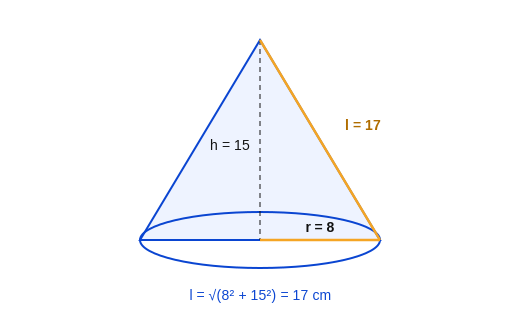
The radius of a right circular cone is 8 cm and its height is 15 cm. The total surface area of the cone is:
एक लंब वृत्तीय शंकु की त्रिज्या 8 cm और ऊँचाई 15 cm है। शंकु का संपूर्ण पृष्ठीय क्षेत्रफल है:
  1. A184πcm2
  2. B136πcm2
  3. C200πcm2
  4. D64πcm2
Show answer

Concept: TSA of cone =πr(l+r), where l=r2+h2.

  1. l=82+152=289=17cm.
  2. TSA =π×8×(17+8)=200πcm2.

Trick: 8-15-17 is a Pythagorean triplet.

Answer: (C) 200πcm2

अवधारणा: शंकु का कुल पृष्ठीय क्षेत्रफल =πr(l+r), जहाँ l=r2+h2।

  1. l=82+152=289=17cm।
  2. TSA =π×8×(17+8)=200πcm2।

ट्रिक: 8-15-17 पाइथागोरस त्रिक है।

उत्तर: (C) 200πcm2

RRB NTPC Graduate CBT 2MathematicsMensuration – ConeRRB NTPC Graduate CBT 2 2024 · 13 Oct Shift 2 →
Q11324.
A boat travels downstream at a speed of 25 km/hr and upstream at a speed of 15 km/hr. What is the speed of the stream?
एक नाव धारा के अनुकूल 25 km/hr की चाल से और धारा के प्रतिकूल 15 km/hr की चाल से चलती है। धारा की चाल कितनी है?
  1. A4 km/hr
  2. B5 km/hr
  3. C6 km/hr
  4. D8 km/hr
Show answer

Concept: Stream speed =Downstream−Upstream2

  1. =25−152=5km/h.
  2. (Boat speed =25+152=20km/h.)

Trick: Half the sum = boat; half the difference = stream.

Answer: (B) 5 km/hr

अवधारणा: धारा की चाल =अनुप्रवाह−ऊर्ध्वप्रवाह2

  1. =25−152=5km/h।
  2. (नाव की चाल =25+152=20km/h।)

ट्रिक: आधा योग = नाव; आधा अंतर = धारा।

उत्तर: (B) 5 km/hr

RRB NTPC Graduate CBT 2MathematicsBoats and StreamsRRB NTPC Graduate CBT 2 2024 · 13 Oct Shift 2 →
Q11325.
If x is inversely proportional to y, and y=6 when x=4, find the value of x, when y=32.
यदि x, y के व्युत्क्रमानुपाती है, और y=6, जब x=4 हो, तो y=32 होने पर x का मान ज्ञात कीजिए।
  1. A34
  2. B1513
  3. C823
  4. D1912
Show answer

Concept: If x∝1y then xy= constant.

  1. xy=4×6=24.
  2. When y=32: x=2432=34.

Trick: x1y1=x2y2 – no need to find the constant separately.

Answer: (A) 34

अवधारणा: यदि x∝1y तो xy= स्थिरांक।

  1. xy=4×6=24।
  2. y=32 पर: x=2432=34।

ट्रिक: x1y1=x2y2 – सीधे लगाएँ।

उत्तर: (A) 34

RRB NTPC Graduate CBT 2MathematicsInverse ProportionRRB NTPC Graduate CBT 2 2024 · 13 Oct Shift 2 →
Q11326.
A shop offers three successive discounts of 10%, 15% and 20% on a product. Find the single equivalent discount percentage that would result in the same final price.
एक दुकान किसी उत्पाद पर 10%, 15% और 20% की तीन क्रमिक छूटें देती है। वह एकल समतुल्य छूट प्रतिशत ज्ञात कीजिए जिससे समान अंतिम मूल्य प्राप्त हो।
  1. A40.8%
  2. B45%
  3. C38.8%
  4. D42.8%
Show answer

Concept: Multiply the remaining fractions of price.

  1. Final price =100×0.90×0.85×0.80.
  2. =100×0.612=61.2.
  3. Single discount =100−61.2=38.8%.

Trick: Two at a time: 10,15→10+15−150100=23.5; then 23.5,20→43.5−4.7=38.8%.

Answer: (C) 38.8%

अवधारणा: मूल्य के बचे हुए भागों का गुणा करें।

  1. अंतिम मूल्य =100×0.90×0.85×0.80।
  2. =100×0.612=61.2।
  3. एकल छूट =100−61.2=38.8%।

ट्रिक: दो-दो करके: 10,15→10+15−150100=23.5; फिर 23.5,20→43.5−4.7=38.8%।

उत्तर: (C) 38.8%

RRB NTPC Graduate CBT 2MathematicsSuccessive DiscountsRRB NTPC Graduate CBT 2 2024 · 13 Oct Shift 2 →
Q11327.
The mean of three numbers is 15. If 2 is added to each of these numbers, what will be the new mean?
तीन संख्याओं का माध्य 15 है। यदि इनमें से प्रत्येक संख्या में 2 जोड़ दिया जाए, तो नया माध्य क्या होगा?
  1. A17
  2. B16
  3. C18
  4. D15
Show answer

Concept: Adding the same number to every value raises the average by that number.

  1. Old mean =15.
  2. New mean =15+2=17.

Trick: Same change to each item → same change to the mean.

Answer: (A) 17

अवधारणा: हर संख्या में समान संख्या जोड़ने पर औसत भी उतना ही बढ़ता है।

  1. पुराना औसत =15।
  2. नया औसत =15+2=17।

ट्रिक: हर पद में समान परिवर्तन → औसत में भी वही परिवर्तन।

उत्तर: (A) 17

RRB NTPC Graduate CBT 2MathematicsAverageRRB NTPC Graduate CBT 2 2024 · 13 Oct Shift 2 →
Q11328.
Simplify: 0.5+0.2×4.8÷(2.4÷1.2)−0.90÷2
सरल कीजिए: 0.5+0.2×4.8÷(2.4÷1.2)−0.90÷2
  1. A0.53
  2. B0.51
  3. C0.50
  4. D0.52
Show answer

Concept: Brackets first, then ÷ and × from left to right, then + and −.

  1. Bracket: 2.4÷1.2=2.
  2. 0.2×4.8÷2=0.96÷2=0.48; 0.90÷2=0.45.
  3. 0.5+0.48−0.45=0.53.

Trick: Clear all ÷/× terms first, then add/subtract in one line.

Answer: (A) 0.53

अवधारणा: पहले कोष्ठक, फिर बाएँ से दाएँ ÷ और ×, फिर + और −।

  1. कोष्ठक: 2.4÷1.2=2।
  2. 0.2×4.8÷2=0.96÷2=0.48; 0.90÷2=0.45।
  3. 0.5+0.48−0.45=0.53।

ट्रिक: पहले सभी ÷/× पद निकालें, फिर एक साथ जोड़ें/घटाएँ।

उत्तर: (A) 0.53

RRB NTPC Graduate CBT 2MathematicsSimplification – Decimals (BODMAS)RRB NTPC Graduate CBT 2 2024 · 13 Oct Shift 2 →
Q11329.
Which of the following ratios is greatest?
निम्नलिखित में से कौन-सा अनुपात सबसे बड़ा है?
  1. A43 : 76
  2. B38 : 51
  3. C22 : 61
  4. D30 : 74
Show answer

Concept: Convert each ratio to a decimal (or compare with 12 first).

  1. 4376≈0.57, 3851≈0.75.
  2. 2261≈0.36, 3074≈0.41.
  3. Greatest: 38:51.

Trick: Only 38:51 is well above 23 (38×3=114>102).

Answer: (B) 38 : 51

अवधारणा: हर अनुपात को दशमलव में बदलें (या पहले 12 से तुलना करें)।

  1. 4376≈0.57, 3851≈0.75।
  2. 2261≈0.36, 3074≈0.41।
  3. सबसे बड़ा: 38:51।

ट्रिक: केवल 38:51 ही 23 से बड़ा है (38×3=114>102)।

उत्तर: (B) 38 : 51

RRB NTPC Graduate CBT 2MathematicsRatio ComparisonRRB NTPC Graduate CBT 2 2024 · 13 Oct Shift 2 →
Q11330.
A person covers certain distance in 13 hours at a speed of 3 km/hr and some more distance in 15 hours at a speed of 6 km/hr. Find his average speed for the entire distance covered.
एक व्यक्ति 3 km/hr की चाल से 13 घंटे में कुछ दूरी तय करता है और 6 km/hr की चाल से 15 घंटे में कुछ और दूरी तय करता है। तय की गई संपूर्ण दूरी के लिए उसकी औसत चाल ज्ञात कीजिए।
  1. A41728km/hr
  2. B111728km/hr
  3. C81728km/hr
  4. D51728km/hr
Show answer

Concept: Average speed =Total distanceTotal time

  1. Distances: 13×3=39km and 15×6=90km; total =129km.
  2. Total time =13+15=28h.
  3. Average =12928=41728km/h.

Trick: Average must lie between 3 and 6 – only 41728 fits.

Answer: (A) 41728km/hr

अवधारणा: औसत चाल =कुल दूरीकुल समय

  1. दूरियाँ: 13×3=39km और 15×6=90km; कुल =129km।
  2. कुल समय =13+15=28h।
  3. औसत =12928=41728km/h।

ट्रिक: औसत 3 और 6 के बीच होना चाहिए – केवल 41728 सही।

उत्तर: (A) 41728km/hr

RRB NTPC Graduate CBT 2MathematicsAverage SpeedRRB NTPC Graduate CBT 2 2024 · 13 Oct Shift 2 →
Q11331.
​Based on the English alphabetical order, three of the following four letter-cluster pairs are alike in a certain way and thus form a group. Which is the letter-cluster pair that DOES NOT belong to that group?
(Note: The odd one out is not based on the number of consonants/vowels or their position in the letter-cluster.)
​अंग्रेज़ी वर्णमाला क्रम के आधार पर, निम्नलिखित चार अक्षर-समूह युग्मों में से तीन किसी निश्चित प्रकार से एकसमान हैं और इस प्रकार एक समूह बनाते हैं। वह अक्षर-समूह युग्म कौन-सा है जो उस समूह से संबंधित नहीं है?
(ध्यान दें: असंगत अक्षर-समूह, उस अक्षर-समूह में व्यंजनों/स्वरों की संख्या या उनकी स्थिति पर आधारित नहीं है।)
  1. ANQ−NT
  2. BLO−MP
  3. CIL−JM
  4. DJM−KN
Show answer

Concept: Compare each letter of the first cluster with the corresponding letter of the second.

  1. LO−MP: L→M (+1), O→P (+1).
  2. IL−JM: +1,+1; JM−KN: +1,+1.
  3. NQ−NT: N→N (0), Q→T (+3) – different.

Trick: In such pairs write the jump under each letter; the pair with a different jump is the answer.

Answer: (A) NQ−NT

अवधारणा: पहले समूह के हर अक्षर की तुलना दूसरे समूह के संगत अक्षर से करें।

  1. LO−MP: L→M (+1), O→P (+1)।
  2. IL−JM और JM−KN: +1,+1।
  3. NQ−NT: N→N (0), Q→T (+3) – अलग।

ट्रिक: हर अक्षर के नीचे अंतर लिखें; जिसका अंतर अलग हो वही उत्तर।

उत्तर: (A) NQ−NT

RRB NTPC Graduate CBT 2General Intelligence and ReasoningOdd One Out (Letter Pairs)RRB NTPC Graduate CBT 2 2024 · 13 Oct Shift 2 →
Q11332.
​Based on the English alphabetical order, three of the following four letter-cluster pairs are alike in a certain way and thus form a group. Which is the letter-cluster pair that DOES NOT belong to that group?
(Note: The odd one out is not based on the number of consonants/vowels or their position in the letter-cluster.)
​अंग्रेज़ी वर्णमाला क्रम के आधार पर, निम्नलिखित चार अक्षर-समूह युग्मों में से तीन किसी निश्चित प्रकार से एकसमान हैं और इस प्रकार एक समूह बनाते हैं। वह अक्षर-समूह युग्म कौन-सा है जो उस समूह से संबंधित नहीं है?
(ध्यान दें: असंगत अक्षर-समूह, उस अक्षर-समूह में व्यंजनों/स्वरों की संख्या या उनकी स्थिति पर आधारित नहीं है।)
  1. ADH−DK
  2. BNR−OS
  3. CQU−RV
  4. DVZ−WA
Show answer

Concept: Compare corresponding letters of the two clusters in each pair.

  1. NR−OS: +1,+1; QU−RV: +1,+1.
  2. VZ−WA: V→W (+1), Z→A (+1, wrapping).
  3. DH−DK: D→D (0), H→K (+3) – odd.

Trick: After Z comes A again – treat the alphabet as a circle.

Answer: (A) DH−DK

अवधारणा: हर युग्म में दोनों समूहों के संगत अक्षरों की तुलना करें।

  1. NR−OS और QU−RV: +1,+1।
  2. VZ−WA: V→W (+1), Z→A (+1) (चक्रीय)।
  3. DH−DK: 0,+3 – विषम।

ट्रिक: Z के बाद फिर A आता है – वर्णमाला को चक्र मानें।

उत्तर: (A) DH−DK

RRB NTPC Graduate CBT 2General Intelligence and ReasoningOdd One Out (Letter Pairs)RRB NTPC Graduate CBT 2 2024 · 13 Oct Shift 2 →
Q11333.
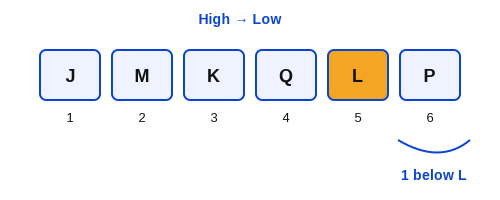
J, K, L, M, P and Q each scored different marks. Only two people have scored between P and K. Only one person has scored more than M. Only three people have scored between M and P. Q has scored more than L but less than J. How many people have scored less than L?
J, K, L, M, P और Q में से प्रत्येक ने अलग-अलग अंक प्राप्त किए। केवल दो व्यक्तियों ने P और K के बीच अंक प्राप्त किए हैं। केवल एक व्यक्ति ने M से अधिक अंक प्राप्त किए हैं। केवल तीन व्यक्तियों ने M और P के बीच अंक प्राप्त किए हैं। Q ने L से अधिक लेकिन J से कम अंक प्राप्त किए हैं। कितने व्यक्तियों ने L से कम अंक प्राप्त किए हैं?
  1. AFourचार
  2. BOneएक
  3. CTwoदो
  4. DThree
    तीन
Show answer

Concept: Place people on ranks 1 (highest) to 6 using fixed clues first.

  1. Only one above M → M is 2nd.
  2. Three between M and P → P is 6th.
  3. Two between P and K → K is 3rd.
  4. J, Q, L fill 1, 4, 5 with L < Q < J → J 1st, Q 4th, L 5th.
  5. Below L: only P → one person.

Trick: Start with 'only one more than' type clues – they fix a rank immediately.

Answer: (B) One

अवधारणा: निश्चित संकेतों से रैंक 1 (सबसे अधिक) से 6 तक व्यवस्था बनाएँ।

  1. M से अधिक केवल एक → M दूसरा।
  2. M और P के बीच तीन → P छठा।
  3. P और K के बीच दो → K तीसरा।
  4. J, Q, L स्थान 1, 4, 5 पर; L < Q < J → J 1, Q 4, L 5।
  5. L से कम: केवल P → एक।

ट्रिक: 'केवल एक से अधिक' जैसे संकेत तुरंत रैंक तय करते हैं।

उत्तर: (B) एक

RRB NTPC Graduate CBT 2General Intelligence and ReasoningRanking / OrderRRB NTPC Graduate CBT 2 2024 · 13 Oct Shift 2 →
Q11334.
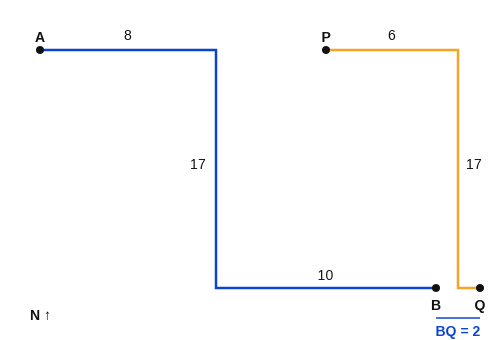
Ajit starts from point A and drives 8 km towards east. He then takes a right turn and drives 17 km. He takes a final left turn and drives 10 km and stops at point B. Vishal starts from point P, which is 13 km east of point A, and drives 6 km towards east. He then takes a right turn and drives 17 km. He takes a final left turn and drives 1 km and stops at point Q. What is the shortest distance between point Q and point B? (All turns are 90-degree turns only.)
अजीत बिंदु A से चलना शुरू करता है और पूर्व की ओर 8 km गाड़ी चलाता है। फिर वह दाएँ मुड़ता है और 17 km गाड़ी चलाता है। वह अंतिम बार बाएँ मुड़ता है और 10 km गाड़ी चलाकर बिंदु B पर रुक जाता है। विशाल बिंदु P से चलना शुरू करता है, जो बिंदु A से 13 km पूर्व में है, और पूर्व की ओर 6 km गाड़ी चलाता है। फिर वह दाएँ मुड़ता है और 17 km गाड़ी चलाता है। वह अंतिम बार बाएँ मुड़ता है और 1 km गाड़ी चलाकर बिंदु Q पर रुक जाता है। बिंदु Q और बिंदु B के बीच की न्यूनतम दूरी कितनी है? (सभी मोड़ केवल 90 डिग्री के मोड़ हैं।)
  1. A3 km
  2. B1 km
  3. C4 km
  4. D2 km
Show answer

Concept: Use coordinates with A at origin, east = +x, south = −y.

  1. Ajit: east 8 → (8, 0); right turn (south) 17 → (8, −17); left turn (east) 10 → B (18, −17).
  2. Vishal: P (13, 0); east 6 → (19, 0); south 17 → (19, −17); east 1 → Q (20, −17).
  3. B and Q lie on the same line: QB=20−18=2km.

Trick: Both went 17 km south, so only eastward totals matter: 8+10=18 vs 13+6+1=20.

Answer: (D) 2 km

अवधारणा: A को मूल बिंदु लें, पूर्व = +x, दक्षिण = −y।

  1. अजीत: पूर्व 8 → (8, 0); दाएँ (दक्षिण) 17 → (8, −17); बाएँ (पूर्व) 10 → B (18, −17)।
  2. विशाल: P (13, 0); पूर्व 6 → (19, 0); दक्षिण 17; पूर्व 1 → Q (20, −17)।
  3. QB=20−18=2km।

ट्रिक: दोनों 17 km दक्षिण गए, इसलिए केवल पूर्व की कुल दूरी देखें: 18 बनाम 20।

उत्तर: (D) 2 km

RRB NTPC Graduate CBT 2General Intelligence and ReasoningDirection & DistanceRRB NTPC Graduate CBT 2 2024 · 13 Oct Shift 2 →
Q11335.
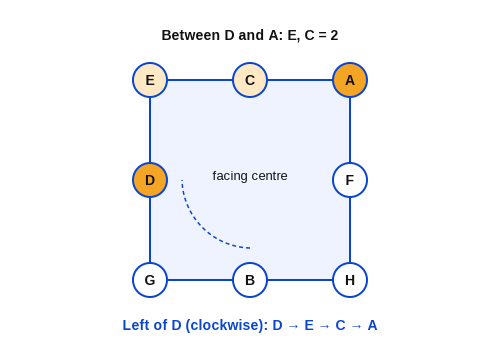
A, B, C, D, E, F, G and H are sitting around a square table facing the centre of the table. Some of them are sitting at the corners while some are sitting at the exact centre of the sides. E sits third to the left of B. E does not sit at the centre of any side. F sits second to the right of B. G is the immediate neighbour of D and B. H sits to the immediate left of F. C does not sit in a corner. How many people sit between D and A when counted from the left of D?
A, B, C, D, E, F, G और H एक वर्गाकार मेज़ के चारों ओर मेज़ के केंद्र की ओर मुख करके बैठे हैं। उनमें से कुछ कोनों पर बैठे हैं जबकि कुछ भुजाओं के ठीक मध्य में बैठे हैं। E, B के बाएँ से तीसरे स्थान पर बैठा है। E किसी भी भुजा के मध्य में नहीं बैठा है। F, B के दाएँ से दूसरे स्थान पर बैठा है। G, D और B दोनों का निकटतम पड़ोसी है। H, F के ठीक बाएँ बैठा है। C किसी कोने पर नहीं बैठा है। D के बाएँ से गिनने पर D और A के बीच कितने व्यक्ति बैठे हैं?
  1. AFourचार
  2. BOneएक
  3. CTwoदो
  4. DFiveपाँच
Show answer

Concept: Facing the centre, 'left' means clockwise. Corners and side-centres alternate.

  1. Fix B at a side-centre. E third to left of B (a corner ✓); F second to right of B; H immediately left of F, i.e. right neighbour of B.
  2. G is between D and B → G left of B, D next.
  3. Remaining two seats (between E and F): side-centre and corner. C is not at a corner → C beside E, A at the corner.
  4. From D going left: E, C, then A → two people between.

Trick: Draw 8 seats first and mark corners; place B, then fill using 'left = clockwise'.

Answer: (C) Two

अवधारणा: केंद्र की ओर मुख होने पर 'बाएँ' = दक्षिणावर्त (clockwise)। कोने और भुजा-मध्य बारी-बारी से।

  1. B को भुजा के मध्य रखें। E, B के बाएँ तीसरा (कोना ✓); F, B के दाएँ दूसरा; H, F के तुरंत बाएँ यानी B के दाएँ।
  2. G, D और B के बीच → G, B के बाएँ, फिर D।
  3. शेष दो सीटें (E और F के बीच): C कोने पर नहीं → C, E के बगल, A कोने पर।
  4. D के बाएँ से: E, C, फिर A → बीच में दो।

ट्रिक: पहले 8 सीटें और कोने बनाएँ; B रखें, फिर 'बाएँ = clockwise' से भरें।

उत्तर: (C) दो

RRB NTPC Graduate CBT 2General Intelligence and ReasoningSeating – Square TableRRB NTPC Graduate CBT 2 2024 · 13 Oct Shift 2 →
Q11336.
Select the triad that follows the same pattern as the one followed by the two triads given below. Both triads follow the same pattern.
KH-MI-NP
MJ-OK-PR
उस त्रिक का चयन कीजिए जो उसी पैटर्न का अनुसरण करता है जिसका अनुसरण नीचे दिए गए दो त्रिक करते हैं। दोनों त्रिक एक ही पैटर्न का अनुसरण करते हैं।
KH-MI-NP
MJ-OK-PR
  1. APL-QN-RV
  2. BOL-QM-RV
  3. COL-QM-RT
  4. DPL-QM-RV
Show answer

Concept: Track first letters and second letters across the three clusters separately.

  1. KH-MI-NP: first letters K→M→N (+2,+1); second letters H→I→P (+1,+7).
  2. MJ-OK-PR: M→O→P (+2,+1); J→K→R (+1,+7) ✓.
  3. OL-QM-RT: O→Q→R (+2,+1); L→M→T (+1,+7) ✓. (OL-QM-RV has M→V =+9.)

Trick: Two similar options differ only in the last letter – check just that jump.

Answer: (C) OL-QM-RT

अवधारणा: तीनों समूहों में पहले अक्षर और दूसरे अक्षर अलग-अलग देखें।

  1. KH-MI-NP: पहले अक्षर (+2,+1); दूसरे अक्षर (+1,+7)।
  2. MJ-OK-PR: (+2,+1) और (+1,+7) ✓।
  3. OL-QM-RT: O→Q→R (+2,+1); L→M→T (+1,+7) ✓।

ट्रिक: मिलते-जुलते विकल्प केवल अंतिम अक्षर में अलग हैं – वही जाँचें।

उत्तर: (C) OL-QM-RT

RRB NTPC Graduate CBT 2General Intelligence and ReasoningLetter Analogy (Triads)RRB NTPC Graduate CBT 2 2024 · 13 Oct Shift 2 →
Q11337.
In the following triads, each group of letters is related to the subsequent one following a certain logic. Select from the given options, the one which follows the same logic. CLAY - YLCA - LACY
BOWS - SOBW - OWBS
निम्नलिखित त्रिकों में, अक्षरों का प्रत्येक समूह एक निश्चित तर्क का अनुसरण करते हुए अगले समूह से संबंधित है। दिए गए विकल्पों में से उस विकल्प का चयन कीजिए जो उसी तर्क का अनुसरण करता है। CLAY - YLCA - LACY
BOWS - SOBW - OWBS
  1. ADENT - EDNT - TEND
  2. BFROM - MRFO - ROFM
  3. CFILE - EIFL - LIFE
  4. DGEAR - GAER - RAEG
Show answer

Concept: Number the letters 1-2-3-4 and track their positions.

  1. CLAY (1234) → YLCA = 4-2-1-3; YLCA → LACY = 2-4-3-1 of the second word.
  2. BOWS → SOBW (4-2-1-3) → OWBS (2-4-3-1) ✓.
  3. FROM → MRFO (4-2-1-3) → ROFM (2-4-3-1) ✓.

Trick: Check only the first step (4-2-1-3) on all options; usually only one survives.

Answer: (B) FROM - MRFO - ROFM

अवधारणा: अक्षरों को 1-2-3-4 क्रमांक देकर स्थान देखें।

  1. CLAY → YLCA = 4-2-1-3; YLCA → LACY = दूसरे शब्द का 2-4-3-1।
  2. BOWS → SOBW → OWBS ✓।
  3. FROM → MRFO (4-2-1-3) → ROFM (2-4-3-1) ✓।

ट्रिक: पहले चरण (4-2-1-3) से ही विकल्प जाँचें; प्रायः एक ही बचता है।

उत्तर: (B) FROM - MRFO - ROFM

RRB NTPC Graduate CBT 2General Intelligence and ReasoningLetter RearrangementRRB NTPC Graduate CBT 2 2024 · 13 Oct Shift 2 →
Q11338.
If ‘A’ stands for ‘+’, ‘B’ stands for ‘−’, ‘C’ stands for ‘×’ and ‘D’ stands for ‘÷‘, what will come in place of the question mark (?) in the following equation?
8 C 7 B 24 D 8 A 5 = ?
यदि 'A' का अर्थ '+', 'B' का अर्थ '−', 'C' का अर्थ '×' और 'D' का अर्थ '÷' है, तो निम्नलिखित समीकरण में प्रश्न चिह्न (?) के स्थान पर क्या आएगा?
8 C 7 B 24 D 8 A 5 = ?
  1. A56
  2. B57
  3. C59
  4. D58
Show answer

Concept: Replace letters by signs and apply BODMAS.

  1. 8×7−24÷8+5.
  2. =56−3+5.
  3. =58.

Trick: Do × and ÷ first, then + and − left to right.

Answer: (D) 58

अवधारणा: अक्षरों के स्थान पर चिह्न रखें और BODMAS लगाएँ।

  1. 8×7−24÷8+5।
  2. =56−3+5।
  3. =58।

ट्रिक: पहले ×, ÷, फिर +, −।

उत्तर: (D) 58

RRB NTPC Graduate CBT 2General Intelligence and ReasoningMathematical OperationsRRB NTPC Graduate CBT 2 2024 · 13 Oct Shift 2 →
Q11339.
Based on the English alphabetical order, three of the following four letter-clusters are alike in a certain way and thus form a group. Which letter-cluster DOES NOT belong to that group?
(Note: The odd one out is not based on the number of consonants/vowels or their position in the letter-cluster.)
अंग्रेज़ी वर्णमाला क्रम के आधार पर, निम्नलिखित चार अक्षर-समूहों में से तीन किसी निश्चित प्रकार से एकसमान हैं और इस प्रकार एक समूह बनाते हैं। कौन-सा अक्षर-समूह उस समूह से संबंधित नहीं है?
(ध्यान दें: असंगत अक्षर-समूह, उस अक्षर-समूह में व्यंजनों/स्वरों की संख्या या उनकी स्थिति पर आधारित नहीं है।)
  1. ALCT
  2. BIZQ
  3. CSAI
  4. DOFW
Show answer

Concept: Find the gap between consecutive letters (wrapping after Z).

  1. LCT: L→C +17 (12→29→3), C→T +17.
  2. IZQ: +17,+17; OFW: O→F +17, F→W +17.
  3. SAI: S→A +8, A→I +8 – different.

Trick: +17 forward is the same as −9 backward (L→C is 9 steps back).

Answer: (C) SAI

अवधारणा: क्रमागत अक्षरों का अंतर निकालें (Z के बाद A)।

  1. LCT: L→C +17, C→T +17।
  2. IZQ और OFW: +17,+17।
  3. SAI: +8,+8 – अलग।

ट्रिक: आगे +17 = पीछे −9 (L से C, 9 कदम पीछे)।

उत्तर: (C) SAI

RRB NTPC Graduate CBT 2General Intelligence and ReasoningOdd One Out (Letter Clusters)RRB NTPC Graduate CBT 2 2024 · 13 Oct Shift 2 →
Q11340.
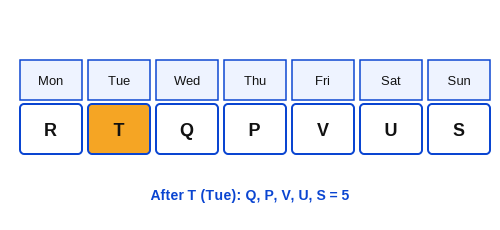
Each of P, Q, R, S, T, U and V has an exam on a different day of a week starting from Monday and ending on Sunday of the same week. U has an exam on Saturday. Only four people have an exam between T and S, neither of whom has an exam on Monday. V has an exam immediately after P and Q has an exam immediately before P. S has an exam after V. How many people have exams after T?
P, Q, R, S, T, U और V में से प्रत्येक की परीक्षा एक ही सप्ताह के सोमवार से शुरू होकर रविवार को समाप्त होने वाले सप्ताह के एक अलग दिन है। U की परीक्षा शनिवार को है। T और S के बीच केवल चार व्यक्तियों की परीक्षा है, जिनमें से किसी की भी परीक्षा सोमवार को नहीं है। V की परीक्षा P के ठीक बाद है और Q की परीक्षा P के ठीक पहले है। S की परीक्षा V के बाद है। T के बाद कितने व्यक्तियों की परीक्षाएँ हैं?
  1. A5
  2. B2
  3. C3
  4. D4
Show answer

Concept: Fix U, then try the possible places of T and S.

  1. U = Saturday. Four between T and S → (Mon, Sat) or (Tue, Sun); Sat is U, so T/S are Tue and Sun.
  2. Q, P, V are consecutive and S is after V → S cannot be Tue, so T = Tue, S = Sun.
  3. Q-P-V fit only on Wed-Thu-Fri; R = Mon.
  4. After T (Tue): Q, P, V, U, S = 5.

Trick: Check the case-breaking clue ('S after V') immediately after placing a pair.

Answer: (A) 5

अवधारणा: पहले U तय करें, फिर T और S के संभव स्थान देखें।

  1. U = शनिवार। T और S के बीच चार → (सोम, शनि) या (मंगल, रवि); शनि U का है, अतः मंगल और रवि।
  2. Q, P, V लगातार हैं और S, V के बाद → S मंगल नहीं, अतः T = मंगल, S = रवि।
  3. Q-P-V = बुध-गुरु-शुक्र; R = सोम।
  4. T के बाद: Q, P, V, U, S = 5।

ट्रिक: जोड़ी रखते ही निर्णायक संकेत ('S, V के बाद') जाँचें।

उत्तर: (A) 5

RRB NTPC Graduate CBT 2General Intelligence and ReasoningScheduling – DaysRRB NTPC Graduate CBT 2 2024 · 13 Oct Shift 2 →