Question bank

Q&A: practice questions with answers

Search questions on any topic. Filter by exam category, exam, subject and topic, try the question, then open the answer and explanation.

Courses – airGurukul

20,719 questions found.

Q11441.
If x varies inversely as y3−1 and x is equal to 6 when y=4, find the value of x when y=8.
यदि x, y3−1 के व्युत्क्रमानुपाती है और x का मान 6 है जब y=4 है, तो x का मान ज्ञात कीजिए जब y=8 है।
  1. A143141
  2. B147115
  3. C8398
  4. D5473
Show answer

Concept: If x varies inversely as (y3−1), then x(y3−1)=k (constant).

  1. At y=4: y3−1=63 → k=6×63=378.
  2. At y=8: y3−1=511.
  3. x=378511=5473 (divide by 7).

Trick: 378=7×54 and 511=7×73.

Answer: (D) 5473

अवधारणा: यदि x, (y3−1) के व्युत्क्रमानुपाती है, तो x(y3−1)=k (स्थिरांक)।

  1. y=4 पर: y3−1=63 → k=6×63=378।
  2. y=8 पर: y3−1=511।
  3. x=378511=5473 (7 से भाग)।

ट्रिक: 378=7×54 और 511=7×73।

उत्तर: (D) 5473

RRB NTPC Graduate CBT 2MathematicsVariationRRB NTPC Graduate CBT 2 2024 · 13 Oct Shift 1 →
Q11442.
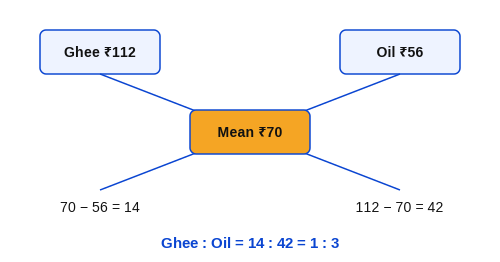
Pure ghee costs ₹112/kg. After adulterating it with vegetable oil costing ₹56/kg, a dishonest shopkeeper sells the mixture at the rate of ₹91/kg, thereby making a profit of 30%. In what ratio does he mix the two?
शुद्ध घी का मूल्य ₹112/kg है। इसमें ₹56/kg मूल्य वाला वनस्पति तेल मिलाकर, एक बेईमान दुकानदार मिश्रण को ₹91/kg की दर से बेचता है, और इस प्रकार 30% लाभ कमाता है। वह दोनों को किस अनुपात में मिलाता है?
  1. A2 : 3
  2. B6 : 5
  3. C3 : 5
  4. D1 : 3
Show answer

Concept: Find the cost price of the mixture from the selling price and profit, then use alligation.

  1. CP of mixture =911.30=70 per kg.
  2. Ghee: 70−56=14; Oil: 112−70=42.
  3. Ghee : Oil =14:42=1:3.

Trick: Alligation always uses the mean cost price, never the selling price.

Answer: (D) 1 : 3

अवधारणा: विक्रय मूल्य और लाभ से मिश्रण का क्रय मूल्य निकालें, फिर एलिगेशन लगाएँ।

  1. मिश्रण का CP =911.30=70 प्रति kg।
  2. घी: 70−56=14; तेल: 112−70=42।
  3. घी : तेल =14:42=1:3।

ट्रिक: एलिगेशन में हमेशा औसत क्रय मूल्य लें, विक्रय मूल्य नहीं।

उत्तर: (D) 1 : 3

RRB NTPC Graduate CBT 2MathematicsMixture and AlligationRRB NTPC Graduate CBT 2 2024 · 13 Oct Shift 1 →
Q11443.
A machine depreciates at a rate of 10% per annum. If the current value of the machine is ₹1,00,000, what will be its value after 2 years?
एक मशीन का मूल्य 10% प्रति वर्ष की दर से घटता है। यदि मशीन का वर्तमान मूल्य ₹1,00,000 है, तो 2 वर्ष बाद इसका मूल्य क्या होगा?
  1. A₹79,000
  2. B₹81,000
  3. C₹78,000
  4. D₹80,000
Show answer

Concept: Value after n years =P(1−r100)n.

  1. P=100000, r=10, n=2.
  2. Value =100000×0.9×0.9=100000×0.81.
  3. =81000.

Trick: Two successive 10% falls = 19% fall (10+10−1).

Answer: (B) ₹81,000

अवधारणा: n वर्ष बाद मूल्य =P(1−r100)n।

  1. P=100000, r=10, n=2।
  2. मूल्य =100000×0.9×0.9=100000×0.81।
  3. =81000।

ट्रिक: दो बार 10% कमी = 19% कमी (10+10−1)।

उत्तर: (B) ₹81,000

RRB NTPC Graduate CBT 2MathematicsDepreciationRRB NTPC Graduate CBT 2 2024 · 13 Oct Shift 1 →
Q11444.
Which of the following numbers is divisible by 39?
निम्नलिखित में से कौन-सी संख्या 39 से विभाज्य है?
  1. A625649
  2. B622710
  3. C622776
  4. D625092
Show answer

Concept: 39=3×13, so the number must be divisible by both 3 and 13.

  1. 625092: digit sum =6+2+5+0+9+2=24 → divisible by 3.
  2. 625092÷13=48084 exactly (13×48084=625092) → divisible by 13.
  3. Hence divisible by 39: 625092=39×16028. Others fail (e.g. 625649 has digit sum 32, not divisible by 3).

Trick: Use the digit-sum test for 3 to cut options quickly, then divide only the survivors by 13.

Answer: (D) 625092

अवधारणा: 39=3×13, अतः संख्या 3 और 13 दोनों से विभाज्य होनी चाहिए।

  1. 625092: अंकों का योग =6+2+5+0+9+2=24 → 3 से विभाज्य।
  2. 625092÷13=48084 पूर्णतः (13×48084=625092) → 13 से विभाज्य।
  3. अतः 39 से विभाज्य: 625092=39×16028। अन्य विफल (जैसे 625649 का अंक-योग 32, 3 से विभाज्य नहीं)।

ट्रिक: पहले 3 के अंक-योग नियम से विकल्प छाँटें, फिर बचे हुओं को 13 से भाग दें।

उत्तर: (D) 625092

RRB NTPC Graduate CBT 2MathematicsDivisibilityRRB NTPC Graduate CBT 2 2024 · 13 Oct Shift 1 →
Q11445.
If the ratio of two numbers is 5 : 4 and their HCF is 5, find their LCM.
यदि दो संख्याओं का अनुपात 5 : 4 है और उनका HCF 5 है, तो उनका LCM ज्ञात कीजिए।
  1. A90
  2. B128
  3. C100
  4. D124
Show answer

Concept: If two numbers are in ratio a:b (co-prime) with HCF h, the numbers are ha and hb, and LCM =h×a×b.

  1. Numbers =5×5=25 and 5×4=20.
  2. LCM =5×5×4=100.
  3. Check: HCF×LCM=5×100=500=25×20 ✓.

Trick: LCM = HCF × product of ratio terms.

Answer: (C) 100

अवधारणा: यदि दो संख्याएँ a:b (सह-अभाज्य) अनुपात में हों और HCF h हो, तो संख्याएँ ha, hb और LCM =h×a×b।

  1. संख्याएँ =5×5=25 और 5×4=20।
  2. LCM =5×5×4=100।
  3. जाँच: HCF×LCM=5×100=500=25×20 ✓।

ट्रिक: LCM = HCF × अनुपात के पदों का गुणनफल।

उत्तर: (C) 100

RRB NTPC Graduate CBT 2MathematicsHCF and LCMRRB NTPC Graduate CBT 2 2024 · 13 Oct Shift 1 →
Q11446.
A man covers equal distances at the speeds of 19 km/hr, 8 km/hr and 5 km/hr. His average speed for the entire journey is:
एक व्यक्ति समान दूरियाँ 19 km/hr, 8 km/hr और 5 km/hr की चाल से तय करता है। पूरी यात्रा के लिए उसकी औसत चाल है:
  1. A13271287 km/hr
  2. B3271287 km/hr
  3. C7271287 km/hr
  4. D5271287 km/hr
Show answer

Concept: For equal distances at speeds a,b,c: average speed =31a+1b+1c (harmonic mean).

  1. 119+18+15=40+95+152760=287760.
  2. Average =3×760287=2280287.
  3. 2280=7×287+271 → 7271287km/h.

Trick: Average speed must lie between 5 and 19 and below the plain average 10.67 → only 7.9 fits.

Answer: (C) 7271287km/h

अवधारणा: समान दूरियाँ a,b,c चालों से: औसत चाल =31a+1b+1c (हरात्मक माध्य)।

  1. 119+18+15=40+95+152760=287760।
  2. औसत =3×760287=2280287।
  3. 2280=7×287+271 → 7271287km/h।

ट्रिक: औसत चाल 5 और 19 के बीच तथा साधारण औसत 10.67 से कम होगी → केवल 7.9 सही।

उत्तर: (C) 7271287km/h

RRB NTPC Graduate CBT 2MathematicsAverage SpeedRRB NTPC Graduate CBT 2 2024 · 13 Oct Shift 1 →
Q11447.
Three bells ring at intervals of 12, 15 and 18 minutes. If they rang together at 10:00 am, when will they ring together again?
तीन घंटियाँ 12, 15 और 18 मिनट के अंतराल पर बजती हैं। यदि वे पूर्वाह्न 10:00 बजे एक साथ बजी थीं, तो वे फिर से एक साथ कब बजेंगी?
  1. A4:00 p.m.4:00 अपराह्न
  2. B12: 00 p.m.12: 00 अपराह्न
  3. C1:00 p.m.1:00 अपराह्न
  4. D2:00 p.m.2:00 अपराह्न
Show answer

Concept: Bells ring together again after the LCM of their intervals.

  1. 12=22×3, 15=3×5, 18=2×32.
  2. LCM =22×32×5=180 minutes =3 hours.
  3. 10:00 am +3 h = 1:00 pm.

Trick: LCM in minutes ÷ 60 gives the hours to add.

Answer: (C) 1:00 p.m.

अवधारणा: घंटियाँ अपने अंतरालों के LCM के बाद फिर साथ बजती हैं।

  1. 12=22×3, 15=3×5, 18=2×32।
  2. LCM =22×32×5=180 मिनट =3 घंटे।
  3. सुबह 10:00 +3 घंटे = दोपहर 1:00।

ट्रिक: मिनट में LCM ÷ 60 = जोड़ने वाले घंटे।

उत्तर: (C) 1:00 p.m.

RRB NTPC Graduate CBT 2MathematicsLCM ApplicationRRB NTPC Graduate CBT 2 2024 · 13 Oct Shift 1 →
Q11448.
Find the simplified value of 7−8×11−8×13−8.
7−8×11−8×13−8 का सरलीकृत मान ज्ञात कीजिए।
  1. A19628
  2. B110018
  3. C19958
  4. D110258
Show answer

Concept: am×bm=(ab)m and a−m=1am.

  1. 7−8×11−8×13−8=(7×11×13)−8.
  2. 7×11×13=1001.
  3. So the value =1001−8=110018.

Trick: 7×11×13=1001 – a number worth remembering.

Answer: (B) 110018

अवधारणा: am×bm=(ab)m और a−m=1am।

  1. 7−8×11−8×13−8=(7×11×13)−8।
  2. 7×11×13=1001।
  3. अतः मान =1001−8=110018।

ट्रिक: 7×11×13=1001 – याद रखने योग्य संख्या।

उत्तर: (B) 110018

RRB NTPC Graduate CBT 2MathematicsLaws of ExponentsRRB NTPC Graduate CBT 2 2024 · 13 Oct Shift 1 →
Q11449.
The simple interest (in ₹) on ₹5,000 at 5% per annum for 2 years is:
₹5,000 पर 5% वार्षिक दर से 2 वर्ष का साधारण ब्याज (₹ में) है:
  1. A530
  2. B500
  3. C600
  4. D580
Show answer

Concept: SI=P×R×T100.

  1. P=5000, R=5, T=2.
  2. SI=5000×5×2100=500.

Trick: 5% for 2 years = 10% of 5000 = 500.

Answer: (B) 500

अवधारणा: SI=P×R×T100।

  1. P=5000, R=5, T=2।
  2. SI=5000×5×2100=500।

ट्रिक: 2 वर्ष के लिए 5% = 5000 का 10% = 500।

उत्तर: (B) 500

RRB NTPC Graduate CBT 2MathematicsSimple InterestRRB NTPC Graduate CBT 2 2024 · 13 Oct Shift 1 →
Q11450.
The price of fuel decreases by 10%, 45% and 10% in three successive months, but increases by 65% in the fourth month. What is the percentage increase/decrease in the price of fuel in the fourth month as compared to its original price? (Round off the answer to two decimal places.)
ईंधन के मूल्य में लगातार तीन महीनों में 10%, 45% और 10% की कमी होती है, लेकिन चौथे महीने में 65% की वृद्धि होती है। चौथे महीने में ईंधन का मूल्य उसके मूल मूल्य की तुलना में कितने प्रतिशत बढ़ा/घटा है? (उत्तर को दो दशमलव स्थानों तक पूर्णांकित कीजिए।)
  1. ADecreases by 26.49%26.49% घटता है
  2. BDecreases by 30.57%30.57% घटता है
  3. CIncreases by 21.55%21.55% बढ़ता है
  4. DIncreases by 25.16%25.16% बढ़ता है
Show answer

Concept: Successive changes multiply: final =original×(1±r1100)×(1±r2100)⋯

  1. Take original price =100.
  2. 100×0.90×0.55×0.90=44.55.
  3. 44.55×1.65=73.5075.
  4. Change =73.5075−100=−26.4925 → decrease of about 26.49%.

Trick: Multiply the easy pair first: 0.9×0.9=0.81, then ×0.55×1.65.

Answer: (A) Decreases by 26.49%

अवधारणा: क्रमिक परिवर्तन गुणा होते हैं: अंतिम =मूल×(1±r1100)×(1±r2100)⋯

  1. मूल मूल्य =100 लें।
  2. 100×0.90×0.55×0.90=44.55।
  3. 44.55×1.65=73.5075।
  4. परिवर्तन =73.5075−100=−26.4925 → लगभग 26.49% कमी।

ट्रिक: पहले आसान जोड़ी: 0.9×0.9=0.81, फिर ×0.55×1.65।

उत्तर: (A) 26.49% की कमी

RRB NTPC Graduate CBT 2MathematicsSuccessive Percentage ChangeRRB NTPC Graduate CBT 2 2024 · 13 Oct Shift 1 →
Q11451.
A question is followed by two statements numbered (I) and (II). You have to decide whether the data provided in the statements are sufficient to answer the question. Read both the statements and decide the appropriate answer.
What is Rahul's age(in years)?
Statements:
I. Rahul was born when his father was 33 years old.
II. Rahul is 29 years younger than his mother.
प्रश्न के बाद दो कथन (I) और (II) दिए गए हैं। आपको यह तय करना है कि कथनों में दिए गए आँकड़े प्रश्न का उत्तर देने के लिए पर्याप्त हैं या नहीं। दोनों कथनों को पढ़िए और उचित उत्तर चुनिए।
राहुल की आयु (वर्षों में) क्या है?
कथन:
I. राहुल का जन्म तब हुआ जब उसके पिता 33 वर्ष के थे।
II. राहुल अपनी माँ से 29 वर्ष छोटा है।
  1. AData in Statement II alone is sufficient to answer the question while data in statement I is notप्रश्न का उत्तर देने के लिए अकेले कथन II के आँकड़े पर्याप्त हैं, जबकि कथन I के आँकड़े पर्याप्त नहीं हैं
  2. BBoth statements I and II together are NOT sufficient to answer the questionकथन I और II दोनों मिलकर भी प्रश्न का उत्तर देने के लिए पर्याप्त नहीं हैं
  3. CBoth statements I and II together (and not statement I alone or statement II alone) are sufficient to answer the question.कथन I और II दोनों मिलकर (न कि अकेले कथन I या अकेले कथन II) प्रश्न का उत्तर देने के लिए पर्याप्त हैं।
  4. DData in statement I alone is sufficient to answer the question while data in statement II is notप्रश्न का उत्तर देने के लिए अकेले कथन I के आँकड़े पर्याप्त हैं, जबकि कथन II के आँकड़े पर्याप्त नहीं हैं
Show answer

Concept: To find an age we need at least one actual value (present age of someone, or a year), not just age differences.

  1. Statement I gives only the father's age at Rahul's birth (a difference of 33 years).
  2. Statement II gives only a difference of 29 years with the mother.
  3. Together we know two differences but no actual age of anyone, so Rahul's age cannot be found.

Trick: Only differences (no absolute age/year) → never sufficient.

Answer: (B) Both statements I and II together are NOT sufficient

अवधारणा: आयु ज्ञात करने के लिए किसी की वास्तविक आयु या वर्ष चाहिए; केवल अंतर से काम नहीं चलता।

  1. कथन I केवल बताता है कि जन्म के समय पिता 33 वर्ष के थे (अंतर)।
  2. कथन II केवल माँ से 29 वर्ष का अंतर बताता है।
  3. दोनों मिलाकर भी किसी की वास्तविक आयु नहीं मिलती, अतः राहुल की आयु ज्ञात नहीं।

ट्रिक: सिर्फ़ अंतर दिए हों, कोई वास्तविक आयु नहीं → पर्याप्त नहीं।

उत्तर: (B) कथन I और II दोनों मिलकर भी पर्याप्त नहीं

RRB NTPC Graduate CBT 2General Intelligence and ReasoningData sufficiency – ageRRB NTPC Graduate CBT 2 2024 · 13 Oct Shift 1 →
Q11452.
Based on the English alphabetical order, three of the following four letter-cluster pairs are alike in a certain way and thus form a group. Which letter-cluster pair DOES NOT belong to that group?
(Note: The odd one out is not based on the number of consonants/vowels or their position in the letter-cluster.)
अंग्रेज़ी वर्णमाला क्रम के आधार पर, निम्नलिखित चार अक्षर-समूह युग्मों में से तीन किसी निश्चित प्रकार से एक समान हैं और इस प्रकार एक समूह बनाते हैं। कौन-सा अक्षर-समूह युग्म उस समूह से संबंधित नहीं है?
(नोट: असंगत को व्यंजनों/स्वरों की संख्या या अक्षर-समूह में उनके स्थान के आधार पर नहीं चुना गया है।)
  1. ARX – MS
  2. BNR – GL
  3. CMF – HA
  4. DIO – DJ
Show answer

Concept: Compare the shift from the first cluster to the second cluster letter by letter.

  1. RX – MS: R→M=−5, X→S=−5
  2. MF – HA: −5,−5; IO – DJ: −5,−5
  3. NR – GL: N→G=−7, R→L=−6 → different

Trick: Write positions: R18→M13, X24→S19; the odd pair breaks the uniform −5.

Answer: (B) NR – GL

अवधारणा: पहले क्लस्टर से दूसरे क्लस्टर में प्रत्येक अक्षर का अंतर देखें।

  1. RX – MS: R→M=−5, X→S=−5
  2. MF – HA: −5,−5; IO – DJ: −5,−5
  3. NR – GL: N→G=−7, R→L=−6 → भिन्न

ट्रिक: स्थान लिखें: R18→M13, X24→S19; जो −5 नियम तोड़े वही विषम।

उत्तर: (B) NR – GL

RRB NTPC Graduate CBT 2General Intelligence and ReasoningOdd one out – letter pairsRRB NTPC Graduate CBT 2 2024 · 13 Oct Shift 1 →
Q11453.
In a certain code, ‘food is tasty’ is coded as ‘gm rt pj’, ‘snack is good’ is coded as ‘xl rt bn’, and ‘tasty good meal’ is coded as ‘pj bn dv’. What is the code for ‘meal’ in that code? (All codes are two-letter codes.)
एक निश्चित कूट में, ‘food is tasty’ को ‘gm rt pj’ लिखा जाता है, ‘snack is good’ को ‘xl rt bn’ लिखा जाता है, और ‘tasty good meal’ को ‘pj bn dv’ लिखा जाता है। उस कूट में ‘meal’ के लिए कूट क्या है? (सभी कूट दो-अक्षरीय कूट हैं।)
  1. Abn
  2. Bdv
  3. Crt
  4. Dpj
Show answer

Concept: A word common to two sentences gets the code common to both.

  1. 'is' in sentences 1 & 2 → common code rt, so is = rt.
  2. 'tasty' in 1 & 3 → common code pj; 'good' in 2 & 3 → common code bn.
  3. Sentence 3: tasty good meal = pj bn dv → meal = dv.

Trick: Strike out codes already decoded in the third sentence; the leftover is the answer.

Answer: (B) dv

अवधारणा: दो वाक्यों में साझा शब्द का कोड भी दोनों में साझा होता है।

  1. 'is' वाक्य 1 और 2 में → साझा कोड rt।
  2. 'tasty' वाक्य 1 और 3 में → pj; 'good' वाक्य 2 और 3 में → bn।
  3. वाक्य 3: tasty good meal = pj bn dv → meal = dv।

ट्रिक: तीसरे वाक्य से ज्ञात कोड हटाइए; बचा कोड ही उत्तर।

उत्तर: (B) dv

RRB NTPC Graduate CBT 2General Intelligence and ReasoningCoding–decoding (word codes)RRB NTPC Graduate CBT 2 2024 · 13 Oct Shift 1 →
Q11454.
Based on the English alphabetical order, three of the following four letter-clusters are alike in a certain way and thus form a group. Which letter-cluster DOES NOT belong to that group?
​
(Note: The odd one out is not based on the number of consonants/vowels or their position in the letter-cluster.)
अंग्रेज़ी वर्णमाला क्रम के आधार पर, निम्नलिखित चार अक्षर-समूहों में से तीन किसी निश्चित प्रकार से एक समान हैं और इस प्रकार एक समूह बनाते हैं। कौन-सा अक्षर-समूह उस समूह से संबंधित नहीं है?
​
(नोट: असंगत को व्यंजनों/स्वरों की संख्या या अक्षर-समूह में उनके स्थान के आधार पर नहीं चुना गया है।)
  1. ANSS
  2. BLPQ
  3. CXBC
  4. DSWX
Show answer

Concept: Check the gaps between consecutive letters of each cluster.

  1. LPQ: L→P=+4, P→Q=+1
  2. XBC: X→B=+4 (cyclic), B→C=+1; SWX: +4,+1
  3. NSS: N→S=+5, S→S=0 → odd

Trick: Pattern +4,+1: last two letters are consecutive in three clusters; NSS has a repeated letter.

Answer: (A) NSS

अवधारणा: प्रत्येक समूह के क्रमागत अक्षरों का अंतर देखें।

  1. LPQ: L→P=+4, P→Q=+1
  2. XBC: X→B=+4 (चक्रीय), B→C=+1; SWX: +4,+1
  3. NSS: N→S=+5, S→S=0 → विषम

ट्रिक: नियम +4,+1: तीन समूहों में अंतिम दो अक्षर क्रमागत हैं; NSS में अक्षर दोहराया गया है।

उत्तर: (A) NSS

RRB NTPC Graduate CBT 2General Intelligence and ReasoningOdd one out – letter clustersRRB NTPC Graduate CBT 2 2024 · 13 Oct Shift 1 →
Q11455.
Read the given statements and conclusions carefully. Assuming that the information given in the statements is true, even if it appears to be at variance with commonly known facts, decide which of the given conclusions logically follow(s) from the statements.
Statements:
Some calculators are stones.
All calculators are pens.
No calculator is an octopus.
Conclusions:
(I): No octopus is a stone.
(II): Some pens are octopuses.
दिए गए कथनों और निष्कर्षों को ध्यानपूर्वक पढ़िए। यह मानते हुए कि कथनों में दी गई जानकारी सत्य है, भले ही वह सामान्यतः ज्ञात तथ्यों से भिन्न प्रतीत होती हो, निर्णय कीजिए कि दिए गए निष्कर्षों में से कौन-सा/से निष्कर्ष कथनों का तार्किक रूप से अनुसरण करता है/करते हैं।
कथन:
कुछ कैलकुलेटर, पत्थर हैं।
सभी कैलकुलेटर, पेन हैं।
कोई कैलकुलेटर, ऑक्टोपस नहीं है।
निष्कर्ष:
(I): कोई ऑक्टोपस, पत्थर नहीं है।
(II): कुछ पेन, ऑक्टोपस हैं।
  1. ANeither conclusion (I) nor (II) followsन तो निष्कर्ष (I) और न ही (II) अनुसरण करता है
  2. BOnly conclusion (I) followsकेवल निष्कर्ष (I) अनुसरण करता है
  3. COnly conclusion (II) followsकेवल निष्कर्ष (II) अनुसरण करता है
  4. DBoth conclusions (I) and (II) followनिष्कर्ष (I) और (II) दोनों अनुसरण करते हैं
Show answer

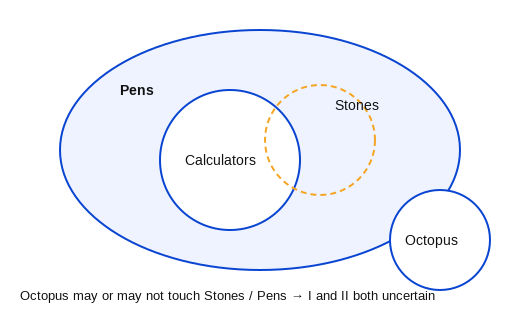
Concept: Draw the least-overlap Venn diagram; a conclusion follows only if it is true in every possible diagram.

  1. All calculators are inside Pens; some calculators overlap Stones.
  2. Octopus is outside Calculators, but it may or may not overlap Stones or Pens.
  3. I ('No octopus is a stone') and II ('Some pens are octopuses') are only possibilities, not certain.

Trick: 'No A is B' with no direct link between Octopus and Stones/Pens → neither definite.

Answer: (A) Neither conclusion (I) nor (II) follows

अवधारणा: न्यूनतम-ओवरलैप वाला वेन आरेख बनाइए; निष्कर्ष तभी सही जब हर संभव आरेख में सत्य हो।

  1. सभी calculators, Pens के अंदर; कुछ calculators, Stones से ओवरलैप।
  2. Octopus, Calculators से बाहर है, पर Stones या Pens से मिल भी सकता है, नहीं भी।
  3. I ('कोई octopus stone नहीं') और II ('कुछ pens octopus हैं') केवल संभावनाएँ हैं, निश्चित नहीं।

ट्रिक: Octopus और Stones/Pens के बीच सीधा संबंध नहीं → कोई निष्कर्ष निश्चित नहीं।

उत्तर: (A) न तो (I) और न ही (II) अनुसरण करता है

RRB NTPC Graduate CBT 2General Intelligence and ReasoningSyllogismRRB NTPC Graduate CBT 2 2024 · 13 Oct Shift 1 →
Q11456.
What will come in the place of the question mark (?) in the following equation, if ‘+’ and ‘−’ are interchanged and ‘×’ and ‘÷’ are interchanged?
26 + 8 × 4 − 10 ÷ 5 = ?
यदि ‘+’ और ‘−’ को आपस में बदल दिया जाए तथा ‘×’ और ‘÷’ को आपस में बदल दिया जाए, तो निम्नलिखित समीकरण में प्रश्न चिह्न (?) के स्थान पर क्या आएगा?
26 + 8 × 4 − 10 ÷ 5 = ?
  1. A75
  2. B73
  3. C77
  4. D74
Show answer

Concept: Swap the signs first, then solve using BODMAS.

  1. After swapping: 26−8÷4+10×5
  2. 8÷4=2, 10×5=50
  3. 26−2+50=74

Trick: Rewrite the whole expression with new signs before any calculation – avoids half-swapped errors.

Answer: (D) 74

अवधारणा: पहले चिह्न बदलें, फिर BODMAS से हल करें।

  1. बदलने के बाद: 26−8÷4+10×5
  2. 8÷4=2, 10×5=50
  3. 26−2+50=74

ट्रिक: गणना से पहले पूरा व्यंजक नए चिह्नों के साथ दोबारा लिखें।

उत्तर: (D) 74

RRB NTPC Graduate CBT 2General Intelligence and ReasoningMathematical operations – interchangeRRB NTPC Graduate CBT 2 2024 · 13 Oct Shift 1 →
Q11457.
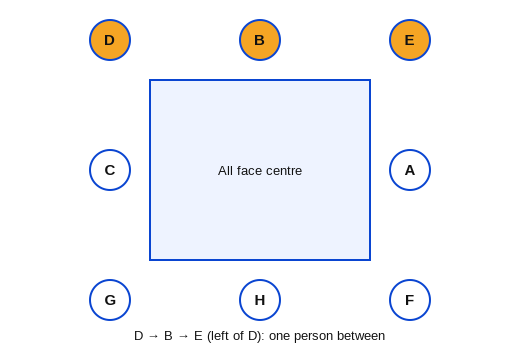
A, B, C, D, E, F, G and H are sitting around a square table facing the centre of the table. Some of them are sitting at the corners while some are sitting at the exact centre of the sides. F sits second to the right of G. F sits at one of the corners. Only three people sit between G and E when counted from the left of G. H sits third to the left of E. Only three people sit between H and B when counted from the left of H. C sits second to the right of B. D is not an immediate neighbour of E. How many people sit between E and D, when counted from the left of D?
A, B, C, D, E, F, G और H एक वर्गाकार मेज़ के चारों ओर मेज़ के केंद्र की ओर मुख करके बैठे हैं। उनमें से कुछ कोनों पर बैठे हैं, जबकि कुछ भुजाओं के ठीक मध्य में बैठे हैं। F, G के दाईं ओर दूसरे स्थान पर बैठा है। F एक कोने पर बैठा है। G के बाईं ओर से गिनने पर G और E के बीच केवल तीन व्यक्ति बैठे हैं। H, E के बाईं ओर तीसरे स्थान पर बैठा है। H के बाईं ओर से गिनने पर H और B के बीच केवल तीन व्यक्ति बैठे हैं। C, B के दाईं ओर दूसरे स्थान पर बैठा है। D, E का निकटतम पड़ोसी नहीं है। D के बाईं ओर से गिनने पर E और D के बीच कितने व्यक्ति बैठे हैं?
  1. ANoneकोई नहीं
  2. BOneएक
  3. CTwoदो
  4. DMore than twoदो से अधिक
Show answer

Concept: All face the centre, so 'left' means clockwise and 'right' means anticlockwise (seen from above).

  1. Place G at a corner (F, second to G's right, must be a corner); F is two seats anticlockwise.
  2. E is 4th to G's left (three between); H is third to the left of E, i.e. just right of G.
  3. B is 4th to H's left; C is second to B's right; remaining seats go to D and A – D not next to E, so D sits between C and B.
  4. Going left (clockwise) from D: D → B → E, so one person (B) sits between.

Trick: In a facing-centre circle/square, left = clockwise; count seats, not people.

Answer: (B) One

अवधारणा: सभी केंद्र की ओर देख रहे हैं, अतः ऊपर से देखने पर 'बाएँ' = दक्षिणावर्त, 'दाएँ' = वामावर्त।

  1. G को कोने पर रखें (G के दूसरे दाएँ F कोने पर है); F, G से दो स्थान वामावर्त।
  2. E, G के बाएँ चौथे स्थान पर (बीच में तीन); H, E के तीसरे बाएँ, अर्थात G के ठीक दाएँ।
  3. B, H के बाएँ चौथे स्थान पर; C, B के दूसरे दाएँ; शेष स्थान D और A – D, E का पड़ोसी नहीं, अतः D, C और B के बीच।
  4. D से बाएँ (दक्षिणावर्त) गिनें: D → B → E, बीच में एक व्यक्ति (B)।

ट्रिक: केंद्र की ओर मुख हो तो बायाँ = दक्षिणावर्त; स्थान गिनें, सावधानी से।

उत्तर: (B) एक

RRB NTPC Graduate CBT 2General Intelligence and ReasoningSeating arrangement – square tableRRB NTPC Graduate CBT 2 2024 · 13 Oct Shift 1 →
Q11458.
In the following series, only one letter-cluster is incorrect. Select the INCORRECT letter- cluster.
HQK KNN NKQ QHS TEW WBZ
निम्नलिखित शृंखला में केवल एक अक्षर-समूह गलत है। गलत अक्षर-समूह का चयन कीजिए।
HQK KNN NKQ QHS TEW WBZ
  1. ANKQ
  2. BTEW
  3. CQHS
  4. DWBZ
Show answer

Concept: Track each letter position of the clusters separately.

  1. 1st letters: H, K, N, Q, T, W → +3 each.
  2. 2nd letters: Q, N, K, H, E, B → −3 each.
  3. 3rd letters: K, N, Q, T, W, Z → +3 each; so 4th term should be QHT, not QHS.

Trick: Write position numbers under the third letters: 11, 14, 17, 19, 23, 26 – the break is obvious.

Answer: (C) QHS

अवधारणा: प्रत्येक स्थान के अक्षरों को अलग-अलग देखें।

  1. पहले अक्षर: H, K, N, Q, T, W → +3।
  2. दूसरे अक्षर: Q, N, K, H, E, B → −3।
  3. तीसरे अक्षर: K, N, Q, T, W, Z → +3; अतः चौथा पद QHT होना चाहिए, QHS नहीं।

ट्रिक: तीसरे अक्षरों के क्रमांक: 11, 14, 17, 19, 23, 26 – गड़बड़ी तुरंत दिखती है।

उत्तर: (C) QHS

RRB NTPC Graduate CBT 2General Intelligence and ReasoningLetter series – wrong termRRB NTPC Graduate CBT 2 2024 · 13 Oct Shift 1 →
Q11459.
What should come in place of the question mark (?) in the given series?
7, 25, 61, 115, 187 , ?
दी गई शृंखला में प्रश्न चिह्न (?) के स्थान पर क्या आना चाहिए?
7, 25, 61, 115, 187 , ?
  1. A278
  2. B277
  3. C276
  4. D275
Show answer

Concept: Find the differences between consecutive terms.

  1. Differences: 18,36,54,72 → multiples of 18.
  2. Next difference =90
  3. 187+90=277

Trick: Differences 18×1,18×2,… → arithmetic progression of second order.

Answer: (B) 277

अवधारणा: क्रमागत पदों के अंतर निकालें।

  1. अंतर: 18,36,54,72 → 18 के गुणज।
  2. अगला अंतर =90
  3. 187+90=277

ट्रिक: अंतर 18×1,18×2,… → द्वितीय कोटि की समांतर श्रेणी।

उत्तर: (B) 277

RRB NTPC Graduate CBT 2General Intelligence and ReasoningNumber seriesRRB NTPC Graduate CBT 2 2024 · 13 Oct Shift 1 →
Q11460.
MOST is related to EFKK in a certain way based on the English alphabetical order. In the same way, GEMJ is related to YVEA. To which of the given options is IDOI related, following the same logic?
अंग्रेज़ी वर्णमाला क्रम के आधार पर MOST एक निश्चित प्रकार से EFKK से संबंधित है। उसी प्रकार, GEMJ, YVEA से संबंधित है। समान तर्क का अनुसरण करते हुए, IDOI दिए गए विकल्पों में से किससे संबंधित है?
  1. AAUZG
  2. BAGUZ
  3. CAUGZ
  4. DAGZU
Show answer

Concept: Find the shift for each letter position (cyclic A–Z).

  1. MOST → EFKK: M→E=−8, O→F=−9, S→K=−8, T→K=−9
  2. Check GEMJ → YVEA: −8,−9,−8,−9 ✓
  3. IDOI: I−8=A, D−9=U, O−8=G, I−9=Z → AUGZ

Trick: Alternate −8,−9; going below A wraps to Z (e.g. D(4)−9=−5→21=U).

Answer: (C) AUGZ

अवधारणा: प्रत्येक स्थान का विस्थापन ज्ञात करें (A–Z चक्रीय)।

  1. MOST → EFKK: M→E=−8, O→F=−9, S→K=−8, T→K=−9
  2. जाँच GEMJ → YVEA: −8,−9,−8,−9 ✓
  3. IDOI: I−8=A, D−9=U, O−8=G, I−9=Z → AUGZ

ट्रिक: बारी-बारी −8,−9; A से नीचे जाने पर Z पर लौटें (D(4)−9=−5→21=U)।

उत्तर: (C) AUGZ

RRB NTPC Graduate CBT 2General Intelligence and ReasoningAnalogy – letter shiftsRRB NTPC Graduate CBT 2 2024 · 13 Oct Shift 1 →