Question bank

Q&A: practice questions with answers

Search questions on any topic. Filter by exam category, exam, subject and topic, try the question, then open the answer and explanation.

Courses – airGurukul

20,719 questions found.

Q11461.
What should come in place of the question mark (?) in the given series?
2 12 60 240 ? 1440
दी गई शृंखला में प्रश्न चिह्न (?) के स्थान पर क्या आना चाहिए?
2 12 60 240 ? 1440
  1. A760
  2. B720
  3. C660
  4. D780
Show answer

Concept: Check the ratio of consecutive terms.

  1. 12=2×6, 60=12×5, 240=60×4
  2. Next: 240×3=720
  3. Check: 720×2=1440 ✓

Trick: Multipliers fall by 1: ×6,×5,×4,×3,×2.

Answer: (B) 720

अवधारणा: क्रमागत पदों का अनुपात देखें।

  1. 12=2×6, 60=12×5, 240=60×4
  2. अगला: 240×3=720
  3. जाँच: 720×2=1440 ✓

ट्रिक: गुणक 1-1 घटते हैं: ×6,×5,×4,×3,×2।

उत्तर: (B) 720

RRB NTPC Graduate CBT 2General Intelligence and ReasoningNumber seriesRRB NTPC Graduate CBT 2 2024 · 13 Oct Shift 1 →
Q11462.
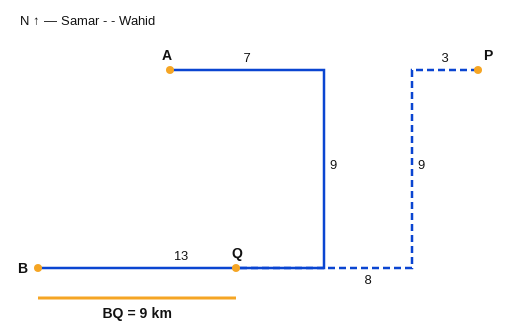
Samar starts from point A and drives 7 km towards east. He then takes a right turn and drives 9 km. He takes a final right turn and drives 13 km and stops at point B. Wahid starts from point P, which is 14 km east of Point A, and drives 3 km towards west. He then takes a left turn and drives 9 km. He takes a final right turn and drives 8 km and stops at Point Q. What is the shortest distance between Point Q and Point B? (All turns are 90 degree turns only.)
समर बिंदु A से चलना शुरू करता है और पूर्व की ओर 7 km गाड़ी चलाता है। फिर वह दाएँ मुड़ता है और 9 km गाड़ी चलाता है। वह अंतिम बार दाएँ मुड़ता है और 13 km गाड़ी चलाकर बिंदु B पर रुक जाता है। वाहिद बिंदु P से, जो बिंदु A से 14 km पूर्व में है, चलना शुरू करता है और पश्चिम की ओर 3 km गाड़ी चलाता है। फिर वह बाएँ मुड़ता है और 9 km गाड़ी चलाता है। वह अंतिम बार दाएँ मुड़ता है और 8 km गाड़ी चलाकर बिंदु Q पर रुक जाता है। बिंदु Q और बिंदु B के बीच की न्यूनतम दूरी क्या है? (सभी मोड़ केवल 90 डिग्री के मोड़ हैं।)
  1. A11 km
  2. B10 km
  3. C9 km
  4. D8 km
Show answer

Concept: Take A as origin (East = +x, North = +y) and track coordinates after every turn.

  1. Samar: east 7 → (7,0); right (south) 9 → (7,−9); right (west) 13 → B =(−6,−9).
  2. Wahid: P =(14,0); west 3 → (11,0); left (south) 9 → (11,−9); right (west) 8 → Q =(3,−9).
  3. B and Q are on the same horizontal line: BQ=3−(−6)=9 km.

Trick: Same y-coordinate → distance is just the difference of x-coordinates.

Answer: (C) 9 km

अवधारणा: A को मूल बिंदु लें (पूर्व = +x, उत्तर = +y) और हर मोड़ के बाद निर्देशांक लिखें।

  1. समर: पूर्व 7 → (7,0); दाएँ (दक्षिण) 9 → (7,−9); दाएँ (पश्चिम) 13 → B =(−6,−9)।
  2. वाहिद: P =(14,0); पश्चिम 3 → (11,0); बाएँ (दक्षिण) 9 → (11,−9); दाएँ (पश्चिम) 8 → Q =(3,−9)।
  3. B और Q एक ही क्षैतिज रेखा पर: BQ=3−(−6)=9 km।

ट्रिक: y-निर्देशांक समान → दूरी = x-निर्देशांकों का अंतर।

उत्तर: (C) 9 km

RRB NTPC Graduate CBT 2General Intelligence and ReasoningDirection and distanceRRB NTPC Graduate CBT 2 2024 · 13 Oct Shift 1 →
Q11463.
If ‘A’ stands for ‘+’, ‘B’ stands for ‘−’, ‘C’ stands for ‘×’ and ‘D’ stands for ‘÷‘, what will come in place of the question mark (?) in the following equation?
25 C 3 B 12 D 4 A 10 = ?
यदि ‘A’ का अर्थ ‘+’, ‘B’ का अर्थ ‘−’, ‘C’ का अर्थ ‘×’ और ‘D’ का अर्थ ‘÷‘ है, तो निम्नलिखित समीकरण में प्रश्न चिह्न (?) के स्थान पर क्या आएगा?
25 C 3 B 12 D 4 A 10 = ?
  1. A83
  2. B81
  3. C82
  4. D80
Show answer

Concept: Replace letters by operators, then apply BODMAS.

  1. 25×3−12÷4+10
  2. 25×3=75, 12÷4=3
  3. 75−3+10=82

Trick: Decode the whole line first: C = ×, B = −, D = ÷, A = +.

Answer: (C) 82

अवधारणा: अक्षरों को चिह्नों से बदलें, फिर BODMAS लगाएँ।

  1. 25×3−12÷4+10
  2. 25×3=75, 12÷4=3
  3. 75−3+10=82

ट्रिक: पहले पूरी पंक्ति डिकोड करें: C = ×, B = −, D = ÷, A = +।

उत्तर: (C) 82

RRB NTPC Graduate CBT 2General Intelligence and ReasoningMathematical operations – letter codingRRB NTPC Graduate CBT 2 2024 · 13 Oct Shift 1 →
Q11464.
In the following series, only one letter-cluster is incorrect. Select the INCORRECT letter- cluster.
FHK IKN LNQ OQT RSW
निम्नलिखित शृंखला में केवल एक अक्षर-समूह गलत है। गलत अक्षर-समूह का चयन कीजिए।
FHK IKN LNQ OQT RSW
  1. AOQT
  2. BFHK
  3. CLNQ
  4. DRSW
Show answer

Concept: Check each letter position separately.

  1. 1st letters: F, I, L, O, R → +3
  2. 2nd letters: H, K, N, Q, should be T → +3
  3. 3rd letters: K, N, Q, T, W → +3; so last term should be RTW, not RSW.

Trick: Each cluster is 'x, x+2, x+5' – RSW breaks the gap of 2 between first and second letters.

Answer: (D) RSW

अवधारणा: प्रत्येक स्थान के अक्षर अलग से देखें।

  1. पहले अक्षर: F, I, L, O, R → +3
  2. दूसरे अक्षर: H, K, N, Q, अगला T होना चाहिए → +3
  3. तीसरे अक्षर: K, N, Q, T, W → +3; अतः अंतिम पद RTW होना चाहिए, RSW नहीं।

ट्रिक: प्रत्येक समूह 'x, x+2, x+5' है – RSW में पहले-दूसरे अक्षर का अंतर 2 नहीं।

उत्तर: (D) RSW

RRB NTPC Graduate CBT 2General Intelligence and ReasoningLetter series – wrong termRRB NTPC Graduate CBT 2 2024 · 13 Oct Shift 1 →
Q11465.
What will come in the place of the question mark (?) in the following equation, if ‘+’ and ‘−’ are interchanged and ‘×’ and ‘÷’ are interchanged?
32 − 15 ÷ 5 + 10 × 2 = ?
यदि ‘+’ और ‘−’ को आपस में बदल दिया जाए तथा ‘×’ और ‘÷’ को आपस में बदल दिया जाए, तो निम्नलिखित समीकरण में प्रश्न चिह्न (?) के स्थान पर क्या आएगा?
32 − 15 ÷ 5 + 10 × 2 = ?
  1. A101
  2. B100
  3. C103
  4. D102
Show answer

Concept: Interchange the signs first, then apply BODMAS.

  1. After swapping: 32+15×5−10÷2
  2. 15×5=75, 10÷2=5
  3. 32+75−5=102

Trick: Rewrite the full expression with new signs before solving.

Answer: (D) 102

अवधारणा: पहले चिह्न बदलें, फिर BODMAS लगाएँ।

  1. बदलने के बाद: 32+15×5−10÷2
  2. 15×5=75, 10÷2=5
  3. 32+75−5=102

ट्रिक: हल करने से पहले पूरा व्यंजक नए चिह्नों से लिखें।

उत्तर: (D) 102

RRB NTPC Graduate CBT 2General Intelligence and ReasoningMathematical operations – interchangeRRB NTPC Graduate CBT 2 2024 · 13 Oct Shift 1 →
Q11466.
Refer to the following letter, number, symbol series and answer the question
(Left) $ T 1 & 9 Z 7 * A M S 1 * D % 7 * (Right)
If all the symbols are dropped from the series, which of the following will be seventh from the right?
निम्नलिखित अक्षर, संख्या, प्रतीक शृंखला को देखिए और प्रश्न का उत्तर दीजिए
(बाएँ) $ T 1 & 9 Z 7 * A M S 1 * D % 7 * (दाएँ)
यदि शृंखला से सभी प्रतीक हटा दिए जाएँ, तो निम्नलिखित में से कौन दाएँ से सातवाँ होगा?
  1. AT
  2. B7
  3. C9
  4. D1
Show answer

Concept: Remove all symbols ($, &, *, %) and then count positions.

  1. Remaining: T 1 9 Z 7 A M S 1 D 7 → 11 elements.
  2. 7th from right = (11−7+1)=5th from left.
  3. 5th from left = 7

Trick: kth from right =(n−k+1)th from left.

Answer: (B) 7

अवधारणा: सभी चिह्न ($, &, *, %) हटाएँ, फिर स्थान गिनें।

  1. शेष: T 1 9 Z 7 A M S 1 D 7 → 11 पद।
  2. दाएँ से 7वाँ =(11−7+1)=5वाँ बाएँ से।
  3. बाएँ से 5वाँ = 7

ट्रिक: दाएँ से kवाँ =(n−k+1)वाँ बाएँ से।

उत्तर: (B) 7

RRB NTPC Graduate CBT 2General Intelligence and ReasoningAlphanumeric seriesRRB NTPC Graduate CBT 2 2024 · 13 Oct Shift 1 →
Q11467.
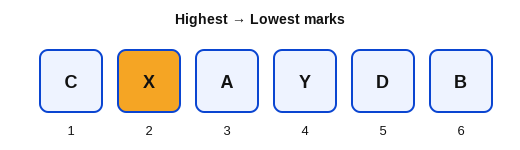
A, B, C, D, X and Y each scored different marks. Only two people have scored more than A. Only B has scored less than D. X has scored more than Y but less than C. How many people have scored more than X?
A, B, C, D, X और Y में से प्रत्येक ने अलग-अलग अंक प्राप्त किए। केवल दो व्यक्तियों ने A से अधिक अंक प्राप्त किए हैं। केवल B ने D से कम अंक प्राप्त किए हैं। X ने Y से अधिक लेकिन C से कम अंक प्राप्त किए हैं। कितने व्यक्तियों ने X से अधिक अंक प्राप्त किए हैं?
  1. AFourचार
  2. BOneएक
  3. CTwoदो
  4. DThreeतीन
Show answer

Concept: Fix the definite positions first, then fill the rest with the remaining conditions.

  1. Only two scored more than A → A is 3rd.
  2. Only B scored less than D → B is 6th, D is 5th.
  3. Left positions 1, 2, 4 for C, X, Y with C > X > Y → C 1st, X 2nd, Y 4th.
  4. Only C scored more than X → one person.

Trick: Place the 'only' clues first – they fix exact ranks.

Answer: (B) One

अवधारणा: पहले निश्चित स्थान तय करें, फिर बाकी शर्तों से भरें।

  1. केवल दो ने A से अधिक अंक पाए → A तीसरे स्थान पर।
  2. केवल B ने D से कम पाए → B छठे, D पाँचवें।
  3. शेष स्थान 1, 2, 4 पर C, X, Y; C > X > Y → C पहले, X दूसरे, Y चौथे।
  4. X से अधिक केवल C → एक व्यक्ति।

ट्रिक: 'केवल' वाले संकेत पहले लगाएँ – वे सटीक स्थान देते हैं।

उत्तर: (B) एक

RRB NTPC Graduate CBT 2General Intelligence and ReasoningRanking – comparisonRRB NTPC Graduate CBT 2 2024 · 13 Oct Shift 1 →
Q11468.
MPQO is related to UXYW in a certain way based on the English alphabetical order. In the same way, DGHF is related to LOPN. To which of the given options is KNOM related, following the same logic?
अंग्रेज़ी वर्णमाला क्रम के आधार पर MPQO एक निश्चित प्रकार से UXYW से संबंधित है। उसी प्रकार, DGHF, LOPN से संबंधित है। समान तर्क का अनुसरण करते हुए, KNOM दिए गए विकल्पों में से किससे संबंधित है?
  1. ASWUV
  2. BSVWU
  3. CSUWV
  4. DSWVU
Show answer

Concept: Each letter of the first cluster is shifted forward by the same number of places.

  1. M→U, P→X, Q→Y, O→W: each letter +8.
  2. D→L, G→O, H→P, F→N: again each +8.
  3. K+8 = S, N+8 = V, O+8 = W, M+8 = U → SVWU.

Trick: Check only the first letter of each option: all start with S, so test the second letter N+8 = V.

Answer: (B) SVWU

अवधारणा: पहले समूह के हर अक्षर को समान स्थान आगे बढ़ाया गया है।

  1. M→U, P→X, Q→Y, O→W: हर अक्षर +8।
  2. D→L, G→O, H→P, F→N: फिर से हर अक्षर +8।
  3. K+8 = S, N+8 = V, O+8 = W, M+8 = U → SVWU।

ट्रिक: सभी विकल्प S से शुरू हैं, तो दूसरा अक्षर जाँचें: N+8 = V, केवल (B) में।

उत्तर: (B) SVWU

RRB NTPC Graduate CBT 2General Intelligence and ReasoningLetter AnalogyRRB NTPC Graduate CBT 2 2024 · 13 Oct Shift 1 →
Q11469.
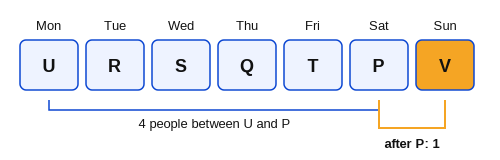
Each of P, Q, R, S, T, U and V has an exam on a different day of a week starting from Monday and ending on Sunday of the same week. Q has an exam on Thursday. Exactly four people have their exam between U and P, neither of whom has an exam on Sunday. R has an exam immediately before S. V does not have an exam on Friday. U does not have an exam after S. How many people have exams after P?
P, Q, R, S, T, U और V में से प्रत्येक की परीक्षा एक ही सप्ताह के सोमवार से शुरू होकर रविवार को समाप्त होने वाले सप्ताह के अलग-अलग दिन है। Q की परीक्षा गुरुवार को है। U और P के बीच ठीक चार व्यक्तियों की परीक्षा है, और इन दोनों (U और P) में से किसी की भी परीक्षा रविवार को नहीं है। R की परीक्षा S से ठीक पहले है। V की परीक्षा शुक्रवार को नहीं है। U की परीक्षा S के बाद नहीं है। P के बाद कितने व्यक्तियों की परीक्षा है?
  1. A4
  2. B3
  3. C1
  4. D2
Show answer

Concept: Use the fixed day (Q on Thursday) and the gap condition between U and P first.

  1. Four people between U and P → they are on (Mon, Sat) or (Tue, Sun); Sunday is not allowed → U, P on Mon and Sat.
  2. If U were Saturday, S would have to be Sunday and R Saturday – clash. So U = Mon, P = Sat.
  3. R, S consecutive in the free days → R = Tue, S = Wed.
  4. T and V take Fri, Sun; V not Friday → T = Fri, V = Sun. After P (Sat) only V → 1.

Trick: With 7 days, "4 between" leaves only two pairs: (1, 6) or (2, 7).

Answer: (C) 1

अवधारणा: पहले निश्चित दिन (Q – गुरुवार) और U, P के बीच के अंतर वाली शर्त लगाएँ।

  1. U और P के बीच 4 लोग → (सोम, शनि) या (मंगल, रवि); रविवार नहीं हो सकता → U, P सोम और शनि पर।
  2. यदि U शनिवार हो तो S रविवार और R शनिवार होगा – टकराव। अतः U = सोम, P = शनि।
  3. R, S लगातार → R = मंगल, S = बुध।
  4. T, V के लिए शुक्र, रवि; V शुक्रवार नहीं → T = शुक्र, V = रवि। P (शनि) के बाद केवल V → 1।

ट्रिक: 7 दिनों में "बीच में 4" के केवल दो जोड़े: (1, 6) या (2, 7)।

उत्तर: (C) 1

RRB NTPC Graduate CBT 2General Intelligence and ReasoningScheduling PuzzleRRB NTPC Graduate CBT 2 2024 · 13 Oct Shift 1 →
Q11470.
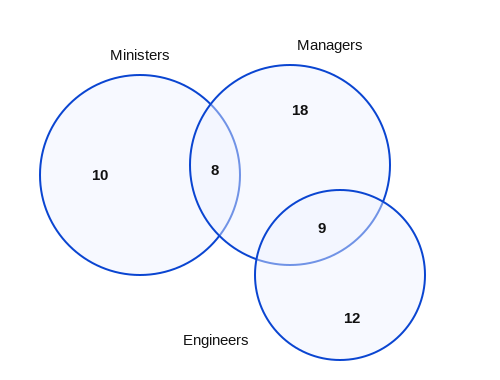
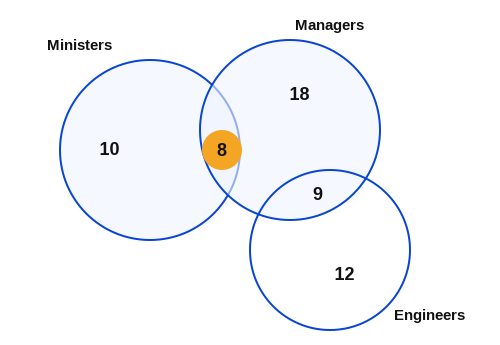
Study the given Venn diagram carefully and answer the question that follows. The numbers in different sections indicate the number of persons.

How many Ministers are there who are Managers but NOT Engineers?
दिए गए वेन आरेख का ध्यानपूर्वक अध्ययन कीजिए और उसके बाद दिए गए प्रश्न का उत्तर दीजिए। विभिन्न भागों में दी गई संख्याएँ व्यक्तियों की संख्या दर्शाती हैं।

ऐसे कितने मंत्री (Ministers) हैं जो प्रबंधक (Managers) हैं लेकिन इंजीनियर (Engineers) नहीं हैं?
  1. A10
  2. B8
  3. C9
  4. D18
Show answer

Concept: Ministers who are Managers but not Engineers = region common to Ministers and Managers only, outside the Engineers circle.

  1. Region only in Ministers = 10 (not Managers).
  2. Region in Managers and Engineers = 9 (not Ministers).
  3. Region common to Ministers and Managers only = 8.

Trick: Read the question as "inside A and B, outside C" and shade just that region.

Answer: (B) 8

अवधारणा: जो मंत्री (Ministers) प्रबंधक (Managers) हैं पर इंजीनियर नहीं = केवल Ministers और Managers का साझा भाग, Engineers वृत्त के बाहर।

  1. केवल Ministers वाला भाग = 10 (Managers नहीं)।
  2. Managers और Engineers का भाग = 9 (Ministers नहीं)।
  3. केवल Ministers और Managers का साझा भाग = 8।

ट्रिक: प्रश्न को "A और B के अंदर, C के बाहर" पढ़ें और केवल वही भाग छायांकित करें।

उत्तर: (B) 8

RRB NTPC Graduate CBT 2General Intelligence and ReasoningVenn DiagramRRB NTPC Graduate CBT 2 2024 · 13 Oct Shift 1 →
Q11471.
What should come in place of the question mark (?) in the given series?
12, 25, 51, 90, 142 , ?
दी गई शृंखला में प्रश्न चिह्न (?) के स्थान पर क्या आना चाहिए?
12, 25, 51, 90, 142 , ?
  1. A207
  2. B206
  3. C208
  4. D209
Show answer

Concept: Look at the differences between consecutive terms.

  1. Differences: 25−12=13, 51−25=26, 90−51=39, 142−90=52.
  2. They are multiples of 13: 13×1,13×2,13×3,13×4.
  3. Next difference =13×5=65 → 142+65=207.

Trick: Differences in a table of a number (13, 26, 39…) → just add the next multiple.

Answer: (A) 207

अवधारणा: क्रमागत पदों के अंतर देखें।

  1. अंतर: 25−12=13, 51−25=26, 90−51=39, 142−90=52।
  2. ये 13 के गुणज हैं: 13×1,13×2,13×3,13×4।
  3. अगला अंतर =13×5=65 → 142+65=207।

ट्रिक: अंतर किसी संख्या का पहाड़ा (13, 26, 39…) हों तो अगला गुणज जोड़ दें।

उत्तर: (A) 207

RRB NTPC Graduate CBT 2General Intelligence and ReasoningNumber SeriesRRB NTPC Graduate CBT 2 2024 · 13 Oct Shift 1 →
Q11472.
In a certain code language,
A + B means ‘A is the mother of B’,
A – B means ‘A is the brother of B’,
A x B means ‘A is the wife of B’,
and A ÷ B means ‘A is the father of B’.
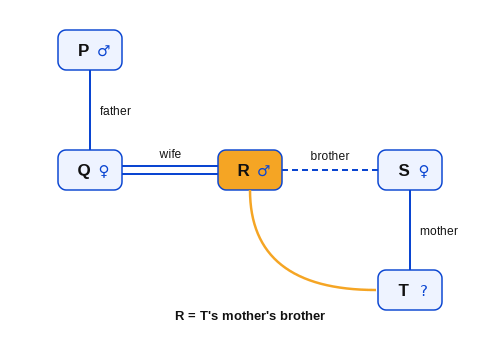
Which of the following means that R is the mother's brother of T ?
एक निश्चित कूट भाषा में,
A + B का अर्थ है ‘A, B की माता है’,
A – B का अर्थ है ‘A, B का भाई है’,
A x B का अर्थ है ‘A, B की पत्नी है’,
और A ÷ B का अर्थ है ‘A, B का पिता है’।
निम्नलिखित में से किसका अर्थ है कि R, T का मामा (माता का भाई) है?
  1. AP x Q ÷ R – S x T
  2. BP ÷ Q x R ÷ S + T
  3. CP ÷ Q x R – S + T
  4. DP ÷ Q – R x S – T
Show answer

Concept: Decode each option; R must be the brother of a woman who is T's mother.

  1. Option (C): P ÷ Q → P is father of Q; Q × R → Q is wife of R.
  2. R – S → R is brother of S; S + T → S is mother of T.
  3. So S is T's mother and R is her brother → R is T's mother's brother (maternal uncle).
  4. In (B), R ÷ S makes R a father, and in (D), R × S makes R a wife – both wrong.

Trick: Look for the pattern "R – S + T" (R brother of S, S mother of T) in the options.

Answer: (C) P ÷ Q x R – S + T

अवधारणा: हर विकल्प को डिकोड करें; R उस महिला का भाई होना चाहिए जो T की माँ है।

  1. विकल्प (C): P ÷ Q → P, Q का पिता; Q × R → Q, R की पत्नी।
  2. R – S → R, S का भाई; S + T → S, T की माँ।
  3. अतः S, T की माँ है और R उसका भाई → R, T का मामा (mother's brother) है।
  4. (B) में R ÷ S से R पिता बनता है, (D) में R × S से R पत्नी – दोनों गलत।

ट्रिक: विकल्पों में "R – S + T" (R, S का भाई; S, T की माँ) ढूँढें।

उत्तर: (C) P ÷ Q x R – S + T

RRB NTPC Graduate CBT 2General Intelligence and ReasoningCoded Blood RelationsRRB NTPC Graduate CBT 2 2024 · 13 Oct Shift 1 →
Q11473.
In the following series, only one letter-cluster is incorrect. Select the INCORRECT letter- cluster.
JFB RNJ ZVR HDZ PLK XTP
निम्नलिखित शृंखला में केवल एक अक्षर-समूह गलत है। गलत अक्षर-समूह का चयन कीजिए।
JFB RNJ ZVR HDZ PLK XTP
  1. AHDZ
  2. BZVR
  3. CPLK
  4. DRNJ
Show answer

Concept: Each position of the clusters moves forward by the same step.

  1. First letters: J, R, Z, H, P, X – each +8 (with wrap-around).
  2. Second letters: F, N, V, D, L, T – each +8.
  3. Third letters: B, J, R, Z, ?, P → after Z comes Z+8 = H, so the fifth cluster should be PLH.
  4. Given PLK breaks the pattern.

Trick: Check one position at a time; the odd letter shows the wrong cluster at once.

Answer: (C) PLK

अवधारणा: हर समूह का हर स्थान समान कदम से आगे बढ़ता है।

  1. पहले अक्षर: J, R, Z, H, P, X – हर बार +8 (Z के बाद फिर A से)।
  2. दूसरे अक्षर: F, N, V, D, L, T – हर बार +8।
  3. तीसरे अक्षर: B, J, R, Z, ?, P → Z+8 = H, अतः पाँचवाँ समूह PLH होना चाहिए।
  4. दिया गया PLK पैटर्न तोड़ता है।

ट्रिक: एक-एक स्थान अलग जाँचें; गलत अक्षर तुरंत गलत समूह दिखा देता है।

उत्तर: (C) PLK

RRB NTPC Graduate CBT 2General Intelligence and ReasoningLetter Cluster SeriesRRB NTPC Graduate CBT 2 2024 · 13 Oct Shift 1 →
Q11474.
​Based on the English alphabetical order, three of the following four letter-cluster pairs are alike in a certain way and thus form a group. Which is the letter-cluster pair that DOES NOT belong to that group?
(Note: The odd one out is not based on the number of consonants/vowels or their position in the letter-cluster.)
​अंग्रेज़ी वर्णमाला क्रम के आधार पर, निम्नलिखित चार अक्षर-समूह युग्मों में से तीन किसी निश्चित प्रकार से एक समान हैं और इस प्रकार एक समूह बनाते हैं। वह कौन-सा अक्षर-समूह युग्म है जो उस समूह से संबंधित नहीं है?
(नोट: असंगत को व्यंजनों/स्वरों की संख्या या अक्षर-समूह में उनके स्थान के आधार पर नहीं चुना गया है।)
  1. AKO−NR
  2. BMQ−PT
  3. CAE−DH
  4. DGK−IP
Show answer

Concept: Find the letter-gaps inside each pair: first cluster XY, second cluster PQ.

  1. KO−NR: K+4 = O, K+3 = N, N+4 = R.
  2. MQ−PT: M+4 = Q, M+3 = P, P+4 = T. AE−DH: A+4 = E, A+3 = D, D+4 = H.
  3. GK−IP: G+4 = K but G+2 = I and I+7 = P – pattern broken.

Trick: Pattern is (+4) in each cluster and (+3) between clusters; GK−IP fails at once.

Answer: (D) GK−IP

अवधारणा: हर युग्म के अंदर अक्षरों का अंतर देखें।

  1. KO−NR: K+4 = O, K+3 = N, N+4 = R।
  2. MQ−PT: M+4 = Q, M+3 = P, P+4 = T। AE−DH: A+4 = E, A+3 = D, D+4 = H।
  3. GK−IP: G+4 = K पर G+2 = I और I+7 = P – पैटर्न टूटा।

ट्रिक: हर समूह में (+4) और दोनों समूहों के बीच (+3); GK−IP तुरंत अलग।

उत्तर: (D) GK−IP

RRB NTPC Graduate CBT 2General Intelligence and ReasoningOdd One Out (Letter Pairs)RRB NTPC Graduate CBT 2 2024 · 13 Oct Shift 1 →
Q11475.
In the following triads, each group of letters is related to the subsequent one following a certain logic. Select from the given options, the one which follows the same logic. WASH - HSWA - WSAH
NEST - TSNE - NSET
निम्नलिखित त्रयी (triads) में, अक्षरों का प्रत्येक समूह एक निश्चित तर्क का अनुसरण करते हुए अगले समूह से संबंधित है। दिए गए विकल्पों में से उसका चयन कीजिए जो समान तर्क का अनुसरण करता है। WASH - HSWA - WSAH
NEST - TSNE - NSET
  1. AFOGS - SGFO - OGFS
  2. BPACE - PCAE - ECAP
  3. CTRAY - RATY - RAYT
  4. DOILS - SLOI - OLIS
Show answer

Concept: Number the letters 1 2 3 4 and find how positions move.

  1. WASH → HSWA: order 4 3 1 2. NEST → TSNE: same 4 3 1 2.
  2. HSWA → WSAH: order 3 2 4 1 of the second word (NSET from TSNE too).
  3. OILS → 4 3 1 2 = SLOI; SLOI → 3 2 4 1 = OLIS. Matches (D).
  4. FOGS → 4 3 1 2 would be SGFO ✓, but SGFO → 3 2 4 1 = FGOS, not OGFS.

Trick: Fix the rule on one triad, verify on the second, then test options only.

Answer: (D) OILS - SLOI - OLIS

अवधारणा: अक्षरों को 1 2 3 4 क्रमांक दें और स्थान परिवर्तन देखें।

  1. WASH → HSWA: क्रम 4 3 1 2। NEST → TSNE: वही 4 3 1 2।
  2. HSWA → WSAH: दूसरे शब्द का क्रम 3 2 4 1 (TSNE → NSET भी)।
  3. OILS → 4 3 1 2 = SLOI; SLOI → 3 2 4 1 = OLIS। (D) मेल खाता है।
  4. FOGS → SGFO ✓, पर SGFO → 3 2 4 1 = FGOS, OGFS नहीं।

ट्रिक: एक त्रिक से नियम निकालें, दूसरे पर जाँचें, फिर विकल्प परखें।

उत्तर: (D) OILS - SLOI - OLIS

RRB NTPC Graduate CBT 2General Intelligence and ReasoningLetter Triads (Position Rearrangement)RRB NTPC Graduate CBT 2 2024 · 13 Oct Shift 1 →
Q11476.
In the following number-pairs, the second number is obtained by applying certain mathematical operation(s) to the first number. Select the number-pair in which the numbers are related in the same way as are the numbers of the following pairs. (NOTE: Operations should be performed on the whole numbers, without breaking down the numbers into their constituent digits. E.g. 13 – Operations on 13 such as adding to/subtracting from/multiplying with 13 can be performed. Breaking down 13 into 1 and 3 and then performing mathematical operations on 1 and 3 is not allowed.)
11, 68
14, 86
निम्नलिखित संख्या-युग्मों में, पहली संख्या पर कुछ निश्चित गणितीय संक्रिया/संक्रियाएँ करके दूसरी संख्या प्राप्त की जाती है। उस संख्या-युग्म का चयन कीजिए जिसमें संख्याएँ उसी प्रकार संबंधित हैं जिस प्रकार निम्नलिखित युग्मों की संख्याएँ संबंधित हैं। (नोट: संक्रियाएँ संख्याओं को उनके घटक अंकों में तोड़े बिना, पूर्ण संख्याओं पर की जानी चाहिए। उदाहरण के लिए 13 – 13 पर संक्रियाएँ जैसे 13 में जोड़ना/13 में से घटाना/13 से गुणा करना आदि की जा सकती हैं। 13 को 1 और 3 में तोड़कर फिर 1 और 3 पर गणितीय संक्रियाएँ करने की अनुमति नहीं है।)
11, 68
14, 86
  1. A17, 103
  2. B17, 104
  3. C18, 103
  4. D18, 104
Show answer

Concept: Find one operation that converts the first number into the second in both pairs.

  1. 11×6+2=68.
  2. 14×6+2=86.
  3. Option (B): 17×6+2=104 ✓. (A) gives 103, (C) and (D) would need 18×6+2=110.

Trick: Difference of second numbers 86−68=18 for difference 3 in first numbers → multiplier =6.

Answer: (B) 17, 104

अवधारणा: एक ऐसी संक्रिया खोजें जो दोनों युग्मों में पहली संख्या को दूसरी में बदले।

  1. 11×6+2=68।
  2. 14×6+2=86।
  3. विकल्प (B): 17×6+2=104 ✓। (A) में 103, (C), (D) के लिए 18×6+2=110 चाहिए।

ट्रिक: दूसरी संख्याओं का अंतर 86−68=18, पहली का अंतर 3 → गुणक =6।

उत्तर: (B) 17, 104

RRB NTPC Graduate CBT 2General Intelligence and ReasoningNumber Pair RelationRRB NTPC Graduate CBT 2 2024 · 13 Oct Shift 1 →
Q11477.
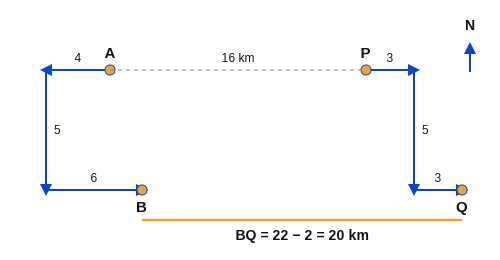
Namesh starts from point A and drives 4 km towards west. He then takes a left turn and drives 5 km. He takes a final left turn and drives 6 km and stops at point B. Rimit starts from point P, which is 16 km east of Point A, and drives 3 km towards east. He then takes a right turn and drives 5 km. He takes a final left turn and drives 3 km and stops at Point Q. What is the shortest distance between Point Q and Point B? (All turns are 90 degree turns only.)
नमेश बिंदु A से चलना शुरू करता है और पश्चिम की ओर 4 km गाड़ी चलाता है। फिर वह बाएँ मुड़ता है और 5 km गाड़ी चलाता है। वह अंतिम बार बाएँ मुड़ता है और 6 km गाड़ी चलाकर बिंदु B पर रुक जाता है। रिमित बिंदु P से, जो बिंदु A से 16 km पूर्व में है, चलना शुरू करता है और पूर्व की ओर 3 km गाड़ी चलाता है। फिर वह दाएँ मुड़ता है और 5 km गाड़ी चलाता है। वह अंतिम बार बाएँ मुड़ता है और 3 km गाड़ी चलाकर बिंदु Q पर रुक जाता है। बिंदु Q और बिंदु B के बीच की न्यूनतम दूरी क्या है? (सभी मोड़ केवल 90 डिग्री के मोड़ हैं।)
  1. A19 km
  2. B21 km
  3. C20 km
  4. D22 km
Show answer

Concept: Place A at the origin, east = +x, north = +y, and track both journeys.

  1. Namesh: west 4 → (−4,0); left (south) 5 → (−4,−5); left (east) 6 → B =(2,−5).
  2. P =(16,0). Rimit: east 3 → (19,0); right (south) 5 → (19,−5); left (east) 3 → Q =(22,−5).
  3. B and Q are on the same line y=−5: BQ =22−2=20km.

Trick: Both end 5 km south, so only the east–west gap matters.

Answer: (C) 20 km

अवधारणा: A को मूल बिंदु लें, पूर्व = +x, उत्तर = +y, और दोनों यात्राएँ अंकित करें।

  1. नमेश: पश्चिम 4 → (−4,0); बाएँ (दक्षिण) 5 → (−4,−5); बाएँ (पूर्व) 6 → B =(2,−5)।
  2. P =(16,0)। रिमित: पूर्व 3 → (19,0); दाएँ (दक्षिण) 5 → (19,−5); बाएँ (पूर्व) 3 → Q =(22,−5)।
  3. B और Q एक ही रेखा y=−5 पर: BQ =22−2=20km।

ट्रिक: दोनों 5 km दक्षिण में रुकते हैं, इसलिए केवल पूर्व–पश्चिम अंतर देखें।

उत्तर: (C) 20 km

RRB NTPC Graduate CBT 2General Intelligence and ReasoningDirection and DistanceRRB NTPC Graduate CBT 2 2024 · 13 Oct Shift 1 →
Q11478.
In this question, a statement is given followed by two courses of action, numbered I and II. You must assume everything in the statement to be true, and on the basis of the information given in the statement, decide which of the given courses of action logically follow(s) for pursuing.
Statement:
Reports indicate that fish populations in River Y have declined sharply due to excessive fishing and industrial pollution.
Courses of Action:
I. Fishing in River Y should be regulated for at least six months.
II. Industries should be ordered to treat waste before discharging into River Y.
इस प्रश्न में, एक कथन के बाद I और II क्रमांकित दो कार्यवाहियाँ दी गई हैं। आपको कथन में दी गई प्रत्येक बात को सत्य मानना है, और कथन में दी गई जानकारी के आधार पर निर्णय करना है कि दी गई कार्यवाहियों में से कौन-सी तार्किक रूप से अनुसरण करने योग्य है/हैं।
कथन:
रिपोर्टों से संकेत मिलता है कि अत्यधिक मछली पकड़ने और औद्योगिक प्रदूषण के कारण नदी Y में मछलियों की संख्या में तेज़ी से गिरावट आई है।
कार्यवाहियाँ:
I. नदी Y में मछली पकड़ने को कम से कम छह महीने के लिए विनियमित किया जाना चाहिए।
II. उद्योगों को नदी Y में छोड़ने से पहले अपशिष्ट का उपचार करने का आदेश दिया जाना चाहिए।
  1. AOnly II followsकेवल II अनुसरण करती है
  2. BNeither I nor II followsन तो I और न ही II अनुसरण करती है
  3. COnly I followsकेवल I अनुसरण करती है
  4. DBoth I and II followI और II दोनों अनुसरण करती हैं
Show answer

Concept: A course of action follows if it practically tackles a cause stated in the problem.

  1. Cause 1 – excessive fishing: regulating fishing for some months lets fish breed and recover → I follows.
  2. Cause 2 – industrial pollution: treating waste before discharge removes the pollution → II follows.
  3. Both actions address the two stated causes directly.

Trick: One action per cause mentioned in the statement → both follow.

Answer: (D) Both I and II follow

अवधारणा: कोई कार्यवाही तभी अनुसरण करती है जब वह समस्या के बताए गए कारण को व्यावहारिक रूप से दूर करे।

  1. कारण 1 – अत्यधिक मछली पकड़ना: कुछ महीने मछली पकड़ने पर नियंत्रण से मछलियाँ प्रजनन कर बढ़ेंगी → I अनुसरण करता है।
  2. कारण 2 – औद्योगिक प्रदूषण: छोड़ने से पहले अपशिष्ट का उपचार प्रदूषण घटाएगा → II अनुसरण करता है।
  3. दोनों कार्यवाहियाँ दोनों कारणों को सीधे हल करती हैं।

ट्रिक: कथन में हर कारण के लिए एक कार्यवाही → दोनों अनुसरण करती हैं।

उत्तर: (D) I और II दोनों अनुसरण करते हैं

RRB NTPC Graduate CBT 2General Intelligence and ReasoningStatement and Course of ActionRRB NTPC Graduate CBT 2 2024 · 13 Oct Shift 1 →
Q11479.
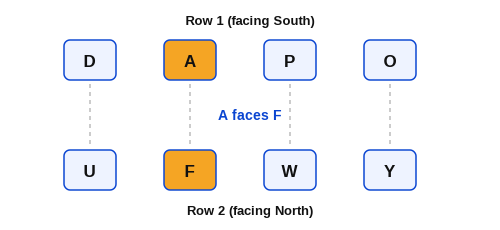
Eight people are sitting in two parallel rows containing 4 people each in such a way that there is equal distance between adjacent persons.
In row 1 – A, D, O and P are seated and all of them are facing south.
In row 2 – U,W, Y and F are seated and all of them are facing north.
Thus each person faces another person from the other row.
U sits third to the left of Y. The one facing P is an immediate neighbour of Y. A sits at some place to the right of P and is not facing W. D sits third to the right of O. Who amongst the following faces F?
आठ व्यक्ति 4-4 व्यक्तियों वाली दो समानांतर पंक्तियों में इस प्रकार बैठे हैं कि आसन्न व्यक्तियों के बीच समान दूरी है।
पंक्ति 1 में – A, D, O और P बैठे हैं और उन सभी का मुख दक्षिण की ओर है।
पंक्ति 2 में – U,W, Y और F बैठे हैं और उन सभी का मुख उत्तर की ओर है।
इस प्रकार प्रत्येक व्यक्ति दूसरी पंक्ति के किसी अन्य व्यक्ति की ओर मुख किए हुए है।
U, Y के बाईं ओर तीसरे स्थान पर बैठा है। P की ओर मुख किए हुए व्यक्ति, Y का निकटतम पड़ोसी है। A, P के दाईं ओर किसी स्थान पर बैठा है और W की ओर मुख किए हुए नहीं है। D, O के दाईं ओर तीसरे स्थान पर बैठा है। निम्नलिखित में से कौन F की ओर मुख किए हुए है?
  1. AU
  2. BD
  3. CA
  4. DW
Show answer

Concept: Row 2 faces north (its left = west); Row 1 faces south (its left = east). Number columns 1–4 from west to east.

  1. U third to the left of Y → U at 1, Y at 4 (Row 2).
  2. Person facing P is Y's neighbour → column 3, so P is at 3 (Row 1).
  3. D third to the right of O (Row 1 faces south) → O at 4, D at 1; A right of P → A at 2.
  4. A is not facing W → column 2 of Row 2 is F, W at 3. So F faces A.

Trick: For south-facing people, "right" is your left on paper – flip directions for Row 1.

Answer: (C) A

अवधारणा: पंक्ति 2 उत्तर की ओर (बायाँ = पश्चिम); पंक्ति 1 दक्षिण की ओर (बायाँ = पूर्व)। स्तंभ 1–4 पश्चिम से पूर्व क्रमांकित करें।

  1. U, Y के बाएँ से तीसरा → U स्थान 1, Y स्थान 4 (पंक्ति 2)।
  2. P के सामने वाला Y का पड़ोसी → स्तंभ 3, अतः P स्थान 3 (पंक्ति 1)।
  3. D, O के दाएँ से तीसरा (दक्षिणमुखी) → O 4 पर, D 1 पर; A, P के दाएँ → A 2 पर।
  4. A, W के सामने नहीं → पंक्ति 2 का स्तंभ 2 = F, W = 3। अतः F के सामने A।

ट्रिक: दक्षिणमुखी व्यक्तियों के लिए "दायाँ" कागज़ पर आपका बायाँ होता है।

उत्तर: (C) A

RRB NTPC Graduate CBT 2General Intelligence and ReasoningSeating Arrangement (Two Rows)RRB NTPC Graduate CBT 2 2024 · 13 Oct Shift 1 →
Q11480.
6 is related to 34 following a certain logic. Following the same logic, 8 is related to 46. To which of the given options is 10 related, following the same logic?
(NOTE: Operations should be performed on the whole numbers, without breaking down the numbers into their constituent digits. E.g. 13 – Operations on 13 such as adding to/subtracting from/multiplying with 13 can be performed. Breaking down 13 into 1 and 3 and then performing mathematical operations on 1 and 3 is not allowed.)
एक निश्चित तर्क का अनुसरण करते हुए 6, 34 से संबंधित है। उसी तर्क का अनुसरण करते हुए, 8, 46 से संबंधित है। समान तर्क का अनुसरण करते हुए, 10 दिए गए विकल्पों में से किससे संबंधित है?
(नोट: संक्रियाएँ संख्याओं को उनके घटक अंकों में तोड़े बिना, पूर्ण संख्याओं पर की जानी चाहिए। उदाहरण के लिए 13 – 13 पर संक्रियाएँ जैसे 13 में जोड़ना/13 में से घटाना/13 से गुणा करना आदि की जा सकती हैं। 13 को 1 और 3 में तोड़कर फिर 1 और 3 पर गणितीय संक्रियाएँ करने की अनुमति नहीं है।)
  1. A57
  2. B55
  3. C56
  4. D58
Show answer

Concept: Find the common operation in both given pairs.

  1. 6×6−2=34.
  2. 8×6−2=46.
  3. 10×6−2=58.

Trick: Increase of 2 in the first number raised the second by 12 → multiplier 6.

Answer: (D) 58

अवधारणा: दोनों दिए गए युग्मों में समान संक्रिया खोजें।

  1. 6×6−2=34।
  2. 8×6−2=46।
  3. 10×6−2=58।

ट्रिक: पहली संख्या में 2 बढ़ने पर दूसरी में 12 बढ़े → गुणक 6।

उत्तर: (D) 58

RRB NTPC Graduate CBT 2General Intelligence and ReasoningNumber AnalogyRRB NTPC Graduate CBT 2 2024 · 13 Oct Shift 1 →