Question bank

Q&A: practice questions with answers

Search questions on any topic. Filter by exam category, exam, subject and topic, try the question, then open the answer and explanation.

Courses – airGurukul

20,719 questions found.

Q11521.
India became a founding member of which global organization promoting peace and cooperation?
भारत शांति और सहयोग को बढ़ावा देने वाले किस वैश्विक संगठन का संस्थापक सदस्य बना?
  1. AUnited Nationsसंयुक्त राष्ट्र
  2. BNATO
  3. COPEC
  4. DASEAN
Show answer

Concept: The United Nations was created in 1945 to maintain international peace and promote cooperation.

  1. India signed the UN Charter in June 1945 and is one of the 51 founding members of the UN (UN Day – 24 October 1945).
  2. India was not then independent, yet it joined as an original member.
  3. India is not a member of NATO (military alliance), OPEC (oil exporters) or ASEAN (South-East Asian nations).

Trick: Peace + cooperation + 1945 = United Nations.

Answer: (A) United Nations

अवधारणा: संयुक्त राष्ट्र (UN) 1945 में अंतरराष्ट्रीय शांति और सहयोग के लिए बना।

  1. भारत ने जून 1945 में UN चार्टर पर हस्ताक्षर किए और वह UN के 51 संस्थापक सदस्यों में है (UN दिवस – 24 अक्टूबर 1945)।
  2. उस समय भारत स्वतंत्र नहीं था, फिर भी मूल सदस्य बना।
  3. भारत NATO (सैन्य गठबंधन), OPEC (तेल निर्यातक) या ASEAN (दक्षिण-पूर्व एशियाई देश) का सदस्य नहीं है।

ट्रिक: शांति + सहयोग + 1945 = संयुक्त राष्ट्र।

उत्तर: (A) संयुक्त राष्ट्र
RRB NTPC Undergraduate CBT 1General AwarenessInternational OrganisationsRRB NTPC Undergraduate CBT 1 2025 · 20 Jun Shift 3 →
Q11522.
What is the primary purpose of Task Manager in Windows?
Windows में Task Manager का प्राथमिक उद्देश्य क्या है?
  1. ATo manage user passwordsउपयोगकर्ता पासवर्ड प्रबंधित करना
  2. BTo edit text documentsटेक्स्ट डॉक्यूमेंट संपादित करना
  3. CTo monitor and manage running applications, processes and system performanceचल रहे एप्लिकेशन, प्रोसेस और सिस्टम प्रदर्शन की निगरानी और प्रबंधन करना
  4. DTo install new applicationsनए एप्लिकेशन इंस्टॉल करना
Show answer

Concept: Windows provides built-in utilities to watch and control the system.

  1. Task Manager shows running applications, background processes and CPU, memory, disk and network usage.
  2. It can end a hanging (not responding) program and manage startup apps.
  3. Open it with Ctrl + Shift + Esc (or Ctrl + Alt + Del → Task Manager).

Trick: Task Manager = ‘task’ (running programs) + ‘manager’ (control them). Shortcut: Ctrl + Shift + Esc.

Answer: (C) To monitor and manage running applications, processes and system performance

अवधारणा: Windows में सिस्टम पर नज़र रखने व नियंत्रित करने के लिए अंतर्निहित उपकरण होते हैं।

  1. Task Manager चल रहे एप्लिकेशन, background processes तथा CPU, मेमोरी, डिस्क और नेटवर्क उपयोग दिखाता है।
  2. इससे अटका हुआ (not responding) प्रोग्राम बंद किया जा सकता है और startup apps संभाले जा सकते हैं।
  3. इसे Ctrl + Shift + Esc (या Ctrl + Alt + Del → Task Manager) से खोलते हैं।

ट्रिक: Task Manager = चलते प्रोग्रामों का प्रबंधक। शॉर्टकट: Ctrl + Shift + Esc।

उत्तर: (C) चल रहे एप्लिकेशन, प्रोसेस और सिस्टम प्रदर्शन की निगरानी व प्रबंधन

RRB NTPC Undergraduate CBT 1General AwarenessComputer – Windows UtilitiesRRB NTPC Undergraduate CBT 1 2025 · 20 Jun Shift 3 →
Q11523.
Which of the following landforms develops when a river cuts through a ridge, forming a narrow and steep-sided passage?
निम्नलिखित में से कौन-सी स्थलाकृति तब विकसित होती है जब कोई नदी किसी कटक को काटकर एक संकरा और खड़ी ढाल वाला मार्ग बनाती है?
  1. APlainमैदान
  2. BMorainesहिमोढ़ (Moraines)
  3. CGorgeमहाखड्ड (Gorge)
  4. DDuneटिब्बा (Dune)
Show answer

Concept: Rivers in their youthful (mountain) stage cut downward strongly (vertical erosion).

  1. When a river cuts down through hard rock or a ridge, it forms a gorge – a deep, narrow valley with steep sides.
  2. A larger, wider version is a canyon (e.g. Grand Canyon). Example in India: Indus gorge, Gandak gorge.
  3. Moraines are glacial deposits; dunes are wind deposits; plains are formed by deposition.

Trick: Narrow + steep + river cutting = Gorge.

Answer: (C) Gorge

अवधारणा: युवावस्था (पर्वतीय भाग) में नदी नीचे की ओर तेज़ कटाव (ऊर्ध्वाधर अपरदन) करती है।

  1. जब नदी कठोर चट्टान या कटक (ridge) को काटती है तो गॉर्ज (महाखड्ड) बनता है – गहरी, सँकरी, खड़ी दीवारों वाली घाटी।
  2. इसका बड़ा और चौड़ा रूप कैनियन है। भारत में उदाहरण: सिंधु गॉर्ज, गंडक गॉर्ज।
  3. मोरेन हिमनद निक्षेप हैं; टिब्बे (dune) पवन निक्षेप हैं; मैदान निक्षेपण से बनते हैं।

ट्रिक: सँकरा + खड़ा + नदी का कटाव = गॉर्ज।

उत्तर: (C) गॉर्ज (Gorge)

RRB NTPC Undergraduate CBT 1General AwarenessGeography – Fluvial LandformsRRB NTPC Undergraduate CBT 1 2025 · 20 Jun Shift 3 →
Q11524.
Which type of mixture is formed when Ethyl alcohol is dissolved in water?
जब एथिल ऐल्कोहॉल को जल में घोला जाता है तो किस प्रकार का मिश्रण बनता है?
  1. ACompoundsयौगिक
  2. BNew elementनया तत्व
  3. CHomogeneousसमांगी (Homogeneous)
  4. DHeterogeneousविषमांगी (Heterogeneous)
Show answer

Concept: A homogeneous mixture has a uniform composition throughout; its parts cannot be seen separately.

  1. Ethyl alcohol (ethanol) is completely miscible with water.
  2. The two mix evenly to give a single clear phase – a homogeneous mixture (a solution).
  3. No new compound or element forms; the components can be separated by fractional distillation.

Trick: Miscible liquids (alcohol + water) → homogeneous; immiscible (oil + water) → heterogeneous.

Answer: (C) Homogeneous

अवधारणा: समांगी (homogeneous) मिश्रण में संघटन हर जगह एक-सा होता है; घटक अलग-अलग दिखाई नहीं देते।

  1. एथिल ऐल्कोहॉल (एथेनॉल) पानी में पूरी तरह घुलनशील (miscible) है।
  2. दोनों समान रूप से मिलकर एक ही स्पष्ट प्रावस्था देते हैं – समांगी मिश्रण (विलयन)।
  3. कोई नया यौगिक या तत्व नहीं बनता; घटक प्रभाजी आसवन से अलग हो सकते हैं।

ट्रिक: मिश्रणीय द्रव (ऐल्कोहॉल + पानी) → समांगी; अमिश्रणीय (तेल + पानी) → विषमांगी।

उत्तर: (C) समांगी (Homogeneous)

RRB NTPC Undergraduate CBT 1General AwarenessChemistry – MixturesRRB NTPC Undergraduate CBT 1 2025 · 20 Jun Shift 3 →
Q11525.
The Pattachitra paintings, known for intricate detailing and mythological themes, originate from which Indian state?
जटिल बारीकियों और पौराणिक विषयों के लिए प्रसिद्ध पट्टचित्र चित्रकला का उद्गम किस भारतीय राज्य से हुआ है?
  1. ARajasthanराजस्थान
  2. BAssamअसम
  3. CMadhya Pradeshमध्य प्रदेश
  4. DOdishaओडिशा
Show answer

Concept: Pattachitra means ‘painting on cloth’ (patta = cloth, chitra = picture).

  1. It is a traditional scroll painting of Odisha, famous at Raghurajpur near Puri.
  2. Themes come from mythology – especially Lord Jagannath and stories of Krishna; natural colours are used.
  3. Rajasthan – Phad; Madhya Pradesh – Gond; Assam is known for Sattriya art, not Pattachitra.

Trick: Pattachitra → Puri → Odisha (Raghurajpur heritage village).

Answer: (D) Odisha

अवधारणा: पट्टचित्र का अर्थ है ‘कपड़े पर चित्र’ (पट्ट = कपड़ा, चित्र = चित्र)।

  1. यह ओडिशा की पारंपरिक चित्रकला है, जो पुरी के पास रघुराजपुर गाँव में प्रसिद्ध है।
  2. विषय पौराणिक होते हैं – विशेषकर भगवान जगन्नाथ और कृष्ण कथाएँ; प्राकृतिक रंगों का प्रयोग होता है।
  3. राजस्थान – फड़; मध्य प्रदेश – गोंड; असम पट्टचित्र के लिए नहीं जाना जाता।

ट्रिक: पट्टचित्र → पुरी → ओडिशा (रघुराजपुर)।

उत्तर: (D) ओडिशा

RRB NTPC Undergraduate CBT 1General AwarenessArt and Culture – PaintingsRRB NTPC Undergraduate CBT 1 2025 · 20 Jun Shift 3 →
Q11526.
A person walks 40 km at a speed of 5 km/hr, then runs 30 km at a speed of 10 km/hr. What is the ratio of walking time to running time?
एक व्यक्ति 5 km/hr की चाल से 40 km पैदल चलता है, फिर 10 km/hr की चाल से 30 km दौड़ता है। पैदल चलने के समय और दौड़ने के समय का अनुपात क्या है?
  1. A3 : 8
  2. B3 : 5
  3. C5 : 3
  4. D8 : 3
Show answer

Concept: Time=DistanceSpeed.

  1. Walking time =405=8 h.
  2. Running time =3010=3 h.
  3. Ratio =8:3.

Trick: Find each time separately, then compare – never compare speeds directly.

Answer: (D) 8:3

अवधारणा: समय=दूरीचाल.

  1. चलने का समय =405=8 घंटे।
  2. दौड़ने का समय =3010=3 घंटे।
  3. अनुपात =8:3।

ट्रिक: पहले दोनों समय अलग-अलग निकालें, फिर अनुपात लें।

उत्तर: (D) 8:3

RRB NTPC Undergraduate CBT 1MathematicsTime, Speed and DistanceRRB NTPC Undergraduate CBT 1 2025 · 20 Jun Shift 3 →
Q11527.
Suppose the ratio of income to expenditure is 8 : 5. If income rises by 40% and expenditure falls by 10%, and the initial expenditure is ₹10,000, what is the amount (in ₹) of saving after these changes?
मान लीजिए आय और व्यय का अनुपात 8 : 5 है। यदि आय में 40% की वृद्धि होती है और व्यय में 10% की कमी होती है, तथा प्रारंभिक व्यय ₹10,000 है, तो इन परिवर्तनों के बाद बचत की राशि (₹ में) कितनी है?
  1. A13,400
  2. B13,500
  3. C13,300
  4. D13,200
Show answer

Concept: Saving=Income−Expenditure.

  1. Expenditure =10000 ⇒ 5 parts =10000, so income =8×2000=16000.
  2. New income =16000×1.4=22400; new expenditure =10000×0.9=9000.
  3. New saving =22400−9000=13400.

Trick: 1 part =100005=2000 – convert the ratio to rupees first.

Answer: (A) ₹13,400

अवधारणा: बचत=आय−व्यय.

  1. व्यय =10000 ⇒ 5 भाग =10000, अतः आय =8×2000=16000।
  2. नई आय =16000×1.4=22400; नया व्यय =10000×0.9=9000।
  3. नई बचत =22400−9000=13400।

ट्रिक: 1 भाग =100005=2000 – पहले अनुपात को रुपयों में बदलें।

उत्तर: (A) ₹13,400

RRB NTPC Undergraduate CBT 1MathematicsIncome, Expenditure and SavingsRRB NTPC Undergraduate CBT 1 2025 · 20 Jun Shift 3 →
Q11528.
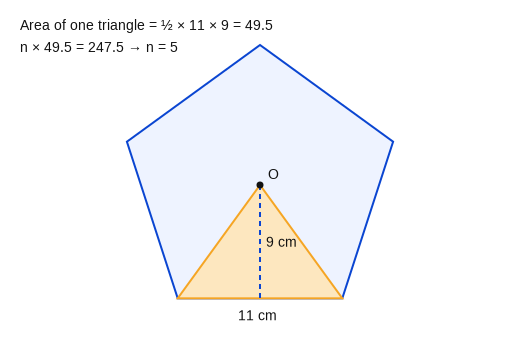
The area of a regular polygon with a side of 11 cm is 247.5 cm². If the perpendicular distance from the centre to the side of the polygon is 9 cm, what is the number of sides of the polygon?
11 cm भुजा वाले एक सम बहुभुज का क्षेत्रफल 247.5 cm² है। यदि केंद्र से बहुभुज की भुजा की लंबवत दूरी 9 cm है, तो बहुभुज की भुजाओं की संख्या कितनी है?
  1. A8
  2. B5
  3. C7
  4. D6
Show answer

Concept: A regular n-gon splits into n equal triangles: Area=n×12×a×r (r = distance from centre to side).

  1. One triangle =12×11×9=49.5cm2.
  2. n×49.5=247.5.
  3. n=247.549.5=5.

Trick: Area=12×Perimeter×r ⇒ perimeter =55, so n=5511=5.

Answer: (B) 5

अवधारणा: सम n-भुज n बराबर त्रिभुजों में बँटता है: क्षेत्रफल=n×12×a×r (r = केंद्र से भुजा की लंबवत दूरी)।

  1. एक त्रिभुज =12×11×9=49.5cm2।
  2. n×49.5=247.5।
  3. n=247.549.5=5।

ट्रिक: क्षेत्रफल=12×परिमाप×r ⇒ परिमाप =55, अतः n=5511=5।

उत्तर: (B) 5

RRB NTPC Undergraduate CBT 1MathematicsMensuration – Regular PolygonRRB NTPC Undergraduate CBT 1 2025 · 20 Jun Shift 3 →
Q11529.
The largest four-digit number which when divided by 6, 10 and 14 leaves remainder 3 in each case is:
चार अंकों की वह सबसे बड़ी संख्या, जिसे 6, 10 और 14 से विभाजित करने पर प्रत्येक स्थिति में शेषफल 3 प्राप्त होता है, कौन-सी है?
  1. A9873
  2. B9716
  3. C9889
  4. D9932
Show answer

Concept: Number =k×LCM+3.

  1. LCM(6,10,14)=210.
  2. 9999÷210 gives quotient 47, so largest multiple =47×210=9870.
  3. Add remainder: 9870+3=9873.

Trick: Check: 9873−3=9870 is divisible by 6, 10 and 14.

Answer: (A) 9873

अवधारणा: संख्या =k×LCM+3।

  1. LCM(6,10,14)=210।
  2. 9999÷210 का भागफल 47, अतः सबसे बड़ा गुणज =47×210=9870।
  3. शेष जोड़ें: 9870+3=9873।

ट्रिक: जाँच: 9873−3=9870 जो 6, 10 और 14 से विभाज्य है।

उत्तर: (A) 9873

RRB NTPC Undergraduate CBT 1MathematicsLCM – RemainderRRB NTPC Undergraduate CBT 1 2025 · 20 Jun Shift 3 →
Q11530.
If 6x−6x−1=180, then the value of 2x−12x+3 is:
यदि 6x−6x−1=180 है, तो 2x−12x+3 का मान क्या है?
  1. A514
  2. B59
  3. C56
  4. D512
Show answer

Concept: Take the lower power common: 6x−6x−1=6x−1(6−1).

  1. 5×6x−1=180 ⇒ 6x−1=36=62.
  2. So x−1=2, x=3.
  3. 2x−12x+3=59.

Trick: ax−ax−1=ax−1(a−1) – always factor out the smaller power.

Answer: (B) 59

अवधारणा: छोटी घात उभयनिष्ठ लें: 6x−6x−1=6x−1(6−1)।

  1. 5×6x−1=180 ⇒ 6x−1=36=62।
  2. अतः x−1=2, x=3।
  3. 2x−12x+3=59।

ट्रिक: ax−ax−1=ax−1(a−1) – हमेशा छोटी घात बाहर निकालें।

उत्तर: (B) 59

RRB NTPC Undergraduate CBT 1MathematicsIndices – Exponential EquationRRB NTPC Undergraduate CBT 1 2025 · 20 Jun Shift 3 →
Q11531.
S's expenditure is double the difference between his savings and expenditure. What percentage of his salary is his expenditure?
S का व्यय उसकी बचत और व्यय के अंतर का दोगुना है। उसका व्यय उसके वेतन का कितना प्रतिशत है?
  1. A40%
  2. B42%
  3. C46%
  4. D44%
Show answer

Concept: Salary =Expenditure(E)+Savings(S).

  1. Given E=2(S−E) ⇒ 3E=2S ⇒ E:S=2:3.
  2. Salary =2+3=5 parts.
  3. E%=25×100=40%.

Trick: Convert the condition to a ratio, then parttotal×100.

Answer: (A) 40%

अवधारणा: वेतन =व्यय(E)+बचत(S)।

  1. दिया है E=2(S−E) ⇒ 3E=2S ⇒ E:S=2:3।
  2. वेतन =2+3=5 भाग।
  3. E%=25×100=40%।

ट्रिक: शर्त को अनुपात में बदलें, फिर भागकुल×100।

उत्तर: (A) 40%

RRB NTPC Undergraduate CBT 1MathematicsPercentage – Savings and ExpenditureRRB NTPC Undergraduate CBT 1 2025 · 20 Jun Shift 3 →
Q11532.
A customer is given two options for purchasing a product priced at ₹8,000:
Option 1: A single discount of 30%.
Option 2: Successive discounts of 20% and 15%.
Which option provides a greater discount, and by how much?
एक ग्राहक को ₹8,000 मूल्य का एक उत्पाद खरीदने के लिए दो विकल्प दिए जाते हैं:
विकल्प 1: 30% की एकल छूट।
विकल्प 2: 20% और 15% की क्रमिक छूट।
कौन-सा विकल्प अधिक छूट देता है, और कितनी अधिक?
  1. AOption 2 and by ₹160विकल्प 2 और ₹160 अधिक
  2. BOption 1 and by ₹160विकल्प 1 और ₹160 अधिक
  3. COption 1 and by ₹150विकल्प 1 और ₹150 अधिक
  4. DOption 2 and by ₹150विकल्प 2 और ₹150 अधिक
Show answer

Concept: Successive discounts a%,b% = single (a+b−ab100)%.

  1. Option 1: 30% of 8000 =2400.
  2. Option 2: 20+15−300100=32% ⇒ 32% of 8000 =2560.
  3. Difference =2560−2400=160, Option 2 is better.

Trick: Difference =(32−30)% of 8000=2%×8000=160.

Answer: (A) Option 2 and by ₹160

अवधारणा: क्रमिक छूट a%,b% = एकल (a+b−ab100)%।

  1. विकल्प 1: 8000 का 30%=2400।
  2. विकल्प 2: 20+15−300100=32% ⇒ 8000 का 32%=2560।
  3. अंतर =2560−2400=160, विकल्प 2 अधिक छूट देता है।

ट्रिक: अंतर =(32−30)% × 8000 =160।

उत्तर: (A) Option 2 and by ₹160

RRB NTPC Undergraduate CBT 1MathematicsDiscount – Successive DiscountsRRB NTPC Undergraduate CBT 1 2025 · 20 Jun Shift 3 →
Q11533.
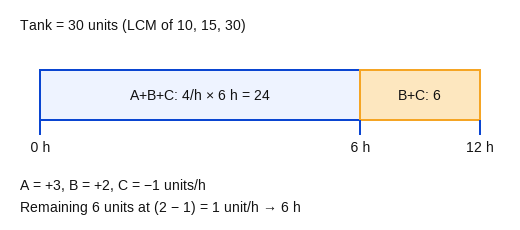
Pipe A can fill a cistern in 10 hours, pipe B in 15 hours, and pipe C can empty it in 30 hours. All three pipes are opened together. After 6 hours, pipe A is closed, but B and C continue working. How much total time will it take to completely fill the cistern?
पाइप A एक टंकी को 10 घंटे में, पाइप B 15 घंटे में भर सकता है, और पाइप C उसे 30 घंटे में खाली कर सकता है। तीनों पाइप एक साथ खोले जाते हैं। 6 घंटे बाद पाइप A बंद कर दिया जाता है, लेकिन B और C कार्य करते रहते हैं। टंकी को पूरी तरह भरने में कुल कितना समय लगेगा?
  1. A20 hours20 घंटे
  2. B10 hours10 घंटे
  3. C12 hours12 घंटे
  4. D15 hours15 घंटे
Show answer

Concept: Use LCM as tank capacity; emptying pipe has negative efficiency.

  1. Tank =LCM(10,15,30)=30 units; A =+3, B =+2, C =−1 per hour.
  2. First 6 h (all three): 4×6=24 units.
  3. Remaining 6 units by B + C at 1 unit/h ⇒ 6 h.
  4. Total time =6+6=12 h.

Trick: Efficiency method avoids fractions: units ÷ net rate = time.

Answer: (C) 12 hours

अवधारणा: LCM को टंकी की क्षमता मानें; खाली करने वाले पाइप की दक्षता ऋणात्मक।

  1. टंकी =LCM(10,15,30)=30 इकाई; A =+3, B =+2, C =−1 प्रति घंटा।
  2. पहले 6 घंटे (तीनों): 4×6=24 इकाई।
  3. शेष 6 इकाई B + C से 1 इकाई/घंटा ⇒ 6 घंटे।
  4. कुल समय =6+6=12 घंटे।

ट्रिक: दक्षता विधि: इकाई ÷ शुद्ध दर = समय।

उत्तर: (C) 12 hours

RRB NTPC Undergraduate CBT 1MathematicsPipes and CisternsRRB NTPC Undergraduate CBT 1 2025 · 20 Jun Shift 3 →
Q11534.
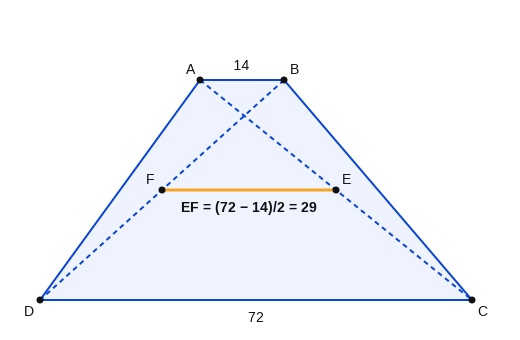
ABCD is a quadrilateral in which AB ∥ DC, and E and F are the mid points of the diagonals AC and BD, respectively. If AB = 14 cm, BC = 64 cm, DC = 72 cm, and AD = 47 cm, then what is the length (in cm) of EF?
ABCD एक चतुर्भुज है जिसमें AB ∥ DC है, और E तथा F क्रमशः विकर्णों AC और BD के मध्य-बिंदु हैं। यदि AB = 14 cm, BC = 64 cm, DC = 72 cm, और AD = 47 cm है, तो EF की लंबाई (cm में) कितनी है?
  1. A27
  2. B28
  3. C29
  4. D31
Show answer

Concept: In a trapezium, the segment joining the midpoints of the diagonals is parallel to the bases and equals half their difference.

  1. Here AB ∥ DC, so EF=DC−AB2.
  2. EF=72−142=582=29 cm.
  3. BC and AD are extra data (not needed).

Yaad rakhein: Midpoints of sides → half the sum; midpoints of diagonals → half the difference.

Answer: (C) 29

अवधारणा: समलंब में विकर्णों के मध्य-बिंदुओं को मिलाने वाला रेखाखंड आधारों के समांतर और उनके अंतर का आधा होता है।

  1. यहाँ AB ∥ DC, अतः EF=DC−AB2।
  2. EF=72−142=582=29 cm।
  3. BC और AD अतिरिक्त आँकड़े हैं।

याद रखें: भुजाओं के मध्य-बिंदु → योग का आधा; विकर्णों के मध्य-बिंदु → अंतर का आधा।

उत्तर: (C) 29

RRB NTPC Undergraduate CBT 1MathematicsGeometry – TrapeziumRRB NTPC Undergraduate CBT 1 2025 · 20 Jun Shift 3 →
Q11535.
If the median of the data x5,x,x3,2x3,x4,2x5 and 3x4, where x>0 is 8.4, then find the value of x.
यदि आँकड़ों x5,x,x3,2x3,x4,2x5 और 3x4, जहाँ x>0, की माध्यिका 8.4 है, तो x का मान ज्ञात कीजिए।
  1. A12
  2. B16
  3. C24
  4. D21
Show answer

Concept: Median of an odd number of terms = middle term after arranging in order.

  1. Since x>0: x5<x4<x3<2x5<2x3<3x4<x.
  2. 7 terms ⇒ median = 4th term =2x5.
  3. 2x5=8.4 ⇒ x=21.

Trick: Compare as decimals: 0.2,0.25,0.33,0.4,0.67,0.75,1.

Answer: (D) 21

अवधारणा: विषम संख्या के पदों की माध्यिका = क्रम में लगाने पर बीच का पद।

  1. x>0 होने से: x5<x4<x3<2x5<2x3<3x4<x।
  2. 7 पद ⇒ माध्यिका = चौथा पद =2x5।
  3. 2x5=8.4 ⇒ x=21।

ट्रिक: दशमलव में तुलना करें: 0.2,0.25,0.33,0.4,0.67,0.75,1।

उत्तर: (D) 21

RRB NTPC Undergraduate CBT 1MathematicsStatistics – MedianRRB NTPC Undergraduate CBT 1 2025 · 20 Jun Shift 3 →
Q11536.
An article is sold at a profit of 32%. If the cost price is increased by ₹20 and the selling price is reduced by ₹42, then the profit would be 27.5%. What is the original cost price (in ₹) of the article?
एक वस्तु 32% के लाभ पर बेची जाती है। यदि क्रय मूल्य में ₹20 की वृद्धि कर दी जाए और विक्रय मूल्य में ₹42 की कमी कर दी जाए, तो लाभ 27.5% होगा। वस्तु का मूल क्रय मूल्य (₹ में) क्या है?
  1. A1,500
  2. B1,800
  3. C1,200
  4. D1,700
Show answer

Concept: Write both situations in terms of the cost price x.

  1. Original SP =1.32x.
  2. New CP =x+20, new SP =1.32x−42, profit 27.5%.
  3. 1.32x−42=1.275(x+20)=1.275x+25.5 ⇒ 0.045x=67.5.
  4. x=1500.

Trick: Option check: CP 1500 ⇒ SP 1980; 1938=1.275×1520 ✓.

Answer: (A) ₹1,500

अवधारणा: दोनों स्थितियों को क्रय मूल्य x में लिखें।

  1. मूल SP =1.32x।
  2. नया CP =x+20, नया SP =1.32x−42, लाभ 27.5%।
  3. 1.32x−42=1.275(x+20)=1.275x+25.5 ⇒ 0.045x=67.5।
  4. x=1500।

ट्रिक: विकल्प जाँच: CP 1500 ⇒ SP 1980; 1938=1.275×1520 ✓।

उत्तर: (A) ₹1,500

RRB NTPC Undergraduate CBT 1MathematicsProfit and LossRRB NTPC Undergraduate CBT 1 2025 · 20 Jun Shift 3 →
Q11537.
Two taps can fill a cistern in 4 hours and 20 hours, respectively. A third tap can empty it in 20 hours. How long (in hours) will it take to fill one-fourth of the empty cistern if all the taps are opened together?
दो नल एक टंकी को क्रमशः 4 घंटे और 20 घंटे में भर सकते हैं। एक तीसरा नल उसे 20 घंटे में खाली कर सकता है। यदि सभी नल एक साथ खोल दिए जाएँ, तो खाली टंकी का एक-चौथाई भाग भरने में कितना समय (घंटों में) लगेगा?
  1. A3
  2. B4
  3. C2
  4. D1
Show answer

Concept: Net part filled per hour = sum of filling rates − emptying rate.

  1. Net rate =14+120−120=14 per hour.
  2. The 20-h filler and 20-h emptier cancel out.
  3. Time for 14 tank =1/41/4=1 hour.

Trick: Equal fill and empty times cancel – only the 4-h tap matters.

Answer: (D) 1

अवधारणा: प्रति घंटा शुद्ध भरा भाग = भरने की दरों का योग − खाली करने की दर।

  1. शुद्ध दर =14+120−120=14 प्रति घंटा।
  2. 20 घंटे वाला भरने और 20 घंटे वाला खाली करने वाला नल एक-दूसरे को निरस्त करते हैं।
  3. 14 टंकी का समय =1 घंटा।

ट्रिक: बराबर भरने-खाली करने के समय वाले नल निरस्त – केवल 4 घंटे वाला नल बचता है।

उत्तर: (D) 1

RRB NTPC Undergraduate CBT 1MathematicsPipes and CisternsRRB NTPC Undergraduate CBT 1 2025 · 20 Jun Shift 3 →
Q11538.
Simplify: 30 + [{-9 × (26 - 11 + 3)}]
सरल कीजिए: 30 + [{-9 × (26 - 11 + 3)}]
  1. A-132
  2. B-134
  3. C-135
  4. D-133
Show answer

Concept: Solve innermost bracket first (BODMAS).

  1. 26−11+3=18.
  2. −9×18=−162.
  3. 30+(−162)=−132.

Trick: Sign rule: 30−162 ⇒ answer negative, magnitude 132.

Answer: (A) −132

अवधारणा: सबसे भीतरी कोष्ठक पहले (BODMAS)।

  1. 26−11+3=18।
  2. −9×18=−162।
  3. 30+(−162)=−132।

ट्रिक: चिह्न नियम: 30−162 ⇒ उत्तर ऋणात्मक, मान 132।

उत्तर: (A) −132

RRB NTPC Undergraduate CBT 1MathematicsSimplification – BODMASRRB NTPC Undergraduate CBT 1 2025 · 20 Jun Shift 3 →
Q11539.
The 7-digit number 12A916B is divisible by 24. What is the maximum value of (A + B)?
7 अंकों की संख्या 12A916B, 24 से विभाज्य है। (A + B) का अधिकतम मान क्या है?
  1. A16
  2. B17
  3. C13
  4. D12
Show answer

Concept: 24=8×3 (coprime) ⇒ number must be divisible by both 8 and 3.

  1. By 8: last three digits 16B ⇒ 160 or 168, so B=0 or 8.
  2. By 3: digit sum =19+A+B must be a multiple of 3.
  3. For max, take B=8: 27+A ⇒ A=9 is allowed.
  4. Max A+B=9+8=17.

Trick: For a maximum, try the largest B first, then the largest valid A.

Answer: (B) 17

अवधारणा: 24=8×3 (सह-अभाज्य) ⇒ संख्या 8 और 3 दोनों से विभाज्य हो।

  1. 8 से: अंतिम तीन अंक 16B ⇒ 160 या 168, अतः B=0 या 8।
  2. 3 से: अंकों का योग =19+A+B, 3 का गुणज हो।
  3. अधिकतम के लिए B=8: 27+A ⇒ A=9 संभव।
  4. अधिकतम A+B=9+8=17।

ट्रिक: अधिकतम के लिए पहले सबसे बड़ा B, फिर सबसे बड़ा मान्य A लें।

उत्तर: (B) 17

RRB NTPC Undergraduate CBT 1MathematicsDivisibility RulesRRB NTPC Undergraduate CBT 1 2025 · 20 Jun Shift 3 →
Q11540.
The sum of two positive numbers is 88 and their product is 1927. The positive difference between them is:
दो धनात्मक संख्याओं का योग 88 है और उनका गुणनफल 1927 है। उनके बीच का धनात्मक अंतर कितना है?
  1. A17
  2. B26
  3. C6
  4. D21
Show answer

Concept: (a−b)2=(a+b)2−4ab.

  1. (a+b)2=882=7744.
  2. 4ab=4×1927=7708.
  3. (a−b)2=36 ⇒ a−b=6.

Trick: Numbers are 47 and 41: 47×41=1927 ✓.

Answer: (C) 6

अवधारणा: (a−b)2=(a+b)2−4ab।

  1. (a+b)2=882=7744।
  2. 4ab=4×1927=7708।
  3. (a−b)2=36 ⇒ a−b=6।

ट्रिक: संख्याएँ 47 और 41: 47×41=1927 ✓।

उत्तर: (C) 6

RRB NTPC Undergraduate CBT 1MathematicsAlgebraic IdentitiesRRB NTPC Undergraduate CBT 1 2025 · 20 Jun Shift 3 →