Question bank

Q&A: practice questions with answers

Search questions on any topic. Filter by exam category, exam, subject and topic, try the question, then open the answer and explanation.

Courses – airGurukul

20,719 questions found.

Q11661.
In a certain code language,
A ÷ B means ‘A is the son of B’,
A # B means ‘A is the wife of B’,
A + B means ‘A is the brother of B’ and
A & B means ‘A is the father of B’.
How is S related to H if ‘S + D & R # Y ÷ H’?
एक निश्चित कूट भाषा में,
A ÷ B का अर्थ है ‘A, B का पुत्र है’,
A # B का अर्थ है ‘A, B की पत्नी है’,
A + B का अर्थ है ‘A, B का भाई है’ और
A & B का अर्थ है ‘A, B का पिता है’।
यदि ‘S + D & R # Y ÷ H’ है, तो S का H से क्या संबंध है?
  1. ASon's wife's brother's sonपुत्र की पत्नी के भाई का पुत्र
  2. BWife's father's brotherपत्नी के पिता का भाई
  3. CSon's wife's father's brotherपुत्र की पत्नी के पिता का भाई
  4. DSon's wife's father's sisterपुत्र की पत्नी के पिता की बहन
Show answer

Concept: Decode each symbol and build the tree from H.
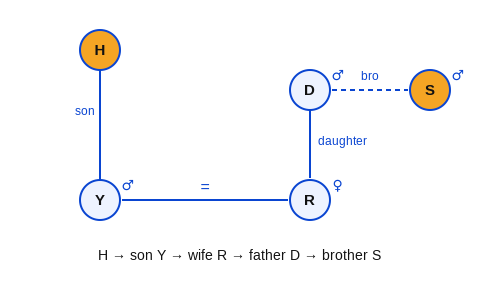
  1. Y ÷ H: Y is the son of H.
  2. R # Y: R is the wife of Y (H's son's wife).
  3. D & R: D is the father of R; S + D: S is the brother of D.
  4. So S is H's son's wife's father's brother.

Trick: Read the chain backwards from H: son → wife → father → brother.

Answer: (C) Son's wife's father's brother

अवधारणा: हर चिह्न को डिकोड कर H से वंश-वृक्ष बनाएँ।

  1. Y ÷ H: Y, H का पुत्र है।
  2. R # Y: R, Y की पत्नी है (H के पुत्र की पत्नी)।
  3. D & R: D, R का पिता है; S + D: S, D का भाई है।
  4. अतः S, H के पुत्र की पत्नी के पिता का भाई है।

Trick: H से उल्टा पढ़ें: पुत्र → पत्नी → पिता → भाई।

उत्तर: (C) पुत्र की पत्नी के पिता का भाई
RRB NTPC Undergraduate CBT 1General Intelligence and ReasoningBlood Relation – CodedRRB NTPC Undergraduate CBT 1 2025 · 20 Jun Shift 2 →
Q11662.
Seven boxes, G, H, I, L, M, N and O, are kept one over the other, but not necessarily in the same order.
No box is kept below L. Only four boxes are kept between M and L. H is kept above M. Only two boxes are kept between O and N. I is kept immediately above G. N is not kept immediately above I.
Which box is kept fourth from the bottom?
सात बक्से, G, H, I, L, M, N और O, एक के ऊपर एक रखे गए हैं, लेकिन जरूरी नहीं कि इसी क्रम में हों।
L के नीचे कोई बक्सा नहीं रखा गया है। M और L के बीच केवल चार बक्से रखे गए हैं। H को M के ऊपर रखा गया है। O और N के बीच केवल दो बक्से रखे गए हैं। I को G के ठीक ऊपर रखा गया है। N को I के ठीक ऊपर नहीं रखा गया है।
नीचे से चौथे स्थान पर कौन-सा बक्सा रखा गया है?
  1. AO
  2. BM
  3. CN
  4. DI
Show answer

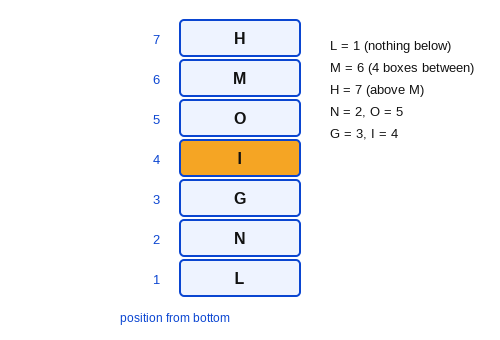
Concept: Number positions 1 (bottom) to 7 (top) and fix the definite clues first.

  1. No box below L → L = 1. Four boxes between M and L → M = 6. H above M → H = 7.
  2. Left: positions 2–5 for G, I, N, O. O and N need two boxes between them → 2 and 5.
  3. I immediately above G → G = 3, I = 4.
  4. N not immediately above I → N ≠ 5, so N = 2, O = 5. Fourth from bottom = I.

Trick: Start with words like 'no box below' – they fix an exact position.

Answer: (D) I

अवधारणा: स्थान 1 (नीचे) से 7 (ऊपर) मानें और पहले निश्चित संकेत लगाएँ।

  1. L के नीचे कोई नहीं → L = 1। M और L के बीच चार → M = 6। H, M के ऊपर → H = 7।
  2. बचे स्थान 2–5 में G, I, N, O। O और N के बीच दो बॉक्स → स्थान 2 और 5।
  3. I, G के ठीक ऊपर → G = 3, I = 4।
  4. N, I के ठीक ऊपर नहीं → N ≠ 5, अतः N = 2, O = 5। नीचे से चौथा = I।

Trick: 'नीचे कोई नहीं' जैसे संकेत सीधे स्थान तय करते हैं।

उत्तर: (D) I

RRB NTPC Undergraduate CBT 1General Intelligence and ReasoningBox ArrangementRRB NTPC Undergraduate CBT 1 2025 · 20 Jun Shift 2 →
Q11663.
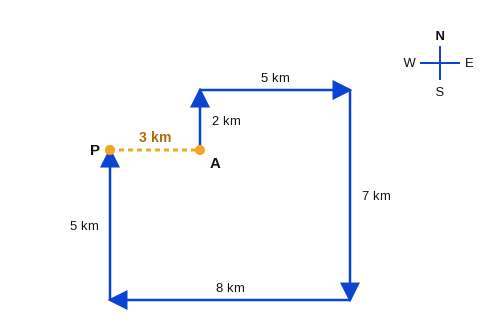
Anamika starts from Point A and drives 2 km towards the north. She then takes a right turn, drives 5 km, turns right and drives 7 km. She then takes a right turn and drives 8 km. She takes a final right turn, drives 5 km and stops at Point P. How far (shortest distance) and towards which direction should she drive in order to reach Point A again? (All turns are 90-degree turns only unless specified.)
अनामिका बिंदु A से शुरू करती है और उत्तर की ओर 2 km गाड़ी चलाती है। फिर वह दाएँ मुड़ती है, 5 km गाड़ी चलाती है, दाएँ मुड़ती है और 7 km गाड़ी चलाती है। फिर वह दाएँ मुड़ती है और 8 km गाड़ी चलाती है। वह अंतिम बार दाएँ मुड़ती है, 5 km गाड़ी चलाती है और बिंदु P पर रुक जाती है। फिर से बिंदु A तक पहुँचने के लिए उसे कितनी दूर (न्यूनतम दूरी) और किस दिशा में गाड़ी चलानी चाहिए? (जब तक निर्दिष्ट न किया जाए, सभी मोड़ केवल 90 डिग्री के मोड़ हैं।)
  1. A3 km to the eastपूर्व की ओर 3 km
  2. B2 km to the westपश्चिम की ओर 2 km
  3. C1 km to the eastपूर्व की ओर 1 km
  4. D4 km to the eastपूर्व की ओर 4 km
Show answer

Concept: Take A as origin; east and north positive.

  1. North 2 → (0, 2); right = east 5 → (5, 2).
  2. Right = south 7 → (5, −5); right = west 8 → (−3, −5).
  3. Right = north 5 → (−3, 0) = P.
  4. P is 3 km west of A, so she must drive 3 km to the east.

Trick: Net east-west: 5−8=−3 (3 km west); net north-south: 2−7+5=0.

Answer: (A) 3 km to the east

अवधारणा: A को मूल बिंदु मानें; पूर्व और उत्तर धनात्मक।

  1. उत्तर 2 → (0, 2); दाएँ = पूर्व 5 → (5, 2)।
  2. दाएँ = दक्षिण 7 → (5, −5); दाएँ = पश्चिम 8 → (−3, −5)।
  3. दाएँ = उत्तर 5 → (−3, 0) = P।
  4. P, A से 3 km पश्चिम है, अतः उसे 3 km पूर्व जाना होगा।

Trick: शुद्ध पूर्व-पश्चिम: 5−8=−3 (3 km पश्चिम); उत्तर-दक्षिण: 2−7+5=0।

उत्तर: (A) 3 km पूर्व की ओर

RRB NTPC Undergraduate CBT 1General Intelligence and ReasoningDirection & DistanceRRB NTPC Undergraduate CBT 1 2025 · 20 Jun Shift 2 →
Q11664.
Each vowel in the word CONTACT is changed to the letter immediately following it in the English alphabetical order and each consonant is changed to the letter immediately preceding it in the English alphabetical order. Which of the following letters will be first from the right in the new group of letters thus formed?
शब्द CONTACT के प्रत्येक स्वर को अंग्रेज़ी वर्णमाला क्रम में उसके ठीक बाद वाले अक्षर में बदल दिया जाता है और प्रत्येक व्यंजन को अंग्रेज़ी वर्णमाला क्रम में उसके ठीक पहले वाले अक्षर में बदल दिया जाता है। इस प्रकार बने अक्षरों के नए समूह में दाएँ से पहला अक्षर निम्नलिखित में से कौन-सा होगा?
  1. AT
  2. BR
  3. CS
  4. DU
Show answer

Concept: Vowel → next letter; consonant → previous letter.

  1. C→B, O→P, N→M, T→S, A→B, C→B, T→S.
  2. New group: B P M S B B S.
  3. First from the right = S.

Trick: Only the last letter matters: T is a consonant → S.

Answer: (C) S

अवधारणा: स्वर → अगला अक्षर; व्यंजन → पिछला अक्षर।

  1. C→B, O→P, N→M, T→S, A→B, C→B, T→S।
  2. नया समूह: B P M S B B S।
  3. दाएँ से पहला = S।

Trick: सिर्फ़ अंतिम अक्षर बदलें: T व्यंजन है → S।

उत्तर: (C) S

RRB NTPC Undergraduate CBT 1General Intelligence and ReasoningLetter CodingRRB NTPC Undergraduate CBT 1 2025 · 20 Jun Shift 2 →
Q11665.
Based on the English alphabetical order, three of the following four letter-cluster pairs are alike in a certain way and thus form a group. Which letter-cluster pair DOES NOT belong to that group?
(Note: The odd one out is not based on the number of consonants/vowels or their position in the letter-cluster.)
अंग्रेज़ी वर्णमाला क्रम के आधार पर, निम्नलिखित चार अक्षर-समूह युग्मों में से तीन किसी निश्चित प्रकार से एकसमान हैं और इस प्रकार एक समूह बनाते हैं। कौन-सा अक्षर-समूह युग्म उस समूह से संबंधित नहीं है?
(ध्यान दें: असंगत अक्षर-समूह, उस अक्षर-समूह में व्यंजनों/स्वरों की संख्या या उनके स्थान पर आधारित नहीं है।)
  1. AQM – XJ
  2. BHP – OM
  3. CRD – YA
  4. DLG – SC
Show answer

Concept: Compare the first letters (+7) and the second letters of the two clusters.

  1. QM – XJ: Q+7 = X, M−3 = J.
  2. HP – OM: H+7 = O, P−3 = M.
  3. RD – YA: R+7 = Y, D−3 = A.
  4. LG – SC: L+7 = S but G−4 = C (not −3). Odd one.

Trick: When all first letters fit, the odd one hides in the second letters.

Answer: (D) LG – SC

अवधारणा: दोनों समूहों के पहले अक्षर (+7) और दूसरे अक्षर की तुलना करें।

  1. QM – XJ: Q+7 = X, M−3 = J।
  2. HP – OM: H+7 = O, P−3 = M।
  3. RD – YA: R+7 = Y, D−3 = A।
  4. LG – SC: L+7 = S पर G−4 = C (−3 नहीं)। यही विषम है।

Trick: जब सभी पहले अक्षर सही हों, अंतर दूसरे अक्षरों में छिपा होता है।

उत्तर: (D) LG – SC

RRB NTPC Undergraduate CBT 1General Intelligence and ReasoningOdd Pair – LettersRRB NTPC Undergraduate CBT 1 2025 · 20 Jun Shift 2 →
Q11666.
Select the pair which follows the same pattern as that followed by the two sets of pairs given below. Both pairs follow the same pattern.
DKW : HEV
EGK : IAJ
उस युग्म का चयन कीजिए जो उसी पैटर्न का अनुसरण करता है जिसका अनुसरण नीचे दिए गए युग्मों के दो समुच्चयों द्वारा किया जाता है। दोनों युग्म एक ही पैटर्न का अनुसरण करते हैं।
DKW : HEV
EGK : IAJ
  1. ASOT : WJS
  2. BLRD : PLC
  3. CFQK : JKL
  4. DJGX : NAV
Show answer

Concept: Apply the letter-wise change: 1st +4, 2nd −6, 3rd −1.

  1. DKW : HEV → D+4 = H, K−6 = E, W−1 = V.
  2. EGK : IAJ → E+4 = I, G−6 = A, K−1 = J.
  3. LRD : PLC → L+4 = P, R−6 = L, D−1 = C ✓.
  4. SOT : WJS fails (O−6 = I, not J); FQK : JKL and JGX : NAV fail at the 3rd letter.

Trick: The '−1' on the last letter alone removes (C) and (D).

Answer: (B) LRD : PLC

अवधारणा: अक्षरवार बदलाव: पहला +4, दूसरा −6, तीसरा −1।

  1. DKW : HEV → D+4 = H, K−6 = E, W−1 = V।
  2. EGK : IAJ → E+4 = I, G−6 = A, K−1 = J।
  3. LRD : PLC → L+4 = P, R−6 = L, D−1 = C ✓।
  4. SOT : WJS में O−6 = I होना चाहिए, J नहीं; FQK : JKL और JGX : NAV तीसरे अक्षर पर गलत।

Trick: केवल अंतिम अक्षर का '−1' ही (C) और (D) को हटा देता है।

उत्तर: (B) LRD : PLC

RRB NTPC Undergraduate CBT 1General Intelligence and ReasoningLetter AnalogyRRB NTPC Undergraduate CBT 1 2025 · 20 Jun Shift 2 →
Q11667.
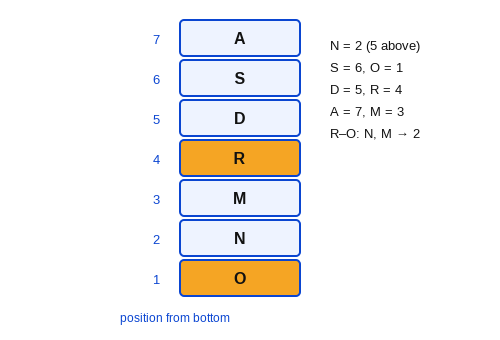
Seven boxes R, A, N, D, O, M and S are kept one over the other but not necessarily in the same order. Only five boxes are kept above N. Only three boxes are kept between N and S. O is kept at one of the positions below N. Only D is kept between S and R. A is kept at one of the positions above S. How many boxes are kept between R and O?
सात बक्से R, A, N, D, O, M और S एक के ऊपर एक रखे गए हैं, लेकिन जरूरी नहीं कि इसी क्रम में हों। N के ऊपर केवल पाँच बक्से रखे गए हैं। N और S के बीच केवल तीन बक्से रखे गए हैं। O को N के नीचे के किसी एक स्थान पर रखा गया है। S और R के बीच केवल D रखा गया है। A को S के ऊपर के किसी एक स्थान पर रखा गया है। R और O के बीच कितने बक्से रखे गए हैं?
  1. AThreeतीन
  2. BOneएक
  3. CFourचार
  4. DTwoदो
Show answer

Concept: Number positions 1 (bottom) to 7 (top).

  1. Five boxes above N → N = 2. Three boxes between N and S → S = 6.
  2. O below N → O = 1. Only D between S and R → D = 5, R = 4.
  3. A above S → A = 7; the remaining box M = 3.
  4. Between R (4) and O (1): N and M → two boxes.

Trick: Boxes between = difference of positions − 1 = 4−1−1=2.

Answer: (D) Two

अवधारणा: स्थान 1 (नीचे) से 7 (ऊपर) मानें।

  1. N के ऊपर पाँच → N = 2। N और S के बीच तीन → S = 6।
  2. O, N के नीचे → O = 1। S और R के बीच केवल D → D = 5, R = 4।
  3. A, S के ऊपर → A = 7; बचा M = 3।
  4. R (4) और O (1) के बीच: N और M → दो बॉक्स।

Trick: बीच के बॉक्स = स्थानों का अंतर − 1 = 4−1−1=2।

उत्तर: (D) दो

RRB NTPC Undergraduate CBT 1General Intelligence and ReasoningBox ArrangementRRB NTPC Undergraduate CBT 1 2025 · 20 Jun Shift 2 →
Q11668.
Based on the English alphabetical order, three of the following four letter-cluster pairs are alike in a certain way and thus form a group. Which is the one that does not belong to that group?
(Note: The odd one out is not based on the number of consonants/vowels or their position in the letter-cluster.)
अंग्रेज़ी वर्णमाला क्रम के आधार पर, निम्नलिखित चार अक्षर-समूह युग्मों में से तीन किसी निश्चित प्रकार से एकसमान हैं और इस प्रकार एक समूह बनाते हैं। वह कौन-सा युग्म है जो उस समूह से संबंधित नहीं है?
(ध्यान दें: असंगत अक्षर-समूह, उस अक्षर-समूह में व्यंजनों/स्वरों की संख्या या उनके स्थान पर आधारित नहीं है।)
  1. AKH - MJ
  2. BIF - KH
  3. CNK - PM
  4. DPM - NM
Show answer

Concept: In each cluster the second letter is 3 before the first, and the second cluster is +2 of the first.

  1. KH – MJ: K−3 = H, M−3 = J, K+2 = M.
  2. IF – KH: I−3 = F, K−3 = H, I+2 = K.
  3. NK – PM: N−3 = K, P−3 = M, N+2 = P.
  4. PM – NM: N−1 = M (not −3) and P−2 = N. Odd one.

Trick: Check the gap inside each cluster first – −3 everywhere except NM.

Answer: (D) PM - NM

अवधारणा: हर समूह में दूसरा अक्षर पहले से 3 पीछे है, और दूसरा समूह पहले से +2 है।

  1. KH – MJ: K−3 = H, M−3 = J, K+2 = M।
  2. IF – KH: I−3 = F, K−3 = H, I+2 = K।
  3. NK – PM: N−3 = K, P−3 = M, N+2 = P।
  4. PM – NM: N−1 = M (−3 नहीं) और P−2 = N। यही विषम है।

Trick: पहले हर समूह के अंदर का अंतर देखें – NM को छोड़ सब जगह −3।

उत्तर: (D) PM - NM

RRB NTPC Undergraduate CBT 1General Intelligence and ReasoningOdd Pair – LettersRRB NTPC Undergraduate CBT 1 2025 · 20 Jun Shift 2 →
Q11669.
If 3 is added to each odd digit and 2 is subtracted from each even digit in the number 8254316, then what will be the sum of the digits that are third from the left and third from the right in the new number thus formed?
यदि संख्या 8254316 के प्रत्येक विषम अंक में 3 जोड़ दिया जाए और प्रत्येक सम अंक में से 2 घटा दिया जाए, तो इस प्रकार बनी नई संख्या में बाएँ से तीसरे और दाएँ से तीसरे अंकों का योग क्या होगा?
  1. A14
  2. B13
  3. C15
  4. D12
Show answer

Concept: Odd digit +3, even digit −2, then pick positions.

  1. 8→6, 2→0, 5→8, 4→2, 3→6, 1→4, 6→4.
  2. New number: 6 0 8 2 6 4 4.
  3. Third from left = 8; third from right = 6.
  4. Sum =8+6=14.

Trick: Change only the needed digits: 3rd from left is 5 → 8, 3rd from right is 3 → 6.

Answer: (A) 14

अवधारणा: विषम अंक +3, सम अंक −2, फिर स्थान चुनें।

  1. 8→6, 2→0, 5→8, 4→2, 3→6, 1→4, 6→4।
  2. नई संख्या: 6 0 8 2 6 4 4।
  3. बाएँ से तीसरा = 8; दाएँ से तीसरा = 6।
  4. योग =8+6=14।

Trick: केवल ज़रूरी अंक बदलें: बाएँ से तीसरा 5 → 8, दाएँ से तीसरा 3 → 6।

उत्तर: (A) 14

RRB NTPC Undergraduate CBT 1General Intelligence and ReasoningDigit OperationsRRB NTPC Undergraduate CBT 1 2025 · 20 Jun Shift 2 →
Q11670.
In a certain code language, "JCPV" is coded as "51" and "DYSF" is coded as "48". What is the code for "HTOB" in that given language?
एक निश्चित कूट भाषा में, "JCPV" को "51" के रूप में और "DYSF" को "48" के रूप में कूटबद्ध किया जाता है। उसी भाषा में "HTOB" का कूट क्या है?
  1. A50
  2. B53
  3. C49
  4. D57
Show answer

Concept: Use reverse alphabet values (Z = 1, Y = 2 … A = 26), add them and subtract 6.

  1. JCPV: 17+24+11+5=57, 57−6=51 ✓.
  2. DYSF: 23+2+8+21=54, 54−6=48 ✓.
  3. HTOB: 19+7+12+25=63.
  4. Code =63−6=57.

Trick: Reverse value =27−forward value.

Answer: (D) 57

अवधारणा: उल्टे वर्णमाला मान (Z = 1, Y = 2 … A = 26) जोड़ें और 6 घटाएँ।

  1. JCPV: 17+24+11+5=57, 57−6=51 ✓।
  2. DYSF: 23+2+8+21=54, 54−6=48 ✓।
  3. HTOB: 19+7+12+25=63।
  4. कोड =63−6=57।

Trick: उल्टा मान =27−सीधा मान।

उत्तर: (D) 57

RRB NTPC Undergraduate CBT 1General Intelligence and ReasoningCoding–Decoding (Letter Values)RRB NTPC Undergraduate CBT 1 2025 · 20 Jun Shift 2 →
Q11671.
Refer to the following letter series and answer the question that follows. Counting to be done from left to right only.
(Left) R D A U F U E Q Y U M U Y G J S P B A J L Q S H (Right)
How many such consonants are there, each of which is immediately preceded by a vowel and also immediately followed by a consonant?
निम्नलिखित अक्षर शृंखला को देखिए और उसके बाद दिए गए प्रश्न का उत्तर दीजिए। गिनती केवल बाएँ से दाएँ की जानी है।
(बाएँ) R D A U F U E Q Y U M U Y G J S P B A J L Q S H (दाएँ)
ऐसे कितने व्यंजन हैं, जिनमें से प्रत्येक के ठीक पहले एक स्वर है और ठीक बाद में भी एक व्यंजन है?
  1. ATwoदो
  2. BFourचार
  3. CThreeतीन
  4. DOneएक
Show answer

Concept: Look for Vowel – Consonant – Consonant (Y is a consonant).

  1. E Q Y ✓.
  2. U Y G ✓.
  3. A J L ✓.
  4. U F U and U M U fail (followed by a vowel). Total = 3.

Trick: Locate every vowel first (A, U, U, E, U, U, A) and test the next two letters.

Answer: (C) Three

अवधारणा: ढाँचा स्वर – व्यंजन – व्यंजन खोजें (Y व्यंजन है)।

  1. E Q Y ✓।
  2. U Y G ✓।
  3. A J L ✓।
  4. U F U और U M U असफल (बाद में स्वर)। कुल = 3।

Trick: पहले सभी स्वर (A, U, U, E, U, U, A) ढूँढें और अगले दो अक्षर जाँचें।

उत्तर: (C) तीन

RRB NTPC Undergraduate CBT 1General Intelligence and ReasoningLetter Series – CountingRRB NTPC Undergraduate CBT 1 2025 · 20 Jun Shift 2 →
Q11672.
Which of the following letter-number clusters will replace the question mark (?) in the given series to make it logically complete?
PHX 80, TLB 73 , XPF 66 , BTJ 59, ?
दी गई शृंखला को तार्किक रूप से पूर्ण करने के लिए निम्नलिखित में से कौन-सा अक्षर-संख्या समूह प्रश्न चिह्न (?) के स्थान पर आएगा?
PHX 80, TLB 73 , XPF 66 , BTJ 59, ?
  1. AGYM 44
  2. BHYN 49
  3. CGWM 50
  4. DFXN 52
Show answer

Concept: Each letter moves +4 and the number decreases by 7.

  1. 1st letters: P, T, X, B, F (+4).
  2. 2nd letters: H, L, P, T, X (+4).
  3. 3rd letters: X, B, F, J, N (+4).
  4. Numbers: 80, 73, 66, 59, 52 (−7).

Trick: The number alone (−7 → 52) picks the answer.

Answer: (D) FXN 52

अवधारणा: हर अक्षर +4 बढ़ता है और संख्या 7 घटती है।

  1. पहले अक्षर: P, T, X, B, F (+4)।
  2. दूसरे अक्षर: H, L, P, T, X (+4)।
  3. तीसरे अक्षर: X, B, F, J, N (+4)।
  4. संख्याएँ: 80, 73, 66, 59, 52 (−7)।

Trick: केवल संख्या (−7 → 52) से उत्तर मिल जाता है।

उत्तर: (D) FXN 52

RRB NTPC Undergraduate CBT 1General Intelligence and ReasoningLetter-Number SeriesRRB NTPC Undergraduate CBT 1 2025 · 20 Jun Shift 2 →
Q11673.
In a certain code language, ‘zip sip unit’ is coded as ‘zm ax jn’ and ‘wife zip house’ is coded as ‘jn yc fj’. How is ‘zip’ coded in that language?
एक निश्चित कूट भाषा में, ‘zip sip unit’ को ‘zm ax jn’ के रूप में और ‘wife zip house’ को ‘jn yc fj’ के रूप में कूटबद्ध किया जाता है। उसी भाषा में ‘zip’ को किस प्रकार कूटबद्ध किया जाता है?
  1. Aax
  2. Bzm
  3. Cjn
  4. Dyc
Show answer

Concept: A word common to two sentences takes the code common to both codes.

  1. 'zip sip unit' → 'zm ax jn'.
  2. 'wife zip house' → 'jn yc fj'.
  3. Common word: zip; common code: jn.

Trick: Match the common word with the common code.

Answer: (C) jn

अवधारणा: दो वाक्यों में उभयनिष्ठ शब्द का कोड दोनों कोडों में उभयनिष्ठ होता है।

  1. 'zip sip unit' → 'zm ax jn'।
  2. 'wife zip house' → 'jn yc fj'।
  3. उभयनिष्ठ शब्द: zip; उभयनिष्ठ कोड: jn।

Trick: उभयनिष्ठ शब्द = उभयनिष्ठ कोड।

उत्तर: (C) jn

RRB NTPC Undergraduate CBT 1General Intelligence and ReasoningCoding – Common WordsRRB NTPC Undergraduate CBT 1 2025 · 20 Jun Shift 2 →
Q11674.
If ‘A’ stands for ‘+’, ‘B’ stands for ‘−’, ‘C’ stands for ‘×’ and ‘D’ stands for ‘÷’, what will come in place of the question mark (?) in the following equation?
34 B 45 D 5 A 2 C 4 = ?
यदि ‘A’ का अर्थ ‘+’, ‘B’ का अर्थ ‘−’, ‘C’ का अर्थ ‘×’ और ‘D’ का अर्थ ‘÷’ है, तो निम्नलिखित समीकरण में प्रश्न चिह्न (?) के स्थान पर क्या आएगा?
34 B 45 D 5 A 2 C 4 = ?
  1. A35
  2. B33
  3. C37
  4. D31
Show answer

Concept: Replace letters by signs, then apply BODMAS.

  1. Equation: 34−45÷5+2×4.
  2. 45÷5=9, 2×4=8.
  3. 34−9+8=33.

Trick: Do ÷ and × first, then + and −.

Answer: (B) 33

अवधारणा: अक्षरों के स्थान पर चिह्न रखें, फिर BODMAS लगाएँ।

  1. समीकरण: 34−45÷5+2×4।
  2. 45÷5=9, 2×4=8।
  3. 34−9+8=33।

Trick: पहले भाग और गुणा, फिर जोड़ और घटाव।

उत्तर: (B) 33

RRB NTPC Undergraduate CBT 1General Intelligence and ReasoningMathematical OperationsRRB NTPC Undergraduate CBT 1 2025 · 20 Jun Shift 2 →
Q11675.
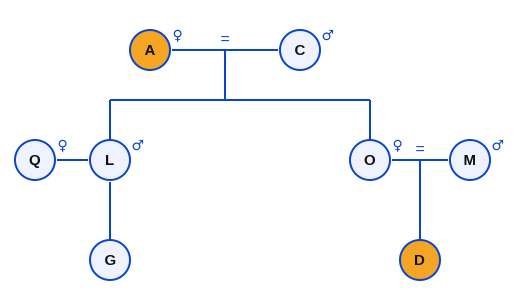
A is the wife of C. L and O are the son and daughter of C, respectively. Q is the wife of L and L is the father of G. M is the husband of O and M is the father of D. How is A related to D?
A, C की पत्नी है। L और O क्रमशः C के पुत्र और पुत्री हैं। Q, L की पत्नी है और L, G का पिता है। M, O का पति है और M, D का पिता है। A का D से क्या संबंध है?
  1. AMother's motherमाँ की माँ
  2. BMotherमाँ
  3. CSisterबहन
  4. DFather's motherपिता की माँ
Show answer

Concept: Draw the family tree with A–C as the top couple.

  1. A is C's wife; L (son) and O (daughter) are their children.
  2. M is O's husband and the father of D, so O is D's mother.
  3. A is O's mother → A is D's mother's mother.

Trick: D's link to A runs through the daughter O → maternal side.

Answer: (A) Mother's mother

अवधारणा: A–C को शीर्ष दंपति रखकर वंश-वृक्ष बनाएँ।

  1. A, C की पत्नी है; L (पुत्र) और O (पुत्री) उनकी संतान हैं।
  2. M, O का पति और D का पिता है, अतः O, D की माता है।
  3. A, O की माता है → A, D की माता की माता (नानी) है।

Trick: D का A से संबंध पुत्री O के रास्ते है → ननिहाल पक्ष।

उत्तर: (A) माता की माता

RRB NTPC Undergraduate CBT 1General Intelligence and ReasoningBlood RelationRRB NTPC Undergraduate CBT 1 2025 · 20 Jun Shift 2 →
Q11676.
What should come in place of ‘?’ in the given series?
47 61 78 98 121 147 ?
दी गई शृंखला में ‘?’ के स्थान पर क्या आना चाहिए?
47 61 78 98 121 147 ?
  1. A168
  2. B176
  3. C173
  4. D180
Show answer

Concept: Differences increase by 3.

  1. Differences: 14, 17, 20, 23, 26.
  2. Next difference =29.
  3. 147+29=176.

Trick: Second-level difference constant (3) → add the next difference.

Answer: (B) 176

अवधारणा: अंतर 3-3 से बढ़ रहे हैं।

  1. अंतर: 14, 17, 20, 23, 26।
  2. अगला अंतर =29।
  3. 147+29=176।

Trick: दूसरे स्तर का अंतर स्थिर (3) → अगला अंतर जोड़ें।

उत्तर: (B) 176

RRB NTPC Undergraduate CBT 1General Intelligence and ReasoningNumber SeriesRRB NTPC Undergraduate CBT 1 2025 · 20 Jun Shift 2 →
Q11677.
If + means -, - means ×, × means ÷, and ÷ means +, then what will come in place of the question mark (?) in the following equation?
41 - 16 ÷ 271 + 611 × 13 = ?
यदि + का अर्थ -, - का अर्थ ×, × का अर्थ ÷ और ÷ का अर्थ + है, तो निम्नलिखित समीकरण में प्रश्न चिह्न (?) के स्थान पर क्या आएगा?
41 - 16 ÷ 271 + 611 × 13 = ?
  1. A866
  2. B812
  3. C880
  4. D860
Show answer

Concept: Swap signs: + → −, − → ×, × → ÷, ÷ → +, then BODMAS.

  1. Equation: 41×16+271−611÷13.
  2. 41×16=656, 611÷13=47.
  3. 656+271−47=880.

Trick: Unit digit check: 6+1−7 ends in 0 → only 880 fits.

Answer: (C) 880

अवधारणा: चिह्न बदलें: + → −, − → ×, × → ÷, ÷ → +, फिर BODMAS।

  1. समीकरण: 41×16+271−611÷13।
  2. 41×16=656, 611÷13=47।
  3. 656+271−47=880।

Trick: इकाई अंक: 6+1−7 → 0 पर समाप्त → केवल 880।

उत्तर: (C) 880

RRB NTPC Undergraduate CBT 1General Intelligence and ReasoningMathematical OperationsRRB NTPC Undergraduate CBT 1 2025 · 20 Jun Shift 2 →
Q11678.
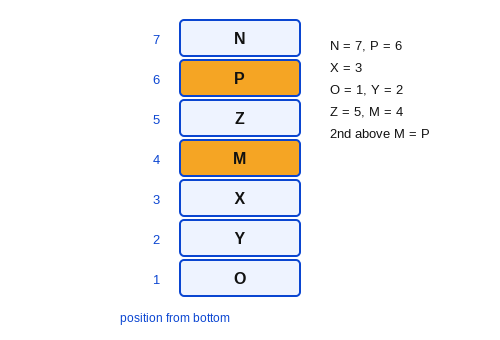
Seven boxes M, N, O, P, X, Y and Z are kept one over the other but not necessarily in the same order. Only N is kept above P. Only two boxes are kept between P and X. Only O is kept below Y. Z is not kept immediately above X. Which box is kept second above M?
सात बक्से M, N, O, P, X, Y और Z एक के ऊपर एक रखे गए हैं, लेकिन जरूरी नहीं कि इसी क्रम में हों। P के ऊपर केवल N रखा गया है। P और X के बीच केवल दो बक्से रखे गए हैं। Y के नीचे केवल O रखा गया है। Z को X के ठीक ऊपर नहीं रखा गया है। M से दूसरे स्थान ऊपर कौन-सा बक्सा रखा गया है?
  1. AZ
  2. BO
  3. CX
  4. DP
Show answer

Concept: Number positions 1 (bottom) to 7 (top).

  1. Only N above P → N = 7, P = 6. Two boxes between P and X → X = 3.
  2. Only O below Y → O = 1, Y = 2.
  3. M and Z take 4 and 5; Z not immediately above X → Z = 5, M = 4.
  4. Second above M (position 6) = P.

Trick: 'Only N above P' fixes the top two boxes at once.

Answer: (D) P

अवधारणा: स्थान 1 (नीचे) से 7 (ऊपर) मानें।

  1. P के ऊपर केवल N → N = 7, P = 6। P और X के बीच दो → X = 3।
  2. Y के नीचे केवल O → O = 1, Y = 2।
  3. M, Z को 4 और 5; Z, X के ठीक ऊपर नहीं → Z = 5, M = 4।
  4. M से दूसरा ऊपर (स्थान 6) = P।

Trick: 'P के ऊपर केवल N' से ऊपर के दोनों बॉक्स तय हो जाते हैं।

उत्तर: (D) P

RRB NTPC Undergraduate CBT 1General Intelligence and ReasoningBox ArrangementRRB NTPC Undergraduate CBT 1 2025 · 20 Jun Shift 2 →
Q11679.
Read the given statements and conclusions carefully. You have to take the given statements to be true even if they seem to be at variance from commonly known facts. You have to decide which conclusion(s) logically follow(s) from the given statements. Statements: Some butters are vegetables. All scales are vegetables.
Conclusions (I) Some butters are scales.
Conclusions (II) All vegetables are scales.
दिए गए कथनों और निष्कर्षों को ध्यानपूर्वक पढ़िए। आपको दिए गए कथनों को सत्य मानना है, भले ही वे सामान्यतः ज्ञात तथ्यों से भिन्न प्रतीत होते हों। आपको निर्णय करना है कि कौन-सा/से निष्कर्ष दिए गए कथनों का तार्किक रूप से अनुसरण करता है/करते हैं। कथन: कुछ बटर, सब्ज़ियाँ हैं। सभी स्केल, सब्ज़ियाँ हैं।
निष्कर्ष (I) कुछ बटर, स्केल हैं।
निष्कर्ष (II) सभी सब्ज़ियाँ, स्केल हैं।
  1. AOnly conclusion (I) followsकेवल निष्कर्ष (I) अनुसरण करता है
  2. BNeither conclusion (I) nor (II) followsन तो निष्कर्ष (I) और न ही (II) अनुसरण करता है
  3. COnly conclusion (II) followsकेवल निष्कर्ष (II) अनुसरण करता है
  4. DBoth conclusions (I) and (II) followनिष्कर्ष (I) और (II) दोनों अनुसरण करते हैं
Show answer

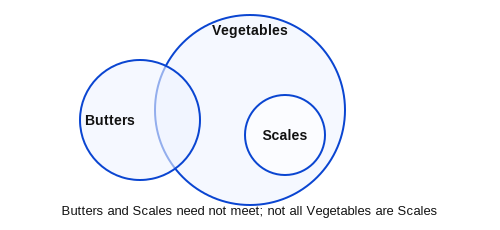
Concept: Draw the least-overlap Venn diagram allowed by the statements.

  1. Some butters are vegetables; all scales are vegetables.
  2. Butters and scales both touch vegetables, but need not touch each other → I does not follow.
  3. 'All scales are vegetables' does not give 'all vegetables are scales' → II does not follow.

Trick: Two 'some/all' links through the middle term give no definite link between the ends.

Answer: (B) Neither conclusion (I) nor (II) follows

अवधारणा: कथनों के अनुसार न्यूनतम-अतिव्यापन वाला वेन आरेख बनाएँ।

  1. कुछ butters, vegetables हैं; सभी scales, vegetables हैं।
  2. butters और scales दोनों vegetables से जुड़े हैं, पर आपस में जुड़ना ज़रूरी नहीं → I नहीं।
  3. 'सभी scales vegetables हैं' से 'सभी vegetables scales हैं' नहीं निकलता → II नहीं।

Trick: बीच के पद से 'कुछ/सभी' जुड़ाव होने पर छोरों में निश्चित संबंध नहीं बनता।

उत्तर: (B) न तो निष्कर्ष (I) न (II) अनुसरण करता है

RRB NTPC Undergraduate CBT 1General Intelligence and ReasoningSyllogismRRB NTPC Undergraduate CBT 1 2025 · 20 Jun Shift 2 →
Q11680.
What should come in place of the question mark (?) in the given series based on the English alphabetical order?
OSR NRQ MQP LPO ?
अंग्रेज़ी वर्णमाला क्रम के आधार पर दी गई शृंखला में प्रश्न चिह्न (?) के स्थान पर क्या आना चाहिए?
OSR NRQ MQP LPO ?
  1. AKNM
  2. BKON
  3. CKPM
  4. DKLN
Show answer

Concept: Every letter of each group moves one step back.

  1. 1st letters: O, N, M, L, K.
  2. 2nd letters: S, R, Q, P, O.
  3. 3rd letters: R, Q, P, O, N.

Trick: Each group is the previous group with every letter −1.

Answer: (B) KON

अवधारणा: हर समूह का हर अक्षर एक स्थान पीछे जाता है।

  1. पहले अक्षर: O, N, M, L, K।
  2. दूसरे अक्षर: S, R, Q, P, O।
  3. तीसरे अक्षर: R, Q, P, O, N।

Trick: हर समूह = पिछला समूह, प्रत्येक अक्षर −1।

उत्तर: (B) KON

RRB NTPC Undergraduate CBT 1General Intelligence and ReasoningLetter SeriesRRB NTPC Undergraduate CBT 1 2025 · 20 Jun Shift 2 →