Question bank

Q&A: practice questions with answers

Search questions on any topic. Filter by exam category, exam, subject and topic, try the question, then open the answer and explanation.

Courses – airGurukul

20,719 questions found.

Q11741.
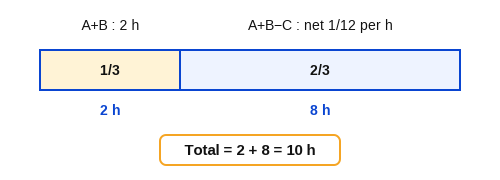
A tank is full. Pipes A and B can drain the tank in 10 hours and 15 hours, respectively, while pipe C can fill the tank in 12 hours. Pipes A and B run for 2 hours, after which pipe C is also turned on. How many hours will it take to empty the tank completely?
एक टंकी पूरी भरी हुई है। पाइप A और B टंकी को क्रमशः 10 घंटे और 15 घंटे में खाली कर सकते हैं, जबकि पाइप C टंकी को 12 घंटे में भर सकता है। पाइप A और B 2 घंटे तक चलते हैं, जिसके बाद पाइप C को भी खोल दिया जाता है। टंकी को पूरी तरह खाली होने में कितने घंटे लगेंगे?
  1. A10 hours10 घंटे
  2. B4 hours4 घंटे
  3. C8 hours8 घंटे
  4. D6 hours6 घंटे
Show answer

Concept: Rates add: draining pipes +, filling pipe − (taking tank = 1).

  1. A + B drain 110+115=16 per h; in 2 h → 13 drained, 23 left.
  2. With C: net 16−112=112 per h.
  3. Time =23÷112=8 h; total from start =2+8=10 h.

Trick: LCM 60 units: A = 6, B = 4, C = −5; first 2 h drain 20, then 40 at 5 per h = 8 h.

Answer: (A) 10 hours

अवधारणा: दर जोड़ें: खाली करने वाले पाइप +, भरने वाला पाइप − (टंकी = 1)।

  1. A + B: 110+115=16 प्रति घंटा; 2 घंटे में 13 खाली, 23 शेष।
  2. C के साथ शुद्ध दर 16−112=112 प्रति घंटा।
  3. समय =23÷112=8 घंटे; शुरुआत से कुल =2+8=10 घंटे।

ट्रिक: LCM 60 इकाई: A = 6, B = 4, C = −5; पहले 2 घंटे में 20, फिर 40 इकाई 5 प्रति घंटा = 8 घंटे।

उत्तर: (A) 10 घंटे
RRB NTPC Undergraduate CBT 1MathematicsPipes and CisternRRB NTPC Undergraduate CBT 1 2025 · 20 Jun Shift 1 →
Q11742.
Simplify: {1227÷122}÷(111×223+59)+29÷3322 of 229
सरल कीजिए: {1227÷122}÷(111×223+59)+29÷3322 of 229
  1. A1441
  2. B433
  3. C−18
  4. D923
Show answer

Concept: BODMAS: brackets first, and "of" is done before ÷.

  1. 1227÷122=1227×212=227
  2. 111×223+59=23+59=119
  3. 227÷119=233
  4. 3322 of 229=339, so 29÷339=233
  5. Sum =233+233=433

Trick: "of" means multiply and has higher priority than ÷.

Answer: (B) 433

अवधारणा: BODMAS: पहले कोष्ठक, और "of" (का) ÷ से पहले।

  1. 1227÷122=1227×212=227
  2. 111×223+59=23+59=119
  3. 227÷119=233
  4. 3322 of 229=339, अतः 29÷339=233
  5. योग =233+233=433

ट्रिक: "of" = गुणा, और इसकी प्राथमिकता ÷ से अधिक है।

उत्तर: (B) 433

RRB NTPC Undergraduate CBT 1MathematicsSimplification (BODMAS)RRB NTPC Undergraduate CBT 1 2025 · 20 Jun Shift 1 →
Q11743.
20 note books, 100 pens and 50 pencils were bought for ₹3,500. If the average cost of a note book is ₹50 and that of a pencil is ₹10, find the average cost of a pen.
20 नोटबुक, 100 पेन और 50 पेंसिलें ₹3,500 में खरीदी गईं। यदि एक नोटबुक की औसत लागत ₹50 और एक पेंसिल की औसत लागत ₹10 है, तो एक पेन की औसत लागत ज्ञात कीजिए।
  1. A₹20
  2. B₹25
  3. C₹15
  4. D₹16
Show answer

Concept: Total cost = sum of (number × average cost) of each item.

  1. Notebooks: 20×50=1000; pencils: 50×10=500
  2. Pens: 3500−1000−500=2000
  3. Average per pen =2000100=20

Trick: Subtract the known totals first, then divide.

Answer: (A) ₹20

अवधारणा: कुल लागत = हर वस्तु की (संख्या × औसत लागत) का योग।

  1. नोटबुक: 20×50=1000; पेंसिल: 50×10=500
  2. पेन: 3500−1000−500=2000
  3. प्रति पेन औसत =2000100=20

ट्रिक: पहले ज्ञात कुल घटाएँ, फिर भाग दें।

उत्तर: (A) ₹20

RRB NTPC Undergraduate CBT 1MathematicsAverageRRB NTPC Undergraduate CBT 1 2025 · 20 Jun Shift 1 →
Q11744.
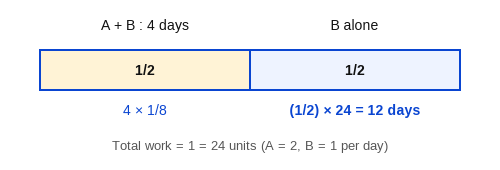
A and B can do a piece of work in 12 days and 24 days, respectively. Both work for 4 days and then A leaves. How long (in days) will B take to complete the remaining work?
A और B किसी कार्य को क्रमशः 12 दिनों और 24 दिनों में कर सकते हैं। दोनों 4 दिनों तक कार्य करते हैं और फिर A कार्य छोड़ देता है। शेष कार्य को पूरा करने में B को कितना समय (दिनों में) लगेगा?
  1. A14
  2. B13
  3. C11
  4. D12
Show answer

Concept: Take total work = LCM of days; one-day work = units per day.

  1. Work =24 units; A =2, B =1 unit/day.
  2. In 4 days together: 4×3=12 units.
  3. Remaining 12 units by B: 121=12 days.

Trick: Together they finish half in 4 days; B alone does half in 242=12 days.

Answer: (D) 12

अवधारणा: कुल कार्य = दिनों का LCM; एक दिन का कार्य = इकाइयाँ प्रति दिन।

  1. कार्य =24 इकाई; A =2, B =1 इकाई/दिन।
  2. 4 दिन साथ में: 4×3=12 इकाई।
  3. शेष 12 इकाई B: 121=12 दिन।

ट्रिक: दोनों 4 दिन में आधा काम करते हैं; B अकेला आधा 242=12 दिन में।

उत्तर: (D) 12

RRB NTPC Undergraduate CBT 1MathematicsTime and WorkRRB NTPC Undergraduate CBT 1 2025 · 20 Jun Shift 1 →
Q11745.
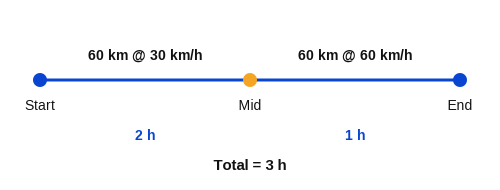
A person travels half of a total distance at 30 km/h and the remaining half at 60 km/h. If the total distance is 120 km, how much time does the person take to complete the entire journey?
एक व्यक्ति कुल दूरी का आधा भाग 30 km/h की चाल से और शेष आधा भाग 60 km/h की चाल से तय करता है। यदि कुल दूरी 120 km है, तो व्यक्ति को पूरी यात्रा पूरी करने में कितना समय लगता है?
  1. A3 hours3 घंटे
  2. B5 hours5 घंटे
  3. C4 hours4 घंटे
  4. D2.5 hours2.5 घंटे
Show answer

Concept: Find time for each half separately: Time=DistanceSpeed.

  1. Each half =60 km.
  2. 6030=2 h and 6060=1 h
  3. Total =3 h

Trick: Average speed =2×30×6090=40 km/h → 12040=3 h.

Answer: (A) 3 hours

अवधारणा: हर आधे भाग का समय अलग निकालें: समय=दूरीचाल।

  1. हर आधा =60 km।
  2. 6030=2 घंटे और 6060=1 घंटा
  3. कुल =3 घंटे

ट्रिक: औसत चाल =2×30×6090=40 km/h → 12040=3 घंटे।

उत्तर: (A) 3 घंटे

RRB NTPC Undergraduate CBT 1MathematicsTime and DistanceRRB NTPC Undergraduate CBT 1 2025 · 20 Jun Shift 1 →
Q11746.
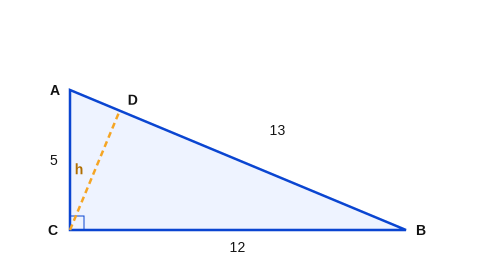
A triangle has sides of lengths 5 cm, 12 cm, and 13 cm. If a perpendicular is drawn from the vertex opposite the longest side to the longest side, what is the length of the perpendicular? (Rounded off to two decimal places)
एक त्रिभुज की भुजाओं की लंबाइयाँ 5 cm, 12 cm और 13 cm हैं। यदि सबसे लंबी भुजा के सम्मुख शीर्ष से सबसे लंबी भुजा पर एक लंब डाला जाए, तो लंब की लंबाई कितनी है? (दशमलव के दो स्थानों तक पूर्णांकित)
  1. A6.51 cm
  2. B5.37 cm
  3. C5.08 cm
  4. D4.62 cm
Show answer

Concept: 52+122=132, so the triangle is right-angled. Altitude to the hypotenuse =product of legshypotenuse.

  1. Area =12×5×12=30
  2. Also area =12×13×h
  3. h=6013≈4.615≈4.62 cm

Trick: Altitude on hypotenuse =abc; it is always less than the shorter leg (5).

Answer: (D) 4.62 cm

अवधारणा: 52+122=132, अतः त्रिभुज समकोण है। कर्ण पर लंब =भुजाओं का गुणनफलकर्ण।

  1. क्षेत्रफल =12×5×12=30
  2. साथ ही क्षेत्रफल =12×13×h
  3. h=6013≈4.615≈4.62 cm

ट्रिक: कर्ण पर लंब =abc; यह छोटी भुजा (5) से हमेशा कम होता है।

उत्तर: (D) 4.62 cm

RRB NTPC Undergraduate CBT 1MathematicsGeometry – Right TriangleRRB NTPC Undergraduate CBT 1 2025 · 20 Jun Shift 1 →
Q11747.
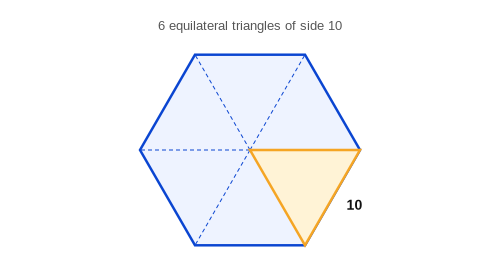
A city is planning a new park in the shape of a regular hexagon with each side measuring 10 meters. Which of the following is closest to the area of the park?
एक शहर एक समषट्भुज के आकार के एक नए पार्क की योजना बना रहा है, जिसकी प्रत्येक भुजा 10 मीटर है। निम्नलिखित में से कौन-सा पार्क के क्षेत्रफल के सबसे निकट है?
  1. A173.2 square meters173.2 वर्ग मीटर
  2. B259.8 square meters259.8 वर्ग मीटर
  3. C150 square meters150 वर्ग मीटर
  4. D600 square meters600 वर्ग मीटर
Show answer

Concept: A regular hexagon = 6 equilateral triangles: Area =332a2.

  1. a=10, a2=100
  2. Area =3×1.7322×100=2.598×100
  3. ≈259.8 m²

Trick: 173.2 is the area of just 4 such triangles — a common trap.

Answer: (B) 259.8 square meters

अवधारणा: समषट्भुज = 6 समबाहु त्रिभुज: क्षेत्रफल =332a2।

  1. a=10, a2=100
  2. क्षेत्रफल =3×1.7322×100=2.598×100
  3. ≈259.8 वर्ग मीटर

ट्रिक: 173.2 केवल 4 त्रिभुजों का क्षेत्रफल है — आम जाल।

उत्तर: (B) 259.8 वर्ग मीटर

RRB NTPC Undergraduate CBT 1MathematicsMensuration – Regular HexagonRRB NTPC Undergraduate CBT 1 2025 · 20 Jun Shift 1 →
Q11748.
A shopkeeper buys an article for ₹500 and sells it for ₹575. What is the percentage profit?
एक दुकानदार एक वस्तु ₹500 में खरीदता है और उसे ₹575 में बेचता है। प्रतिशत लाभ कितना है?
  1. A20%
  2. B15%
  3. C12.5%
  4. D10%
Show answer

Concept: Profit%=ProfitCP×100.

  1. Profit =575−500=75
  2. 75500×100=15%

Trick: Profit % is always on cost price, not selling price.

Answer: (B) 15%

अवधारणा: लाभ%=लाभक्रय मूल्य×100।

  1. लाभ =575−500=75
  2. 75500×100=15%

ट्रिक: लाभ % हमेशा क्रय मूल्य (CP) पर।

उत्तर: (B) 15%

RRB NTPC Undergraduate CBT 1MathematicsProfit PercentageRRB NTPC Undergraduate CBT 1 2025 · 20 Jun Shift 1 →
Q11749.
Priya invested ₹3200 in a bank at a simple interest rate of 12% per annum. If she kept her money in the bank for 5 years, what will be the total interest earned?
प्रिया ने 12% वार्षिक साधारण ब्याज दर पर एक बैंक में ₹3200 का निवेश किया। यदि उसने अपना धन 5 वर्षों तक बैंक में रखा, तो अर्जित कुल ब्याज कितना होगा?
  1. A₹1910
  2. B₹1930
  3. C₹1920
  4. D₹1940
Show answer

Concept: SI=P×R×T100.

  1. SI=3200×12×5100
  2. =32×60=1920

Trick: Total rate =12×5=60%; 60% of 3200 =1920.

Answer: (C) ₹1920

अवधारणा: SI=P×R×T100।

  1. SI=3200×12×5100
  2. =32×60=1920

ट्रिक: कुल दर =12×5=60%; 3200 का 60% =1920।

उत्तर: (C) ₹1920

RRB NTPC Undergraduate CBT 1MathematicsSimple InterestRRB NTPC Undergraduate CBT 1 2025 · 20 Jun Shift 1 →
Q11750.
Which of the following numbers are not divisible by 68?
( i ) 17350
( ii ) 23800
( iii ) 28560
( iv ) 35350
निम्नलिखित में से कौन-सी संख्याएँ 68 से विभाज्य नहीं हैं?
( i ) 17350
( ii ) 23800
( iii ) 28560
( iv ) 35350
  1. A( iii ) and ( iv )( iii ) और ( iv )
  2. B( ii ) and ( iii )( ii ) और ( iii )
  3. C( i ) and ( iv )( i ) और ( iv )
  4. D( i ) and ( ii )( i ) और ( ii )
Show answer

Concept: 68=4×17; a number must be divisible by both 4 and 17.

  1. Test by 4 (last two digits): 17350 → 50 ✗; 35350 → 50 ✗.
  2. 23800 =68×350 ✓; 28560 =68×420 ✓.
  3. Not divisible: (i) and (iv).

Trick: The quick test by 4 eliminates (i) and (iv) at once.

Answer: (C) ( i ) and ( iv )

अवधारणा: 68=4×17; संख्या 4 और 17 दोनों से विभाज्य होनी चाहिए।

  1. 4 की जाँच (अंतिम दो अंक): 17350 → 50 ✗; 35350 → 50 ✗।
  2. 23800 =68×350 ✓; 28560 =68×420 ✓।
  3. विभाज्य नहीं: (i) और (iv)।

ट्रिक: 4 का त्वरित परीक्षण ही (i) और (iv) को हटा देता है।

उत्तर: (C) ( i ) और ( iv )

RRB NTPC Undergraduate CBT 1MathematicsDivisibilityRRB NTPC Undergraduate CBT 1 2025 · 20 Jun Shift 1 →
Q11751.
Find the greatest number that will divide 186, 321 and 402 so as to leave the same remainder in each case.
वह सबसे बड़ी संख्या ज्ञात कीजिए जिससे 186, 321 और 402 को विभाजित करने पर प्रत्येक स्थिति में समान शेषफल प्राप्त हो।
  1. A23
  2. B19
  3. C13
  4. D27
Show answer

Concept: Greatest number leaving the same remainder = HCF of the differences of the numbers.

  1. 321−186=135, 402−321=81, 402−186=216
  2. 135=27×5, 81=27×3, 216=27×8
  3. HCF =27

Trick: Same remainder → take differences, then HCF.

Answer: (D) 27

अवधारणा: समान शेषफल छोड़ने वाली सबसे बड़ी संख्या = संख्याओं के अंतरों का HCF।

  1. 321−186=135, 402−321=81, 402−186=216
  2. 135=27×5, 81=27×3, 216=27×8
  3. HCF =27

ट्रिक: समान शेषफल → अंतर लें, फिर HCF।

उत्तर: (D) 27

RRB NTPC Undergraduate CBT 1MathematicsHCF – Same RemainderRRB NTPC Undergraduate CBT 1 2025 · 20 Jun Shift 1 →
Q11752.
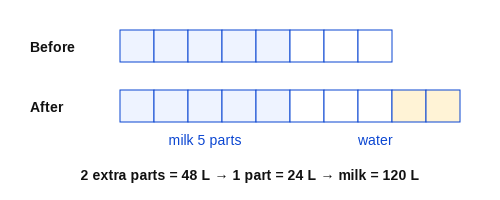
A mixture contains milk and water in the ratio 5:3. If 48 liters of water is added, the ratio becomes 5:5. Find the initial quantity of milk.
एक मिश्रण में दूध और पानी का अनुपात 5:3 है। यदि इसमें 48 लीटर पानी मिलाया जाए, तो अनुपात 5:5 हो जाता है। दूध की प्रारंभिक मात्रा ज्ञात कीजिए।
  1. A125 liters125 लीटर
  2. B120 liters120 लीटर
  3. C110 liters110 लीटर
  4. D115 liters115 लीटर
Show answer

Concept: Milk does not change; only water increases.

  1. Milk =5x, water =3x.
  2. 5x3x+48=55 ⇒ 3x+48=5x ⇒ x=24
  3. Milk =5×24=120 L

Trick: Water parts go from 3 to 5: 2 parts = 48 L.

Answer: (B) 120 liters

अवधारणा: दूध नहीं बदलता; केवल पानी बढ़ता है।

  1. दूध =5x, पानी =3x।
  2. 5x3x+48=55 ⇒ 3x+48=5x ⇒ x=24
  3. दूध =5×24=120 लीटर

ट्रिक: पानी के भाग 3 से 5: 2 भाग = 48 लीटर।

उत्तर: (B) 120 लीटर

RRB NTPC Undergraduate CBT 1MathematicsMixture and RatioRRB NTPC Undergraduate CBT 1 2025 · 20 Jun Shift 1 →
Q11753.
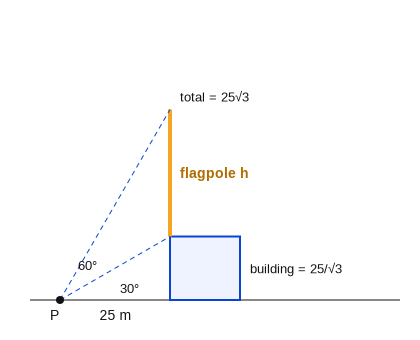
A flagpole stands on top of a building. From a point 25 metres away from the base of the building, the angle of elevation to the top of the flagpole is 60°, and to the top of the building is 30°. What is the height of the flagpole? (Round your answer off to the nearest metre, and use √3=1.7)
एक इमारत के शीर्ष पर एक ध्वज-स्तंभ खड़ा है। इमारत के आधार से 25 मीटर दूर स्थित एक बिंदु से ध्वज-स्तंभ के शीर्ष का उन्नयन कोण 60° है, और इमारत के शीर्ष का उन्नयन कोण 30° है। ध्वज-स्तंभ की ऊँचाई कितनी है? (अपने उत्तर को निकटतम मीटर तक पूर्णांकित कीजिए, और √3=1.7 का उपयोग कीजिए)
  1. A30 m
  2. B35 m
  3. C29 m
  4. D31 m
Show answer

Concept: tanθ=heightbase with base =25 m for both angles.

  1. Building: 25tan30∘=253
  2. Building + pole: 25tan60∘=253
  3. Pole =253−253=503≈28.9≈29 m

Trick: For angles 30∘ and 60∘ from the same point, pole =2× building.

Answer: (C) 29 m

अवधारणा: tanθ=ऊँचाईआधार, दोनों कोणों के लिए आधार =25 m।

  1. भवन: 25tan30∘=253
  2. भवन + ध्वज-स्तंभ: 25tan60∘=253
  3. ध्वज-स्तंभ =253−253=503≈28.9≈29 m

ट्रिक: एक ही बिंदु से 30∘ और 60∘ हों तो स्तंभ =2× भवन।

उत्तर: (C) 29 m

RRB NTPC Undergraduate CBT 1MathematicsHeights and DistancesRRB NTPC Undergraduate CBT 1 2025 · 20 Jun Shift 1 →
Q11754.
Simplify: 196−81+(16)2
सरल कीजिए: 196−81+(16)2
  1. A21
  2. B5
  3. C7
  4. D14
Show answer

Concept: (a)2=a; evaluate each root first.

  1. 196=14, 81=9
  2. (16)2=16
  3. 14−9+16=21

Trick: Squaring a square root just gives back the number.

Answer: (A) 21

अवधारणा: (a)2=a; पहले हर वर्गमूल निकालें।

  1. 196=14, 81=9
  2. (16)2=16
  3. 14−9+16=21

ट्रिक: वर्गमूल का वर्ग वही संख्या देता है।

उत्तर: (A) 21

RRB NTPC Undergraduate CBT 1MathematicsSimplification – Square RootsRRB NTPC Undergraduate CBT 1 2025 · 20 Jun Shift 1 →
Q11755.
If the ratio of two numbers is 6 : 4, and their HCF is 49, then their LCM is:
यदि दो संख्याओं का अनुपात 6 : 4 है, और उनका HCF 49 है, तो उनका LCM है:
  1. A294
  2. B298
  3. C287
  4. D295
Show answer

Concept: Write the ratio in lowest terms: numbers =HCF× co-prime ratio terms.

  1. 6:4=3:2
  2. Numbers =3×49=147 and 2×49=98
  3. LCM =49×3×2=294

Trick: LCM =HCF× product of co-prime ratio terms.

Answer: (A) 294

अवधारणा: अनुपात को न्यूनतम रूप में लिखें: संख्याएँ =HCF× सह-अभाज्य अनुपात पद।

  1. 6:4=3:2
  2. संख्याएँ =3×49=147 और 2×49=98
  3. LCM =49×3×2=294

ट्रिक: LCM =HCF× सह-अभाज्य पदों का गुणनफल।

उत्तर: (A) 294

RRB NTPC Undergraduate CBT 1MathematicsHCF and LCMRRB NTPC Undergraduate CBT 1 2025 · 20 Jun Shift 1 →
Q11756.
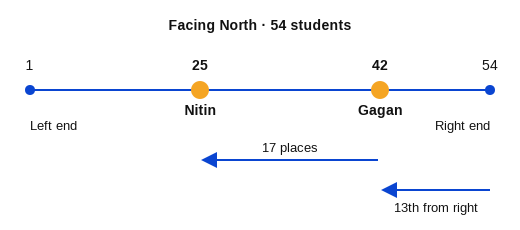
In a row of 54 students facing the north, Gagan is 13th from the right end. If Nitin is 17th to the left of Gagan, what is Nitin's position from the left end of the row?
उत्तर की ओर मुख करके खड़े 54 छात्रों की एक पंक्ति में, गगन दाएँ छोर से 13वें स्थान पर है। यदि नितिन, गगन के बाईं ओर 17वें स्थान पर है, तो पंक्ति के बाएँ छोर से नितिन का स्थान क्या है?
  1. A23rd23वाँ
  2. B30th30वाँ
  3. C27th27वाँ
  4. D25th25वाँ
Show answer

Concept: Position from left = Total − position from right +1.

  1. Gagan from left =54−13+1=42nd.
  2. Nitin is 17 places to the left of Gagan: 42−17=25.

Trick: Left + Right = Total +1.

Answer: (D) 25th

अवधारणा: बाएँ से स्थान = कुल − दाएँ से स्थान +1।

  1. गगन बाएँ से =54−13+1=42वाँ।
  2. नितिन, गगन से 17 स्थान बाएँ है: 42−17=25।

ट्रिक: बाएँ + दाएँ = कुल +1।

उत्तर: (D) 25वाँ

RRB NTPC Undergraduate CBT 1General Intelligence and ReasoningRanking & positionRRB NTPC Undergraduate CBT 1 2025 · 20 Jun Shift 1 →
Q11757.
Read the given statement(s) and conclusions carefully. Assuming that the information given in the statements is true, even if it appears to be at variance with commonly known facts, decide which of the given conclusions logically follow(s) from the statement(s).
Statements:
All drawings are mountains.
All mountains are planes.
Conclusions:
(I) Some planes are mountains.
(II) All drawings are planes.
दिए गए कथन(नों) और निष्कर्षों को ध्यानपूर्वक पढ़िए। यह मानते हुए कि कथनों में दी गई जानकारी सत्य है, भले ही वह सामान्यतः ज्ञात तथ्यों से भिन्न प्रतीत होती हो, निर्णय कीजिए कि दिए गए निष्कर्षों में से कौन-सा/से निष्कर्ष तार्किक रूप से कथन(नों) का अनुसरण करता है/करते हैं।
कथन:
सभी चित्र पर्वत हैं।
सभी पर्वत समतल हैं।
निष्कर्ष:
(I) कुछ समतल पर्वत हैं।
(II) सभी चित्र समतल हैं।
  1. AOnly conclusion (II) followsकेवल निष्कर्ष (II) अनुसरण करता है
  2. BNeither conclusion (I) nor (II) followsन तो निष्कर्ष (I) और न ही (II) अनुसरण करता है
  3. CBoth conclusions (I) and (II) followनिष्कर्ष (I) और (II) दोनों अनुसरण करते हैं
  4. DOnly conclusion (I) followsकेवल निष्कर्ष (I) अनुसरण करता है
Show answer

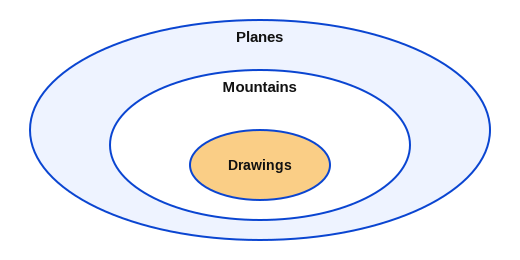
Concept: Draw the Venn diagram: Drawings inside Mountains, Mountains inside Planes.

  1. (I) Every mountain is a plane, so some planes are certainly mountains → follows.
  2. (II) Drawings lie inside Mountains which lie inside Planes → all drawings are planes → follows.

Trick: All A are B + All B are C ⇒ All A are C; and 'All B are C' always gives 'Some C are B'.

Answer: (C) Both conclusions (I) and (II) follow

अवधारणा: वेन आरेख बनाएँ: Drawings, Mountains के अंदर; Mountains, Planes के अंदर।

  1. (I) हर mountain एक plane है, इसलिए कुछ planes निश्चित रूप से mountains हैं → अनुसरण करता है।
  2. (II) Drawings, Mountains में और Mountains, Planes में → सभी drawings, planes हैं → अनुसरण करता है।

ट्रिक: सभी A, B + सभी B, C ⇒ सभी A, C; और 'सभी B, C' से हमेशा 'कुछ C, B' मिलता है।

उत्तर: (C) दोनों निष्कर्ष (I) और (II) अनुसरण करते हैं

RRB NTPC Undergraduate CBT 1General Intelligence and ReasoningSyllogismRRB NTPC Undergraduate CBT 1 2025 · 20 Jun Shift 1 →
Q11758.
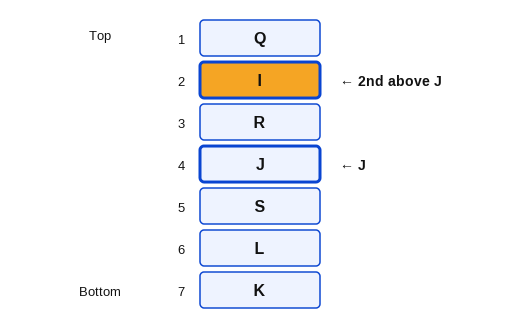
Seven boxes, I, J, K, L, Q, R and S, are kept one over the other, but not necessarily in the same order.
Only Q is kept above I. Only two boxes are kept between I and S. R is kept immediately below I. Only K is kept below L.
Which box is kept second above J?
सात बक्से, I, J, K, L, Q, R और S, एक के ऊपर एक रखे गए हैं, परंतु जरूरी नहीं कि इसी क्रम में हों।
केवल Q, I के ऊपर रखा गया है। I और S के बीच केवल दो बक्से रखे गए हैं। R, I के ठीक नीचे रखा गया है। केवल K, L के नीचे रखा गया है।
J के ऊपर दूसरे स्थान पर कौन-सा बक्सा रखा गया है?
  1. AI
  2. BQ
  3. CR
  4. DS
Show answer

Concept: Fix the boxes from top (1) to bottom (7) using the definite clues first.

  1. Only Q above I → Q = 1, I = 2. R immediately below I → R = 3.
  2. Two boxes between I and S → S = 5. Only K below L → K = 7, L = 6.
  3. Remaining J = 4. Second above J (4) is position 2 = I.

Trick: 'Only X above Y' means Y is 2nd from top – start with such fixed clues.

Answer: (A) I

अवधारणा: सुनिश्चित संकेतों से ऊपर (1) से नीचे (7) तक बॉक्स तय करें।

  1. केवल Q, I के ऊपर → Q = 1, I = 2। R, I के ठीक नीचे → R = 3।
  2. I और S के बीच दो बॉक्स → S = 5। केवल K, L के नीचे → K = 7, L = 6।
  3. बचा J = 4। J (4) से दूसरा ऊपर स्थान 2 = I।

ट्रिक: 'केवल X, Y के ऊपर' का अर्थ Y ऊपर से दूसरा – ऐसे निश्चित संकेत पहले लगाएँ।

उत्तर: (A) I

RRB NTPC Undergraduate CBT 1General Intelligence and ReasoningVertical box arrangementRRB NTPC Undergraduate CBT 1 2025 · 20 Jun Shift 1 →
Q11759.
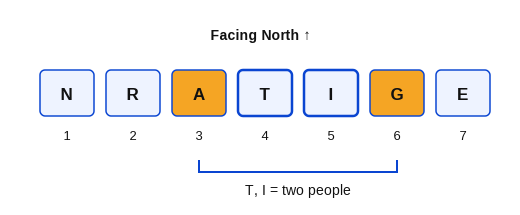
Seven people, T, E, A, R, I, N and G, are sitting in a row, facing north. Only three people sit between N and I. T sits to the immediate left of I. No one sits to the right of E. Only two people sit between E and T. A sits to the immediate right of R. How many people sit between G and A?
सात व्यक्ति, T, E, A, R, I, N और G, उत्तर की ओर मुख करके एक पंक्ति में बैठे हैं। N और I के बीच केवल तीन व्यक्ति बैठे हैं। T, I के ठीक बाएँ बैठा है। E के दाईं ओर कोई नहीं बैठा है। E और T के बीच केवल दो व्यक्ति बैठे हैं। A, R के ठीक दाएँ बैठा है। G और A के बीच कितने व्यक्ति बैठे हैं?
  1. ATwoदो
  2. BFourचार
  3. COneएक
  4. DThreeतीन
Show answer

Concept: Facing north, number seats 1 (left) to 7 (right).

  1. No one to the right of E → E = 7. Two between E and T → T = 4; T immediately left of I → I = 5.
  2. Three between N and I → N = 1.
  3. A immediately right of R in seats 2, 3, 6 → R = 2, A = 3; G = 6.
  4. Between G (6) and A (3): T and I → two people.

Trick: Seats between positions a and b =|a−b|−1=6−3−1=2.

Answer: (A) Two

अवधारणा: उत्तर की ओर मुख – स्थान 1 (बाएँ) से 7 (दाएँ) तक क्रमांकित करें।

  1. E के दाएँ कोई नहीं → E = 7। E और T के बीच दो → T = 4; T, I के ठीक बाएँ → I = 5।
  2. N और I के बीच तीन → N = 1।
  3. A, R के ठीक दाएँ, बचे स्थान 2, 3, 6 → R = 2, A = 3; G = 6।
  4. G (6) और A (3) के बीच: T और I → दो व्यक्ति।

ट्रिक: स्थान a और b के बीच व्यक्ति =|a−b|−1=6−3−1=2।

उत्तर: (A) दो

RRB NTPC Undergraduate CBT 1General Intelligence and ReasoningLinear seating arrangementRRB NTPC Undergraduate CBT 1 2025 · 20 Jun Shift 1 →
Q11760.
What should come in place of ‘?’ in the given series?
152 140 134 122 116 104 ?
दी गई श्रृंखला में ‘?’ के स्थान पर क्या आना चाहिए?
152 140 134 122 116 104 ?
  1. A98
  2. B101
  3. C100
  4. D95
Show answer

Concept: Look at the differences between consecutive terms.

  1. 152−12=140,140−6=134,134−12=122,122−6=116,116−12=104
  2. The pattern alternates −12,−6, so next =104−6=98.

Trick: Alternating differences → the next step repeats the pair.

Answer: (A) 98

अवधारणा: क्रमागत पदों का अंतर देखें।

  1. 152−12=140,140−6=134,134−12=122,122−6=116,116−12=104
  2. क्रम −12,−6 बारी-बारी से है, अतः अगला =104−6=98।

ट्रिक: बारी-बारी अंतर → अगला कदम जोड़ी दोहराता है।

उत्तर: (A) 98

RRB NTPC Undergraduate CBT 1General Intelligence and ReasoningNumber seriesRRB NTPC Undergraduate CBT 1 2025 · 20 Jun Shift 1 →