Question bank

Q&A: practice questions with answers

Search questions on any topic. Filter by exam category, exam, subject and topic, try the question, then open the answer and explanation.

Courses – airGurukul

20,719 questions found.

Q1161.
Pick the INCORRECT statement regarding the life of Birsa Munda.
बिरसा मुंडा के जीवन के संबंध में गलत कथन चुनिए।
  1. AHe urged people to destroy the Europeans.उन्होंने लोगों से यूरोपीय लोगों को नष्ट करने का आह्वान किया।
  2. BHe advised his people to bring back the Golden Age of Mundas.उन्होंने अपने लोगों को मुंडाओं के स्वर्ण युग को वापस लाने की सलाह दी।
  3. CBirsa was born in the forests of Madhya Pradesh.बिरसा का जन्म मध्य प्रदेश के जंगलों में हुआ था।
  4. DHe had joined the local missionary school.वे स्थानीय मिशनरी स्कूल में शामिल हुए थे।
Show answer

Concept: Birsa Munda (1875–1900) led the Ulgulan (great tumult) of the Mundas against the British and dikus.

  1. He was born in Ulihatu, Chotanagpur (present-day Jharkhand), not in Madhya Pradesh – so statement C is incorrect.
  2. He studied at a local missionary school and was influenced by Vaishnav ideas.
  3. He urged people to destroy missionaries, moneylenders, Europeans and to bring back the Munda Golden Age (satyug).

Yaad rakhein: Birsa – Ulihatu (Jharkhand) – 'Dharti Aaba' – 15 November = Janjatiya Gaurav Divas.

Answer: (C) Birsa was born in the forests of Madhya Pradesh.

अवधारणा: बिरसा मुंडा (1875–1900) ने अंग्रेज़ों और दिकुओं के विरुद्ध मुंडाओं के उलगुलान (महाविद्रोह) का नेतृत्व किया।

  1. उनका जन्म उलिहातु, छोटानागपुर (वर्तमान झारखंड) में हुआ, मध्य प्रदेश में नहीं – अतः कथन C गलत है।
  2. उन्होंने स्थानीय मिशनरी स्कूल में पढ़ाई की और वैष्णव विचारों से प्रभावित हुए।
  3. उन्होंने मिशनरियों, साहूकारों, यूरोपीयों को नष्ट करने और मुंडाओं का स्वर्ण युग वापस लाने का आह्वान किया।

याद रखें: बिरसा – उलिहातु (झारखंड) – 'धरती आबा' – 15 नवंबर = जनजातीय गौरव दिवस।

उत्तर: (C) बिरसा का जन्म मध्य प्रदेश के जंगलों में हुआ था।
RRB NTPC Undergraduate CBT 1General AwarenessTribal movements – Birsa MundaRRB NTPC Undergraduate CBT 1 2024 · 28 Aug Shift 3 →
Q1162.
As per India Justice Report 2025, how many judges does India have per million population?
इंडिया जस्टिस रिपोर्ट 2025 के अनुसार, भारत में प्रति दस लाख जनसंख्या पर कितने न्यायाधीश हैं?
  1. A10
  2. B17
  3. C21
  4. D15
Show answer

Concept: The India Justice Report (by Tata Trusts and partners) ranks states on police, judiciary, prisons and legal aid.

  1. IJR 2025 found India has only about 15 judges per million population.
  2. This is far below the Law Commission's 1987 recommendation of 50 judges per million.
  3. Karnataka topped the overall ranking among large and mid-sized states.

Yaad rakhein: IJR 2025: 15 judges per million vs 50 recommended.

Answer: (D) 15

अवधारणा: इंडिया जस्टिस रिपोर्ट (टाटा ट्रस्ट्स व सहयोगी) पुलिस, न्यायपालिका, जेल और विधिक सहायता पर राज्यों की रैंकिंग करती है।

  1. IJR 2025 के अनुसार भारत में प्रति दस लाख जनसंख्या पर केवल लगभग 15 न्यायाधीश हैं।
  2. यह विधि आयोग (1987) की 50 न्यायाधीश प्रति दस लाख की सिफारिश से बहुत कम है।
  3. बड़े व मध्यम राज्यों में कर्नाटक शीर्ष पर रहा।

याद रखें: IJR 2025: प्रति दस लाख 15 न्यायाधीश बनाम 50 अनुशंसित।

उत्तर: (D) 15

RRB NTPC Undergraduate CBT 1General AwarenessReports – India Justice Report 2025RRB NTPC Undergraduate CBT 1 2024 · 28 Aug Shift 3 →
Q1163.
In which year was the Industrial Policy Resolution that gave importance to the public sector adopted?
सार्वजनिक क्षेत्र को महत्व देने वाला औद्योगिक नीति प्रस्ताव किस वर्ष अपनाया गया था?
  1. A1951
  2. B1956
  3. C1947
  4. D1991
Show answer

Concept: Industrial Policy Resolutions set the roles of public and private sectors in India's industrialisation.

  1. The Industrial Policy Resolution of 1956 (Second Five Year Plan, Mahalanobis model) gave the public sector the leading role.
  2. It divided industries into Schedule A (state monopoly – 17 industries), Schedule B and Schedule C.
  3. 1948 was the first IPR; 1991 brought liberalisation and reduced the public sector's role.

Yaad rakhein: 1956 = 'Economic Constitution of India' – public sector on top.

Answer: (B) 1956

अवधारणा: औद्योगिक नीति प्रस्ताव भारत के औद्योगीकरण में सार्वजनिक व निजी क्षेत्र की भूमिका तय करते हैं।

  1. 1956 का औद्योगिक नीति प्रस्ताव (दूसरी पंचवर्षीय योजना, महालनोबिस मॉडल) ने सार्वजनिक क्षेत्र को प्रमुख भूमिका दी।
  2. इसमें उद्योगों को अनुसूची A (17 उद्योग राज्य के एकाधिकार में), B और C में बाँटा गया।
  3. 1948 पहला IPR था; 1991 में उदारीकरण से सार्वजनिक क्षेत्र की भूमिका घटी।

याद रखें: 1956 = 'भारत का आर्थिक संविधान' – सार्वजनिक क्षेत्र सर्वोपरि।

उत्तर: (B) 1956

RRB NTPC Undergraduate CBT 1General AwarenessIndustrial policyRRB NTPC Undergraduate CBT 1 2024 · 28 Aug Shift 3 →
Q1164.
According to the Henley Passport Index released in January 2025, what is India's global passport ranking for 2025?
जनवरी 2025 में जारी हेनले पासपोर्ट इंडेक्स के अनुसार, 2025 के लिए भारत की वैश्विक पासपोर्ट रैंकिंग क्या है?
  1. A85th85वीं
  2. B88th88वीं
  3. C83rd83वीं
  4. D80th80वीं
Show answer

Concept: The Henley Passport Index ranks passports by the number of destinations reachable without a prior visa.

  1. In the January 2025 edition India ranked 85th (down from 80th in 2024).
  2. Singapore was ranked 1st.
  3. The index uses IATA data.

Yaad rakhein: Henley Jan 2025: Singapore 1st, India 85th.

Answer: (A) 85th

अवधारणा: हेनली पासपोर्ट इंडेक्स पासपोर्टों को बिना पूर्व वीज़ा पहुँच वाले गंतव्यों की संख्या पर रैंक करता है।

  1. जनवरी 2025 संस्करण में भारत 85वें स्थान पर रहा (2024 में 80वाँ था)।
  2. सिंगापुर पहले स्थान पर रहा।
  3. यह सूचकांक IATA डेटा पर आधारित है।

याद रखें: हेनली जनवरी 2025: सिंगापुर 1, भारत 85।

उत्तर: (A) 85वाँ

RRB NTPC Undergraduate CBT 1General AwarenessIndices – Henley Passport IndexRRB NTPC Undergraduate CBT 1 2024 · 28 Aug Shift 3 →
Q1165.
When and where were the flight trials of the ULPGM‑V3 missile conducted?
ULPGM‑V3 मिसाइल के उड़ान परीक्षण कब और कहाँ किए गए थे?
  1. ARajasthan (Pokhran), 24 July 2025राजस्थान (पोखरण), 24 जुलाई 2025
  2. BMaharashtra (Pune), 27 July 2025महाराष्ट्र (पुणे), 27 जुलाई 2025
  3. COdisha (Chandipur), 26 July 2025ओडिशा (चांदीपुर), 26 जुलाई 2025
  4. DAndhra Pradesh (Kurnool), 25 July 2025आंध्र प्रदेश (कुरनूल), 25 जुलाई 2025
Show answer

Concept: ULPGM-V3 (UAV-Launched Precision Guided Missile) is a DRDO weapon fired from drones.

  1. Its flight trials were conducted at the National Open Area Range (NOAR), Kurnool, Andhra Pradesh, on 25 July 2025.
  2. It is an upgraded version of ULPGM-V2 with day-night and multiple warhead options.
  3. Chandipur (Odisha) and Pokhran (Rajasthan) are other test ranges, but not for this trial.

Yaad rakhein: ULPGM-V3 – Kurnool NOAR – 25 July 2025.

Answer: (D) Andhra Pradesh (Kurnool), 25 July 2025

अवधारणा: ULPGM-V3 (UAV-लॉन्च्ड प्रिसिशन गाइडेड मिसाइल) ड्रोन से दागी जाने वाली DRDO की मिसाइल है।

  1. इसके उड़ान परीक्षण नेशनल ओपन एरिया रेंज (NOAR), कुरनूल, आंध्र प्रदेश में 25 जुलाई 2025 को हुए।
  2. यह ULPGM-V2 का उन्नत संस्करण है, दिन-रात क्षमता और कई वारहेड विकल्पों के साथ।
  3. चाँदीपुर (ओडिशा) और पोखरण (राजस्थान) अन्य परीक्षण रेंज हैं, पर यह परीक्षण वहाँ नहीं हुआ।

याद रखें: ULPGM-V3 – कुरनूल NOAR – 25 जुलाई 2025।

उत्तर: (D) आंध्र प्रदेश (कुरनूल), 25 जुलाई 2025

RRB NTPC Undergraduate CBT 1General AwarenessDefence – missiles 2025RRB NTPC Undergraduate CBT 1 2024 · 28 Aug Shift 3 →
Q1166.
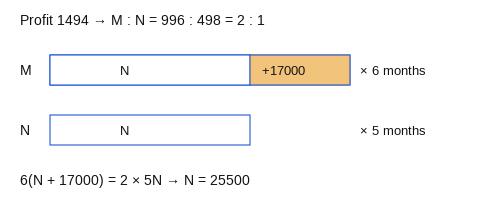
M and N start a business. M invests ₹17,000 more than N for 6 months and N invests for 5 months. M's share is ₹498 more than that of N, out of a total profit of ₹1,494. Find the capital contributed by M.
M और N एक व्यवसाय शुरू करते हैं। M, N से ₹17,000 अधिक 6 महीने के लिए निवेश करता है और N 5 महीने के लिए निवेश करता है। ₹1,494 के कुल लाभ में से M का हिस्सा N के हिस्से से ₹498 अधिक है। M द्वारा लगाई गई पूँजी ज्ञात कीजिए।
  1. A₹42,500
  2. B₹42,326
  3. C₹42,661
  4. D₹42,304
Show answer

Concept: In a partnership, profit is shared in the ratio of (capital × time).

  1. Total profit = ₹1,494 and M gets ₹498 more, so M =1494+4982=996, N =498; ratio M : N =2:1.
  2. Let N's capital =x; M's =x+17000. Then 6(x+17000)5x=21.
  3. 6x+102000=10x⇒x=25500.
  4. M's capital =25500+17000=42500.

Trick: Check options: M = 42,500 → N = 25,500; 42500×625500×5=255000127500=2 ✓.

Answer: (A) ₹42,500

अवधारणा: साझेदारी में लाभ (पूँजी × समय) के अनुपात में बँटता है।

  1. कुल लाभ = ₹1,494 और M को ₹498 अधिक, अतः M =1494+4982=996, N =498; अनुपात 2:1।
  2. माना N की पूँजी =x; M की =x+17000। तब 6(x+17000)5x=21।
  3. 6x+102000=10x⇒x=25500।
  4. M की पूँजी =25500+17000=42500।

ट्रिक: विकल्प जाँचें: M = 42,500 → N = 25,500; 42500×625500×5=2 ✓।

उत्तर: (A) ₹42,500

RRB NTPC Undergraduate CBT 1MathematicsPartnershipRRB NTPC Undergraduate CBT 1 2024 · 28 Aug Shift 3 →
Q1167.
Find the simple interest (in ₹) on ₹1,200 at an interest rate of 4% per month for 10 months.
₹1,200 पर 4% प्रति माह की ब्याज दर से 10 महीने का साधारण ब्याज (₹ में) ज्ञात कीजिए।
  1. A₹40
  2. B₹60
  3. C₹480
  4. D₹80
Show answer

Concept: SI=P×R×T100, with R and T in the same time unit.

  1. Here P=1200, R=4% per month, T=10 months.
  2. SI=1200×4×10100=480.
  3. (If the rate were 4% per annum, T=1012 year would give 1200×4×101200=40 – but the question says per month.)

Trick: 4% per month for 10 months = 40% of 1200 = 480.

Answer: (C) ₹480

अवधारणा: SI=P×R×T100, जहाँ R और T एक ही समय-इकाई में हों।

  1. यहाँ P=1200, R=4% प्रति माह, T=10 माह।
  2. SI=1200×4×10100=480।
  3. (यदि दर 4% वार्षिक होती तो T=1012 वर्ष से 1200×4×101200=40 आता – पर प्रश्न में प्रति माह दिया है।)

ट्रिक: 4% प्रति माह × 10 माह = 1200 का 40% = 480।

उत्तर: (C) ₹480

RRB NTPC Undergraduate CBT 1MathematicsSimple interestRRB NTPC Undergraduate CBT 1 2024 · 28 Aug Shift 3 →
Q1168.
Simplify the given expression.
x(7x − 5) + 3(x2 − 2) + 14
दिए गए व्यंजक को सरल कीजिए।
x(7x − 5) + 3(x2 − 2) + 14
  1. A−10x2 − 5x + 8
  2. B10x2 − 5x − 8
  3. C10x2 − 5x + 8
  4. D−10x2 − 5x − 8
Show answer

Concept: Expand each bracket, then combine like terms.

  1. x(7x−5)=7x2−5x
  2. 3(x2−2)=3x2−6
  3. Sum: 7x2−5x+3x2−6+14=10x2−5x+8

Trick: Put x=1: 1(2)+3(−1)+14=13; only 10−5+8=13 ✓.

Answer: (C) 10x2−5x+8

अवधारणा: प्रत्येक कोष्ठक खोलें, फिर समान पदों को जोड़ें।

  1. x(7x−5)=7x2−5x
  2. 3(x2−2)=3x2−6
  3. योग: 7x2−5x+3x2−6+14=10x2−5x+8

ट्रिक: x=1 रखें: 1(2)+3(−1)+14=13; केवल 10−5+8=13 ✓।

उत्तर: (C) 10x2−5x+8

RRB NTPC Undergraduate CBT 1MathematicsAlgebra – simplificationRRB NTPC Undergraduate CBT 1 2024 · 28 Aug Shift 3 →
Q1169.
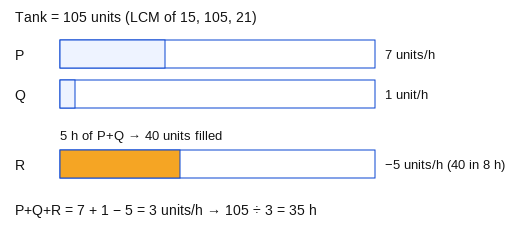
Pipe P can fill 45 part of a tank in 12 hours and pipe Q can fill 27 part of the same tank in 30 hours. Both P and Q were kept open for 5 hours, then both were closed. Pipe R alone was then opened and it emptied the water in the tank in 8 hours.
Pipes P, Q and R together can fill the empty tank in:
पाइप P किसी टंकी का 45 भाग 12 घंटे में भर सकता है और पाइप Q उसी टंकी का 27 भाग 30 घंटे में भर सकता है। P और Q दोनों को 5 घंटे तक खुला रखा गया, फिर दोनों को बंद कर दिया गया। इसके बाद केवल पाइप R को खोला गया और उसने टंकी का पानी 8 घंटे में खाली कर दिया।
पाइप P, Q और R मिलकर खाली टंकी को कितने समय में भर सकते हैं?
  1. A17 hours17 घंटे
  2. B35 hours35 घंटे
  3. C43 hours43 घंटे
  4. D18 hours18 घंटे
Show answer

Concept: Find each pipe's full-tank time, take LCM as tank capacity, and add efficiencies (emptying pipe negative).

  1. P fills 45 in 12 h → full in 12×54=15 h; Q fills 27 in 30 h → full in 30×72=105 h.
  2. Tank =105 units: P =7, Q =1 unit/h. In 5 h: 5×8=40 units.
  3. R empties 40 units in 8 h → R =−5 unit/h.
  4. P + Q + R =7+1−5=3 unit/h → time =1053=35 h.

Yaad rakhein: Filling pipe +, emptying pipe −; time =capacitynet efficiency.

Answer: (B) 35 hours

अवधारणा: प्रत्येक पाइप का पूरी टंकी भरने का समय निकालें, LCM को क्षमता मानें और दक्षताएँ जोड़ें (खाली करने वाला पाइप ऋणात्मक)।

  1. P, 12 घंटे में 45 भरता है → पूरी 12×54=15 घंटे; Q, 30 घंटे में 27 → पूरी 30×72=105 घंटे।
  2. टंकी =105 इकाई: P =7, Q =1 इकाई/घंटा। 5 घंटे में: 5×8=40 इकाई।
  3. R, 8 घंटे में 40 इकाई खाली करता है → R =−5 इकाई/घंटा।
  4. P + Q + R =7+1−5=3 इकाई/घंटा → समय =1053=35 घंटे।

याद रखें: भरने वाला +, खाली करने वाला −; समय =क्षमताकुल दक्षता।

उत्तर: (B) 35 घंटे

RRB NTPC Undergraduate CBT 1MathematicsPipes and cisternsRRB NTPC Undergraduate CBT 1 2024 · 28 Aug Shift 3 →
Q1170.
The average of first 163 even numbers is
प्रथम 163 सम संख्याओं का औसत कितना है?
  1. A165
  2. B163.5
  3. C164.5
  4. D164
Show answer

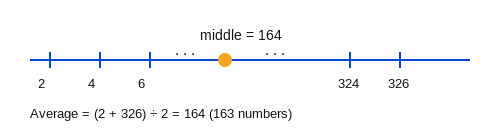
Concept: First n even numbers: 2,4,…,2n; their sum =n(n+1), so average =n+1.

  1. Here n=163; last term =2×163=326.
  2. Average =2+3262=164.
  3. Or directly: n+1=163+1=164.

Trick: Average of first n even numbers =n+1; of first n odd numbers =n.

Answer: (D) 164

अवधारणा: पहली n सम संख्याएँ: 2,4,…,2n; योग =n(n+1), अतः औसत =n+1।

  1. यहाँ n=163; अंतिम पद =2×163=326।
  2. औसत =2+3262=164।
  3. सीधे: n+1=163+1=164।

ट्रिक: पहली n सम संख्याओं का औसत =n+1; पहली n विषम संख्याओं का =n।

उत्तर: (D) 164

RRB NTPC Undergraduate CBT 1MathematicsAverage – even numbersRRB NTPC Undergraduate CBT 1 2024 · 28 Aug Shift 3 →
Q1171.
The value of 53+(11+49)−25 is
53+(11+49)−25 का मान है:
  1. A384191
  2. B382195
  3. C379201
  4. D380197
Show answer

Concept: Simplify the inner (continued) fraction first, then add/subtract using the LCM.

  1. 1+49=139, so 11+49=913.
  2. Expression =53+913−25; LCM of 3, 13, 5 =195.
  3. =325+135−78195=382195.

Trick: Denominator must be the LCM 195 – only option B has it.

Answer: (B) 382195

अवधारणा: पहले अंदर की भिन्न सरल करें, फिर LCM से जोड़-घटाव करें।

  1. 1+49=139, अतः 11+49=913।
  2. व्यंजक =53+913−25; 3, 13, 5 का LCM =195।
  3. =325+135−78195=382195।

ट्रिक: हर LCM 195 होना चाहिए – केवल विकल्प B में है।

उत्तर: (B) 382195

RRB NTPC Undergraduate CBT 1MathematicsFractions – simplificationRRB NTPC Undergraduate CBT 1 2024 · 28 Aug Shift 3 →
Q1172.
The product of two consecutive natural numbers is 110. The greater of the two numbers is:
दो क्रमागत प्राकृत संख्याओं का गुणनफल 110 है। दोनों संख्याओं में से बड़ी संख्या है:
  1. A3
  2. B5
  3. C11
  4. D7
Show answer

Concept: Consecutive natural numbers are n and n+1.

  1. n(n+1)=110⇒n2+n−110=0.
  2. (n+11)(n−10)=0⇒n=10 (natural).
  3. Numbers: 10 and 11; greater =11.

Trick: 110≈10.5 → the numbers lie on either side: 10×11=110.

Answer: (C) 11

अवधारणा: क्रमागत प्राकृतिक संख्याएँ n और n+1 हैं।

  1. n(n+1)=110⇒n2+n−110=0।
  2. (n+11)(n−10)=0⇒n=10 (प्राकृतिक)।
  3. संख्याएँ: 10 और 11; बड़ी =11।

ट्रिक: 110≈10.5 → संख्याएँ इसके दोनों ओर: 10×11=110।

उत्तर: (C) 11

RRB NTPC Undergraduate CBT 1MathematicsNumber systemRRB NTPC Undergraduate CBT 1 2024 · 28 Aug Shift 3 →
Q1173.
The value of 121+0.0225−5.76=
121+0.0225−5.76= का मान है:
  1. A13.05
  2. B12.62
  3. C8.75
  4. D5.35
Show answer

Concept: For a decimal, take the square root of the digits and halve the number of decimal places.

  1. 121=11
  2. 0.0225=0.15 (since 152=225)
  3. 5.76=2.4 (since 242=576)
  4. 11+0.15−2.4=8.75

Trick: Decimal places in the square = 2 × decimal places in the root: 0.0225 (4) → 0.15 (2).

Answer: (C) 8.75

अवधारणा: दशमलव संख्या का वर्गमूल: अंकों का वर्गमूल लें और दशमलव स्थान आधे करें।

  1. 121=11
  2. 0.0225=0.15 (क्योंकि 152=225)
  3. 5.76=2.4 (क्योंकि 242=576)
  4. 11+0.15−2.4=8.75

ट्रिक: वर्ग में दशमलव स्थान = मूल के दशमलव स्थान का दोगुना: 0.0225 (4) → 0.15 (2)।

उत्तर: (C) 8.75

RRB NTPC Undergraduate CBT 1MathematicsSquare roots of decimalsRRB NTPC Undergraduate CBT 1 2024 · 28 Aug Shift 3 →
Q1174.
Simplify: tan2βcosec2β1+tan2β
सरल कीजिए: tan2βcosec2β1+tan2β
  1. A−1
  2. Btanβ
  3. C1
  4. Dsecβ
Show answer

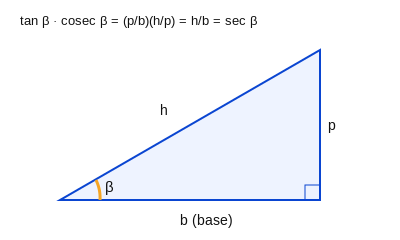
Concept: Use 1+tan2β=sec2β and tanβcosecβ=sinβcosβ·1sinβ=secβ.

  1. Numerator: tan2βcosec2β=sec2β.
  2. Denominator: 1+tan2β=sec2β.
  3. sec2βsec2β=1.

Trick: Put β=45∘: 1×21+1=1.

Answer: (C) 1

अवधारणा: 1+tan2β=sec2β और tanβcosecβ=sinβcosβ·1sinβ=secβ का प्रयोग करें।

  1. अंश: tan2βcosec2β=sec2β।
  2. हर: 1+tan2β=sec2β।
  3. sec2βsec2β=1।

ट्रिक: β=45∘ रखें: 1×21+1=1।

उत्तर: (C) 1

RRB NTPC Undergraduate CBT 1MathematicsTrigonometric identitiesRRB NTPC Undergraduate CBT 1 2024 · 28 Aug Shift 3 →
Q1175.
The HCF and LCM of two numbers are 72 and 432, respectively. If one of the numbers is 144, find the other one.
दो संख्याओं का महत्तम समापवर्तक (HCF) और लघुत्तम समापवर्त्य (LCM) क्रमशः 72 और 432 हैं। यदि उनमें से एक संख्या 144 है, तो दूसरी संख्या ज्ञात कीजिए।
  1. A216
  2. B144
  3. C72
  4. D288
Show answer

Concept: For two numbers: HCF×LCM=product of the numbers.

  1. 72×432=144×x
  2. x=72×432144=4322=216.
  3. Check: HCF(144, 216) =72, LCM =432 ✓.

Trick: 14472=2, so x=4322=216.

Answer: (A) 216

अवधारणा: दो संख्याओं के लिए: HCF×LCM=संख्याओं का गुणनफल।

  1. 72×432=144×x
  2. x=72×432144=4322=216।
  3. जाँच: HCF(144, 216) =72, LCM =432 ✓।

ट्रिक: 14472=2, अतः x=4322=216।

उत्तर: (A) 216

RRB NTPC Undergraduate CBT 1MathematicsHCF and LCMRRB NTPC Undergraduate CBT 1 2024 · 28 Aug Shift 3 →
Q1176.
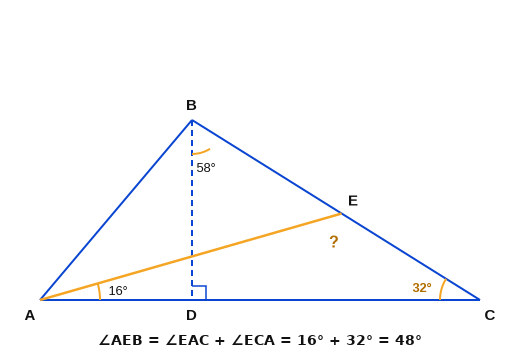
In △ABC, BD ⟂ AC at D and ∠DBC = 58°. E is a point on BC such that ∠CAE = 16°. What is the measure of ∠AEB?
△ABC में, BD ⟂ AC, D पर है और ∠DBC = 58° है। BC पर एक बिंदु E इस प्रकार है कि ∠CAE = 16° है। ∠AEB की माप क्या है?
  1. A42°
  2. B49°
  3. C52°
  4. D48°
Show answer

Concept: An exterior angle of a triangle equals the sum of the two opposite interior angles.

  1. In right △BDC: ∠BDC=90∘, so ∠C=180∘−90∘−58∘=32∘.
  2. In △AEC, ∠AEB is the exterior angle at E (since B, E, C are collinear).
  3. ∠AEB=∠EAC+∠ECA=16∘+32∘=48∘.

Trick: In a right triangle the two acute angles add to 90∘, so ∠C=90∘−58∘ directly.

Answer: (D) 48∘

अवधारणा: त्रिभुज का बाह्य कोण = दोनों सम्मुख अंतः कोणों का योग।

  1. समकोण △BDC में ∠BDC=90∘, अतः ∠C=180∘−90∘−58∘=32∘।
  2. B, E, C एक रेखा पर हैं, इसलिए ∠AEB, △AEC का E पर बाह्य कोण है।
  3. ∠AEB=∠EAC+∠ECA=16∘+32∘=48∘।

ट्रिक: समकोण त्रिभुज में दोनों न्यून कोणों का योग 90∘ होता है, अतः ∠C=90∘−58∘।

उत्तर: (D) 48∘

RRB NTPC Undergraduate CBT 1MathematicsTriangles – exterior angleRRB NTPC Undergraduate CBT 1 2024 · 28 Aug Shift 3 →
Q1177.
What is the volume of a cylindrical container that has a base radius of 3.5 metres and a height of 5.2 metres?
एक बेलनाकार पात्र का आयतन क्या है, जिसके आधार की त्रिज्या 3.5 मीटर और ऊँचाई 5.2 मीटर है?
  1. A67.3π cubic metres67.3π घन मीटर
  2. B65.4π cubic metres65.4π घन मीटर
  3. C63.7π cubic metres63.7π घन मीटर
  4. D68.6π cubic metres68.6π घन मीटर
Show answer

Concept: Volume of a cylinder V=πr2h.

  1. r=3.5m, so r2=12.25.
  2. V=π×12.25×5.2=63.7πm3.

Trick: 3.52×5.2=12.25×5.2: 12×5.2=62.4 and 0.25×5.2=1.3, total 63.7.

Answer: (C) 63.7π cubic metres

अवधारणा: बेलन (cylinder) का आयतन V=πr2h।

  1. r=3.5m, अतः r2=12.25।
  2. V=π×12.25×5.2=63.7πm3।

ट्रिक: 12×5.2=62.4 और 0.25×5.2=1.3, कुल 63.7।

उत्तर: (C) 63.7π घन मीटर

RRB NTPC Undergraduate CBT 1MathematicsMensuration – cylinder volumeRRB NTPC Undergraduate CBT 1 2024 · 28 Aug Shift 3 →
Q1178.
Find the mean proportional of 96 and 54.
96 और 54 का मध्यानुपाती ज्ञात कीजिए।
  1. A71
  2. B69
  3. C75
  4. D72
Show answer

Concept: Mean proportional of a and b is ab.

  1. 96×54=5184.
  2. 5184=72.

Trick: 96=6×16, 54=6×9, so 96×54=6×4×3=72.

Answer: (D) 72

अवधारणा: a और b का मध्यानुपाती (mean proportional) ab होता है।

  1. 96×54=5184।
  2. 5184=72।

ट्रिक: 96=6×16, 54=6×9, अतः 96×54=6×4×3=72।

उत्तर: (D) 72

RRB NTPC Undergraduate CBT 1MathematicsMean proportionalRRB NTPC Undergraduate CBT 1 2024 · 28 Aug Shift 3 →
Q1179.
The value of 72+82−516−14 is:
72+82−516−14 का मान है:
  1. A16
  2. B31
  3. C23
  4. D26
Show answer

Concept: Evaluate powers and roots first, then add/subtract left to right.

  1. 72=49, 82=8, 516=5×4=20.
  2. 49+8−20−14=23.

Trick: a2=a for positive a – no need to square 8.

Answer: (C) 23

अवधारणा: पहले घात और मूल हल करें, फिर बाएँ से दाएँ जोड़/घटाव।

  1. 72=49, 82=8, 516=5×4=20।
  2. 49+8−20−14=23।

ट्रिक: धनात्मक a के लिए a2=a।

उत्तर: (C) 23

RRB NTPC Undergraduate CBT 1MathematicsSimplification – powers and rootsRRB NTPC Undergraduate CBT 1 2024 · 28 Aug Shift 3 →
Q1180.
Pipe A can fill a tank in 11 hours, pipe B can fill the same tank in 24 hours and pipe C can fill the same tank in 19 hours. The time taken by them to fill the same tank if they operate together is::
पाइप A किसी टंकी को 11 घंटे में भर सकता है, पाइप B उसी टंकी को 24 घंटे में भर सकता है और पाइप C उसी टंकी को 19 घंटे में भर सकता है। यदि वे एक साथ कार्य करें, तो उसी टंकी को भरने में उनके द्वारा लिया गया समय है:
  1. A4371929 hours4371929 घंटे
  2. B7371929 hours7371929 घंटे
  3. C5371929 hours5371929 घंटे
  4. D9371929 hours9371929 घंटे
Show answer

Concept: Work per hour adds up: combined rate =111+124+119.

  1. LCM =11×24×19=5016.
  2. Rate =456+209+2645016=9295016 tank per hour.
  3. Time =5016929=5371929 hours (since 929×5=4645, remainder 371).

Trick: Estimate: rate ≈0.091+0.042+0.053=0.186, so time ≈5.4 h – only option (C) starts with 5.

Answer: (C) 5371929 hours

अवधारणा: प्रति घंटे का काम जुड़ता है: संयुक्त दर =111+124+119।

  1. LCM =11×24×19=5016।
  2. दर =456+209+2645016=9295016 टंकी प्रति घंटा।
  3. समय =5016929=5371929 घंटे (929×5=4645, शेष 371)।

ट्रिक: अनुमान: दर ≈0.186, अतः समय ≈5.4 घंटे – केवल विकल्प (C) 5 से शुरू होता है।

उत्तर: (C) 5371929 घंटे

RRB NTPC Undergraduate CBT 1MathematicsPipes and cisternsRRB NTPC Undergraduate CBT 1 2024 · 28 Aug Shift 3 →