Question bank

Q&A: practice questions with answers

Search questions on any topic. Filter by exam category, exam, subject and topic, try the question, then open the answer and explanation.

Courses – airGurukul

20,719 questions found.

Q11841.
The length of the shadow of a tower increases by 20 m when the angle of elevation of the Sun changes from 60° to 45°. Find the height of the tower (in m, rounded to one decimal place). (Use 3=1.7)
जब सूर्य का उन्नयन कोण 60° से 45° हो जाता है, तो एक मीनार की छाया की लंबाई 20 m बढ़ जाती है। मीनार की ऊँचाई (m में, एक दशमलव स्थान तक पूर्णांकित) ज्ञात कीजिए। (3=1.7 का प्रयोग कीजिए)
  1. A48.6
  2. B17.4
  3. C24.7
  4. D27.5
Show answer

Concept: Shadow length =htanθ; it increases when the Sun's elevation falls.
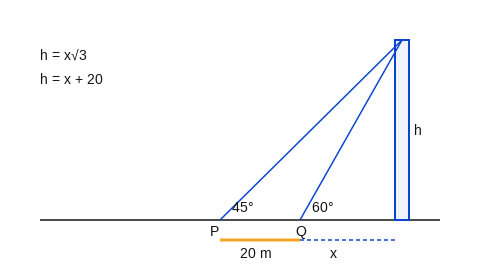
  1. At 60∘: x=h3; at 45∘: x+20=h.
  2. h−h3=20 → h=2033−1.
  3. With 3=1.7: h=340.7=48.57≈48.6 m.

Trick: h=d33−1 for 60∘→45∘ shadow change d.

Answer: (A) 48.6

अवधारणा: छाया की लंबाई =htanθ; सूर्य का उन्नयन कोण घटने पर छाया बढ़ती है।

  1. 60∘ पर: x=h3; 45∘ पर: x+20=h।
  2. h−h3=20 → h=2033−1।
  3. 3=1.7 लेकर: h=340.7=48.57≈48.6 m।

ट्रिक: 60∘→45∘ पर छाया का अंतर d हो तो h=d33−1।

उत्तर: (A) 48.6

RRB NTPC Undergraduate CBT 1MathematicsHeights and DistancesRRB NTPC Undergraduate CBT 1 2025 · 19 Jun Shift 3 →
Q11842.
A and B can complete a piece of work in 12 days and 20 days respectively. After both work together for 3 days, A leaves. How many days will B take to finish the remaining work?
A और B किसी कार्य को क्रमशः 12 दिन और 20 दिन में पूरा कर सकते हैं। दोनों के 3 दिन तक एक साथ कार्य करने के बाद A कार्य छोड़ देता है। शेष कार्य को पूरा करने में B को कितने दिन लगेंगे?
  1. A12
  2. B13
  3. C11
  4. D14
Show answer

Concept: Take total work = LCM of days and use units per day.

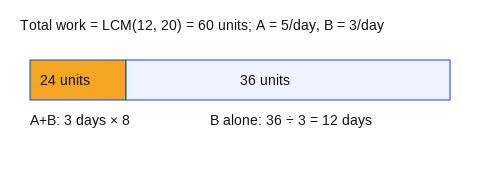
  1. Work =60 units; A =5/day, B =3/day.
  2. In 3 days together: 3×8=24 units.
  3. Remaining 36 units by B: 363=12 days.

Trick: Fraction done =3(112+120)=25; B does 35×20=12.

Answer: (A) 12

अवधारणा: कुल कार्य = दिनों का LCM लें और प्रति दिन इकाइयाँ निकालें।

  1. कार्य =60 इकाई; A =5/दिन, B =3/दिन।
  2. 3 दिन साथ: 3×8=24 इकाई।
  3. शेष 36 इकाई B: 363=12 दिन।

ट्रिक: किया गया भाग =3(112+120)=25; B करेगा 35×20=12।

उत्तर: (A) 12

RRB NTPC Undergraduate CBT 1MathematicsTime and WorkRRB NTPC Undergraduate CBT 1 2025 · 19 Jun Shift 3 →
Q11843.
An article is sold at a profit of 20%. If its selling price is reduced by 10%, what will be the profit percentage?
एक वस्तु 20% लाभ पर बेची जाती है। यदि इसके विक्रय मूल्य में 10% की कमी कर दी जाए, तो लाभ प्रतिशत क्या होगा?
  1. A6%
  2. B12%
  3. C8%
  4. D20%
Show answer

Concept: Take CP =100.

  1. SP at 20% profit =120.
  2. New SP =120×0.9=108.
  3. Profit =108−100=8%.

Trick: 1.2×0.9=1.08 → 8% profit.

Answer: (C) 8%

अवधारणा: CP =100 मानें।

  1. 20% लाभ पर SP =120।
  2. नया SP =120×0.9=108।
  3. लाभ =108−100=8%।

ट्रिक: 1.2×0.9=1.08 → 8% लाभ।

उत्तर: (C) 8%

RRB NTPC Undergraduate CBT 1MathematicsProfit and LossRRB NTPC Undergraduate CBT 1 2025 · 19 Jun Shift 3 →
Q11844.
A regular polygon has 45 sides and the length of each side is 2 cm. What is the area of the polygon (in cm²)?
एक सम बहुभुज की 45 भुजाएँ हैं और प्रत्येक भुजा की लंबाई 2 cm है। बहुभुज का क्षेत्रफल (cm² में) क्या है?
  1. A45
  2. B45cos(4∘)
  3. C45tan(4∘)
  4. D45cot(4∘)
Show answer

Concept: Area of a regular n-gon of side a =na24cot180∘n.

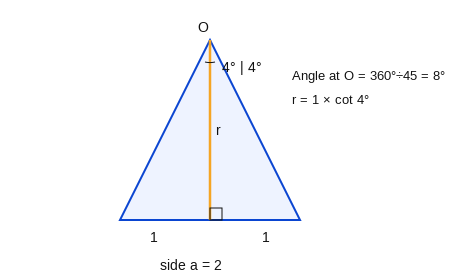
  1. Split into 45 isosceles triangles; angle at centre =360∘45=8∘, half-angle 4∘.
  2. Apothem r=a2cot4∘=cot4∘.
  3. Area =45×12×2×cot4∘=45cot4∘.

Trick: Apothem is large (polygon is nearly a circle), so area must be much bigger than 45 – it needs cot, not tan (tan4∘≈0.07).

Answer: (D) 45cot(4∘)

अवधारणा: भुजा a वाले सम n-भुज का क्षेत्रफल =na24cot180∘n।

  1. 45 समद्विबाहु त्रिभुजों में बाँटें; केंद्र पर कोण =360∘45=8∘, आधा 4∘।
  2. केंद्र से भुजा की दूरी r=a2cot4∘=cot4∘।
  3. क्षेत्रफल =45×12×2×cot4∘=45cot4∘।

ट्रिक: बहुभुज लगभग वृत्त जैसा है, इसलिए क्षेत्रफल 45 से बहुत बड़ा होगा – cot आएगा, tan नहीं (tan4∘≈0.07)।

उत्तर: (D) 45cot(4∘)

RRB NTPC Undergraduate CBT 1MathematicsRegular Polygon – AreaRRB NTPC Undergraduate CBT 1 2025 · 19 Jun Shift 3 →
Q11845.
A person covers a certain distance by train. If the train had travelled 14 km/hr faster than its usual speed, the journey would have taken 35 minutes less. If it had travelled 10 km/hr slower, the journey would have taken 30 minutes more. Find the total distance covered by the train.
एक व्यक्ति रेलगाड़ी द्वारा एक निश्चित दूरी तय करता है। यदि रेलगाड़ी अपनी सामान्य चाल से 14 km/hr अधिक तेज़ चलती, तो यात्रा में 35 मिनट कम लगते। यदि वह 10 km/hr धीमी चलती, तो यात्रा में 30 मिनट अधिक लगते। रेलगाड़ी द्वारा तय की गई कुल दूरी ज्ञात कीजिए।
  1. A780 km
  2. B480 km
  3. C720 km
  4. D560 km
Show answer

Concept: Write two time-difference equations for distance d and usual speed s.

  1. ds−ds+14=3560 → d=s(s+14)24.
  2. ds−10−ds=12 → d=s(s−10)20.
  3. 20(s+14)=24(s−10) → s=130; d=130×14424=780 km.

Trick: Verify: 780130=6 h, 780144=5512 h (35 min less), 780120=6.5 h ✓.

Answer: (A) 780 km

अवधारणा: दूरी d और सामान्य चाल s के लिए समय-अंतर के दो समीकरण बनाएँ।

  1. ds−ds+14=3560 → d=s(s+14)24।
  2. ds−10−ds=12 → d=s(s−10)20।
  3. 20(s+14)=24(s−10) → s=130; d=130×14424=780 km।

ट्रिक: जाँच: 780130=6 घंटे, 780144=5512 घंटे (35 मिनट कम), 780120=6.5 घंटे ✓।

उत्तर: (A) 780 km

RRB NTPC Undergraduate CBT 1MathematicsSpeed, Time and DistanceRRB NTPC Undergraduate CBT 1 2025 · 19 Jun Shift 3 →
Q11846.
The price of a machine increases by 20%. Due to a fall in demand, the increased price is reduced by 25%. Finally, the price increases again by 10%. What is the overall percentage change in the price of the machine?
एक मशीन के मूल्य में 20% की वृद्धि होती है। माँग में गिरावट के कारण, बढ़े हुए मूल्य में 25% की कमी की जाती है। अंत में, मूल्य में पुनः 10% की वृद्धि होती है। मशीन के मूल्य में कुल प्रतिशत परिवर्तन क्या है?
  1. A1% decrease1% कमी
  2. B1.1% decrease1.1% कमी
  3. C1% increase1% वृद्धि
  4. D1.1% increase1.1% वृद्धि
Show answer

Concept: Multiply the successive factors.

  1. Factors: 1.20×0.75×1.10.
  2. 1.2×0.75=0.9; 0.9×1.1=0.99.
  3. Net change =0.99−1=−1% → 1% decrease.

Trick: Take price 100: 120→90→99.

Answer: (A) 1% decrease

अवधारणा: क्रमिक गुणकों को गुणा करें।

  1. गुणक: 1.20×0.75×1.10।
  2. 1.2×0.75=0.9; 0.9×1.1=0.99।
  3. कुल परिवर्तन =−1% → 1% कमी।

ट्रिक: मूल्य 100 लें: 120→90→99।

उत्तर: (A) 1% कमी

RRB NTPC Undergraduate CBT 1MathematicsSuccessive Percentage ChangeRRB NTPC Undergraduate CBT 1 2025 · 19 Jun Shift 3 →
Q11847.
A factory produces three types of widgets A, B and C. In a week, 12 units of A (average weight 47 kg each), 8 units of B (average weight 62 kg each) and 15 units of C (average weight 53 kg each) are produced. Find the weighted average weight of the widgets produced in that week.
एक कारखाना तीन प्रकार के विजेट (widgets) A, B और C का उत्पादन करता है। एक सप्ताह में A की 12 इकाइयाँ (प्रत्येक का औसत भार 47 kg), B की 8 इकाइयाँ (प्रत्येक का औसत भार 62 kg) और C की 15 इकाइयाँ (प्रत्येक का औसत भार 53 kg) उत्पादित की जाती हैं। उस सप्ताह उत्पादित विजेटों का भारित औसत भार ज्ञात कीजिए।
  1. A54 kg
  2. B53 kg
  3. C51 kg
  4. D52.5 kg
Show answer

Concept: Weighted average =∑(count×weight)∑count.

  1. 12×47=564, 8×62=496, 15×53=795.
  2. Total =1855 kg for 35 units.
  3. Average =185535=53 kg.

Trick: Deviations from 53: 12(−6)+8(9)+15(0)=0 → average is exactly 53.

Answer: (B) 53 kg

अवधारणा: भारित औसत =∑(संख्या×भार)∑संख्या।

  1. 12×47=564, 8×62=496, 15×53=795।
  2. कुल =1855 kg, 35 इकाइयाँ।
  3. औसत =185535=53 kg।

ट्रिक: 53 से विचलन: 12(−6)+8(9)+15(0)=0 → औसत ठीक 53।

उत्तर: (B) 53 kg

RRB NTPC Undergraduate CBT 1MathematicsWeighted AverageRRB NTPC Undergraduate CBT 1 2025 · 19 Jun Shift 3 →
Q11848.
A customer orders food worth ₹1,000 online. The food delivery app gives a flat promotional discount of 20% on the bill. After this discount, if the bill amount is between ₹650 and ₹800 (both inclusive), an additional 5% discount is applied on the bill. If all orders include a fixed delivery charge of ₹80, what is the final amount the customer has to pay?
एक ग्राहक ऑनलाइन ₹1,000 का भोजन ऑर्डर करता है। फ़ूड डिलीवरी ऐप बिल पर 20% की एकमुश्त प्रचारात्मक छूट देता है। इस छूट के बाद, यदि बिल राशि ₹650 और ₹800 (दोनों सम्मिलित) के बीच है, तो बिल पर 5% की अतिरिक्त छूट लागू होती है। यदि सभी ऑर्डरों में ₹80 का निश्चित डिलीवरी शुल्क शामिल है, तो ग्राहक को अंतिम रूप से कितनी राशि का भुगतान करना होगा?
  1. A₹760
  2. B₹900
  3. C₹800
  4. D₹840
Show answer

Concept: Apply the discounts in order, check the slab, then add the fixed delivery charge.

  1. After 20%: 1000×0.8=800 – lies in ₹650–₹800 (inclusive).
  2. Extra 5%: 800×0.95=760.
  3. Add delivery: 760+80=840.

Trick: Watch 'inclusive' – ₹800 qualifies for the extra 5%.

Answer: (D) ₹840

अवधारणा: छूट क्रम से लगाएँ, स्लैब जाँचें, फिर निश्चित डिलीवरी शुल्क जोड़ें।

  1. 20% के बाद: 1000×0.8=800 – ₹650–₹800 (सम्मिलित) में है।
  2. अतिरिक्त 5%: 800×0.95=760।
  3. डिलीवरी जोड़ें: 760+80=840।

ट्रिक: 'सम्मिलित' पर ध्यान दें – ₹800 पर भी 5% अतिरिक्त छूट मिलेगी।

उत्तर: (D) ₹840

RRB NTPC Undergraduate CBT 1MathematicsDiscountRRB NTPC Undergraduate CBT 1 2025 · 19 Jun Shift 3 →
Q11849.
A student adds 3/5 unit of a solution, then adds 0.4 unit of the same solution, and finally removes 1/10 unit. What is the net change in the quantity of the solution?
एक विद्यार्थी किसी विलयन की 3/5 इकाई मिलाता है, फिर उसी विलयन की 0.4 इकाई मिलाता है, और अंत में 1/10 इकाई निकाल देता है। विलयन की मात्रा में निवल परिवर्तन क्या है?
  1. Adecrease of 1.5 unit1.5 इकाई की कमी
  2. Bincrease of 0.9 unit0.9 इकाई की वृद्धि
  3. Cdecrease of 0.8 unit0.8 इकाई की कमी
  4. Dincrease of 1.0 unit1.0 इकाई की वृद्धि
Show answer

Concept: Additions are positive, removals negative; convert all to decimals.

  1. 35=0.6, 110=0.1.
  2. Net =0.6+0.4−0.1=0.9.
  3. Positive → increase of 0.9 unit.

Trick: Positive net = increase; negative net = decrease.

Answer: (B) increase of 0.9 unit

अवधारणा: जोड़ना धनात्मक, निकालना ऋणात्मक; सबको दशमलव में बदलें।

  1. 35=0.6, 110=0.1।
  2. शुद्ध =0.6+0.4−0.1=0.9।
  3. धनात्मक → 0.9 इकाई की वृद्धि।

ट्रिक: शुद्ध धनात्मक = वृद्धि; ऋणात्मक = कमी।

उत्तर: (B) 0.9 इकाई की वृद्धि

RRB NTPC Undergraduate CBT 1MathematicsFractions and DecimalsRRB NTPC Undergraduate CBT 1 2025 · 19 Jun Shift 3 →
Q11850.
Find the compound interest on ₹25,600 for 2 years 3 months at 1212% per annum, compounded annually.
₹25,600 पर 2 वर्ष 3 महीने के लिए 1212% वार्षिक दर से, वार्षिक रूप से संयोजित होने वाला चक्रवृद्धि ब्याज ज्ञात कीजिए।
  1. A₹8,650.50
  2. B₹10,580.50
  3. C₹7,812.50
  4. D₹9,750.50
Show answer

Concept: For a fractional year with annual compounding, the extra 3 months earn simple interest on the amount after 2 years.

  1. 1212%=18: after 2 years 25600×(98)2=32400.
  2. 3 months: rate 12.54=3.125% → 32400×0.03125=1012.5.
  3. Amount =33412.5; CI =33412.5−25600=7812.5.

Trick: 1212%=18 – use fraction multipliers 98×98×3332.

Answer: (C) ₹7,812.50

अवधारणा: वार्षिक चक्रवृद्धि में बचे 3 महीनों पर 2 वर्ष के मिश्रधन पर साधारण ब्याज लगता है।

  1. 1212%=18: 2 वर्ष बाद 25600×(98)2=32400।
  2. 3 महीने: दर 12.54=3.125% → 32400×0.03125=1012.5।
  3. मिश्रधन =33412.5; CI =33412.5−25600=7812.5।

ट्रिक: 1212%=18 – गुणक 98×98×3332 लें।

उत्तर: (C) ₹7,812.50

RRB NTPC Undergraduate CBT 1MathematicsCompound Interest – Fractional PeriodRRB NTPC Undergraduate CBT 1 2025 · 19 Jun Shift 3 →
Q11851.
A, B and C are partners in a business. A, who invested for 4 months, claims 18 of the total profit. B, who invested for 6 months, claims 18 of the total profit. C invested ₹1560 for 8 months. How much did A contribute?
A, B और C एक व्यवसाय में साझेदार हैं। A, जिसने 4 महीने के लिए निवेश किया, कुल लाभ के 18 का दावा करता है। B, जिसने 6 महीने के लिए निवेश किया, कुल लाभ के 18 का दावा करता है। C ने 8 महीने के लिए ₹1560 का निवेश किया। A ने कितना योगदान दिया?
  1. A₹690
  2. B₹794
  3. C₹810
  4. D₹720
Show answer

Concept: Profit share ∝ capital × time. Find C's share, then the total "capital-months", then A's capital.

  1. As printed, A and B each claim 18, so C gets 1−18−18=34. C's capital-months =1560×8=12480, so total =12480÷34=16640; A's capital =16640×184=₹520 – not among the options, so the printed fraction for B is a printing error.
  2. In the original exam version B claims 13: C gets 1−18−13=1324.
  3. Total capital-months =12480÷1324=23040.
  4. A's capital-months =18×23040=2880, so A's capital =2880÷4=₹720.

Trick: Share ÷ time gives capital: A =1/84 of the total capital-months.

Answer: (D) ₹720

अवधारणा: लाभ का हिस्सा ∝ पूँजी × समय। पहले C का हिस्सा, फिर कुल "पूँजी-माह", फिर A की पूँजी निकालें।

  1. छपे प्रश्न में A और B दोनों 18 लेते हैं, तो C को 34 मिलेगा। C के पूँजी-माह =1560×8=12480, कुल =16640; A की पूँजी =₹520 – यह किसी विकल्प में नहीं है, अतः B का छपा भिन्न मुद्रण-त्रुटि है।
  2. मूल परीक्षा में B का हिस्सा 13 है: C को 1−18−13=1324 मिलता है।
  3. कुल पूँजी-माह =12480÷1324=23040।
  4. A के पूँजी-माह =18×23040=2880, अतः A की पूँजी =2880÷4=₹720।

ट्रिक: हिस्सा ÷ समय = पूँजी का अनुपात।

उत्तर: (D) ₹720

RRB NTPC Undergraduate CBT 1MathematicsPartnershipRRB NTPC Undergraduate CBT 1 2025 · 19 Jun Shift 3 →
Q11852.
A car covers a distance of 360 km in 8 hours at a uniform speed. Find its speed in metres per second.
एक कार एकसमान चाल से 8 घंटे में 360 km की दूरी तय करती है। उसकी चाल मीटर प्रति सेकंड में ज्ञात कीजिए।
  1. A13 m/s
  2. B12 m/s
  3. C12.5 m/s
  4. D13.5 m/s
Show answer

Concept: Speed =distancetime; km/h to m/s multiply by 518.

  1. Speed =3608=45 km/h.
  2. 45×518=12.5 m/s.

Trick: 360000 m28800 s=12.5 directly.

Answer: (C) 12.5 m/s

अवधारणा: चाल =दूरीसमय; km/h को m/s में बदलने हेतु 518 से गुणा।

  1. चाल =3608=45 km/h।
  2. 45×518=12.5 m/s।

ट्रिक: सीधे 360000 m28800 s=12.5।

उत्तर: (C) 12.5 m/s

RRB NTPC Undergraduate CBT 1MathematicsSpeed ConversionRRB NTPC Undergraduate CBT 1 2025 · 19 Jun Shift 3 →
Q11853.
Simplify:
{(1333)÷(137)}÷(28×166+511)+73÷3720 of 203
सरल कीजिए:
{(1333)÷(137)}÷(28×166+511)+73÷3720 of 203
  1. A1944
  2. B1729
  3. C1742
  4. D1437
Show answer

Concept: Order: brackets, then 'of', then ÷/× left to right, then +.

  1. 1333÷137=733; 28×166+511=23+511=3733.
  2. First part =733÷3733=737.
  3. 'of': 3720×203=373; 73÷373=737.
  4. Total =737+737=1437.

Trick: 'of' is done before ÷ – that is what makes the second term 737.

Answer: (D) 1437

अवधारणा: क्रम: कोष्ठक, फिर 'का (of)', फिर बाएँ से दाएँ ÷/×, फिर +।

  1. 1333÷137=733; 28×166+511=23+511=3733।
  2. पहला भाग =733÷3733=737।
  3. 'of': 3720×203=373; 73÷373=737।
  4. कुल =737+737=1437।

ट्रिक: 'of' को ÷ से पहले हल करें – तभी दूसरा पद 737 बनता है।

उत्तर: (D) 1437

RRB NTPC Undergraduate CBT 1MathematicsSimplification – Fractions (BODMAS)RRB NTPC Undergraduate CBT 1 2025 · 19 Jun Shift 3 →
Q11854.
The sum of two positive numbers is 13 and their product is 30. The positive difference between them is ________.
दो धनात्मक संख्याओं का योग 13 है और उनका गुणनफल 30 है। उनके बीच का धनात्मक अंतर ________ है।
  1. A8
  2. B7
  3. C12
  4. D9
Show answer

Concept: (a−b)2=(a+b)2−4ab.

  1. (a−b)2=132−4×30=169−120=49.
  2. a−b=7 (numbers 10 and 3).

Trick: Two numbers with sum 13, product 30: 10 and 3 at sight.

Answer: (B) 7

अवधारणा: (a−b)2=(a+b)2−4ab।

  1. (a−b)2=132−4×30=169−120=49।
  2. a−b=7 (संख्याएँ 10 और 3)।

ट्रिक: योग 13, गुणनफल 30 → तुरंत 10 और 3।

उत्तर: (B) 7

RRB NTPC Undergraduate CBT 1MathematicsAlgebra – Sum and ProductRRB NTPC Undergraduate CBT 1 2025 · 19 Jun Shift 3 →
Q11855.
A trader offers 'buy two, get one free' on a certain type of trousers. The marked price of one trouser is ₹2,700. If the trader still earns a 20% profit after this offer, find the cost price of one trouser.
एक व्यापारी एक निश्चित प्रकार की पतलून पर 'दो खरीदें, एक मुफ़्त पाएँ' का प्रस्ताव देता है। एक पतलून का अंकित मूल्य ₹2,700 है। यदि इस प्रस्ताव के बाद भी व्यापारी 20% लाभ अर्जित करता है, तो एक पतलून का क्रय मूल्य ज्ञात कीजिए।
  1. A₹ 1,500
  2. B₹ 1,450
  3. C₹ 1,600
  4. D₹ 1,550
Show answer

Concept: 'Buy 2 get 1 free' – customer pays for 2 but takes 3.

  1. Money received for 3 trousers =2×2700=5400 → SP per trouser =1800.
  2. 20% profit: CP =18001.2=1500.

Trick: Effective discount =13: 2700×23÷65=1500.

Answer: (A) ₹1,500

अवधारणा: '2 खरीदें 1 मुफ़्त' – ग्राहक 2 का भुगतान कर 3 लेता है।

  1. 3 पतलून के लिए प्राप्त राशि =2×2700=5400 → प्रति पतलून SP =1800।
  2. 20% लाभ: CP =18001.2=1500।

ट्रिक: प्रभावी छूट =13: 2700×23÷65=1500।

उत्तर: (A) ₹1,500

RRB NTPC Undergraduate CBT 1MathematicsOffers and ProfitRRB NTPC Undergraduate CBT 1 2025 · 19 Jun Shift 3 →
Q11856.
Which letter-cluster will replace the question mark (?) in the following series based on the English alphabetical order?
HKS GMP FOM EQJ ?
अंग्रेज़ी वर्णमाला क्रम के आधार पर निम्नलिखित श्रृंखला में प्रश्न चिह्न (?) के स्थान पर कौन-सा अक्षर-समूह आएगा?
HKS GMP FOM EQJ ?
  1. AMTC
  2. BVTF
  3. CPVE
  4. DDSG
Show answer

Concept: Split each term into its 1st, 2nd and 3rd letters and find the step for each position.

  1. 1st letters: H, G, F, E → −1 each → D.
  2. 2nd letters: K, M, O, Q → +2 each → S.
  3. 3rd letters: S, P, M, J → −3 each → G.

Trick: Read column-wise – each position usually has its own constant jump.

Answer: (D) DSG

अवधारणा: प्रत्येक पद के पहले, दूसरे और तीसरे अक्षर को अलग कर हर स्थान का अंतर ज्ञात करें।

  1. पहले अक्षर: H, G, F, E → प्रत्येक −1 → D।
  2. दूसरे अक्षर: K, M, O, Q → प्रत्येक +2 → S।
  3. तीसरे अक्षर: S, P, M, J → प्रत्येक −3 → G।

ट्रिक: कॉलम-वार पढ़ें – प्रायः हर स्थान का अपना स्थिर अंतर होता है।

उत्तर: (D) DSG

RRB NTPC Undergraduate CBT 1General Intelligence and ReasoningAlphabet seriesRRB NTPC Undergraduate CBT 1 2025 · 19 Jun Shift 3 →
Q11857.
Based on the English alphabetical order, three of the following four letter-cluster pairs are alike in a certain way and thus form a group. Which is the one that does NOT belong to that group?
(Note: The odd one out is not based on the number of consonants/vowels or their position in the letter-cluster.)
अंग्रेज़ी वर्णमाला क्रम के आधार पर, निम्नलिखित चार अक्षर-समूह युग्मों में से तीन किसी निश्चित प्रकार से एकसमान हैं और इस प्रकार एक समूह बनाते हैं। वह कौन-सा युग्म है जो उस समूह से संबंधित नहीं है?
(नोट: असंगत अक्षर-समूह, उस अक्षर-समूह में व्यंजनों/स्वरों की संख्या या उनके स्थान पर आधारित नहीं है।)
  1. AIB-DG
  2. BKD-FI
  3. CNG-IL
  4. DPI-KM
Show answer

Concept: Use letter positions (A = 1 … Z = 26) and compare the first letter of each half and the second letter of each half.

  1. IB-DG: I(9)−5 = D(4); B(2)+5 = G(7).
  2. KD-FI: K(11)−5 = F; D(4)+5 = I ✓. NG-IL: N(14)−5 = I; G(7)+5 = L ✓.
  3. PI-KM: P(16)−5 = K ✓, but I(9)+5 = N(14), not M(13) ✗.

Trick: Check both rules in every option; the one that breaks either rule is the odd one.

Answer: (D) PI-KM

अवधारणा: अक्षरों की स्थिति (A = 1 … Z = 26) लें और दोनों भागों के पहले-पहले तथा दूसरे-दूसरे अक्षर की तुलना करें।

  1. IB-DG: I(9)−5 = D(4); B(2)+5 = G(7)।
  2. KD-FI: K(11)−5 = F; D(4)+5 = I ✓। NG-IL: N(14)−5 = I; G(7)+5 = L ✓।
  3. PI-KM: P(16)−5 = K ✓, पर I(9)+5 = N(14), M(13) नहीं ✗।

ट्रिक: हर विकल्प में दोनों नियम जाँचें; जो कोई भी नियम तोड़े वही विषम है।

उत्तर: (D) PI-KM

RRB NTPC Undergraduate CBT 1General Intelligence and ReasoningOdd one out – letter pairsRRB NTPC Undergraduate CBT 1 2025 · 19 Jun Shift 3 →
Q11858.
If 'A' stands for '÷', 'B' stands for '×', 'C' stands for '+' and 'D' stands for '−', what will come in place of the question mark (?) in the following equation?
10 B 3 D 45 A 9 C 2 = ? D 18
यदि 'A' का अर्थ '÷', 'B' का अर्थ '×', 'C' का अर्थ '+' और 'D' का अर्थ '−' है, तो निम्नलिखित समीकरण में प्रश्न चिह्न (?) के स्थान पर क्या आएगा?
10 B 3 D 45 A 9 C 2 = ? D 18
  1. A50
  2. B45
  3. C55
  4. D40
Show answer

Concept: Replace the letters by signs (A =÷, B =×, C =+, D =−) and apply BODMAS.

  1. LHS: 10×3−45÷9+2.
  2. =30−5+2=27.
  3. RHS: ?−18=27⇒?=45.

Trick: Do the division and multiplication first, then addition/subtraction from left to right.

Answer: (B) 45

अवधारणा: अक्षरों के स्थान पर चिह्न रखें (A =÷, B =×, C =+, D =−) और BODMAS लगाएँ।

  1. बायाँ पक्ष: 10×3−45÷9+2।
  2. =30−5+2=27।
  3. दायाँ पक्ष: ?−18=27⇒?=45।

ट्रिक: पहले भाग व गुणा, फिर बाएँ से दाएँ जोड़-घटाव।

उत्तर: (B) 45

RRB NTPC Undergraduate CBT 1General Intelligence and ReasoningMathematical operations – symbol substitutionRRB NTPC Undergraduate CBT 1 2025 · 19 Jun Shift 3 →
Q11859.
Which of the following letter-number clusters will replace the question mark (?) to complete the given series logically?
HDZM 42 BYFR 36 VTLW 30 PORB 24 ?
दी गई श्रृंखला को तार्किक रूप से पूर्ण करने के लिए निम्नलिखित में से कौन-सा अक्षर-संख्या समूह प्रश्न चिह्न (?) का स्थान लेगा?
HDZM 42 BYFR 36 VTLW 30 PORB 24 ?
  1. AJKYH 16
  2. BKKXG 16
  3. CKJYH 18
  4. DJJXG 18
Show answer

Concept: Treat each letter position and the number separately.

  1. 1st letters H, B, V, P: each −6 → J.
  2. 2nd letters D, Y, T, O: each −5 → J.
  3. 3rd letters Z, F, L, R: each +6 → X; 4th letters M, R, W, B: each +5 → G.
  4. Numbers 42, 36, 30, 24: each −6 → 18.

Trick: Use backward wrap: P−6 = J, Z+6 = F (after Z go to A).

Answer: (D) JJXG 18

अवधारणा: हर अक्षर-स्थान और संख्या को अलग-अलग देखें।

  1. पहले अक्षर H, B, V, P: प्रत्येक −6 → J।
  2. दूसरे अक्षर D, Y, T, O: प्रत्येक −5 → J।
  3. तीसरे अक्षर Z, F, L, R: प्रत्येक +6 → X; चौथे अक्षर M, R, W, B: प्रत्येक +5 → G।
  4. संख्याएँ 42, 36, 30, 24: प्रत्येक −6 → 18।

ट्रिक: चक्रीय क्रम याद रखें: Z के बाद A आता है (Z+6 = F)।

उत्तर: (D) JJXG 18

RRB NTPC Undergraduate CBT 1General Intelligence and ReasoningAlpha-numeric seriesRRB NTPC Undergraduate CBT 1 2025 · 19 Jun Shift 3 →
Q11860.
In a certain code language, 'PACK' is coded as '1376' and 'CAKE' is coded as '7615'. What is the code for 'E' in the given code language?
एक निश्चित कूट भाषा में, 'PACK' को '1376' और 'CAKE' को '7615' के रूप में कूटबद्ध किया जाता है। दी गई कूट भाषा में 'E' के लिए कूट क्या है?
  1. A7
  2. B6
  3. C1
  4. D5
Show answer

Concept: Letters common to two words share the common digits; the leftover letter takes the leftover digit.

  1. PACK → 1376 and CAKE → 7615.
  2. Common letters A, C, K ↔ common digits 1, 7, 6.
  3. Leftover: P → 3 and E → 5.

Trick: Match the 'extra' letter with the 'extra' digit – no need to decode A, C, K individually.

Answer: (D) 5

अवधारणा: दो शब्दों के उभयनिष्ठ अक्षरों को उभयनिष्ठ अंक मिलते हैं; बचे अक्षर को बचा अंक मिलता है।

  1. PACK → 1376 और CAKE → 7615।
  2. उभयनिष्ठ अक्षर A, C, K ↔ उभयनिष्ठ अंक 1, 7, 6।
  3. बचे हुए: P → 3 और E → 5।

ट्रिक: 'अतिरिक्त' अक्षर को 'अतिरिक्त' अंक से मिलाएँ – A, C, K अलग से निकालने की ज़रूरत नहीं।

उत्तर: (D) 5

RRB NTPC Undergraduate CBT 1General Intelligence and ReasoningCoding–decodingRRB NTPC Undergraduate CBT 1 2025 · 19 Jun Shift 3 →