Question bank

Q&A: practice questions with answers

Search questions on any topic. Filter by exam category, exam, subject and topic, try the question, then open the answer and explanation.

Courses – airGurukul

20,719 questions found.

Q11941.
P sells an item to Q and earns 12% profit. Q sells it to R and earns a profit of ₹26. If the item was sold to R directly by P at the same price, the percentage of profit would have been 25%. The cost price of the item is ₹_____.
P एक वस्तु Q को बेचता है और 12% लाभ अर्जित करता है। Q उसे R को बेचता है और ₹26 का लाभ अर्जित करता है। यदि वस्तु को P द्वारा सीधे R को उसी मूल्य पर बेचा जाता, तो लाभ प्रतिशत 25% होता। वस्तु का क्रय मूल्य ₹_____ है।
  1. A180
  2. B220
  3. C250
  4. D200
Show answer

Concept: Q\'s selling price is the price R pays; compare it with the 25% profit price.

  1. Let CP =x. Q buys at 1.12x and sells to R at 1.12x+26.
  2. Direct sale at 25% profit: 1.25x.
  3. 1.25x=1.12x+26⇒0.13x=26⇒x=200.

Trick: 25%−12%=13% of CP equals ₹26, so CP =2613×100=200.

Answer: (D) 200

अवधारणा: Q का विक्रय मूल्य = R द्वारा दिया मूल्य; इसे 25% लाभ वाले मूल्य के बराबर रखें।

  1. क्रय मूल्य =x। Q ने 1.12x में खरीदा, R को 1.12x+26 में बेचा।
  2. सीधे 25% लाभ पर: 1.25x।
  3. 1.25x=1.12x+26⇒0.13x=26⇒x=200।

ट्रिक: 25%−12%=13% = ₹26, अतः क्रय मूल्य =2613×100=200।

उत्तर: (D) 200

RRB NTPC Undergraduate CBT 1MathematicsProfit and LossRRB NTPC Undergraduate CBT 1 2025 · 19 Jun Shift 2 →
Q11942.
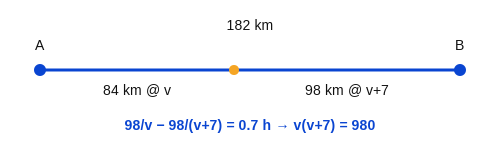
A cyclist travels from town A to town B, a distance of 182 km. For the first 84 km, he rides at a certain speed. For the remaining distance (98 km), he increases his speed by 7 km/h and therefore reaches 42 minutes earlier than the time he would have taken if he had travelled the entire distance at the original speed. Find the original speed.
एक साइकिल चालक नगर A से नगर B तक 182 km की दूरी तय करता है। पहले 84 km वह एक निश्चित चाल से चलता है। शेष दूरी (98 km) के लिए वह अपनी चाल 7 km/h बढ़ा देता है और इसलिए वह उस समय से 42 मिनट पहले पहुँच जाता है, जो संपूर्ण दूरी मूल चाल से तय करने पर लगता। मूल चाल ज्ञात कीजिए।
  1. A21 km/hr
  2. B28 km/hr
  3. C22.5 km/hr
  4. D24 km/hr
Show answer

Concept: Time saved occurs only on the 98 km part: 98v−98v+7=4260 h.

  1. 98·7v(v+7)=0.7.
  2. v(v+7)=6860.7=980.
  3. 28×35=980⇒v=28km/h.

Trick: Test options in v(v+7)=980: 28×35=980 ✔ directly.

Answer: (B) 28 km/hr

अवधारणा: समय की बचत केवल 98 km भाग पर: 98v−98v+7=4260 घंटा।

  1. 98·7v(v+7)=0.7।
  2. v(v+7)=6860.7=980।
  3. 28×35=980⇒v=28km/h।

ट्रिक: विकल्प v(v+7)=980 में रखें: 28×35=980 ✔

उत्तर: (B) 28 km/hr

RRB NTPC Undergraduate CBT 1MathematicsSpeed, Time and DistanceRRB NTPC Undergraduate CBT 1 2025 · 19 Jun Shift 2 →
Q11943.
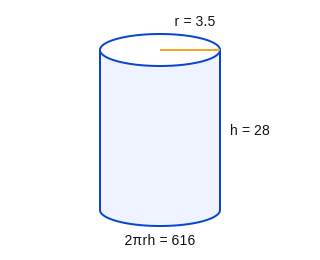
The radius of the base of a cylinder is 3.5 cm and its curved surface area is 616 cm². Find the volume of the cylinder.
(Take π=227)
एक बेलन के आधार की त्रिज्या 3.5 cm है और उसका वक्र पृष्ठीय क्षेत्रफल 616 cm² है। बेलन का आयतन ज्ञात कीजिए।
(Take π=227)
  1. A1370 cm³
  2. B1024 cm³
  3. C1424 cm³
  4. D1078 cm³
Show answer

Concept: CSA =2πrh, Volume =πr2h.

  1. 2×227×3.5×h=616⇒22h=616⇒h=28cm.
  2. V=227×3.5×3.5×28=38.5×28.
  3. V=1078cm3.

Trick: V=CSA×r2=616×3.52=1078.

Answer: (D) 1078 cm³

अवधारणा: वक्र पृष्ठीय क्षेत्रफल =2πrh, आयतन =πr2h।

  1. 2×227×3.5×h=616⇒22h=616⇒h=28cm।
  2. V=227×3.5×3.5×28=38.5×28।
  3. V=1078cm3।

ट्रिक: V=CSA×r2=616×3.52=1078।

उत्तर: (D) 1078 cm³

RRB NTPC Undergraduate CBT 1MathematicsCylinder – CSA and VolumeRRB NTPC Undergraduate CBT 1 2025 · 19 Jun Shift 2 →
Q11944.
What is the average of prime numbers lying between 5 and 30?
5 और 30 के बीच स्थित अभाज्य संख्याओं का औसत कितना है?
  1. A17
  2. B19
  3. C21
  4. D23
Show answer

Concept: Average =sumcount.

  1. Primes between 5 and 30: 7, 11, 13, 17, 19, 23, 29 (7 numbers).
  2. Sum =119.
  3. Average =1197=17.

Trick: "Between 5 and 30" excludes 5; including it would wrongly give 1248=15.5, not an option.

Answer: (A) 17

अवधारणा: औसत =योगसंख्या।

  1. 5 और 30 के बीच अभाज्य: 7, 11, 13, 17, 19, 23, 29 (7 संख्याएँ)।
  2. योग =119।
  3. औसत =1197=17।

ट्रिक: "5 और 30 के बीच" में 5 शामिल नहीं; 5 जोड़ने पर 1248=15.5 आएगा, जो विकल्प नहीं।

उत्तर: (A) 17

RRB NTPC Undergraduate CBT 1MathematicsAverage of PrimesRRB NTPC Undergraduate CBT 1 2025 · 19 Jun Shift 2 →
Q11945.
A fruit seller uses a faulty balance that reads 900 grams as 1 kg. He sells apples at ₹150 per kg (as per faulty balance). If his purchase price is ₹120 per kg (actual weight), what is his actual profit percentage?
एक फल विक्रेता एक दोषपूर्ण तराज़ू का उपयोग करता है जो 900 ग्राम को 1 kg दर्शाता है। वह सेब ₹150 प्रति kg (दोषपूर्ण तराज़ू के अनुसार) की दर से बेचता है। यदि उसका क्रय मूल्य ₹120 प्रति kg (वास्तविक भार) है, तो उसका वास्तविक लाभ प्रतिशत कितना है?
  1. A3889%
  2. B3849%
  3. C3789%
  4. D3749%
Show answer

Concept: Compare the actual cost of the goods given with the money received.

  1. For "1 kg" he gives 900 g and gets ₹150.
  2. Cost of 900 g =120×0.9=108.
  3. Profit %=150−108108×100=42108×100=3889%.

Trick: Combined: 150120×1000900=2518⇒718×100=3889%.

Answer: (A) 3889%

अवधारणा: दिए गए सामान की वास्तविक लागत की तुलना प्राप्त राशि से करें।

  1. "1 kg" के बदले 900 g देता है और ₹150 लेता है।
  2. 900 g की लागत =120×0.9=108।
  3. लाभ%=150−108108×100=42108×100=3889%।

ट्रिक: एक साथ: 150120×1000900=2518⇒718×100=3889%।

उत्तर: (A) 3889%

RRB NTPC Undergraduate CBT 1MathematicsFaulty BalanceRRB NTPC Undergraduate CBT 1 2025 · 19 Jun Shift 2 →
Q11946.
₹1,472 is divided among Rohit, Maya, and Vikas in such a way that if ₹25, ₹52, and ₹18 be deducted from their respective shares, they have money in the ratio 15:19:17. Find Vikas’s amount after deduction.
₹1,472 को रोहित, माया और विकास के बीच इस प्रकार बाँटा जाता है कि यदि उनके संबंधित हिस्सों में से क्रमशः ₹25, ₹52 और ₹18 घटा दिए जाएँ, तो उनके पास धनराशि का अनुपात 15:19:17 हो जाता है। कटौती के बाद विकास की राशि ज्ञात कीजिए।
  1. A₹359
  2. B₹509
  3. C₹559
  4. D₹459
Show answer

Concept: Remove the deductions first; the rest is split in the given ratio.

  1. Total deducted =25+52+18=95; remaining =1472−95=1377.
  2. 15k+19k+17k=51k=1377⇒k=27.
  3. Vikas after deduction =17×27=459.

Trick: Remaining amount must be divisible by 51: 1377÷51=27.

Answer: (D) ₹459

अवधारणा: पहले कटौतियाँ हटाएँ; शेष राशि दिए अनुपात में बँटती है।

  1. कुल कटौती =25+52+18=95; शेष =1472−95=1377।
  2. 15k+19k+17k=51k=1377⇒k=27।
  3. कटौती के बाद विकास =17×27=459।

ट्रिक: शेष राशि 51 से विभाज्य: 1377÷51=27।

उत्तर: (D) ₹459

RRB NTPC Undergraduate CBT 1MathematicsRatio and ProportionRRB NTPC Undergraduate CBT 1 2025 · 19 Jun Shift 2 →
Q11947.
The marked price of a cooker is the same at four shops I, II, III and IV. Shop I allows two successive discounts of 89% and 68%, shop II allows successive discounts of 50% and 51%, shop III allows successive discounts of 25% and 11% and shop IV allows successive discounts of 94%, 49%, and 21% on the marked price of the cooker. Which shop is selling the cooker at the lowest price?
चार दुकानों I, II, III और IV पर एक कुकर का अंकित मूल्य समान है। दुकान I कुकर के अंकित मूल्य पर 89% और 68% की दो क्रमिक छूट देती है, दुकान II 50% और 51% की क्रमिक छूट देती है, दुकान III 25% और 11% की क्रमिक छूट देती है और दुकान IV 94%, 49% और 21% की क्रमिक छूट देती है। कौन-सी दुकान कुकर को सबसे कम मूल्य पर बेच रही है?
  1. AI
  2. BIV
  3. CII
  4. DIII
Show answer

Concept: Selling price after successive discounts =MP×(1−d1)(1−d2)…

  1. I: 0.11×0.32=0.0352 of MP.
  2. II: 0.50×0.49=0.245; III: 0.75×0.89=0.6675.
  3. IV: 0.06×0.51×0.79≈0.0242 of MP — the smallest.

Trick: Compare the "remaining" fractions, not the discount totals; IV leaves only about 2.4% of MP.

Answer: (B) IV

अवधारणा: क्रमिक छूट के बाद मूल्य =MP×(1−d1)(1−d2)…

  1. I: 0.11×0.32=0.0352 MP।
  2. II: 0.50×0.49=0.245; III: 0.75×0.89=0.6675।
  3. IV: 0.06×0.51×0.79≈0.0242 MP — सबसे कम।

ट्रिक: छूट नहीं, बचा हुआ भाग तुलना करें; IV में केवल लगभग 2.4% MP बचता है।

उत्तर: (B) IV

RRB NTPC Undergraduate CBT 1MathematicsSuccessive DiscountsRRB NTPC Undergraduate CBT 1 2025 · 19 Jun Shift 2 →
Q11948.
If the cost of 6 chocolates, 12 chocolates, and x chocolates are in proportion such that x is the third proportional, how many chocolates correspond to x?
यदि 6 चॉकलेट, 12 चॉकलेट और x चॉकलेट का मूल्य इस प्रकार समानुपात में है कि x तृतीयानुपाती है, तो x कितनी चॉकलेट के संगत है?
  1. A24
  2. B32
  3. C28
  4. D26
Show answer

Concept: Third proportional of a and b: a:b=b:x⇒x=b2a.

  1. 6:12=12:x.
  2. x=1226=1446=24.

Trick: 6→12 doubles, so 12→24.

Answer: (A) 24

अवधारणा: a और b का तृतीयानुपाती: a:b=b:x⇒x=b2a।

  1. 6:12=12:x।
  2. x=1226=1446=24।

ट्रिक: 6→12 दोगुना, तो 12→24।

उत्तर: (A) 24

RRB NTPC Undergraduate CBT 1MathematicsThird ProportionalRRB NTPC Undergraduate CBT 1 2025 · 19 Jun Shift 2 →
Q11949.
Simplify: (32×9)3272×34
सरल कीजिए: (32×9)3272×34
  1. A13
  2. B3
  3. C9
  4. D19
Show answer

Concept: Write everything as powers of 3: (am)n=amn, am×an=am+n.

  1. Numerator: (32×32)3=(34)3=312.
  2. Denominator: 272×34=36×34=310.
  3. 312310=32=9.

Trick: Convert 9 and 27 to base 3 first — then just subtract exponents.

Answer: (C) 9

अवधारणा: सबको 3 की घात में लिखें: (am)n=amn, am×an=am+n।

  1. अंश: (32×32)3=(34)3=312।
  2. हर: 272×34=36×34=310।
  3. 312310=32=9।

ट्रिक: 9 और 27 को पहले आधार 3 में बदलें — फिर घातांक घटाएँ।

उत्तर: (C) 9

RRB NTPC Undergraduate CBT 1MathematicsLaws of ExponentsRRB NTPC Undergraduate CBT 1 2025 · 19 Jun Shift 2 →
Q11950.
The average of 8 numbers is 43. If each number is decreased by 7, what will the new average be?
8 संख्याओं का औसत 43 है। यदि प्रत्येक संख्या में 7 की कमी की जाए, तो नया औसत क्या होगा?
  1. A43
  2. B36
  3. C8
  4. D29
Show answer

Concept: If every number decreases by k, the average also decreases by k.

  1. New average =43−7=36.

Yaad rakhein: Adding/subtracting the same value to all shifts the average by that value; multiplying scales it.

Answer: (B) 36

अवधारणा: प्रत्येक संख्या k घटे तो औसत भी k घटता है।

  1. नया औसत =43−7=36।

याद रखें: सभी में समान मान जोड़ने/घटाने से औसत उतना ही बदलता है; गुणा करने पर उसी अनुपात में।

उत्तर: (B) 36

RRB NTPC Undergraduate CBT 1MathematicsAverageRRB NTPC Undergraduate CBT 1 2025 · 19 Jun Shift 2 →
Q11951.
The mode of the numbers 7, 8, 7, 9, 10 is:
संख्याओं 7, 8, 7, 9, 10 का बहुलक (mode) कितना है?
  1. A7
  2. B9
  3. C10
  4. D8
Show answer

Concept: Mode is the value that occurs most often.

  1. 7 occurs twice; 8, 9, 10 occur once each.
  2. Mode =7.

Yaad rakhein: Mode = most frequent, median = middle value, mean = average.

Answer: (A) 7

अवधारणा: बहुलक (mode) वह मान है जो सबसे अधिक बार आता है।

  1. 7 दो बार; 8, 9, 10 एक-एक बार।
  2. बहुलक =7।

याद रखें: Mode = सबसे अधिक बार, Median = बीच का मान, Mean = औसत।

उत्तर: (A) 7

RRB NTPC Undergraduate CBT 1MathematicsModeRRB NTPC Undergraduate CBT 1 2025 · 19 Jun Shift 2 →
Q11952.
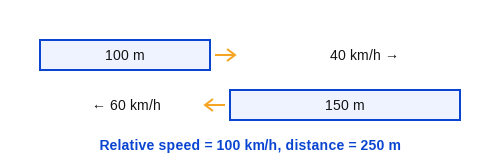
Two trains of lengths 100 m and 150 m are moving in opposite directions at 40 km/h and 60 km/h, respectively. Find the time taken by the trains (in seconds) to cross each other other.
100 m और 150 m लंबाई वाली दो रेलगाड़ियाँ क्रमशः 40 km/h और 60 km/h की चाल से विपरीत दिशाओं में चल रही हैं। रेलगाड़ियों द्वारा एक-दूसरे को पार करने में लगा समय (सेकंड में) ज्ञात कीजिए।
  1. A8 seconds8 सेकंड
  2. B9.5 seconds9.5 सेकंड
  3. C9 seconds9 सेकंड
  4. D8.9 seconds8.9 सेकंड
Show answer

Concept: Opposite directions: relative speed = sum; distance = sum of lengths.

  1. Relative speed =40+60=100km/h=100×518=2509m/s.
  2. Distance =100+150=250m.
  3. Time =250÷2509=9s.

Trick: Time (s) =total length (m)×18speed (km/h)×5=250×18500=9.

Answer: (C) 9 seconds

अवधारणा: विपरीत दिशा: सापेक्ष चाल = योग; दूरी = लंबाइयों का योग।

  1. सापेक्ष चाल =40+60=100km/h=100×518=2509m/s।
  2. दूरी =100+150=250m।
  3. समय =250÷2509=9s।

ट्रिक: समय (s) =कुल लंबाई (m)×18चाल (km/h)×5=250×18500=9।

उत्तर: (C) 9 सेकंड

RRB NTPC Undergraduate CBT 1MathematicsTrains – Opposite DirectionsRRB NTPC Undergraduate CBT 1 2025 · 19 Jun Shift 2 →
Q11953.
The present ages of A and B are in the ratio 5 : 7. After 6 years, the sum of their ages will be 60 years. What is A’s present age?
A और B की वर्तमान आयु का अनुपात 5 : 7 है। 6 वर्ष बाद, उनकी आयु का योग 60 वर्ष होगा। A की वर्तमान आयु क्या है?
  1. A40 years40 वर्ष
  2. B20 years20 वर्ष
  3. C25 years25 वर्ष
  4. D30 years30 वर्ष
Show answer

Concept: After n years, the sum of two ages increases by 2n.

  1. Present sum =60−2×6=48.
  2. 5x+7x=12x=48⇒x=4.
  3. A =5×4=20 years.

Trick: A =512×48=20.

Answer: (B) 20 years

अवधारणा: n वर्ष बाद दोनों की आयु का योग 2n बढ़ता है।

  1. वर्तमान योग =60−2×6=48।
  2. 5x+7x=12x=48⇒x=4।
  3. A =5×4=20 वर्ष।

ट्रिक: A =512×48=20।

उत्तर: (B) 20 वर्ष

RRB NTPC Undergraduate CBT 1MathematicsProblems on AgesRRB NTPC Undergraduate CBT 1 2025 · 19 Jun Shift 2 →
Q11954.
A wholesaler allows a scheme discount of 25% on an article whose marked price is ₹2,400. The retailer is required to pay the remaining amount in full. What is the net price paid by the retailer?
एक थोक विक्रेता ₹2,400 अंकित मूल्य वाली एक वस्तु पर 25% की योजना छूट (scheme discount) देता है। खुदरा विक्रेता को शेष राशि का पूरा भुगतान करना होता है। खुदरा विक्रेता द्वारा भुगतान किया गया शुद्ध मूल्य कितना है?
  1. A₹1,700
  2. B₹1,750
  3. C₹1,900
  4. D₹1,800
Show answer

Concept: Net price =MP×100−d100.

  1. 2400×75100=1800.

Trick: 25%=14: 2400−600=1800.

Answer: (D) ₹1,800

अवधारणा: शुद्ध मूल्य =MP×100−d100।

  1. 2400×75100=1800।

ट्रिक: 25%=14: 2400−600=1800।

उत्तर: (D) ₹1,800

RRB NTPC Undergraduate CBT 1MathematicsDiscountRRB NTPC Undergraduate CBT 1 2025 · 19 Jun Shift 2 →
Q11955.
A sum, when invested at 20% simple interest per annum, amounts to ₹5,040 after 3 years. What is the simple interest (in ₹) on the same sum at the same rate in 2 years?
एक राशि, 20% वार्षिक साधारण ब्याज पर निवेश करने पर, 3 वर्ष बाद ₹5,040 हो जाती है। उसी राशि पर उसी दर से 2 वर्ष में साधारण ब्याज (₹ में) कितना होगा?
  1. A630
  2. B2,520
  3. C5,040
  4. D1,260
Show answer

Concept: A=P(1+RT100), SI=PRT100.

  1. 5040=P(1+0.6)=1.6P⇒P=3150.
  2. SI for 2 years =3150×20×2100=1260.

Trick: 3 years' SI =60% of P, amount =160%; 2 years =40%: 40160×5040=1260.

Answer: (D) 1,260

अवधारणा: A=P(1+RT100), SI=PRT100।

  1. 5040=P(1+0.6)=1.6P⇒P=3150।
  2. 2 वर्ष का SI =3150×20×2100=1260।

ट्रिक: मिश्रधन =160%, 2 वर्ष का ब्याज =40%: 40160×5040=1260।

उत्तर: (D) 1,260

RRB NTPC Undergraduate CBT 1MathematicsSimple InterestRRB NTPC Undergraduate CBT 1 2025 · 19 Jun Shift 2 →
Q11956.
Based on the English alphabetical order, three of the following four are alike in a certain way and thus form a group. Which is the one that does not belong to that group? (Note: The odd man out is not based on the number of consonants/vowels or their position in the letter cluster.)
अंग्रेज़ी वर्णमाला क्रम के आधार पर, निम्नलिखित चार में से तीन किसी निश्चित प्रकार से एकसमान हैं और इस प्रकार एक समूह बनाते हैं। वह कौन-सा विकल्प है जो उस समूह से संबंधित नहीं है? (ध्यान दें: असंगत, अक्षर-समूह में व्यंजनों/स्वरों की संख्या या उनके स्थान पर आधारित नहीं है।)
  1. ABCDF
  2. BUVWX
  3. CHIJL
  4. DOPQS
Show answer

Concept: Check the gaps between consecutive letters of each cluster.

  1. BCDF: +1,+1,+2
  2. HIJL: +1,+1,+2; OPQS: +1,+1,+2
  3. UVWX: +1,+1,+1 – different pattern.

Trick: Three clusters skip one letter at the end (E, K, R missing); UVWX skips nothing.

Answer: (B) UVWX

अवधारणा: हर समूह के क्रमागत अक्षरों का अंतर देखें।

  1. BCDF: +1,+1,+2
  2. HIJL: +1,+1,+2; OPQS: +1,+1,+2
  3. UVWX: +1,+1,+1 – पैटर्न अलग।

ट्रिक: तीन समूहों में अंत में एक अक्षर छूटता है (E, K, R); UVWX में कोई नहीं।

उत्तर: (B) UVWX

RRB NTPC Undergraduate CBT 1General Intelligence and ReasoningOdd one out – letter clustersRRB NTPC Undergraduate CBT 1 2025 · 19 Jun Shift 2 →
Q11957.
What should come in place of the question mark (?) in the given series based on the English alphabetical order?
FJI JNM NRQ RVU ?
अंग्रेज़ी वर्णमाला क्रम के आधार पर दी गई श्रृंखला में प्रश्न चिह्न (?) के स्थान पर क्या आना चाहिए?
FJI JNM NRQ RVU ?
  1. AVWY
  2. BVZY
  3. CVAX
  4. DVYX
Show answer

Concept: Look at the first letters and at the link inside each term.

  1. First letters: F, J, N, R → each +4, so next is V.
  2. Inside each term: 2nd = 1st +4, 3rd = 2nd −1 (F→J→I, J→N→M, R→V→U).
  3. V +4 = Z, Z −1 = Y → VZY.

Trick: Every letter of each term moves +4: FJI → JNM → NRQ → RVU → VZY.

Answer: (B) VZY

अवधारणा: पहले अक्षर और हर पद के भीतर का संबंध देखें।

  1. पहले अक्षर: F, J, N, R → हर बार +4, अतः अगला V।
  2. हर पद में: दूसरा = पहला +4, तीसरा = दूसरा −1 (F→J→I, R→V→U)।
  3. V +4 = Z, Z −1 = Y → VZY।

ट्रिक: हर पद का हर अक्षर +4 खिसकता है: RVU → VZY।

उत्तर: (B) VZY

RRB NTPC Undergraduate CBT 1General Intelligence and ReasoningLetter seriesRRB NTPC Undergraduate CBT 1 2025 · 19 Jun Shift 2 →
Q11958.
In a certain code language, ‘CONE’ is coded as ‘1536’ and ‘NOTE’ is coded as ‘3146’. What is the code for ‘T’ in the given code language?
एक निश्चित कूट भाषा में, ‘CONE’ को ‘1536’ लिखा जाता है और ‘NOTE’ को ‘3146’ लिखा जाता है। उसी कूट भाषा में ‘T’ के लिए कूट क्या है?
  1. A6
  2. B1
  3. C3
  4. D4
Show answer

Concept: Letters common to both words take the digits common to both codes.

  1. CONE = 1536, NOTE = 3146.
  2. Common letters: O, N, E ↔ common digits: 1, 3, 6.
  3. Left over: CONE has C ↔ 5; NOTE has T ↔ 4.

Trick: Remove the common part; the unmatched letter gets the unmatched digit.

Answer: (D) 4

अवधारणा: दोनों शब्दों के उभयनिष्ठ अक्षरों को दोनों कोडों के उभयनिष्ठ अंक मिलते हैं।

  1. CONE = 1536, NOTE = 3146।
  2. उभयनिष्ठ अक्षर: O, N, E ↔ उभयनिष्ठ अंक: 1, 3, 6।
  3. शेष: CONE में C ↔ 5; NOTE में T ↔ 4।

ट्रिक: उभयनिष्ठ भाग हटाएँ; बचे अक्षर को बचा अंक मिलेगा।

उत्तर: (D) 4

RRB NTPC Undergraduate CBT 1General Intelligence and ReasoningCoding-decoding – common lettersRRB NTPC Undergraduate CBT 1 2025 · 19 Jun Shift 2 →
Q11959.
If ‘A’ stands for ‘÷’, ‘B’ stands for ‘×’, ‘C’ stands for ‘+’ and ‘D’ stands for ‘−’, then what will come in place of the question mark (?) in the following equation?
43 D 28 C 35 A 7 B 11 = ?
यदि ‘A’ का अर्थ ‘÷’, ‘B’ का अर्थ ‘×’, ‘C’ का अर्थ ‘+’ और ‘D’ का अर्थ ‘−’ है, तो निम्नलिखित समीकरण में प्रश्न चिह्न (?) के स्थान पर क्या आएगा?
43 D 28 C 35 A 7 B 11 = ?
  1. A73
  2. B74
  3. C70
  4. D71
Show answer

Concept: Replace the letters with signs, then apply BODMAS.

  1. A = ÷, B = ×, C = +, D = −.
  2. 43−28+35÷7×11
  3. =43−28+5×11=43−28+55
  4. =70

Trick: Do ÷ and × left to right first: 35÷7×11=55.

Answer: (C) 70

अवधारणा: अक्षरों को चिह्नों से बदलें, फिर BODMAS लगाएँ।

  1. A = ÷, B = ×, C = +, D = −।
  2. 43−28+35÷7×11
  3. =43−28+5×11=43−28+55
  4. =70

ट्रिक: पहले ÷ और × बाएँ से दाएँ: 35÷7×11=55।

उत्तर: (C) 70

RRB NTPC Undergraduate CBT 1General Intelligence and ReasoningMathematical operationsRRB NTPC Undergraduate CBT 1 2025 · 19 Jun Shift 2 →
Q11960.
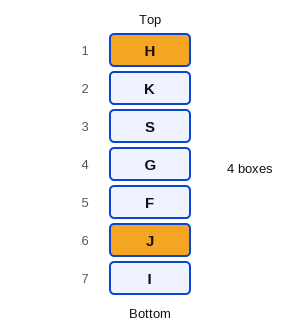
Seven boxes F,G,H,I,J,K and S are kept one over the other but not necessarily in the same order. Only three boxes are kept above G. Only one box is kept between J and G. Only three boxes are kept between J and K. K is kept at some place above G. S is kept immediately below K. F is kept at one of the places above I. H is not kept immediately above or below J. How many boxes are kept between H and J?
सात बक्से F,G,H,I,J,K और S एक के ऊपर एक रखे गए हैं, लेकिन जरूरी नहीं कि इसी क्रम में हों। G के ऊपर केवल तीन बक्से रखे हैं। J और G के बीच केवल एक बक्सा रखा है। J और K के बीच केवल तीन बक्से रखे हैं। K, G के ऊपर किसी स्थान पर रखा है। S, K के ठीक नीचे रखा है। F, I के ऊपर के स्थानों में से किसी एक पर रखा है। H, J के ठीक ऊपर या ठीक नीचे नहीं रखा है। H और J के बीच कितने बक्से रखे हैं?
  1. AOneएक
  2. BFourचार
  3. CTwoदो
  4. DThreeतीन
Show answer

Concept: Number positions 1 (top) to 7 (bottom) and fix the definite clues first.

  1. Three boxes above G → G = 4. One box between J and G → J = 2 or 6.
  2. Three between J and K, with K above G: J = 6, K = 2 (J = 2 would put K at 6, below G). S just below K → S = 3.
  3. F, H, I take 1, 5, 7. H is not next to J (5, 7) → H = 1; F above I → F = 5, I = 7.
  4. Order: H, K, S, G, F, J, I. Between H(1) and J(6): K, S, G, F = 4.

Trick: Boxes between = 6−1−1=4.

Answer: (B) Four

अवधारणा: स्थान 1 (ऊपर) से 7 (नीचे) तक लें और पहले निश्चित सूचनाएँ लगाएँ।

  1. G के ऊपर तीन बॉक्स → G = 4। J और G के बीच एक → J = 2 या 6।
  2. J और K के बीच तीन, K, G के ऊपर: J = 6, K = 2। S, K के ठीक नीचे → S = 3।
  3. F, H, I के लिए 1, 5, 7। H, J के पास (5, 7) नहीं → H = 1; F, I के ऊपर → F = 5, I = 7।
  4. क्रम: H, K, S, G, F, J, I। H(1) और J(6) के बीच: K, S, G, F = 4।

ट्रिक: बीच के बॉक्स = 6−1−1=4।

उत्तर: (B) चार

RRB NTPC Undergraduate CBT 1General Intelligence and ReasoningBox arrangementRRB NTPC Undergraduate CBT 1 2025 · 19 Jun Shift 2 →