Question bank

Q&A: practice questions with answers

Search questions on any topic. Filter by exam category, exam, subject and topic, try the question, then open the answer and explanation.

Courses – airGurukul

20,719 questions found.

Q12021.
Which combination of SI base units correctly represents the unit of density based on its dimensional formula?
घनत्व के विमीय सूत्र के आधार पर SI मूल मात्रकों का कौन-सा संयोजन घनत्व के मात्रक को सही रूप से दर्शाता है?
  1. AGram per litreग्राम प्रति लीटर
  2. BKilogram per metre cubedकिलोग्राम प्रति घन मीटर
  3. CKilogram per litreकिलोग्राम प्रति लीटर
  4. DMilligram per cubic centimetreमिलीग्राम प्रति घन सेंटीमीटर
Show answer

Concept: Density =massvolume, dimensional formula [ML−3].

  1. SI base unit of mass = kilogram (kg); of length = metre (m), so volume = m3.
  2. Hence SI unit of density = kgm−3 (kilogram per metre cubed).
  3. Gram, litre and cubic centimetre are not SI base units.

Trick: [ML−3] → kg/m3.

Answer: (B) Kilogram per metre cubed

अवधारणा: घनत्व =द्रव्यमानआयतन, विमीय सूत्र [ML−3]।

  1. द्रव्यमान का SI मूल मात्रक = किलोग्राम; लंबाई का = मीटर, अतः आयतन = m3।
  2. अतः घनत्व का SI मात्रक = kgm−3 (किलोग्राम प्रति घन मीटर)।
  3. ग्राम, लीटर और घन सेंटीमीटर SI मूल मात्रक नहीं हैं।

ट्रिक: [ML−3] → kg/m3।

उत्तर: (B) किलोग्राम प्रति घन मीटर
RRB NTPC Undergraduate CBT 1General AwarenessPhysics – Units and dimensionsRRB NTPC Undergraduate CBT 1 2025 · 19 Jun Shift 1 →
Q12022.
Which of the following folk music styles belongs to Sikkim?
निम्नलिखित में से कौन-सी लोक संगीत शैली सिक्किम से संबंधित है?
  1. ABihu songsबिहू गीत
  2. BBaulबाउल
  3. CLepchaलेप्चा
  4. DLavaniलावणी
Show answer

Concept: The Lepchas are the indigenous people of Sikkim, and Lepcha folk songs are a traditional music style of the state.

  1. Bihu songs – Assam.
  2. Baul – West Bengal (wandering minstrels).
  3. Lavani – Maharashtra.

Yaad rakhein: Sikkim → Lepcha; Assam → Bihu; Bengal → Baul; Maharashtra → Lavani.

Answer: (C) Lepcha

अवधारणा: लेप्चा सिक्किम की मूल जनजाति हैं और लेप्चा लोकगीत राज्य की पारंपरिक संगीत शैली हैं।

  1. बिहू गीत – असम।
  2. बाउल – पश्चिम बंगाल (घुमंतू गायक)।
  3. लावणी – महाराष्ट्र।

याद रखें: सिक्किम → लेप्चा; असम → बिहू; बंगाल → बाउल; महाराष्ट्र → लावणी।

उत्तर: (C) लेप्चा

RRB NTPC Undergraduate CBT 1General AwarenessArt & Culture – Folk musicRRB NTPC Undergraduate CBT 1 2025 · 19 Jun Shift 1 →
Q12023.
Which of the following courts upheld the government’s “Sahyog portal” takedown powers in September 2025?
सितंबर 2025 में निम्नलिखित में से किस न्यायालय ने सरकार की “सहयोग पोर्टल” संबंधी सामग्री हटाने (takedown) की शक्तियों को बरकरार रखा?
  1. ADelhi High Courtदिल्ली उच्च न्यायालय
  2. BBombay High Courtबॉम्बे उच्च न्यायालय
  3. CCalcutta High Courtकलकत्ता उच्च न्यायालय
  4. DKarnataka High Courtकर्नाटक उच्च न्यायालय
Show answer

Concept: The Sahyog portal of the Ministry of Home Affairs lets government agencies send content-takedown notices to online platforms.

  1. In September 2025 the Karnataka High Court dismissed X Corp's petition challenging the portal.
  2. The court upheld the government's takedown mechanism, saying platforms operating in India must follow Indian law.

Yaad rakhein: Sahyog portal case → X Corp vs Union → Karnataka HC (Sept 2025).

Answer: (D) Karnataka High Court

अवधारणा: गृह मंत्रालय का सहयोग पोर्टल सरकारी एजेंसियों को ऑनलाइन प्लेटफ़ॉर्म को सामग्री हटाने (takedown) के नोटिस भेजने देता है।

  1. सितंबर 2025 में कर्नाटक उच्च न्यायालय ने पोर्टल को चुनौती देने वाली X Corp की याचिका खारिज कर दी।
  2. न्यायालय ने सरकार की takedown व्यवस्था को सही ठहराया और कहा कि भारत में काम करने वाले प्लेटफ़ॉर्म को भारतीय कानून मानना होगा।

याद रखें: सहयोग पोर्टल → X Corp बनाम भारत संघ → कर्नाटक HC (सितंबर 2025)।

उत्तर: (D) कर्नाटक उच्च न्यायालय

RRB NTPC Undergraduate CBT 1General AwarenessCurrent Affairs – JudiciaryRRB NTPC Undergraduate CBT 1 2025 · 19 Jun Shift 1 →
Q12024.
The bar at the bottom of the Windows screen that shows open applications is:
Windows स्क्रीन के निचले भाग में स्थित वह बार, जो खुले हुए एप्लिकेशन दर्शाता है, क्या कहलाता है?
  1. AMenu barमेन्यू बार (Menu bar)
  2. BTitle barटाइटल बार (Title bar)
  3. CScroll barस्क्रॉल बार (Scroll bar)
  4. DTaskbarटास्कबार (Taskbar)
Show answer

Concept: In Windows, the Taskbar is the bar at the bottom of the screen.

  1. It holds the Start button, icons of open/pinned applications, and the notification area with clock.
  2. Title bar = top of a window showing its name; Menu bar = File/Edit/View menus; Scroll bar = moves content up/down or sideways.

Yaad rakhein: Bottom = Taskbar; top of window = Title bar.

Answer: (D) Taskbar

अवधारणा: विंडोज़ में स्क्रीन के नीचे की पट्टी टास्कबार (Taskbar) है।

  1. इसमें Start बटन, खुले/पिन किए गए एप्लिकेशन के आइकन और घड़ी वाला नोटिफिकेशन क्षेत्र होता है।
  2. टाइटल बार = विंडो के ऊपर नाम; मेनू बार = File/Edit/View मेनू; स्क्रॉल बार = सामग्री को ऊपर-नीचे/दाएँ-बाएँ करना।

याद रखें: नीचे = टास्कबार; विंडो के ऊपर = टाइटल बार।

उत्तर: (D) टास्कबार

RRB NTPC Undergraduate CBT 1General AwarenessComputer – Windows basicsRRB NTPC Undergraduate CBT 1 2025 · 19 Jun Shift 1 →
Q12025.
In which of the following ways has the private sector contributed to India's industrial growth and global expansion since the economic reforms of 1991?
1991 के आर्थिक सुधारों के बाद से निजी क्षेत्र ने भारत की औद्योगिक वृद्धि और वैश्विक विस्तार में निम्नलिखित में से किस प्रकार योगदान दिया है?
  1. ARelying solely on government subsidies for expansionविस्तार के लिए पूर्णतः सरकारी सब्सिडी पर निर्भर रहकर
  2. BAggressively pursuing global acquisitions and enhancing industrial growthआक्रामक रूप से वैश्विक अधिग्रहण करके और औद्योगिक वृद्धि को बढ़ाकर
  3. CLimiting its activities to non-core industriesअपनी गतिविधियों को गैर-प्रमुख उद्योगों तक सीमित रखकर
  4. DRestricting industrial growth to maintain a stable economyस्थिर अर्थव्यवस्था बनाए रखने के लिए औद्योगिक वृद्धि को प्रतिबंधित करके
Show answer

Concept: The LPG reforms of 1991 (liberalisation, privatisation, globalisation) opened most industries to the private sector.

  1. Licence raj was largely removed and foreign investment allowed, so private firms expanded quickly.
  2. Indian companies grew globally through acquisitions, e.g. Tata Steel–Corus, Tata Motors–Jaguar Land Rover, Hindalco–Novelis.
  3. Other options (relying only on subsidies, limiting or restricting growth) are the opposite of what happened.

Yaad rakhein: Post-1991 private sector = growth + global acquisitions.

Answer: (B) Aggressively pursuing global acquisitions and enhancing industrial growth

अवधारणा: 1991 के LPG सुधारों (उदारीकरण, निजीकरण, वैश्वीकरण) ने अधिकांश उद्योगों को निजी क्षेत्र के लिए खोल दिया।

  1. लाइसेंस राज लगभग समाप्त हुआ और विदेशी निवेश की अनुमति मिली, अतः निजी कंपनियाँ तेज़ी से बढ़ीं।
  2. भारतीय कंपनियों ने विदेशी अधिग्रहण किए, जैसे टाटा स्टील–कोरस, टाटा मोटर्स–जगुआर लैंड रोवर, हिंडाल्को–नोवेलिस।
  3. अन्य विकल्प (केवल सब्सिडी पर निर्भरता, वृद्धि सीमित करना) वास्तविकता के उलट हैं।

याद रखें: 1991 के बाद निजी क्षेत्र = वृद्धि + वैश्विक अधिग्रहण।

उत्तर: (B) आक्रामक रूप से वैश्विक अधिग्रहण और औद्योगिक वृद्धि

RRB NTPC Undergraduate CBT 1General AwarenessEconomy – Reforms of 1991RRB NTPC Undergraduate CBT 1 2025 · 19 Jun Shift 1 →
Q12026.
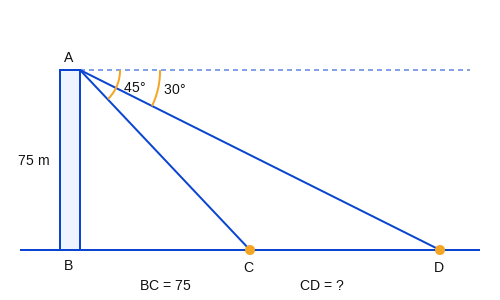
From the top of a 75-meter-high lighthouse, the angles of depression of two ships are 30° and 45°. If the two ships are on the same side of the lighthouse and in a straight line with its base, find the distance between the two ships. (Use √3 = 1.732)
75 मीटर ऊँचे प्रकाश स्तंभ के शीर्ष से दो जहाजों के अवनमन कोण 30° और 45° हैं। यदि दोनों जहाज प्रकाश स्तंभ के एक ही ओर तथा उसके आधार के साथ एक सीधी रेखा में हैं, तो दोनों जहाजों के बीच की दूरी ज्ञात कीजिए। (√3 = 1.732 का प्रयोग कीजिए)
  1. A54.9 meters54.9 मीटर
  2. B52.5 meters52.5 मीटर
  3. C58.4 meters58.4 मीटर
  4. D61.2 meters61.2 मीटर
Show answer

Concept: Angle of depression from the top equals the angle of elevation from the ship; use tanθ=heightbase.

  1. Nearer ship C (45∘): BC=75tan45∘=75 m.
  2. Farther ship D (30∘): BD=75tan30∘=753=75×1.732=129.9 m.
  3. Distance CD=129.9−75=54.9 m.

Trick: Same side, 45∘ & 30∘: gap =h(3−1)=75×0.732=54.9 m.

Answer: (A) 54.9 meters

अवधारणा: शीर्ष से अवनमन कोण = जहाज़ से उन्नयन कोण; tanθ=ऊँचाईआधार लगाएँ।

  1. पास वाला जहाज़ C (45∘): BC=75tan45∘=75 m.
  2. दूर वाला जहाज़ D (30∘): BD=753=75×1.732=129.9 m.
  3. दूरी CD=129.9−75=54.9 m.

ट्रिक: एक ही तरफ़ 45∘ व 30∘: दूरी =h(3−1)=75×0.732=54.9 m.

उत्तर: (A) 54.9 मीटर

RRB NTPC Undergraduate CBT 1MathematicsHeights and DistancesRRB NTPC Undergraduate CBT 1 2025 · 19 Jun Shift 1 →
Q12027.
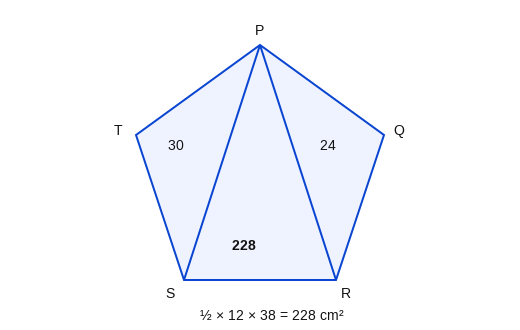
A pentagon is divided into three triangles by drawing diagonals from one of its vertices. The areas of two of these triangles are 24 cm2 and 30 cm2. The third triangle has a base of 12 cm and a height of 38 cm. What is the area (in cm2) of the pentagon?
एक पंचभुज को उसके एक शीर्ष से विकर्ण खींचकर तीन त्रिभुजों में विभाजित किया गया है। इनमें से दो त्रिभुजों के क्षेत्रफल 24 cm2 और 30 cm2 हैं। तीसरे त्रिभुज का आधार 12 cm और ऊँचाई 38 cm है। पंचभुज का क्षेत्रफल (cm2 में) कितना है?
  1. A282
  2. B242
  3. C275
  4. D228
Show answer

Concept: Diagonals from one vertex split a pentagon into 3 non-overlapping triangles; pentagon area = sum of the three areas.

  1. Third triangle: 12×12×38=228cm2.
  2. Pentagon =24+30+228=282cm2.

Trick: From one vertex an n-gon gives (n−2) triangles – here 5−2=3; just add them.

Answer: (A) 282

अवधारणा: एक शीर्ष से विकर्ण खींचने पर पंचभुज 3 त्रिभुजों में बँटता है; पंचभुज का क्षेत्रफल = तीनों त्रिभुजों का योग।

  1. तीसरा त्रिभुज: 12×12×38=228cm2.
  2. पंचभुज =24+30+228=282cm2.

ट्रिक: n भुजाओं वाले बहुभुज में एक शीर्ष से (n−2) त्रिभुज बनते हैं – यहाँ 3; बस जोड़ दें।

उत्तर: (A) 282

RRB NTPC Undergraduate CBT 1MathematicsMensuration – Area of PolygonRRB NTPC Undergraduate CBT 1 2025 · 19 Jun Shift 1 →
Q12028.
The price of an article is successively increased by 9% and 13%. Find the percentage increase in the price of the article.
एक वस्तु के मूल्य में क्रमशः 9% और 13% की वृद्धि की जाती है। वस्तु के मूल्य में प्रतिशत वृद्धि ज्ञात कीजिए।
  1. A23.17%
  2. B22.57%
  3. C20.68%
  4. D24.69%
Show answer

Concept: Two successive increases a% and b% give a net increase of a+b+ab100 %.

  1. a=9, b=13.
  2. Net =9+13+9×13100=22+1.17=23.17%.

Trick: Check: 1.09×1.13=1.2317 → 23.17%.

Answer: (A) 23.17%

अवधारणा: क्रमागत वृद्धि a% और b% का शुद्ध प्रभाव =a+b+ab100 %।

  1. a=9, b=13.
  2. शुद्ध वृद्धि =9+13+117100=23.17%.

ट्रिक: जाँच: 1.09×1.13=1.2317 → 23.17%.

उत्तर: (A) 23.17%

RRB NTPC Undergraduate CBT 1MathematicsSuccessive Percentage ChangeRRB NTPC Undergraduate CBT 1 2025 · 19 Jun Shift 1 →
Q12029.
The present age of a father is equal to sum of ages of his son and daughter. Ten years ago from now, the age of the father was double the age of the son and four times the age of the daughter. The total present age of the father, daughter and son is ____ years.
एक पिता की वर्तमान आयु उसके पुत्र और पुत्री की आयु के योग के बराबर है। अब से दस वर्ष पहले, पिता की आयु पुत्र की आयु की दोगुनी और पुत्री की आयु की चार गुनी थी। पिता, पुत्री और पुत्र की कुल वर्तमान आयु ____ वर्ष है।
  1. A100
  2. B120
  3. C80
  4. D60
Show answer

Concept: Express the son's and daughter's ages through the father's age 10 years ago.

  1. Let father's age 10 years ago =4k. Then son =2k, daughter =k (10 years ago).
  2. Present: father 4k+10, son 2k+10, daughter k+10.
  3. 4k+10=(2k+10)+(k+10)⇒k=10.
  4. Ages: 50, 30, 20; total =100.

Trick: Father = son + daughter, so total =2× father =2×50=100.

Answer: (A) 100

अवधारणा: 10 वर्ष पहले के पिता की आयु के आधार पर पुत्र और पुत्री की आयु लिखें।

  1. 10 वर्ष पहले पिता =4k, पुत्र =2k, पुत्री =k.
  2. वर्तमान: पिता 4k+10, पुत्र 2k+10, पुत्री k+10.
  3. 4k+10=(2k+10)+(k+10)⇒k=10.
  4. आयु: 50, 30, 20; कुल =100.

ट्रिक: पिता = पुत्र + पुत्री, इसलिए कुल =2× पिता =2×50=100.

उत्तर: (A) 100

RRB NTPC Undergraduate CBT 1MathematicsProblems on AgesRRB NTPC Undergraduate CBT 1 2025 · 19 Jun Shift 1 →
Q12030.
A positive integer N divides 228, leaving a remainder of 18. What is the greatest two- digit value of N?
एक धनात्मक पूर्णांक N, 228 को विभाजित करने पर 18 शेषफल देता है। N का सबसे बड़ा दो-अंकीय मान क्या है?
  1. A60
  2. B70
  3. C42
  4. D84
Show answer

Concept: If N divides 228 leaving remainder 18, then N divides 228−18 and N>18.

  1. 228−18=210=2×3×5×7.
  2. Two-digit divisors of 210 greater than 18: 21,30,35,42,70.
  3. Greatest is 70 (check: 228=3×70+18).

Trick: Divisor must always be greater than the remainder.

Answer: (B) 70

अवधारणा: यदि N से 228 को भाग देने पर शेष 18 है, तो N, 228−18 को पूर्णतः विभाजित करता है और N>18।

  1. 228−18=210=2×3×5×7.
  2. 210 के दो अंकों वाले भाजक (18 से बड़े): 21,30,35,42,70.
  3. सबसे बड़ा 70 (जाँच: 228=3×70+18).

ट्रिक: भाजक हमेशा शेषफल से बड़ा होता है।

उत्तर: (B) 70

RRB NTPC Undergraduate CBT 1MathematicsDivision and RemainderRRB NTPC Undergraduate CBT 1 2025 · 19 Jun Shift 1 →
Q12031.
Pipes, A and B, can fill a tank in 10 hours. Pipes, B and C, can fill the same tank in 20 hours. If pipe B alone can fill the same tank in 30 hours, how much time will the pipes A and C take together to fill the same tank.
पाइप A और B मिलकर एक टंकी को 10 घंटे में भर सकते हैं। पाइप B और C मिलकर उसी टंकी को 20 घंटे में भर सकते हैं। यदि अकेला पाइप B उसी टंकी को 30 घंटे में भर सकता है, तो पाइप A और C मिलकर उसी टंकी को भरने में कितना समय लेंगे?
  1. A13 hours13 घंटे
  2. B14 hours14 घंटे
  3. C12 hours12 घंटे
  4. D16 hours16 घंटे
Show answer

Concept: Work per hour of each pipe is the reciprocal of its time; take LCM capacity.

  1. Tank =LCM(10,20,30)=60 units. A+B =6, B+C =3, B =2 units/h.
  2. A =6−2=4, C =3−2=1 unit/h.
  3. A+C =5 units/h → time =605=12 hours.

Trick: A+C =(A+B)+(B+C)−2B=6+3−4=5 units/h.

Answer: (C) 12 hours

अवधारणा: प्रत्येक पाइप का प्रति घंटा कार्य = समय का व्युत्क्रम; LCM को टंकी की क्षमता मानें।

  1. टंकी =LCM(10,20,30)=60 इकाई। A+B =6, B+C =3, B =2 इकाई/घंटा।
  2. A =4, C =1 इकाई/घंटा।
  3. A+C =5 इकाई/घंटा → समय =605=12 घंटे।

ट्रिक: A+C =(A+B)+(B+C)−2B=6+3−4=5.

उत्तर: (C) 12 घंटे

RRB NTPC Undergraduate CBT 1MathematicsPipes and CisternsRRB NTPC Undergraduate CBT 1 2025 · 19 Jun Shift 1 →
Q12032.
Chetan’s salary is ₹16000 per month. He spends ₹6000 on house rent, ₹1500 on bills and the rest of the amount is his monthly savings. Find his savings(in ₹) in a year, if in the month of his birthday he spent his complete monthly saving for birthday
celebration.
चेतन का वेतन ₹16000 प्रति माह है। वह ₹6000 मकान किराए पर, ₹1500 बिलों पर खर्च करता है और शेष राशि उसकी मासिक बचत है। एक वर्ष में उसकी बचत (₹ में) ज्ञात कीजिए, यदि अपने जन्मदिन वाले महीने में उसने अपनी पूरी मासिक बचत जन्मदिन
समारोह पर खर्च कर दी।
  1. A85000
  2. B76500
  3. C102000
  4. D93500
Show answer

Concept: Monthly saving = salary − expenses; in the birthday month saving becomes zero.

  1. Saving per month =16000−6000−1500=8500.
  2. Saved in only 11 months: 11×8500=93500.

Trick: Year saving =12×8500−8500=93500.

Answer: (D) ₹93500

अवधारणा: मासिक बचत = वेतन − खर्च; जन्मदिन वाले महीने में बचत शून्य।

  1. प्रति माह बचत =16000−6000−1500=8500.
  2. केवल 11 महीनों की बचत: 11×8500=93500.

ट्रिक: वार्षिक बचत =12×8500−8500=93500.

उत्तर: (D) ₹93500

RRB NTPC Undergraduate CBT 1MathematicsIncome and SavingsRRB NTPC Undergraduate CBT 1 2025 · 19 Jun Shift 1 →
Q12033.
Simplify: (1321)(1310)÷(59×1815+57)+106÷2915 of 156
सरल कीजिए: (1321)(1310)÷(59×1815+57)+106÷2915 of 156
  1. A1336
  2. B1027
  3. C2029
  4. D2637
Show answer

Concept: Follow VBODMAS: brackets first, then ‘of’, then division, multiplication, addition.

  1. 13/2113/10=1021.
  2. Bracket: 59×1815+57=23+57=2921; so 1021÷2921=1029.
  3. ‘of’ first: 2915 of 156=296; so 106÷296=1029.
  4. Total =1029+1029=2029.

Trick: ‘of’ is solved before ÷ – doing ÷ first gives a wrong answer.

Answer: (C) 2029

अवधारणा: VBODMAS नियम: पहले कोष्ठक, फिर ‘of’ (का), फिर भाग, गुणा, जोड़।

  1. 13/2113/10=1021.
  2. कोष्ठक: 23+57=2921; अतः 1021÷2921=1029.
  3. पहले ‘of’: 2915×156=296; अतः 106÷296=1029.
  4. कुल =2029.

ट्रिक: ‘of’ को ÷ से पहले हल करें।

उत्तर: (C) 2029

RRB NTPC Undergraduate CBT 1MathematicsSimplification (BODMAS)RRB NTPC Undergraduate CBT 1 2025 · 19 Jun Shift 1 →
Q12034.
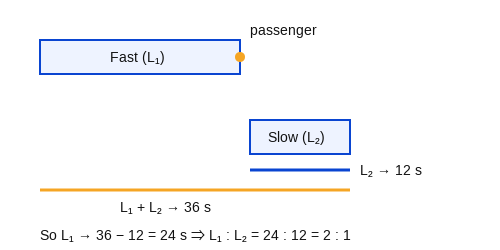
A faster train overtakes a slower train, both moving in the same direction. The faster train takes 36 seconds to completely pass the slower train. A passenger sitting in the faster train observes that he passes the slower train in 12 seconds. Find the ratio of the length of the faster train to the length of the slower train.
एक तेज़ गति वाली रेलगाड़ी, एक धीमी गति वाली रेलगाड़ी से आगे निकलती है, दोनों एक ही दिशा में चल रही हैं। तेज़ रेलगाड़ी को धीमी रेलगाड़ी को पूरी तरह पार करने में 36 सेकंड लगते हैं। तेज़ रेलगाड़ी में बैठा एक यात्री देखता है कि वह धीमी रेलगाड़ी को 12 सेकंड में पार कर लेता है। तेज़ रेलगाड़ी की लंबाई और धीमी रेलगाड़ी की लंबाई का अनुपात ज्ञात कीजिए।
  1. A3 : 2
  2. B3 : 1
  3. C1 : 1
  4. D2 : 1
Show answer

Concept: At the same relative speed v, the time taken is proportional to the length covered.

  1. Faster train fully passing slower: L1+L2=36v.
  2. Passenger (a point) passing slower train: L2=12v.
  3. L1=36v−12v=24v, so L1:L2=24:12=2:1.

Trick: Ratio =(36−12):12=2:1.

Answer: (D) 2:1

अवधारणा: समान सापेक्ष चाल v पर समय ∝ तय की गई लंबाई।

  1. तेज़ गाड़ी द्वारा धीमी को पूरा पार करना: L1+L2=36v.
  2. यात्री (एक बिंदु) द्वारा धीमी गाड़ी पार करना: L2=12v.
  3. L1=24v, अतः L1:L2=2:1.

ट्रिक: अनुपात =(36−12):12=2:1.

उत्तर: (D) 2:1

RRB NTPC Undergraduate CBT 1MathematicsTrains – Relative SpeedRRB NTPC Undergraduate CBT 1 2025 · 19 Jun Shift 1 →
Q12035.
Two trains, 130 meters and 120 meters long, are running in parallel tracks in the same direction at speeds of 62 km/hr and 44 km/hr, respectively. How much time will the faster train take to completely cross the slower one?
130 मीटर और 120 मीटर लंबी दो रेलगाड़ियाँ समांतर पटरियों पर एक ही दिशा में क्रमशः 62 km/hr और 44 km/hr की चाल से चल रही हैं। तेज़ रेलगाड़ी को धीमी रेलगाड़ी को पूरी तरह पार करने में कितना समय लगेगा?
  1. A45 seconds45 सेकंड
  2. B50 seconds50 सेकंड
  3. C60 seconds60 सेकंड
  4. D55 seconds55 सेकंड
Show answer

Concept: Same direction: relative speed = difference; distance = sum of lengths.

  1. Relative speed =62−44=18km/h=18×518=5 m/s.
  2. Distance =130+120=250 m.
  3. Time =2505=50 s.

Trick: 18km/h=5 m/s – remember this pair.

Answer: (B) 50 seconds

अवधारणा: एक ही दिशा: सापेक्ष चाल = अंतर; दूरी = दोनों लंबाइयों का योग।

  1. सापेक्ष चाल =18km/h=5 m/s.
  2. दूरी =250 m.
  3. समय =2505=50 सेकंड।

ट्रिक: 18km/h=5 m/s याद रखें।

उत्तर: (B) 50 सेकंड

RRB NTPC Undergraduate CBT 1MathematicsTrains – Same DirectionRRB NTPC Undergraduate CBT 1 2025 · 19 Jun Shift 1 →
Q12036.
If the average of four numbers is 15, and three of the numbers are 10, 20, and 25, what is the fourth number?
यदि चार संख्याओं का औसत 15 है, और उनमें से तीन संख्याएँ 10, 20 और 25 हैं, तो चौथी संख्या क्या है?
  1. A5
  2. B10
  3. C15
  4. D20
Show answer

Concept: Sum = average × count.

  1. Sum of 4 numbers =4×15=60.
  2. Fourth =60−(10+20+25)=5.

Trick: Deviation method: −5+5+10=10 above 15, so fourth =15−10=5.

Answer: (A) 5

अवधारणा: योग = औसत × संख्या।

  1. चार संख्याओं का योग =60.
  2. चौथी =60−55=5.

ट्रिक: विचलन: −5+5+10=10, अतः चौथी =15−10=5.

उत्तर: (A) 5

RRB NTPC Undergraduate CBT 1MathematicsAverageRRB NTPC Undergraduate CBT 1 2025 · 19 Jun Shift 1 →
Q12037.
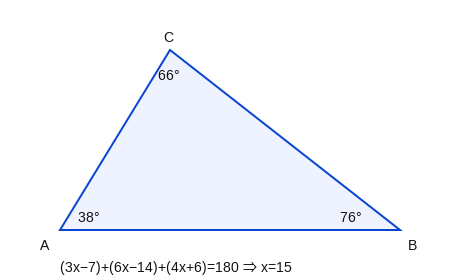
In △ABC, ∠A=(3x−7)∘, ∠B=2∠A and ∠C=(4x+6)∘. Find the value of ∠A+∠C.
△ABC में, ∠A=(3x−7)∘, ∠B=2∠A और ∠C=(4x+6)∘ है। ∠A+∠C का मान ज्ञात कीजिए।
  1. A115∘
  2. B148∘
  3. C135∘
  4. D104∘
Show answer

Concept: Sum of the three angles of a triangle is 180∘.

  1. ∠B=2∠A=6x−14.
  2. (3x−7)+(6x−14)+(4x+6)=180⇒13x=195⇒x=15.
  3. ∠A=38∘, ∠C=66∘; ∠A+∠C=104∘.

Trick: Check: 38+76+66=180 ✓.

Answer: (D) 104∘

अवधारणा: त्रिभुज के तीनों कोणों का योग 180∘ होता है।

  1. ∠B=2∠A=6x−14.
  2. 13x−15=180⇒x=15.
  3. ∠A=38∘, ∠C=66∘; योग =104∘.

ट्रिक: जाँच: 38+76+66=180 ✓.

उत्तर: (D) 104∘

RRB NTPC Undergraduate CBT 1MathematicsAngle Sum of TriangleRRB NTPC Undergraduate CBT 1 2025 · 19 Jun Shift 1 →
Q12038.
The simple interest on a certain sum for 4 years at 10% interest per annum is ₹3,200. What will be the amount payable after 6 years at the same rate?
किसी निश्चित राशि पर 10% वार्षिक ब्याज दर से 4 वर्षों का साधारण ब्याज ₹3,200 है। उसी दर पर 6 वर्षों के बाद देय मिश्रधन कितना होगा?
  1. A₹12,800
  2. B₹12,400
  3. C₹11,800
  4. D₹11,400
Show answer

Concept: SI=P×R×T100; amount =P+SI.

  1. 3200=P×10×4100⇒P=8000.
  2. SI for 6 years =8000×10×6100=4800.
  3. Amount =8000+4800=12800.

Trick: SI per year =32004=800 = 10% of P → P=8000.

Answer: (A) ₹12,800

अवधारणा: SI=P×R×T100; मिश्रधन =P+SI.

  1. 3200=P×40100⇒P=8000.
  2. 6 वर्ष का ब्याज =4800.
  3. मिश्रधन =12800.

ट्रिक: प्रति वर्ष ब्याज =800 = P का 10% → P=8000.

उत्तर: (A) ₹12,800

RRB NTPC Undergraduate CBT 1MathematicsSimple InterestRRB NTPC Undergraduate CBT 1 2025 · 19 Jun Shift 1 →
Q12039.
A and B can complete a piece of work in 12 days and 6 days, respectively. Both work together for 2 days and then A leaves. B completes the remaining work alone. In how many days is the whole work completed?
A और B किसी कार्य को क्रमशः 12 दिन और 6 दिन में पूरा कर सकते हैं। दोनों 2 दिन तक साथ मिलकर कार्य करते हैं और फिर A कार्य छोड़ देता है। B शेष कार्य अकेले पूरा करता है। पूरा कार्य कितने दिनों में पूरा होता है?
  1. A6
  2. B4
  3. C5
  4. D3
Show answer

Concept: Take total work = LCM of days and find daily units.

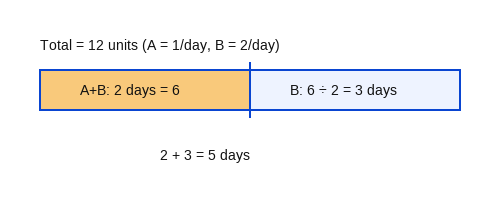
  1. Work =LCM(12,6)=12 units; A =1, B =2 units/day.
  2. Together for 2 days: 2×3=6 units.
  3. Remaining 6 units by B: 62=3 days.
  4. Total =2+3=5 days.

Trick: Half the work is done in 2 days; B alone does half in 62=3 days.

Answer: (C) 5

अवधारणा: कुल कार्य = दिनों का LCM; प्रतिदिन की इकाइयाँ निकालें।

  1. कार्य =12 इकाई; A =1, B =2 इकाई/दिन।
  2. 2 दिन साथ में: 6 इकाई।
  3. शेष 6 इकाई B: 3 दिन।
  4. कुल =5 दिन।

ट्रिक: 2 दिन में आधा कार्य; B अकेले बाकी आधा 3 दिन में।

उत्तर: (C) 5

RRB NTPC Undergraduate CBT 1MathematicsTime and WorkRRB NTPC Undergraduate CBT 1 2025 · 19 Jun Shift 1 →
Q12040.
₹5,278 is divided among X, Y, and Z in such a way that if ₹67, ₹61, and ₹68 are deducted from their respective shares, they have money in the ratio 8 : 20 : 5. Find X’s share after deduction.
₹5,278 को X, Y और Z के बीच इस प्रकार विभाजित किया जाता है कि यदि उनके संबंधित हिस्सों में से क्रमशः ₹67, ₹61 और ₹68 घटा दिए जाएँ, तो उनके पास धनराशि 8 : 20 : 5 के अनुपात में रहती है। कटौती के बाद X का हिस्सा ज्ञात कीजिए।
  1. A₹1,132
  2. B₹1,082
  3. C₹1,232
  4. D₹1,332
Show answer

Concept: Subtract the deductions from the total, then divide in the given ratio.

  1. Total after deduction =5278−(67+61+68)=5278−196=5082.
  2. Ratio parts =8+20+5=33; one part =508233=154.
  3. X after deduction =8×154=1232.

Trick: Question asks share after deduction – don't add 67 back (that would give ₹1,299).

Answer: (C) ₹1,232

अवधारणा: कुल राशि से कटौतियाँ घटाएँ, फिर दिए अनुपात में बाँटें।

  1. कटौती के बाद कुल =5278−196=5082.
  2. 8+20+5=33 भाग; एक भाग =508233=154.
  3. कटौती के बाद X =8×154=1232.

ट्रिक: प्रश्न कटौती के बाद का हिस्सा पूछता है – 67 वापस न जोड़ें।

उत्तर: (C) ₹1,232

RRB NTPC Undergraduate CBT 1MathematicsRatio and ProportionRRB NTPC Undergraduate CBT 1 2025 · 19 Jun Shift 1 →