Question bank

Q&A: practice questions with answers

Search questions on any topic. Filter by exam category, exam, subject and topic, try the question, then open the answer and explanation.

Courses – airGurukul

20,719 questions found.

Q12061.
Read the given statement(s) and conclusions carefully. Assuming that the information given in the statements is true, even if it appears to be at variance with commonly known facts, decide which of the given conclusions logically follow(s) from the statement(s).
Statements:
Some fishes are watches.
No watch is an octopus.
Conclusions:
(I) Some fishes are octopus.
(II) Some watches are fishes.
दिए गए कथन/कथनों और निष्कर्षों को ध्यानपूर्वक पढ़िए। यह मानते हुए कि कथनों में दी गई जानकारी सत्य है, भले ही वह सामान्यतः ज्ञात तथ्यों से भिन्न प्रतीत होती हो, निर्णय कीजिए कि दिए गए निष्कर्षों में से कौन-सा/कौन-से निष्कर्ष तार्किक रूप से कथन/कथनों का अनुसरण करता है/करते हैं।
कथन:
कुछ मछलियाँ, घड़ियाँ हैं।
कोई घड़ी, ऑक्टोपस नहीं है।
निष्कर्ष:
(I) कुछ मछलियाँ, ऑक्टोपस हैं।
(II) कुछ घड़ियाँ, मछलियाँ हैं।
  1. ANeither conclusion (I) nor (II) followsन तो निष्कर्ष (I) और न ही (II) अनुसरण करता है
  2. BOnly conclusion (II) followsकेवल निष्कर्ष (II) अनुसरण करता है
  3. COnly conclusion (I) followsकेवल निष्कर्ष (I) अनुसरण करता है
  4. DBoth conclusions (I) and (II) followनिष्कर्ष (I) और (II) दोनों अनुसरण करते हैं
Show answer

Concept: Draw the least-overlap Venn diagram that satisfies both statements.
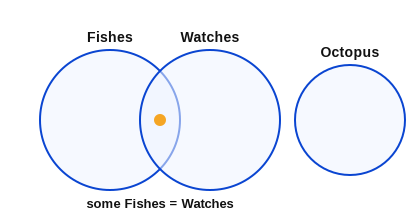
  1. Some fishes are watches → Fishes and Watches overlap.
  2. No watch is an octopus → Octopus is separate from Watches, but may or may not touch Fishes ⇒ (I) is not certain.
  3. 'Some fishes are watches' converts to 'Some watches are fishes' ⇒ (II) follows.

Trick: 'Some A are B' always ⇔ 'Some B are A'.

Answer: (B) Only conclusion (II) follows

अवधारणा: दोनों कथनों को संतुष्ट करने वाला न्यूनतम Venn चित्र बनाएँ।

  1. कुछ मछलियाँ घड़ियाँ हैं → Fishes और Watches आपस में मिलते हैं।
  2. कोई घड़ी ऑक्टोपस नहीं → Octopus, Watches से अलग; Fishes से मिले या न मिले, निश्चित नहीं ⇒ (I) नहीं।
  3. 'कुछ मछलियाँ घड़ियाँ हैं' का उलटा 'कुछ घड़ियाँ मछलियाँ हैं' ⇒ (II) सही।

ट्रिक: 'कुछ A, B हैं' ⇔ 'कुछ B, A हैं' – हमेशा।

उत्तर: (B) केवल निष्कर्ष (II) अनुसरण करता है
RRB NTPC Undergraduate CBT 1General Intelligence and ReasoningSyllogismRRB NTPC Undergraduate CBT 1 2025 · 19 Jun Shift 1 →
Q12062.
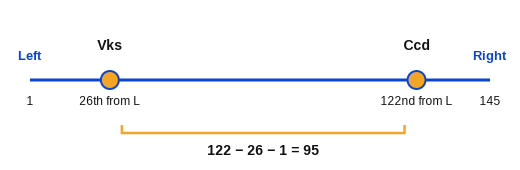
All 145 people are standing in a row facing north. Ccd is 24th from the right end while Vks is 26th from the left end. How many people are there between Ccd and Vks?
सभी 145 व्यक्ति एक पंक्ति में उत्तर की ओर मुख करके खड़े हैं। Ccd दाएँ छोर से 24वें स्थान पर है जबकि Vks बाएँ छोर से 26वें स्थान पर है। Ccd और Vks के बीच कितने व्यक्ति हैं?
  1. A92
  2. B94
  3. C95
  4. D98
Show answer

Concept: Position from left =Total−position from right+1.

  1. Ccd from left =145−24+1=122.
  2. Vks is 26th from left.
  3. People between =122−26−1=95.

Trick: Direct: Total−(L+R)=145−(26+24)=95 when no overlap.

Answer: (C) 95

अवधारणा: बाएँ से स्थान =कुल−दाएँ से स्थान+1।

  1. Ccd बाएँ से =145−24+1=122वाँ।
  2. Vks बाएँ से 26वाँ।
  3. बीच में व्यक्ति =122−26−1=95।

ट्रिक: सीधा: कुल−(बायाँ+दायाँ)=145−(26+24)=95 (जब overlap न हो)।

उत्तर: (C) 95

RRB NTPC Undergraduate CBT 1General Intelligence and ReasoningRanking – rowRRB NTPC Undergraduate CBT 1 2025 · 19 Jun Shift 1 →
Q12063.
The position(s) of how many letters will remain unchanged if each letter in the word SERVANT is arranged in the alphabetical order?
यदि शब्द SERVANT के प्रत्येक अक्षर को वर्णमाला क्रम में व्यवस्थित किया जाए, तो कितने अक्षरों का/के स्थान अपरिवर्तित रहेगा/रहेंगे?
  1. A3
  2. B2
  3. C1
  4. D0
Show answer

Concept: Write the word and its alphabetical arrangement one below the other and compare position by position.

  1. SERVANT: S E R V A N T
  2. Sorted: A E N R S T V
  3. Only position 2 (E) is the same in both ⇒ 1 letter unchanged.

Trick: Compare column by column – don't count letters, count matching positions.

Answer: (C) 1

अवधारणा: शब्द और उसका वर्णानुक्रम एक के नीचे एक लिखकर स्थान-दर-स्थान मिलाएँ।

  1. SERVANT: S E R V A N T
  2. वर्णानुक्रम: A E N R S T V
  3. केवल स्थान 2 (E) दोनों में समान ⇒ 1 अक्षर अपरिवर्तित।

ट्रिक: स्तंभ-दर-स्तंभ मिलाएँ – समान स्थान गिनें।

उत्तर: (C) 1

RRB NTPC Undergraduate CBT 1General Intelligence and ReasoningAlphabetical arrangementRRB NTPC Undergraduate CBT 1 2025 · 19 Jun Shift 1 →
Q12064.
Based on the English alphabetical order, three of the following four letter-cluster pairs are alike in a certain way and thus form a group. Which is the one that does not belong to that group?
(Note: The odd one out is not based on the number of consonants/vowels or their position in the letter-cluster pairs.)
अंग्रेज़ी वर्णमाला क्रम के आधार पर, निम्नलिखित चार अक्षर-समूह युग्मों में से तीन किसी निश्चित प्रकार से एकसमान हैं और इस प्रकार एक समूह बनाते हैं। वह कौन-सा है जो उस समूह से संबंधित नहीं है?
(नोट: असंगत, अक्षर-समूह युग्मों में व्यंजनों/स्वरों की संख्या या उनके स्थान पर आधारित नहीं है।)
  1. AFJ-LP
  2. BHL-NR
  3. CDH-JN
  4. DJO-QU
Show answer

Concept: Compare letter gaps within and between the clusters (A=1 … Z=26).

  1. FJ-LP: 6,10,12,16 → gaps +4,+2,+4.
  2. HL-NR: 8,12,14,18 → +4,+2,+4; DH-JN: 4,8,10,14 → +4,+2,+4.
  3. JO-QU: 10,15,17,21 → +5,+2,+4 – different.

Trick: Check the first gap only: three have +4, JO has +5.

Answer: (D) JO-QU

अवधारणा: समूह के भीतर और बीच में अक्षरों का अंतर देखें (A=1 … Z=26)।

  1. FJ-LP: 6,10,12,16 → अंतर +4,+2,+4।
  2. HL-NR: 8,12,14,18 → +4,+2,+4; DH-JN: 4,8,10,14 → +4,+2,+4।
  3. JO-QU: 10,15,17,21 → +5,+2,+4 – अलग।

ट्रिक: केवल पहला अंतर देखें: तीन में +4, JO में +5।

उत्तर: (D) JO-QU

RRB NTPC Undergraduate CBT 1General Intelligence and ReasoningOdd one out – letter pairsRRB NTPC Undergraduate CBT 1 2025 · 19 Jun Shift 1 →
Q12065.
What should come in place of '?' in the given series based on the English alphabetical order?
COV ERX GUZ IXB ?
अंग्रेज़ी वर्णमाला क्रम के आधार पर दी गई शृंखला में '?' के स्थान पर क्या आना चाहिए?
COV ERX GUZ IXB ?
  1. ALBE
  2. BKAD
  3. CLAC
  4. DMAD
Show answer

Concept: Track each letter position separately.

  1. 1st letters: C, E, G, I → +2 → K.
  2. 2nd letters: O, R, U, X → +3 → A (after Z).
  3. 3rd letters: V, X, Z, B → +2 → D.

Trick: Positions: +2,+3,+2 on IXB gives KAD.

Answer: (B) KAD

अवधारणा: हर स्थान के अक्षर अलग देखें।

  1. पहले अक्षर: C, E, G, I → +2 → K।
  2. दूसरे अक्षर: O, R, U, X → +3 → A (Z के बाद)।
  3. तीसरे अक्षर: V, X, Z, B → +2 → D।

ट्रिक: IXB पर +2,+3,+2 → KAD।

उत्तर: (B) KAD

RRB NTPC Undergraduate CBT 1General Intelligence and ReasoningLetter seriesRRB NTPC Undergraduate CBT 1 2025 · 19 Jun Shift 1 →
Q12066.
Select the triad that follows the same pattern as that followed by the two sets of triads given below. Both triads follow the same pattern.
BATH –HBAT –THBA
TOYS –STOY -YSTO
उस त्रिक का चयन कीजिए जो उसी पैटर्न का अनुसरण करता है जिसका अनुसरण नीचे दिए गए त्रिकों के दो समुच्चय करते हैं। दोनों त्रिक एक ही पैटर्न का अनुसरण करते हैं।
BATH –HBAT –THBA
TOYS –STOY -YSTO
  1. ATOMB -OMTB -MTOB
  2. BCART - ACTR - CTAR
  3. CABLE-EABL-LEAB
  4. DLOVE- OVEL -VELO
Show answer

Concept: Each next word is formed by moving the last letter to the front.

  1. BATH → HBAT (H to front) → THBA (T to front).
  2. TOYS → STOY → YSTO – same rule.
  3. ABLE → EABL → LEAB ✓. LOVE → OVEL uses first-to-end, so it fails.

Trick: Rule = rotate right by one letter each time.

Answer: (C) ABLE-EABL-LEAB

अवधारणा: हर अगला शब्द पिछले शब्द के अंतिम अक्षर को आगे लाकर बनता है।

  1. BATH → HBAT (H आगे) → THBA (T आगे)।
  2. TOYS → STOY → YSTO – वही नियम।
  3. ABLE → EABL → LEAB ✓। LOVE → OVEL में पहला अक्षर पीछे गया है, अतः गलत।

ट्रिक: नियम = हर बार एक अक्षर दाएँ घुमाएँ।

उत्तर: (C) ABLE-EABL-LEAB

RRB NTPC Undergraduate CBT 1General Intelligence and ReasoningLetter triads – patternRRB NTPC Undergraduate CBT 1 2025 · 19 Jun Shift 1 →
Q12067.
Select the triad which follows the same pattern as that followed by the two triads given below. Both triads follow the same pattern.
DF – HJ – LN
GI – KM –OQ
उस त्रिक का चयन कीजिए जो उसी पैटर्न का अनुसरण करता है जिसका अनुसरण नीचे दिए गए दो त्रिक करते हैं। दोनों त्रिक एक ही पैटर्न का अनुसरण करते हैं।
DF – HJ – LN
GI – KM –OQ
  1. AAC – EG – IK
  2. BEB – IG – NL
  3. CME – QK – XQ
  4. DHI – MP – SU
Show answer

Concept: Convert letters to numbers (A=1 … Z=26).

  1. DF–HJ–LN: (4,6),(8,10),(12,14) → within pair +2, pair to pair +4.
  2. GI–KM–OQ: (7,9),(11,13),(15,17) → same.
  3. AC–EG–IK: (1,3),(5,7),(9,11) → +2 within, +4 between ✓.

Trick: Skip one letter inside a pair, skip three between pairs.

Answer: (A) AC – EG – IK

अवधारणा: अक्षरों को संख्या में बदलें (A=1 … Z=26)।

  1. DF–HJ–LN: (4,6),(8,10),(12,14) → युग्म के भीतर +2, युग्म से युग्म +4।
  2. GI–KM–OQ: (7,9),(11,13),(15,17) → वही।
  3. AC–EG–IK: (1,3),(5,7),(9,11) → भीतर +2, बीच +4 ✓।

ट्रिक: युग्म के भीतर एक अक्षर छोड़ें, युग्मों के बीच तीन।

उत्तर: (A) AC – EG – IK

RRB NTPC Undergraduate CBT 1General Intelligence and ReasoningLetter triads – patternRRB NTPC Undergraduate CBT 1 2025 · 19 Jun Shift 1 →
Q12068.
What will come in place of the question mark (?) in the following equation, if ‘+’ and ‘−’ are interchanged and ‘×’ and ‘÷’ are interchanged?
558 × 31 − 18 ÷ 17 + 321 = ?
यदि ‘+’ और ‘−’ को आपस में बदल दिया जाए तथा ‘×’ और ‘÷’ को आपस में बदल दिया जाए, तो निम्नलिखित समीकरण में प्रश्न चिह्न (?) के स्थान पर क्या आएगा?
558 × 31 − 18 ÷ 17 + 321 = ?
  1. A3
  2. B33
  3. C24
  4. D16
Show answer

Concept: Swap the signs first, then solve using BODMAS.

  1. After swapping: 558÷31+18×17−321.
  2. 558÷31=18, 18×17=306.
  3. 18+306−321=3.

Trick: Rewrite the whole expression before calculating – never swap mentally.

Answer: (A) 3

अवधारणा: पहले चिह्न बदलें, फिर BODMAS से हल करें।

  1. बदलने के बाद: 558÷31+18×17−321।
  2. 558÷31=18, 18×17=306।
  3. 18+306−321=3।

ट्रिक: गणना से पहले पूरा व्यंजक नया लिखें।

उत्तर: (A) 3

RRB NTPC Undergraduate CBT 1General Intelligence and ReasoningMathematical operations – interchangeRRB NTPC Undergraduate CBT 1 2025 · 19 Jun Shift 1 →
Q12069.
Pqr ranked 71st from the bottom and 39th from the top in his class. How many students are there in his class?
Pqr अपनी कक्षा में नीचे से 71वें और ऊपर से 39वें स्थान पर है। उसकी कक्षा में कितने विद्यार्थी हैं?
  1. A109
  2. B113
  3. C107
  4. D108
Show answer

Concept: Total = rank from top + rank from bottom −1.

  1. Total =39+71−1.
  2. =109 students.

Trick: The person is counted twice, so subtract 1.

Answer: (A) 109

अवधारणा: कुल = ऊपर से रैंक + नीचे से रैंक −1।

  1. कुल =39+71−1।
  2. =109 छात्र।

ट्रिक: व्यक्ति दो बार गिना जाता है, अतः 1 घटाएँ।

उत्तर: (A) 109

RRB NTPC Undergraduate CBT 1General Intelligence and ReasoningRankingRRB NTPC Undergraduate CBT 1 2025 · 19 Jun Shift 1 →
Q12070.
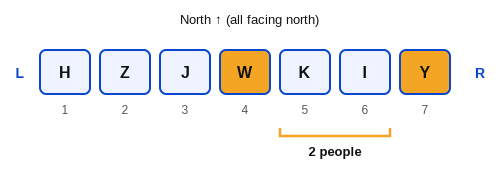
Seven people H, I, J, K, W, Y and Z are sitting in a row facing north. No one sits to the left of H. Only four people sit between H and I. Only three people sit to the right of W. Z sits to the immediate left of J. Y is not an immediate neighbor of W. How many people sit between Y and W?
सात व्यक्ति H, I, J, K, W, Y और Z एक पंक्ति में उत्तर की ओर मुख करके बैठे हैं। H के बाईं ओर कोई नहीं बैठा है। H और I के बीच केवल चार व्यक्ति बैठे हैं। W के दाईं ओर केवल तीन व्यक्ति बैठे हैं। Z, J के ठीक बाईं ओर बैठा है। Y, W का निकटतम पड़ोसी नहीं है। Y और W के बीच कितने व्यक्ति बैठे हैं?
  1. AThreeतीन
  2. BOneएक
  3. CFourचार
  4. DTwoदो
Show answer

Concept: 7 seats facing north; position 1 = extreme left.

  1. No one left of H ⇒ H = 1. Four between H and I ⇒ I = 6.
  2. Three to the right of W ⇒ W = 4.
  3. Z immediately left of J – free consecutive seats only 2, 3 ⇒ Z = 2, J = 3.
  4. Seats 5 and 7 left for Y and K; Y is not next to W ⇒ Y = 7, K = 5. Between Y and W: K, I = 2.

Trick: Between =7−4−1=2.

Answer: (D) Two

अवधारणा: 7 सीटें, सभी उत्तरमुखी; स्थान 1 = सबसे बायाँ।

  1. H के बाएँ कोई नहीं ⇒ H = 1। H और I के बीच चार ⇒ I = 6।
  2. W के दाएँ तीन ⇒ W = 4।
  3. Z, J के ठीक बाएँ – लगातार खाली सीटें केवल 2, 3 ⇒ Z = 2, J = 3।
  4. सीट 5 और 7 पर Y, K; Y, W का पड़ोसी नहीं ⇒ Y = 7, K = 5। Y और W के बीच: K, I = 2।

ट्रिक: बीच में =7−4−1=2।

उत्तर: (D) दो

RRB NTPC Undergraduate CBT 1General Intelligence and ReasoningSeating arrangement – linearRRB NTPC Undergraduate CBT 1 2025 · 19 Jun Shift 1 →
Q12071.
In a certain code language, ‘depth salad road’ is coded as ' ok oh wc' and ‘salad shirt rat’ is coded as ‘ut cu oh’. How is ‘salad’ coded in the given language?
एक निश्चित कूट भाषा में, ‘depth salad road’ को ' ok oh wc' के रूप में और ‘salad shirt rat’ को ‘ut cu oh’ के रूप में कूटबद्ध किया जाता है। दी गई भाषा में ‘salad’ को किस प्रकार कूटबद्ध किया जाता है?
  1. Aok
  2. Boh
  3. Cwc
  4. Dut
Show answer

Concept: A word common to two sentences takes the code common to both.

  1. 'depth salad road' → ok, oh, wc.
  2. 'salad shirt rat' → ut, cu, oh.
  3. Common word = salad; common code = oh.

Trick: Common word ↔ common code.

Answer: (B) oh

अवधारणा: दो वाक्यों में समान शब्द का कोड भी दोनों में समान होता है।

  1. 'depth salad road' → ok, oh, wc।
  2. 'salad shirt rat' → ut, cu, oh।
  3. समान शब्द = salad; समान कोड = oh।

ट्रिक: समान शब्द ↔ समान कोड।

उत्तर: (B) oh

RRB NTPC Undergraduate CBT 1General Intelligence and ReasoningCoding-decoding – wordsRRB NTPC Undergraduate CBT 1 2025 · 19 Jun Shift 1 →
Q12072.
Based on the alphabetical order, three of the following four are alike in a certain way and thus form a group. Which is the one that does not belong to that group?
(Note: The odd man out is not based on the number of consonants/vowels or their position in the letter cluster.)
वर्णमाला क्रम के आधार पर, निम्नलिखित चार में से तीन किसी निश्चित प्रकार से एकसमान हैं और इस प्रकार एक समूह बनाते हैं। वह कौन-सा है जो उस समूह से संबंधित नहीं है?
(नोट: असंगत, अक्षर-समूह में व्यंजनों/स्वरों की संख्या या उनके स्थान पर आधारित नहीं है।)
  1. AFCZ
  2. BTQN
  3. CEBY
  4. DBZV
Show answer

Concept: Find gaps between consecutive letters (A=1 … Z=26, wrap around after Z).

  1. FCZ: F −3​ C −3​ Z; TQN: T −3​ Q −3​ N; EBY: E −3​ B −3​ Y.
  2. BZV: B −2​ Z −4​ V – different.

Trick: Three go −3,−3; BZV breaks it.

Answer: (D) BZV

अवधारणा: क्रमागत अक्षरों का अंतर देखें (A=1 … Z=26; Z के बाद चक्र)।

  1. FCZ: F −3​ C −3​ Z; TQN: T −3​ Q −3​ N; EBY: E −3​ B −3​ Y।
  2. BZV: B −2​ Z −4​ V – अलग।

ट्रिक: तीन में −3,−3; BZV अलग।

उत्तर: (D) BZV

RRB NTPC Undergraduate CBT 1General Intelligence and ReasoningOdd one out – lettersRRB NTPC Undergraduate CBT 1 2025 · 19 Jun Shift 1 →
Q12073.
Read the given statement(s) and conclusions carefully. Assuming that the information given in the statements is true, even if it appears to be at variance with commonly known facts, decide which of the given conclusions logically follow(s) from the statement(s).
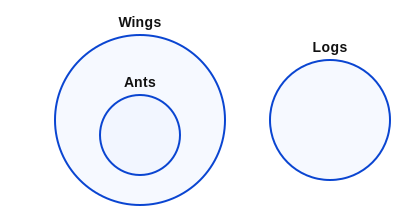
Statements: All ants are wings. No logs are wings.
Conclusion (I): No logs are ants.
Conclusion (II): Some wings are ants.
दिए गए कथन/कथनों और निष्कर्षों को ध्यानपूर्वक पढ़िए। यह मानते हुए कि कथनों में दी गई जानकारी सत्य है, भले ही वह सामान्यतः ज्ञात तथ्यों से भिन्न प्रतीत होती हो, निर्णय कीजिए कि दिए गए निष्कर्षों में से कौन-सा/कौन-से निष्कर्ष तार्किक रूप से कथन/कथनों का अनुसरण करता है/करते हैं।
कथन: सभी चींटियाँ, पंख हैं। कोई लट्ठा, पंख नहीं है।
निष्कर्ष (I): कोई लट्ठा, चींटी नहीं है।
निष्कर्ष (II): कुछ पंख, चींटियाँ हैं।
  1. ABoth conclusions (I) and (II) followनिष्कर्ष (I) और (II) दोनों अनुसरण करते हैं
  2. BOnly conclusion (I) followsकेवल निष्कर्ष (I) अनुसरण करता है
  3. COnly conclusion (II) followsकेवल निष्कर्ष (II) अनुसरण करता है
  4. DNeither conclusion (I) nor (II) followsन तो निष्कर्ष (I) और न ही (II) अनुसरण करता है
Show answer

Concept: Draw the Venn diagram: 'All A are B' puts A inside B; 'No C is B' keeps C outside B.

  1. Ants lie completely inside Wings.
  2. Logs lie completely outside Wings, so they cannot touch Ants ⇒ (I) No logs are ants – follows.
  3. Since all ants are wings (and ants exist), some wings are ants ⇒ (II) follows.

Trick: 'All A are B' ⇒ 'Some B are A' always.

Answer: (A) Both conclusions (I) and (II) follow

अवधारणा: Venn चित्र बनाएँ: 'सभी A, B हैं' में A, B के भीतर; 'कोई C, B नहीं' में C, B से बाहर।

  1. Ants पूरी तरह Wings के भीतर।
  2. Logs पूरी तरह Wings के बाहर, अतः Ants को छू नहीं सकते ⇒ (I) कोई log, ant नहीं – सही।
  3. सभी ants, wings हैं, अतः कुछ wings, ants हैं ⇒ (II) सही।

ट्रिक: 'सभी A, B हैं' ⇒ 'कुछ B, A हैं' – हमेशा।

उत्तर: (A) निष्कर्ष (I) और (II) दोनों अनुसरण करते हैं

RRB NTPC Undergraduate CBT 1General Intelligence and ReasoningSyllogismRRB NTPC Undergraduate CBT 1 2025 · 19 Jun Shift 1 →
Q12074.
In a certain code language,
A ÷ B means ‘A is the son of B’,
A # B means ‘A is the wife of B’,
A + B means ‘A is the brother of B’ and
A & B means ‘A is the father of B’.
How is S related to H if ‘S ÷ D # R & Y + H’?
एक निश्चित कूट भाषा में,
A ÷ B का अर्थ है ‘A, B का पुत्र है’,
A # B का अर्थ है ‘A, B की पत्नी है’,
A + B का अर्थ है ‘A, B का भाई है’ और
A & B का अर्थ है ‘A, B का पिता है’।
यदि ‘S ÷ D # R & Y + H’ है, तो S का H से क्या संबंध है?
  1. AFatherपिता
  2. BSonपुत्र
  3. CHusbandपति
  4. DBrotherभाई
Show answer

Concept: Decode each symbol step by step and build a family tree.

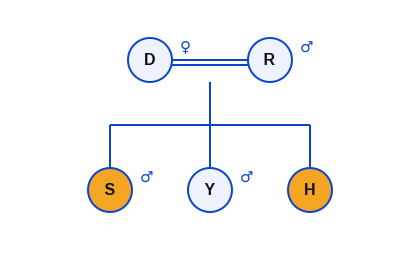
  1. S ÷ D: S is the son of D.
  2. D # R: D is the wife of R ⇒ D and R are S's parents.
  3. R & Y: R is the father of Y; Y + H: Y is the brother of H ⇒ S, Y, H are children of R and D.
  4. S is male ⇒ S is the brother of H.

Trick: Two children of the same parents, one male ⇒ brother.

Answer: (D) Brother

अवधारणा: हर चिह्न का अर्थ क्रम से लगाकर परिवार वृक्ष बनाएँ।

  1. S ÷ D: S, D का पुत्र है।
  2. D # R: D, R की पत्नी है ⇒ D और R, S के माता-पिता।
  3. R & Y: R, Y का पिता; Y + H: Y, H का भाई ⇒ S, Y, H तीनों R-D की संतान।
  4. S पुरुष है ⇒ S, H का भाई है।

ट्रिक: एक ही माता-पिता की संतान, पुरुष ⇒ भाई।

उत्तर: (D) भाई

RRB NTPC Undergraduate CBT 1General Intelligence and ReasoningCoded blood relationRRB NTPC Undergraduate CBT 1 2025 · 19 Jun Shift 1 →
Q12075.
What will come in place of ‘?’ in the following equation, if ‘+’ and ‘-‘ are interchanged and ‘x’ and ‘÷’ are interchanged?
94 ÷ 5 + 262 - 24 x 6 = ?
यदि ‘+’ और ‘-‘ को आपस में बदल दिया जाए तथा ‘x’ और ‘÷’ को आपस में बदल दिया जाए, तो निम्नलिखित समीकरण में ‘?’ के स्थान पर क्या आएगा?
94 ÷ 5 + 262 - 24 x 6 = ?
  1. A212
  2. B209
  3. C210
  4. D211
Show answer

Concept: Swap the signs, then apply BODMAS.

  1. After swapping: 94×5−262+24÷6.
  2. 94×5=470, 24÷6=4.
  3. 470−262+4=212.

Trick: Do × and ÷ first, then + and − from left to right.

Answer: (A) 212

अवधारणा: चिह्न बदलें, फिर BODMAS लगाएँ।

  1. बदलने के बाद: 94×5−262+24÷6।
  2. 94×5=470, 24÷6=4।
  3. 470−262+4=212।

ट्रिक: पहले ×, ÷, फिर बाएँ से दाएँ +, −।

उत्तर: (A) 212

RRB NTPC Undergraduate CBT 1General Intelligence and ReasoningMathematical operations – interchangeRRB NTPC Undergraduate CBT 1 2025 · 19 Jun Shift 1 →
Q12076.
What should come in place of the ‘?’ in the given series?
15 22 40 67 105 152 ?
दी गई शृंखला में ‘?’ के स्थान पर क्या आना चाहिए?
15 22 40 67 105 152 ?
  1. A210
  2. B156
  3. C165
  4. D167
Show answer

Concept: Use first and second differences.

  1. First differences: 7,18,27,38,47.
  2. Second differences: 11,9,11,9 – alternating, so next is 11.
  3. Next difference =47+11=58 ⇒ 152+58=210.

Trick: When first differences look irregular, check the second differences.

Answer: (A) 210

अवधारणा: प्रथम और द्वितीय अंतर देखें।

  1. प्रथम अंतर: 7,18,27,38,47।
  2. द्वितीय अंतर: 11,9,11,9 – बारी-बारी, अतः अगला 11।
  3. अगला अंतर =47+11=58 ⇒ 152+58=210।

ट्रिक: प्रथम अंतर अनियमित लगे तो द्वितीय अंतर देखें।

उत्तर: (A) 210

RRB NTPC Undergraduate CBT 1General Intelligence and ReasoningNumber seriesRRB NTPC Undergraduate CBT 1 2025 · 19 Jun Shift 1 →
Q12077.
Select the set in which the numbers are related in the same way as are the numbers of the following sets.
(NOTE: Operations should be performed on the whole numbers, without breaking down the numbers into their constituent digits. E.g. 13 – Operations on 13 such as
adding/subtracting/multiplying etc. to 13 can be performed. Breaking down 13 into 1 and 3 and then performing mathematical operations on 1 and 3 is not allowed.) 18, 200
17, 189
उस समुच्चय का चयन कीजिए जिसमें संख्याएँ उसी प्रकार संबंधित हैं जिस प्रकार निम्नलिखित समुच्चयों की संख्याएँ संबंधित हैं।
(नोट: संख्याओं को उनके घटक अंकों में विभाजित किए बिना, पूर्ण संख्याओं पर संक्रियाएँ की जानी चाहिए। उदाहरण के लिए, 13 – 13 पर संक्रियाएँ जैसे
13 में जोड़ना/घटाना/गुणा करना आदि किया जा सकता है। 13 को 1 और 3 में विभाजित करना और फिर 1 और 3 पर गणितीय संक्रियाएँ करना वर्जित है।) 18, 200
17, 189
  1. A22, 246
  2. B19, 211
  3. C16, 176
  4. D24, 264
Show answer

Concept: Find one rule that turns the first number into the second.

  1. 18×11+2=200 ✓; 17×11+2=189 ✓.
  2. Check options: 19×11+2=211 ✓.
  3. 22×11+2=244≠246; 16×11+2=178≠176; 24×11+2=266≠264.

Trick: Second number ≈ 11× first – then fix the small remainder (+2).

Answer: (B) 19, 211

अवधारणा: पहली संख्या को दूसरी में बदलने वाला एक नियम खोजें।

  1. 18×11+2=200 ✓; 17×11+2=189 ✓।
  2. विकल्प जाँचें: 19×11+2=211 ✓।
  3. 22×11+2=244≠246; 16×11+2=178≠176; 24×11+2=266≠264।

ट्रिक: दूसरी संख्या ≈ पहली का 11 गुना – फिर छोटा शेष (+2) देखें।

उत्तर: (B) 19, 211

RRB NTPC Undergraduate CBT 1General Intelligence and ReasoningNumber relationshipRRB NTPC Undergraduate CBT 1 2025 · 19 Jun Shift 1 →
Q12078.
Refer to the following number series and answer the question that follows. Counting to be done from left to right only. (All numbers are single-digit numbers only.)
(Left) 6 4 2 9 3 2 6 8 4 2 8 8 1 6 7 6 5 8 7 5 4 3 4 (Right)
How many such odd digits are there, each of which immediately preceded by an even digit and also immediately followed by an odd digit?
निम्नलिखित संख्या शृंखला को देखिए और उसके बाद दिए गए प्रश्न का उत्तर दीजिए। गिनती केवल बाएँ से दाएँ की जानी है। (सभी संख्याएँ केवल एक-अंकीय संख्याएँ हैं।)
(बाएँ) 6 4 2 9 3 2 6 8 4 2 8 8 1 6 7 6 5 8 7 5 4 3 4 (दाएँ)
ऐसे कितने विषम अंक हैं, जिनमें से प्रत्येक के ठीक पहले एक सम अंक है और ठीक बाद एक विषम अंक है?
  1. ANoneकोई नहीं
  2. BTwoदो
  3. COneएक
  4. DThreeतीन
Show answer

Concept: Required pattern: Even – Odd – Odd.

  1. Check each odd digit: 2 9 3 ✓ (2 even, 3 odd).
  2. 8 7 5 ✓ (8 even, 5 odd).
  3. Others fail: 9 3 2 (prev odd), 8 1 6, 6 7 6, 6 5 8, 7 5 4, 4 3 4 (next even). Count =2.

Trick: Scan only for 'even, odd, odd' triplets.

Answer: (B) Two

अवधारणा: आवश्यक पैटर्न: सम – विषम – विषम।

  1. हर विषम अंक जाँचें: 2 9 3 ✓ (2 सम, 3 विषम)।
  2. 8 7 5 ✓ (8 सम, 5 विषम)।
  3. बाकी असफल: 9 3 2 (पहले विषम), 8 1 6, 6 7 6, 6 5 8, 7 5 4, 4 3 4 (बाद में सम)। कुल =2।

ट्रिक: केवल 'सम, विषम, विषम' त्रिक खोजें।

उत्तर: (B) दो

RRB NTPC Undergraduate CBT 1General Intelligence and ReasoningNumber series – countingRRB NTPC Undergraduate CBT 1 2025 · 19 Jun Shift 1 →
Q12079.
What should come in place of ? in the given series based on the English alphabetical order?
LMO STV ZAC GHJ ?
अंग्रेज़ी वर्णमाला क्रम के आधार पर दी गई शृंखला में ? के स्थान पर क्या आना चाहिए?
LMO STV ZAC GHJ ?
  1. ANNP
  2. BMPQ
  3. CNPP
  4. DNOQ
Show answer

Concept: Each group is formed with gaps +1,+2 and groups move +7.

  1. 1st letters: L, S, Z, G → +7 → N.
  2. Inside each group: LMO, STV, ZAC, GHJ → +1,+2.
  3. So N → O → Q ⇒ NOQ.

Trick: Find the new first letter, then apply the inner pattern.

Answer: (D) NOQ

अवधारणा: हर समूह के भीतर अंतर +1,+2 है और समूह +7 से आगे बढ़ते हैं।

  1. पहले अक्षर: L, S, Z, G → +7 → N।
  2. समूह के भीतर: LMO, STV, ZAC, GHJ → +1,+2।
  3. अतः N → O → Q ⇒ NOQ।

ट्रिक: नया पहला अक्षर निकालें, फिर भीतरी पैटर्न लगाएँ।

उत्तर: (D) NOQ

RRB NTPC Undergraduate CBT 1General Intelligence and ReasoningLetter seriesRRB NTPC Undergraduate CBT 1 2025 · 19 Jun Shift 1 →
Q12080.
Select the pair which follows the same pattern as that followed by the two pairs given below. Both pairs follow the same pattern.
DGD−ADA
ILI−FIF
उस युग्म का चयन कीजिए जो उसी पैटर्न का अनुसरण करता है जिसका अनुसरण नीचे दिए गए दो युग्म करते हैं। दोनों युग्म एक ही पैटर्न का अनुसरण करते हैं।
DGD−ADA
ILI−FIF
  1. AACY−WZW
  2. BADA−WAW
  3. CACY−XAX
  4. DADA−XAX
Show answer

Concept: Each letter of the first cluster moves −3 to form the second.

  1. DGD → ADA: D−3=A, G−3=D.
  2. ILI → FIF: I−3=F, L−3=I.
  3. ADA → A−3=X (wrap), D−3=A ⇒ XAX ✓. (ACY changes into a non-palindrome, and WAW uses −4.)

Trick: Before Z comes Y, X: so A−3=X.

Answer: (D) ADA−XAX

अवधारणा: पहले समूह का हर अक्षर −3 होकर दूसरा बनता है।

  1. DGD → ADA: D−3=A, G−3=D।
  2. ILI → FIF: I−3=F, L−3=I।
  3. ADA → A−3=X (चक्र), D−3=A ⇒ XAX ✓। (WAW में −4 है।)

ट्रिक: A से पीछे Z, Y, X: अतः A−3=X।

उत्तर: (D) ADA−XAX

RRB NTPC Undergraduate CBT 1General Intelligence and ReasoningLetter pairs – patternRRB NTPC Undergraduate CBT 1 2025 · 19 Jun Shift 1 →