Question bank

Q&A: practice questions with answers

Search questions on any topic. Filter by exam category, exam, subject and topic, try the question, then open the answer and explanation.

Courses – airGurukul

20,719 questions found.

Q12141.
Two taps can fill a cistern in 4 hours and 15 hours, respectively. A third tap can empty it in 15 hours. How long (in hours) will it take to fill one-fourth of the empty cistern if all the taps are opened together?
दो नल एक टंकी को क्रमशः 4 घंटे और 15 घंटे में भर सकते हैं। एक तीसरा नल इसे 15 घंटे में खाली कर सकता है। यदि सभी नल एक साथ खोल दिए जाएँ, तो खाली टंकी के एक-चौथाई भाग को भरने में कितना समय (घंटों में) लगेगा?
  1. A1
  2. B3
  3. C4
  4. D2
Show answer

Concept: Net work per hour = sum of filling rates − emptying rate.

  1. Net rate =14+115−115=14 per hour
  2. Time for 14 cistern =14÷14=1 hour

Trick: Second and third taps have equal rates and cancel — only the 4-hour tap matters.

Answer: (A) 1

अवधारणा: प्रति घंटा शुद्ध कार्य = भरने की दरों का योग − खाली करने की दर।

  1. शुद्ध दर =14+115−115=14 प्रति घंटा
  2. 14 टंकी का समय =14÷14=1 घंटा

ट्रिक: दूसरा और तीसरा नल बराबर दर से एक-दूसरे को काट देते हैं — केवल 4 घंटे वाला नल बचता है।

उत्तर: (A) 1
RRB NTPC Undergraduate CBT 1MathematicsPipes and CisternsRRB NTPC Undergraduate CBT 1 2025 · 18 Jun Shift 3 →
Q12142.
A stationery shop sells notebooks and pens. The cost of 4 notebooks and 6 pens is ₹228. The cost of 7 notebooks and 6 pens is ₹333. Find the cost of one notebook.
एक स्टेशनरी की दुकान नोटबुक और पेन बेचती है। 4 नोटबुक और 6 पेन का मूल्य ₹228 है। 7 नोटबुक और 6 पेन का मूल्य ₹333 है। एक नोटबुक का मूल्य ज्ञात कीजिए।
  1. A₹ 35
  2. B₹ 37.50
  3. C₹ 32
  4. D₹ 39
Show answer

Concept: Subtract equations having the same pen term to eliminate it.

  1. 4n+6p=228 and 7n+6p=333
  2. Subtract: 3n=105⇒n=35

Trick: Same number of pens in both → extra 3 notebooks cost 333−228=105.

Answer: (A) ₹ 35

अवधारणा: जिन समीकरणों में पेन का पद समान है उन्हें घटाकर उसे हटाएँ।

  1. 4n+6p=228 तथा 7n+6p=333
  2. घटाने पर: 3n=105⇒n=35

ट्रिक: दोनों में पेन बराबर → 3 अतिरिक्त नोटबुक का मूल्य 333−228=105.

उत्तर: (A) ₹ 35

RRB NTPC Undergraduate CBT 1MathematicsLinear EquationsRRB NTPC Undergraduate CBT 1 2025 · 18 Jun Shift 3 →
Q12143.
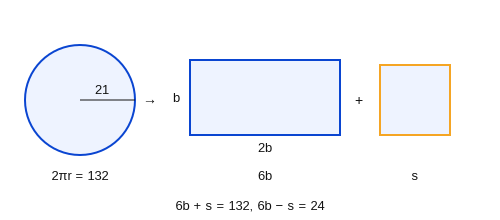
A string initially in the shape of a circle with a radius of 21 cm is cut into two distinct pieces. The first piece is reshaped into a rectangle where the length is twice its breadth, while the second piece is formed into a square. If the perimeter of the rectangle is 24 cm greater than the perimeter of the square, find the breadth of the rectangle. [Use π = 22/7]
एक डोरी, जो प्रारंभ में 21 cm त्रिज्या वाले वृत्त के आकार में है, को दो भिन्न टुकड़ों में काटा जाता है। पहले टुकड़े को एक ऐसे आयत का आकार दिया जाता है जिसकी लंबाई उसकी चौड़ाई की दोगुनी है, जबकि दूसरे टुकड़े से एक वर्ग बनाया जाता है। यदि आयत का परिमाप वर्ग के परिमाप से 24 cm अधिक है, तो आयत की चौड़ाई ज्ञात कीजिए। [π = 22/7 का प्रयोग कीजिए]
  1. A26 cm
  2. B13 cm
  3. C4 cm
  4. D4.25 cm
Show answer

Concept: Total string length = circumference; it is shared by the rectangle and square perimeters.

  1. Length =2πr=2×227×21=132cm
  2. Rectangle: l=2b⇒ perimeter =2(2b+b)=6b; square perimeter =s
  3. 6b+s=132 and 6b−s=24⇒12b=156⇒b=13cm

Trick: Sum and difference given → bigger part =132+242=78=6b, so b=13.

Answer: (B) 13 cm

अवधारणा: धागे की कुल लंबाई = वृत्त की परिधि; यही आयत और वर्ग के परिमापों में बँटती है।

  1. लंबाई =2πr=2×227×21=132cm
  2. आयत: l=2b⇒ परिमाप =2(2b+b)=6b; वर्ग का परिमाप =s
  3. 6b+s=132 और 6b−s=24⇒12b=156⇒b=13cm

ट्रिक: योग और अंतर दिए हों → बड़ा भाग =132+242=78=6b, अतः b=13.

उत्तर: (B) 13 cm

RRB NTPC Undergraduate CBT 1MathematicsPerimeter (Circle, Rectangle, Square)RRB NTPC Undergraduate CBT 1 2025 · 18 Jun Shift 3 →
Q12144.
What is the mean proportional between 0.16 and 0.49?
0.16 और 0.49 के बीच मध्यानुपाती क्या है?
  1. A0.24
  2. B0.26
  3. C0.28
  4. D0.21
Show answer

Concept: Mean proportional of a,b =ab.

  1. 0.16×0.49=0.16×0.49
  2. =0.4×0.7=0.28

Trick: Both are perfect squares — take roots separately and multiply.

Answer: (C) 0.28

अवधारणा: a,b का मध्यानुपाती =ab.

  1. 0.16×0.49=0.16×0.49
  2. =0.4×0.7=0.28

ट्रिक: दोनों पूर्ण वर्ग हैं — अलग-अलग मूल लेकर गुणा करें।

उत्तर: (C) 0.28

RRB NTPC Undergraduate CBT 1MathematicsMean ProportionalRRB NTPC Undergraduate CBT 1 2025 · 18 Jun Shift 3 →
Q12145.
A trader sells goods at a 15% profit but uses a weight of 950 grams for a kilogram. What is his total profit percentage? (Correct to two decimal places.)
एक व्यापारी 15% लाभ पर सामान बेचता है, लेकिन एक किलोग्राम के लिए 950 ग्राम के बाट का उपयोग करता है। उसका कुल लाभ प्रतिशत क्या है? (दो दशमलव स्थानों तक सही।)
  1. A18.95%
  2. B20%
  3. C21.05%
  4. D25%
Show answer

Concept: Effective SP/CP ratio =(1+profit)×true weightfalse weight.

  1. He charges for 1000 g at 115% but gives only 950 g
  2. Ratio =1.15×1000950=1150950=1.2105
  3. Profit ≈21.05%

Trick: Use 1000×(100+15)950−100=21.05% directly.

Answer: (C) 21.05%

अवधारणा: प्रभावी विक्रय/क्रय अनुपात =(1+लाभ)×सही भारगलत भार.

  1. वह 1000 g का 115% लेता है पर देता केवल 950 g
  2. अनुपात =1.15×1000950=1150950=1.2105
  3. लाभ ≈21.05%

ट्रिक: सीधे 1000×(100+15)950−100=21.05%.

उत्तर: (C) 21.05%

RRB NTPC Undergraduate CBT 1MathematicsProfit with False WeightRRB NTPC Undergraduate CBT 1 2025 · 18 Jun Shift 3 →
Q12146.
The cost of an article is increased by 20% in the first year. In the second year the increased cost is decreased by 24%. If the final cost of the article is ₹1,938, find the original cost of the article.
किसी वस्तु के मूल्य में पहले वर्ष 20% की वृद्धि की जाती है। दूसरे वर्ष में बढ़े हुए मूल्य में 24% की कमी की जाती है। यदि वस्तु का अंतिम मूल्य ₹1,938 है, तो वस्तु का मूल मूल्य ज्ञात कीजिए।
  1. A₹2,160
  2. B₹2,196
  3. C₹2,125
  4. D₹2,148
Show answer

Concept: Final = Original ×(1+r1)(1−r2).

  1. Factor =1.20×0.76=0.912
  2. Original =19380.912=2125

Trick: Check option: 2125×1.2=2550, 2550×0.76=1938. ✔

Answer: (C) ₹2,125

अवधारणा: अंतिम = मूल ×(1+r1)(1−r2).

  1. गुणक =1.20×0.76=0.912
  2. मूल =19380.912=2125

ट्रिक: विकल्प जाँचें: 2125×1.2=2550, 2550×0.76=1938. ✔

उत्तर: (C) ₹2,125

RRB NTPC Undergraduate CBT 1MathematicsSuccessive Percentage ChangeRRB NTPC Undergraduate CBT 1 2025 · 18 Jun Shift 3 →
Q12147.
The HCF and LCM of two numbers are 27 and 324, respectively. If one number is 81, find the other number.
दो संख्याओं का HCF और LCM क्रमशः 27 और 324 है। यदि एक संख्या 81 है, तो दूसरी संख्या ज्ञात कीजिए।
  1. A108
  2. B96
  3. C120
  4. D84
Show answer

Concept: Product of two numbers = HCF × LCM.

  1. Other number =27×32481
  2. =874881=108

Trick: Check: HCF(81, 108) =27 and LCM =324. ✔

Answer: (A) 108

अवधारणा: दो संख्याओं का गुणनफल = म.स. × ल.स.

  1. दूसरी संख्या =27×32481
  2. =874881=108

ट्रिक: जाँच: म.स.(81, 108) =27, ल.स. =324. ✔

उत्तर: (A) 108

RRB NTPC Undergraduate CBT 1MathematicsHCF and LCMRRB NTPC Undergraduate CBT 1 2025 · 18 Jun Shift 3 →
Q12148.
Rajiv invested a certain sum of money at 10% per annum. After 2 years, he received ₹199.5 as compound interest, compounded annually. Find the corresponding simple interest (in ₹) for 2 years at the same rate.
राजीव ने एक निश्चित धनराशि 10% वार्षिक दर पर निवेश की। 2 वर्ष बाद, उसे वार्षिक रूप से संयोजित चक्रवृद्धि ब्याज के रूप में ₹199.5 प्राप्त हुए। समान दर पर 2 वर्ष के लिए संगत साधारण ब्याज (₹ में) ज्ञात कीजिए।
  1. A200
  2. B190
  3. C205
  4. D185
Show answer

Concept: For 2 years at r%: CI = SI + interest on interest; at 10%, CI =21% of P, SI =20% of P.

  1. 0.21P=199.5⇒P=950
  2. SI =950×10×2100=190

Trick: SI : CI for 2 years at 10% =20:21 → SI =199.5×2021=190.

Answer: (B) 190

अवधारणा: 2 वर्ष, r% पर: CI = SI + ब्याज पर ब्याज; 10% पर CI = P का 21%, SI = P का 20%.

  1. 0.21P=199.5⇒P=950
  2. SI =950×10×2100=190

ट्रिक: 10% पर 2 वर्ष का SI : CI =20:21 → SI =199.5×2021=190.

उत्तर: (B) 190

RRB NTPC Undergraduate CBT 1MathematicsCompound vs Simple InterestRRB NTPC Undergraduate CBT 1 2025 · 18 Jun Shift 3 →
Q12149.
A teacher records the number of books read by each student in a month: 3, 5, 2, 3, 4, 5, 3, 2, 5, 5. What is the mode of this data set?
एक शिक्षक एक महीने में प्रत्येक छात्र द्वारा पढ़ी गई पुस्तकों की संख्या दर्ज करता है: 3, 5, 2, 3, 4, 5, 3, 2, 5, 5। इस आँकड़ा समुच्चय का बहुलक क्या है?
  1. A3
  2. B2
  3. C5
  4. D4
Show answer

Concept: Mode is the value that occurs most often.

  1. Counts: 2 → 2 times, 3 → 3 times, 4 → 1 time, 5 → 4 times
  2. Highest frequency is for 5

Trick: Tally quickly; the most repeated value wins.

Answer: (C) 5

अवधारणा: बहुलक वह मान है जो सबसे अधिक बार आता है।

  1. गिनती: 2 → 2 बार, 3 → 3 बार, 4 → 1 बार, 5 → 4 बार
  2. सर्वाधिक बारंबारता 5 की है

ट्रिक: मिलान चिह्न लगाएँ; सबसे अधिक दोहराया मान बहुलक।

उत्तर: (C) 5

RRB NTPC Undergraduate CBT 1MathematicsModeRRB NTPC Undergraduate CBT 1 2025 · 18 Jun Shift 3 →
Q12150.
If xx+1+x+1x=52, then find x.
यदि xx+1+x+1x=52 है, तो x ज्ञात कीजिए।
  1. A0 or -10 या -1
  2. B-1 or 2-1 या 2
  3. C0 or 10 या 1
  4. D1 or -21 या -2
Show answer

Concept: Put t=xx+1; then t+1t=52⇒t=2 or t=12.

  1. xx+1=2⇒x=2x+2⇒x=−2
  2. xx+1=12⇒2x=x+1⇒x=1

Trick: t+1t=52=2+12 — read the two values of t directly.

Answer: (D) 1 or −2

अवधारणा: t=xx+1 रखें; तब t+1t=52⇒t=2 या t=12.

  1. xx+1=2⇒x=2x+2⇒x=−2
  2. xx+1=12⇒2x=x+1⇒x=1

ट्रिक: t+1t=52=2+12 — t के दोनों मान सीधे पढ़ें।

उत्तर: (D) 1 या −2

RRB NTPC Undergraduate CBT 1MathematicsEquations (Reciprocal Form)RRB NTPC Undergraduate CBT 1 2025 · 18 Jun Shift 3 →
Q12151.
Harish bought an article for ₹347 and sold it to Renu at a loss of 6%. With this amount, Harish bought another article and sold it at a gain of 65%. What is Harish's overall gain percentage?
हरीश ने एक वस्तु ₹347 में खरीदी और उसे 6% की हानि पर रेणु को बेच दिया। इस राशि से हरीश ने एक अन्य वस्तु खरीदी और उसे 65% के लाभ पर बेच दिया। हरीश का कुल लाभ प्रतिशत क्या है?
  1. A53.1%
  2. B50.9%
  3. C51.8%
  4. D55.1%
Show answer

Concept: Overall factor = product of individual factors.

  1. After 6% loss: factor 0.94; after 65% gain: factor 1.65
  2. Overall =0.94×1.65=1.551
  3. Gain =55.1% (₹347 → ₹538.20)

Trick: −6+65−6×65100=59−3.9=55.1%.

Answer: (D) 55.1%

अवधारणा: कुल गुणक = अलग-अलग गुणकों का गुणनफल।

  1. 6% हानि: गुणक 0.94; 65% लाभ: गुणक 1.65
  2. कुल =0.94×1.65=1.551
  3. लाभ =55.1% (₹347 → ₹538.20)

ट्रिक: −6+65−6×65100=59−3.9=55.1%.

उत्तर: (D) 55.1%

RRB NTPC Undergraduate CBT 1MathematicsSuccessive Profit and LossRRB NTPC Undergraduate CBT 1 2025 · 18 Jun Shift 3 →
Q12152.
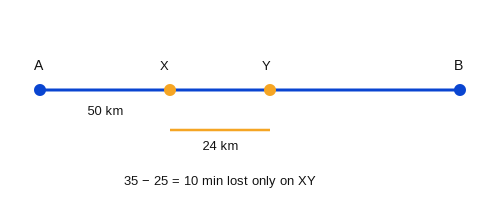
A train met with an accident 50 km away from station A. It completed the remaining journey at three-fourth of its original speed and reached station B 35 minutes late. Had the accident occurred 24 km further down the line, it would have been only 25 minutes late. What is the original speed of the train?
एक ट्रेन स्टेशन A से 50 km दूर दुर्घटनाग्रस्त हो गई। उसने शेष यात्रा अपनी मूल चाल की तीन-चौथाई चाल से पूरी की और स्टेशन B पर 35 मिनट देरी से पहुँची। यदि दुर्घटना लाइन पर 24 km और आगे हुई होती, तो वह केवल 25 मिनट देरी से पहुँचती। ट्रेन की मूल चाल क्या है?
  1. A60 km/hr
  2. B40 km/hr
  3. C45 km/hr
  4. D48 km/hr
Show answer

Concept: The two cases differ only on the extra 24 km, which is run at full speed in case 2 instead of 34 speed.

  1. Time saved =35−25=10 min =16 h
  2. 2434v−24v=32v−24v=8v
  3. 8v=16⇒v=48km/h

Trick: At 34 speed time becomes 43, i.e. extra 13 of normal time: 13×24v=16.

Answer: (D) 48 km/hr

अवधारणा: दोनों स्थितियों में अंतर केवल अतिरिक्त 24 km का है, जो दूसरी स्थिति में पूरी चाल से चलती है, 34 चाल से नहीं।

  1. बचा समय =35−25=10 मिनट =16 घंटा
  2. 2434v−24v=32v−24v=8v
  3. 8v=16⇒v=48km/h

ट्रिक: 34 चाल पर समय 43 गुना, यानी सामान्य समय का 13 अधिक: 13×24v=16.

उत्तर: (D) 48 km/hr

RRB NTPC Undergraduate CBT 1MathematicsTrain Delay ProblemsRRB NTPC Undergraduate CBT 1 2025 · 18 Jun Shift 3 →
Q12153.
The price of fuel decreases by 45%, 50% and 25% in three successive months, but increases by 65% in the fourth month. What is the percentage decrease in the price of fuel in the fourth month as compared to its original price? (Round off to 2 decimal places.)
ईंधन के मूल्य में तीन क्रमिक महीनों में 45%, 50% और 25% की कमी होती है, लेकिन चौथे महीने में 65% की वृद्धि होती है। मूल मूल्य की तुलना में चौथे महीने में ईंधन के मूल्य में कितने प्रतिशत की कमी हुई है? (2 दशमलव स्थानों तक पूर्णांकित कीजिए।)
  1. A69.13%
  2. B65.97%
  3. C67.46%
  4. D70.35%
Show answer

Concept: Multiply the factors of all changes.

  1. Factor =0.55×0.50×0.75×1.65
  2. =0.275×0.75×1.65=0.20625×1.65=0.3403
  3. Decrease =100−34.03=65.97%

Trick: Take original = 100: 55 → 27.5 → 20.625 → 34.03.

Answer: (B) 65.97%

अवधारणा: सभी परिवर्तनों के गुणक गुणा करें।

  1. गुणक =0.55×0.50×0.75×1.65
  2. =0.275×0.75×1.65=0.20625×1.65=0.3403
  3. कमी =100−34.03=65.97%

ट्रिक: मूल = 100 लें: 55 → 27.5 → 20.625 → 34.03.

उत्तर: (B) 65.97%

RRB NTPC Undergraduate CBT 1MathematicsSuccessive Percentage ChangeRRB NTPC Undergraduate CBT 1 2025 · 18 Jun Shift 3 →
Q12154.
Pipe X can fill a reservoir in 15 hours and pipe Y can empty it in 20 hours. If both pipes are opened simultaneously and pipe Y is closed after 10 hours, find the total time to fill the reservoir.
पाइप X एक जलाशय को 15 घंटे में भर सकता है और पाइप Y इसे 20 घंटे में खाली कर सकता है। यदि दोनों पाइप एक साथ खोले जाते हैं और पाइप Y को 10 घंटे बाद बंद कर दिया जाता है, तो जलाशय को भरने में लगा कुल समय ज्ञात कीजिए।
  1. A23 hours23 घंटे
  2. B23.5 hours23.5 घंटे
  3. C24 hours24 घंटे
  4. D22.5 hours22.5 घंटे
Show answer

Concept: Work done = rate × time; filling pipe positive, emptying pipe negative.

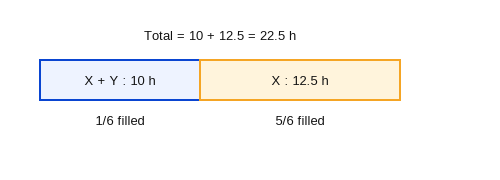
  1. Both for 10 h: 10(115−120)=10×160=16
  2. Remaining 56 by X: 56×15=12.5 h
  3. Total =10+12.5=22.5 h

Trick: LCM capacity 60 units: X =+4, Y =−3; 10 h → 10 units; remaining 50 units ÷4=12.5 h.

Answer: (D) 22.5 hours

अवधारणा: कार्य = दर × समय; भरने वाला पाइप धनात्मक, खाली करने वाला ऋणात्मक।

  1. दोनों 10 घंटे: 10(115−120)=10×160=16
  2. शेष 56 X से: 56×15=12.5 घंटे
  3. कुल =10+12.5=22.5 घंटे

ट्रिक: ल.स. क्षमता 60 इकाई: X =+4, Y =−3; 10 घंटे → 10 इकाई; शेष 50 इकाई ÷4=12.5 घंटे।

उत्तर: (D) 22.5 घंटे

RRB NTPC Undergraduate CBT 1MathematicsPipes and CisternsRRB NTPC Undergraduate CBT 1 2025 · 18 Jun Shift 3 →
Q12155.
If the ratio of two numbers is 4 : 1, and their HCF is 47, then their LCM is:
यदि दो संख्याओं का अनुपात 4 : 1 है, और उनका HCF 47 है, तो उनका LCM क्या है?
  1. A376
  2. B188
  3. C412
  4. D406
Show answer

Concept: Numbers in ratio a:b (co-prime) with HCF h are ha,hb; LCM =h×a×b.

  1. Numbers: 47×4=188 and 47×1=47
  2. LCM =47×4×1=188

Trick: When one number divides the other, LCM is the bigger number.

Answer: (B) 188

अवधारणा: अनुपात a:b (सहअभाज्य) व म.स. h हो तो संख्याएँ ha,hb; ल.स. =h×a×b.

  1. संख्याएँ: 47×4=188 और 47×1=47
  2. ल.स. =47×4×1=188

ट्रिक: जब एक संख्या दूसरी को विभाजित करे, ल.स. बड़ी संख्या होती है।

उत्तर: (B) 188

RRB NTPC Undergraduate CBT 1MathematicsHCF and LCMRRB NTPC Undergraduate CBT 1 2025 · 18 Jun Shift 3 →
Q12156.
In a certain code language, ‘CHIN’ is coded as ‘9413’ and ‘NICE’ is coded as ‘2319’. What is the code for ‘E’ in that language?
एक निश्चित कूट भाषा में, ‘CHIN’ को ‘9413’ और ‘NICE’ को ‘2319’ के रूप में कूटबद्ध किया जाता है। उस भाषा में ‘E’ का कूट क्या है?
  1. A1
  2. B9
  3. C3
  4. D2
Show answer

Concept: Letters common to two words share the common codes (order is jumbled).

  1. CHIN → {9, 4, 1, 3}; NICE → {2, 3, 1, 9}.
  2. Common letters C, I, N ↔ common codes 9, 1, 3.
  3. Left-over in NICE: E ↔ 2 (and H ↔ 4).

Trick: Remove common codes; the leftover code belongs to the leftover letter.

Answer: (D) 2

अवधारणा: दो शब्दों के उभयनिष्ठ अक्षरों के कोड भी उभयनिष्ठ होते हैं (क्रम बदला हुआ)।

  1. CHIN → {9, 4, 1, 3}; NICE → {2, 3, 1, 9}।
  2. उभयनिष्ठ अक्षर C, I, N ↔ उभयनिष्ठ कोड 9, 1, 3।
  3. NICE में बचा E ↔ 2 (और H ↔ 4)।

ट्रिक: उभयनिष्ठ कोड हटाइए; बचा कोड बचे अक्षर का है।

उत्तर: (D) 2

RRB NTPC Undergraduate CBT 1General Intelligence and ReasoningCoding–decodingRRB NTPC Undergraduate CBT 1 2025 · 18 Jun Shift 3 →
Q12157.
What should come in place of the question mark (?) in the given series based on the English alphabetical order?
ZEK UZF PUA KPV ?
अंग्रेज़ी वर्णमाला क्रम के आधार पर दी गई शृंखला में प्रश्न चिह्न (?) के स्थान पर क्या आना चाहिए?
ZEK UZF PUA KPV ?
  1. ADKR
  2. BPFY
  3. CFKQ
  4. DEGP
Show answer

Concept: Check each letter position separately across the terms.

  1. 1st letters: Z, U, P, K, F (each −5).
  2. 2nd letters: E, Z, U, P, K (each −5).
  3. 3rd letters: K, F, A, V, Q (each −5, wrapping A → V).

Trick: Each term's 1st letter = previous term's 2nd letter, so the answer starts F, K.

Answer: (C) FKQ

अवधारणा: हर स्थान के अक्षर को अलग-अलग जाँचें।

  1. पहले अक्षर: Z, U, P, K, F (हर बार −5)।
  2. दूसरे अक्षर: E, Z, U, P, K (हर बार −5)।
  3. तीसरे अक्षर: K, F, A, V, Q (हर बार −5, A के बाद V पर लौटकर)।

ट्रिक: हर पद का पहला अक्षर = पिछले पद का दूसरा अक्षर, अतः उत्तर F, K से शुरू।

उत्तर: (C) FKQ

RRB NTPC Undergraduate CBT 1General Intelligence and ReasoningLetter seriesRRB NTPC Undergraduate CBT 1 2025 · 18 Jun Shift 3 →
Q12158.
If ‘A’ stands for ‘÷’, ‘B’ stands for ‘x’, ‘C’ stands for ‘+’ and ‘D’ stands for ‘−’, then the resultant of which of the following would be 4?
यदि ‘A’ का अर्थ ‘÷’, ‘B’ का अर्थ ‘x’, ‘C’ का अर्थ ‘+’ और ‘D’ का अर्थ ‘−’ है, तो निम्नलिखित में से किसका परिणाम 4 होगा?
  1. A85 B 5 D 7 C 5 A 22
  2. B85 C 5 D 7 A 5 B 22
  3. C85 A 5 D 7 B 5 C 22
  4. D85 D 5 A 7 B 5 C 22
Show answer

Concept: Replace letters with signs (A ÷, B ×, C +, D −) and apply BODMAS.

  1. (C): 85÷5−7×5+22
  2. =17−35+22=4 ✓
  3. (A) =425−7+522≠4; (B) =85+5−75×22≠4; (D) =85−57×5+22≠4.

Trick: Look for an option where division gives a whole number (85÷5=17).

Answer: (C) 85÷5−7×5+22=4

अवधारणा: अक्षरों को चिह्नों से बदलें (A ÷, B ×, C +, D −) और BODMAS लगाएँ।

  1. (C): 85÷5−7×5+22
  2. =17−35+22=4 ✓
  3. (A) =425−7+522≠4; (B) =85+5−75×22≠4; (D) =85−57×5+22≠4।

ट्रिक: ऐसा विकल्प देखें जिसमें भाग पूर्णांक दे (85÷5=17)।

उत्तर: (C) 85÷5−7×5+22=4

RRB NTPC Undergraduate CBT 1General Intelligence and ReasoningMathematical operationsRRB NTPC Undergraduate CBT 1 2025 · 18 Jun Shift 3 →
Q12159.
Based on the English alphabetical order, three of the following four letter-cluster pairs are alike in a certain way and thus form a group. Which is the one that does not belong to that group?
(Note: The odd one out is not based on the number of consonants/vowels or their position in the letter-cluster.)
अंग्रेज़ी वर्णमाला क्रम के आधार पर, निम्नलिखित चार अक्षर-समूह युग्मों में से तीन किसी निश्चित प्रकार से एकसमान हैं और इस प्रकार एक समूह बनाते हैं। कौन-सा युग्म उस समूह से संबंधित नहीं है?
(ध्यान दें: असंगत युग्म, व्यंजनों/स्वरों की संख्या या अक्षर-समूह में उनके स्थान पर आधारित नहीं है।)
  1. AGJ - FI
  2. BKN - HU
  3. CPS - OR
  4. DOR - NQ
Show answer

Concept: Compare letter positions within and between the clusters.

  1. GJ – FI: G+3=J, F+3=I, and G−1=F ✓
  2. PS – OR and OR – NQ follow the same +3 / −1 pattern ✓
  3. KN – HU: K+3=N but H+13=U (and K−3=H) ✗

Trick: Check the gap inside the second cluster first – only HU breaks the +3 gap.

Answer: (B) KN - HU

अवधारणा: क्लस्टर के अंदर और दोनों क्लस्टरों के बीच अक्षरों की स्थिति की तुलना करें।

  1. GJ – FI: G+3=J, F+3=I, तथा G−1=F ✓
  2. PS – OR और OR – NQ में भी वही +3 / −1 पैटर्न ✓
  3. KN – HU: K+3=N पर H+13=U (और K−3=H) ✗

ट्रिक: पहले दूसरे क्लस्टर का अंतर देखें – केवल HU में +3 नहीं है।

उत्तर: (B) KN - HU

RRB NTPC Undergraduate CBT 1General Intelligence and ReasoningOdd one out – letter pairsRRB NTPC Undergraduate CBT 1 2025 · 18 Jun Shift 3 →
Q12160.
In a certain code language, ‘uncle steak gum’ is coded as 'xl wc iv' and ‘sir gum barn’ is coded as ‘wc mn ut’. How is ‘gum’ coded in the given language?
एक निश्चित कूट भाषा में, ‘uncle steak gum’ को 'xl wc iv' और ‘sir gum barn’ को ‘wc mn ut’ के रूप में कूटबद्ध किया जाता है। दी गई भाषा में ‘gum’ को किस प्रकार कूटबद्ध किया जाता है?
  1. Amn
  2. Biv
  3. Cxl
  4. Dwc
Show answer

Concept: A word common to two sentences takes the code common to both.

  1. ‘uncle steak gum’ → xl wc iv; ‘sir gum barn’ → wc mn ut.
  2. Common word: gum; common code: wc.
  3. So gum = wc.

Trick: Common word ↔ common code.

Answer: (D) wc

अवधारणा: दो वाक्यों में उभयनिष्ठ शब्द का कोड दोनों में उभयनिष्ठ होता है।

  1. ‘uncle steak gum’ → xl wc iv; ‘sir gum barn’ → wc mn ut।
  2. उभयनिष्ठ शब्द: gum; उभयनिष्ठ कोड: wc।
  3. अतः gum = wc।

ट्रिक: उभयनिष्ठ शब्द ↔ उभयनिष्ठ कोड।

उत्तर: (D) wc

RRB NTPC Undergraduate CBT 1General Intelligence and ReasoningCoding–decoding – wordsRRB NTPC Undergraduate CBT 1 2025 · 18 Jun Shift 3 →