Question bank

Q&A: practice questions with answers

Search questions on any topic. Filter by exam category, exam, subject and topic, try the question, then open the answer and explanation.

Courses – airGurukul

20,719 questions found.

Q1201.
JM 8 is related to FI 11 in a certain way. In the same way, LO 19 is related to HK 22. To which of the following is UX 27 related, following the same logic?
JM 8 एक निश्चित प्रकार से FI 11 से संबंधित है। उसी प्रकार, LO 19, HK 22 से संबंधित है। समान तर्क का अनुसरण करते हुए, UX 27 निम्नलिखित में से किससे संबंधित है?
  1. AQT 30
  2. BPT 33
  3. CQT 33
  4. DPT 30
Show answer

Concept: Check the change in each letter and in the number separately.

  1. JM → FI: each letter −4; 8 → 11: +3.
  2. LO → HK: −4, −4; 19 → 22: +3.
  3. UX → U−4=Q, X−4=T; 27+3=30 ⇒ QT 30.

Trick: Number +3 already removes (B) and (C) (33).

Answer: (A) QT 30

अवधारणा: अक्षरों और संख्या का परिवर्तन अलग-अलग देखें।

  1. JM → FI: हर अक्षर −4; 8 → 11: +3।
  2. LO → HK: −4, −4; 19 → 22: +3।
  3. UX → Q, T; 27+3=30 ⇒ QT 30।

ट्रिक: संख्या +3 से ही (B) और (C) (33) हट जाते हैं।

उत्तर: (A) QT 30
RRB NTPC Undergraduate CBT 1General Intelligence and ReasoningLetter-number analogyRRB NTPC Undergraduate CBT 1 2024 · 28 Aug Shift 3 →
Q1202.
Which of the following letter-number clusters will replace the question mark (?) in the given series to make it logically complete?
ROP 1, VST 3, ZWX 5, DAB 7, ?
निम्नलिखित में से कौन-सा अक्षर-संख्या समूह दी गई श्रृंखला को तार्किक रूप से पूर्ण करने के लिए प्रश्न चिह्न (?) का स्थान लेगा?
ROP 1, VST 3, ZWX 5, DAB 7, ?
  1. AHGF 9
  2. BHEF 11
  3. CHEF 9
  4. DHGF 11
Show answer

Concept: Track each letter position and the number separately.

  1. 1st letters: R, V, Z, D, H (+4 each).
  2. 2nd letters: O, S, W, A, E (+4); 3rd letters: P, T, X, B, F (+4).
  3. Numbers: 1, 3, 5, 7, 9 (+2) ⇒ HEF 9.

Trick: In every term the last two letters are consecutive (OP, ST, WX, AB) ⇒ EF.

Answer: (C) HEF 9

अवधारणा: हर स्थान के अक्षर और संख्या को अलग-अलग देखें।

  1. पहले अक्षर: R, V, Z, D, H (+4)।
  2. दूसरे: O, S, W, A, E (+4); तीसरे: P, T, X, B, F (+4)।
  3. संख्याएँ: 1, 3, 5, 7, 9 (+2) ⇒ HEF 9।

ट्रिक: हर पद के अंतिम दो अक्षर क्रमागत हैं (OP, ST, WX, AB) ⇒ EF।

उत्तर: (C) HEF 9

RRB NTPC Undergraduate CBT 1General Intelligence and ReasoningLetter-number seriesRRB NTPC Undergraduate CBT 1 2024 · 28 Aug Shift 3 →
Q1203.
Which of the following letter-number clusters will replace the question mark (?) in the given series to make it logically complete?
IGE 13, LJH 17, OMK 21, RPN 25, ?
निम्नलिखित में से कौन-सा अक्षर-संख्या समूह दी गई श्रृंखला को तार्किक रूप से पूर्ण करने के लिए प्रश्न चिह्न (?) का स्थान लेगा?
IGE 13, LJH 17, OMK 21, RPN 25, ?
  1. AUTS 29
  2. BVTQ 28
  3. CUSQ 29
  4. DVTS 29
Show answer

Concept: Each letter moves forward by the same step; the number has its own pattern.

  1. 1st letters: I, L, O, R, U (+3).
  2. 2nd: G, J, M, P, S (+3); 3rd: E, H, K, N, Q (+3).
  3. Numbers: 13, 17, 21, 25, 29 (+4) ⇒ USQ 29.

Trick: Letters within a term go backward by 2 (I-G-E, U-S-Q).

Answer: (C) USQ 29

अवधारणा: हर स्थान का अक्षर समान कदम से आगे बढ़ता है; संख्या का अलग पैटर्न है।

  1. पहले अक्षर: I, L, O, R, U (+3)।
  2. दूसरे: G, J, M, P, S (+3); तीसरे: E, H, K, N, Q (+3)।
  3. संख्याएँ: 13, 17, 21, 25, 29 (+4) ⇒ USQ 29।

ट्रिक: एक पद के भीतर अक्षर 2-2 पीछे जाते हैं (I-G-E, U-S-Q)।

उत्तर: (C) USQ 29

RRB NTPC Undergraduate CBT 1General Intelligence and ReasoningLetter-number seriesRRB NTPC Undergraduate CBT 1 2024 · 28 Aug Shift 3 →
Q1204.
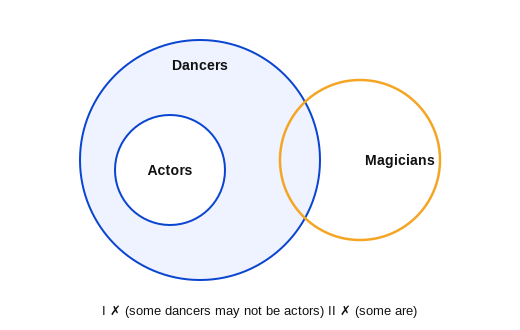
Read the given statements and conclusions carefully. Assuming that the information given in the statements is true, even if it appears to be at variance with commonly known facts, decide which of the given conclusions logically follow(s) from the statements.
Statements:
All actors are dancers.
Some dancers are magicians.
Conclusions:
(I) All dancers are actors.
(II) No magician is a dancer.
दिए गए कथनों और निष्कर्षों को ध्यानपूर्वक पढ़िए। कथनों में दी गई जानकारी को सत्य मानते हुए, भले ही वह सामान्यतः ज्ञात तथ्यों से भिन्न प्रतीत होती हो, निर्णय लीजिए कि दिए गए निष्कर्षों में से कौन-सा/से निष्कर्ष तार्किक रूप से कथनों का अनुसरण करता है/करते हैं।
कथन:
सभी अभिनेता, नर्तक हैं।
कुछ नर्तक, जादूगर हैं।
निष्कर्ष:
(I) सभी नर्तक, अभिनेता हैं।
(II) कोई भी जादूगर, नर्तक नहीं है।
  1. AOnly conclusion (II) follows.केवल निष्कर्ष (II) अनुसरण करता है।
  2. BBoth conclusions (I) and (II) follow.निष्कर्ष (I) और (II) दोनों अनुसरण करते हैं।
  3. COnly conclusion (I) follows.केवल निष्कर्ष (I) अनुसरण करता है।
  4. DNeither conclusion (I) nor (II) follows.न तो निष्कर्ष (I) और न ही (II) अनुसरण करता है।
Show answer

Concept: Draw the minimum Venn diagram and test each conclusion.

  1. All actors are inside dancers, but dancers can exist outside actors ⇒ I (All dancers are actors) does not follow.
  2. Some dancers are magicians is given ⇒ II (No magician is a dancer) directly contradicts it.

Yaad rakhein: 'All A are B' never gives 'All B are A'.

Answer: (D) Neither conclusion (I) nor (II) follows.

अवधारणा: न्यूनतम वेन आरेख बनाकर हर निष्कर्ष जाँचें।

  1. सभी अभिनेता नर्तकों के अंदर हैं, पर नर्तक बाहर भी हो सकते हैं ⇒ I अनुसरण नहीं करता।
  2. 'कुछ नर्तक जादूगर हैं' दिया है ⇒ II इसका सीधा खंडन है।

याद रखें: 'सभी A, B हैं' से 'सभी B, A हैं' कभी नहीं निकलता।

उत्तर: (D) Neither conclusion (I) nor (II) follows.

RRB NTPC Undergraduate CBT 1General Intelligence and ReasoningSyllogismRRB NTPC Undergraduate CBT 1 2024 · 28 Aug Shift 3 →
Q1205.
In a certain code language, ‘FLAG’ is coded as ‘7239’ and ‘ALIF’ is coded as ‘3289’. What is the code for ‘I’ in the given code language?
एक निश्चित कूट भाषा में, ‘FLAG’ को ‘7239’ के रूप में कूटबद्ध किया जाता है और ‘ALIF’ को ‘3289’ के रूप में कूटबद्ध किया जाता है। दी गई कूट भाषा में ‘I’ के लिए कूट क्या है?
  1. A9
  2. B3
  3. C2
  4. D8
Show answer

Concept: Letters common to both words share the common digits.

  1. FLAG = 7239, ALIF = 3289.
  2. Common letters F, L, A ↔ common digits 2, 3, 9.
  3. Left over: G ↔ 7 and I ↔ 8.

Trick: Cancel common letters and common digits – the leftover pairs match.

Answer: (D) 8

अवधारणा: दोनों शब्दों के उभयनिष्ठ अक्षरों के कोड भी उभयनिष्ठ होते हैं।

  1. FLAG = 7239, ALIF = 3289।
  2. उभयनिष्ठ F, L, A ↔ 2, 3, 9।
  3. बचे: G ↔ 7 और I ↔ 8।

ट्रिक: उभयनिष्ठ अक्षर व अंक हटाएँ – बचे हुए जोड़े मेल खाते हैं।

उत्तर: (D) 8

RRB NTPC Undergraduate CBT 1General Intelligence and ReasoningCoding-decoding – common lettersRRB NTPC Undergraduate CBT 1 2024 · 28 Aug Shift 3 →
Q1206.
Based on the English alphabetical order, three of the following four letter-clusters are alike in a certain way and thus form a group. Which letter-cluster DOES NOT belong to that group? (Note: The odd one out is not based on the number of consonants/vowels or their position in the letter-cluster.)
अंग्रेज़ी वर्णमाला क्रम के आधार पर, निम्नलिखित चार अक्षर-समूहों में से तीन किसी निश्चित प्रकार से एक समान हैं और इस प्रकार एक समूह बनाते हैं। कौन-सा अक्षर-समूह उस समूह से संबंधित नहीं है? (ध्यान दें: असंगत अक्षर-समूह, उस अक्षर-समूह में व्यंजनों/स्वरों की संख्या या उनके स्थान पर आधारित नहीं है।)
  1. ACELS
  2. BJMSZ
  3. CNQWD
  4. DSVBI
Show answer

Concept: Find the gaps between consecutive letters (positions A=1 … Z=26, wrapping after Z).

  1. JMSZ: +3, +6, +7.
  2. NQWD: +3, +6, +7 (W→D wraps).
  3. SVBI: +3, +6, +7.
  4. CELS: +2, +7, +7 ⇒ odd.

Trick: Only the first gap already differs (+2 vs +3) – checking one gap is enough.

Answer: (A) CELS

अवधारणा: क्रमागत अक्षरों के बीच अंतर देखें (Z के बाद A)।

  1. JMSZ: +3, +6, +7।
  2. NQWD: +3, +6, +7।
  3. SVBI: +3, +6, +7।
  4. CELS: +2, +7, +7 ⇒ विषम।

ट्रिक: पहला अंतर ही अलग है (+2 बनाम +3)।

उत्तर: (A) CELS

RRB NTPC Undergraduate CBT 1General Intelligence and ReasoningOdd one out – letter clustersRRB NTPC Undergraduate CBT 1 2024 · 28 Aug Shift 3 →
Q1207.
Each of the digits in the number 817594326 is arranged in ascending order from left to right. Which of the following digits will be fourth from the left?
संख्या 817594326 के प्रत्येक अंक को बाएँ से दाएँ आरोही क्रम में व्यवस्थित किया जाता है। निम्नलिखित में से कौन-सा अंक बाएँ से चौथे स्थान पर होगा?
  1. A5
  2. B6
  3. C4
  4. D3
Show answer

Concept: Arrange all digits in ascending order.

  1. Digits: 8, 1, 7, 5, 9, 4, 3, 2, 6.
  2. Ascending: 1 2 3 4 5 6 7 8 9.
  3. Fourth from left =4.

Trick: All digits 1–9 appear once, so the nth from left is simply n.

Answer: (C) 4

अवधारणा: सभी अंकों को आरोही क्रम में लगाएँ।

  1. अंक: 8, 1, 7, 5, 9, 4, 3, 2, 6।
  2. आरोही: 1 2 3 4 5 6 7 8 9।
  3. बाएँ से चौथा =4।

ट्रिक: 1–9 सभी अंक एक-एक बार हैं, अतः बाएँ से nवाँ अंक n ही है।

उत्तर: (C) 4

RRB NTPC Undergraduate CBT 1General Intelligence and ReasoningDigit arrangementRRB NTPC Undergraduate CBT 1 2024 · 28 Aug Shift 3 →
Q1208.
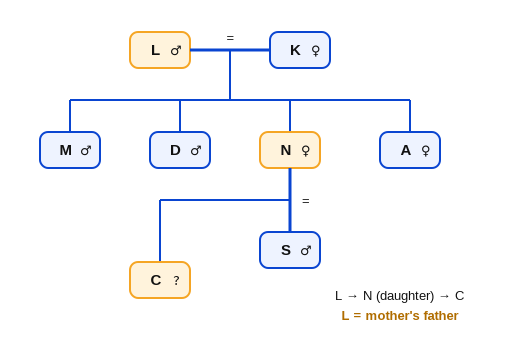
M is the son of L. L is the father of D. D is the brother of N. N is the sister of A. A is the daughter of K. K is the mother of Q. N is married to S. S is the father of C. How is L related to C?
M, L का पुत्र है। L, D का पिता है। D, N का भाई है। N, A की बहन है। A, K की पुत्री है। K, Q की माता है। N का विवाह S से हुआ है। S, C का पिता है। L का C से क्या संबंध है?
  1. AFather's fatherपिता के पिता
  2. BMother's fatherमाता के पिता
  3. CFather's brotherपिता के भाई
  4. DMother's brotherमाता के भाई
Show answer

Concept: Build the family tree step by step.

  1. L (male) and K (female) are parents of M, D, N, A.
  2. N is a sister ⇒ female; N is married to S.
  3. S is the father of C ⇒ N is C's mother.
  4. L is N's father ⇒ L is C's mother's father.

Trick: Trace the path L → N → C: father of mother.

Answer: (B) Mother's father

अवधारणा: चरणबद्ध परिवार वृक्ष बनाएँ।

  1. L (पुरुष) और K (महिला) M, D, N, A के माता-पिता हैं।
  2. N बहन है ⇒ महिला; N का विवाह S से।
  3. S, C का पिता ⇒ N, C की माँ।
  4. L, N का पिता ⇒ L, C का नाना (माँ का पिता)।

ट्रिक: पथ L → N → C: माँ के पिता।

उत्तर: (B) Mother's father

RRB NTPC Undergraduate CBT 1General Intelligence and ReasoningBlood relationsRRB NTPC Undergraduate CBT 1 2024 · 28 Aug Shift 3 →
Q1209.
In a certain code language, ‘TAME’ is coded as ‘4257’ and ‘MIND’ is coded as ‘1365’. What is the code for ‘M’ in the given code language?
एक निश्चित कूट भाषा में, ‘TAME’ को ‘4257’ के रूप में कूटबद्ध किया जाता है और ‘MIND’ को ‘1365’ के रूप में कूटबद्ध किया जाता है। दी गई कूट भाषा में ‘M’ के लिए कूट क्या है?
  1. A6
  2. B7
  3. C5
  4. D1
Show answer

Concept: The only letter common to both words gets the only digit common to both codes.

  1. TAME = 4257, MIND = 1365.
  2. Common letter: M; common digit: 5.
  3. So M = 5.

Trick: One common letter ↔ one common digit.

Answer: (C) 5

अवधारणा: दोनों शब्दों में उभयनिष्ठ अक्षर का कोड दोनों कोडों का उभयनिष्ठ अंक होता है।

  1. TAME = 4257, MIND = 1365।
  2. उभयनिष्ठ अक्षर: M; उभयनिष्ठ अंक: 5।
  3. अतः M = 5।

ट्रिक: एक उभयनिष्ठ अक्षर ↔ एक उभयनिष्ठ अंक।

उत्तर: (C) 5

RRB NTPC Undergraduate CBT 1General Intelligence and ReasoningCoding-decoding – common lettersRRB NTPC Undergraduate CBT 1 2024 · 28 Aug Shift 3 →
Q1210.
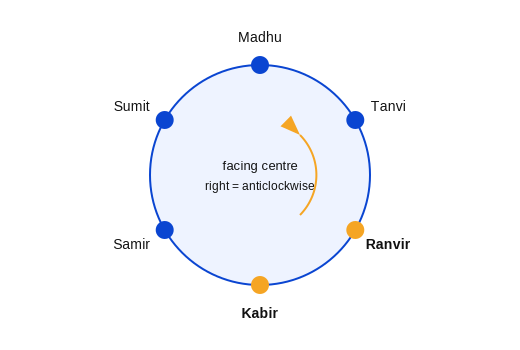
Kabir, Sumit, Ranvir, Madhu, Samir and Tanvi are sitting around a circle, facing the centre. Ranvir sits second to the right of Samir. Samir sits second to the right of Madhu. Sumit sits to the immediate left of Samir. Kabir sits second to the left of Tanvi. Who sits to the immediate right of Kabir?
कबीर, सुमित, रणवीर, मधु, समीर और तन्वी एक वृत्त के चारों ओर केंद्र की ओर मुख करके बैठे हैं। रणवीर, समीर के दाईं ओर दूसरे स्थान पर बैठा है। समीर, मधु के दाईं ओर दूसरे स्थान पर बैठा है। सुमित, समीर के ठीक बाईं ओर बैठा है। कबीर, तन्वी के बाईं ओर दूसरे स्थान पर बैठा है। कबीर के ठीक दाईं ओर कौन बैठा है?
  1. ATanviतन्वी
  2. BRanvirरणवीर
  3. CSamirसमीर
  4. DSumitसुमित
Show answer

Concept: Facing the centre, 'right' is anticlockwise and 'left' is clockwise.

  1. Fix Madhu; Samir is 2nd to her right, Ranvir 2nd to Samir's right.
  2. Sumit sits immediately left of Samir.
  3. Remaining two seats: Kabir 2nd to the left of Tanvi works only with Kabir opposite Madhu.
  4. Immediate right of Kabir = Ranvir.

Trick: 6 people: 'second to the left/right' twice from one person covers alternate seats – fix those first.

Answer: (B) Ranvir

अवधारणा: केंद्र की ओर मुख होने पर 'दाएँ' = वामावर्त (anticlockwise), 'बाएँ' = दक्षिणावर्त।

  1. Madhu को स्थिर करें; Samir उसके दाएँ दूसरे, Ranvir, Samir के दाएँ दूसरे।
  2. Sumit, Samir के ठीक बाएँ।
  3. शेष दो स्थान: Kabir, Tanvi के बाएँ दूसरा – केवल तभी संभव जब Kabir, Madhu के सामने हो।
  4. Kabir के ठीक दाएँ = Ranvir।

ट्रिक: पहले 'दूसरा दाएँ' वाली शर्तें लगाएँ – वे एकांतर स्थान भर देती हैं।

उत्तर: (B) Ranvir

RRB NTPC Undergraduate CBT 1General Intelligence and ReasoningCircular seating arrangementRRB NTPC Undergraduate CBT 1 2024 · 28 Aug Shift 3 →
Q1211.
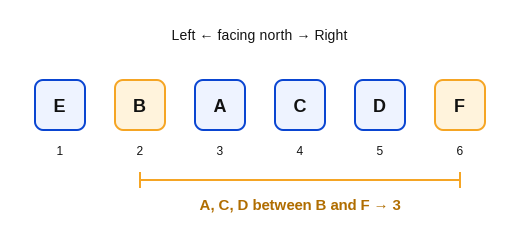
Six people, A, B, C, D, E and F are sitting in a row, facing north. Only two people sit to the right of C. A sits second to the left of D. B sits to the immediate right of E. F sits on the extreme right end of the line. How many people sit between B and F?
छह व्यक्ति A, B, C, D, E और F एक पंक्ति में उत्तर की ओर मुख करके बैठे हैं। C के दाईं ओर केवल दो व्यक्ति बैठे हैं। A, D के बाईं ओर दूसरे स्थान पर बैठा है। B, E के ठीक दाईं ओर बैठा है। F पंक्ति के अंतिम दाएँ छोर पर बैठा है। B और F के बीच कितने व्यक्ति बैठे हैं?
  1. AOneएक
  2. BTwoदो
  3. CFourचार
  4. DThreeतीन
Show answer

Concept: Number seats 1–6 from left (facing north, right = higher number).

  1. F at 6; only two to the right of C ⇒ C at 4.
  2. A is 2nd to the left of D: (1,3) leaves 2 and 5 non-adjacent for E-B, so A = 3, D = 5.
  3. E, B take 1 and 2 with B right of E: E = 1, B = 2.
  4. Between B(2) and F(6): A, C, D ⇒ three.

Trick: Fill fixed seats (F, C) first, then test the A–D pair.

Answer: (D) Three

अवधारणा: बाएँ से 1–6 स्थान लें (उत्तरमुख, दायाँ = बड़ी संख्या)।

  1. F स्थान 6 पर; C के दाएँ केवल दो ⇒ C स्थान 4।
  2. A, D के बाएँ दूसरा: (1,3) लेने पर E-B के लिए 2 और 5 बचते हैं जो साथ नहीं, अतः A = 3, D = 5।
  3. E = 1, B = 2।
  4. B(2) और F(6) के बीच: A, C, D ⇒ तीन।

ट्रिक: पहले निश्चित स्थान (F, C) भरें, फिर A–D युग्म जाँचें।

उत्तर: (D) Three

RRB NTPC Undergraduate CBT 1General Intelligence and ReasoningLinear seating arrangementRRB NTPC Undergraduate CBT 1 2024 · 28 Aug Shift 3 →
Q1212.
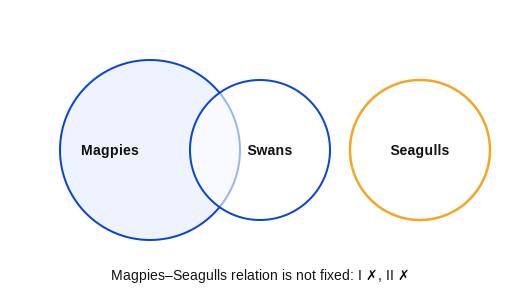
Read the given statement(s) and conclusions carefully. Assuming that the information given in the statements is true, even if it appears to be at variance with commonly known facts, decide which of the given conclusions logically follow(s) from the statement(s).
Statements:
Some Magpies are Swans.
No Swans are Seagulls.
Conclusions:
I: Some Magpies are Seagulls.
II: No Seagulls are Magpies.
दिए गए कथन/कथनों और निष्कर्षों को ध्यानपूर्वक पढ़िए। कथनों में दी गई जानकारी को सत्य मानते हुए, भले ही वह सामान्यतः ज्ञात तथ्यों से भिन्न प्रतीत होती हो, निर्णय लीजिए कि दिए गए निष्कर्षों में से कौन-सा/से निष्कर्ष तार्किक रूप से कथन/कथनों का अनुसरण करता है/करते हैं।
कथन:
कुछ मैगपाई, हंस हैं।
कोई भी हंस, सीगल नहीं है।
निष्कर्ष:
I: कुछ मैगपाई, सीगल हैं।
II: कोई भी सीगल, मैगपाई नहीं है।
  1. ANeither conclusion (I) nor (II) follows.न तो निष्कर्ष (I) और न ही (II) अनुसरण करता है।
  2. BOnly conclusion (II) follows.केवल निष्कर्ष (II) अनुसरण करता है।
  3. CBoth conclusions (I) and (II) follow.निष्कर्ष (I) और (II) दोनों अनुसरण करते हैं।
  4. DOnly conclusion (I) follows.केवल निष्कर्ष (I) अनुसरण करता है।
Show answer

Concept: Draw the minimum Venn diagram; Magpies and Seagulls are linked only through Swans.

  1. Swans and Seagulls are disjoint; Magpies overlap Swans.
  2. Magpies may or may not touch Seagulls ⇒ neither 'Some Magpies are Seagulls' nor 'No Seagulls are Magpies' is certain.

Yaad rakhein: I and II form a complementary pair (either I or II is true), but since an 'either-or' option is not given, choose 'neither'.

Answer: (A) Neither conclusion (I) nor (II) follows.

अवधारणा: न्यूनतम वेन आरेख बनाएँ; Magpies और Seagulls का संबंध केवल Swans से होकर है।

  1. Swans और Seagulls अलग हैं; Magpies, Swans से जुड़े हैं।
  2. Magpies, Seagulls को छू भी सकते हैं, नहीं भी ⇒ दोनों में से कोई निश्चित नहीं।

याद रखें: I और II पूरक युग्म हैं ('या तो I या II'), पर यह विकल्प नहीं है, अतः 'कोई नहीं'।

उत्तर: (A) Neither conclusion (I) nor (II) follows.

RRB NTPC Undergraduate CBT 1General Intelligence and ReasoningSyllogismRRB NTPC Undergraduate CBT 1 2024 · 28 Aug Shift 3 →
Q1213.
QERG is related to WJVJ in a certain way based on the English alphabetical order. In the same way, OYHS is related to UDLV. To which of the given options is GNTB related, following the same logic?
अंग्रेज़ी वर्णमाला क्रम के आधार पर QERG एक निश्चित प्रकार से WJVJ से संबंधित है। उसी प्रकार, OYHS, UDLV से संबंधित है। समान तर्क का अनुसरण करते हुए, GNTB दिए गए विकल्पों में से किससे संबंधित है?
  1. AMSXE
  2. BMSEX
  3. CMSWE
  4. DMXEW
Show answer

Concept: Find the shift for each letter position.

  1. QERG → WJVJ: +6, +5, +4, +3.
  2. OYHS → UDLV: +6, +5, +4, +3 ✓.
  3. GNTB: G+6=M, N+5=S, T+4=X, B+3=E ⇒ MSXE.

Trick: Decreasing shifts +6, +5, +4, +3 – check the last letter first: B+3=E rules out (B) and (D).

Answer: (A) MSXE

अवधारणा: हर स्थान के अक्षर का खिसकाव ज्ञात करें।

  1. QERG → WJVJ: +6, +5, +4, +3।
  2. OYHS → UDLV: +6, +5, +4, +3 ✓।
  3. GNTB: M, S, X, E ⇒ MSXE।

ट्रिक: अंतिम अक्षर B+3=E से (B) और (D) तुरंत हटते हैं।

उत्तर: (A) MSXE

RRB NTPC Undergraduate CBT 1General Intelligence and ReasoningLetter analogyRRB NTPC Undergraduate CBT 1 2024 · 28 Aug Shift 3 →
Q1214.
What should come in place of the question mark (?) in the given series?
82 , 83 , 85 , 89 , 97 , ?
दी गई श्रृंखला में प्रश्न चिह्न (?) के स्थान पर क्या आना चाहिए?
82 , 83 , 85 , 89 , 97 , ?
  1. A112
  2. B113
  3. C121
  4. D131
Show answer

Concept: Look at the differences between consecutive terms.

  1. Differences: 1, 2, 4, 8 (doubling).
  2. Next difference =16.
  3. 97+16=113.

Trick: Differences as powers of 2: 20,21,22,23,24.

Answer: (B) 113

अवधारणा: क्रमागत पदों के अंतर देखें।

  1. अंतर: 1, 2, 4, 8 (दोगुना)।
  2. अगला अंतर =16।
  3. 97+16=113।

ट्रिक: अंतर 2 की घातें: 20,21,22,23,24।

उत्तर: (B) 113

RRB NTPC Undergraduate CBT 1General Intelligence and ReasoningNumber seriesRRB NTPC Undergraduate CBT 1 2024 · 28 Aug Shift 3 →
Q1215.
Each of the digits in the number 9254631 is arranged in ascending order from left to right. The position(s) of how many digits will remain unchanged as compared to that in the original number?
संख्या 9254631 के प्रत्येक अंक को बाएँ से दाएँ आरोही क्रम में व्यवस्थित किया जाता है। मूल संख्या की तुलना में कितने अंकों का/के स्थान अपरिवर्तित रहेगा/रहेंगे?
  1. AThreeतीन
  2. BTwoदो
  3. CNoneएक भी नहीं
  4. DOneएक
Show answer

Concept: Compare the original and ascending numbers position by position.

  1. Original: 9 2 5 4 6 3 1.
  2. Ascending: 1 2 3 4 5 6 9.
  3. Same: 2nd (2) and 4th (4) ⇒ two.

Trick: Write the two numbers one under the other – matching columns are easy to spot.

Answer: (B) Two

अवधारणा: मूल और आरोही संख्या की स्थान-दर-स्थान तुलना करें।

  1. मूल: 9 2 5 4 6 3 1।
  2. आरोही: 1 2 3 4 5 6 9।
  3. समान: दूसरा (2) और चौथा (4) ⇒ दो।

ट्रिक: दोनों संख्याएँ एक के नीचे एक लिखें।

उत्तर: (B) Two

RRB NTPC Undergraduate CBT 1General Intelligence and ReasoningDigit arrangementRRB NTPC Undergraduate CBT 1 2024 · 28 Aug Shift 3 →
Q1216.
Kiya ranked 7th from the bottom and 15th from the top in her class. How many students are there in her class?
किया अपनी कक्षा में नीचे से 7वें और ऊपर से 15वें स्थान पर है। उसकी कक्षा में कितने विद्यार्थी हैं?
  1. A22
  2. B21
  3. C20
  4. D19
Show answer

Concept: Total = rank from top + rank from bottom −1.

  1. Total =15+7−1=21.

Trick: Subtract 1 because Kiya is counted twice.

Answer: (B) 21

अवधारणा: कुल = ऊपर से स्थान + नीचे से स्थान − 1।

  1. कुल =15+7−1=21।

ट्रिक: Kiya दो बार गिनी गई है, अतः 1 घटाएँ।

उत्तर: (B) 21

RRB NTPC Undergraduate CBT 1General Intelligence and ReasoningRankingRRB NTPC Undergraduate CBT 1 2024 · 28 Aug Shift 3 →
Q1217.
Based on the English alphabetical order, three of the following four letter-cluster pairs are alike in a certain way and thus form a group. Which letter-cluster pair DOES NOT belong to that group?
(Note: The odd one out is not based on the number of consonants/vowels or their position in the letter-cluster.)
अंग्रेज़ी वर्णमाला क्रम के आधार पर, निम्नलिखित चार अक्षर-समूह युग्मों में से तीन किसी निश्चित प्रकार से एक समान हैं और इस प्रकार एक समूह बनाते हैं। कौन-सा अक्षर-समूह युग्म उस समूह से संबंधित नहीं है?
(ध्यान दें: असंगत अक्षर-समूह, उस अक्षर-समूह में व्यंजनों/स्वरों की संख्या या उनके स्थान पर आधारित नहीं है।)
  1. ALP-GI
  2. BNR-IL
  3. CQU-LO
  4. DJN-EH
Show answer

Concept: Compare each letter of the first cluster with the corresponding letter of the second.

  1. NR-IL: N−5=I, R−6=L.
  2. QU-LO: Q−5=L, U−6=O.
  3. JN-EH: J−5=E, N−6=H.
  4. LP-GI: L−5=G but P−7=I ⇒ odd.

Trick: In the group, both clusters have letters 4 apart (NR) and 3 apart (IL); LP-GI has G–I only 2 apart.

Answer: (A) LP-GI

अवधारणा: पहले समूह के प्रत्येक अक्षर की तुलना दूसरे के संगत अक्षर से करें।

  1. NR-IL: N−5=I, R−6=L।
  2. QU-LO: −5, −6।
  3. JN-EH: −5, −6।
  4. LP-GI: L−5=G पर P−7=I ⇒ विषम।

ट्रिक: समूह में दूसरे भाग के अक्षरों में 3 का अंतर (IL, LO, EH); GI में केवल 2।

उत्तर: (A) LP-GI

RRB NTPC Undergraduate CBT 1General Intelligence and ReasoningOdd one out – letter pairsRRB NTPC Undergraduate CBT 1 2024 · 28 Aug Shift 3 →
Q1218.
What should come in place of the question mark (?) in the given series?
425 300 236 209 201 ?
दी गई श्रृंखला में प्रश्न चिह्न (?) के स्थान पर क्या आना चाहिए?
425 300 236 209 201 ?
  1. A200
  2. B182
  3. C172
  4. D152
Show answer

Concept: Differences between terms are perfect cubes.

  1. 425−300=125=53, 300−236=64=43.
  2. 236−209=27=33, 209−201=8=23.
  3. Next: 201−13=200.

Trick: Decreasing differences ending near 1 – check cubes 53,43,33…

Answer: (A) 200

अवधारणा: पदों के अंतर पूर्ण घन हैं।

  1. 425−300=53, 300−236=43।
  2. 236−209=33, 209−201=23।
  3. अगला: 201−13=200।

ट्रिक: घटते अंतर – घन 53,43,33… जाँचें।

उत्तर: (A) 200

RRB NTPC Undergraduate CBT 1General Intelligence and ReasoningNumber series – cubesRRB NTPC Undergraduate CBT 1 2024 · 28 Aug Shift 3 →
Q1219.
If + means −, − means ×, × means ÷ and ÷ means +, then what will come in place of the question mark (?) in the following equation?
8 − 3 + 63 × 3 ÷ 14 = ?
यदि + का अर्थ −, − का अर्थ ×, × का अर्थ ÷ और ÷ का अर्थ + है, तो निम्नलिखित समीकरण में प्रश्न चिह्न (?) के स्थान पर क्या आएगा?
8 − 3 + 63 × 3 ÷ 14 = ?
  1. A24
  2. B17
  3. C12
  4. D30
Show answer

Concept: Replace the symbols, then apply BODMAS.

  1. 8−3+63×3÷14 becomes 8×3−63÷3+14.
  2. =24−21+14.
  3. =17.

Trick: Do division and multiplication first, then addition/subtraction from left.

Answer: (B) 17

अवधारणा: चिह्न बदलें, फिर BODMAS लगाएँ।

  1. 8−3+63×3÷14 बनता है 8×3−63÷3+14।
  2. =24−21+14।
  3. =17।

ट्रिक: पहले भाग व गुणा, फिर जोड़-घटाव।

उत्तर: (B) 17

RRB NTPC Undergraduate CBT 1General Intelligence and ReasoningMathematical operations – symbol substitutionRRB NTPC Undergraduate CBT 1 2024 · 28 Aug Shift 3 →
Q1220.
Refer to the following number and symbol series and answer the question that follows. Counting to be done from left to right only.
(Left) 8 € 1 @ % 5 5 3 % © 2 € £ 7 1 # 8 % 8 7 2 @ (Right)
How many such numbers are there, each of which is immediately preceded by a number and also immediately followed by a number?
निम्नलिखित संख्या और प्रतीक श्रृंखला को देखिए और उसके बाद पूछे गए प्रश्न का उत्तर दीजिए। गिनती केवल बाएँ से दाएँ की जानी है।
(बाएँ) 8 € 1 @ % 5 5 3 % © 2 € £ 7 1 # 8 % 8 7 2 @ (दाएँ)
ऐसी कितनी संख्याएँ हैं, जिनमें से प्रत्येक के ठीक पहले एक संख्या है और ठीक बाद भी एक संख्या है?
  1. A4
  2. B2
  3. C3
  4. D1
Show answer

Concept: Look for three consecutive numbers – the middle one qualifies.

  1. Runs of numbers: '5 5 3' and '8 7 2' (also '7 1' and '8' alone – too short).
  2. Middle of '5 5 3' → 5; middle of '8 7 2' → 7.
  3. Count =2.

Trick: Only a run of at least 3 numbers can give an answer – scan for such runs.

Answer: (B) 2

अवधारणा: तीन लगातार संख्याएँ खोजें – बीच वाली संख्या मान्य है।

  1. संख्याओं के समूह: '5 5 3' और '8 7 2' ('7 1' छोटा है)।
  2. '5 5 3' में बीच का 5; '8 7 2' में 7।
  3. गिनती =2।

ट्रिक: कम से कम 3 लगातार संख्याओं वाले समूह ही काम के हैं।

उत्तर: (B) 2

RRB NTPC Undergraduate CBT 1General Intelligence and ReasoningNumber-symbol seriesRRB NTPC Undergraduate CBT 1 2024 · 28 Aug Shift 3 →