Question bank

Q&A: practice questions with answers

Search questions on any topic. Filter by exam category, exam, subject and topic, try the question, then open the answer and explanation.

Courses – airGurukul

20,719 questions found.

Q12221.
World Toilet Day was observed on which date in 2025?
2025 में विश्व शौचालय दिवस किस तिथि को मनाया गया?
  1. A9 October9 अक्टूबर
  2. B19 October19 अक्टूबर
  3. C9 November9 नवंबर
  4. D19 November19 नवंबर
Show answer

Concept: World Toilet Day is a UN observance to raise awareness about the global sanitation crisis.

  1. It is observed every year on 19 November, so in 2025 it was on 19 November.
  2. The UN General Assembly made it an official UN day in 2013; it supports SDG 6 (clean water and sanitation for all).
  3. In India it links with the Swachh Bharat Mission.

Yaad rakhein: 19 November – World Toilet Day; 22 March – World Water Day.

Answer: (D) 19 November

अवधारणा: विश्व शौचालय दिवस (World Toilet Day) वैश्विक स्वच्छता संकट के प्रति जागरूकता के लिए संयुक्त राष्ट्र का दिवस है।

  1. यह हर वर्ष 19 नवंबर को मनाया जाता है, इसलिए 2025 में भी 19 नवंबर को था।
  2. संयुक्त राष्ट्र महासभा ने 2013 में इसे आधिकारिक UN दिवस बनाया; यह SDG 6 (सभी के लिए स्वच्छ जल व स्वच्छता) से जुड़ा है।
  3. भारत में यह स्वच्छ भारत मिशन से जुड़ता है।

याद रखें: 19 नवंबर – विश्व शौचालय दिवस; 22 मार्च – विश्व जल दिवस।

उत्तर: (D) 19 नवंबर
RRB NTPC Undergraduate CBT 1General AwarenessImportant DaysRRB NTPC Undergraduate CBT 1 2025 · 18 Jun Shift 2 →
Q12222.
Which Article of the Indian Constitution directs the State to protect and improve the environment?
भारतीय संविधान का कौन-सा अनुच्छेद राज्य को पर्यावरण के संरक्षण और सुधार का निर्देश देता है?
  1. AArticle 37Aअनुच्छेद 37A
  2. BArticle 43Aअनुच्छेद 43A
  3. CArticle 39Aअनुच्छेद 39A
  4. DArticle 48Aअनुच्छेद 48A
Show answer

Concept: Environment protection appears in the Constitution both as a Directive Principle and as a Fundamental Duty.

  1. Article 48A (DPSP): the State shall endeavour to protect and improve the environment and safeguard forests and wildlife.
  2. It was added by the 42nd Amendment, 1976, along with Article 51A(g) – the citizen’s duty to protect the environment.
  3. Art. 39A = equal justice and free legal aid; Art. 43A = workers’ participation in management; 37A does not exist.

Yaad rakhein: 42nd Amendment added 39A, 43A, 48A to DPSP.

Answer: (D) Article 48A

अवधारणा: पर्यावरण संरक्षण संविधान में नीति निदेशक तत्व और मौलिक कर्तव्य, दोनों रूपों में है।

  1. अनुच्छेद 48A (DPSP): राज्य पर्यावरण की रक्षा व सुधार तथा वनों और वन्यजीवों की रक्षा का प्रयास करेगा।
  2. इसे 42वें संशोधन, 1976 ने जोड़ा, साथ ही अनुच्छेद 51A(g) – नागरिक का पर्यावरण रक्षा का कर्तव्य।
  3. अनु. 39A = समान न्याय व निःशुल्क विधिक सहायता; अनु. 43A = प्रबंधन में कर्मकारों की भागीदारी; 37A अस्तित्व में नहीं।

याद रखें: 42वें संशोधन ने DPSP में 39A, 43A, 48A जोड़े।

उत्तर: (D) अनुच्छेद 48A

RRB NTPC Undergraduate CBT 1General AwarenessPolity – DPSPRRB NTPC Undergraduate CBT 1 2025 · 18 Jun Shift 2 →
Q12223.
Which of the following countries participated in the 3rd edition of the Joint Special Forces Exercise 'CYCLONE' at Mahajan Field Firing Ranges in Rajasthan from 10th to 23rd February 2025?
निम्नलिखित में से किन देशों ने 10th से 23rd फरवरी 2025 तक राजस्थान की महाजन फील्ड फायरिंग रेंज में संयुक्त विशेष बल अभ्यास 'CYCLONE' के 3rd संस्करण में भाग लिया?
  1. AIndia and Egyptभारत और मिस्र
  2. BIndia and Namibiaभारत और नामीबिया
  3. CIndia and Chinaभारत और चीन
  4. DIndia and Iranभारत और ईरान
Show answer

Concept: CYCLONE is the joint special forces exercise between India and Egypt.

  1. Its 3rd edition was held at the Mahajan Field Firing Ranges, Rajasthan, from 10 to 23 February 2025.
  2. The 1st edition was held in India (Jaisalmer, 2023) and the 2nd in Egypt (2024).
  3. It aims at interoperability in desert and semi-desert terrain and counter-terrorism operations.

Yaad rakhein: India–Egypt exercises: CYCLONE (Army special forces), Bright Star (multinational, hosted by Egypt).

Answer: (A) India and Egypt

अवधारणा: CYCLONE भारत और मिस्र (Egypt) के बीच संयुक्त विशेष बल अभ्यास है।

  1. इसका तीसरा संस्करण 10 से 23 फरवरी 2025 तक महाजन फील्ड फायरिंग रेंज, राजस्थान में हुआ।
  2. पहला संस्करण भारत (जैसलमेर, 2023) में और दूसरा मिस्र (2024) में हुआ।
  3. इसका उद्देश्य रेगिस्तानी व अर्ध-रेगिस्तानी क्षेत्र में तालमेल और आतंकवाद-रोधी अभियान है।

याद रखें: भारत–मिस्र अभ्यास: CYCLONE (सेना विशेष बल), Bright Star (बहुराष्ट्रीय, मिस्र में)।

उत्तर: (A) भारत और मिस्र

RRB NTPC Undergraduate CBT 1General AwarenessDefence ExercisesRRB NTPC Undergraduate CBT 1 2025 · 18 Jun Shift 2 →
Q12224.
When a program in Windows appears as “Not Responding” and the user ends it using Task Manager, which action is effectively being requested from the operating system?
जब Windows में कोई प्रोग्राम “Not Responding” के रूप में दिखाई देता है और उपयोगकर्ता Task Manager का उपयोग करके उसे बंद करता है, तो वस्तुतः ऑपरेटिंग सिस्टम से कौन-सी क्रिया करने का अनुरोध किया जा रहा है?
  1. AConvert the program into a serviceप्रोग्राम को एक सर्विस (service) में बदलना
  2. BChange the program’s file typeप्रोग्राम का फ़ाइल प्रकार बदलना
  3. CMove the program to another driveप्रोग्राम को किसी अन्य ड्राइव पर ले जाना
  4. DForce the process to terminate and release its resourcesप्रोसेस को बलपूर्वक समाप्त करना और उसके संसाधनों को मुक्त करना
Show answer

Concept: A running program is a process; the operating system manages its CPU time and memory.

  1. “Not Responding” means the process has stopped reacting to messages from the OS.
  2. Clicking “End task” in Task Manager asks the OS to forcibly terminate the process and free its memory, handles and other resources.
  3. It does not change the file type, move the program or convert it into a service.

Trick: Ctrl + Shift + Esc opens Task Manager directly; End task = kill process.

Answer: (D) Force the process to terminate and release its resources

अवधारणा: चल रहा प्रोग्राम एक प्रोसेस (process) है; ऑपरेटिंग सिस्टम उसका CPU समय और मेमोरी प्रबंधित करता है।

  1. “Not Responding” का अर्थ है प्रोसेस OS के संदेशों का उत्तर नहीं दे रहा।
  2. Task Manager में “End task” दबाने पर OS से प्रोसेस को ज़बरदस्ती बंद करने और उसकी मेमोरी, हैंडल आदि संसाधन मुक्त करने को कहा जाता है।
  3. इससे न फ़ाइल प्रकार बदलता है, न प्रोग्राम दूसरी ड्राइव पर जाता है, न सर्विस बनता है।

ट्रिक: Ctrl + Shift + Esc से Task Manager सीधे खुलता है; End task = प्रोसेस समाप्त।

उत्तर: (D) प्रोसेस को ज़बरदस्ती समाप्त कर उसके संसाधन मुक्त करना

RRB NTPC Undergraduate CBT 1General AwarenessOperating System – ProcessesRRB NTPC Undergraduate CBT 1 2025 · 18 Jun Shift 2 →
Q12225.
When moving down a group in the Modern Periodic Table, what happens to the number of valence electrons?
आधुनिक आवर्त सारणी में किसी समूह में नीचे जाने पर संयोजकता इलेक्ट्रॉनों (valence electrons) की संख्या में क्या परिवर्तन होता है?
  1. ARemains the sameसमान रहती है
  2. BIncreases by twoदो से बढ़ जाती है
  3. CDecreases by oneएक से घट जाती है
  4. DIncreases by oneएक से बढ़ जाती है
Show answer

Concept: Elements of the same group have the same outer (valence) electronic configuration.

  1. Down a group a new shell is added each period, but the number of electrons in the outermost shell stays the same.
  2. Example Group 1: Li (2,1), Na (2,8,1), K (2,8,8,1) – all have 1 valence electron.
  3. Across a period (left to right) valence electrons increase by one.

Yaad rakhein: Down a group: valence electrons same, shells and atomic size increase.

Answer: (A) Remains the same

अवधारणा: एक ही समूह के तत्वों का बाह्यतम (संयोजकता) इलेक्ट्रॉनिक विन्यास समान होता है।

  1. समूह में नीचे जाने पर हर आवर्त में एक नया कोश जुड़ता है, पर बाह्यतम कोश के इलेक्ट्रॉनों की संख्या वही रहती है।
  2. उदाहरण समूह 1: Li (2,1), Na (2,8,1), K (2,8,8,1) – सभी में 1 संयोजकता इलेक्ट्रॉन।
  3. आवर्त में बाएँ से दाएँ संयोजकता इलेक्ट्रॉन एक-एक बढ़ते हैं।

याद रखें: समूह में नीचे: संयोजकता इलेक्ट्रॉन समान, कोश और परमाणु आकार बढ़ते हैं।

उत्तर: (A) समान रहती है

RRB NTPC Undergraduate CBT 1General AwarenessPeriodic Table – TrendsRRB NTPC Undergraduate CBT 1 2025 · 18 Jun Shift 2 →
Q12226.
Simplify: (1621)(164)÷(45×1012+47)+48÷2614 of 148
सरल कीजिए: (1621)(164)÷(45×1012+47)+48÷2614 of 148
  1. A413
  2. B115
  3. C723
  4. D25
Show answer

Concept: Apply BODMAS: brackets first, then of, then ÷/× left to right, then +.

  1. 16/2116/4=1621×416=421
  2. Bracket: 45×1012+47=23+47=2621, so 421÷2621=213
  3. of first: 2614×148=268, so 48÷268=426=213
  4. Total =213+213=413

Trick: of is solved before ÷ — that is why the second part gives 213, not a big number.

Answer: (A) 413

अवधारणा: BODMAS लागू करें: पहले कोष्ठक, फिर of (का), फिर ÷/× बाएँ से दाएँ, फिर +।

  1. 16/2116/4=1621×416=421
  2. कोष्ठक: 45×1012+47=23+47=2621, अतः 421÷2621=213
  3. पहले of: 2614×148=268, अतः 48÷268=213
  4. कुल =213+213=413

ट्रिक: of को ÷ से पहले हल करें — इसी से दूसरा भाग 213 आता है।

उत्तर: (A) 413

RRB NTPC Undergraduate CBT 1MathematicsSimplification (BODMAS)RRB NTPC Undergraduate CBT 1 2025 · 18 Jun Shift 2 →
Q12227.
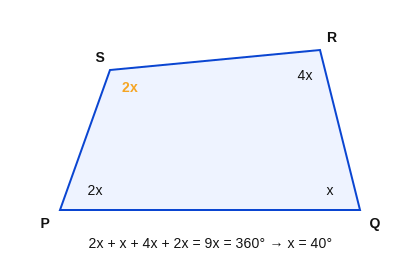
In quadrilateral PQRS, ∠P=2∠Q, ∠Q=∠R4, ∠R=2∠S. Find the value of ∠S.
चतुर्भुज PQRS में, ∠P=2∠Q, ∠Q=∠R4, ∠R=2∠S। ∠S का मान ज्ञात कीजिए।
  1. A60∘
  2. B85∘
  3. C80∘
  4. D45∘
Show answer

Concept: Sum of the interior angles of a quadrilateral =360∘. Express all angles in terms of ∠Q.

  1. Let ∠Q=x. Then ∠P=2x, ∠R=4x, ∠S=∠R2=2x
  2. 2x+x+4x+2x=9x=360∘⇒x=40∘
  3. ∠S=2x=80∘

Trick: Write every angle as a multiple of the smallest one; sum of multiples =9, so one part =360∘9=40∘.

Answer: (C) 80∘

अवधारणा: चतुर्भुज के अंतः कोणों का योग =360∘। सभी कोणों को ∠Q के रूप में लिखें।

  1. माना ∠Q=x, तो ∠P=2x, ∠R=4x, ∠S=∠R2=2x
  2. 2x+x+4x+2x=9x=360∘⇒x=40∘
  3. ∠S=2x=80∘

ट्रिक: सबसे छोटे कोण के गुणज लिखें; गुणजों का योग 9, एक भाग =360∘9=40∘।

उत्तर: (C) 80∘

RRB NTPC Undergraduate CBT 1MathematicsAngles of a quadrilateralRRB NTPC Undergraduate CBT 1 2025 · 18 Jun Shift 2 →
Q12228.
The value of (2+32)2−[4−(63)2]÷12 is
(2+32)2−[4−(63)2]÷12 का मान है
  1. A74
  2. B492
  3. C494
  4. D72
Show answer

Concept: BODMAS – brackets first, then division, then subtraction.

  1. (2+32)2=(72)2=494
  2. [4−(63)2]=4−22=0
  3. Division before subtraction: 0÷12=0
  4. 494−0=494

Trick: The ÷12 acts only on the square bracket next to it, and that bracket is 0 – so the answer is just the first term.

Answer: (C) 494

अवधारणा: BODMAS – पहले कोष्ठक, फिर भाग, फिर घटाव।

  1. (2+32)2=(72)2=494
  2. [4−(63)2]=4−22=0
  3. घटाव से पहले भाग: 0÷12=0
  4. 494−0=494

ट्रिक: ÷12 केवल उसके साथ वाले वर्ग कोष्ठक पर लगता है, और वह 0 है – इसलिए उत्तर पहला पद ही है।

उत्तर: (C) 494

RRB NTPC Undergraduate CBT 1MathematicsSimplification (BODMAS)RRB NTPC Undergraduate CBT 1 2025 · 18 Jun Shift 2 →
Q12229.
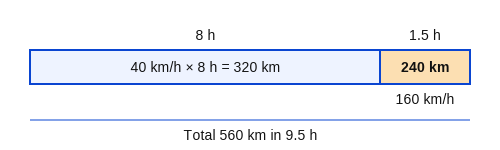
A car travels 560 km in 9.5 hours, partly at 40 km/h and partly at 160 km/h. Find the distance travelled at 160 km/h.
एक कार 9.5 घंटे में 560 km की दूरी तय करती है, कुछ दूरी 40 km/h की चाल से और कुछ दूरी 160 km/h की चाल से। 160 km/h की चाल से तय की गई दूरी ज्ञात कीजिए।
  1. A216 km
  2. B240 km
  3. C230 km
  4. D260 km
Show answer

Concept: Total distance and total time are fixed; let the time at 40km/h be t.

  1. 40t+160(9.5−t)=560
  2. 1520−120t=560⇒t=8h
  3. Time at 160km/h=1.5h, distance =160×1.5=240km

Trick: If all 9.5 h were at 40km/h: 380km. Extra 180km comes from the extra 120km/h → 180120=1.5h at the fast speed.

Answer: (B) 240km

अवधारणा: कुल दूरी और कुल समय ज्ञात हैं; 40km/h पर समय t मानें।

  1. 40t+160(9.5−t)=560
  2. 1520−120t=560⇒t=8h
  3. 160km/h पर समय =1.5h, दूरी =160×1.5=240km

ट्रिक: यदि पूरे 9.5 घंटे 40km/h पर: 380km। बची 180km अतिरिक्त 120km/h से → 180120=1.5h।

उत्तर: (B) 240km

RRB NTPC Undergraduate CBT 1MathematicsSpeed, distance and timeRRB NTPC Undergraduate CBT 1 2025 · 18 Jun Shift 2 →
Q12230.
Two banks, A and B, offered loans at 3.5% and 6.5% per annum, respectively. Ashish borrowed an amount of ₹3,40,000 from each bank. Find the positive difference between the amounts of simple interest (in ₹) paid to the two banks by Ashish after 2 years.
दो बैंक, A और B, क्रमशः 3.5% और 6.5% वार्षिक दर पर ऋण देते हैं। आशीष ने प्रत्येक बैंक से ₹3,40,000 की राशि उधार ली। 2 वर्ष बाद आशीष द्वारा दोनों बैंकों को भुगतान किए गए साधारण ब्याज की राशियों (₹ में) के बीच धनात्मक अंतर ज्ञात कीजिए।
  1. A21,900
  2. B19,900
  3. C20,400
  4. D21,400
Show answer

Concept: Same principal and time, so the SI difference depends only on the rate difference: SI=P×R×T100.

  1. Rate difference =6.5%−3.5%=3%
  2. Difference =340000×3×2100=20400

Trick: Never compute both interests separately — use the rate difference directly.

Answer: (C) ₹20,400

अवधारणा: मूलधन और समय समान हैं, अतः ब्याज का अंतर केवल दरों के अंतर पर निर्भर है: SI=P×R×T100।

  1. दरों का अंतर =6.5%−3.5%=3%
  2. अंतर =340000×3×2100=20400

ट्रिक: दोनों ब्याज अलग-अलग न निकालें — सीधे दरों का अंतर लें।

उत्तर: (C) ₹20,400

RRB NTPC Undergraduate CBT 1MathematicsSimple interestRRB NTPC Undergraduate CBT 1 2025 · 18 Jun Shift 2 →
Q12231.
Three positive numbers are in proportion such that the ratio of the first number to the second number is the same as the ratio of the second number to the third number. If the first number is 16 and the second number is 24, find the value of the third number.
तीन धनात्मक संख्याएँ इस प्रकार समानुपात में हैं कि पहली संख्या और दूसरी संख्या का अनुपात, दूसरी संख्या और तीसरी संख्या के अनुपात के समान है। यदि पहली संख्या 16 और दूसरी संख्या 24 है, तो तीसरी संख्या का मान ज्ञात कीजिए।
  1. A64
  2. B32
  3. C36
  4. D48
Show answer

Concept: If a:b=b:c (continued proportion), then b2=ac, so c=b2a.

  1. 16:24=24:c
  2. c=24216=57616=36

Trick: Third proportional =(second)2first.

Answer: (C) 36

अवधारणा: यदि a:b=b:c (क्रमागत अनुपात), तो b2=ac, अतः c=b2a।

  1. 16:24=24:c
  2. c=24216=57616=36

ट्रिक: तृतीयानुपाती =(दूसरी)2पहली।

उत्तर: (C) 36

RRB NTPC Undergraduate CBT 1MathematicsContinued proportionRRB NTPC Undergraduate CBT 1 2025 · 18 Jun Shift 2 →
Q12232.
The price of an article is increased by 20%. In the next step, it is decreased by x% of the new price. Finally, the price is increased by 10% of the original price. If the final price becomes exactly equal to the original price, the value of x is:
एक वस्तु के मूल्य में 20% की वृद्धि की जाती है। अगले चरण में, नए मूल्य में x% की कमी की जाती है। अंत में, मूल्य में मूल मूल्य के 10% की वृद्धि की जाती है। यदि अंतिम मूल्य ठीक मूल मूल्य के बराबर हो जाता है, तो x का मान है:
  1. A22.75
  2. B12.25
  3. C25
  4. D17.5
Show answer

Concept: Take original price =100 and follow each step carefully — the last increase is on the original price.

  1. After 20% increase: 120
  2. Decrease of x% of 120: 120−1.2x
  3. Add 10% of original =10: 130−1.2x=100
  4. 1.2x=30⇒x=25

Trick: Base 100 makes every % a plain number.

Answer: (C) 25

अवधारणा: मूल मूल्य =100 लें और हर चरण देखें — अंतिम वृद्धि मूल मूल्य पर है।

  1. 20% वृद्धि के बाद: 120
  2. 120 का x% घटाने पर: 120−1.2x
  3. मूल का 10%=10 जोड़ें: 130−1.2x=100
  4. 1.2x=30⇒x=25

ट्रिक: आधार 100 लेने से हर % सीधी संख्या बन जाता है।

उत्तर: (C) 25

RRB NTPC Undergraduate CBT 1MathematicsPercentage changeRRB NTPC Undergraduate CBT 1 2025 · 18 Jun Shift 2 →
Q12233.
A four-digit number 3P2Q is divisible by both 2 and 3. Find the smallest value of P + Q.
चार अंकों की एक संख्या 3P2Q, 2 और 3 दोनों से विभाज्य है। P + Q का न्यूनतम मान ज्ञात कीजिए।
  1. A4
  2. B7
  3. C2
  4. D1
Show answer

Concept: Divisible by 2 → last digit even; divisible by 3 → digit sum divisible by 3.

  1. Digit sum =3+P+2+Q=5+P+Q must be a multiple of 3
  2. Smallest P+Q with 5+P+Q a multiple of 3 is 1 (sum =6)
  3. P=1, Q=0 (even) works: 3120=2×1560=3×1040

Trick: Check smallest option first: P+Q=1 makes digit sum 6 ✓.

Answer: (D) 1

अवधारणा: 2 से विभाज्य → अंतिम अंक सम; 3 से विभाज्य → अंकों का योग 3 से विभाज्य।

  1. अंकों का योग =5+P+Q, 3 का गुणज होना चाहिए
  2. सबसे छोटा P+Q=1 (योग =6)
  3. P=1, Q=0 (सम): 3120 दोनों से विभाज्य

ट्रिक: सबसे छोटा विकल्प पहले जाँचें: P+Q=1 से योग 6 ✓।

उत्तर: (D) 1

RRB NTPC Undergraduate CBT 1MathematicsDivisibility rulesRRB NTPC Undergraduate CBT 1 2025 · 18 Jun Shift 2 →
Q12234.
If the mean proportional between x and 36 is 12, find x.
यदि x और 36 का मध्यानुपाती 12 है, तो x ज्ञात कीजिए।
  1. A7
  2. B5
  3. C4
  4. D6
Show answer

Concept: Mean proportional of a and b is ab.

  1. 36x=12
  2. 36x=144⇒x=4

Trick: x=(mean)236=14436.

Answer: (C) 4

अवधारणा: a और b का मध्यानुपाती =ab।

  1. 36x=12
  2. 36x=144⇒x=4

ट्रिक: x=(मध्यानुपाती)236=14436।

उत्तर: (C) 4

RRB NTPC Undergraduate CBT 1MathematicsMean proportionalRRB NTPC Undergraduate CBT 1 2025 · 18 Jun Shift 2 →
Q12235.
The price of an article is first increased by 20% and then decreased by 20%. If the original price of the article is ₹500, what is the net percentage change in the price?
एक वस्तु के मूल्य में पहले 20% की वृद्धि की जाती है और फिर 20% की कमी की जाती है। यदि वस्तु का मूल मूल्य ₹500 है, तो मूल्य में निवल प्रतिशत परिवर्तन कितना है?
  1. A2% increase2% वृद्धि
  2. BNo changeकोई परिवर्तन नहीं
  3. C4% decrease4% कमी
  4. D5% decrease5% कमी
Show answer

Concept: Net change for +a% then −b%: a−b−ab100. The original price does not matter.

  1. 20−20−20×20100=−4%
  2. Check: 500→600→480, fall =20 = 4% of 500

Trick: Equal % up then down always gives a loss of x2100%.

Answer: (C) 4% decrease

अवधारणा: +a% फिर −b% का शुद्ध परिवर्तन: a−b−ab100। मूल मूल्य से फर्क नहीं पड़ता।

  1. 20−20−20×20100=−4%
  2. जाँच: 500→600→480, कमी =20 = 500 का 4%

ट्रिक: समान % बढ़ाकर फिर घटाने पर हमेशा x2100% की कमी।

उत्तर: (C) 4% कमी (decrease)

RRB NTPC Undergraduate CBT 1MathematicsSuccessive percentage changeRRB NTPC Undergraduate CBT 1 2025 · 18 Jun Shift 2 →
Q12236.
A man bought an article and sold it at a profit of 15%. If he had bought it at 25% less cost price and sold it for ₹294 less than the original selling price, he would have made a profit of 30%. Find the cost price of the article.
एक व्यक्ति ने एक वस्तु खरीदी और उसे 15% लाभ पर बेच दिया। यदि उसने इसे 25% कम क्रय मूल्य पर खरीदा होता और मूल विक्रय मूल्य से ₹294 कम में बेचा होता, तो उसे 30% लाभ होता। वस्तु का क्रय मूल्य ज्ञात कीजिए।
  1. A₹1,630
  2. B₹1,540
  3. C₹1,590
  4. D₹1,680
Show answer

Concept: Write both selling prices in terms of CP x and equate the ₹294 gap.

  1. Original SP =1.15x
  2. New CP =0.75x, new SP =1.30×0.75x=0.975x
  3. 1.15x−0.975x=294⇒0.175x=294
  4. x=2940.175=1680

Trick: Gap in SP =17.5% of CP =294 → CP =294×10017.5.

Answer: (D) ₹1,680

अवधारणा: दोनों विक्रय मूल्य क्रय मूल्य x में लिखें और ₹294 के अंतर को बराबर करें।

  1. मूल SP =1.15x
  2. नया CP =0.75x, नया SP =1.30×0.75x=0.975x
  3. 1.15x−0.975x=294⇒0.175x=294
  4. x=2940.175=1680

ट्रिक: SP का अंतर = CP का 17.5% =294 → CP =294×10017.5।

उत्तर: (D) ₹1,680

RRB NTPC Undergraduate CBT 1MathematicsProfit and lossRRB NTPC Undergraduate CBT 1 2025 · 18 Jun Shift 2 →
Q12237.
A bus travels 90 km at 45 km/h, 120 km at 60 km/h, and 150 km at 75 km/h. What is the average speed of the bus for the entire journey?
एक बस 90 km की दूरी 45 km/h की चाल से, 120 km की दूरी 60 km/h की चाल से और 150 km की दूरी 75 km/h की चाल से तय करती है। पूरी यात्रा के लिए बस की औसत चाल कितनी है?
  1. A66 km/h
  2. B70 km/h
  3. C55 km/h
  4. D60 km/h
Show answer

Concept: Average speed =total distancetotal time (not the mean of speeds).

  1. Times: 9045=2, 12060=2, 15075=2 hours
  2. Total distance =360km, total time =6h
  3. Average =3606=60km/h

Trick: Equal times on each part → average speed = simple mean 45+60+753=60.

Answer: (D) 60km/h

अवधारणा: औसत चाल =कुल दूरीकुल समय (चालों का साधारण औसत नहीं)।

  1. समय: 9045=2, 12060=2, 15075=2 घंटे
  2. कुल दूरी =360km, कुल समय =6h
  3. औसत =3606=60km/h

ट्रिक: हर भाग में समय बराबर → औसत चाल = साधारण औसत 45+60+753=60।

उत्तर: (D) 60km/h

RRB NTPC Undergraduate CBT 1MathematicsAverage speedRRB NTPC Undergraduate CBT 1 2025 · 18 Jun Shift 2 →
Q12238.
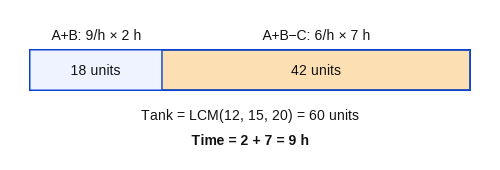
Pipes A and B can fill a tank in 12 hours and 15 hours, respectively. A third pipe C can empty the full tank in 20 hours. If A and B are opened together for 2 hours and then C is also opened, what is the total time taken to fill the tank?
पाइप A और B किसी टंकी को क्रमशः 12 घंटे और 15 घंटे में भर सकते हैं। एक तीसरा पाइप C भरी हुई टंकी को 20 घंटे में खाली कर सकता है। यदि A और B को एक साथ 2 घंटे के लिए खोला जाता है और फिर C को भी खोल दिया जाता है, तो टंकी को भरने में लगने वाला कुल समय कितना है?
  1. A10 hours10 घंटे
  2. B8 hours8 घंटे
  3. C9.5 hours9.5 घंटे
  4. D9 hours9 घंटे
Show answer

Concept: Take tank =LCM(12,15,20)=60 units; filling pipes add, emptying pipe subtracts.

  1. Rates: A =5, B =4, C =−3 units/h
  2. First 2 h (A+B): 9×2=18 units
  3. Remaining 42 units at 5+4−3=6 units/h → 7 h
  4. Total =2+7=9 hours

Trick: LCM-unit method avoids fractions completely.

Answer: (D) 9 hours

अवधारणा: टंकी =LCM(12,15,20)=60 इकाई लें; भरने वाले पाइप जोड़ें, खाली करने वाला घटाएँ।

  1. दरें: A =5, B =4, C =−3 इकाई/घंटा
  2. पहले 2 घंटे (A+B): 9×2=18 इकाई
  3. शेष 42 इकाई, दर 5+4−3=6 → 7 घंटे
  4. कुल =2+7=9 घंटे

ट्रिक: LCM-इकाई विधि से भिन्न नहीं आतीं।

उत्तर: (D) 9 घंटे

RRB NTPC Undergraduate CBT 1MathematicsPipes and cisternsRRB NTPC Undergraduate CBT 1 2025 · 18 Jun Shift 2 →
Q12239.
Arun sold an article for ₹1,786.40 and incurred a loss of 12%. At what price should he sell the article to earn a profit of 14%?
अरुण ने एक वस्तु ₹1,786.40 में बेची और उसे 12% की हानि हुई। 14% का लाभ अर्जित करने के लिए उसे वस्तु किस मूल्य पर बेचनी चाहिए?
  1. A₹2,268.70
  2. B₹2,112.20
  3. C₹2,485.70
  4. D₹2,314.20
Show answer

Concept: SP=CP×100±%100. Find CP from the loss, then apply the profit.

  1. CP=1786.400.88=2030
  2. Required SP =2030×1.14=2314.20

Trick: Directly: new SP =1786.40×11488.

Answer: (D) ₹2,314.20

अवधारणा: SP=CP×100±%100। हानि से CP निकालें, फिर लाभ लगाएँ।

  1. CP=1786.400.88=2030
  2. अभीष्ट SP =2030×1.14=2314.20

ट्रिक: सीधे: नया SP =1786.40×11488।

उत्तर: (D) ₹2,314.20

RRB NTPC Undergraduate CBT 1MathematicsProfit and lossRRB NTPC Undergraduate CBT 1 2025 · 18 Jun Shift 2 →
Q12240.
Two taps can fill a cistern in 4 hours and 8 hours, respectively. A third tap can empty it in 8 hours. How long (in hours) will it take to fill one-fourth of the empty cistern if all the taps are opened together?
दो नल किसी टंकी को क्रमशः 4 घंटे और 8 घंटे में भर सकते हैं। एक तीसरा नल इसे 8 घंटे में खाली कर सकता है। यदि सभी नल एक साथ खोल दिए जाएँ, तो खाली टंकी का एक-चौथाई भाग भरने में कितना समय (घंटों में) लगेगा?
  1. A1
  2. B4
  3. C2
  4. D3
Show answer

Concept: Net work per hour = sum of filling rates − emptying rate.

  1. Net rate =14+18−18=14 per hour
  2. Time for 14 tank =1/41/4=1 hour

Trick: The 8-hour filler and 8-hour emptier cancel each other — only the 4-hour tap works.

Answer: (A) 1

अवधारणा: प्रति घंटा शुद्ध कार्य = भरने की दरों का योग − खाली करने की दर।

  1. शुद्ध दर =14+18−18=14 प्रति घंटा
  2. 14 टंकी का समय =1 घंटा

ट्रिक: 8 घंटे वाला भरने और 8 घंटे वाला खाली करने वाला नल एक-दूसरे को रद्द करते हैं।

उत्तर: (A) 1

RRB NTPC Undergraduate CBT 1MathematicsPipes and cisternsRRB NTPC Undergraduate CBT 1 2025 · 18 Jun Shift 2 →