Question bank

Q&A: practice questions with answers

Search questions on any topic. Filter by exam category, exam, subject and topic, try the question, then open the answer and explanation.

Courses – airGurukul

20,719 questions found.

Q12321.
Which of the following coastal plains contains irregular, indented coastlines with natural harbours?
निम्नलिखित में से किस तटीय मैदान में प्राकृतिक बंदरगाहों वाली अनियमित, कटी-फटी तटरेखाएँ हैं?
  1. AKonkan Regionकोंकण क्षेत्र
  2. BEast Coastal Plainपूर्वी तटीय मैदान
  3. CKathiawar Plainकाठियावाड़ मैदान
  4. DRann of Kutchकच्छ का रण
Show answer

Concept: The Western Coastal Plain is a submerged coast; its northern part from Maharashtra to Goa is the Konkan coast.

  1. Submergence makes the coastline irregular and indented, with creeks and estuaries that form natural harbours (e.g. Mumbai, Mormugao).
  2. The East Coastal Plain is an emergent coast – wide, regular and with few natural harbours.
  3. Kathiawar and the Rann of Kutch are not the indented, harbour-rich stretch asked for.

Trick: West coast = submerged = indented = natural ports; East coast = emergent = deltas, smooth coastline.

Answer: (A) Konkan Region

अवधारणा: पश्चिमी तटीय मैदान एक निमज्जित (submerged) तट है; महाराष्ट्र से गोवा तक इसका उत्तरी भाग कोंकण तट कहलाता है।

  1. निमज्जन से तटरेखा अनियमित व कटी-फटी (indented) होती है, जिसकी खाड़ियाँ व ज्वारनदमुख प्राकृतिक बंदरगाह बनाते हैं (जैसे मुंबई, मोरमुगाओ)।
  2. पूर्वी तटीय मैदान उभरा हुआ (emergent) तट है – चौड़ा, सीधा और कम प्राकृतिक बंदरगाह वाला।
  3. काठियावाड़ और कच्छ का रण वह कटा-फटा, बंदरगाह-समृद्ध भाग नहीं हैं।

ट्रिक: पश्चिमी तट = निमज्जित = कटा-फटा = प्राकृतिक बंदरगाह; पूर्वी तट = उभरा = डेल्टा, सपाट तटरेखा।

उत्तर: (A) कोंकण क्षेत्र
RRB NTPC Undergraduate CBT 1General AwarenessIndian Geography – Coastal plainsRRB NTPC Undergraduate CBT 1 2025 · 18 Jun Shift 1 →
Q12322.
The Paika Rebellion (1817), considered one of the earliest anti-colonial uprisings, took place in which region?
सबसे प्रारंभिक उपनिवेशवाद-विरोधी विद्रोहों में से एक माना जाने वाला पाइका विद्रोह (1817) किस क्षेत्र में हुआ था?
  1. ABengalबंगाल
  2. BAssamअसम
  3. COdishaओडिशा
  4. DMaharashtraमहाराष्ट्र
Show answer

Concept: The Paika Rebellion of 1817 broke out in Khurda, Odisha, against East India Company rule.

  1. It was led by Bakshi Jagabandhu Bidyadhar, military chief of the Raja of Khurda.
  2. Paikas (traditional militia) lost their rent-free lands and faced high revenue demands after the British conquest of Odisha (1803).

Yaad rakhein: Paika – Khurda – Bakshi Jagabandhu – Odisha, 1817.

Answer: (C) Odisha

अवधारणा: 1817 का पाइका विद्रोह ओडिशा के खुर्दा में ईस्ट इंडिया कंपनी के विरुद्ध हुआ।

  1. इसका नेतृत्व खुर्दा के राजा के सेनापति बक्शी जगबंधु विद्याधर ने किया।
  2. 1803 में अंग्रेज़ों द्वारा ओडिशा विजय के बाद पाइकों (पारंपरिक सैनिकों) की लगान-मुक्त ज़मीनें छिन गईं और राजस्व माँग बढ़ गई।

याद रखें: पाइका – खुर्दा – बक्शी जगबंधु – ओडिशा, 1817।

उत्तर: (C) ओडिशा

RRB NTPC Undergraduate CBT 1General AwarenessModern Indian History – Early revoltsRRB NTPC Undergraduate CBT 1 2025 · 18 Jun Shift 1 →
Q12323.
India’s fourth Asia Cup win in men’s hockey (2025) ended a drought of how many years?
पुरुष हॉकी में भारत की चौथी एशिया कप जीत (2025) ने कितने वर्षों के सूखे को समाप्त किया?
  1. A12 years12 वर्ष
  2. B10 years10 वर्ष
  3. C8 years8 वर्ष
  4. D5 years5 वर्ष
Show answer

Concept: India won the 2025 Men’s Hockey Asia Cup at Rajgir, Bihar, beating South Korea 4–1 in the final (September 2025).

  1. India’s Asia Cup titles: 2003, 2007, 2017 and 2025 – the 2025 win was the fourth.
  2. The previous title came in 2017 (Dhaka), so the gap is 2025−2017=8 years.

Yaad rakhein: Last win 2017 → next win 2025 → 8-year wait; the win also gave India a 2026 World Cup berth.

Answer: (C) 8 years

अवधारणा: भारत ने सितंबर 2025 में राजगीर (बिहार) में पुरुष हॉकी एशिया कप जीता; फ़ाइनल में दक्षिण कोरिया को 4–1 से हराया।

  1. भारत के एशिया कप ख़िताब: 2003, 2007, 2017 और 2025 – 2025 की जीत चौथी थी।
  2. पिछला ख़िताब 2017 (ढाका) में आया था, अतः अंतर 2025−2017=8 वर्ष।

याद रखें: पिछली जीत 2017 → अगली 2025 → 8 वर्ष; इस जीत से भारत को 2026 विश्व कप में स्थान भी मिला।

उत्तर: (C) 8 वर्ष

RRB NTPC Undergraduate CBT 1General AwarenessCurrent Affairs – SportsRRB NTPC Undergraduate CBT 1 2025 · 18 Jun Shift 1 →
Q12324.
What is the title of the book, released in April 2025 in New Delhi, that compiles Prime Minister Narendra Modi’s speeches on culture?
अप्रैल 2025 में नई दिल्ली में विमोचित उस पुस्तक का शीर्षक क्या है, जिसमें संस्कृति पर प्रधानमंत्री नरेंद्र मोदी के भाषणों का संकलन है?
  1. ASanskriti Ke Shilpkarसंस्कृति के शिल्पकार
  2. BModi on Culture and Heritage
  3. CBharat Ki Sanskritik Yatraभारत की सांस्कृतिक यात्रा
  4. DSanskriti Ka Panchva Adhyayसंस्कृति का पाँचवाँ अध्याय
Show answer

Concept: The book Sanskriti Ka Panchva Adhyay (“The Fifth Chapter of Culture”) compiles PM Narendra Modi’s speeches on Indian culture and heritage.

  1. It was released in New Delhi in April 2025.
  2. The other options are not the titles of this compilation.

Yaad rakhein: Panchva Adhyay = “fifth chapter” – remember the number five in the title.

Answer: (D) Sanskriti Ka Panchva Adhyay

अवधारणा: पुस्तक संस्कृति का पाँचवाँ अध्याय प्रधानमंत्री नरेंद्र मोदी के भारतीय संस्कृति और विरासत पर दिए गए भाषणों का संकलन है।

  1. इसका विमोचन अप्रैल 2025 में नई दिल्ली में हुआ।
  2. अन्य विकल्प इस संकलन के नाम नहीं हैं।

याद रखें: पाँचवाँ अध्याय – शीर्षक में “पाँच” संख्या याद रखें।

उत्तर: (D) संस्कृति का पाँचवाँ अध्याय

RRB NTPC Undergraduate CBT 1General AwarenessCurrent Affairs – BooksRRB NTPC Undergraduate CBT 1 2025 · 18 Jun Shift 1 →
Q12325.
Which of the following was a characteristic feature of Harappan street planning?
निम्नलिखित में से कौन-सी हड़प्पा की सड़क योजना की एक विशिष्ट विशेषता थी?
  1. ANarrow zig-zag streets designed to control traffic flowयातायात प्रवाह को नियंत्रित करने हेतु बनाई गई संकरी टेढ़ी-मेढ़ी गलियाँ
  2. BBroad circular roads radiating out from a central squareकेंद्रीय चौक से बाहर की ओर फैली चौड़ी वृत्ताकार सड़कें
  3. CStreets intersecting at right angles forming a criss-cross patternसमकोण पर एक-दूसरे को काटती सड़कें, जो जाल जैसा प्रतिरूप (criss-cross pattern) बनाती थीं
  4. DElevated stone causeways replacing ordinary streetsसामान्य सड़कों के स्थान पर ऊँचे पत्थर के मार्ग
Show answer

Concept: Harappan cities followed a planned grid (chessboard) layout.

  1. Main streets ran north–south and east–west and cut each other at right angles, dividing the city into rectangular blocks.
  2. Covered drains ran along the streets; houses opened onto side lanes.
  3. Zig-zag lanes, radial roads or stone causeways are not Harappan features.

Yaad rakhein: Harappan town = grid pattern + covered drains + baked bricks.

Answer: (C) Streets intersecting at right angles forming a criss-cross pattern

अवधारणा: हड़प्पा नगर नियोजित ग्रिड (शतरंज-पट) पद्धति पर बने थे।

  1. मुख्य सड़कें उत्तर–दक्षिण और पूर्व–पश्चिम चलती थीं और एक-दूसरे को समकोण पर काटती थीं, जिससे नगर आयताकार खंडों में बँट जाता था।
  2. सड़कों के साथ ढकी नालियाँ थीं; घरों के द्वार गलियों में खुलते थे।
  3. टेढ़ी-मेढ़ी गलियाँ, अरीय सड़कें या पत्थर के ऊँचे मार्ग हड़प्पा की विशेषता नहीं हैं।

याद रखें: हड़प्पा नगर = ग्रिड पद्धति + ढकी नालियाँ + पकी ईंटें।

उत्तर: (C) सड़कें समकोण पर काटकर जाल (criss-cross) बनाती थीं

RRB NTPC Undergraduate CBT 1General AwarenessAncient History – Harappan civilisationRRB NTPC Undergraduate CBT 1 2025 · 18 Jun Shift 1 →
Q12326.
The sum of two positive numbers is 26 and their product is 144. The positive difference between them is:
दो धनात्मक संख्याओं का योग 26 है और उनका गुणनफल 144 है। उनके बीच का धनात्मक अंतर है:
  1. A5
  2. B13
  3. C10
  4. D16
Show answer

Concept: Use (a−b)2=(a+b)2−4ab.

  1. (a+b)2=262=676, 4ab=4×144=576
  2. (a−b)2=676−576=100
  3. a−b=100=10 (numbers are 18 and 8)

Trick: Find two numbers with sum 26 and product 144 directly: 18×8=144, difference =10.

Answer: (C) 10

अवधारणा: (a−b)2=(a+b)2−4ab का प्रयोग करें।

  1. (a+b)2=262=676, 4ab=4×144=576
  2. (a−b)2=676−576=100
  3. a−b=100=10 (संख्याएँ 18 और 8)

ट्रिक: योग 26 और गुणनफल 144 वाली संख्याएँ सीधे सोचें: 18×8=144, अंतर =10।

उत्तर: (C) 10

RRB NTPC Undergraduate CBT 1MathematicsAlgebraic identitiesRRB NTPC Undergraduate CBT 1 2025 · 18 Jun Shift 1 →
Q12327.
The price of a laptop was initially $1,200. During a sale, the price was first reduced by 20%, and then an additional discount of 15% was applied to the new price. What is the final price of the laptop?
एक लैपटॉप का मूल्य आरंभ में $1,200 था। एक सेल के दौरान, मूल्य को पहले 20% कम किया गया, और फिर नए मूल्य पर 15% की अतिरिक्त छूट दी गई। लैपटॉप का अंतिम मूल्य क्या है?
  1. A$780
  2. B$816
  3. C$899
  4. D$799
Show answer

Concept: Successive discounts multiply: final price = original ×(1−d1)(1−d2).

  1. After 20% off: 1200×0.8=960
  2. After further 15% off: 960×0.85=816
  3. Final price = $816

Trick: Net discount =20+15−20×15100=32%; 68% of 1200 =816.

Answer: (B) $816

अवधारणा: क्रमिक छूटें गुणा होती हैं: अंतिम मूल्य = मूल मूल्य ×(1−d1)(1−d2)।

  1. 20% छूट के बाद: 1200×0.8=960
  2. फिर 15% छूट: 960×0.85=816
  3. अंतिम मूल्य = $816

ट्रिक: कुल छूट =20+15−20×15100=32%; 1200 का 68%=816।

उत्तर: (B) $816

RRB NTPC Undergraduate CBT 1MathematicsSuccessive discountRRB NTPC Undergraduate CBT 1 2025 · 18 Jun Shift 1 →
Q12328.
Three numbers are in the ratio 3 : 2 : 13, and their LCM is 2574. Their HCF is:
तीन संख्याएँ 3 : 2 : 13 के अनुपात में हैं, और उनका LCM 2574 है। उनका HCF है:
  1. A23
  2. B33
  3. C43
  4. D76
Show answer

Concept: Numbers in ratio 3:2:13 are 3x,2x,13x with HCF x (3, 2, 13 are co-prime).

  1. LCM =3×2×13×x=78x
  2. 78x=2574⇒x=257478=33
  3. HCF =x=33

Trick: HCF =LCMLCM of ratio terms=257478=33.

Answer: (B) 33

अवधारणा: अनुपात 3:2:13 वाली संख्याएँ 3x,2x,13x हैं; इनका म.स. (HCF) x है क्योंकि 3, 2, 13 सह-अभाज्य हैं।

  1. ल.स. (LCM) =3×2×13×x=78x
  2. 78x=2574⇒x=257478=33
  3. म.स. =x=33

ट्रिक: म.स. =LCMअनुपात पदों का LCM=257478=33।

उत्तर: (B) 33

RRB NTPC Undergraduate CBT 1MathematicsHCF and LCMRRB NTPC Undergraduate CBT 1 2025 · 18 Jun Shift 1 →
Q12329.
A shopkeeper sells an article for ₹1,200 at a 20% profit. At what price (in ₹) should he sell the article to incur a loss of 10%?
एक दुकानदार एक वस्तु को 20% लाभ पर ₹1,200 में बेचता है। 10% की हानि उठाने के लिए उसे वस्तु किस मूल्य (₹ में) पर बेचनी चाहिए?
  1. A₹950
  2. B₹875
  3. C₹900
  4. D₹980
Show answer

Concept: CP=SP1+profit%, then new SP=CP×(1−loss%).

  1. CP=12001.2=1000
  2. For 10% loss: SP=1000×0.9=900

Trick: SP2=1200×90120=900 in one step.

Answer: (C) ₹900

अवधारणा: क्रय मूल्य=विक्रय मूल्य1+लाभ%, फिर नया विक्रय मूल्य =CP×(1−हानि%)।

  1. CP=12001.2=1000
  2. 10% हानि पर: SP=1000×0.9=900

ट्रिक: एक ही चरण में: 1200×90120=900।

उत्तर: (C) ₹900

RRB NTPC Undergraduate CBT 1MathematicsProfit and lossRRB NTPC Undergraduate CBT 1 2025 · 18 Jun Shift 1 →
Q12330.
The L.C.M. of two numbers is 210 and their H.C.F. is 3. If the first number is divided by 3, the quotient is 7 and the remainder is 0. The second number is:
दो संख्याओं का ल.स. (L.C.M.) 210 है और उनका म.स. (H.C.F.) 3 है। यदि पहली संख्या को 3 से विभाजित किया जाए, तो भागफल 7 और शेषफल 0 आता है। दूसरी संख्या है:
  1. A25
  2. B30
  3. C60
  4. D35
Show answer

Concept: Product of two numbers = HCF×LCM.

  1. First number =3×7+0=21
  2. Second =3×21021=63021=30
  3. Check: HCF(21, 30) = 3, LCM = 210 ✓

Yaad rakhein: a×b=HCF×LCM (only for two numbers).

Answer: (B) 30

अवधारणा: दो संख्याओं का गुणनफल =HCF×LCM।

  1. पहली संख्या =3×7+0=21
  2. दूसरी =3×21021=63021=30
  3. जाँच: HCF(21, 30) = 3, LCM = 210 ✓

याद रखें: a×b=HCF×LCM (केवल दो संख्याओं के लिए)।

उत्तर: (B) 30

RRB NTPC Undergraduate CBT 1MathematicsHCF and LCMRRB NTPC Undergraduate CBT 1 2025 · 18 Jun Shift 1 →
Q12331.
Two taps can fill a cistern in 4 hours and 19 hours, respectively. A third tap can empty it in 19 hours. How long (in hours) will it take to fill one-fourth of the empty cistern if all the taps are opened together?
दो नल एक टंकी को क्रमशः 4 घंटे और 19 घंटे में भर सकते हैं। एक तीसरा नल इसे 19 घंटे में खाली कर सकता है। यदि सभी नल एक साथ खोल दिए जाएँ, तो खाली टंकी का एक-चौथाई भाग भरने में कितना समय (घंटों में) लगेगा?
  1. A3
  2. B1
  3. C2
  4. D4
Show answer

Concept: Net filling rate = sum of filling rates − emptying rate.

  1. Rates: 14+119−119=14 per hour
  2. The 19-hour filler and 19-hour emptier cancel out
  3. Time for 14 tank =1/41/4=1 hour

Trick: Equal fill and empty times cancel — only the 4-hour tap matters.

Answer: (B) 1 hour

अवधारणा: शुद्ध भरने की दर = भरने वाले नलों की दर − खाली करने वाले की दर।

  1. दर: 14+119−119=14 प्रति घंटा
  2. 19 घंटे वाला भरने और खाली करने वाला नल एक-दूसरे को रद्द करते हैं
  3. 14 टंकी का समय =1 घंटा

ट्रिक: बराबर समय वाले भरने व खाली करने वाले नल कट जाते हैं — सिर्फ 4 घंटे वाला नल बचता है।

उत्तर: (B) 1 घंटा

RRB NTPC Undergraduate CBT 1MathematicsPipes and cisternsRRB NTPC Undergraduate CBT 1 2025 · 18 Jun Shift 1 →
Q12332.
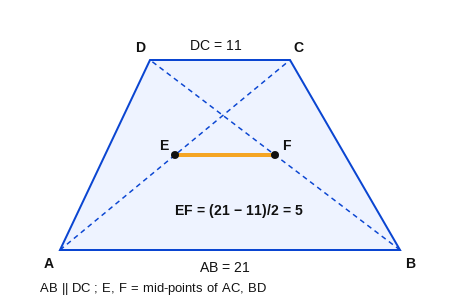
ABCD is a quadrilateral in which AB ∥ DC, and E and F are the mid points of the diagonals AC and BD, respectively. If AB = 21 cm, BC = 33 cm, DC = 11 cm, and AD = 52 cm, then what is the length (in cm) of EF?
ABCD एक चतुर्भुज है, जिसमें AB ∥ DC है, और E तथा F क्रमशः विकर्णों AC और BD के मध्य-बिंदु हैं। यदि AB = 21 cm, BC = 33 cm, DC = 11 cm, और AD = 52 cm है, तो EF की लंबाई (cm में) कितनी है?
  1. A3
  2. B4
  3. C6
  4. D5
Show answer

Concept: In a trapezium, the segment joining mid-points of the diagonals is parallel to the bases and EF=AB−DC2.

  1. Parallel sides: AB=21, DC=11
  2. EF=21−112=5cm
  3. BC and AD are extra data (not needed)

Yaad rakhein: Mid-points of diagonals → half the difference of parallel sides; mid-points of legs → half the sum.

Answer: (D) 5

अवधारणा: समलंब में विकर्णों के मध्य-बिंदुओं को मिलाने वाला रेखाखंड समांतर भुजाओं के समांतर होता है और EF=AB−DC2।

  1. समांतर भुजाएँ: AB=21, DC=11
  2. EF=21−112=5cm
  3. BC और AD अतिरिक्त आँकड़े हैं

याद रखें: विकर्णों के मध्य-बिंदु → समांतर भुजाओं के अंतर का आधा; तिर्यक भुजाओं के मध्य-बिंदु → योग का आधा।

उत्तर: (D) 5

RRB NTPC Undergraduate CBT 1MathematicsTrapezium (mid-points of diagonals)RRB NTPC Undergraduate CBT 1 2025 · 18 Jun Shift 1 →
Q12333.
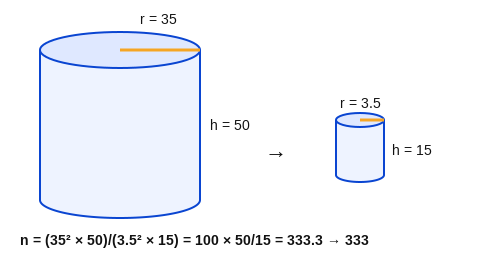
A solid cylinder of radius 35 cm and height 50 cm is melted and recast into smaller identical cylinders, each having radius 3.5 cm and height 15 cm. How many complete such smaller cylinders are formed?
35 cm त्रिज्या और 50 cm ऊँचाई वाले एक ठोस बेलन को पिघलाकर छोटे सर्वसम बेलनों में ढाला जाता है, जिनमें से प्रत्येक की त्रिज्या 3.5 cm और ऊँचाई 15 cm है। ऐसे कितने पूर्ण छोटे बेलन बनेंगे?
  1. A121
  2. B222
  3. C333
  4. D260
Show answer

Concept: Number of small solids =volume of bigvolume of one small.

  1. n=π×352×50π×3.52×15
  2. 3523.52=100, so n=100×5015=333.33
  3. Complete cylinders =333

Trick: Radius ratio 10⇒ area ratio 100; then multiply by height ratio 5015.

Answer: (C) 333

अवधारणा: छोटे ठोसों की संख्या =बड़े का आयतनएक छोटे का आयतन।

  1. n=π×352×50π×3.52×15
  2. 3523.52=100, अतः n=100×5015=333.33
  3. पूरे बेलन =333

ट्रिक: त्रिज्या अनुपात 10⇒ क्षेत्रफल अनुपात 100; फिर ऊँचाई अनुपात 5015 से गुणा करें।

उत्तर: (C) 333

RRB NTPC Undergraduate CBT 1MathematicsMelting and recasting (cylinder)RRB NTPC Undergraduate CBT 1 2025 · 18 Jun Shift 1 →
Q12334.
Amit and Raghav invest in a business in the ratio 5 : 7. If the total profit is ₹48,000, what is Raghav’s share?
अमित और राघव एक व्यवसाय में 5 : 7 के अनुपात में निवेश करते हैं। यदि कुल लाभ ₹48,000 है, तो राघव का हिस्सा कितना है?
  1. A₹26,000
  2. B₹28,000
  3. C₹30,000
  4. D₹32,000
Show answer

Concept: Profit is shared in the ratio of investments.

  1. Total parts =5+7=12
  2. Raghav's share =712×48000=28000

Trick: One part =4800012=4000; Raghav =7×4000.

Answer: (B) ₹28,000

अवधारणा: लाभ निवेश के अनुपात में बँटता है।

  1. कुल भाग =5+7=12
  2. राघव का हिस्सा =712×48000=28000

ट्रिक: एक भाग =4800012=4000; राघव =7×4000।

उत्तर: (B) ₹28,000

RRB NTPC Undergraduate CBT 1MathematicsPartnershipRRB NTPC Undergraduate CBT 1 2025 · 18 Jun Shift 1 →
Q12335.
A sum of money is invested at a simple interest rate of 8% per annum. After 3 years, the simple interest earned is ₹1,920. What is the principal invested?
एक धनराशि 8% वार्षिक साधारण ब्याज दर पर निवेश की जाती है। 3 वर्ष बाद, अर्जित साधारण ब्याज ₹1,920 है। निवेश किया गया मूलधन कितना है?
  1. A₹8,000
  2. B₹6,000
  3. C₹7,500
  4. D₹9,000
Show answer

Concept: SI=P×R×T100.

  1. 1920=P×8×3100
  2. P=1920×10024=8000

Trick: 3 years at 8% =24% of P =1920⇒P=8000.

Answer: (A) ₹8,000

अवधारणा: SI=P×R×T100।

  1. 1920=P×8×3100
  2. P=1920×10024=8000

ट्रिक: 3 वर्ष में 8% = P का 24%=1920⇒P=8000।

उत्तर: (A) ₹8,000

RRB NTPC Undergraduate CBT 1MathematicsSimple interestRRB NTPC Undergraduate CBT 1 2025 · 18 Jun Shift 1 →
Q12336.
A dishonest shopkeeper claims to sell 1 kg of rice at the cost price per kg. He actually uses a weight of 1200 g while purchasing rice, and a weight of 840 g while selling rice. What is the overall percentage profit made by the shopkeeper?
(Round off the result to two decimal places.)
एक बेईमान दुकानदार 1 kg चावल को प्रति kg क्रय मूल्य पर बेचने का दावा करता है। वह वास्तव में चावल खरीदते समय 1200 g के बाट का और चावल बेचते समय 840 g के बाट का उपयोग करता है। दुकानदार द्वारा अर्जित कुल प्रतिशत लाभ कितना है?
(परिणाम को दो दशमलव स्थानों तक पूर्णांकित कीजिए।)
  1. A42.86%
  2. B43.44%
  3. C41.78%
  4. D40.33%
Show answer

Concept: He gets 1200 g for the price of 1000 g and gives 840 g for the price of 1000 g.

  1. Let price of 1 kg = ₹1000. He buys 1200 g for ₹1000 and sells 840 g for ₹1000.
  2. Goods bought for ₹1000 (1200 g) are sold as 1200840 lots of ₹1000
  3. Profit%=1200−840840×100=360840×100=42.86%

Trick: Profit%=goods taken−goods givengoods given×100.

Answer: (A) 42.86%

अवधारणा: वह 1000 g के दाम में 1200 g लेता है और 1000 g के दाम में 840 g देता है।

  1. माना 1 kg का दाम ₹1000; खरीद: 1200 g = ₹1000, बिक्री: 840 g = ₹1000
  2. ₹1000 में खरीदा 1200 g माल 1200840 गुना दाम पर बिकता है
  3. लाभ%=1200−840840×100=360840×100=42.86%

ट्रिक: लाभ%=लिया माल−दिया मालदिया माल×100।

उत्तर: (A) 42.86%

RRB NTPC Undergraduate CBT 1MathematicsFaulty weightsRRB NTPC Undergraduate CBT 1 2025 · 18 Jun Shift 1 →
Q12337.
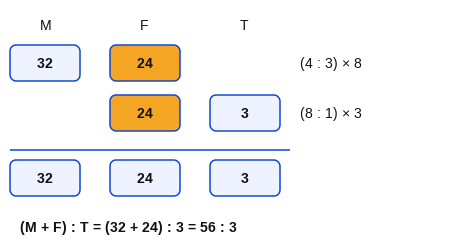
In an educational institute, the ratio of male students to female students is 4 : 3. The ratio of the same female students to teaching staff is 8 : 1. Find the ratio of total students (male + female) to teaching staff.
एक शैक्षणिक संस्थान में, पुरुष छात्रों और महिला छात्रों का अनुपात 4 : 3 है। उन्हीं महिला छात्रों और शिक्षण कर्मचारियों का अनुपात 8 : 1 है। कुल छात्रों (पुरुष + महिला) और शिक्षण कर्मचारियों का अनुपात ज्ञात कीजिए।
  1. A66 : 7
  2. B27 : 1
  3. C21 : 2
  4. D56 : 3
Show answer

Concept: Make the common term (female students) equal in both ratios.

  1. M:F=4:3=32:24 (×8)
  2. F:T=8:1=24:3 (×3)
  3. M:F:T=32:24:3, so (M+F):T=56:3

Trick: Common term: LCM of 3 and 8 is 24.

Answer: (D) 56:3

अवधारणा: दोनों अनुपातों में साझा पद (छात्राएँ) बराबर करें।

  1. M:F=4:3=32:24 (×8)
  2. F:T=8:1=24:3 (×3)
  3. M:F:T=32:24:3, अतः (M+F):T=56:3

ट्रिक: साझा पद: 3 और 8 का LCM 24।

उत्तर: (D) 56:3

RRB NTPC Undergraduate CBT 1MathematicsRatio (combining ratios)RRB NTPC Undergraduate CBT 1 2025 · 18 Jun Shift 1 →
Q12338.
Three classes have 60, 40, and 50 students respectively. Their average marks are 65, 72, and 60. What is the average mark of all 150 students combined?
तीन कक्षाओं में क्रमशः 60, 40 और 50 छात्र हैं। उनके औसत अंक 65, 72 और 60 हैं। सभी 150 छात्रों के संयुक्त औसत अंक कितने हैं?
  1. A70
  2. B65.2
  3. C60
  4. D67
Show answer

Concept: Combined average =∑nix¯i∑ni.

  1. Totals: 60×65=3900, 40×72=2880, 50×60=3000
  2. Sum =9780
  3. Average =9780150=65.2

Trick: Deviation from 65: 0+40×7−50×5=30; 65+30150=65.2.

Answer: (B) 65.2

अवधारणा: संयुक्त औसत =∑nix¯i∑ni।

  1. योग: 60×65=3900, 40×72=2880, 50×60=3000
  2. कुल =9780
  3. औसत =9780150=65.2

ट्रिक: 65 से विचलन: 0+40×7−50×5=30; 65+30150=65.2।

उत्तर: (B) 65.2

RRB NTPC Undergraduate CBT 1MathematicsWeighted averageRRB NTPC Undergraduate CBT 1 2025 · 18 Jun Shift 1 →
Q12339.
What is the mode of the following data?
53, 46, 55, 53, 40, 48, 53, 47, 41, 54, 43, 55, 54, 51, 43, 42, 44, 47
निम्नलिखित आँकड़ों का बहुलक (mode) क्या है?
53, 46, 55, 53, 40, 48, 53, 47, 41, 54, 43, 55, 54, 51, 43, 42, 44, 47
  1. A46
  2. B48
  3. C53
  4. D55
Show answer

Concept: Mode is the value that occurs most often.

  1. 53 occurs 3 times
  2. 43, 47, 54, 55 occur 2 times each; all others once
  3. Highest frequency → 53

Trick: Sort or tally quickly; only one value repeats 3 times.

Answer: (C) 53

अवधारणा: बहुलक (Mode) वह मान है जो सबसे अधिक बार आता है।

  1. 53 तीन बार आता है
  2. 43, 47, 54, 55 दो-दो बार; बाकी एक बार
  3. सर्वाधिक बारंबारता → 53

ट्रिक: जल्दी से गिनती करें; केवल एक मान 3 बार आता है।

उत्तर: (C) 53

RRB NTPC Undergraduate CBT 1MathematicsModeRRB NTPC Undergraduate CBT 1 2025 · 18 Jun Shift 1 →
Q12340.
The difference between two numbers is 8. If twice the larger number is 4 more than three times the smaller number, what is the larger number?
दो संख्याओं का अंतर 8 है। यदि बड़ी संख्या का दोगुना, छोटी संख्या के तिगुने से 4 अधिक है, तो बड़ी संख्या कौन-सी है?
  1. A18
  2. B16
  3. C20
  4. D14
Show answer

Concept: Let larger =x, smaller =y and form two equations.

  1. x−y=8 and 2x=3y+4
  2. 2(y+8)=3y+4⇒y=12
  3. x=12+8=20

Trick: Option check: x=20,y=12: 40=36+4 ✓.

Answer: (C) 20

अवधारणा: माना बड़ी संख्या =x, छोटी =y; दो समीकरण बनाइए।

  1. x−y=8 और 2x=3y+4
  2. 2(y+8)=3y+4⇒y=12
  3. x=12+8=20

ट्रिक: विकल्प जाँच: x=20,y=12: 40=36+4 ✓।

उत्तर: (C) 20

RRB NTPC Undergraduate CBT 1MathematicsLinear equationsRRB NTPC Undergraduate CBT 1 2025 · 18 Jun Shift 1 →