Question bank

Q&A: practice questions with answers

Search questions on any topic. Filter by exam category, exam, subject and topic, try the question, then open the answer and explanation.

Courses – airGurukul

20,719 questions found.

Q12341.
The price of a book is increased from ₹200 to ₹220. What is the percentage increase in the price?
एक पुस्तक का मूल्य ₹200 से बढ़ाकर ₹220 कर दिया जाता है। मूल्य में प्रतिशत वृद्धि कितनी है?
  1. A8%
  2. B10%
  3. C12%
  4. D5%
Show answer

Concept: Increase%=increaseoriginal×100.

  1. Increase =220−200=20
  2. 20200×100=10%

Yaad rakhein: Always divide by the original (old) value.

Answer: (B) 10%

अवधारणा: वृद्धि%=वृद्धिमूल×100।

  1. वृद्धि =220−200=20
  2. 20200×100=10%

याद रखें: हमेशा मूल (पुराने) मान से भाग दें।

उत्तर: (B) 10%
RRB NTPC Undergraduate CBT 1MathematicsPercentage changeRRB NTPC Undergraduate CBT 1 2025 · 18 Jun Shift 1 →
Q12342.
If (3−22+3−19+3−17+3−16)=k(3−24), then find the value of k.
यदि (3−22+3−19+3−17+3−16)=k(3−24) है, तो k का मान ज्ञात कीजिए।
  1. A9000
  2. B900
  3. C1000
  4. D3000
Show answer

Concept: Divide both sides by 3−24: am÷an=am−n.

  1. k=3−22+24+3−19+24+3−17+24+3−16+24
  2. k=32+35+37+38
  3. k=9+243+2187+6561=9000

Trick: Multiply each power by 324 — just add 24 to every exponent.

Answer: (A) 9000

अवधारणा: दोनों पक्षों को 3−24 से भाग दें: am÷an=am−n।

  1. k=3−22+24+3−19+24+3−17+24+3−16+24
  2. k=32+35+37+38
  3. k=9+243+2187+6561=9000

ट्रिक: हर घातांक में 24 जोड़ दें।

उत्तर: (A) 9000

RRB NTPC Undergraduate CBT 1MathematicsIndices (exponents)RRB NTPC Undergraduate CBT 1 2025 · 18 Jun Shift 1 →
Q12343.
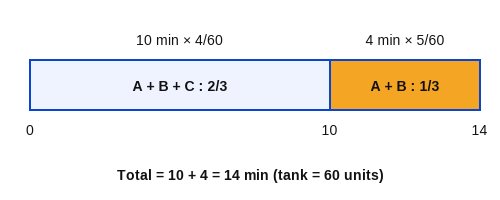
Two pipes, A and B, can fill a tank in 20 minutes and 30 minutes, respectively. A waste pipe C can empty it in 60 minutes. All three are opened together. After 10 minutes, pipe C is closed. How much total time will it take to fill the tank?
दो पाइप, A और B, एक टंकी को क्रमशः 20 मिनट और 30 मिनट में भर सकते हैं। एक निकास पाइप C इसे 60 मिनट में खाली कर सकता है। तीनों को एक साथ खोला जाता है। 10 मिनट बाद, पाइप C को बंद कर दिया जाता है। टंकी को भरने में कुल कितना समय लगेगा?
  1. A14 minutes14 मिनट
  2. B15 minutes15 मिनट
  3. C17 minutes17 मिनट
  4. D12 minutes12 मिनट
Show answer

Concept: Take tank =60 units (LCM of 20, 30, 60).

  1. Rates: A =3, B =2, C =−1 unit/min; together =4
  2. In 10 min: 40 units filled
  3. Left 20 units at 3+2=5 per min → 4 min
  4. Total =10+4=14 min

Trick: LCM-units method avoids fractions.

Answer: (A) 14 minutes

अवधारणा: टंकी =60 इकाई मानें (20, 30, 60 का LCM)।

  1. दर: A =3, B =2, C =−1 इकाई/मिनट; साथ में =4
  2. 10 मिनट में 40 इकाई भरी
  3. बची 20 इकाई, दर 3+2=5 → 4 मिनट
  4. कुल =10+4=14 मिनट

ट्रिक: LCM-इकाई विधि से भिन्न नहीं आते।

उत्तर: (A) 14 मिनट

RRB NTPC Undergraduate CBT 1MathematicsPipes and cisternsRRB NTPC Undergraduate CBT 1 2025 · 18 Jun Shift 1 →
Q12344.
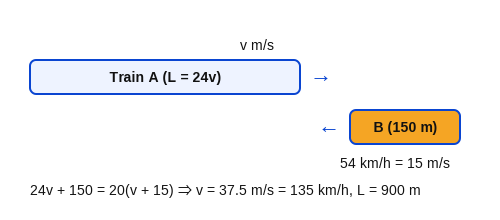
A train A passes a fixed pole in 24 seconds. The same train completely crosses another train B of length 150 m coming from the opposite direction in 20 seconds. Train B’s speed is 54 km/h. Find the length and the speed of train A.
एक रेलगाड़ी A एक स्थिर खंभे को 24 सेकंड में पार करती है। वही रेलगाड़ी विपरीत दिशा से आ रही 150 m लंबी एक अन्य रेलगाड़ी B को 20 सेकंड में पूरी तरह पार कर लेती है। रेलगाड़ी B की चाल 54 km/h है। रेलगाड़ी A की लंबाई और चाल ज्ञात कीजिए।
  1. A900 m and 134 km/h900 m और 134 km/h
  2. B600 m and 135 km/h600 m और 135 km/h
  3. C500 m and 135 km/h500 m और 135 km/h
  4. D900 m and 135 km/h900 m और 135 km/h
Show answer

Concept: Crossing a pole: length =vt; opposite trains: LA+LB=(vA+vB)t.

  1. vB=54×518=15m/s; LA=24v
  2. 24v+150=20(v+15)⇒4v=150⇒v=37.5m/s
  3. v=37.5×185=135km/h, LA=24×37.5=900m

Trick: Only option (D) has 135 km/h with L=24×37.5=900.

Answer: (D) 900 m and 135 km/h

अवधारणा: खंभा पार करने पर लंबाई =vt; विपरीत दिशा में LA+LB=(vA+vB)t।

  1. vB=54×518=15m/s; LA=24v
  2. 24v+150=20(v+15)⇒4v=150⇒v=37.5m/s
  3. v=37.5×185=135km/h, LA=24×37.5=900m

ट्रिक: 135 km/h के साथ L=24×37.5=900 केवल (D) में है।

उत्तर: (D) 900 m और 135 km/h

RRB NTPC Undergraduate CBT 1MathematicsTrains (opposite direction)RRB NTPC Undergraduate CBT 1 2025 · 18 Jun Shift 1 →
Q12345.
A pen is priced at ₹47. A scheme offers “Buy 4, Get 1 at 50% off”. What is the effective price per pen?
एक पेन का मूल्य ₹47 है। एक योजना में “4 खरीदें, 1 पर 50% छूट पाएँ” का प्रस्ताव है। प्रति पेन प्रभावी मूल्य क्या है?
  1. A₹42.30
  2. B₹40.30
  3. C₹38.30
  4. D₹39.30
Show answer

Concept: Effective price per item =total paiditems received.

  1. Pay for 4 full: 4×47=188
  2. 5th pen at 50% off: 23.50
  3. Total =211.50 for 5 pens → 211.55=42.30

Trick: Discount =0.55=10%; 47×0.9=42.30.

Answer: (A) ₹42.30

अवधारणा: प्रति वस्तु प्रभावी मूल्य =कुल भुगतानमिली वस्तुएँ।

  1. 4 पेन पूरे दाम: 4×47=188
  2. 5वाँ पेन 50% छूट पर: 23.50
  3. कुल =211.50, 5 पेन → 211.55=42.30

ट्रिक: छूट =0.55=10%; 47×0.9=42.30।

उत्तर: (A) ₹42.30

RRB NTPC Undergraduate CBT 1MathematicsDiscount schemesRRB NTPC Undergraduate CBT 1 2025 · 18 Jun Shift 1 →
Q12346.
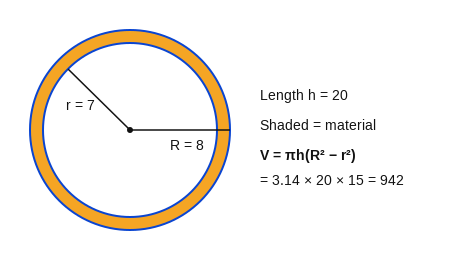
A cylindrical pipe has an external radius of 8 cm and an internal radius of 7 cm. If its length is 20 cm, what is the volume of material used in the pipe? (Use π = 3.14)
एक बेलनाकार पाइप की बाहरी त्रिज्या 8 cm और आंतरिक त्रिज्या 7 cm है। यदि इसकी लंबाई 20 cm है, तो पाइप में प्रयुक्त सामग्री का आयतन कितना है? (π = 3.14 लीजिए)
  1. A192 cubic cm192 घन cm
  2. B201 cubic cm201 घन cm
  3. C320 cubic cm320 घन cm
  4. D942 cubic cm942 घन cm
Show answer

Concept: Volume of material =πh(R2−r2).

  1. R2−r2=64−49=15
  2. V=3.14×20×15=942cm3

Trick: R2−r2=(R+r)(R−r)=15×1.

Answer: (D) 942 cubic cm

अवधारणा: पदार्थ का आयतन =πh(R2−r2)।

  1. R2−r2=64−49=15
  2. V=3.14×20×15=942cm3

ट्रिक: R2−r2=(R+r)(R−r)=15×1।

उत्तर: (D) 942 घन cm

RRB NTPC Undergraduate CBT 1MathematicsHollow cylinderRRB NTPC Undergraduate CBT 1 2025 · 18 Jun Shift 1 →
Q12347.
If x is the fourth proportional of 37, 25 and 888, what is the value of x?
यदि x, 37, 25 और 888 का चतुर्थानुपाती है, तो x का मान क्या है?
  1. A400
  2. B800
  3. C500
  4. D600
Show answer

Concept: Fourth proportional x of a,b,c: a:b=c:x⇒x=bca.

  1. x=25×88837
  2. 88837=24, so x=25×24=600

Yaad rakhein: 888=37×24 — spot the factor first.

Answer: (D) 600

अवधारणा: a,b,c का चतुर्थानुपाती x: a:b=c:x⇒x=bca।

  1. x=25×88837
  2. 88837=24, अतः x=25×24=600

याद रखें: 888=37×24 — पहले गुणनखंड पहचानें।

उत्तर: (D) 600

RRB NTPC Undergraduate CBT 1MathematicsProportionRRB NTPC Undergraduate CBT 1 2025 · 18 Jun Shift 1 →
Q12348.
A daily commuter usually reaches his office on time by driving at a speed of 40 km/hr. One day, due to traffic, he drives at 30 km/hr and reaches 20 minutes late. What is the distance to his office?
एक दैनिक यात्री सामान्यतः 40 km/hr की चाल से गाड़ी चलाकर अपने कार्यालय समय पर पहुँचता है। एक दिन, यातायात के कारण, वह 30 km/hr की चाल से गाड़ी चलाता है और 20 मिनट देरी से पहुँचता है। उसके कार्यालय की दूरी कितनी है?
  1. A40 km
  2. B60 km
  3. C50 km
  4. D30 km
Show answer

Concept: Same distance: difference of times = delay.

  1. d30−d40=2060=13
  2. d120=13⇒d=40km

Trick: d=S1S2S1−S2×t=40×3010×13=40.

Answer: (A) 40km

अवधारणा: दूरी समान: समयों का अंतर = देरी।

  1. d30−d40=2060=13
  2. d120=13⇒d=40km

ट्रिक: d=S1S2S1−S2×t=40×3010×13=40।

उत्तर: (A) 40km

RRB NTPC Undergraduate CBT 1MathematicsSpeed, time and distanceRRB NTPC Undergraduate CBT 1 2025 · 18 Jun Shift 1 →
Q12349.
Which of the expressions given below has the same value as that of cos2(θ) + sin2(θ)?
नीचे दिए गए व्यंजकों में से किसका मान cos2(θ) + sin2(θ) के मान के समान है?
  1. A1 + tan²(θ) - (1- sec²(θ))
  2. Bcosec²(θ) + sec²(θ)
  3. Ccosec²(θ) + cot²(θ)
  4. D1 + tan²(θ) + (1- sec²(θ))
Show answer

Concept: cos2θ+sin2θ=1 and 1+tan2θ=sec2θ.

  1. (D): 1+tan2θ+1−sec2θ=sec2θ+1−sec2θ=1 ✓
  2. (A) gives 2sec2θ−1, not 1
  3. (B), (C) are always greater than 1

Yaad rakhein: sec2θ−tan2θ=1, csc2θ−cot2θ=1.

Answer: (D) 1+tan2θ+(1−sec2θ)

अवधारणा: cos2θ+sin2θ=1 तथा 1+tan2θ=sec2θ।

  1. (D): 1+tan2θ+1−sec2θ=sec2θ+1−sec2θ=1 ✓
  2. (A) से 2sec2θ−1 मिलता है, 1 नहीं
  3. (B), (C) सदैव 1 से बड़े हैं

याद रखें: sec2θ−tan2θ=1, csc2θ−cot2θ=1।

उत्तर: (D) 1+tan2θ+(1−sec2θ)

RRB NTPC Undergraduate CBT 1MathematicsTrigonometric identitiesRRB NTPC Undergraduate CBT 1 2025 · 18 Jun Shift 1 →
Q12350.
What sum (in ₹) will earn a simple interest of ₹1,320 in 4 years at 12% per year rate of interest?
12% वार्षिक ब्याज दर पर 4 वर्षों में कितनी राशि (₹ में) पर ₹1,320 का साधारण ब्याज प्राप्त होगा?
  1. A5,500
  2. B633.6
  3. C1,375
  4. D2,750
Show answer

Concept: P=SI×100R×T.

  1. R×T=12×4=48%
  2. P=1320×10048=2750

Trick: 48% of P =1320 → 1%=27.5 → P=2750.

Answer: (D) ₹2,750

अवधारणा: P=SI×100R×T।

  1. R×T=12×4=48%
  2. P=1320×10048=2750

ट्रिक: P का 48%=1320 → 1%=27.5 → P=2750।

उत्तर: (D) ₹2,750

RRB NTPC Undergraduate CBT 1MathematicsSimple interestRRB NTPC Undergraduate CBT 1 2025 · 18 Jun Shift 1 →
Q12351.
What least value must be given to n so that the number 5135n2 becomes divisible by 9?
n को कम से कम कौन-सा मान दिया जाना चाहिए ताकि संख्या 5135n2, 9 से विभाज्य हो जाए?
  1. A5
  2. B3
  3. C4
  4. D2
Show answer

Concept: A number is divisible by 9 if its digit sum is a multiple of 9.

  1. Digit sum =5+1+3+5+2+n=16+n
  2. Next multiple of 9 is 18 → n=2

Yaad rakhein: 9 test: digit sum ÷ 9; 3 test: digit sum ÷ 3.

Answer: (D) 2

अवधारणा: कोई संख्या 9 से विभाज्य होती है यदि अंकों का योग 9 का गुणज हो।

  1. अंकों का योग =5+1+3+5+2+n=16+n
  2. 9 का अगला गुणज 18 → n=2

याद रखें: 9 का नियम: अंकों का योग 9 से विभाज्य।

उत्तर: (D) 2

RRB NTPC Undergraduate CBT 1MathematicsDivisibility by 9RRB NTPC Undergraduate CBT 1 2025 · 18 Jun Shift 1 →
Q12352.
Five years ago, Rahul was twice as old as his brother. If Rahul is 10 years older than his brother, what is Rahul’s present age?
पाँच वर्ष पहले, राहुल की आयु उसके भाई की आयु की दोगुनी थी। यदि राहुल अपने भाई से 10 वर्ष बड़ा है, तो राहुल की वर्तमान आयु कितनी है?
  1. A15 years15 वर्ष
  2. B25 years25 वर्ष
  3. C30 years30 वर्ष
  4. D20 years20 वर्ष
Show answer

Concept: The age difference stays constant over time.

  1. Let brother =b, Rahul =b+10
  2. 5 years ago: b+5=2(b−5)⇒b=15
  3. Rahul =25 years

Trick: 5 years ago Rahul = 2 × brother and difference 10 → brother 10, Rahul 20 then; now 25.

Answer: (B) 25 years

अवधारणा: समय के साथ आयु का अंतर स्थिर रहता है।

  1. माना भाई =b, राहुल =b+10
  2. 5 वर्ष पहले: b+5=2(b−5)⇒b=15
  3. राहुल =25 वर्ष

ट्रिक: 5 वर्ष पहले राहुल = 2 × भाई और अंतर 10 → तब भाई 10, राहुल 20; अब 25।

उत्तर: (B) 25 वर्ष

RRB NTPC Undergraduate CBT 1MathematicsProblems on agesRRB NTPC Undergraduate CBT 1 2025 · 18 Jun Shift 1 →
Q12353.
A person spends 75% of his income. If his income increases by 20% and his
expenditure increases by 10%, what is the percentage change in his savings?
एक व्यक्ति अपनी आय का 75% व्यय करता है। यदि उसकी आय में 20% की वृद्धि होती है और उसके
व्यय में 10% की वृद्धि होती है, तो उसकी बचत में कितने प्रतिशत का परिवर्तन होगा?
  1. A60% increase60% वृद्धि
  2. B50% increase50% वृद्धि
  3. C40% increase40% वृद्धि
  4. D25% increase25% वृद्धि
Show answer

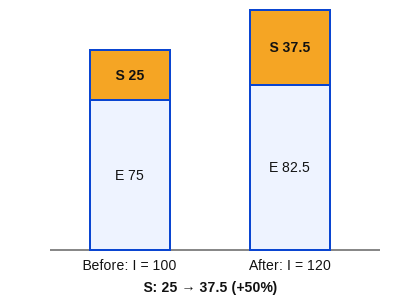
Concept: Savings=Income−Expenditure; take income =100.

  1. Before: I=100, E=75, S=25
  2. After: I=120, E=75×1.1=82.5, S=37.5
  3. Change =12.525×100=50% increase

Trick: Always assume income 100 in such questions.

Answer: (B) 50% increase

अवधारणा: बचत=आय−व्यय; आय =100 मानें।

  1. पहले: I=100, E=75, S=25
  2. बाद में: I=120, E=75×1.1=82.5, S=37.5
  3. परिवर्तन =12.525×100=50% वृद्धि

ट्रिक: ऐसे प्रश्नों में आय 100 मान लें।

उत्तर: (B) 50% वृद्धि

RRB NTPC Undergraduate CBT 1MathematicsIncome, expenditure and savingsRRB NTPC Undergraduate CBT 1 2025 · 18 Jun Shift 1 →
Q12354.
If 2x−2x−1=32, then the value of 2x−12x+3 is:
यदि 2x−2x−1=32 है, तो 2x−12x+3 का मान है:
  1. A1114
  2. B1115
  3. C1112
  4. D1113
Show answer

Concept: Take the common factor 2x−1.

  1. 2x−2x−1=2x−1(2−1)=2x−1
  2. 2x−1=32=25⇒x=6
  3. 2x−12x+3=1115

Yaad rakhein: ax−ax−1=ax−1(a−1).

Answer: (B) 1115

अवधारणा: उभयनिष्ठ गुणनखंड 2x−1 निकालें।

  1. 2x−2x−1=2x−1(2−1)=2x−1
  2. 2x−1=32=25⇒x=6
  3. 2x−12x+3=1115

याद रखें: ax−ax−1=ax−1(a−1)।

उत्तर: (B) 1115

RRB NTPC Undergraduate CBT 1MathematicsExponential equationsRRB NTPC Undergraduate CBT 1 2025 · 18 Jun Shift 1 →
Q12355.
The 7-digit number 77A444B is divisible by 24. What is the maximum value of (A + B)?
7-अंकीय संख्या 77A444B, 24 से विभाज्य है। (A + B) का अधिकतम मान क्या है?
  1. A13
  2. B12
  3. C15
  4. D16
Show answer

Concept: 24=3×8: last three digits divisible by 8 and digit sum divisible by 3.

  1. Last three digits 44B: 440 and 448 are multiples of 8 → B=0 or 8
  2. Digit sum =26+A+B must be a multiple of 3
  3. Take B=8: 34+A → A=2,5,8; max A=8
  4. Max A+B=8+8=16

Trick: Choose the largest B first, then the largest A that fits the 3-test.

Answer: (D) 16

अवधारणा: 24=3×8: अंतिम तीन अंक 8 से और अंकों का योग 3 से विभाज्य हो।

  1. अंतिम तीन अंक 44B: 440 व 448 ही 8 के गुणज → B=0 या 8
  2. अंकों का योग =26+A+B, 3 का गुणज हो
  3. B=8: 34+A → A=2,5,8; अधिकतम A=8
  4. अधिकतम A+B=8+8=16

ट्रिक: पहले सबसे बड़ा B, फिर 3 के नियम से सबसे बड़ा A चुनें।

उत्तर: (D) 16

RRB NTPC Undergraduate CBT 1MathematicsDivisibility by 24RRB NTPC Undergraduate CBT 1 2025 · 18 Jun Shift 1 →
Q12356.
Based on the English alphabetical order, three of the following four are alike in a certain way and thus form a group. Which is the one that does not belong to that group? (Note: The odd man out is not based on the number of consonants/vowels or their position in the letter cluster.)
अंग्रेज़ी वर्णमाला क्रम के आधार पर, निम्नलिखित चार में से तीन किसी निश्चित प्रकार से एकसमान हैं और इस प्रकार एक समूह बनाते हैं। वह कौन-सा है जो उस समूह से संबंधित नहीं है? (ध्यान दें: असंगत, अक्षर-समूह में व्यंजनों/स्वरों की संख्या या उनके स्थान पर आधारित नहीं है।)
  1. APNN
  2. BKHI
  3. CZWX
  4. DFCD
Show answer

Concept: Check the gap between consecutive letters of each cluster.

  1. KHI: K −3​ H +1​ I
  2. ZWX: Z −3​ W +1​ X; FCD: F −3​ C +1​ D
  3. PNN: P −2​ N 0​ N – different pattern.

Trick: A repeated letter (NN) usually signals the odd cluster – verify quickly.

Answer: (A) PNN

अवधारणा: हर समूह के क्रमागत अक्षरों का अंतर देखें।

  1. KHI: K −3​ H +1​ I
  2. ZWX: Z −3​ W +1​ X; FCD: F −3​ C +1​ D
  3. PNN: P −2​ N 0​ N – अलग पैटर्न।

ट्रिक: दोहराया गया अक्षर (NN) अक्सर विषम समूह का संकेत होता है – जल्दी जाँच लें।

उत्तर: (A) PNN

RRB NTPC Undergraduate CBT 1General Intelligence and ReasoningOdd one out – letter clustersRRB NTPC Undergraduate CBT 1 2025 · 18 Jun Shift 1 →
Q12357.
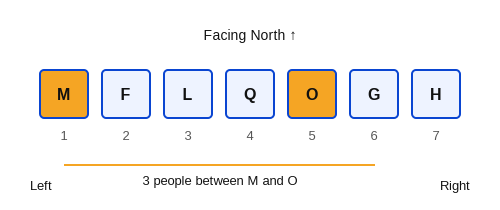
Seven people F, G, H, L, M, O and Q are sitting in a row facing north. Only two people sit between H and Q. Only H sits to the right of G. Only three people sit between G and F. L sits at some place to the left of O, but at some place to the right of M. How many people sit between M and O?
सात व्यक्ति F, G, H, L, M, O और Q एक पंक्ति में उत्तर की ओर मुख करके बैठे हैं। H और Q के बीच केवल दो व्यक्ति बैठे हैं। G के दाईं ओर केवल H बैठा है। G और F के बीच केवल तीन व्यक्ति बैठे हैं। L, O के बाईं ओर किसी स्थान पर, परंतु M के दाईं ओर किसी स्थान पर बैठा है। M और O के बीच कितने व्यक्ति बैठे हैं?
  1. ATwoदो
  2. BThreeतीन
  3. CFourचार
  4. DOneएक
Show answer

Concept: Facing north, “right” is the east end. Fix the person with a unique position first.

  1. Only H is to the right of G → H at the right end (7), G at 6.
  2. Two between H and Q → Q = 4. Three between G and F → F = 2.
  3. Positions 1, 3, 5 left for M, L, O with M < L < O (left to right) → M = 1, L = 3, O = 5.
  4. Between M (1) and O (5): F, L, Q = 3 people.

Trick: “Only X is to the right of Y” → Y is second from the right end.

Answer: (B) Three

अवधारणा: उत्तर की ओर मुख होने पर “दायाँ” = पूर्वी छोर। पहले निश्चित स्थान वाला व्यक्ति रखें।

  1. केवल H, G के दाईं ओर → H दाएँ छोर (7) पर, G 6 पर।
  2. H और Q के बीच दो → Q = 4। G और F के बीच तीन → F = 2।
  3. बचे स्थान 1, 3, 5 पर M, L, O (बाएँ से दाएँ M, L, O क्रम) → M = 1, L = 3, O = 5।
  4. M (1) और O (5) के बीच: F, L, Q = 3 व्यक्ति।

ट्रिक: “केवल X, Y के दाईं ओर” → Y दाएँ छोर से दूसरा।

उत्तर: (B) तीन

RRB NTPC Undergraduate CBT 1General Intelligence and ReasoningLinear seating arrangementRRB NTPC Undergraduate CBT 1 2025 · 18 Jun Shift 1 →
Q12358.
Select the pair which follows the same pattern as that followed by the two pairs given below. Both pairs follow the same pattern.
VXW−UWV
WYX−VXW
उस युग्म का चयन कीजिए जो उसी पैटर्न का अनुसरण करता है जिसका अनुसरण नीचे दिए गए दो युग्म करते हैं। दोनों युग्म एक ही पैटर्न का अनुसरण करते हैं।
VXW−UWV
WYX−VXW
  1. ABDC−ACB
  2. BBCA−ACB
  3. CBDC−ZCA
  4. DBCA−ZBA
Show answer

Concept: Compare each letter of the first cluster with the corresponding letter of the second.

  1. VXW → UWV: each letter −1. WYX → VXW: each letter −1.
  2. BDC → ACB: B→A, D→C, C→B, each −1 ✓.
  3. BCA → ACB, BDC → ZCA and BCA → ZBA break the −1 rule.

Trick: Check only the first letter of each option first (B → A); only (A) and (B) survive, then check the rest.

Answer: (A) BDC−ACB

अवधारणा: पहले समूह के प्रत्येक अक्षर की तुलना दूसरे समूह के संगत अक्षर से करें।

  1. VXW → UWV: हर अक्षर −1। WYX → VXW: हर अक्षर −1।
  2. BDC → ACB: B→A, D→C, C→B, सभी −1 ✓।
  3. BCA → ACB, BDC → ZCA, BCA → ZBA में −1 नियम टूटता है।

ट्रिक: पहले हर विकल्प का पहला अक्षर जाँचें (B → A); केवल (A), (B) बचते हैं, फिर बाकी देखें।

उत्तर: (A) BDC−ACB

RRB NTPC Undergraduate CBT 1General Intelligence and ReasoningLetter analogyRRB NTPC Undergraduate CBT 1 2025 · 18 Jun Shift 1 →
Q12359.
In a certain code language, ‘salt elbow care’ is coded as ' zh pv nf' and ‘night care jar’ is coded as ‘ab po zh’. How is ‘care’ coded in the given language?
एक निश्चित कूट भाषा में, ‘salt elbow care’ को ' zh pv nf' के रूप में कूटबद्ध किया जाता है और ‘night care jar’ को ‘ab po zh’ के रूप में कूटबद्ध किया जाता है। दी गई भाषा में ‘care’ को किस प्रकार कूटबद्ध किया जाता है?
  1. Azh
  2. Bab
  3. Cnf
  4. Dpv
Show answer

Concept: A word common to two sentences gets the code common to both coded sentences.

  1. salt elbow care → zh pv nf
  2. night care jar → ab po zh
  3. Only “care” and only “zh” are common → care = zh.

Trick: Common word ↔ common code – no need to decode other words.

Answer: (A) zh

अवधारणा: दो वाक्यों में उभयनिष्ठ शब्द का कोड दोनों कूट वाक्यों में उभयनिष्ठ कोड होता है।

  1. salt elbow care → zh pv nf
  2. night care jar → ab po zh
  3. केवल “care” और केवल “zh” उभयनिष्ठ → care = zh।

ट्रिक: उभयनिष्ठ शब्द ↔ उभयनिष्ठ कोड – बाकी शब्द डिकोड करने की ज़रूरत नहीं।

उत्तर: (A) zh

RRB NTPC Undergraduate CBT 1General Intelligence and ReasoningCoding–decoding (common word)RRB NTPC Undergraduate CBT 1 2025 · 18 Jun Shift 1 →
Q12360.
Each of the digits in the number 73912685 is arranged in ascending order from left to right. The position(s) of how many digits will remain unchanged as compared to that in the original number?
संख्या 73912685 के प्रत्येक अंक को बाएँ से दाएँ आरोही क्रम में व्यवस्थित किया जाता है। मूल संख्या की तुलना में कितने अंकों का/के स्थान अपरिवर्तित रहेगा/रहेंगे?
  1. ANoneकोई नहीं
  2. BTwoदो
  3. COneएक
  4. DThreeतीन
Show answer

Concept: Write the digits in ascending order and compare place by place with the original number.

  1. Original: 7 3 9 1 2 6 8 5
  2. Ascending: 1 2 3 5 6 7 8 9
  3. Only the 7th place has the same digit (8) in both.

Trick: A digit stays fixed only if exactly (its place − 1) digits are smaller than it: 8 has 6 smaller digits and sits 7th ✓.

Answer: (C) One

अवधारणा: अंकों को आरोही क्रम में लिखें और मूल संख्या से स्थान-दर-स्थान तुलना करें।

  1. मूल: 7 3 9 1 2 6 8 5
  2. आरोही: 1 2 3 5 6 7 8 9
  3. केवल 7वें स्थान पर दोनों में एक ही अंक (8) है।

ट्रिक: कोई अंक तभी अपनी जगह रहता है जब उससे छोटे अंक ठीक (स्थान − 1) हों: 8 से छोटे 6 अंक हैं और 8 सातवें स्थान पर है ✓।

उत्तर: (C) एक

RRB NTPC Undergraduate CBT 1General Intelligence and ReasoningNumber arrangementRRB NTPC Undergraduate CBT 1 2025 · 18 Jun Shift 1 →