Question bank

Q&A: practice questions with answers

Search questions on any topic. Filter by exam category, exam, subject and topic, try the question, then open the answer and explanation.

Courses – airGurukul

20,719 questions found.

Q12441.
Nisha noted the number 76488 in her register. What is the remainder when it is divided by 8?
निशा ने अपने रजिस्टर में संख्या 76488 लिखी। इसे 8 से विभाजित करने पर शेषफल क्या होगा?
  1. A0
  2. B1
  3. C3
  4. D2
Show answer

Concept: Remainder on division by 8 depends only on the last three digits.

  1. Last three digits: 488
  2. 488=8×61, remainder 0

Trick: Divisibility by 8 → check last 3 digits; by 4 → last 2 digits.

Answer: (A) 0

अवधारणा: 8 से भाग देने पर शेषफल केवल अंतिम तीन अंकों पर निर्भर करता है।

  1. अंतिम तीन अंक: 488
  2. 488=8×61, शेषफल 0

याद रखें: 8 के लिए अंतिम 3 अंक, 4 के लिए अंतिम 2 अंक।

उत्तर: (A) 0
RRB NTPC Undergraduate CBT 1MathematicsDivisibility by 8RRB NTPC Undergraduate CBT 1 2025 · 17 Jun Shift 3 →
Q12442.
Evaluate 203 + (-16)3 + (-4)3
203 + (-16)3 + (-4)3 का मान ज्ञात कीजिए।
  1. A3661
  2. B3630
  3. C3840
  4. D3868
Show answer

Concept: If a+b+c=0 then a3+b3+c3=3abc.

  1. 20+(−16)+(−4)=0
  2. Sum =3×20×(−16)×(−4)=3×1280=3840

Trick: Check: 8000−4096−64=3840 ✓.

Answer: (C) 3840

अवधारणा: यदि a+b+c=0 तो a3+b3+c3=3abc।

  1. 20+(−16)+(−4)=0
  2. योग =3×20×(−16)×(−4)=3840

ट्रिक: जाँच: 8000−4096−64=3840 ✓।

उत्तर: (C) 3840

RRB NTPC Undergraduate CBT 1MathematicsAlgebraic IdentityRRB NTPC Undergraduate CBT 1 2025 · 17 Jun Shift 3 →
Q12443.
A shopkeeper buys sugar at ₹25 per kg. He marks it at ₹32 per kg and allows a 20% discount on the marked price. While selling, he uses an 800 g weight instead of 1 kg. There is no other loss or expense. What is the overall profit or loss percentage of the shopkeeper?
एक दुकानदार ₹25 प्रति kg की दर से चीनी खरीदता है। वह इस पर ₹32 प्रति kg मूल्य अंकित करता है और अंकित मूल्य पर 20% की छूट देता है। बेचते समय, वह 1 kg के स्थान पर 800 g के बाट का उपयोग करता है। कोई अन्य हानि या व्यय नहीं है। दुकानदार का कुल लाभ या हानि प्रतिशत क्या है?
  1. A30% loss30% हानि
  2. B28% Loss28% हानि
  3. C28% profit28% लाभ
  4. D30% profit30% लाभ
Show answer

Concept: Compare SP actually received with CP of the quantity actually given.

  1. SP per “kg” =32×0.8=₹25.6
  2. He gives 800 g, whose CP =25×0.8=₹20
  3. Profit %=25.6−2020×100=28%

Trick: Factor method: 0.8×320.8×25=25.620=1.28 ⇒ 28% profit.

Answer: (C) 28% profit

अवधारणा: वास्तव में मिला विक्रय मूल्य और वास्तव में दी गई मात्रा का क्रय मूल्य तुलना करें।

  1. प्रति “kg” विक्रय मूल्य =32×0.8=₹25.6
  2. वह 800 g देता है, जिसका क्रय मूल्य =25×0.8=₹20
  3. लाभ %=25.6−2020×100=28%

ट्रिक: 25.620=1.28 ⇒ 28% लाभ।

उत्तर: (C) 28% लाभ

RRB NTPC Undergraduate CBT 1MathematicsDishonest DealerRRB NTPC Undergraduate CBT 1 2025 · 17 Jun Shift 3 →
Q12444.
A person spends 70% of his income. If his income increases by 20% and his
expenditure increases by 25%, then find the percentage change in his savings.
एक व्यक्ति अपनी आय का 70% खर्च करता है। यदि उसकी आय में 20% की वृद्धि होती है और उसके
व्यय में 25% की वृद्धि होती है, तो उसकी बचत में प्रतिशत परिवर्तन ज्ञात कीजिए।
  1. A813% decrease813% कमी
  2. B714% increase714% वृद्धि
  3. C614% decrease614% कमी
  4. D813% increase813% वृद्धि
Show answer

Concept: Savings = Income − Expenditure; take income =100.

  1. Old: income 100, expenditure 70, savings 30.
  2. New: income 120, expenditure 70×1.25=87.5, savings 32.5.
  3. Change =2.530×100=813% increase

Trick: Always take income as 100 — the whole sum becomes mental maths.

Answer: (D) 813% increase

अवधारणा: बचत = आय − व्यय; आय =100 मानें।

  1. पहले: आय 100, व्यय 70, बचत 30।
  2. बाद में: आय 120, व्यय 70×1.25=87.5, बचत 32.5।
  3. परिवर्तन =2.530×100=813% वृद्धि

ट्रिक: आय 100 मानने से पूरा प्रश्न मौखिक हो जाता है।

उत्तर: (D) 813% वृद्धि

RRB NTPC Undergraduate CBT 1MathematicsPercentage – Income and SavingsRRB NTPC Undergraduate CBT 1 2025 · 17 Jun Shift 3 →
Q12445.
The number of hours spent per day by 10 students watching educational videos during a week are as follows:
2, 3, 4, 2, 5, 3, 2, 4, 2, 3. Find the mode.
एक सप्ताह के दौरान 10 विद्यार्थियों द्वारा प्रतिदिन शैक्षिक वीडियो देखने में बिताए गए घंटों की संख्या इस प्रकार है:
2, 3, 4, 2, 5, 3, 2, 4, 2, 3. बहुलक ज्ञात कीजिए।
  1. A2 hours2 घंटे
  2. B5 hours5 घंटे
  3. C3 hours3 घंटे
  4. D4 hours4 घंटे
Show answer

Concept: Mode = the value occurring most often.

  1. Frequencies: 2 → 4 times, 3 → 3, 4 → 2, 5 → 1.
  2. Highest frequency is for 2 hours.

Trick: Mode = “most” — just count tallies.

Answer: (A) 2 hours

अवधारणा: बहुलक (Mode) = सबसे अधिक बार आने वाला मान।

  1. बारंबारता: 2 → 4 बार, 3 → 3, 4 → 2, 5 → 1।
  2. सर्वाधिक बारंबारता 2 घंटे की है।

याद रखें: Mode = “सबसे ज़्यादा” — केवल गिनती करें।

उत्तर: (A) 2 घंटे

RRB NTPC Undergraduate CBT 1MathematicsStatistics – ModeRRB NTPC Undergraduate CBT 1 2025 · 17 Jun Shift 3 →
Q12446.
A shopkeeper offers the following schemes on toys of the same marked price. (A) Successive discounts of 38% and 39% on any number of toys bought.
(B) Successive discounts of 42%, 38% and 20% on any number of toys bought. (C) 11% discount on the first 2 toys and 42% discount on each toy thereon.
(D) 9 toys free of cost on buying 10 toys.
A customer wants to buy 10 toys. Which of the above schemes is the least beneficial to her?
एक दुकानदार समान अंकित मूल्य वाले खिलौनों पर निम्नलिखित योजनाएँ प्रदान करता है। (A) कितने भी खिलौने खरीदने पर 38% और 39% की क्रमिक छूट।
(B) कितने भी खिलौने खरीदने पर 42%, 38% और 20% की क्रमिक छूट। (C) पहले 2 खिलौनों पर 11% छूट और उसके बाद प्रत्येक खिलौने पर 42% छूट।
(D) 10 खिलौने खरीदने पर 9 खिलौने निःशुल्क।
एक ग्राहक 10 खिलौने खरीदना चाहती है। उपर्युक्त में से कौन-सी योजना उसके लिए सबसे कम लाभदायक है?
  1. AB
  2. BC
  3. CD
  4. DA
Show answer

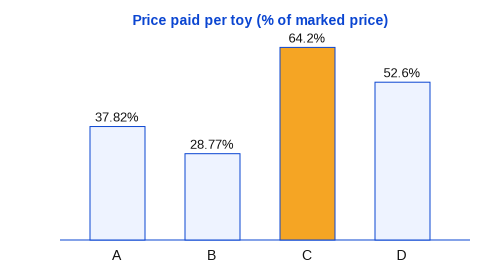
Concept: Compare the fraction of marked price actually paid per toy; the highest payment is the least beneficial.

  1. A: 0.62×0.61=0.3782 → pays 37.82%
  2. B: 0.58×0.62×0.8=0.2877 → pays 28.77%
  3. C: 2×0.89+8×0.5810=6.4210 → pays 64.2%
  4. D: pays for 10, gets 19 toys → 1019≈52.6% per toy
  5. Highest payment per toy is in C.

Trick: Convert each scheme to “% of MP paid per toy” and pick the largest.

Answer: (B) C

अवधारणा: हर योजना में प्रति खिलौना अंकित मूल्य का कितना भाग चुकाया — सबसे अधिक भुगतान वाली योजना सबसे कम लाभकारी।

  1. A: 0.62×0.61=0.3782 → भुगतान 37.82%
  2. B: 0.58×0.62×0.8=0.2877 → भुगतान 28.77%
  3. C: 2×0.89+8×0.5810=6.4210 → भुगतान 64.2%
  4. D: 10 का भुगतान, 19 खिलौने → 1019≈52.6% प्रति खिलौना
  5. सबसे अधिक भुगतान C में।

ट्रिक: हर योजना को “प्रति खिलौना MP का % भुगतान” में बदलें।

उत्तर: (B) C

RRB NTPC Undergraduate CBT 1MathematicsSuccessive DiscountsRRB NTPC Undergraduate CBT 1 2025 · 17 Jun Shift 3 →
Q12447.
Inlet M fills a tank in 24 minutes and Inlet N fills it in 32 minutes. Outlet O drains the tank. When all three operate simultaneously, the tank fills in 32 minutes. How long does O take to drain a full tank alone?
इनलेट M एक टंकी को 24 मिनट में भरता है और इनलेट N इसे 32 मिनट में भरता है। आउटलेट O टंकी को खाली करता है। जब तीनों एक साथ चलते हैं, तो टंकी 32 मिनट में भर जाती है। O अकेले भरी हुई टंकी को खाली करने में कितना समय लेगा?
  1. A44 minutes44 मिनट
  2. B24 minutes24 मिनट
  3. C14 minutes14 मिनट
  4. D34 minutes34 मिनट
Show answer

Concept: Net rate = sum of inlet rates − outlet rate.

  1. 124+132−1x=132
  2. 1x=124⇒x=24 minutes

Trick: With all open the time equals N alone, so O exactly cancels M: O takes 24 min.

Answer: (B) 24 minutes

अवधारणा: शुद्ध दर = भरने वाले नलों की दर − निकास नल की दर।

  1. 124+132−1x=132
  2. 1x=124⇒x=24 मिनट

ट्रिक: सभी खुलने पर समय = केवल N का समय, यानी O ठीक M को निष्प्रभावी करता है: 24 मिनट।

उत्तर: (B) 24 मिनट

RRB NTPC Undergraduate CBT 1MathematicsPipes and CisternsRRB NTPC Undergraduate CBT 1 2025 · 17 Jun Shift 3 →
Q12448.
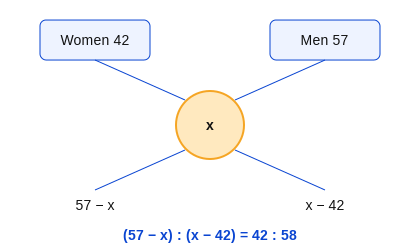
At a health club, 42% of the members are women and 58% of the members are men. If the average age of the men is 57 years and the average age of the women is 42 years, what is the average age (in years) of all the members?
एक हेल्थ क्लब में, 42% सदस्य महिलाएँ हैं और 58% सदस्य पुरुष हैं। यदि पुरुषों की औसत आयु 57 वर्ष है और महिलाओं की औसत आयु 42 वर्ष है, तो सभी सदस्यों की औसत आयु (वर्षों में) कितनी है?
  1. A50.7
  2. B56.7
  3. C57.6
  4. D44.9
Show answer

Concept: Weighted average =∑(share×average)100.

  1. 0.42×42=17.64
  2. 0.58×57=33.06
  3. Average =17.64+33.06=50.7 years

Trick: Answer must lie between 42 and 57, closer to 57 (men are more): only 50.7 fits.

Answer: (A) 50.7

अवधारणा: भारित औसत =∑(हिस्सा×औसत)100।

  1. 0.42×42=17.64
  2. 0.58×57=33.06
  3. औसत =17.64+33.06=50.7 वर्ष

ट्रिक: उत्तर 42 और 57 के बीच, 57 के अधिक पास (पुरुष अधिक हैं): केवल 50.7।

उत्तर: (A) 50.7

RRB NTPC Undergraduate CBT 1MathematicsWeighted AverageRRB NTPC Undergraduate CBT 1 2025 · 17 Jun Shift 3 →
Q12449.
Simplify: (5+20)2
सरल कीजिए: (5+20)2
  1. A45
  2. B50
  3. C65
  4. D25
Show answer

Concept: Simplify surds first: 20=25.

  1. 5+25=35
  2. (35)2=9×5=45

Trick: Or expand: 5+20+2100=25+20=45.

Answer: (A) 45

अवधारणा: पहले करणी सरल करें: 20=25।

  1. 5+25=35
  2. (35)2=9×5=45

ट्रिक: या: 5+20+2100=45।

उत्तर: (A) 45

RRB NTPC Undergraduate CBT 1MathematicsSurdsRRB NTPC Undergraduate CBT 1 2025 · 17 Jun Shift 3 →
Q12450.
If the ratio of the number of boys to girls in a class is 5:7 and the ratio of girls to teachers is 14:1, what is the ratio of boys to teachers?
यदि किसी कक्षा में लड़कों और लड़कियों की संख्या का अनुपात 5:7 है और लड़कियों और शिक्षकों का अनुपात 14:1 है, तो लड़कों और शिक्षकों का अनुपात क्या है?
  1. A10:1
  2. B7:2
  3. C5:2
  4. D7:1
Show answer

Concept: Make the common term (girls) equal in both ratios.

  1. Boys : Girls =5:7=10:14
  2. Girls : Teachers =14:1
  3. Boys : Teachers =10:1

Trick: Boys/Teachers =57×141=10.

Answer: (A) 10:1

अवधारणा: दोनों अनुपातों में साझा पद (लड़कियाँ) समान करें।

  1. लड़के : लड़कियाँ =5:7=10:14
  2. लड़कियाँ : शिक्षक =14:1
  3. लड़के : शिक्षक =10:1

ट्रिक: 57×141=10।

उत्तर: (A) 10:1

RRB NTPC Undergraduate CBT 1MathematicsRatio – CombiningRRB NTPC Undergraduate CBT 1 2025 · 17 Jun Shift 3 →
Q12451.
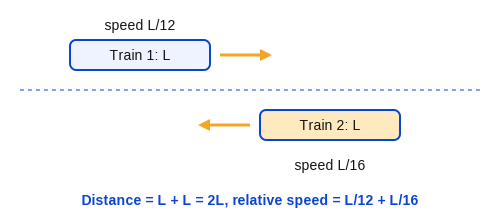
Two trains of equal lengths cross a stationary pole in 12 seconds and 16 seconds, respectively. How long will it take for the trains to cross each other when running in opposite directions? (Write your answer rounded off to two decimal places.)
समान लंबाई की दो रेलगाड़ियाँ एक स्थिर खंभे को क्रमशः 12 सेकंड और 16 सेकंड में पार करती हैं। विपरीत दिशाओं में चलते हुए रेलगाड़ियों को एक-दूसरे को पार करने में कितना समय लगेगा? (अपना उत्तर दो दशमलव स्थानों तक पूर्णांकित करके लिखिए।)
  1. A14.53 seconds14.53 सेकंड
  2. B12.61 seconds12.61 सेकंड
  3. C15.43 seconds15.43 सेकंड
  4. D13.71 seconds13.71 सेकंड
Show answer

Concept: Opposite directions: relative speed = sum; distance = sum of lengths.

  1. Length L each; speeds L12 and L16.
  2. Relative speed =L12+L16=7L48
  3. Time =2L7L/48=967=13.71s

Trick: Equal lengths: t=2t1t2t1+t2=2×12×1628.

Answer: (D) 13.71 seconds

अवधारणा: विपरीत दिशा: सापेक्ष चाल = चालों का योग; दूरी = लंबाइयों का योग।

  1. प्रत्येक लंबाई L; चाल L12 और L16।
  2. सापेक्ष चाल =L12+L16=7L48
  3. समय =2L7L/48=967=13.71s

ट्रिक: समान लंबाई: t=2t1t2t1+t2=2×12×1628।

उत्तर: (D) 13.71 सेकंड

RRB NTPC Undergraduate CBT 1MathematicsTrains – Crossing Each OtherRRB NTPC Undergraduate CBT 1 2025 · 17 Jun Shift 3 →
Q12452.
The ratio between the speeds of two trains is 5:8. If the second train covers 300 km in 3 hours, then find the speed of the first train.
दो रेलगाड़ियों की चालों का अनुपात 5:8 है। यदि दूसरी रेलगाड़ी 3 घंटे में 300 km की दूरी तय करती है, तो पहली रेलगाड़ी की चाल ज्ञात कीजिए।
  1. A63.8 km/h
  2. B62.5 km/h
  3. C65.2 km/h
  4. D72.5 km/h
Show answer

Concept: Speed =DistanceTime; speeds follow the given ratio.

  1. Second train: 3003=100km/h
  2. First train =100×58=62.5km/h

Trick: 8 parts = 100 ⇒ 1 part = 12.5 ⇒ 5 parts = 62.5.

Answer: (B) 62.5km/h

अवधारणा: चाल =दूरीसमय; चालें दिए अनुपात में।

  1. दूसरी ट्रेन: 3003=100km/h
  2. पहली ट्रेन =100×58=62.5km/h

ट्रिक: 8 भाग = 100 ⇒ 1 भाग = 12.5 ⇒ 5 भाग = 62.5।

उत्तर: (B) 62.5km/h

RRB NTPC Undergraduate CBT 1MathematicsSpeed and RatioRRB NTPC Undergraduate CBT 1 2025 · 17 Jun Shift 3 →
Q12453.
Three ropes of lengths 54 m, 72 m and 90 m are to be cut into smaller pieces of equal lengths such that no rope is left over. What is the maximum possible length of each smaller piece?
54 m, 72 m और 90 m लंबाई की तीन रस्सियों को समान लंबाई के छोटे टुकड़ों में इस प्रकार काटा जाना है कि कोई भी रस्सी शेष न बचे। प्रत्येक छोटे टुकड़े की अधिकतम संभव लंबाई कितनी है?
  1. A24 m
  2. B18 m
  3. C36 m
  4. D12 m
Show answer

Concept: Largest equal piece that divides all lengths exactly = HCF.

  1. 54=2×33, 72=23×32, 90=2×32×5
  2. HCF =2×32=18m

Trick: “Maximum equal length / largest size” → HCF; “minimum common” → LCM.

Answer: (B) 18 m

अवधारणा: सभी लंबाइयों को पूरा-पूरा बाँटने वाला सबसे बड़ा टुकड़ा = HCF।

  1. 54=2×33, 72=23×32, 90=2×32×5
  2. HCF =2×32=18m

याद रखें: “अधिकतम समान लंबाई” → HCF; “न्यूनतम साझा” → LCM।

उत्तर: (B) 18 m

RRB NTPC Undergraduate CBT 1MathematicsHCF – ApplicationRRB NTPC Undergraduate CBT 1 2025 · 17 Jun Shift 3 →
Q12454.
A jacket with a marked price of ₹2,000 is sold for ₹1,530 after two successive discounts. If the first discount is 15%, what is the second discount percentage?
₹2,000 अंकित मूल्य वाली एक जैकेट दो क्रमिक छूटों के बाद ₹1,530 में बेची जाती है। यदि पहली छूट 15% है, तो दूसरी छूट का प्रतिशत क्या है?
  1. A8%
  2. B5%
  3. C12%
  4. D10%
Show answer

Concept: Apply discounts one after another on the reduced price.

  1. After 15%: 2000×0.85=1700
  2. Second discount =1700−1530=170
  3. 1701700×100=10%

Trick: 15301700=0.9 ⇒ second discount 10%.

Answer: (D) 10%

अवधारणा: छूट एक के बाद एक घटे हुए मूल्य पर लगती है।

  1. 15% के बाद: 2000×0.85=1700
  2. दूसरी छूट =1700−1530=170
  3. 1701700×100=10%

ट्रिक: 15301700=0.9 ⇒ दूसरी छूट 10%।

उत्तर: (D) 10%

RRB NTPC Undergraduate CBT 1MathematicsSuccessive DiscountsRRB NTPC Undergraduate CBT 1 2025 · 17 Jun Shift 3 →
Q12455.
If twice the smaller of two numbers is added to three times the larger number, the result is 55. If the larger is increased by 5, it becomes twice the smaller. What is the larger number?
यदि दो संख्याओं में से छोटी संख्या के दोगुने को बड़ी संख्या के तीन गुने में जोड़ा जाए, तो परिणाम 55 आता है। यदि बड़ी संख्या में 5 की वृद्धि की जाए, तो वह छोटी संख्या की दोगुनी हो जाती है। बड़ी संख्या क्या है?
  1. A10.5
  2. B12.75
  3. C10.75
  4. D12.5
Show answer

Concept: Form two equations and substitute.

  1. Let smaller =s, larger =L: 2s+3L=55 and L+5=2s.
  2. Substitute 2s: L+5+3L=55⇒4L=50
  3. L=12.5 (and s=8.75)

Trick: Replace “2s” directly — no need to find s first.

Answer: (D) 12.5

अवधारणा: दो समीकरण बनाकर प्रतिस्थापन करें।

  1. छोटी संख्या =s, बड़ी =L: 2s+3L=55 और L+5=2s।
  2. 2s रखने पर: L+5+3L=55⇒4L=50
  3. L=12.5 (और s=8.75)

ट्रिक: सीधे “2s” प्रतिस्थापित करें — पहले s निकालना ज़रूरी नहीं।

उत्तर: (D) 12.5

RRB NTPC Undergraduate CBT 1MathematicsLinear EquationsRRB NTPC Undergraduate CBT 1 2025 · 17 Jun Shift 3 →
Q12456.
What should come in place of ‘?’ in the given series?
4 4 8 12 16 28 32 ?
दी गई श्रृंखला में ‘?’ के स्थान पर क्या आना चाहिए?
4 4 8 12 16 28 32 ?
  1. A68
  2. B62
  3. C64
  4. D60
Show answer

Concept: Split the series into two alternate series.

  1. Odd positions: 4,8,16,32 – each ×2.
  2. Even positions: 4,12,28,? – differences 8,16, so next difference 32.
  3. ?=28+32=60

Trick: When numbers jump irregularly, check alternate terms first.

Answer: (D) 60

अवधारणा: श्रृंखला को दो एकांतर (alternate) श्रृंखलाओं में बाँटें।

  1. विषम स्थान: 4,8,16,32 – हर बार ×2।
  2. सम स्थान: 4,12,28,? – अंतर 8,16, अतः अगला अंतर 32।
  3. ?=28+32=60

ट्रिक: संख्याएँ अनियमित बढ़ें तो पहले एकांतर पद जाँचें।

उत्तर: (D) 60

RRB NTPC Undergraduate CBT 1General Intelligence and ReasoningNumber seriesRRB NTPC Undergraduate CBT 1 2025 · 17 Jun Shift 3 →
Q12457.
If ‘A’ stands for ‘÷’, ‘B’ stands for ‘×’, ‘C’ stands for ‘+’ and ‘D’ stands for ‘−’, then what will come in place of the question mark (?) in the following equation?
1 D 40 A 7 B 7 C 46 = ?
यदि ‘A’ का अर्थ ‘÷’, ‘B’ का अर्थ ‘×’, ‘C’ का अर्थ ‘+’ और ‘D’ का अर्थ ‘−’ है, तो निम्नलिखित समीकरण में प्रश्न चिह्न (?) के स्थान पर क्या आएगा?
1 D 40 A 7 B 7 C 46 = ?
  1. A9
  2. B8
  3. C5
  4. D7
Show answer

Concept: Replace letters by signs, then apply BODMAS.

  1. A = ÷, B = ×, C = +, D = −
  2. 1−40÷7×7+46
  3. 40÷7×7=40 (left to right), so 1−40+46=7

Trick: ÷7 and ×7 cancel each other – no fractions needed.

Answer: (D) 7

अवधारणा: अक्षरों को चिह्नों से बदलें, फिर BODMAS लगाएँ।

  1. A = ÷, B = ×, C = +, D = −
  2. 1−40÷7×7+46
  3. 40÷7×7=40 (बाएँ से दाएँ), अतः 1−40+46=7

ट्रिक: ÷7 और ×7 एक-दूसरे को काट देते हैं – भिन्न की ज़रूरत नहीं।

उत्तर: (D) 7

RRB NTPC Undergraduate CBT 1General Intelligence and ReasoningMathematical operationsRRB NTPC Undergraduate CBT 1 2025 · 17 Jun Shift 3 →
Q12458.
Based on the alphabetical order, three of the following four are alike in a certain way and thus form a group. Which is the one that does not belong to that group?
(Note: The odd one out is not based on the number of consonants/vowels or their position in the letter cluster.)
वर्णमाला क्रम के आधार पर, निम्नलिखित चार में से तीन किसी निश्चित प्रकार से समान हैं और इस प्रकार एक समूह बनाते हैं। वह कौन-सा है जो उस समूह से संबंधित नहीं है?
(ध्यान दें: असंगत अक्षर-समूह, उस अक्षर-समूह में व्यंजनों/स्वरों की संख्या या उनके स्थान पर आधारित नहीं है।)
  1. ANRT
  2. BJNP
  3. CSWY
  4. DQUO
Show answer

Concept: Write the position values of the letters and find the gaps.

  1. NRT: 14,18,20 → +4,+2; JNP: 10,14,16 → +4,+2
  2. SWY: 19,23,25 → +4,+2
  3. QUO: 17,21,15 → +4,−6 ✗

Trick: EJOTY: E5, J10, O15, T20, Y25 – reach any letter quickly.

Answer: (D) QUO

अवधारणा: अक्षरों के स्थानीय मान लिखकर अंतर देखें।

  1. NRT: 14,18,20 → +4,+2; JNP: 10,14,16 → +4,+2
  2. SWY: 19,23,25 → +4,+2
  3. QUO: 17,21,15 → +4,−6 ✗

ट्रिक: EJOTY: E5, J10, O15, T20, Y25 – किसी भी अक्षर तक जल्दी पहुँचें।

उत्तर: (D) QUO

RRB NTPC Undergraduate CBT 1General Intelligence and ReasoningOdd one out – lettersRRB NTPC Undergraduate CBT 1 2025 · 17 Jun Shift 3 →
Q12459.
Based on the English alphabetical order, three of the following four are alike in a certain way and thus form a group. Which is the one that does not belong to that group? (Note: The odd man out is not based on the number of consonants/vowels or their position in the letter cluster.)
अंग्रेज़ी वर्णमाला क्रम के आधार पर, निम्नलिखित चार में से तीन किसी निश्चित प्रकार से समान हैं और इस प्रकार एक समूह बनाते हैं। वह कौन-सा है जो उस समूह से संबंधित नहीं है? (ध्यान दें: असंगत अक्षर-समूह, उस अक्षर-समूह में व्यंजनों/स्वरों की संख्या या उनके स्थान पर आधारित नहीं है।)
  1. AMKI
  2. BQOM
  3. CCBY
  4. DBZX
Show answer

Concept: Check the gap between consecutive letters (wrapping Z → A).

  1. MKI: 13,11,9 → −2,−2; QOM: 17,15,13 → −2,−2
  2. BZX: B → Z → X is also −2,−2 (going back past A)
  3. CBY: 3,2,25 → −1,−3 ✗

Trick: In backward series, after A comes Z – B−2 = Z.

Answer: (C) CBY

अवधारणा: क्रमागत अक्षरों का अंतर देखें (Z → A चक्र मानें)।

  1. MKI: 13,11,9 → −2,−2; QOM: 17,15,13 → −2,−2
  2. BZX: B → Z → X भी −2,−2 (A के बाद पीछे Z)
  3. CBY: 3,2,25 → −1,−3 ✗

ट्रिक: उल्टी गिनती में A के बाद Z आता है – B−2 = Z।

उत्तर: (C) CBY

RRB NTPC Undergraduate CBT 1General Intelligence and ReasoningOdd one out – lettersRRB NTPC Undergraduate CBT 1 2025 · 17 Jun Shift 3 →
Q12460.
Which of the following letter-number clusters will replace the question mark (?) in the given series to make it logically complete?
OKH 41, GCZ 47, YUR 53, QMJ 59, ?
निम्नलिखित में से कौन-सा अक्षर-संख्या समूह दी गई श्रृंखला में प्रश्न चिह्न (?) को प्रतिस्थापित करके उसे तार्किक रूप से पूर्ण करेगा?
OKH 41, GCZ 47, YUR 53, QMJ 59, ?
  1. AIDA 64
  2. BIJL 64
  3. CIEB 65
  4. DIFA 65
Show answer

Concept: Treat each letter position and the number separately.

  1. 1st letter: O → G → Y → Q → I (each −8)
  2. 2nd letter: K → C → U → M → E (−8); 3rd letter: H → Z → R → J → B (−8)
  3. Numbers: 41,47,53,59,65 (each +6)

Trick: Moving back 8 = moving forward 18 (since 26−8=18).

Answer: (C) IEB 65

अवधारणा: हर अक्षर-स्थान और संख्या को अलग-अलग देखें।

  1. पहला अक्षर: O → G → Y → Q → I (हर बार −8)
  2. दूसरा: K → C → U → M → E (−8); तीसरा: H → Z → R → J → B (−8)
  3. संख्याएँ: 41,47,53,59,65 (हर बार +6)

ट्रिक: 8 पीछे जाना = 18 आगे जाना (26−8=18)।

उत्तर: (C) IEB 65

RRB NTPC Undergraduate CBT 1General Intelligence and ReasoningLetter-number seriesRRB NTPC Undergraduate CBT 1 2025 · 17 Jun Shift 3 →