Question bank

Q&A: practice questions with answers

Search questions on any topic. Filter by exam category, exam, subject and topic, try the question, then open the answer and explanation.

Courses – airGurukul

20,719 questions found.

Q12461.
What should come in place of ‘?’ in the given series?
10 19 36 58 88 123 ?
दी गई श्रृंखला में ‘?’ के स्थान पर क्या आना चाहिए?
10 19 36 58 88 123 ?
  1. A171
  2. B169
  3. C175
  4. D166
Show answer

Concept: Take first differences, then look for a pattern in them.

  1. Differences: 9,17,22,30,35
  2. Second differences: 8,5,8,5 → next is 8
  3. Next difference =35+8=43; ?=123+43=166

Trick: Alternating +8,+5 in the differences = two-level series.

Answer: (D) 166

अवधारणा: पहले अंतर निकालें, फिर उनमें पैटर्न देखें।

  1. अंतर: 9,17,22,30,35
  2. दूसरे अंतर: 8,5,8,5 → अगला 8
  3. अगला अंतर =35+8=43; ?=123+43=166

ट्रिक: अंतरों में +8,+5 बारी-बारी = दो-स्तरीय श्रृंखला।

उत्तर: (D) 166
RRB NTPC Undergraduate CBT 1General Intelligence and ReasoningNumber seriesRRB NTPC Undergraduate CBT 1 2025 · 17 Jun Shift 3 →
Q12462.
FACN is related to LFIS in a certain way based on the English alphabetical order. In the same way, DUAH is related to JZGM. To which of the following options is VJSW related, following the same logic?
अंग्रेज़ी वर्णमाला क्रम के आधार पर FACN एक निश्चित प्रकार से LFIS से संबंधित है। उसी प्रकार, DUAH, JZGM से संबंधित है। समान तर्क का अनुसरण करते हुए, VJSW निम्नलिखित में से किस विकल्प से संबंधित है?
  1. ABOBY
  2. BBYOB
  3. CBOYB
  4. DBBOY
Show answer

Concept: Find the shift for each letter of the first pair and verify it on the second pair.

  1. FACN → LFIS: F+6=L, A+5=F, C+6=I, N+5=S
  2. DUAH → JZGM: same +6,+5,+6,+5 ✓
  3. VJSW: V+6=B, J+5=O, S+6=Y, W+5=B → BOYB

Trick: Wrap round: V(22)+6=28−26=2 = B.

Answer: (C) BOYB

अवधारणा: पहले जोड़े में हर अक्षर का खिसकाव निकालें और दूसरे जोड़े से पुष्टि करें।

  1. FACN → LFIS: F+6=L, A+5=F, C+6=I, N+5=S
  2. DUAH → JZGM: वही +6,+5,+6,+5 ✓
  3. VJSW: V+6=B, J+5=O, S+6=Y, W+5=B → BOYB

ट्रिक: चक्र: V(22)+6=28−26=2 = B।

उत्तर: (C) BOYB

RRB NTPC Undergraduate CBT 1General Intelligence and ReasoningLetter analogyRRB NTPC Undergraduate CBT 1 2025 · 17 Jun Shift 3 →
Q12463.
If ‘P’ stands for ‘×’ , ‘Q’ stands for ‘÷’, ‘R’ stands for ‘-’ and ‘S’ stands for ‘+’, what will come in place of the question mark ‘?’ in the following equation?
(96 Q 12) P 5 S (42 Q 7) P 8 R 12 P 5 = ?
यदि ‘P’ का अर्थ ‘×’, ‘Q’ का अर्थ ‘÷’, ‘R’ का अर्थ ‘-’ और ‘S’ का अर्थ ‘+’ है, तो निम्नलिखित समीकरण में प्रश्न चिह्न ‘?’ के स्थान पर क्या आएगा?
(96 Q 12) P 5 S (42 Q 7) P 8 R 12 P 5 = ?
  1. A34
  2. B20
  3. C28
  4. D48
Show answer

Concept: Replace letters by signs and use BODMAS.

  1. P = ×, Q = ÷, R = −, S = +
  2. (96÷12)×5+(42÷7)×8−12×5
  3. =8×5+6×8−60=40+48−60=28

Trick: Solve brackets first, then all ×, then +/−.

Answer: (C) 28

अवधारणा: अक्षरों को चिह्नों से बदलें और BODMAS लगाएँ।

  1. P = ×, Q = ÷, R = −, S = +
  2. (96÷12)×5+(42÷7)×8−12×5
  3. =8×5+6×8−60=40+48−60=28

ट्रिक: पहले कोष्ठक, फिर सभी ×, फिर +/−।

उत्तर: (C) 28

RRB NTPC Undergraduate CBT 1General Intelligence and ReasoningMathematical operationsRRB NTPC Undergraduate CBT 1 2025 · 17 Jun Shift 3 →
Q12464.
Which of the following letter-number clusters will replace the question mark (?) in the given series to make it logically complete?
RTR 77 NPN 72 JLJ 67 FHF 62 ?
निम्नलिखित में से कौन-सा अक्षर-संख्या समूह दी गई श्रृंखला में प्रश्न चिह्न (?) को प्रतिस्थापित करके उसे तार्किक रूप से पूर्ण करेगा?
RTR 77 NPN 72 JLJ 67 FHF 62 ?
  1. ABDB 57
  2. BBFK 56
  3. CBEA 57
  4. DBCA 56
Show answer

Concept: Each cluster is of the form X Y X; track letters and numbers separately.

  1. Outer letters: R → N → J → F → B (each −4)
  2. Middle letter: T → P → L → H → D (each −4)
  3. Numbers: 77,72,67,62,57 (each −5)

Trick: Middle letter is always 2 ahead of the outer letter: B + 2 = D.

Answer: (A) BDB 57

अवधारणा: हर समूह X Y X रूप का है; अक्षर और संख्या अलग-अलग देखें।

  1. बाहरी अक्षर: R → N → J → F → B (हर बार −4)
  2. बीच का अक्षर: T → P → L → H → D (हर बार −4)
  3. संख्याएँ: 77,72,67,62,57 (हर बार −5)

ट्रिक: बीच का अक्षर हमेशा बाहरी अक्षर से 2 आगे: B + 2 = D।

उत्तर: (A) BDB 57

RRB NTPC Undergraduate CBT 1General Intelligence and ReasoningLetter-number seriesRRB NTPC Undergraduate CBT 1 2025 · 17 Jun Shift 3 →
Q12465.
Raman ranked 25th from the top and 67th from the bottom in his class. How many students are there in his class?
रमन अपनी कक्षा में ऊपर से 25वें और नीचे से 67वें स्थान पर था। उसकी कक्षा में कितने विद्यार्थी हैं?
  1. A90
  2. B93
  3. C92
  4. D91
Show answer

Concept: Total = rank from top + rank from bottom −1 (the person is counted twice).

  1. Rank from top =25, rank from bottom =67
  2. Total =25+67−1=91

Trick: Always subtract 1 – Raman is included in both counts.

Answer: (D) 91

अवधारणा: कुल = ऊपर से रैंक + नीचे से रैंक −1 (व्यक्ति दो बार गिना जाता है)।

  1. ऊपर से रैंक =25, नीचे से रैंक =67
  2. कुल =25+67−1=91

ट्रिक: हमेशा 1 घटाएँ – रमन दोनों गिनतियों में शामिल है।

उत्तर: (D) 91

RRB NTPC Undergraduate CBT 1General Intelligence and ReasoningRankingRRB NTPC Undergraduate CBT 1 2025 · 17 Jun Shift 3 →
Q12466.
Which two numbers should be interchanged to make the given equation correct? (21 × 2) ÷ 3 + 15 × 5 − 19 × 4 + 36 + 7 × 6 = 57
दिए गए समीकरण को सही बनाने के लिए किन दो संख्याओं को आपस में बदला जाना चाहिए? (21 × 2) ÷ 3 + 15 × 5 − 19 × 4 + 36 + 7 × 6 = 57
  1. A2 and 42 और 4
  2. B5 and 65 और 6
  3. C36 and 2136 और 21
  4. D4 and 54 और 5
Show answer

Concept: Interchange the numbers in each option and test the equation with BODMAS.

  1. Interchange 4 and 5: (21×2)÷3+15×4−19×5+36+7×6
  2. =14+60−95+36+42
  3. =152−95=57 ✓

Trick: Original value: 14+75−76+36+42=91; need 34 less – swapping 4, 5 changes +75−76 to +60−95 (34 less).

Answer: (D) 4 and 5

अवधारणा: हर विकल्प की संख्याओं को आपस में बदलकर BODMAS से जाँचें।

  1. 4 और 5 बदलने पर: (21×2)÷3+15×4−19×5+36+7×6
  2. =14+60−95+36+42
  3. =152−95=57 ✓

ट्रिक: मूल मान: 14+75−76+36+42=91; 34 कम चाहिए – 4, 5 बदलने से +75−76 बनता है +60−95 (34 कम)।

उत्तर: (D) 4 and 5

RRB NTPC Undergraduate CBT 1General Intelligence and ReasoningInterchange of numbersRRB NTPC Undergraduate CBT 1 2025 · 17 Jun Shift 3 →
Q12467.
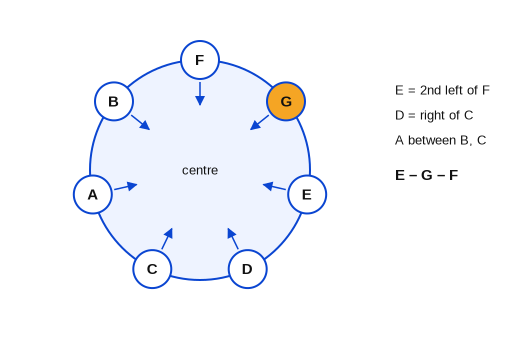
Seven people A, B, C, D, E, F and G are sitting around a circular table facing towards the centre of the table. E sits second to the left of F. A is sitting immediately between B and C. D sits to the immediate right of C. Who is sitting immediately between E and F?
सात व्यक्ति A, B, C, D, E, F और G एक वृत्ताकार मेज़ के चारों ओर मेज़ के केंद्र की ओर मुख करके बैठे हैं। E, F के बाएँ से दूसरे स्थान पर बैठा है। A, B और C के ठीक बीच में बैठा है। D, C के ठीक दाएँ बैठा है। E और F के ठीक बीच में कौन बैठा है?
  1. AB
  2. BD
  3. CG
  4. DC
Show answer

Concept: Facing the centre: left = clockwise, right = anticlockwise.

  1. E is second to the left of F → one seat lies between F and E.
  2. D is immediately right of C and A sits between B and C → D, C, A, B form a block of four consecutive seats.
  3. This block cannot fit in the single gap between F and E, so it takes the other four seats; the gap gets G.
  4. Order (clockwise): F, G, E, D, C, A, B.

Trick: Place the biggest block first – the leftover seat is the answer.

Answer: (C) G

अवधारणा: केंद्र की ओर मुख: बायाँ = दक्षिणावर्त (clockwise), दायाँ = वामावर्त।

  1. E, F के बाएँ से दूसरे स्थान पर → F और E के बीच एक सीट।
  2. D, C के ठीक दाएँ और A, B व C के बीच → D, C, A, B चार लगातार सीटों का ब्लॉक।
  3. यह ब्लॉक F और E के बीच की एक सीट में नहीं आ सकता, अतः बाकी चार सीटें लेता है; बीच की सीट पर G।
  4. क्रम (दक्षिणावर्त): F, G, E, D, C, A, B।

ट्रिक: पहले सबसे बड़ा ब्लॉक रखें – बची हुई सीट ही उत्तर है।

उत्तर: (C) G

RRB NTPC Undergraduate CBT 1General Intelligence and ReasoningCircular arrangementRRB NTPC Undergraduate CBT 1 2025 · 17 Jun Shift 3 →
Q12468.
In a certain code language, ‘SOAP’ is coded as ‘5279’ and ‘ATOP’ is coded as ‘4527’. What is the code for ‘T’ in the given code language?
एक निश्चित कूट भाषा में, ‘SOAP’ को ‘5279’ के रूप में और ‘ATOP’ को ‘4527’ के रूप में कूटबद्ध किया जाता है। दी गई कूट भाषा में ‘T’ के लिए कूट क्या है?
  1. A5
  2. B4
  3. C7
  4. D2
Show answer

Concept: Letters common to both words share the common digits.

  1. SOAP = 5279, ATOP = 4527
  2. Common letters O, A, P ↔ common digits 5, 2, 7
  3. Left over: S = 9 and T = 4

Trick: Cancel the common part – the unique letter gets the unique digit.

Answer: (B) 4

अवधारणा: दोनों शब्दों के समान अक्षरों के कोड भी समान अंक होंगे।

  1. SOAP = 5279, ATOP = 4527
  2. समान अक्षर O, A, P ↔ समान अंक 5, 2, 7
  3. शेष: S = 9 और T = 4

ट्रिक: समान भाग हटाएँ – अलग अक्षर को अलग अंक मिलेगा।

उत्तर: (B) 4

RRB NTPC Undergraduate CBT 1General Intelligence and ReasoningCoding-decodingRRB NTPC Undergraduate CBT 1 2025 · 17 Jun Shift 3 →
Q12469.
Refer to the following series and answer the question. (Counting to be done from left to right only.) (All numbers are single-digit numbers only.)
(Left) 9 3 1 2 6 8 4 5 3 9 7 2 4 5 1 8 2 3 5 9 8 5 7 3 5 6 (Right)
How many such odd digits are there, each of which is immediately preceded by an even digit and also immediately followed by an odd digit?
निम्नलिखित श्रृंखला को देखिए और प्रश्न का उत्तर दीजिए। (गिनती केवल बाएँ से दाएँ की जानी है।) (सभी संख्याएँ केवल एक अंक वाली संख्याएँ हैं।)
(बाएँ) 9 3 1 2 6 8 4 5 3 9 7 2 4 5 1 8 2 3 5 9 8 5 7 3 5 6 (दाएँ)
ऐसे कितने विषम अंक हैं, जिनमें से प्रत्येक के ठीक पहले एक सम अंक है और ठीक बाद भी एक विषम अंक है?
  1. AOneएक
  2. BNoneकोई नहीं
  3. CMore than twoदो से अधिक
  4. DTwoदो
Show answer

Concept: Look for the pattern Even – Odd – Odd and count the middle digits.

  1. … 4 5 3 … ✓
  2. … 4 5 1 … ✓
  3. … 2 3 5 … ✓
  4. … 8 5 7 … ✓ → total 4 such digits

Trick: First mark every even digit, then check only the next two digits.

Answer: (C) More than two

अवधारणा: सम – विषम – विषम पैटर्न खोजें और बीच वाले अंक गिनें।

  1. … 4 5 3 … ✓
  2. … 4 5 1 … ✓
  3. … 2 3 5 … ✓
  4. … 8 5 7 … ✓ → कुल 4 अंक

ट्रिक: पहले हर सम अंक पर निशान लगाएँ, फिर केवल अगले दो अंक जाँचें।

उत्तर: (C) More than two

RRB NTPC Undergraduate CBT 1General Intelligence and ReasoningNumber sequence analysisRRB NTPC Undergraduate CBT 1 2025 · 17 Jun Shift 3 →
Q12470.
Refer to the following letter series and answer the question that follows. Counting to be done from left to right only.
(Left) U N E H W Y B X P E L Q R C G R U A Z R U (Right)
How many such vowels are there, each of which is immediately preceded by a vowel and also immediately followed by a consonant?
निम्नलिखित अक्षर श्रृंखला को देखिए और उसके बाद आने वाले प्रश्न का उत्तर दीजिए। गिनती केवल बाएँ से दाएँ की जानी है।
(बाएँ) U N E H W Y B X P E L Q R C G R U A Z R U (दाएँ)
ऐसे कितने स्वर हैं, जिनमें से प्रत्येक के ठीक पहले एक स्वर है और ठीक बाद एक व्यंजन है?
  1. AThreeतीन
  2. BTwoदो
  3. CNoneकोई नहीं
  4. DOneएक
Show answer

Concept: Look for Vowel – Vowel – Consonant.

  1. Vowels in the series: U (1st), E, E, U, A, U (last).
  2. Only A has a vowel before it (U) and a consonant after it (Z): U A Z ✓
  3. Other vowels are preceded by consonants (N E, P E, R U, R U).

Trick: Find adjacent vowel pairs first – they are rare.

Answer: (D) One

अवधारणा: स्वर – स्वर – व्यंजन पैटर्न खोजें।

  1. श्रृंखला के स्वर: U (पहला), E, E, U, A, U (अंतिम)।
  2. केवल A से पहले स्वर (U) और बाद में व्यंजन (Z) है: U A Z ✓
  3. बाकी स्वरों से पहले व्यंजन हैं (N E, P E, R U, R U)।

ट्रिक: पहले लगातार दो स्वर खोजें – ऐसे जोड़े कम होते हैं।

उत्तर: (D) One

RRB NTPC Undergraduate CBT 1General Intelligence and ReasoningLetter sequence analysisRRB NTPC Undergraduate CBT 1 2025 · 17 Jun Shift 3 →
Q12471.
In the following triad, each group of letters is related to the subsequent one following a certain logic. Select, from the given options, the one which follows the same logic. MEGA - EAGM - AGEM
TONS - OSNT - SNOT
निम्नलिखित त्रय में, अक्षरों का प्रत्येक समूह एक निश्चित तर्क का अनुसरण करते हुए अगले समूह से संबंधित है। दिए गए विकल्पों में से उसका चयन कीजिए जो समान तर्क का अनुसरण करता है। MEGA - EAGM - AGEM
TONS - OSNT - SNOT
  1. AWEAR - WAER - RAEW
  2. BPOND - OPND - DONP
  3. CKITE - IETK - ETIK
  4. DLEGS - ELGS - SEGL
Show answer

Concept: Track the positions: word 1234 → 2nd word, then 2nd word → 3rd word.

  1. MEGA (1234) → EAGM = 2, 4, 3, 1; EAGM → AGEM = its letters 2, 3, 1, 4
  2. Check TONS → OSNT → SNOT ✓
  3. KITE → IETK (2, 4, 3, 1) → ETIK (2, 3, 1, 4) ✓

Trick: Write numbers 1–4 under the first word; test only one option fully.

Answer: (C) KITE - IETK - ETIK

अवधारणा: स्थान ट्रैक करें: शब्द 1234 → दूसरा शब्द, फिर दूसरा → तीसरा।

  1. MEGA (1234) → EAGM = 2, 4, 3, 1; EAGM → AGEM = उसके अक्षर 2, 3, 1, 4
  2. जाँच: TONS → OSNT → SNOT ✓
  3. KITE → IETK (2, 4, 3, 1) → ETIK (2, 3, 1, 4) ✓

ट्रिक: पहले शब्द के नीचे 1–4 लिखें; केवल एक विकल्प पूरा जाँचें।

उत्तर: (C) KITE - IETK - ETIK

RRB NTPC Undergraduate CBT 1General Intelligence and ReasoningLetter triadsRRB NTPC Undergraduate CBT 1 2025 · 17 Jun Shift 3 →
Q12472.
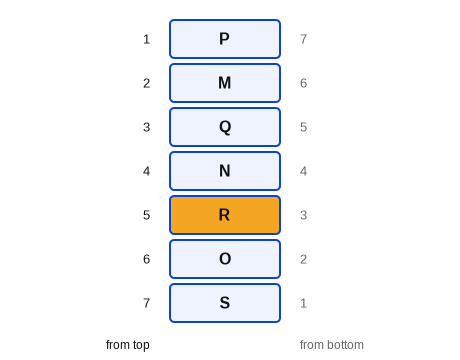
Seven boxes, M, N, O, P, Q, R and S, are kept one over the other, but not necessarily in the same order.
N is kept fourth from the top. Only two boxes are kept between N and S. Only P is kept above M. O is kept immediately above S. Q is kept on one of the positions after M but on one of the positions before N.
Which box is kept third from the bottom?
सात डिब्बे M, N, O, P, Q, R और S एक के ऊपर एक रखे गए हैं, लेकिन आवश्यक नहीं कि इसी क्रम में हों।
N को ऊपर से चौथे स्थान पर रखा गया है। N और S के बीच केवल दो डिब्बे रखे गए हैं। M के ऊपर केवल P रखा गया है। O को S के ठीक ऊपर रखा गया है। Q को M के बाद वाले किसी एक स्थान पर लेकिन N से पहले वाले किसी एक स्थान पर रखा गया है।
नीचे से तीसरे स्थान पर कौन-सा डिब्बा रखा गया है?
  1. AQ
  2. BR
  3. CO
  4. DS
Show answer

Concept: Number positions 1 (top) to 7 (bottom) and fix definite clues first.

  1. N = 4. Only P above M → P = 1, M = 2.
  2. Two boxes between N and S → S = 7 (1 is taken). O immediately above S → O = 6.
  3. Q between M and N → Q = 3; remaining R = 5.
  4. Third from bottom = position 5 = R.

Trick: nth from bottom =8−n from top for 7 boxes.

Answer: (B) R

अवधारणा: स्थान 1 (ऊपर) से 7 (नीचे) तक मानें और निश्चित सुराग पहले लगाएँ।

  1. N = 4। M के ऊपर केवल P → P = 1, M = 2।
  2. N और S के बीच दो बॉक्स → S = 7 (1 भरा है)। O, S के ठीक ऊपर → O = 6।
  3. Q, M और N के बीच → Q = 3; शेष R = 5।
  4. नीचे से तीसरा = स्थान 5 = R।

ट्रिक: 7 बॉक्स में नीचे से n-वाँ =8−n ऊपर से।

उत्तर: (B) R

RRB NTPC Undergraduate CBT 1General Intelligence and ReasoningBox arrangementRRB NTPC Undergraduate CBT 1 2025 · 17 Jun Shift 3 →
Q12473.
In a certain code language, ‘SAFE’ is coded as ‘3698’ and ‘FACE’ is coded as ‘5398’. What is the code for ‘S’ in the given code language?
एक निश्चित कूट भाषा में, ‘SAFE’ को ‘3698’ के रूप में और ‘FACE’ को ‘5398’ के रूप में कूटबद्ध किया जाता है। दी गई कूट भाषा में ‘S’ के लिए कूट क्या है?
  1. A3
  2. B9
  3. C8
  4. D6
Show answer

Concept: Letters common to both words share the common digits.

  1. SAFE = 3698, FACE = 5398
  2. Common letters A, F, E ↔ common digits 3, 9, 8
  3. Left over: S = 6, C = 5

Trick: Remove common letters and digits – what remains pairs up.

Answer: (D) 6

अवधारणा: दोनों शब्दों के समान अक्षरों के कोड भी समान अंक होंगे।

  1. SAFE = 3698, FACE = 5398
  2. समान अक्षर A, F, E ↔ समान अंक 3, 9, 8
  3. शेष: S = 6, C = 5

ट्रिक: समान अक्षर व अंक हटाएँ – जो बचे वही जोड़ी है।

उत्तर: (D) 6

RRB NTPC Undergraduate CBT 1General Intelligence and ReasoningCoding-decodingRRB NTPC Undergraduate CBT 1 2025 · 17 Jun Shift 3 →
Q12474.
Read the given statements and conclusions carefully. Assuming that the information given in the statements is true, even if it appears to be at variance with commonly known facts, decide which of the given conclusions logically follow(s) from the statements.
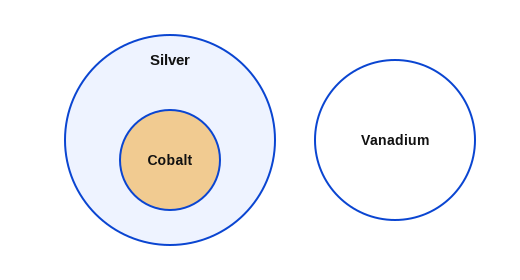
Statement: All Cobalt is Silver. No Silver is Vanadium.
Conclusion I: No Vanadium is Cobalt.
Conclusion II: Some Vanadium is Cobalt.
दिए गए कथनों और निष्कर्षों को ध्यानपूर्वक पढ़िए। यह मानते हुए कि कथनों में दी गई जानकारी सत्य है, भले ही वह सामान्यतः ज्ञात तथ्यों से भिन्न प्रतीत होती हो, निर्णय कीजिए कि दिए गए निष्कर्षों में से कौन-सा/कौन-से निष्कर्ष कथनों का तार्किक रूप से अनुसरण करता है/करते हैं।
कथन: सभी कोबाल्ट, सिल्वर हैं। कोई सिल्वर, वैनेडियम नहीं है।
निष्कर्ष I: कोई वैनेडियम, कोबाल्ट नहीं है।
निष्कर्ष II: कुछ वैनेडियम, कोबाल्ट हैं।
  1. ABoth conclusions (I) and (II) followनिष्कर्ष (I) और (II) दोनों अनुसरण करते हैं
  2. BOnly conclusion (I) followsकेवल निष्कर्ष (I) अनुसरण करता है
  3. CNeither conclusion (I) nor (II) followsन तो निष्कर्ष (I) और न ही (II) अनुसरण करता है
  4. DOnly conclusion (II) followsकेवल निष्कर्ष (II) अनुसरण करता है
Show answer

Concept: Draw the Venn diagram: Cobalt lies inside Silver; Silver and Vanadium do not touch.

  1. Since all Cobalt is inside Silver and Silver is completely away from Vanadium, Cobalt can never touch Vanadium.
  2. Conclusion I: No Vanadium is Cobalt → definitely true ✓
  3. Conclusion II: Some Vanadium is Cobalt → impossible ✗

Trick: All A are B + No B is C ⇒ No A is C (and No C is A).

Answer: (B) Only conclusion (I) follows

अवधारणा: वेन आरेख बनाएँ: Cobalt, Silver के अंदर; Silver और Vanadium अलग।

  1. सारा Cobalt, Silver में है और Silver, Vanadium से पूरी तरह अलग है – अतः Cobalt कभी Vanadium को नहीं छू सकता।
  2. निष्कर्ष I: कोई Vanadium, Cobalt नहीं → निश्चित सत्य ✓
  3. निष्कर्ष II: कुछ Vanadium, Cobalt हैं → असंभव ✗

ट्रिक: सभी A, B हैं + कोई B, C नहीं ⇒ कोई A, C नहीं (और कोई C, A नहीं)।

उत्तर: (B) Only conclusion (I) follows

RRB NTPC Undergraduate CBT 1General Intelligence and ReasoningSyllogismRRB NTPC Undergraduate CBT 1 2025 · 17 Jun Shift 3 →
Q12475.
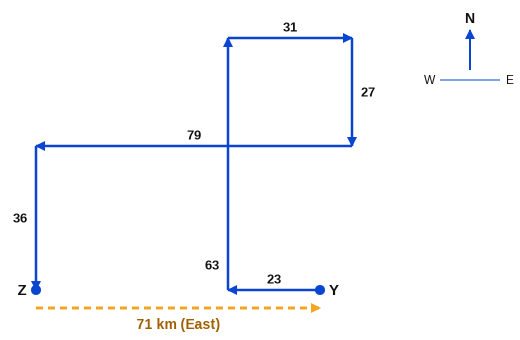
Tanmay starts from Point Y and drives 23 km towards West. He then takes a right turn, drives 63 km, turns right and drives 31 km. He then takes a right turn and drives 27 km. He takes a right turn, drives 79 km. He then turns left, drives 36 km to stop at Point Z. How far (shortest distance) and towards which direction should he drive in order to reach Point Y again? (All turns are 90° turns only unless specified.)
तन्मय बिंदु Y से चलना शुरू करता है और पश्चिम की ओर 23 km गाड़ी चलाता है। फिर वह दाएँ मुड़ता है, 63 km गाड़ी चलाता है, दाएँ मुड़ता है और 31 km गाड़ी चलाता है। फिर वह दाएँ मुड़ता है और 27 km गाड़ी चलाता है। वह दाएँ मुड़ता है, 79 km गाड़ी चलाता है। फिर वह बाएँ मुड़ता है, 36 km गाड़ी चलाकर बिंदु Z पर रुकता है। बिंदु Y पर फिर से पहुँचने के लिए उसे कितनी दूरी (न्यूनतम दूरी) और किस दिशा में गाड़ी चलानी चाहिए? (जब तक निर्दिष्ट न किया जाए, सभी मोड़ केवल 90° के मोड़ हैं।)
  1. A73 km towards westपश्चिम की ओर 73 km
  2. B75 km towards eastपूर्व की ओर 75 km
  3. C71 km towards westपश्चिम की ओर 71 km
  4. D71 km towards eastपूर्व की ओर 71 km
Show answer

Concept: Take Y as origin; East and North positive.

  1. West 23 → (−23,0); right (North) 63 → (−23,63); right (East) 31 → (8,63)
  2. Right (South) 27 → (8,36); right (West) 79 → (−71,36)
  3. Left (South) 36 → Z =(−71,0), on the same horizontal line as Y
  4. Y is 71km to the East of Z.

Trick: Net E–W: −23+31−79=−71; net N–S: 63−27−36=0.

Answer: (D) 71 km towards east

अवधारणा: Y को मूल बिंदु मानें; पूर्व और उत्तर धनात्मक।

  1. पश्चिम 23 → (−23,0); दाएँ (उत्तर) 63 → (−23,63); दाएँ (पूर्व) 31 → (8,63)
  2. दाएँ (दक्षिण) 27 → (8,36); दाएँ (पश्चिम) 79 → (−71,36)
  3. बाएँ (दक्षिण) 36 → Z =(−71,0), Y की ही क्षैतिज रेखा पर
  4. Y, Z से 71km पूर्व में है।

ट्रिक: कुल पूर्व–पश्चिम: −23+31−79=−71; उत्तर–दक्षिण: 63−27−36=0।

उत्तर: (D) 71 km towards east

RRB NTPC Undergraduate CBT 1General Intelligence and ReasoningDirection and distanceRRB NTPC Undergraduate CBT 1 2025 · 17 Jun Shift 3 →
Q12476.
Which of the following letter-number clusters will replace the question mark (?) in the given series to make it logically complete?
KE64, MC27, PZ8, ?
निम्नलिखित में से कौन-सा अक्षर-संख्या समूह दी गई श्रृंखला में प्रश्न चिह्न (?) को प्रतिस्थापित करके उसे तार्किक रूप से पूर्ण करेगा?
KE64, MC27, PZ8, ?
  1. ATW1
  2. BSV1
  3. CTV1
  4. DTV8
Show answer

Concept: Check each part separately.

  1. 1st letter: K → M → P → T (+2,+3,+4)
  2. 2nd letter: E → C → Z → V (−2,−3,−4)
  3. Numbers: 64=43,27=33,8=23 → next 13=1

Trick: The two letters move by the same steps in opposite directions.

Answer: (C) TV1

अवधारणा: हर भाग को अलग-अलग जाँचें।

  1. पहला अक्षर: K → M → P → T (+2,+3,+4)
  2. दूसरा अक्षर: E → C → Z → V (−2,−3,−4)
  3. संख्याएँ: 64=43,27=33,8=23 → अगला 13=1

ट्रिक: दोनों अक्षर समान कदमों से उल्टी दिशाओं में चलते हैं।

उत्तर: (C) TV1

RRB NTPC Undergraduate CBT 1General Intelligence and ReasoningLetter-number seriesRRB NTPC Undergraduate CBT 1 2025 · 17 Jun Shift 3 →
Q12477.
Select the set in which the numbers are related in the same way as are the numbers of the following sets.
(NOTE: Operations should be performed on the whole numbers, without breaking down the numbers into their constituent digits. E.g. 13 – Operations on 13 such as
adding/subtracting/multiplying etc. to 13 can be performed. Breaking down 13 into 1 and 3 and then performing mathematical operations on 1 and 3 is not allowed.) (53, 47, 35)
(117, 111, 99)
उस समुच्चय का चयन कीजिए जिसमें संख्याएँ उसी प्रकार संबंधित हैं जिस प्रकार निम्नलिखित समुच्चयों की संख्याएँ संबंधित हैं।
(ध्यान दें: संक्रियाएँ संख्याओं को उनके घटक अंकों में तोड़े बिना, पूर्ण संख्याओं पर की जानी चाहिए। उदाहरण के लिए, 13 – 13 पर संक्रियाएँ जैसे 13 में
जोड़ना/घटाना/गुणा करना आदि की जा सकती हैं। 13 को 1 और 3 में तोड़कर फिर 1 और 3 पर गणितीय संक्रियाएँ करने की अनुमति नहीं है।) (53, 47, 35)
(117, 111, 99)
  1. A(212, 206, 194)
  2. B(74, 68, 55)
  3. C(33, 27, 14)
  4. D(85, 76, 64)
Show answer

Concept: Find how the 2nd and 3rd numbers come from the 1st.

  1. (53,47,35): 53−6=47, 47−12=35
  2. (117,111,99): 117−6=111, 111−12=99 ✓
  3. (212,206,194): 212−6=206, 206−12=194 ✓

Trick: Rule: −6 then −12. Others fail: 68−13=55, 27−13=14, 85−9=76.

Answer: (A) (212,206,194)

अवधारणा: देखें कि दूसरी और तीसरी संख्या पहली से कैसे बनती है।

  1. (53,47,35): 53−6=47, 47−12=35
  2. (117,111,99): 117−6=111, 111−12=99 ✓
  3. (212,206,194): 212−6=206, 206−12=194 ✓

ट्रिक: नियम: −6 फिर −12। बाकी विफल: 68−13=55, 27−13=14, 85−9=76।

उत्तर: (A) (212,206,194)

RRB NTPC Undergraduate CBT 1General Intelligence and ReasoningNumber analogy – setsRRB NTPC Undergraduate CBT 1 2025 · 17 Jun Shift 3 →
Q12478.
Read the given statement(s) and conclusions carefully. Assuming that the information given in the statements is true, even if it appears to be at variance with commonly known facts, decide which of the given conclusions logically follow(s) from the statement(s).
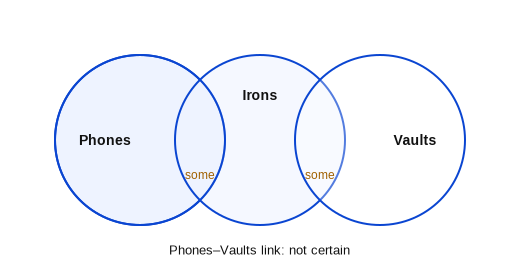
Statements: Some phones are irons. Some irons are vaults.
Conclusions (I) : No iron is a phone.
Conclusions (II) : Some phones are vaults.
दिए गए कथन/कथनों और निष्कर्षों को ध्यानपूर्वक पढ़िए। यह मानते हुए कि कथनों में दी गई जानकारी सत्य है, भले ही वह सामान्यतः ज्ञात तथ्यों से भिन्न प्रतीत होती हो, निर्णय कीजिए कि दिए गए निष्कर्षों में से कौन-सा/कौन-से निष्कर्ष कथन/कथनों का तार्किक रूप से अनुसरण करता है/करते हैं।
कथन: कुछ फ़ोन, इस्त्री हैं। कुछ इस्त्री, तिजोरी हैं।
निष्कर्ष (I) : कोई इस्त्री, फ़ोन नहीं है।
निष्कर्ष (II) : कुछ फ़ोन, तिजोरी हैं।
  1. ANeither conclusion (I) nor (II) followsन तो निष्कर्ष (I) और न ही (II) अनुसरण करता है
  2. BBoth conclusions (I) and (II) followनिष्कर्ष (I) और (II) दोनों अनुसरण करते हैं
  3. COnly conclusion (I) followsकेवल निष्कर्ष (I) अनुसरण करता है
  4. DOnly conclusion (II) followsकेवल निष्कर्ष (II) अनुसरण करता है
Show answer

Concept: Draw the minimum Venn diagram: Phones overlap Irons, Irons overlap Vaults.

  1. Conclusion I 'No iron is a phone' directly contradicts 'Some phones are irons' ✗
  2. Conclusion II: Phones and Vaults are linked only through Irons by two 'some' statements – no definite relation ✗
  3. So neither conclusion follows.

Trick: Some + Some = no conclusion.

Answer: (A) Neither conclusion (I) nor (II) follows

अवधारणा: न्यूनतम वेन आरेख बनाएँ: Phones–Irons में कुछ भाग साझा, Irons–Vaults में कुछ भाग साझा।

  1. निष्कर्ष I 'कोई iron, phone नहीं' सीधे 'कुछ phones, irons हैं' का खंडन करता है ✗
  2. निष्कर्ष II: Phones और Vaults केवल Irons के माध्यम से दो 'कुछ' कथनों से जुड़े हैं – निश्चित संबंध नहीं ✗
  3. अतः कोई निष्कर्ष नहीं निकलता।

ट्रिक: कुछ + कुछ = कोई निष्कर्ष नहीं।

उत्तर: (A) Neither conclusion (I) nor (II) follows

RRB NTPC Undergraduate CBT 1General Intelligence and ReasoningSyllogismRRB NTPC Undergraduate CBT 1 2025 · 17 Jun Shift 3 →
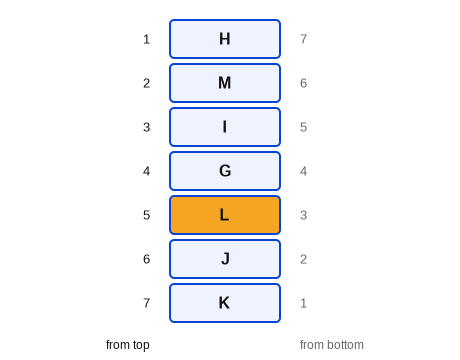
Q12479.
Seven boxes, G, H, I, J, K, L and M, are kept one over the other, but not necessarily in the same order.
Only three boxes are kept between M and J. I is kept third from the top. Only M is kept between H and I. Only K is kept below J. G is kept at one of the positions below M but not immediately above J.
Which box is kept third from the bottom?
सात डिब्बे G, H, I, J, K, L और M एक के ऊपर एक रखे गए हैं, लेकिन आवश्यक नहीं कि इसी क्रम में हों।
M और J के बीच केवल तीन डिब्बे रखे गए हैं। I को ऊपर से तीसरे स्थान पर रखा गया है। H और I के बीच केवल M रखा गया है। J के नीचे केवल K रखा गया है। G को M के नीचे वाले किसी एक स्थान पर रखा गया है, लेकिन J के ठीक ऊपर नहीं।
नीचे से तीसरे स्थान पर कौन-सा डिब्बा रखा गया है?
  1. AH
  2. BK
  3. CG
  4. DL
Show answer

Concept: Number positions 1 (top) to 7 (bottom).

  1. I = 3. Only K below J → J = 6, K = 7.
  2. Only M between H and I → M = 2 or 4; three boxes between M and J (6) → M = 2, so H = 1.
  3. G below M but not immediately above J → G ≠ 5, so G = 4 and L = 5.
  4. Order: H, M, I, G, L, J, K → third from bottom = L.

Trick: 'Only K below J' fixes the bottom two at once.

Answer: (D) L

अवधारणा: स्थान 1 (ऊपर) से 7 (नीचे) तक मानें।

  1. I = 3। J के नीचे केवल K → J = 6, K = 7।
  2. H और I के बीच केवल M → M = 2 या 4; M और J (6) के बीच तीन बॉक्स → M = 2, अतः H = 1।
  3. G, M के नीचे पर J के ठीक ऊपर नहीं → G ≠ 5, अतः G = 4 और L = 5।
  4. क्रम: H, M, I, G, L, J, K → नीचे से तीसरा = L।

ट्रिक: 'J के नीचे केवल K' से नीचे के दो स्थान तुरंत तय।

उत्तर: (D) L

RRB NTPC Undergraduate CBT 1General Intelligence and ReasoningBox arrangementRRB NTPC Undergraduate CBT 1 2025 · 17 Jun Shift 3 →
Q12480.
Based on the alphabetical order, three of the following four are alike in a certain way and thus form a group. Which is the one that does not belong to that group?
(Note: The odd man out is not based on the number of consonants/vowels or their position in the letter cluster.)
वर्णमाला क्रम के आधार पर, निम्नलिखित चार में से तीन किसी निश्चित प्रकार से समान हैं और इस प्रकार एक समूह बनाते हैं। वह कौन-सा है जो उस समूह से संबंधित नहीं है?
(ध्यान दें: असंगत अक्षर-समूह, उस अक्षर-समूह में व्यंजनों/स्वरों की संख्या या उनके स्थान पर आधारित नहीं है।)
  1. AROS
  2. BXUY
  3. CNKO
  4. DLJM
Show answer

Concept: Write letter positions and check the gaps.

  1. ROS: 18,15,19 → −3,+4; XUY: 24,21,25 → −3,+4
  2. NKO: 14,11,15 → −3,+4
  3. LJM: 12,10,13 → −2,+3 ✗

Trick: Shortcut: in the group, 3rd letter = 1st letter +1 and 2nd = 1st −3.

Answer: (D) LJM

अवधारणा: अक्षरों के स्थानीय मान लिखकर अंतर जाँचें।

  1. ROS: 18,15,19 → −3,+4; XUY: 24,21,25 → −3,+4
  2. NKO: 14,11,15 → −3,+4
  3. LJM: 12,10,13 → −2,+3 ✗

ट्रिक: शॉर्टकट: समूह में तीसरा अक्षर = पहला +1 और दूसरा = पहला −3।

उत्तर: (D) LJM

RRB NTPC Undergraduate CBT 1General Intelligence and ReasoningOdd one out – lettersRRB NTPC Undergraduate CBT 1 2025 · 17 Jun Shift 3 →