Question bank

Q&A: practice questions with answers

Search questions on any topic. Filter by exam category, exam, subject and topic, try the question, then open the answer and explanation.

Courses – airGurukul

20,719 questions found.

Q12521.
Which Indian badminton player became the first from the country to win the prestigious All England Championship?
कौन-सा भारतीय बैडमिंटन खिलाड़ी प्रतिष्ठित ऑल इंग्लैंड चैंपियनशिप जीतने वाला देश का पहला खिलाड़ी बना?
  1. AKidambi Srikanthकिदांबी श्रीकांत
  2. BHS Prannoyएच. एस. प्रणय
  3. CSaina Nehwalसाइना नेहवाल
  4. DPrakash Padukoneप्रकाश पादुकोण
Show answer

Concept: The All England Open is one of the oldest and most prestigious badminton tournaments.

  1. Prakash Padukone became the first Indian to win the All England men’s singles title in 1980.
  2. Pullela Gopichand was the second Indian to win it, in 2001.
  3. Saina Nehwal and Kidambi Srikanth never won this title (Saina was runner-up in 2015).

Yaad rakhein: All England: Padukone 1980, Gopichand 2001.

Answer: (D) Prakash Padukone

अवधारणा: ऑल इंग्लैंड ओपन सबसे पुराने और प्रतिष्ठित बैडमिंटन टूर्नामेंटों में से एक है।

  1. प्रकाश पादुकोण 1980 में ऑल इंग्लैंड पुरुष एकल खिताब जीतने वाले पहले भारतीय बने।
  2. पुलेला गोपीचंद 2001 में यह जीतने वाले दूसरे भारतीय थे।
  3. साइना नेहवाल 2015 में उपविजेता रहीं, विजेता नहीं।

याद रखें: ऑल इंग्लैंड: पादुकोण 1980, गोपीचंद 2001।

उत्तर: (D) प्रकाश पादुकोण
RRB NTPC Undergraduate CBT 1General AwarenessSports – BadmintonRRB NTPC Undergraduate CBT 1 2025 · 17 Jun Shift 2 →
Q12522.
When did the Balwant Rai Mehta Committee submit its report related to the Panchayati Raj System?
बलवंत राय मेहता समिति ने पंचायती राज व्यवस्था से संबंधित अपनी रिपोर्ट कब प्रस्तुत की?
  1. A1958
  2. B1956
  3. C1957
  4. D1962
Show answer

Concept: The Balwant Rai Mehta Committee (appointed January 1957) reviewed the Community Development Programme.

  1. It submitted its report in November 1957 and recommended “democratic decentralisation”.
  2. It proposed a three-tier Panchayati Raj: village, block and district levels.
  3. Rajasthan (Nagaur, 2 October 1959) was the first to adopt it.

Yaad rakhein: Mehta 1957 → three tiers; Ashok Mehta 1977 → two tiers.

Answer: (C) 1957

अवधारणा: बलवंत राय मेहता समिति (जनवरी 1957 में गठित) ने सामुदायिक विकास कार्यक्रम की समीक्षा की।

  1. इसने नवंबर 1957 में रिपोर्ट सौंपी और “लोकतांत्रिक विकेंद्रीकरण” की सिफारिश की।
  2. इसने त्रिस्तरीय पंचायती राज सुझाया: ग्राम, ब्लॉक और ज़िला स्तर।
  3. राजस्थान (नागौर, 2 अक्टूबर 1959) ने इसे सबसे पहले अपनाया।

याद रखें: बलवंत राय मेहता 1957 → तीन स्तर; अशोक मेहता 1977 → दो स्तर।

उत्तर: (C) 1957

RRB NTPC Undergraduate CBT 1General AwarenessPanchayati Raj CommitteesRRB NTPC Undergraduate CBT 1 2025 · 17 Jun Shift 2 →
Q12523.
Overseas Citizenship of India cardholders receive lifelong visa facilities, but they cannot obtain which of the following rights in India?
भारत के प्रवासी नागरिक (OCI) कार्डधारकों को आजीवन वीज़ा सुविधा प्राप्त होती है, लेकिन वे भारत में निम्नलिखित में से कौन-सा अधिकार प्राप्त नहीं कर सकते?
  1. APay taxesकर का भुगतान करना
  2. BOwn property in Indiaभारत में संपत्ति रखना
  3. CVoting or holding a government jobमतदान करना या सरकारी नौकरी करना
  4. DStudy in Indiaभारत में अध्ययन करना
Show answer

Concept: Overseas Citizenship of India (OCI) gives foreign nationals of Indian origin a lifelong multiple-entry visa, but it is not citizenship.

  1. OCI cardholders cannot vote, cannot contest elections, and cannot hold constitutional posts or regular government jobs.
  2. They also cannot buy agricultural/farm land.
  3. They can study, work, pay taxes and own non-agricultural property in India.

Yaad rakhein: OCI = visa + most economic rights, but no political rights.

Answer: (C) Voting or holding a government job

अवधारणा: भारत की प्रवासी नागरिकता (OCI) भारतीय मूल के विदेशी नागरिकों को आजीवन बहु-प्रवेश वीज़ा देती है, पर यह नागरिकता नहीं है।

  1. OCI कार्डधारक वोट नहीं दे सकते, चुनाव नहीं लड़ सकते, संवैधानिक पद या नियमित सरकारी नौकरी नहीं पा सकते।
  2. वे कृषि भूमि भी नहीं खरीद सकते।
  3. वे भारत में पढ़ाई, काम, टैक्स भुगतान और गैर-कृषि संपत्ति रख सकते हैं।

याद रखें: OCI = वीज़ा + अधिकतर आर्थिक अधिकार, पर राजनीतिक अधिकार नहीं।

उत्तर: (C) मतदान या सरकारी नौकरी

RRB NTPC Undergraduate CBT 1General AwarenessCitizenship – OCIRRB NTPC Undergraduate CBT 1 2025 · 17 Jun Shift 2 →
Q12524.
Which of the following best describes ‘disguised unemployment’ in the Indian context?
भारतीय संदर्भ में ‘प्रच्छन्न बेरोज़गारी’ का सबसे उपयुक्त वर्णन निम्नलिखित में से कौन-सा है?
  1. AWorkers are temporarily unemployed during economic slowdown.आर्थिक मंदी के दौरान श्रमिक अस्थायी रूप से बेरोज़गार हो जाते हैं।
  2. BWorkers shift from one job to another frequently.श्रमिक बार-बार एक नौकरी से दूसरी नौकरी में चले जाते हैं।
  3. CMore people are employed than actually needed, with marginal productivity being zero.वास्तविक आवश्यकता से अधिक लोग नियोजित होते हैं, जिनकी सीमांत उत्पादकता शून्य होती है।
  4. DWorkers are not willing to work.श्रमिक काम करने के इच्छुक नहीं होते।
Show answer

Concept: Disguised (hidden) unemployment means more people are engaged in a work than are actually needed.

  1. If some workers are removed, total output does not fall, so their marginal productivity is zero.
  2. It is common in Indian agriculture, where many family members work on a small farm.
  3. Option (A) is cyclical, (B) is frictional and (D) is voluntary unemployment.

Trick: Disguised = looks employed but adds nothing to output.

Answer: (C) More people are employed than actually needed, with marginal productivity being zero.

अवधारणा: प्रच्छन्न (छिपी) बेरोज़गारी में किसी काम में आवश्यकता से अधिक लोग लगे होते हैं।

  1. कुछ लोगों को हटा देने पर भी कुल उत्पादन नहीं घटता, अतः उनकी सीमांत उत्पादकता (marginal productivity) शून्य होती है।
  2. यह भारतीय कृषि में आम है, जहाँ छोटे खेत पर पूरा परिवार काम करता है।
  3. विकल्प (A) चक्रीय, (B) घर्षणात्मक और (D) स्वैच्छिक बेरोज़गारी है।

ट्रिक: प्रच्छन्न = दिखता काम पर है, पर उत्पादन में कोई योगदान नहीं।

उत्तर: (C) आवश्यकता से अधिक लोग लगे हैं और उनकी सीमांत उत्पादकता शून्य है।

RRB NTPC Undergraduate CBT 1General AwarenessTypes of UnemploymentRRB NTPC Undergraduate CBT 1 2025 · 17 Jun Shift 2 →
Q12525.
According to the Census 2011, which of the following states was the second most populous in the country?
जनगणना 2011 के अनुसार, निम्नलिखित में से कौन-सा राज्य देश का दूसरा सर्वाधिक जनसंख्या वाला राज्य था?
  1. AKarnatakaकर्नाटक
  2. BBiharबिहार
  3. CWest Bengalपश्चिम बंगाल
  4. DMaharashtraमहाराष्ट्र
Show answer

Concept: Census 2011 ranking of states by population: Uttar Pradesh, Maharashtra, Bihar, West Bengal, Andhra Pradesh (undivided).

  1. Uttar Pradesh was first with about 19.98 crore people.
  2. Maharashtra was second with about 11.24 crore.
  3. Bihar (about 10.41 crore) was third and West Bengal fourth; Karnataka was much lower.

Trick: Population order: UP – Maha – Bihar – WB (“U M B W”).

Answer: (D) Maharashtra

अवधारणा: जनगणना 2011 में जनसंख्या के अनुसार राज्य: उत्तर प्रदेश, महाराष्ट्र, बिहार, पश्चिम बंगाल, आंध्र प्रदेश (अविभाजित)।

  1. उत्तर प्रदेश लगभग 19.98 करोड़ के साथ पहले स्थान पर था।
  2. महाराष्ट्र लगभग 11.24 करोड़ के साथ दूसरे स्थान पर था।
  3. बिहार (लगभग 10.41 करोड़) तीसरे और पश्चिम बंगाल चौथे स्थान पर था।

ट्रिक: जनसंख्या क्रम: UP – महाराष्ट्र – बिहार – बंगाल (“U M B W”)।

उत्तर: (D) महाराष्ट्र

RRB NTPC Undergraduate CBT 1General AwarenessCensus 2011 – PopulationRRB NTPC Undergraduate CBT 1 2025 · 17 Jun Shift 2 →
Q12526.
If 2, x, and 18 are in continued proportion, find the positive value of x.
यदि 2, x और 18 वितत अनुपात (continued proportion) में हैं, तो x का धनात्मक मान ज्ञात कीजिए।
  1. A12
  2. B4
  3. C6
  4. D9
Show answer

Concept: If a,b,c are in continued proportion, then ab=bc, i.e. b2=ac (the middle term is the mean proportional).

  1. 2x=x18
  2. x2=2×18=36
  3. x=36=6 (positive value)

Trick: Mean proportional of a and c is simply ac: 2×18=6.

Answer: (C) 6

अवधारणा: यदि a,b,c सतत अनुपात (continued proportion) में हों, तो ab=bc अर्थात b2=ac (बीच वाला पद मध्यानुपाती होता है)।

  1. 2x=x18
  2. x2=2×18=36
  3. x=36=6 (धनात्मक मान)

ट्रिक: a और c का मध्यानुपाती सीधे ac होता है: 2×18=6।

उत्तर: (C) 6

RRB NTPC Undergraduate CBT 1MathematicsContinued ProportionRRB NTPC Undergraduate CBT 1 2025 · 17 Jun Shift 2 →
Q12527.
A prize of ₹8,400 is to be shared between A and B in the ratio 3:5. Find B’s share.
₹8,400 का एक पुरस्कार A और B के बीच 3:5 के अनुपात में बाँटा जाना है। B का हिस्सा ज्ञात कीजिए।
  1. A₹5,000
  2. B₹5,200
  3. C₹5,250
  4. D₹5,150
Show answer

Concept: When an amount is divided in the ratio a:b, the second share =ba+b×total.

  1. Sum of ratio terms =3+5=8
  2. B's share =58×8400
  3. =5×1050=5250

Trick: One part =84008=1050; B gets 5 parts =5250.

Answer: (C) ₹5,250

अवधारणा: जब किसी राशि को a:b में बाँटा जाए, तो दूसरा भाग =ba+b×कुल।

  1. अनुपात के पदों का योग =3+5=8
  2. B का भाग =58×8400
  3. =5×1050=5250

ट्रिक: एक भाग =84008=1050; B को 5 भाग =5250।

उत्तर: (C) ₹5,250

RRB NTPC Undergraduate CBT 1MathematicsRatio and ProportionRRB NTPC Undergraduate CBT 1 2025 · 17 Jun Shift 2 →
Q12528.
The present age of a father is thrice that of his son. After 15 years, the age of the father will be twice that of his son. What is the present age ( in years) of the father?
एक पिता की वर्तमान आयु उसके पुत्र की आयु की तीन गुनी है। 15 वर्ष बाद, पिता की आयु उसके पुत्र की आयु की दोगुनी हो जाएगी। पिता की वर्तमान आयु (वर्षों में) कितनी है?
  1. A48
  2. B45
  3. C52
  4. D42
Show answer

Concept: Let the son's present age be x; form an equation from the future condition (both ages increase equally).

  1. Father =3x
  2. After 15 years: 3x+15=2(x+15)
  3. 3x+15=2x+30⇒x=15
  4. Father =3×15=45 years

Trick: Check options: 45÷3=15; after 15 years 60 and 30 — exactly double.

Answer: (B) 45

अवधारणा: पुत्र की वर्तमान आयु x मानें; भविष्य की शर्त से समीकरण बनाएँ (दोनों की आयु समान रूप से बढ़ती है)।

  1. पिता =3x
  2. 15 वर्ष बाद: 3x+15=2(x+15)
  3. 3x+15=2x+30⇒x=15
  4. पिता =3×15=45 वर्ष

ट्रिक: विकल्प जाँचें: 45÷3=15; 15 वर्ष बाद 60 और 30 — ठीक दोगुना।

उत्तर: (B) 45

RRB NTPC Undergraduate CBT 1MathematicsProblems on AgesRRB NTPC Undergraduate CBT 1 2025 · 17 Jun Shift 2 →
Q12529.
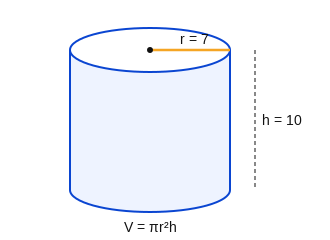
A cylindrical water tank has a radius of 7 cm and a height of 10 cm. What is its volume? (Use π = 22/7)
एक बेलनाकार पानी की टंकी की त्रिज्या 7 cm और ऊँचाई 10 cm है। इसका आयतन कितना है? (π = 22/7 का प्रयोग कीजिए)
  1. A700 cm3
  2. B440 cm3
  3. C1540 cm3
  4. D2200 cm3
Show answer

Concept: Volume of a cylinder V=πr2h.

  1. r=7cm, h=10cm
  2. V=227×7×7×10
  3. =22×7×10=1540cm3

Trick: With r=7, πr2=154 always; just multiply by h: 154×10=1540.

Answer: (C) 1540cm3

अवधारणा: बेलन (cylinder) का आयतन V=πr2h।

  1. r=7cm, h=10cm
  2. V=227×7×7×10
  3. =22×7×10=1540cm3

ट्रिक: r=7 हो तो πr2=154 हमेशा; बस h से गुणा करें: 154×10=1540।

उत्तर: (C) 1540cm3

RRB NTPC Undergraduate CBT 1MathematicsVolume of CylinderRRB NTPC Undergraduate CBT 1 2025 · 17 Jun Shift 2 →
Q12530.
The largest four-digit number which when divided by 14, 15 and 8 leaves remainder 4 in each case is:
चार अंकों की वह सबसे बड़ी संख्या, जिसे 14, 15 और 8 से विभाजित करने पर प्रत्येक स्थिति में 4 शेष बचता है, कौन-सी है?
  1. A9686
  2. B9199
  3. C9196
  4. D9244
Show answer

Concept: Number leaving the same remainder r on division by several divisors =k×LCM+r.

  1. LCM(14,15,8)=840
  2. 9999÷840 gives quotient 11 (since 11×840=9240, 12×840=10080>9999)
  3. Required number =9240+4=9244

Trick: Largest 4-digit multiple of LCM, then add the remainder.

Answer: (D) 9244

अवधारणा: कई भाजकों से भाग देने पर समान शेषफल r बचे, तो संख्या =k×LCM+r।

  1. LCM(14,15,8)=840
  2. 9999÷840 का भागफल 11 (11×840=9240, 12×840=10080>9999)
  3. अभीष्ट संख्या =9240+4=9244

ट्रिक: LCM का सबसे बड़ा 4-अंकीय गुणज निकालें, फिर शेषफल जोड़ें।

उत्तर: (D) 9244

RRB NTPC Undergraduate CBT 1MathematicsLCM with RemainderRRB NTPC Undergraduate CBT 1 2025 · 17 Jun Shift 2 →
Q12531.
Simplify: 1.20.3−25
सरल कीजिए: 1.20.3−25
  1. A3.6
  2. B4
  3. C3.2
  4. D3.4
Show answer

Concept: Convert the decimal fraction to a whole-number fraction by multiplying numerator and denominator by 10.

  1. 1.20.3=123=4
  2. 25=0.4
  3. 4−0.4=3.6

Trick: Same number of decimal places in numerator and denominator → just drop the decimal points.

Answer: (A) 3.6

अवधारणा: दशमलव भिन्न में अंश और हर दोनों को 10 से गुणा कर पूर्णांक भिन्न बनाएँ।

  1. 1.20.3=123=4
  2. 25=0.4
  3. 4−0.4=3.6

ट्रिक: अंश और हर में दशमलव स्थान बराबर हों तो दशमलव हटा दें।

उत्तर: (A) 3.6

RRB NTPC Undergraduate CBT 1MathematicsSimplification of DecimalsRRB NTPC Undergraduate CBT 1 2025 · 17 Jun Shift 2 →
Q12532.
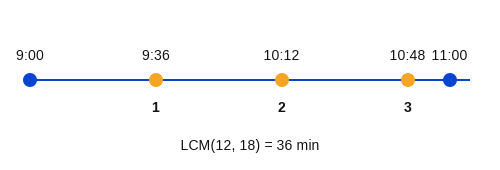
A school drum beats every 12 minutes, and the school bell rings every 18 minutes. If both sounded together at 9:00 AM, how many times will they sound together again before 11:00 AM?
एक स्कूल का ढोल प्रत्येक 12 मिनट पर बजता है, और स्कूल की घंटी प्रत्येक 18 मिनट पर बजती है। यदि दोनों 9:00 AM पर एक साथ बजे, तो 11:00 AM से पहले वे फिर से कितनी बार एक साथ बजेंगे?
  1. A3
  2. B4
  3. C5
  4. D6
Show answer

Concept: Two events sound together again after every LCM of their intervals.

  1. LCM(12,18)=36 minutes
  2. Together at 9:36, 10:12, 10:48 AM
  3. Next would be 11:24 AM — after 11:00
  4. So they sound together 3 times

Trick: Window =120 min; ⌊12036⌋=3 (11:00 itself is not a meeting time).

Answer: (A) 3

अवधारणा: दो घटनाएँ अपने अंतरालों के LCM के बाद फिर से साथ होती हैं।

  1. LCM(12,18)=36 मिनट
  2. साथ में बजेंगे: 9:36, 10:12, 10:48 AM
  3. अगली बार 11:24 AM — 11:00 के बाद
  4. अतः 3 बार साथ बजेंगे

ट्रिक: कुल समय =120 मिनट; ⌊12036⌋=3 (11:00 पर साथ नहीं बजते)।

उत्तर: (A) 3

RRB NTPC Undergraduate CBT 1MathematicsLCM Application (Bells)RRB NTPC Undergraduate CBT 1 2025 · 17 Jun Shift 2 →
Q12533.
Find the value of (3+43 of 214÷225−214 of 315).
(3+43 of 214÷225−214 of 315) का मान ज्ञात कीजिए।
  1. A-2.95
  2. B2.95
  3. C-1.48
  4. D1.48
Show answer

Concept: In BODMAS, 'of' is done before ÷ and ×; convert mixed fractions first.

  1. 214=94, 225=125, 315=165
  2. 43 of 94=3 and 94 of 165=365=7.2
  3. 3÷125=54=1.25
  4. 3+1.25−7.2=−2.95

Trick: Order inside the bracket: of → ÷ → + → −.

Answer: (A) −2.95

अवधारणा: BODMAS में 'का (of)' को ÷ और × से पहले हल करते हैं; मिश्र भिन्नों को पहले बदलें।

  1. 214=94, 225=125, 315=165
  2. 43 of 94=3 तथा 94 of 165=365=7.2
  3. 3÷125=54=1.25
  4. 3+1.25−7.2=−2.95

ट्रिक: कोष्ठक के अंदर क्रम: of → ÷ → + → −।

उत्तर: (A) −2.95

RRB NTPC Undergraduate CBT 1MathematicsSimplification (BODMAS)RRB NTPC Undergraduate CBT 1 2025 · 17 Jun Shift 2 →
Q12534.
Girish scored 448 marks in an examination and was 81 marks short of 46% of maximum marks. In the same examination, his friend scored 805 marks. What is the percentage of marks scored by his friend?
गिरीश ने एक परीक्षा में 448 अंक प्राप्त किए और वह अधिकतम अंकों के 46% से 81 अंक पीछे रह गया। उसी परीक्षा में, उसके मित्र ने 805 अंक प्राप्त किए। उसके मित्र द्वारा प्राप्त अंकों का प्रतिशत कितना है?
  1. A71%
  2. B70%
  3. C67%
  4. D72%
Show answer

Concept: Find maximum marks from the given percentage condition, then convert the friend's marks to a percentage.

  1. 46% of maximum =448+81=529
  2. Maximum =5290.46=1150
  3. Friend's %=8051150×100=70%

Trick: 529=232 and 46=2×23, so maximum =529×10046=1150 quickly.

Answer: (B) 70%

अवधारणा: दी गई प्रतिशत शर्त से अधिकतम अंक निकालें, फिर मित्र के अंकों को प्रतिशत में बदलें।

  1. अधिकतम का 46%=448+81=529
  2. अधिकतम अंक =5290.46=1150
  3. मित्र का %=8051150×100=70%

ट्रिक: 529=232 और 46=2×23, अतः अधिकतम =529×10046=1150 जल्दी निकलता है।

उत्तर: (B) 70%

RRB NTPC Undergraduate CBT 1MathematicsPercentage (Marks)RRB NTPC Undergraduate CBT 1 2025 · 17 Jun Shift 2 →
Q12535.
The average of 6.5, 10.8, 20 and a is 15. The value of a is:
6.5, 10.8, 20 और a का औसत 15 है। a का मान है:
  1. A21.7
  2. B24.7
  3. C22.7
  4. D23.7
Show answer

Concept: Sum=Average×Number of terms.

  1. Total of 4 numbers =15×4=60
  2. Known sum =6.5+10.8+20=37.3
  3. a=60−37.3=22.7

Trick: Deviation method: −8.5−4.2+5+(a−15)=0⇒a=22.7.

Answer: (C) 22.7

अवधारणा: योग=औसत×पदों की संख्या।

  1. 4 संख्याओं का योग =15×4=60
  2. ज्ञात योग =6.5+10.8+20=37.3
  3. a=60−37.3=22.7

ट्रिक: विचलन विधि: −8.5−4.2+5+(a−15)=0⇒a=22.7।

उत्तर: (C) 22.7

RRB NTPC Undergraduate CBT 1MathematicsAverageRRB NTPC Undergraduate CBT 1 2025 · 17 Jun Shift 2 →
Q12536.
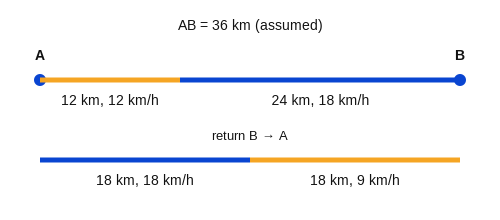
A cyclist travels from point A to B and back from B to A along the same route. On the onward journey, he covers one-third of the distance at 12 km/hr and the remaining distance at 18 km/hr. On the return journey, he covers half of the distance at 9 km/hr and the remaining distance at 18 km/hr. Find the average speed (in km/hr) for the entire round trip.
एक साइकिल चालक बिंदु A से B तक जाता है और उसी मार्ग से B से A तक वापस आता है। जाते समय, वह दूरी का एक-तिहाई भाग 12 km/hr की चाल से और शेष दूरी 18 km/hr की चाल से तय करता है। वापसी यात्रा में, वह दूरी का आधा भाग 9 km/hr की चाल से और शेष दूरी 18 km/hr की चाल से तय करता है। पूरी आने-जाने की यात्रा के लिए औसत चाल (km/hr में) ज्ञात कीजिए।
  1. A9 km/hr
  2. B13.5 km/hr
  3. C15 km/hr
  4. D11.5 km/hr
Show answer

Concept: Average speed=Total distanceTotal time; take a convenient distance (LCM of speeds).

  1. Let AB=36km
  2. Onward: 1212+2418=1+43=73h
  3. Return: 189+1818=2+1=3h
  4. Average =7273+3=72163=13.5km/h

Trick: Never average the speeds directly; always total distance ÷ total time.

Answer: (B) 13.5km/hr

अवधारणा: औसत चाल=कुल दूरीकुल समय; सुविधाजनक दूरी (चालों का LCM) मान लें।

  1. माना AB=36km
  2. जाते समय: 1212+2418=1+43=73h
  3. लौटते समय: 189+1818=2+1=3h
  4. औसत =7273+3=72163=13.5km/h

ट्रिक: चालों का सीधा औसत कभी न लें; हमेशा कुल दूरी ÷ कुल समय।

उत्तर: (B) 13.5km/hr

RRB NTPC Undergraduate CBT 1MathematicsAverage SpeedRRB NTPC Undergraduate CBT 1 2025 · 17 Jun Shift 2 →
Q12537.
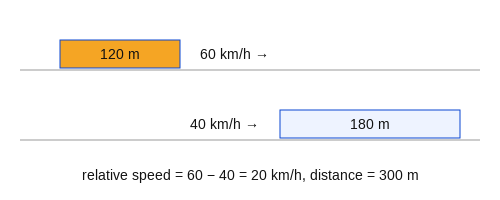
Two trains of lengths 120 m and 180 m are moving in the same direction at speeds of 60 km/h and 40 km/h, respectively. Find the time taken by the trains to cross each other.
120 m और 180 m लंबाई की दो रेलगाड़ियाँ एक ही दिशा में क्रमशः 60 km/h और 40 km/h की चाल से चल रही हैं। रेलगाड़ियों द्वारा एक-दूसरे को पार करने में लिया गया समय ज्ञात कीजिए।
  1. A54 seconds54 सेकंड
  2. B76.9 seconds76.9 सेकंड
  3. C59.3 seconds59.3 सेकंड
  4. D67.9 seconds67.9 सेकंड
Show answer

Concept: Same direction: relative speed = difference of speeds; distance to cross = sum of lengths.

  1. Relative speed =60−40=20km/h=20×518=509m/s
  2. Distance =120+180=300m
  3. Time =300÷509=54s

Trick: Time (s) =total length×18relative speed×5=300×18100=54.

Answer: (A) 54 seconds

अवधारणा: एक ही दिशा में: सापेक्ष चाल = चालों का अंतर; पार करने की दूरी = लंबाइयों का योग।

  1. सापेक्ष चाल =60−40=20km/h=20×518=509m/s
  2. दूरी =120+180=300m
  3. समय =300÷509=54s

ट्रिक: समय (s) =कुल लंबाई×18सापेक्ष चाल×5=300×18100=54।

उत्तर: (A) 54 सेकंड

RRB NTPC Undergraduate CBT 1MathematicsTrains (Same Direction)RRB NTPC Undergraduate CBT 1 2025 · 17 Jun Shift 2 →
Q12538.
The sum of the digits of a two-digit number is 11. If the digits are reversed, the new number is 27 more than the original number. What is the original number?
दो अंकों की एक संख्या के अंकों का योग 11 है। यदि अंकों को उलट दिया जाए, तो नई संख्या मूल संख्या से 27 अधिक हो जाती है। मूल संख्या क्या है?
  1. A56
  2. B47
  3. C38
  4. D65
Show answer

Concept: Number =10a+b; reversed =10b+a; difference =9(b−a).

  1. a+b=11
  2. 9(b−a)=27⇒b−a=3
  3. b=7, a=4 → number =47

Trick: Reversed is larger by 27 → units digit exceeds tens digit by 279=3; only 47 fits (4+7=11).

Answer: (B) 47

अवधारणा: संख्या =10a+b; उलटी संख्या =10b+a; अंतर =9(b−a)।

  1. a+b=11
  2. 9(b−a)=27⇒b−a=3
  3. b=7, a=4 → संख्या =47

ट्रिक: उलटने पर 27 अधिक → इकाई अंक दहाई से 279=3 बड़ा; केवल 47 सही (4+7=11)।

उत्तर: (B) 47

RRB NTPC Undergraduate CBT 1MathematicsTwo-Digit NumbersRRB NTPC Undergraduate CBT 1 2025 · 17 Jun Shift 2 →
Q12539.
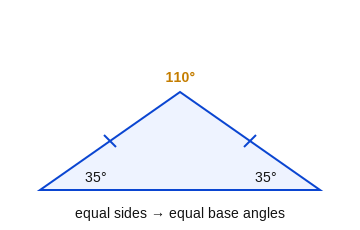
If one angle of an isosceles triangle is 110°, what are the measures of the other angles of the triangle?
यदि एक समद्विबाहु त्रिभुज का एक कोण 110° है, तो त्रिभुज के अन्य कोणों के माप क्या हैं?
  1. A25° and 25°25° और 25°
  2. B35° and 35°35° और 35°
  3. C25° and 35°25° और 35°
  4. D25° and 45°25° और 45°
Show answer

Concept: Angle sum of a triangle =180∘; an isosceles triangle has two equal angles. An angle >90∘ can only be the vertex angle.

  1. 110∘ must be the unequal angle (two angles of 110∘ would exceed 180∘)
  2. Remaining =180∘−110∘=70∘
  3. Each base angle =70∘2=35∘

Trick: Base angle =180∘−vertex2.

Answer: (B) 35∘ and 35∘

अवधारणा: त्रिभुज के कोणों का योग =180∘; समद्विबाहु त्रिभुज में दो कोण बराबर होते हैं। 90∘ से बड़ा कोण केवल शीर्ष कोण हो सकता है।

  1. 110∘ असमान कोण है (दो 110∘ कोण 180∘ से अधिक हो जाएँगे)
  2. शेष =180∘−110∘=70∘
  3. प्रत्येक आधार कोण =70∘2=35∘

ट्रिक: आधार कोण =180∘−शीर्ष कोण2।

उत्तर: (B) 35∘ और 35∘

RRB NTPC Undergraduate CBT 1MathematicsIsosceles TriangleRRB NTPC Undergraduate CBT 1 2025 · 17 Jun Shift 2 →
Q12540.
A shopkeeper offers the following schemes on toys of the same marked price. (A) Successive discounts of 5% and 21% on any number of toys bought.
(B) Successive discounts of 38%, 33% and 21% on any number of toys bought. (C) 8% discount on the first 6 toys and 27% discount on each toy thereon.
(D) 3 toys free of cost on buying 7 toys.
A customer wants to buy 7 toys. Which of the above schemes is the least beneficial to her?
एक दुकानदार समान अंकित मूल्य वाले खिलौनों पर निम्नलिखित योजनाएँ प्रदान करता है। (A) कितने भी खिलौने खरीदने पर 5% और 21% की क्रमागत छूट।
(B) कितने भी खिलौने खरीदने पर 38%, 33% और 21% की क्रमागत छूट। (C) पहले 6 खिलौनों पर 8% छूट और उसके बाद प्रत्येक खिलौने पर 27% छूट।
(D) 7 खिलौने खरीदने पर 3 खिलौने निःशुल्क।
एक ग्राहक 7 खिलौने खरीदना चाहती है। उपरोक्त में से कौन-सी योजना उसके लिए सबसे कम लाभदायक है?
  1. AA
  2. BC
  3. CB
  4. DD
Show answer

Concept: Compare the effective price paid for 7 toys under each scheme (take marked price =100 per toy).

  1. A: 0.95×0.79=0.7505 → pays 75.05%
  2. B: 0.62×0.67×0.79≈0.328 → pays about 32.8%
  3. C: 6×92+1×73=625 out of 700 → pays about 89.3%
  4. D: 3 free on 7 → 10 toys for the price of 7 → pays 70% per toy
  5. Highest payment = least benefit → scheme C

Trick: Least beneficial = largest effective price; successive discounts multiply, never add.

Answer: (B) C

अवधारणा: हर योजना में 7 खिलौनों पर प्रभावी भुगतान की तुलना करें (अंकित मूल्य =100 प्रति खिलौना)।

  1. A: 0.95×0.79=0.7505 → भुगतान 75.05%
  2. B: 0.62×0.67×0.79≈0.328 → भुगतान लगभग 32.8%
  3. C: 6×92+1×73=625, 700 में से → भुगतान लगभग 89.3%
  4. D: 7 पर 3 मुफ्त → 7 के दाम में 10 → प्रति खिलौना 70%
  5. सबसे अधिक भुगतान = सबसे कम लाभ → योजना C

ट्रिक: सबसे कम लाभकारी = सबसे अधिक प्रभावी मूल्य; क्रमागत छूटें गुणा होती हैं, जुड़ती नहीं।

उत्तर: (B) C

RRB NTPC Undergraduate CBT 1MathematicsDiscount SchemesRRB NTPC Undergraduate CBT 1 2025 · 17 Jun Shift 2 →