Question bank

Q&A: practice questions with answers

Search questions on any topic. Filter by exam category, exam, subject and topic, try the question, then open the answer and explanation.

Courses – airGurukul

20,719 questions found.

Q12621.
In which of the following ways is the Speaker of the Vidhan Sabha elected?
विधानसभा के अध्यक्ष का निर्वाचन निम्नलिखित में से किस प्रकार किया जाता है?
  1. ABy the Governorराज्यपाल द्वारा
  2. BDirectly by the publicजनता द्वारा प्रत्यक्ष रूप से
  3. CBy the Chief Ministerमुख्यमंत्री द्वारा
  4. DBy the members of the Vidhan Sabhaविधानसभा के सदस्यों द्वारा
Show answer

Concept: Under Article 178, every Legislative Assembly chooses its Speaker and Deputy Speaker from among its members.

  1. The Speaker is elected by the members of the Vidhan Sabha themselves.
  2. The Governor, Chief Minister or public do not elect the Speaker.
  3. The Speaker can be removed by a resolution passed by a majority of all the then members of the Assembly.

Yaad rakhein: Lok Sabha Speaker – Art. 93; Vidhan Sabha Speaker – Art. 178; both elected by the House.

Answer: (D) By the members of the Vidhan Sabha

अवधारणा: अनुच्छेद 178 के अनुसार प्रत्येक विधानसभा अपने सदस्यों में से अध्यक्ष (Speaker) और उपाध्यक्ष चुनती है।

  1. अध्यक्ष का चुनाव विधानसभा के सदस्य स्वयं करते हैं।
  2. राज्यपाल, मुख्यमंत्री या जनता अध्यक्ष नहीं चुनते।
  3. विधानसभा के तत्कालीन सभी सदस्यों के बहुमत से पारित प्रस्ताव द्वारा अध्यक्ष को हटाया जा सकता है।

याद रखें: लोकसभा अध्यक्ष – अनु. 93; विधानसभा अध्यक्ष – अनु. 178; दोनों सदन द्वारा निर्वाचित।

उत्तर: (D) विधानसभा के सदस्यों द्वारा
RRB NTPC Undergraduate CBT 1General AwarenessPolity – State LegislatureRRB NTPC Undergraduate CBT 1 2025 · 17 Jun Shift 1 →
Q12622.
A quantity is measured in meters per second squared (m/s²). What is this quantity?
एक राशि को मीटर प्रति सेकंड वर्ग (m/s²) में मापा जाता है। यह राशि क्या है?
  1. Aforceबल
  2. Benergyऊर्जा
  3. Caccelerationत्वरण
  4. Dvelocityवेग
Show answer

Concept: Acceleration is the rate of change of velocity: a=Δvt.

  1. Unit of velocity =m/s; dividing by time (s) gives m/s2.
  2. Force has unit newton =kg m/s2; energy has joule =kg m2/s2.
  3. So m/s2 is the unit of acceleration.

Trick: m → length, m/s → velocity, m/s2 → acceleration.

Answer: (C) acceleration

अवधारणा: त्वरण (Acceleration) वेग में परिवर्तन की दर है: a=Δvt।

  1. वेग का मात्रक =m/s; इसे समय (s) से भाग देने पर m/s2 मिलता है।
  2. बल का मात्रक न्यूटन =kg m/s2; ऊर्जा का जूल =kg m2/s2।
  3. अतः m/s2 त्वरण का मात्रक है।

ट्रिक: m → लंबाई, m/s → वेग, m/s2 → त्वरण।

उत्तर: (C) त्वरण (acceleration)

RRB NTPC Undergraduate CBT 1General AwarenessPhysics – UnitsRRB NTPC Undergraduate CBT 1 2025 · 17 Jun Shift 1 →
Q12623.
Which type of Emergency could be implemented due to 'internal disturbance' before the 44th Amendment of the Indian Constitution?
भारतीय संविधान के 44वें संशोधन से पहले 'आंतरिक अशांति' के कारण किस प्रकार का आपातकाल लागू किया जा सकता था?
  1. AFinancial Emergencyवित्तीय आपातकाल
  2. BPresident's Ruleराष्ट्रपति शासन
  3. CNational Emergencyराष्ट्रीय आपातकाल
  4. DMartial Lawसैन्य शासन (मार्शल लॉ)
Show answer

Concept: National Emergency (Article 352) could originally be declared on grounds of war, external aggression or ‘internal disturbance’.

  1. The 1975 Emergency was declared on the ground of internal disturbance.
  2. The 44th Amendment (1978) replaced ‘internal disturbance’ with ‘armed rebellion’.
  3. President’s Rule (Art. 356) is for failure of constitutional machinery; Financial Emergency (Art. 360) for financial crisis.

Yaad rakhein: 44th Amendment: internal disturbance → armed rebellion (Art. 352).

Answer: (C) National Emergency

अवधारणा: राष्ट्रीय आपातकाल (अनुच्छेद 352) मूल रूप से युद्ध, बाहरी आक्रमण या 'आंतरिक अशांति' के आधार पर लगाया जा सकता था।

  1. 1975 का आपातकाल आंतरिक अशांति के आधार पर लगाया गया था।
  2. 44वें संशोधन (1978) ने 'आंतरिक अशांति' की जगह 'सशस्त्र विद्रोह' (armed rebellion) कर दिया।
  3. राष्ट्रपति शासन (अनु. 356) संवैधानिक तंत्र की विफलता पर; वित्तीय आपातकाल (अनु. 360) वित्तीय संकट पर।

याद रखें: 44वाँ संशोधन: आंतरिक अशांति → सशस्त्र विद्रोह (अनु. 352)।

उत्तर: (C) राष्ट्रीय आपातकाल

RRB NTPC Undergraduate CBT 1General AwarenessPolity – Emergency ProvisionsRRB NTPC Undergraduate CBT 1 2025 · 17 Jun Shift 1 →
Q12624.
The assassination attempt on Viceroy Lord Hardinge in Delhi in 1912 was organised by revolutionaries led by:
1912 में दिल्ली में वायसराय लॉर्ड हार्डिंग की हत्या के प्रयास का आयोजन किसके नेतृत्व में क्रांतिकारियों द्वारा किया गया था?
  1. AMadanlal Dhingra and VD Savarkarमदनलाल ढींगरा और वी.डी. सावरकर
  2. BSurya Sen and Jatin Mukherjeeसूर्य सेन और जतिन मुखर्जी
  3. CRasbehari Bose and Sachindranath Sanyalरासबिहारी बोस और शचींद्रनाथ सान्याल
  4. DKhudiram Bose and Prafulla Chakiखुदीराम बोस और प्रफुल्ल चाकी
Show answer

Concept: The bomb attack on Lord Hardinge (Delhi Conspiracy Case, 23 December 1912) occurred during his state entry into the new capital Delhi.

  1. It was planned by Rash Behari Bose with Sachindranath Sanyal; Basanta Kumar Biswas threw the bomb.
  2. Madanlal Dhingra (Curzon Wyllie, London 1909) and Khudiram Bose–Prafulla Chaki (Muzaffarpur, 1908) are linked to other attacks.
  3. Surya Sen led the Chittagong Armoury Raid (1930).

Yaad rakhein: Hardinge bomb 1912 → Rash Behari Bose + Sachindranath Sanyal.

Answer: (C) Rasbehari Bose and Sachindranath Sanyal

अवधारणा: लॉर्ड हार्डिंग पर बम हमला (दिल्ली षड्यंत्र केस, 23 दिसंबर 1912) नई राजधानी दिल्ली में उनके राजकीय प्रवेश के समय हुआ।

  1. इसकी योजना रासबिहारी बोस ने शचीन्द्रनाथ सान्याल के साथ बनाई; बम बसंत कुमार बिस्वास ने फेंका।
  2. मदनलाल ढींगरा (कर्ज़न वायली, लंदन 1909) और खुदीराम बोस–प्रफुल्ल चाकी (मुज़फ़्फ़रपुर, 1908) अन्य घटनाओं से जुड़े हैं।
  3. सूर्य सेन ने चटगाँव शस्त्रागार छापा (1930) का नेतृत्व किया।

याद रखें: हार्डिंग बम 1912 → रासबिहारी बोस + शचीन्द्रनाथ सान्याल।

उत्तर: (C) रासबिहारी बोस और शचीन्द्रनाथ सान्याल

RRB NTPC Undergraduate CBT 1General AwarenessModern History – RevolutionariesRRB NTPC Undergraduate CBT 1 2025 · 17 Jun Shift 1 →
Q12625.
Which type of agriculture is commonly practiced in densely populated monsoon regions of Asia?
एशिया के सघन जनसंख्या वाले मानसूनी क्षेत्रों में सामान्यतः किस प्रकार की कृषि की जाती है?
  1. AMediterranean agricultureभूमध्यसागरीय कृषि
  2. BIntensive subsistence farmingगहन निर्वाह कृषि
  3. CShifting cultivationस्थानांतरी कृषि
  4. DNomadic herdingचलवासी पशुचारण
Show answer

Concept: Intensive subsistence farming is practised where land is scarce and population is dense.

  1. Small holdings are cultivated with family labour, simple tools and high inputs to get maximum output.
  2. Monsoon Asia (India, Bangladesh, China, SE Asia) grows rice mainly this way, often two–three crops a year.
  3. Shifting cultivation is in thinly populated forests; Mediterranean farming is in mild-winter, dry-summer regions; nomadic herding is in dry grasslands.

Yaad rakhein: Dense population + small land = Intensive subsistence (rice paddy).

Answer: (B) Intensive subsistence farming

अवधारणा: गहन निर्वाह कृषि (Intensive subsistence farming) वहाँ होती है जहाँ भूमि कम और जनसंख्या घनी हो।

  1. छोटे खेतों पर पारिवारिक श्रम, सरल औज़ार और अधिक निवेश से अधिकतम उत्पादन लिया जाता है।
  2. मानसून एशिया (भारत, बांग्लादेश, चीन, दक्षिण-पूर्व एशिया) में चावल मुख्यतः इसी तरह उगाया जाता है, प्रायः वर्ष में 2–3 फसलें।
  3. स्थानांतरी कृषि विरल आबादी वाले वनों में; भूमध्यसागरीय कृषि हल्की सर्दी-शुष्क गर्मी वाले क्षेत्रों में; चलवासी पशुचारण शुष्क घास मैदानों में।

याद रखें: घनी आबादी + कम भूमि = गहन निर्वाह कृषि (धान)।

उत्तर: (B) गहन निर्वाह कृषि

RRB NTPC Undergraduate CBT 1General AwarenessGeography – Types of AgricultureRRB NTPC Undergraduate CBT 1 2025 · 17 Jun Shift 1 →
Q12626.
A sum of ₹12,000 is invested at 10% per annum, compound interest, compounded half- yearly. What is the amount after 1.5 years?
₹12,000 की राशि 10% वार्षिक चक्रवृद्धि ब्याज पर निवेश की जाती है, ब्याज अर्धवार्षिक रूप से संयोजित होता है। 1.5 वर्ष बाद मिश्रधन कितना होगा?
  1. A₹13,965.75
  2. B₹14,200
  3. C₹13,891.50
  4. D₹14,000
Show answer

Concept: Compounded half-yearly → rate becomes half and time (periods) becomes double: A=P(1+R/2100)2T.

  1. Rate per half-year =102=5%, periods =1.5×2=3.
  2. A=12000×(2120)3=12000×92618000.
  3. A=1.5×9261=13891.50

Trick: 3 years of 5% CI = 15.7625% → 12000×1.157625=13891.5.

Answer: (C) ₹13,891.50

अवधारणा: अर्धवार्षिक चक्रवृद्धि में दर आधी और समय (अवधियाँ) दोगुना हो जाता है: A=P(1+R/2100)2T.

  1. प्रति छमाही दर =102=5%, अवधियाँ =1.5×2=3.
  2. A=12000×(2120)3=12000×92618000.
  3. A=1.5×9261=13891.50

ट्रिक: 5% की 3 अवधियों का कुल CI =15.7625% → 12000×1.157625=13891.5.

उत्तर: (C) ₹13,891.50

RRB NTPC Undergraduate CBT 1MathematicsCompound Interest (half-yearly)RRB NTPC Undergraduate CBT 1 2025 · 17 Jun Shift 1 →
Q12627.
The marked price of a machine is ₹16,000. The shopkeeper gives two successive discounts of 15% and N% to the customer. If the customer paid ₹12,240 for the machine, the value of N is:
एक मशीन का अंकित मूल्य ₹16,000 है। दुकानदार ग्राहक को 15% और N% की दो क्रमागत छूट देता है। यदि ग्राहक ने मशीन के लिए ₹12,240 का भुगतान किया, तो N का मान है:
  1. A12.5%
  2. B15%
  3. C10%
  4. D13.5%
Show answer

Concept: After successive discounts, SP=MP×(1−d1100)(1−d2100).

  1. After 15% discount: 16000×0.85=13600.
  2. 13600×(1−N100)=12240⇒1−N100=1224013600=0.9.
  3. N=10%

Trick: Second discount =13600−1224013600×100=136013600×100=10%.

Answer: (C) 10%

अवधारणा: क्रमिक छूट के बाद SP=MP×(1−d1100)(1−d2100).

  1. 15% छूट के बाद: 16000×0.85=13600.
  2. 13600×(1−N100)=12240⇒1−N100=1224013600=0.9.
  3. N=10%

ट्रिक: दूसरी छूट =13600−1224013600×100=136013600×100=10%.

उत्तर: (C) 10%

RRB NTPC Undergraduate CBT 1MathematicsSuccessive DiscountsRRB NTPC Undergraduate CBT 1 2025 · 17 Jun Shift 1 →
Q12628.
Simplify [8.162.4+(3.64×1.5)] to two decimal places.
[8.162.4+(3.64×1.5)] को दो दशमलव स्थानों तक सरल कीजिए।
  1. A8.76
  2. B8.56
  3. C9.26
  4. D8.86
Show answer

Concept: Solve the bracket first (BODMAS): division and multiplication, then addition.

  1. 8.162.4=81.624=3.4
  2. 3.64×1.5=5.46
  3. 3.4+5.46=8.86

Trick: 3.64×1.5=3.64+1.82=5.46 (half of the number added to itself).

Answer: (D) 8.86

अवधारणा: पहले कोष्ठक हल करें (BODMAS): भाग व गुणा, फिर जोड़।

  1. 8.162.4=81.624=3.4
  2. 3.64×1.5=5.46
  3. 3.4+5.46=8.86

ट्रिक: 3.64×1.5=3.64+1.82=5.46 (संख्या + उसका आधा)।

उत्तर: (D) 8.86

RRB NTPC Undergraduate CBT 1MathematicsSimplification (decimals)RRB NTPC Undergraduate CBT 1 2025 · 17 Jun Shift 1 →
Q12629.
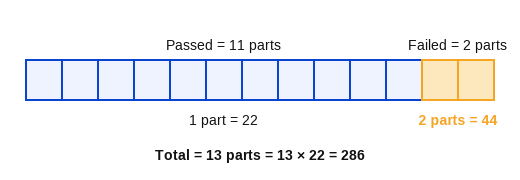
In a class, the ratio of students who passed to those who failed is 11:2. If 44 students failed, what is the total number of students in the class?
एक कक्षा में, उत्तीर्ण होने वाले विद्यार्थियों और अनुत्तीर्ण होने वाले विद्यार्थियों का अनुपात 11:2 है। यदि 44 विद्यार्थी अनुत्तीर्ण हुए, तो कक्षा में विद्यार्थियों की कुल संख्या कितनी है?
  1. A284
  2. B282
  3. C286
  4. D280
Show answer

Concept: In a ratio, find the value of 1 part from the known quantity, then multiply by total parts.

  1. Passed : Failed =11:2; total parts =13.
  2. Failed =2 parts =44⇒1 part =22.
  3. Total students =13×22=286

Trick: Total must be a multiple of 13 → only 286 (13×22) fits.

Answer: (C) 286

अवधारणा: अनुपात में ज्ञात राशि से 1 भाग का मान निकालें, फिर कुल भागों से गुणा करें।

  1. उत्तीर्ण : अनुत्तीर्ण =11:2; कुल भाग =13.
  2. अनुत्तीर्ण =2 भाग =44⇒1 भाग =22.
  3. कुल छात्र =13×22=286

ट्रिक: कुल संख्या 13 का गुणज होनी चाहिए → केवल 286 (13×22) सही बैठता है।

उत्तर: (C) 286

RRB NTPC Undergraduate CBT 1MathematicsRatioRRB NTPC Undergraduate CBT 1 2025 · 17 Jun Shift 1 →
Q12630.
The sum of two positive numbers is 31 and their product is 220. The positive difference between them is:
दो धनात्मक संख्याओं का योग 31 है और उनका गुणनफल 220 है। उनके बीच का धनात्मक अंतर है:
  1. A13
  2. B9
  3. C25
  4. D26
Show answer

Concept: (a−b)2=(a+b)2−4ab.

  1. (a−b)2=312−4×220=961−880=81
  2. a−b=81=9
  3. Check: numbers are 20 and 11 (20+11=31, 20×11=220).

Trick: Factor 220 into a pair adding to 31 → 20×11 → difference 9.

Answer: (B) 9

अवधारणा: (a−b)2=(a+b)2−4ab.

  1. (a−b)2=312−4×220=961−880=81
  2. a−b=81=9
  3. जाँच: संख्याएँ 20 और 11 (20+11=31, 20×11=220)।

ट्रिक: 220 के ऐसे गुणनखंड चुनें जिनका योग 31 हो → 20×11 → अंतर 9.

उत्तर: (B) 9

RRB NTPC Undergraduate CBT 1MathematicsAlgebraic IdentitiesRRB NTPC Undergraduate CBT 1 2025 · 17 Jun Shift 1 →
Q12631.
A person covers a certain distance. If he reduces his speed by 25%, by what percentage does the time taken to cover the same distance increase? (Rounded off to two decimal places)
एक व्यक्ति एक निश्चित दूरी तय करता है। यदि वह अपनी चाल 25% कम कर दे, तो उसी दूरी को तय करने में लगने वाले समय में कितने प्रतिशत की वृद्धि होगी? (दो दशमलव स्थानों तक पूर्णांकित)
  1. A25.67%
  2. B30.67%
  3. C20.33%
  4. D33.33%
Show answer

Concept: For a fixed distance, time ∝1speed.

  1. New speed =34 of original.
  2. New time =43 of original.
  3. Increase =4−33×100=1003=33.33%

Trick: If speed falls by x%, time rises by x100−x×100=2575×100=33.33%.

Answer: (D) 33.33%

अवधारणा: निश्चित दूरी के लिए समय ∝1चाल.

  1. नई चाल = मूल का 34.
  2. नया समय = मूल का 43.
  3. वृद्धि =4−33×100=1003=33.33%

ट्रिक: चाल x% घटे तो समय x100−x×100=2575×100=33.33% बढ़ता है।

उत्तर: (D) 33.33%

RRB NTPC Undergraduate CBT 1MathematicsSpeed and TimeRRB NTPC Undergraduate CBT 1 2025 · 17 Jun Shift 1 →
Q12632.
The present age of Mohit is three times the present age of his son Rahul. After 12 years from now, Mohit’s age will be twice Rahul’s age. What is the sum of their present ages (in years)?
मोहित की वर्तमान आयु उसके पुत्र राहुल की वर्तमान आयु की तीन गुनी है। अब से 12 वर्ष बाद, मोहित की आयु राहुल की आयु की दोगुनी होगी। उनकी वर्तमान आयु का योग (वर्षों में) कितना है?
  1. A48
  2. B50
  3. C46
  4. D44
Show answer

Concept: Let the son's present age be x; form the equation for the future condition.

  1. Rahul =x, Mohit =3x.
  2. After 12 years: 3x+12=2(x+12)⇒x=12.
  3. Mohit =36, sum =36+12=48 years.

Trick: Check options: sum must split as 1:3 → 48 gives 12 and 36; after 12 years 48 and 24 ✔.

Answer: (A) 48

अवधारणा: पुत्र की वर्तमान आयु x मानें और भविष्य की शर्त से समीकरण बनाएँ।

  1. राहुल =x, मोहित =3x.
  2. 12 वर्ष बाद: 3x+12=2(x+12)⇒x=12.
  3. मोहित =36, योग =36+12=48 वर्ष।

ट्रिक: विकल्प जाँचें: योग 1:3 में बँटे → 48 से 12 व 36; 12 वर्ष बाद 48 व 24 ✔.

उत्तर: (A) 48

RRB NTPC Undergraduate CBT 1MathematicsProblems on AgesRRB NTPC Undergraduate CBT 1 2025 · 17 Jun Shift 1 →
Q12633.
A local library purchased several biography books and mystery novels for their new collection. The library spent exactly ₹4,800 on biography books and ₹4,800 on mystery novels. Each biography book costs ₹40 more than a mystery novel. The library was able to buy 10 more mystery novels than biography books. Find the number of biography books purchased.
एक स्थानीय पुस्तकालय ने अपने नए संग्रह के लिए कई जीवनी पुस्तकें और रहस्य उपन्यास खरीदे। पुस्तकालय ने जीवनी पुस्तकों पर ठीक ₹4,800 और रहस्य उपन्यासों पर ₹4,800 खर्च किए। प्रत्येक जीवनी पुस्तक का मूल्य एक रहस्य उपन्यास से ₹40 अधिक है। पुस्तकालय जीवनी पुस्तकों की तुलना में 10 अधिक रहस्य उपन्यास खरीद सका। खरीदी गई जीवनी पुस्तकों की संख्या ज्ञात कीजिए।
  1. A18
  2. B24
  3. C21
  4. D30
Show answer

Concept: Number of items =Total costPrice per item; form an equation from the difference in counts.

  1. Let mystery novel price =x, biography price =x+40.
  2. 4800x−4800x+40=10⇒4800×40=10x(x+40)
  3. x2+40x−19200=0⇒(x+160)(x−120)=0⇒x=120
  4. Biography price =160 → books =4800160=30 (mystery =40 ✔).

Trick: Test options: 30 books → ₹160 each; 40 novels → ₹120 each; difference ₹40 ✔.

Answer: (D) 30

अवधारणा: वस्तुओं की संख्या =कुल लागतप्रति वस्तु मूल्य; संख्याओं के अंतर से समीकरण बनाएँ।

  1. रहस्य उपन्यास का मूल्य =x, जीवनी का मूल्य =x+40.
  2. 4800x−4800x+40=10⇒4800×40=10x(x+40)
  3. x2+40x−19200=0⇒(x+160)(x−120)=0⇒x=120
  4. जीवनी का मूल्य =160 → पुस्तकें =4800160=30 (उपन्यास =40 ✔)।

ट्रिक: विकल्प जाँचें: 30 पुस्तकें → ₹160 प्रति; 40 उपन्यास → ₹120 प्रति; अंतर ₹40 ✔.

उत्तर: (D) 30

RRB NTPC Undergraduate CBT 1MathematicsQuadratic Word ProblemRRB NTPC Undergraduate CBT 1 2025 · 17 Jun Shift 1 →
Q12634.
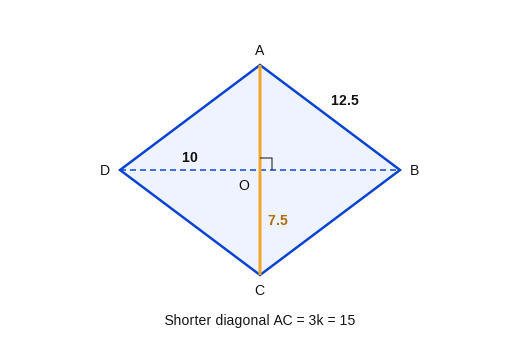
The diagonals of a rhombus are in the ratio 3 :4. If the length of each side of the rhombus is 12.5 units, what is the length of the shorter diagonal?
एक समचतुर्भुज के विकर्णों का अनुपात 3 :4 है। यदि समचतुर्भुज की प्रत्येक भुजा की लंबाई 12.5 इकाई है, तो छोटे विकर्ण की लंबाई कितनी है?
  1. A10 units10 इकाई
  2. B12 units12 इकाई
  3. C18 units18 इकाई
  4. D15 units15 इकाई
Show answer

Concept: Diagonals of a rhombus bisect each other at right angles: side2=(d12)2+(d22)2.

  1. Let diagonals be 3k and 4k; halves 1.5k and 2k.
  2. (1.5k)2+(2k)2=(12.5)2⇒6.25k2=156.25⇒k=5
  3. Shorter diagonal =3k=15 units.

Trick: Half-diagonals and side form a 3:4:5 triangle → 5 parts =12.5, so half-diagonals are 7.5 and 10.

Answer: (D) 15 units

अवधारणा: समचतुर्भुज के विकर्ण एक-दूसरे को समकोण पर समद्विभाजित करते हैं: भुजा2=(d12)2+(d22)2.

  1. विकर्ण 3k और 4k; आधे 1.5k और 2k.
  2. (1.5k)2+(2k)2=(12.5)2⇒6.25k2=156.25⇒k=5
  3. छोटा विकर्ण =3k=15 इकाई।

ट्रिक: आधे विकर्ण व भुजा 3:4:5 त्रिभुज बनाते हैं → 5 भाग =12.5, अतः आधे विकर्ण 7.5 व 10.

उत्तर: (D) 15 इकाई

RRB NTPC Undergraduate CBT 1MathematicsRhombusRRB NTPC Undergraduate CBT 1 2025 · 17 Jun Shift 1 →
Q12635.
A trader buys an article, spends ₹50 on its repair, and sells it for ₹600, making a 25% profit. What was the original purchase price?
एक व्यापारी एक वस्तु खरीदता है, उसकी मरम्मत पर ₹50 खर्च करता है, और उसे ₹600 में बेचकर 25% लाभ अर्जित करता है। वस्तु का मूल क्रय मूल्य कितना था?
  1. A₹480
  2. B₹430
  3. C₹400
  4. D₹450
Show answer

Concept: Repair cost is part of the cost price: CP=SP×100100+Profit%.

  1. Total CP =600×100125=480.
  2. Purchase price =480−50=430.

Trick: 25% profit → SP=54CP → CP=45×600=480; remove repair ₹50.

Answer: (B) ₹430

अवधारणा: मरम्मत खर्च क्रय मूल्य में जुड़ता है: CP=SP×100100+लाभ%.

  1. कुल CP =600×100125=480.
  2. मूल क्रय मूल्य =480−50=430.

ट्रिक: 25% लाभ → SP=54CP → CP=45×600=480; मरम्मत के ₹50 घटाएँ।

उत्तर: (B) ₹430

RRB NTPC Undergraduate CBT 1MathematicsProfit and LossRRB NTPC Undergraduate CBT 1 2025 · 17 Jun Shift 1 →
Q12636.
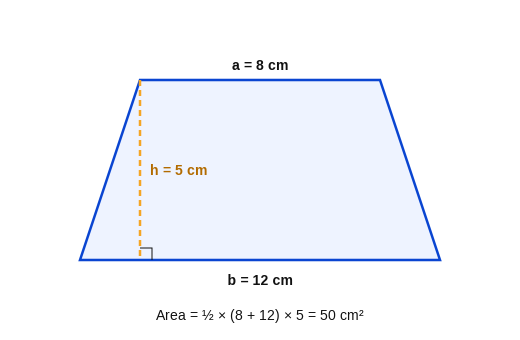
If a trapezium has bases of lengths 8 cm and 12 cm, and height of 5 cm, what is its area?
यदि एक समलंब की समांतर भुजाओं (आधारों) की लंबाई 8 cm और 12 cm है, और ऊँचाई 5 cm है, तो उसका क्षेत्रफल कितना है?
  1. A45 cm²
  2. B50 cm²
  3. C40 cm²
  4. D60 cm²
Show answer

Concept: Area of trapezium =12×(sum of parallel sides)×height.

  1. Sum of bases =8+12=20cm.
  2. Area =12×20×5=50cm2

Trick: Average base × height =10×5=50.

Answer: (B) 50cm2

अवधारणा: समलंब का क्षेत्रफल =12×(समांतर भुजाओं का योग)×ऊँचाई.

  1. आधारों का योग =8+12=20cm.
  2. क्षेत्रफल =12×20×5=50cm2

ट्रिक: औसत आधार × ऊँचाई =10×5=50.

उत्तर: (B) 50cm2

RRB NTPC Undergraduate CBT 1MathematicsArea of TrapeziumRRB NTPC Undergraduate CBT 1 2025 · 17 Jun Shift 1 →
Q12637.
In a batch of 50 managers and supervisors, the average monthly salary of managers is ₹48,000 and that of supervisors is ₹42,000. If the overall monthly average salary of the batch is ₹44,400, find the number of supervisors in the batch.
50 प्रबंधकों और पर्यवेक्षकों के एक बैच में, प्रबंधकों का औसत मासिक वेतन ₹48,000 है और पर्यवेक्षकों का ₹42,000 है। यदि बैच का कुल औसत मासिक वेतन ₹44,400 है, तो बैच में पर्यवेक्षकों की संख्या ज्ञात कीजिए।
  1. A33
  2. B24
  3. C27
  4. D30
Show answer

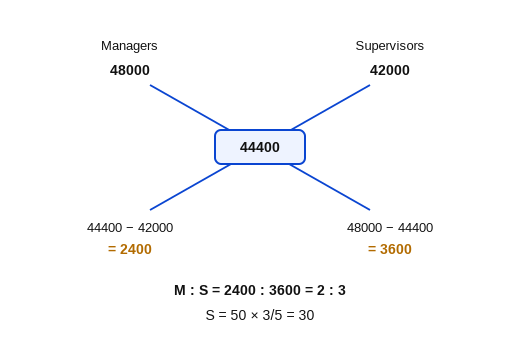
Concept: Alligation: ratio of quantities = (opposite differences from the mean).

  1. Managers : Supervisors =(44400−42000):(48000−44400)=2400:3600=2:3.
  2. Supervisors =50×35=30.
  3. Check: 20×48000+30×4200050=44400 ✔

Trick: Mean is closer to 42000, so supervisors are more than half → 30.

Answer: (D) 30

अवधारणा: एलीगेशन: मात्राओं का अनुपात = औसत से विपरीत अंतरों का अनुपात।

  1. मैनेजर : सुपरवाइज़र =(44400−42000):(48000−44400)=2400:3600=2:3.
  2. सुपरवाइज़र =50×35=30.
  3. जाँच: 20×48000+30×4200050=44400 ✔

ट्रिक: औसत 42000 के अधिक निकट है, अतः सुपरवाइज़र आधे से अधिक → 30.

उत्तर: (D) 30

RRB NTPC Undergraduate CBT 1MathematicsAverage – AlligationRRB NTPC Undergraduate CBT 1 2025 · 17 Jun Shift 1 →
Q12638.
Simplify: (1918÷196)÷(518×1615+46)+68÷2425 of 258
सरल कीजिए: (1918÷196)÷(518×1615+46)+68÷2425 of 258
  1. A1
  2. B34
  3. C3152
  4. D3154
Show answer

Concept: BODMAS – brackets first, then 'of', then division/multiplication, then addition.

  1. 1918÷196=1918×619=13
  2. 518×1615+46=827+1827=2627
  3. 13÷2627=926; and 2425 of 258=3, so 68÷3=14.
  4. 926+14=18+1352=3152

Trick: 'of' is solved before ÷ – the most common trap in such questions.

Answer: (C) 3152

अवधारणा: BODMAS – पहले कोष्ठक, फिर 'of' (का), फिर भाग/गुणा, फिर जोड़।

  1. 1918÷196=1918×619=13
  2. 518×1615+46=827+1827=2627
  3. 13÷2627=926; तथा 2425 of 258=3, अतः 68÷3=14.
  4. 926+14=18+1352=3152

ट्रिक: 'of' को ÷ से पहले हल करें – ऐसे प्रश्नों का सबसे आम जाल।

उत्तर: (C) 3152

RRB NTPC Undergraduate CBT 1MathematicsSimplification (fractions)RRB NTPC Undergraduate CBT 1 2025 · 17 Jun Shift 1 →
Q12639.
A mobile phone is marked at ₹8,000. If two successive discounts of 15% and 10% are given, what is the selling price?
एक मोबाइल फ़ोन का अंकित मूल्य ₹8,000 है। यदि 15% और 10% की दो क्रमागत छूट दी जाती हैं, तो विक्रय मूल्य कितना है?
  1. A₹6,120
  2. B₹6,200
  3. C₹6,160
  4. D₹6,180
Show answer

Concept: SP=MP×(1−d1100)(1−d2100).

  1. After 15%: 8000×0.85=6800.
  2. After 10%: 6800×0.9=6120.

Trick: Net discount =15+10−15×10100=23.5% → 8000×0.765=6120.

Answer: (A) ₹6,120

अवधारणा: SP=MP×(1−d1100)(1−d2100).

  1. 15% के बाद: 8000×0.85=6800.
  2. 10% के बाद: 6800×0.9=6120.

ट्रिक: कुल छूट =15+10−15×10100=23.5% → 8000×0.765=6120.

उत्तर: (A) ₹6,120

RRB NTPC Undergraduate CBT 1MathematicsSuccessive DiscountsRRB NTPC Undergraduate CBT 1 2025 · 17 Jun Shift 1 →
Q12640.
If 2cotA=4, find the value of cosec2A+1cosec2A−1
यदि 2cotA=4 है, तो cosec2A+1cosec2A−1 का मान ज्ञात कीजिए।
  1. A1.5
  2. B1
  3. C4
  4. D2.5
Show answer

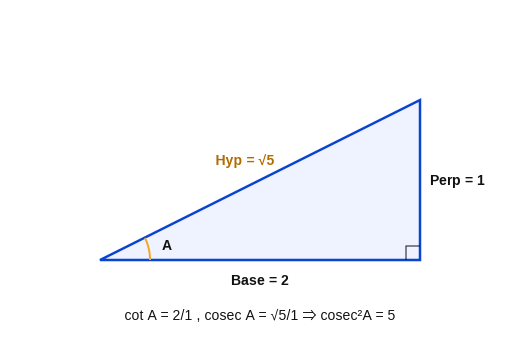
Concept: cosec2A=1+cot2A.

  1. 2cotA=4⇒cotA=2.
  2. cosec2A=1+4=5.
  3. 5+15−1=64=1.5

Trick: Expression =2+cot2Acot2A=2+44=1.5 directly.

Answer: (A) 1.5

अवधारणा: cosec2A=1+cot2A.

  1. 2cotA=4⇒cotA=2.
  2. cosec2A=1+4=5.
  3. 5+15−1=64=1.5

ट्रिक: व्यंजक =2+cot2Acot2A=2+44=1.5 सीधे।

उत्तर: (A) 1.5

RRB NTPC Undergraduate CBT 1MathematicsTrigonometric IdentitiesRRB NTPC Undergraduate CBT 1 2025 · 17 Jun Shift 1 →