Question bank

Q&A: practice questions with answers

Search questions on any topic. Filter by exam category, exam, subject and topic, try the question, then open the answer and explanation.

Courses – airGurukul

20,719 questions found.

Q12641.
If the third proportional to 0.8 and 5.6 is n, then what is the value of n?
यदि 0.8 और 5.6 का तृतीयानुपाती n है, तो n का मान क्या है?
  1. A39.2
  2. B0.84
  3. C31.36
  4. D4.48
Show answer

Concept: Third proportional to a and b is b2a (since a:b=b:n).

  1. n=5.620.8=31.360.8
  2. n=39.2

Trick: 5.60.8=7, so n=5.6×7=39.2.

Answer: (A) 39.2

अवधारणा: a और b का तृतीय समानुपाती =b2a (क्योंकि a:b=b:n)।

  1. n=5.620.8=31.360.8
  2. n=39.2

ट्रिक: 5.60.8=7, अतः n=5.6×7=39.2.

उत्तर: (A) 39.2

RRB NTPC Undergraduate CBT 1MathematicsThird ProportionalRRB NTPC Undergraduate CBT 1 2025 · 17 Jun Shift 1 →
Q12642.
The value of {18 + [24 ÷ (3 of 2)] × 4} − 10 is equal to:
{18 + [24 ÷ (3 of 2)] × 4} − 10 का मान किसके बराबर है?
  1. A40
  2. B28
  3. C24
  4. D72
Show answer

Concept: BODMAS with 'of' solved before division.

  1. 3 of 2=6; 24÷6=4.
  2. 4×4=16; 18+16=34.
  3. 34−10=24

Trick: If you do 24÷3×2 instead of using 'of', you get 72 – a trap option.

Answer: (C) 24

अवधारणा: BODMAS – 'of' को भाग से पहले हल करें।

  1. 3 of 2=6; 24÷6=4.
  2. 4×4=16; 18+16=34.
  3. 34−10=24

ट्रिक: 'of' छोड़कर 24÷3×2 करने पर 72 आता है – यह जाल विकल्प है।

उत्तर: (C) 24

RRB NTPC Undergraduate CBT 1MathematicsSimplification (BODMAS)RRB NTPC Undergraduate CBT 1 2025 · 17 Jun Shift 1 →
Q12643.
The ratio of the heights of Shyam and Manish is 7 : 8. If Shyam’s height is 140 cm, who is taller and by how much?
श्याम और मनीष की ऊँचाइयों का अनुपात 7 : 8 है। यदि श्याम की ऊँचाई 140 cm है, तो कौन लंबा है और कितना?
  1. AManish is taller by 10 cmमनीष 10 cm लंबा है
  2. BManish is taller by 20 cmमनीष 20 cm लंबा है
  3. CShyam is taller by 20 cmश्याम 20 cm लंबा है
  4. DShyam is taller by 10 cmश्याम 10 cm लंबा है
Show answer

Concept: Find 1 part from the known height.

  1. Shyam =7 parts =140⇒1 part =20cm.
  2. Manish =8×20=160cm.
  3. Manish is taller by 160−140=20cm.

Trick: Difference is 1 part =1407=20, and the bigger ratio term (8) belongs to Manish.

Answer: (B) Manish is taller by 20 cm

अवधारणा: ज्ञात ऊँचाई से 1 भाग का मान निकालें।

  1. श्याम =7 भाग =140⇒1 भाग =20cm.
  2. मनीष =8×20=160cm.
  3. मनीष 160−140=20cm लंबा है।

ट्रिक: अंतर = 1 भाग =1407=20, और बड़ा पद (8) मनीष का है।

उत्तर: (B) मनीष 20 cm लंबा है

RRB NTPC Undergraduate CBT 1MathematicsRatioRRB NTPC Undergraduate CBT 1 2025 · 17 Jun Shift 1 →
Q12644.
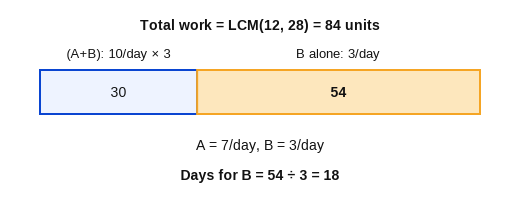
A and B can do a piece of work in 12 days and 28 days, respectively. Both work for 3 days and then A leaves. How long (in days) will B take to complete the remaining work?
A और B किसी काम को क्रमशः 12 दिन और 28 दिन में कर सकते हैं। दोनों 3 दिन तक काम करते हैं और फिर A काम छोड़ देता है। B शेष काम को पूरा करने में कितना समय (दिनों में) लेगा?
  1. A20
  2. B19
  3. C18
  4. D17
Show answer

Concept: Take total work = LCM of days; efficiency =workdays.

  1. Work =LCM(12,28)=84; A =7/day, B =3/day.
  2. In 3 days together: 3×10=30 units.
  3. Remaining =54 units; B alone: 543=18 days.

Trick: Fractions: 3(112+128)=514; rest 914×28=18.

Answer: (C) 18

अवधारणा: कुल कार्य = दिनों का LCM; दक्षता =कार्यदिन.

  1. कार्य =LCM(12,28)=84; A =7/दिन, B =3/दिन।
  2. 3 दिन साथ में: 3×10=30 इकाई।
  3. शेष =54 इकाई; B अकेला: 543=18 दिन।

ट्रिक: भिन्न से: 3(112+128)=514; शेष 914×28=18.

उत्तर: (C) 18

RRB NTPC Undergraduate CBT 1MathematicsTime and WorkRRB NTPC Undergraduate CBT 1 2025 · 17 Jun Shift 1 →
Q12645.
The price of a trouser is first increased by 20% and then decreased by 25%. What is the net percentage change in the price?
एक पतलून के मूल्य में पहले 20% की वृद्धि की जाती है और फिर 25% की कमी की जाती है। मूल्य में शुद्ध प्रतिशत परिवर्तन कितना है?
  1. A5% decrease5% कमी
  2. B5% increase5% वृद्धि
  3. C10% decrease10% कमी
  4. D10% increase10% वृद्धि
Show answer

Concept: Net change =a+b+ab100 (use − sign for decrease).

  1. a=+20, b=−25.
  2. Net =20−25−20×25100=−5−5=−10%

Trick: 100→120→90 → 10% decrease.

Answer: (C) 10% decrease

अवधारणा: कुल परिवर्तन =a+b+ab100 (कमी के लिए ऋण चिह्न)।

  1. a=+20, b=−25.
  2. कुल =20−25−20×25100=−5−5=−10%

ट्रिक: 100→120→90 → 10% कमी।

उत्तर: (C) 10% कमी

RRB NTPC Undergraduate CBT 1MathematicsSuccessive Percentage ChangeRRB NTPC Undergraduate CBT 1 2025 · 17 Jun Shift 1 →
Q12646.
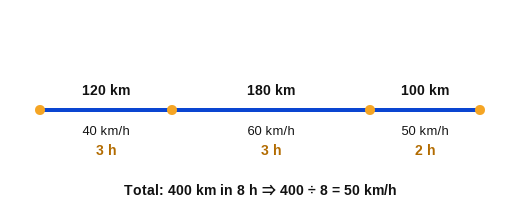
A car travels 120 km at 40 km/h, 180 km at 60 km/h, and 100 km at 50 km/h. What is the average speed of the car for the entire journey?
एक कार 120 km की दूरी 40 km/h से, 180 km की दूरी 60 km/h से, और 100 km की दूरी 50 km/h से तय करती है। पूरी यात्रा के लिए कार की औसत चाल कितनी है?
  1. A50 km/h
  2. B48 km/h
  3. C55 km/h
  4. D45 km/h
Show answer

Concept: Average speed =Total distanceTotal time (not the average of speeds).

  1. Times: 12040=3, 18060=3, 10050=2 hours.
  2. Total distance =400km, total time =8h.
  3. Average speed =4008=50km/h

Trick: Never take 40+60+503 blindly – here it also gives 50 only by coincidence.

Answer: (A) 50km/h

अवधारणा: औसत चाल =कुल दूरीकुल समय (चालों का औसत नहीं)।

  1. समय: 12040=3, 18060=3, 10050=2 घंटे।
  2. कुल दूरी =400km, कुल समय =8h.
  3. औसत चाल =4008=50km/h

ट्रिक: 40+60+503 सीधे न लें – यहाँ भी 50 आना केवल संयोग है।

उत्तर: (A) 50km/h

RRB NTPC Undergraduate CBT 1MathematicsAverage SpeedRRB NTPC Undergraduate CBT 1 2025 · 17 Jun Shift 1 →
Q12647.
If a car travels 120 km using 8 liters of petrol, how much petrol will be required to travel 225 km?
यदि एक कार 8 लीटर पेट्रोल का उपयोग करके 120 km की दूरी तय करती है, तो 225 km की दूरी तय करने के लिए कितने पेट्रोल की आवश्यकता होगी?
  1. A16 liters16 लीटर
  2. B17 liters17 लीटर
  3. C15 liters15 लीटर
  4. D18 liters18 लीटर
Show answer

Concept: Petrol used is directly proportional to distance.

  1. Mileage =1208=15km per litre.
  2. Petrol for 225 km =22515=15 litres.

Trick: 225120=158 → 8×158=15.

Answer: (C) 15 liters

अवधारणा: पेट्रोल की खपत दूरी के समानुपाती है।

  1. माइलेज =1208=15km प्रति लीटर।
  2. 225 km के लिए पेट्रोल =22515=15 लीटर।

ट्रिक: 225120=158 → 8×158=15.

उत्तर: (C) 15 लीटर

RRB NTPC Undergraduate CBT 1MathematicsUnitary MethodRRB NTPC Undergraduate CBT 1 2025 · 17 Jun Shift 1 →
Q12648.
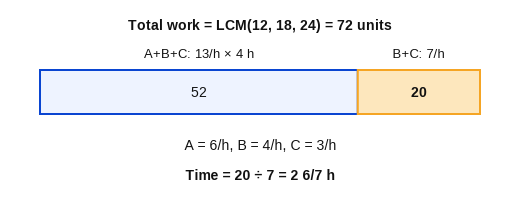
Three friends, Amit, Bharat, and Chitra, can individually complete a painting project in 12 hours, 18 hours, and 24 hours, respectively. If they all work together for 4 hours and then Amit leaves, how many hours will Bharat and Chitra take to finish the remaining work?
तीन मित्र, अमित, भरत और चित्रा, एक पेंटिंग परियोजना को अकेले-अकेले क्रमशः 12 घंटे, 18 घंटे और 24 घंटे में पूरा कर सकते हैं। यदि वे सभी 4 घंटे तक एक साथ काम करते हैं और फिर अमित चला जाता है, तो भरत और चित्रा को शेष काम पूरा करने में कितने घंटे लगेंगे?
  1. A267 hours267 घंटे
  2. B257 hours257 घंटे
  3. C367 hours367 घंटे
  4. D357 hours357 घंटे
Show answer

Concept: Total work = LCM of times; efficiency =worktime.

  1. Work =LCM(12,18,24)=72; A =6, B =4, C =3 units/h.
  2. 4 hours together: 4×13=52 units.
  3. Remaining =20 units; B + C =7 units/h.
  4. Time =207=267 hours.

Trick: 207 lies between 2 and 3 → only (A) or (B); 20=2×7+6 → 267.

Answer: (A) 267 hours

अवधारणा: कुल कार्य = समयों का LCM; दक्षता =कार्यसमय.

  1. कार्य =LCM(12,18,24)=72; A =6, B =4, C =3 इकाई/घंटा।
  2. 4 घंटे साथ में: 4×13=52 इकाई।
  3. शेष =20 इकाई; B + C =7 इकाई/घंटा।
  4. समय =207=267 घंटे।

ट्रिक: 207 2 और 3 के बीच है → केवल (A) या (B); 20=2×7+6 → 267.

उत्तर: (A) 267 घंटे

RRB NTPC Undergraduate CBT 1MathematicsTime and WorkRRB NTPC Undergraduate CBT 1 2025 · 17 Jun Shift 1 →
Q12649.
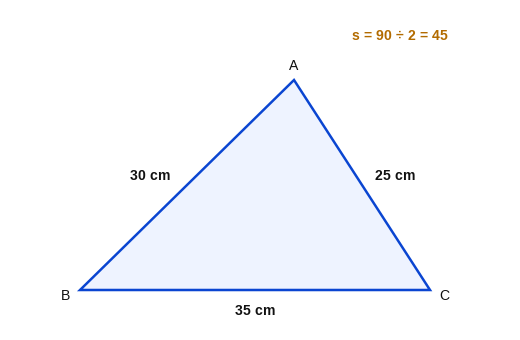
The sides of a triangle are in the ratio 5:6:7 and its perimeter is 90 cm. What is the area of this triangle (in square cm)?
एक त्रिभुज की भुजाओं का अनुपात 5:6:7 है और उसका परिमाप 90 cm है। इस त्रिभुज का क्षेत्रफल (वर्ग cm में) कितना है?
  1. A1503cm2
  2. B1406cm2
  3. C1507cm2
  4. D1506cm2
Show answer

Concept: Heron's formula: Area =s(s−a)(s−b)(s−c), s=a+b+c2.

  1. Sides =5k+6k+7k=90⇒k=5 → 25,30,35cm.
  2. s=45; s−a=20, s−b=15, s−c=10.
  3. Area =45×20×15×10=135000=22500×6=1506

Trick: For ratio 5:6:7, area =66k2=66×25=1506.

Answer: (D) 1506cm2

अवधारणा: हीरोन का सूत्र: क्षेत्रफल =s(s−a)(s−b)(s−c), s=a+b+c2.

  1. भुजाएँ =5k+6k+7k=90⇒k=5 → 25,30,35cm.
  2. s=45; s−a=20, s−b=15, s−c=10.
  3. क्षेत्रफल =45×20×15×10=135000=22500×6=1506

ट्रिक: अनुपात 5:6:7 के लिए क्षेत्रफल =66k2=66×25=1506.

उत्तर: (D) 1506cm2

RRB NTPC Undergraduate CBT 1MathematicsHeron's FormulaRRB NTPC Undergraduate CBT 1 2025 · 17 Jun Shift 1 →
Q12650.
What is the mode of the following data: 12, 15, 18, 18, 20, 18, 22, 22, 25, 28, 22, 15, 18, 12?
निम्नलिखित आँकड़ों का बहुलक (mode) क्या है: 12, 15, 18, 18, 20, 18, 22, 22, 25, 28, 22, 15, 18, 12?
  1. A22
  2. B18
  3. C15
  4. D12
Show answer

Concept: Mode is the value that occurs most often.

  1. Frequencies: 12 → 2, 15 → 2, 18 → 4, 20 → 1, 22 → 3, 25 → 1, 28 → 1.
  2. 18 occurs the maximum (4) times.

Trick: Only compare the repeated values – 18 (4 times) beats 22 (3 times).

Answer: (B) 18

अवधारणा: बहुलक (Mode) वह मान है जो सबसे अधिक बार आता है।

  1. बारंबारता: 12 → 2, 15 → 2, 18 → 4, 20 → 1, 22 → 3, 25 → 1, 28 → 1.
  2. 18 सबसे अधिक (4) बार आता है।

ट्रिक: केवल दोहराए गए मानों की तुलना करें – 18 (4 बार), 22 (3 बार) से आगे है।

उत्तर: (B) 18

RRB NTPC Undergraduate CBT 1MathematicsModeRRB NTPC Undergraduate CBT 1 2025 · 17 Jun Shift 1 →
Q12651.
Two successive price increases of 15% and 15% on an article are equivalent to a single percentage increase of:
किसी वस्तु के मूल्य में 15% और 15% की दो क्रमागत वृद्धियाँ कितने प्रतिशत की एकल वृद्धि के समतुल्य हैं?
  1. A31%
  2. B30%
  3. C32.25%
  4. D31.5%
Show answer

Concept: Equivalent single change =a+b+ab100.

  1. a=b=15.
  2. 15+15+15×15100=30+2.25=32.25%

Trick: 1.152=1.3225 → 32.25% increase.

Answer: (C) 32.25%

अवधारणा: समतुल्य एकल परिवर्तन =a+b+ab100.

  1. a=b=15.
  2. 15+15+15×15100=30+2.25=32.25%

ट्रिक: 1.152=1.3225 → 32.25% वृद्धि।

उत्तर: (C) 32.25%

RRB NTPC Undergraduate CBT 1MathematicsSuccessive Percentage ChangeRRB NTPC Undergraduate CBT 1 2025 · 17 Jun Shift 1 →
Q12652.
An investment triples in 6 years under compound interest. After how many years will it become 27 times?
चक्रवृद्धि ब्याज पर एक निवेश 6 वर्षों में तीन गुना हो जाता है। कितने वर्षों बाद यह 27 गुना हो जाएगा?
  1. A24 years24 वर्ष
  2. B15 years15 वर्ष
  3. C21 years21 वर्ष
  4. D18 years18 वर्ष
Show answer

Concept: Under CI, if money becomes x times in n years, it becomes xk times in kn years.

  1. 3 times in 6 years.
  2. 27=33 → time =3×6=18 years.

Trick: CI multiplies: ×3 every 6 years → 1→3→9→27 (3 steps = 18 years).

Answer: (D) 18 years

अवधारणा: चक्रवृद्धि ब्याज में यदि धन n वर्ष में x गुना हो, तो kn वर्ष में xk गुना होगा।

  1. 6 वर्ष में 3 गुना।
  2. 27=33 → समय =3×6=18 वर्ष।

ट्रिक: हर 6 वर्ष में ×3 → 1→3→9→27 (3 चरण = 18 वर्ष)।

उत्तर: (D) 18 वर्ष

RRB NTPC Undergraduate CBT 1MathematicsCompound Interest (multiples)RRB NTPC Undergraduate CBT 1 2025 · 17 Jun Shift 1 →
Q12653.
If the ratio of two numbers is 3 : 8, and their HCF is 6, then their LCM is:
यदि दो संख्याओं का अनुपात 3 : 8 है, और उनका HCF 6 है, तो उनका LCM है:
  1. A155
  2. B189
  3. C148
  4. D144
Show answer

Concept: If numbers are in ratio a:b (co-prime) with HCF h, numbers are ha, hb and LCM =h×a×b.

  1. Numbers =6×3=18 and 6×8=48.
  2. LCM =6×3×8=144

Trick: LCM must be a multiple of 6 and 8 (i.e. of 24) → only 144 fits.

Answer: (D) 144

अवधारणा: यदि संख्याएँ a:b (सह-अभाज्य) में हों और HCF h हो, तो संख्याएँ ha, hb तथा LCM =h×a×b.

  1. संख्याएँ =6×3=18 और 6×8=48.
  2. LCM =6×3×8=144

ट्रिक: LCM, 6 और 8 (अर्थात 24) का गुणज होना चाहिए → केवल 144.

उत्तर: (D) 144

RRB NTPC Undergraduate CBT 1MathematicsHCF and LCMRRB NTPC Undergraduate CBT 1 2025 · 17 Jun Shift 1 →
Q12654.
A two-digit number is such that four times the sum of its digits is equal to the number formed by reversing its digits. If the difference between the digits is 3, find the original number.
एक दो-अंकीय संख्या ऐसी है कि उसके अंकों के योग का चार गुना, उसके अंकों को उलटने से बनी संख्या के बराबर है। यदि अंकों के बीच का अंतर 3 है, तो मूल संख्या ज्ञात कीजिए।
  1. A63
  2. B96
  3. C69
  4. D36
Show answer

Concept: Number =10a+b, reversed =10b+a.

  1. 4(a+b)=10b+a⇒3a=6b⇒a=2b.
  2. a−b=3⇒b=3, a=6.
  3. Number =63; check: 4×9=36 ✔

Trick: Test options: only 63 gives 4×(6+3)=36 = its reverse.

Answer: (A) 63

अवधारणा: संख्या =10a+b, उलटी संख्या =10b+a.

  1. 4(a+b)=10b+a⇒3a=6b⇒a=2b.
  2. a−b=3⇒b=3, a=6.
  3. संख्या =63; जाँच: 4×9=36 ✔

ट्रिक: विकल्प जाँचें: केवल 63 में 4×(6+3)=36 = उलटी संख्या।

उत्तर: (A) 63

RRB NTPC Undergraduate CBT 1MathematicsNumber System – DigitsRRB NTPC Undergraduate CBT 1 2025 · 17 Jun Shift 1 →
Q12655.
A trader buys 20 kg of rice for ₹1,000 and sells it at ₹55 per kg. What is the profit percentage?
एक व्यापारी 20 kg चावल ₹1,000 में खरीदता है और उसे ₹55 प्रति kg की दर से बेचता है। लाभ प्रतिशत कितना है?
  1. A12%
  2. B10%
  3. C8%
  4. D15%
Show answer

Concept: Profit%=SP−CPCP×100.

  1. CP per kg =100020=50.
  2. Profit per kg =55−50=5.
  3. Profit%=550×100=10%

Trick: Total SP =20×55=1100 → ₹100 profit on ₹1000 = 10%.

Answer: (B) 10%

अवधारणा: लाभ%=SP−CPCP×100.

  1. प्रति kg CP =100020=50.
  2. प्रति kg लाभ =55−50=5.
  3. लाभ%=550×100=10%

ट्रिक: कुल SP =20×55=1100 → ₹1000 पर ₹100 लाभ = 10%.

उत्तर: (B) 10%

RRB NTPC Undergraduate CBT 1MathematicsProfit PercentageRRB NTPC Undergraduate CBT 1 2025 · 17 Jun Shift 1 →
Q12656.
Which of the following letter-number clusters will replace the question mark (?) in the given series to make it logically complete?
DIXC 6 JNBF 12 PSFI 18 VXJL 24 BCNO 30 ?
निम्नलिखित में से कौन-सा अक्षर-संख्या समूह दी गई शृंखला में प्रश्न चिह्न (?) के स्थान पर आकर उसे तार्किक रूप से पूर्ण करेगा?
DIXC 6 JNBF 12 PSFI 18 VXJL 24 BCNO 30 ?
  1. AHIRS 34
  2. BIISS 34
  3. CHHRR 36
  4. DIHSR 36
Show answer

Concept: Track each letter position and the number separately.

  1. 1st letters: D, J, P, V, B, H – each +6 (V → B wraps round).
  2. 2nd letters: I, N, S, X, C, H – each +5.
  3. 3rd letters: X, B, F, J, N, R – each +4; 4th letters: C, F, I, L, O, R – each +3.
  4. Numbers: 6, 12, 18, 24, 30, 36 – each +6. So the term is HHRR 36.

Trick: Letter steps +6,+5,+4,+3 fall by one from left to right.

Answer: (C) HHRR 36

अवधारणा: प्रत्येक अक्षर की स्थिति और संख्या को अलग-अलग देखें।

  1. पहले अक्षर: D, J, P, V, B, H – हर बार +6 (V के बाद B, क्रम घूमता है)।
  2. दूसरे अक्षर: I, N, S, X, C, H – हर बार +5।
  3. तीसरे अक्षर: X, B, F, J, N, R – +4; चौथे अक्षर: C, F, I, L, O, R – +3।
  4. संख्याएँ: 6, 12, 18, 24, 30, 36 – +6। अतः पद HHRR 36 है।

ट्रिक: अक्षरों का अंतर बाएँ से दाएँ +6,+5,+4,+3 घटता है।

उत्तर: (C) HHRR 36

RRB NTPC Undergraduate CBT 1General Intelligence and ReasoningLetter-Number SeriesRRB NTPC Undergraduate CBT 1 2025 · 17 Jun Shift 1 →
Q12657.
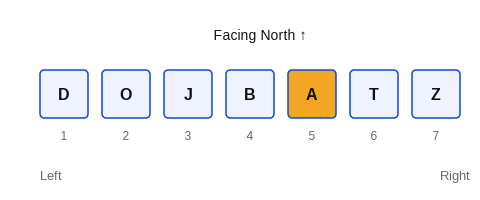
Seven people A, B, D, J, O, T and Z are sitting in a row, facing north. Only three people sit to the left of B. Only Z sits to the right of T. Only three people sit between T and O. J sits at some place to the left of A but at some place to the right of D. Who sits
immediately to the right of B?
सात व्यक्ति A, B, D, J, O, T और Z एक पंक्ति में उत्तर की ओर मुख करके बैठे हैं। B के बाईं ओर केवल तीन व्यक्ति बैठे हैं। T के दाईं ओर केवल Z बैठा है। T और O के बीच केवल तीन व्यक्ति बैठे हैं। J, A के बाईं ओर किसी स्थान पर, किंतु D के दाईं ओर किसी स्थान पर बैठा है। B के
ठीक दाईं ओर कौन बैठा है?
  1. AT
  2. BO
  3. CZ
  4. DA
Show answer

Concept: Fix the definite positions first (seats 1–7 from left, all facing north).

  1. Three people left of B → B is 4th.
  2. Only Z is right of T → T = 6th, Z = 7th.
  3. Three people between T and O → O = 2nd.
  4. D, J, A fill seats 1, 3, 5 with D left of J left of A → D = 1, J = 3, A = 5.
  5. Immediately right of B (4th) is A (5th).

Trick: Start with ‘only’ clues – they lock seats at the ends.

Answer: (D) A

अवधारणा: पहले निश्चित स्थान तय करें (बाएँ से सीट 1–7, सभी उत्तर की ओर मुख)।

  1. B के बाएँ तीन व्यक्ति → B चौथे स्थान पर।
  2. T के दाएँ केवल Z → T = 6, Z = 7।
  3. T और O के बीच तीन व्यक्ति → O = 2।
  4. D, J, A सीट 1, 3, 5 पर, क्रम D, J, A → D = 1, J = 3, A = 5।
  5. B (4) के ठीक दाएँ A (5) है।

ट्रिक: 'केवल' वाले संकेत पहले लगाएँ – वे सिरों की सीटें तय कर देते हैं।

उत्तर: (D) A

RRB NTPC Undergraduate CBT 1General Intelligence and ReasoningLinear Seating ArrangementRRB NTPC Undergraduate CBT 1 2025 · 17 Jun Shift 1 →
Q12658.
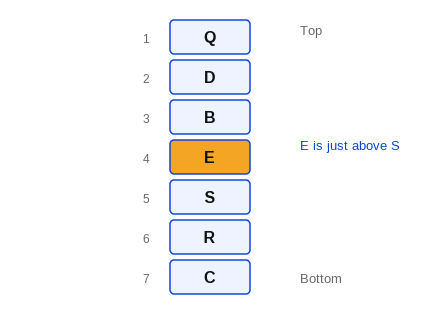
Seven boxes B, C, D, E, Q, R and S are kept one over the other but not necessarily in the same order. No box is kept below C. Only two boxes are kept between E and C. Only Q is kept above D. S is kept at some place below B but at some place above R. Which box is kept immediately above S?
सात बॉक्स B, C, D, E, Q, R और S एक के ऊपर एक रखे गए हैं, लेकिन जरूरी नहीं कि इसी क्रम में हों। C के नीचे कोई बॉक्स नहीं रखा गया है। E और C के बीच केवल दो बॉक्स रखे गए हैं। D के ऊपर केवल Q रखा गया है। S, B के नीचे किसी स्थान पर, किंतु R के ऊपर किसी स्थान पर रखा गया है। S के ठीक ऊपर कौन-सा बॉक्स रखा गया है?
  1. AR
  2. BD
  3. CB
  4. DE
Show answer

Concept: Number the positions 1 (top) to 7 (bottom) and place definite boxes first.

  1. No box below C → C = 7 (bottom).
  2. Two boxes between E and C → E = 4.
  3. Only Q above D → Q = 1, D = 2.
  4. S below B and above R: positions 3, 5, 6 left → B = 3, S = 5, R = 6.
  5. Box immediately above S (5) is E (4).

Trick: ‘No box below X’ = X at bottom; ‘only Q above D’ = Q top, D second.

Answer: (D) E

अवधारणा: स्थान 1 (ऊपर) से 7 (नीचे) तक लें और पहले निश्चित बॉक्स रखें।

  1. C के नीचे कोई बॉक्स नहीं → C = 7 (सबसे नीचे)।
  2. E और C के बीच दो बॉक्स → E = 4।
  3. D के ऊपर केवल Q → Q = 1, D = 2।
  4. S, B के नीचे और R के ऊपर: बचे स्थान 3, 5, 6 → B = 3, S = 5, R = 6।
  5. S (5) के ठीक ऊपर E (4) है।

ट्रिक: 'X के नीचे कोई नहीं' = X सबसे नीचे; 'D के ऊपर केवल Q' = Q सबसे ऊपर, D दूसरा।

उत्तर: (D) E

RRB NTPC Undergraduate CBT 1General Intelligence and ReasoningBox ArrangementRRB NTPC Undergraduate CBT 1 2025 · 17 Jun Shift 1 →
Q12659.
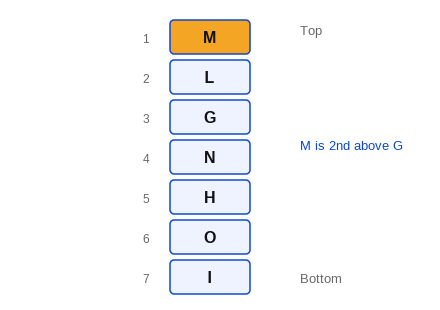
Seven boxes, G, H, I, L, M, N and O, are kept one over the other, but not necessarily in the same order.
No box is kept above M. Only two boxes are kept between L and H. Only three boxes are kept between M and H. N is kept immediately above H. Only four boxes are kept between L and I. G is kept at some place above O.
Which box is kept second above G?
सात बॉक्स, G, H, I, L, M, N और O, एक के ऊपर एक रखे गए हैं, लेकिन जरूरी नहीं कि इसी क्रम में हों।
M के ऊपर कोई बॉक्स नहीं रखा गया है। L और H के बीच केवल दो बॉक्स रखे गए हैं। M और H के बीच केवल तीन बॉक्स रखे गए हैं। N, H के ठीक ऊपर रखा गया है। L और I के बीच केवल चार बॉक्स रखे गए हैं। G, O के ऊपर किसी स्थान पर रखा गया है।
G के ऊपर दूसरे स्थान पर कौन-सा बॉक्स रखा गया है?
  1. AH
  2. BL
  3. CM
  4. DO
Show answer

Concept: Number positions 1 (top) to 7 (bottom).

  1. No box above M → M = 1.
  2. Three boxes between M and H → H = 5; N immediately above H → N = 4.
  3. Two boxes between L and H → L = 2 (8 is not possible).
  4. Four boxes between L and I → I = 7.
  5. G above O in the remaining 3 and 6 → G = 3, O = 6. Second above G (3) is position 1 = M.

Trick: Chain the ‘between’ clues from the fixed box M: M → H → L → I.

Answer: (C) M

अवधारणा: स्थान 1 (ऊपर) से 7 (नीचे) तक लें।

  1. M के ऊपर कोई नहीं → M = 1।
  2. M और H के बीच तीन बॉक्स → H = 5; N, H के ठीक ऊपर → N = 4।
  3. L और H के बीच दो बॉक्स → L = 2 (8 संभव नहीं)।
  4. L और I के बीच चार बॉक्स → I = 7।
  5. बचे स्थान 3 और 6 में G, O के ऊपर → G = 3, O = 6। G (3) से दूसरा ऊपर स्थान 1 = M।

ट्रिक: निश्चित बॉक्स M से 'बीच' वाले संकेत जोड़ते जाएँ: M → H → L → I।

उत्तर: (C) M

RRB NTPC Undergraduate CBT 1General Intelligence and ReasoningBox ArrangementRRB NTPC Undergraduate CBT 1 2025 · 17 Jun Shift 1 →
Q12660.
Based on the English alphabetical order, three of the following four letter-cluster pairs are alike in a certain way and thus form a group. Which is the one that does not belong to that group?
(Note: The odd one out is not based on the number of consonants/vowels or their position in the letter cluster.)
अंग्रेज़ी वर्णमाला क्रम के आधार पर, निम्नलिखित चार अक्षर-समूह युग्मों में से तीन किसी निश्चित प्रकार से एक समान हैं और इस प्रकार एक समूह बनाते हैं। कौन-सा युग्म उस समूह से संबंधित नहीं है?
(ध्यान दें: असंगत अक्षर-समूह, उस अक्षर-समूह में व्यंजनों/स्वरों की संख्या या उनके स्थान पर आधारित नहीं है।)
  1. AHV - KT
  2. BOA - RY
  3. CSZ - VW
  4. DYT - BR
Show answer

Concept: Compare 1st letters of the two parts and 2nd letters of the two parts.

  1. HV – KT: H+3=K, V−2=T.
  2. OA – RY: O+3=R, A−2=Y; YT – BR: Y+3=B, T−2=R.
  3. SZ – VW: S+3=V but Z−3=W (not −2).
  4. So SZ – VW is the odd one.

Trick: Pattern (+3,−2); the alphabet wraps (Y → B, A → Y).

Answer: (C) SZ - VW

अवधारणा: दोनों भागों के पहले अक्षरों और दूसरे अक्षरों की तुलना करें।

  1. HV – KT: H+3=K, V−2=T।
  2. OA – RY: O+3=R, A−2=Y; YT – BR: Y+3=B, T−2=R।
  3. SZ – VW: S+3=V पर Z−3=W (−2 नहीं)।
  4. अतः SZ – VW विषम है।

ट्रिक: पैटर्न (+3,−2); वर्णमाला चक्रीय है (Y → B, A → Y)।

उत्तर: (C) SZ - VW

RRB NTPC Undergraduate CBT 1General Intelligence and ReasoningOdd One Out – Letter PairsRRB NTPC Undergraduate CBT 1 2025 · 17 Jun Shift 1 →