Question bank

Q&A: practice questions with answers

Search questions on any topic. Filter by exam category, exam, subject and topic, try the question, then open the answer and explanation.

Courses – airGurukul

20,719 questions found.

Q12761.
In a certain code language, ‘rest restores energy’ is coded as ‘rk fj mg’ and ‘positive energy attracts’ is coded as ‘tw es fj’. How is ‘energy’ coded in the given language?
एक निश्चित कूट भाषा में, ‘rest restores energy’ को ‘rk fj mg’ के रूप में कूटबद्ध किया जाता है और ‘positive energy attracts’ को ‘tw es fj’ के रूप में कूटबद्ध किया जाता है। दी गई भाषा में ‘energy’ को किस प्रकार कूटबद्ध किया जाता है?
  1. Ark
  2. Bes
  3. Cmg
  4. Dfj
Show answer

Concept: A word common to two sentences takes the code common to both.

  1. 'energy' appears in both: 'rest restores energy' and 'positive energy attracts'.
  2. Common code in 'rk fj mg' and 'tw es fj' is 'fj'.

Trick: Match the common word with the common code.

Answer: (D) fj

अवधारणा: दो वाक्यों में समान शब्द का कोड भी दोनों में समान होगा।

  1. 'energy' दोनों में है: 'rest restores energy' और 'positive energy attracts'।
  2. 'rk fj mg' और 'tw es fj' में समान कोड 'fj' है।

ट्रिक: समान शब्द ↔ समान कोड।

उत्तर: (D) fj
RRB NTPC Undergraduate CBT 1General Intelligence and ReasoningCoding–decoding (word codes)RRB NTPC Undergraduate CBT 1 2025 · 16 Jun Shift 3 →
Q12762.
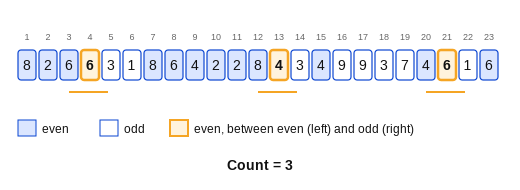
Refer to the following series and answer the question. (Counting to be done from left to right only.) (All numbers are single-digit numbers only.)
(Left) 8 2 6 6 3 1 8 6 4 2 2 8 4 3 4 9 9 3 7 4 6 1 6 (Right)
How many such even digits are there, each of which is immediately preceded by an even digit and also immediately followed by an odd digit?
निम्नलिखित शृंखला का संदर्भ लीजिए और प्रश्न का उत्तर दीजिए। (गिनती केवल बाएँ से दाएँ की जानी है।) (सभी संख्याएँ केवल एक-अंकीय संख्याएँ हैं।)
(बाएँ) 8 2 6 6 3 1 8 6 4 2 2 8 4 3 4 9 9 3 7 4 6 1 6 (दाएँ)
ऐसे कितने सम अंक हैं, जिनमें से प्रत्येक के ठीक पहले एक सम अंक है और ठीक बाद एक विषम अंक भी है?
  1. ANoneकोई नहीं
  2. BTwoदो
  3. CThreeतीन
  4. DOneएक
Show answer

Concept: Scan for the pattern Even – Even – Odd and count the middle digit.

  1. Position 4: 6 → 6 before (even), 3 after (odd) ✓
  2. Position 13: 4 → 8 before, 3 after ✓
  3. Position 21: 6 → 4 before, 1 after ✓
  4. No other even digit has an even neighbour before and an odd one after.

Trick: First mark every odd digit, then look only at the digit just before it.

Answer: (C) Three

अवधारणा: सम – सम – विषम पैटर्न खोजें और बीच वाले अंक गिनें।

  1. स्थान 4: 6 → पहले 6 (सम), बाद में 3 (विषम) ✓
  2. स्थान 13: 4 → पहले 8, बाद में 3 ✓
  3. स्थान 21: 6 → पहले 4, बाद में 1 ✓
  4. किसी अन्य सम अंक के पहले सम और बाद में विषम अंक नहीं है।

ट्रिक: पहले सभी विषम अंक चिह्नित करें, फिर केवल उनके ठीक पहले वाला अंक देखें।

उत्तर: (C) तीन

RRB NTPC Undergraduate CBT 1General Intelligence and ReasoningNumber series – digit conditionsRRB NTPC Undergraduate CBT 1 2025 · 16 Jun Shift 3 →
Q12763.
Based on the English alphabetical order, three of the following four letter-cluster pairs are alike in a certain way and thus form a group. Which letter-cluster pair DOES NOT belong to that group?
(Note: The odd one out is not based on the number of consonants/vowels or their position in the letter-cluster.)
अंग्रेज़ी वर्णमाला क्रम के आधार पर, निम्नलिखित चार अक्षर-समूह युग्मों में से तीन किसी निश्चित प्रकार से समान हैं और इस प्रकार एक समूह बनाते हैं। कौन-सा अक्षर-समूह युग्म उस समूह से संबंधित नहीं है?
(ध्यान दें: असंगत अक्षर-समूह, उस अक्षर-समूह में व्यंजनों/स्वरों की संख्या या उनके स्थान पर आधारित नहीं है।)
  1. ATL - NX
  2. BNF - HR
  3. CJB - DN
  4. DDV - PH
Show answer

Concept: Compare the letter positions within each cluster.

  1. TL – NX: 20→12 (−8), 14→24 (+10).
  2. NF – HR: 14→6 (−8), 8→18 (+10); JB – DN: 10→2 (−8), 4→14 (+10).
  3. DV – PH: 4→22 (+18), 16→8 (−8) – pattern differs.

Trick: Also, first letters T→N, N→H, J→D drop by 6, but D→P does not.

Answer: (D) DV - PH

अवधारणा: हर क्लस्टर के अक्षरों के स्थान की तुलना करें।

  1. TL – NX: 20→12 (−8), 14→24 (+10)।
  2. NF – HR: 14→6 (−8), 8→18 (+10); JB – DN: 10→2 (−8), 4→14 (+10)।
  3. DV – PH: 4→22 (+18), 16→8 (−8) – पैटर्न अलग।

ट्रिक: पहले अक्षर T→N, N→H, J→D में 6 घटता है, D→P में नहीं।

उत्तर: (D) DV - PH

RRB NTPC Undergraduate CBT 1General Intelligence and ReasoningOdd one out – letter pairsRRB NTPC Undergraduate CBT 1 2025 · 16 Jun Shift 3 →
Q12764.
Based on the English alphabetical order, three of the following four are alike in a certain way and thus form a group. Which is the one that does not belong to that group? (Note: The odd man out is not based on the number of consonants/vowels or their position in the letter cluster.)
अंग्रेज़ी वर्णमाला क्रम के आधार पर, निम्नलिखित चार में से तीन किसी निश्चित प्रकार से समान हैं और इस प्रकार एक समूह बनाते हैं। वह कौन-सा है जो उस समूह से संबंधित नहीं है? (ध्यान दें: असंगत, अक्षर-समूह में व्यंजनों/स्वरों की संख्या या उनके स्थान पर आधारित नहीं है।)
  1. ALIH
  2. BCAY
  3. CYVU
  4. DRON
Show answer

Concept: Find the gaps between consecutive letters.

  1. LIH: 12→9→8 (−3,−1); YVU: 25→22→21 (−3,−1); RON: 18→15→14 (−3,−1).
  2. CAY: 3→1→25 (−2,−2 with wrap-around) – different.

Trick: Write the alphabet numbers once; the three matching clusters show the same gaps.

Answer: (B) CAY

अवधारणा: क्रमागत अक्षरों के बीच का अंतर देखें।

  1. LIH: 12→9→8 (−3,−1); YVU: 25→22→21 (−3,−1); RON: 18→15→14 (−3,−1)।
  2. CAY: 3→1→25 (−2,−2, घूमकर) – अलग।

ट्रिक: अक्षरों के क्रमांक एक बार लिख लें; तीन समूहों में एक-सा अंतर दिखेगा।

उत्तर: (B) CAY

RRB NTPC Undergraduate CBT 1General Intelligence and ReasoningOdd one out – letter clustersRRB NTPC Undergraduate CBT 1 2025 · 16 Jun Shift 3 →
Q12765.
What should come in place of ‘?’ in the given series?
56 57 ? 70 86 111
दी गई शृंखला में ‘?’ के स्थान पर क्या आना चाहिए?
56 57 ? 70 86 111
  1. A63
  2. B61
  3. C62
  4. D64
Show answer

Concept: Differences are perfect squares 12,22,32,42,52.

  1. 56+1=57
  2. 57+4=61
  3. 61+9=70, 70+16=86, 86+25=111 ✓

Trick: Check from the end: 111−86=25, 86−70=16 → squares, so ?=70−9.

Answer: (B) 61

अवधारणा: अंतर पूर्ण वर्ग हैं: 12,22,32,42,52।

  1. 56+1=57
  2. 57+4=61
  3. 61+9=70, 70+16=86, 86+25=111 ✓

ट्रिक: पीछे से जाँचें: 111−86=25, 86−70=16 → वर्ग, अतः ?=70−9।

उत्तर: (B) 61

RRB NTPC Undergraduate CBT 1General Intelligence and ReasoningNumber series – squaresRRB NTPC Undergraduate CBT 1 2025 · 16 Jun Shift 3 →
Q12766.
Based on the alphabetical order, three of the following four are alike in a certain way and thus form a group. Which is the one that does not belong to that group?
(Note: The odd man out is not based on the number of consonants/vowels or their position in the letter cluster.)
वर्णमाला क्रम के आधार पर, निम्नलिखित चार में से तीन किसी निश्चित प्रकार से समान हैं और इस प्रकार एक समूह बनाते हैं। वह कौन-सा है जो उस समूह से संबंधित नहीं है?
(ध्यान दें: असंगत, अक्षर-समूह में व्यंजनों/स्वरों की संख्या या उनके स्थान पर आधारित नहीं है।)
  1. ADGI
  2. BLOQ
  3. CZDE
  4. DUXZ
Show answer

Concept: Find the gaps between consecutive letters.

  1. DGI: 4→7→9 (+3,+2); LOQ: 12→15→17 (+3,+2); UXZ: 21→24→26 (+3,+2).
  2. ZDE: 26→4→5 (+4,+1 with wrap-around) – different.

Trick: Use EJOTY (5,10,15,20,25) to read letter positions fast.

Answer: (C) ZDE

अवधारणा: क्रमागत अक्षरों के बीच का अंतर देखें।

  1. DGI: 4→7→9 (+3,+2); LOQ: 12→15→17 (+3,+2); UXZ: 21→24→26 (+3,+2)।
  2. ZDE: 26→4→5 (+4,+1, घूमकर) – अलग।

ट्रिक: अक्षरों के स्थान जल्दी पढ़ने के लिए EJOTY (5,10,15,20,25) याद रखें।

उत्तर: (C) ZDE

RRB NTPC Undergraduate CBT 1General Intelligence and ReasoningOdd one out – letter clustersRRB NTPC Undergraduate CBT 1 2025 · 16 Jun Shift 3 →
Q12767.
Refer to the following letter series and answer the question that follows.
(Left) X P S A D U G L O E J F K I M C R T Q (Right)
How many letters are there in the English alphabetical series between the letter which is fifth from the right end and third from the left end of the series?
निम्नलिखित अक्षर शृंखला का संदर्भ लीजिए और उसके बाद दिए गए प्रश्न का उत्तर दीजिए।
(बाएँ) X P S A D U G L O E J F K I M C R T Q (दाएँ)
अंग्रेज़ी वर्णमाला शृंखला में उस अक्षर, जो शृंखला के दाएँ छोर से पाँचवाँ है, और उस अक्षर, जो बाएँ छोर से तीसरा है, के बीच कितने अक्षर हैं?
  1. AFiveपाँच
  2. BSixछह
  3. CFourचार
  4. DSevenसात
Show answer

Concept: Locate the two letters, then count the letters strictly between them in A–Z.

  1. From the right: Q, T, R, C, M → 5th from right is M.
  2. From the left: X, P, S → 3rd from left is S.
  3. Between M(13) and S(19) in the alphabet: N, O, P, Q, R → 19−13−1=5.

Trick: Letters between two positions = difference −1.

Answer: (A) Five

अवधारणा: दोनों अक्षर ढूँढें, फिर A–Z में उनके बीच के अक्षर गिनें।

  1. दाएँ से: Q, T, R, C, M → दाएँ से 5वाँ M।
  2. बाएँ से: X, P, S → बाएँ से तीसरा S।
  3. वर्णमाला में M(13) और S(19) के बीच: N, O, P, Q, R → 19−13−1=5।

ट्रिक: दो स्थानों के बीच अक्षर = अंतर −1।

उत्तर: (A) पाँच

RRB NTPC Undergraduate CBT 1General Intelligence and ReasoningLetter series – positionRRB NTPC Undergraduate CBT 1 2025 · 16 Jun Shift 3 →
Q12768.
Each of the digits in the number 3184657 is arranged in ascending order from left to right. The position(s) of how many digits will remain unchanged as compared to that in the original number?
संख्या 3184657 के प्रत्येक अंक को बाएँ से दाएँ आरोही क्रम में व्यवस्थित किया जाता है। मूल संख्या की तुलना में कितने अंकों का/के स्थान अपरिवर्तित रहेगा/रहेंगे?
  1. AOneएक
  2. BThreeतीन
  3. CNoneकोई नहीं
  4. DTwoदो
Show answer

Concept: Write the digits in ascending order under the original number and compare place by place.

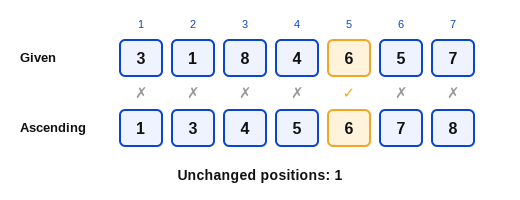
  1. Original: 3 1 8 4 6 5 7
  2. Ascending: 1 3 4 5 6 7 8
  3. Same place: only 6 (5th place) → one digit.

Trick: Only the digits that are already in their 'sorted' place stay unchanged – compare column-wise.

Answer: (A) One

अवधारणा: मूल संख्या के नीचे अंक आरोही क्रम में लिखें और स्थान-दर-स्थान तुलना करें।

  1. मूल: 3 1 8 4 6 5 7
  2. आरोही: 1 3 4 5 6 7 8
  3. समान स्थान: केवल 6 (5वाँ स्थान) → एक अंक।

ट्रिक: केवल वही अंक अपरिवर्तित रहते हैं जो पहले से अपने 'क्रमित' स्थान पर हैं – कॉलम-वार मिलाएँ।

उत्तर: (A) एक

RRB NTPC Undergraduate CBT 1General Intelligence and ReasoningDigit arrangementRRB NTPC Undergraduate CBT 1 2025 · 16 Jun Shift 3 →
Q12769.
In a certain code language, 'PWEA' is coded as '90' and 'QAMT’ is coded as '102'. What is the code for 'LJCV' in the given code language?
एक निश्चित कूट भाषा में, 'PWEA' को '90' के रूप में और 'QAMT' को '102' के रूप में कूटबद्ध किया जाता है। उसी कूट भाषा में 'LJCV' के लिए कूट क्या है?
  1. A91
  2. B94
  3. C86
  4. D97
Show answer

Concept: Code =2×(sum of alphabet positions).

  1. PWEA: 16+23+5+1=45, 45×2=90 ✓
  2. QAMT: 17+1+13+20=51, 51×2=102 ✓
  3. LJCV: 12+10+3+22=47, 47×2=94.

Trick: Both codes are even and roughly double the letter sum – test ×2 first.

Answer: (B) 94

अवधारणा: कोड =2×(अक्षरों के स्थानों का योग)।

  1. PWEA: 16+23+5+1=45, 45×2=90 ✓
  2. QAMT: 17+1+13+20=51, 51×2=102 ✓
  3. LJCV: 12+10+3+22=47, 47×2=94।

ट्रिक: दोनों कोड सम हैं और अक्षर-योग के लगभग दुगने – पहले ×2 जाँचें।

उत्तर: (B) 94

RRB NTPC Undergraduate CBT 1General Intelligence and ReasoningCoding – letter sumRRB NTPC Undergraduate CBT 1 2025 · 16 Jun Shift 3 →
Q12770.
Seven people P1, P2, P3, P4, P5, P6 and P7 are sitting around a circular table facing towards the centre of the table. P5 sits to the immediate left of P6. There are exactly two people between P1 and P6 when checked from right of P6. P3 is sitting immediately between P2 and P1. P7 is sitting immediately between P4 and P5. How many people are sitting between P4 and P6 when checked from left of P6?
सात व्यक्ति P1, P2, P3, P4, P5, P6 और P7 एक वृत्ताकार मेज़ के चारों ओर मेज़ के केंद्र की ओर मुख करके बैठे हैं। P5, P6 के ठीक बाएँ बैठा है। P6 के दाएँ से देखने पर P1 और P6 के बीच ठीक दो व्यक्ति हैं। P3, P2 और P1 के ठीक बीच में बैठा है। P7, P4 और P5 के ठीक बीच में बैठा है। P6 के बाएँ से देखने पर P4 और P6 के बीच कितने व्यक्ति बैठे हैं?
  1. AThreeतीन
  2. BFourचार
  3. CTwoदो
  4. DOneएक
Show answer

Concept: Facing the centre: left = clockwise, right = anticlockwise.

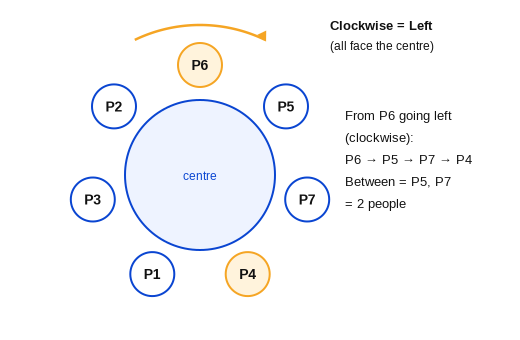
  1. P5 is immediate left of P6. Going right from P6, two people are skipped and P1 comes 3rd.
  2. P7 sits between P4 and P5, so the order to the left of P6 is P5, P7, P4.
  3. P3 between P2 and P1 fills the rest: P6, P5, P7, P4, P1, P3, P2 (clockwise).
  4. From P6 going left to P4: P5 and P7 lie between → 2.

Trick: Fix P6 first and place every person relative to it.

Answer: (C) Two

अवधारणा: केंद्र की ओर मुख होने पर: बायाँ = दक्षिणावर्त (clockwise), दायाँ = वामावर्त।

  1. P5, P6 के ठीक बाएँ है। P6 के दाएँ से दो लोगों के बाद तीसरा P1 है।
  2. P7, P4 और P5 के बीच है, इसलिए P6 के बाएँ क्रम P5, P7, P4 है।
  3. P3, P2 और P1 के बीच → बाकी स्थान भरें: P6, P5, P7, P4, P1, P3, P2 (दक्षिणावर्त)।
  4. P6 के बाएँ से P4 तक: बीच में P5 और P7 → 2।

ट्रिक: पहले P6 को स्थिर करें और बाकी सबको उसके सापेक्ष रखें।

उत्तर: (C) दो

RRB NTPC Undergraduate CBT 1General Intelligence and ReasoningCircular seating arrangementRRB NTPC Undergraduate CBT 1 2025 · 16 Jun Shift 3 →
Q12771.
Select the triad that follows the same pattern as the one followed by the two triads given below. Both triads follow the same pattern.
LG - OJ - QS
OJ - RM - TV
उस त्रिक का चयन कीजिए जो उसी पैटर्न का अनुसरण करता है जिसका अनुसरण नीचे दिए गए दो त्रिक करते हैं। दोनों त्रिक एक ही पैटर्न का अनुसरण करते हैं।
LG - OJ - QS
OJ - RM - TV
  1. AID - LG - NO
  2. BJD - LG - NO
  3. CJD - LH - NO
  4. DID - LG - NP
Show answer

Concept: Find the shift from each pair to the next.

  1. LG → OJ: +3,+3; OJ → QS: +2,+9 (O→Q, J→S).
  2. OJ → RM: +3,+3; RM → TV: +2,+9 ✓ same pattern.
  3. ID → LG (+3,+3) → NP (+2: L→N; +9: G→P). Options with NO fail because G +9 is P, not O.

Trick: The only difference between A and D is the last letter – check G +9.

Answer: (D) ID - LG - NP

अवधारणा: हर युग्म से अगले युग्म तक का खिसकाव देखें।

  1. LG → OJ: +3,+3; OJ → QS: +2,+9 (O→Q, J→S)।
  2. OJ → RM: +3,+3; RM → TV: +2,+9 ✓ समान पैटर्न।
  3. ID → LG (+3,+3) → NP (+2: L→N; +9: G→P)। NO वाले विकल्प गलत हैं क्योंकि G +9 = P है, O नहीं।

ट्रिक: A और D में अंतर केवल अंतिम अक्षर का है – G +9 जाँचें।

उत्तर: (D) ID - LG - NP

RRB NTPC Undergraduate CBT 1General Intelligence and ReasoningLetter triads – analogyRRB NTPC Undergraduate CBT 1 2025 · 16 Jun Shift 3 →
Q12772.
In a certain code language,
A = B means ‘A is the son of B’,
A $ B means ‘A is the sister of B’,
A @ B means ‘A is the wife of B’ and
A * B means ‘A is the father of B’.
How is W related to G if ‘W = F $ K * L @ G’?
एक निश्चित कूट भाषा में,
A = B का अर्थ है ‘A, B का पुत्र है’,
A $ B का अर्थ है ‘A, B की बहन है’,
A @ B का अर्थ है ‘A, B की पत्नी है’ और
A * B का अर्थ है ‘A, B का पिता है’।
यदि ‘W = F $ K * L @ G’ है, तो W का G से क्या संबंध है?
  1. AFather's sister's sonपिता की बहन का पुत्र
  2. BWife's sister's sonपत्नी की बहन का पुत्र
  3. CWife's father's sister's sonपत्नी के पिता की बहन का पुत्र
  4. DSister's sonबहन का पुत्र
Show answer

Concept: Decode each symbol and read the chain from G's side.

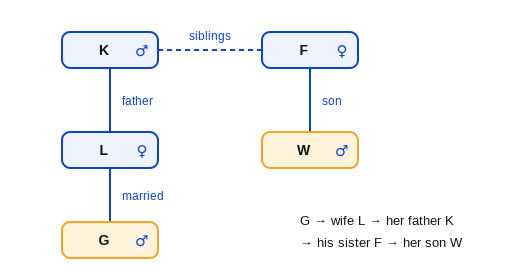
  1. W = F: W is the son of F. F $ K: F is the sister of K.
  2. K * L: K is the father of L. L @ G: L is the wife of G.
  3. From G: wife (L) → her father (K) → his sister (F) → her son (W).

Trick: Start from the person asked about (G) and walk back along the chain.

Answer: (C) Wife's father's sister's son

अवधारणा: हर चिह्न का अर्थ लिखें और G की ओर से शृंखला पढ़ें।

  1. W = F: W, F का पुत्र है। F $ K: F, K की बहन है।
  2. K * L: K, L का पिता है। L @ G: L, G की पत्नी है।
  3. G से: पत्नी (L) → उसके पिता (K) → उनकी बहन (F) → उसका पुत्र (W)।

ट्रिक: जिसके संबंध में पूछा है (G), वहीं से शृंखला उलटी चलें।

उत्तर: (C) पत्नी के पिता की बहन का पुत्र

RRB NTPC Undergraduate CBT 1General Intelligence and ReasoningCoded blood relationsRRB NTPC Undergraduate CBT 1 2025 · 16 Jun Shift 3 →
Q12773.
Which of the following letter-number clusters will replace the question mark (?) in the given series to make it logically complete?
FEL 17, KIQ 21, PMV 25, UQA 29, ?
दी गई शृंखला को तार्किक रूप से पूर्ण करने के लिए निम्नलिखित में से कौन-सा अक्षर-संख्या समूह प्रश्न चिह्न (?) के स्थान पर आएगा?
FEL 17, KIQ 21, PMV 25, UQA 29, ?
  1. AYUF 32
  2. BZUF 33
  3. CZVG 33
  4. DYVG 32
Show answer

Concept: Each position follows its own step.

  1. 1st letters F, K, P, U → +5 → Z.
  2. 2nd letters E, I, M, Q → +4 → U.
  3. 3rd letters L, Q, V, A → +5 → F; number 17, 21, 25, 29 → +4 → 33.

Trick: Number step (+4) equals the middle-letter step – a quick check.

Answer: (B) ZUF 33

अवधारणा: हर स्थान का अपना अंतर है।

  1. पहले अक्षर F, K, P, U → +5 → Z।
  2. दूसरे अक्षर E, I, M, Q → +4 → U।
  3. तीसरे अक्षर L, Q, V, A → +5 → F; संख्या 17, 21, 25, 29 → +4 → 33।

ट्रिक: संख्या का अंतर (+4) बीच वाले अक्षर के अंतर जैसा है – त्वरित जाँच।

उत्तर: (B) ZUF 33

RRB NTPC Undergraduate CBT 1General Intelligence and ReasoningLetter-number seriesRRB NTPC Undergraduate CBT 1 2025 · 16 Jun Shift 3 →
Q12774.
Each of the digits in the number 3219854 is arranged in ascending order from left to right. The position(s) of how many digits will remain unchanged as compared to that in the original number?
संख्या 3219854 के प्रत्येक अंक को बाएँ से दाएँ आरोही क्रम में व्यवस्थित किया जाता है। मूल संख्या की तुलना में कितने अंकों का/के स्थान अपरिवर्तित रहेगा/रहेंगे?
  1. AONEएक
  2. BTHREEतीन
  3. CNONEकोई नहीं
  4. DTWOदो
Show answer

Concept: Write the digits in ascending order under the original number and compare place by place.

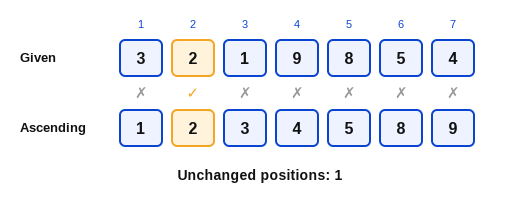
  1. Original: 3 2 1 9 8 5 4
  2. Ascending: 1 2 3 4 5 8 9
  3. Same place: only 2 (2nd place) → one digit.

Trick: Only the digits that are already in their 'sorted' place stay unchanged – compare column-wise.

Answer: (A) ONE

अवधारणा: मूल संख्या के नीचे अंक आरोही क्रम में लिखें और स्थान-दर-स्थान तुलना करें।

  1. मूल: 3 2 1 9 8 5 4
  2. आरोही: 1 2 3 4 5 8 9
  3. समान स्थान: केवल 2 (दूसरा स्थान) → एक अंक।

ट्रिक: केवल वही अंक अपरिवर्तित रहते हैं जो पहले से अपने 'क्रमित' स्थान पर हैं – कॉलम-वार मिलाएँ।

उत्तर: (A) एक

RRB NTPC Undergraduate CBT 1General Intelligence and ReasoningDigit arrangementRRB NTPC Undergraduate CBT 1 2025 · 16 Jun Shift 3 →
Q12775.
DO 9 is related to FL -5 in a certain way. In the same way, EQ 3 is related to GN -11. To which of the following is KH 6 related, following the same logic?
DO 9 एक निश्चित प्रकार से FL -5 से संबंधित है। उसी प्रकार, EQ 3, GN -11 से संबंधित है। समान तर्क का अनुसरण करते हुए, KH 6 निम्नलिखित में से किससे संबंधित है?
  1. AME -8
  2. BGY -11
  3. CIE -7
  4. DNI -14
Show answer

Concept: Apply the same change to each part.

  1. DO 9 → FL −5: D +2 = F, O −3 = L, 9−14=−5.
  2. EQ 3 → GN −11: E +2 = G, Q −3 = N, 3−14=−11 ✓
  3. KH 6 → K +2 = M, H −3 = E, 6−14=−8 → ME −8.

Trick: Number rule −14 alone picks the answer: 6−14=−8.

Answer: (A) ME −8

अवधारणा: हर भाग पर समान बदलाव लगाएँ।

  1. DO 9 → FL −5: D +2 = F, O −3 = L, 9−14=−5।
  2. EQ 3 → GN −11: E +2 = G, Q −3 = N, 3−14=−11 ✓
  3. KH 6 → K +2 = M, H −3 = E, 6−14=−8 → ME −8।

ट्रिक: केवल संख्या नियम −14 से ही उत्तर मिल जाता है: 6−14=−8।

उत्तर: (A) ME −8

RRB NTPC Undergraduate CBT 1General Intelligence and ReasoningAlpha-numeric analogyRRB NTPC Undergraduate CBT 1 2025 · 16 Jun Shift 3 →
Q12776.
MKPT is related to QOTX in a certain way based on the English alphabetical order. In the same way, ENSU is related to IRWY.
To which of the following is DHGR related, following the same logic?
अंग्रेज़ी वर्णमाला क्रम के आधार पर MKPT एक निश्चित प्रकार से QOTX से संबंधित है। उसी प्रकार, ENSU, IRWY से संबंधित है।
समान तर्क का अनुसरण करते हुए, DHGR निम्नलिखित में से किससे संबंधित है?
  1. AHLKV
  2. BHDRG
  3. CFJIT
  4. DQEIY
Show answer

Concept: Each letter moves forward by 4.

  1. MKPT → QOTX: M→Q, K→O, P→T, T→X (+4 each).
  2. ENSU → IRWY: +4 each ✓
  3. DHGR → D+4 = H, H+4 = L, G+4 = K, R+4 = V → HLKV.

Trick: Check only the first letter: D +4 = H leaves A or B; second letter L confirms A.

Answer: (A) HLKV

अवधारणा: हर अक्षर 4 आगे बढ़ता है।

  1. MKPT → QOTX: M→Q, K→O, P→T, T→X (हर एक +4)।
  2. ENSU → IRWY: हर एक +4 ✓
  3. DHGR → D+4 = H, H+4 = L, G+4 = K, R+4 = V → HLKV।

ट्रिक: पहला अक्षर D +4 = H से A या B बचते हैं; दूसरा अक्षर L, A की पुष्टि करता है।

उत्तर: (A) HLKV

RRB NTPC Undergraduate CBT 1General Intelligence and ReasoningLetter analogyRRB NTPC Undergraduate CBT 1 2025 · 16 Jun Shift 3 →
Q12777.
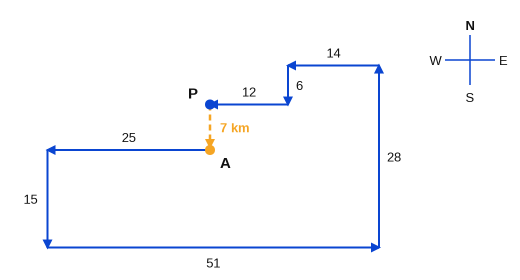
Mr. Vasu starts from Point A and drives 25 km towards the West. He then takes a left turn, drives 15 km, turns left and drives 51 km. He then takes a left turn, drives 28 km, turns left and drives 14 km. He then takes a left turn and drives 6 km. He takes a final right turn, drives 12 km and stops at Point P. How far (shortest distance) and towards which direction should he drive in order to reach Point A again? (All turns are 90-degree turns only unless specified.)
श्री वासु बिंदु A से चलना शुरू करते हैं और पश्चिम की ओर 25 km गाड़ी चलाते हैं। फिर वे बाएँ मुड़ते हैं, 15 km गाड़ी चलाते हैं, बाएँ मुड़ते हैं और 51 km गाड़ी चलाते हैं। फिर वे बाएँ मुड़ते हैं, 28 km गाड़ी चलाते हैं, बाएँ मुड़ते हैं और 14 km गाड़ी चलाते हैं। फिर वे बाएँ मुड़ते हैं और 6 km गाड़ी चलाते हैं। वे अंतिम बार दाएँ मुड़ते हैं, 12 km गाड़ी चलाते हैं और बिंदु P पर रुक जाते हैं। बिंदु A पर फिर से पहुँचने के लिए उन्हें कितनी दूरी (न्यूनतम दूरी) तक और किस दिशा में गाड़ी चलानी चाहिए? (जब तक निर्दिष्ट न हो, सभी मोड़ केवल 90 डिग्री के मोड़ हैं।)
  1. A10 km to the Eastपूर्व की ओर 10 km
  2. B7 km to the Southदक्षिण की ओर 7 km
  3. C9 km to the Westपश्चिम की ओर 9 km
  4. D8 km to the Northउत्तर की ओर 8 km
Show answer

Concept: Track net East–West and North–South movement (take A as origin).

  1. West 25, left → South 15, left → East 51, left → North 28, left → West 14, left → South 6, right → West 12.
  2. East–West: −25+51−14−12=0.
  3. North–South: −15+28−6=+7 → P is 7 km North of A.
  4. To return: 7 km towards the South.

Trick: Sum each axis separately; a zero on one axis means the answer is a straight line on the other.

Answer: (B) 7 km to the South

अवधारणा: कुल पूर्व–पश्चिम और उत्तर–दक्षिण गति निकालें (A को मूल बिंदु मानें)।

  1. पश्चिम 25, बाएँ → दक्षिण 15, बाएँ → पूर्व 51, बाएँ → उत्तर 28, बाएँ → पश्चिम 14, बाएँ → दक्षिण 6, दाएँ → पश्चिम 12।
  2. पूर्व–पश्चिम: −25+51−14−12=0।
  3. उत्तर–दक्षिण: −15+28−6=+7 → P, A से 7 km उत्तर में है।
  4. लौटने के लिए: 7 km दक्षिण की ओर।

ट्रिक: हर अक्ष का योग अलग निकालें; एक अक्ष पर शून्य हो तो उत्तर दूसरे अक्ष पर सीधी दूरी है।

उत्तर: (B) 7 km दक्षिण की ओर

RRB NTPC Undergraduate CBT 1General Intelligence and ReasoningDirection and distanceRRB NTPC Undergraduate CBT 1 2025 · 16 Jun Shift 3 →
Q12778.
Read the given statements and conclusions carefully. Assuming that the information given in the statements is true, even if it appears to be at variance with commonly known facts, decide which of the given conclusions logically follow(s) from the statements.
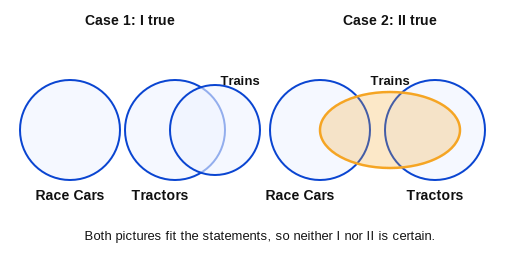
Statement: No Race Cars are Tractors. Some Tractors are Trains.
Conclusion I: No Race Cars are Trains.
Conclusion II: Some Race Cars are Trains.
दिए गए कथन और निष्कर्षों को ध्यानपूर्वक पढ़िए। यह मानते हुए कि कथन में दी गई जानकारी सत्य है, भले ही वह सामान्यतः ज्ञात तथ्यों से भिन्न प्रतीत होती हो, निर्णय लीजिए कि दिए गए निष्कर्षों में से कौन-सा/से निष्कर्ष तार्किक रूप से कथन का अनुसरण करता है/करते हैं।
कथन: कोई भी रेस कार, ट्रैक्टर नहीं है। कुछ ट्रैक्टर, ट्रेन हैं।
निष्कर्ष I: कोई भी रेस कार, ट्रेन नहीं है।
निष्कर्ष II: कुछ रेस कार, ट्रेन हैं।
  1. AOnly conclusion (I) followsकेवल निष्कर्ष (I) अनुसरण करता है
  2. BNeither conclusion (I) nor (II) followsन तो निष्कर्ष (I) और न ही (II) अनुसरण करता है
  3. CBoth conclusions (I) and (II) followदोनों निष्कर्ष (I) और (II) अनुसरण करते हैं
  4. DOnly conclusion (II) followsकेवल निष्कर्ष (II) अनुसरण करता है
Show answer

Concept: A conclusion follows only if it is true in every possible Venn diagram.

  1. Race Cars and Tractors are separate; Trains overlap Tractors.
  2. Trains may or may not overlap Race Cars – both pictures are allowed.
  3. So neither 'No Race Cars are Trains' nor 'Some Race Cars are Trains' is definite.

Trick: 'No' + 'Some' never fixes a definite relation between the two end terms.

Answer: (B) Neither conclusion (I) nor (II) follows

अवधारणा: निष्कर्ष तभी निकलता है जब वह हर संभव वेन आरेख में सत्य हो।

  1. रेस कार और ट्रैक्टर अलग हैं; ट्रेनें ट्रैक्टर से मिलती हैं।
  2. ट्रेनें रेस कार से मिल भी सकती हैं और नहीं भी – दोनों चित्र संभव हैं।
  3. इसलिए 'कोई रेस कार ट्रेन नहीं' और 'कुछ रेस कार ट्रेन हैं' – दोनों में से कोई निश्चित नहीं।

ट्रिक: 'कोई नहीं' + 'कुछ' से अंतिम पदों के बीच कोई निश्चित संबंध नहीं बनता।

उत्तर: (B) न तो निष्कर्ष (I) और न ही (II) अनुसरण करता है

RRB NTPC Undergraduate CBT 1General Intelligence and ReasoningSyllogismRRB NTPC Undergraduate CBT 1 2025 · 16 Jun Shift 3 →
Q12779.
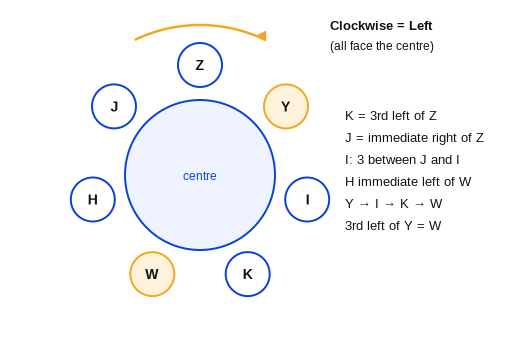
Seven people H, I, J, K, W, Y and Z are sitting around a circular table facing the centre of the table. K sits third to the left of Z. Only two people sit between J and K when counted from the right of J. Only three people sit between J and I. H sits to the immediate left of W. Who sits third to the left of Y?
सात व्यक्ति H, I, J, K, W, Y और Z एक वृत्ताकार मेज़ के चारों ओर मेज़ के केंद्र की ओर मुख करके बैठे हैं। K, Z के बाएँ से तीसरे स्थान पर बैठा है। J के दाएँ से गिनने पर J और K के बीच केवल दो व्यक्ति बैठे हैं। J और I के बीच केवल तीन व्यक्ति बैठे हैं। H, W के ठीक बाएँ बैठा है। Y के बाएँ से तीसरे स्थान पर कौन बैठा है?
  1. AI
  2. BH
  3. CK
  4. DW
Show answer

Concept: Facing the centre: left = clockwise. Place Z first.

  1. K is 3rd to the left of Z. Going right from J, two people are skipped and K is 3rd → J is immediate right of Z.
  2. Three people between J and I → I is 2nd to the left of Z (just before K).
  3. H is immediate left of W → only the seats 4th and 5th left of Z fit: W, then H; Y takes the seat immediately left of Z.
  4. Clockwise from Y: I, K, W → 3rd to the left of Y is W.

Trick: Seven seats: '3rd to the right' = '4th to the left' – use it to cross-check.

Answer: (D) W

अवधारणा: केंद्र की ओर मुख: बायाँ = दक्षिणावर्त। पहले Z को रखें।

  1. K, Z के बाएँ तीसरा है। J के दाएँ से दो लोग छोड़कर तीसरा K → J, Z के ठीक दाएँ है।
  2. J और I के बीच तीन लोग → I, Z के बाएँ दूसरा (K से ठीक पहले)।
  3. H, W के ठीक बाएँ → केवल Z के बाएँ 4था और 5वाँ स्थान बचता है: W फिर H; Y, Z के ठीक बाएँ।
  4. Y से दक्षिणावर्त: I, K, W → Y के बाएँ तीसरा W।

ट्रिक: सात सीटों में 'दाएँ तीसरा' = 'बाएँ चौथा' – इससे जाँच करें।

उत्तर: (D) W

RRB NTPC Undergraduate CBT 1General Intelligence and ReasoningCircular seating arrangementRRB NTPC Undergraduate CBT 1 2025 · 16 Jun Shift 3 →
Q12780.
Read the given statements and conclusions carefully. Assuming that the information given in the statements is true, even if it appears to be at variance with commonly known facts, decide which of the given conclusions logically follow(s) from the statements.
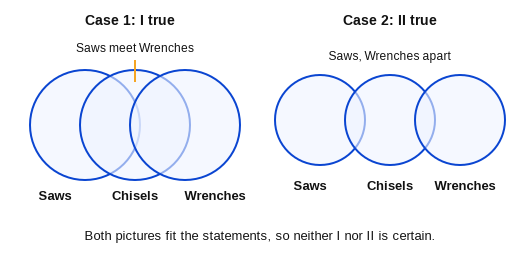
Statement: Some Power Saws are Chisels. Some Chisels are Wrenches.
Conclusion (I): Some Power Saws are Wrenches.
Conclusion (II): No Power Saws are Wrenches.
दिए गए कथन और निष्कर्षों को ध्यानपूर्वक पढ़िए। यह मानते हुए कि कथन में दी गई जानकारी सत्य है, भले ही वह सामान्यतः ज्ञात तथ्यों से भिन्न प्रतीत होती हो, निर्णय लीजिए कि दिए गए निष्कर्षों में से कौन-सा/से निष्कर्ष तार्किक रूप से कथन का अनुसरण करता है/करते हैं।
कथन: कुछ पावर सॉ, छेनी हैं। कुछ छेनी, रिंच हैं।
निष्कर्ष (I): कुछ पावर सॉ, रिंच हैं।
निष्कर्ष (II): कोई भी पावर सॉ, रिंच नहीं है।
  1. ANeither conclusion (I) nor (II) followsन तो निष्कर्ष (I) और न ही (II) अनुसरण करता है
  2. BOnly conclusion (I) followsकेवल निष्कर्ष (I) अनुसरण करता है
  3. COnly conclusion (II) followsकेवल निष्कर्ष (II) अनुसरण करता है
  4. DBoth conclusions (I) and (II) followदोनों निष्कर्ष (I) और (II) अनुसरण करते हैं
Show answer

Concept: A conclusion follows only if it is true in every possible Venn diagram.

  1. Power Saws overlap Chisels; Chisels overlap Wrenches.
  2. Power Saws and Wrenches may overlap or may stay apart – both pictures fit.
  3. So neither 'Some Power Saws are Wrenches' nor 'No Power Saws are Wrenches' is certain.

Trick: 'Some' + 'Some' gives no definite conclusion between the end terms.

Answer: (A) Neither conclusion (I) nor (II) follows

अवधारणा: निष्कर्ष तभी निकलता है जब वह हर संभव वेन आरेख में सत्य हो।

  1. पावर सॉ, छेनी से मिलते हैं; छेनी, रिंच से मिलती है।
  2. पावर सॉ और रिंच मिल भी सकते हैं, अलग भी रह सकते हैं – दोनों चित्र सही।
  3. इसलिए 'कुछ पावर सॉ रिंच हैं' और 'कोई पावर सॉ रिंच नहीं' – दोनों निश्चित नहीं।

ट्रिक: 'कुछ' + 'कुछ' से अंतिम पदों के बीच कोई निश्चित निष्कर्ष नहीं निकलता।

उत्तर: (A) न तो निष्कर्ष (I) और न ही (II) अनुसरण करता है

RRB NTPC Undergraduate CBT 1General Intelligence and ReasoningSyllogismRRB NTPC Undergraduate CBT 1 2025 · 16 Jun Shift 3 →