Question bank

Q&A: practice questions with answers

Search questions on any topic. Filter by exam category, exam, subject and topic, try the question, then open the answer and explanation.

Courses – airGurukul

20,719 questions found.

Q12801.
The Battle of Khanwa (1527) was fought between Babur and which of the following rulers?
खानवा का युद्ध (1527) बाबर और निम्नलिखित में से किस शासक के बीच लड़ा गया था?
  1. AIbrahim Lodiइब्राहिम लोदी
  2. BBairam Khanबैरम खान
  3. CRana Sangaराणा सांगा
  4. DSher Shah Suriशेरशाह सूरी
Show answer

Concept: Babur's battles in India.

  1. Battle of Khanwa (17 March 1527), near Fatehpur Sikri, was fought between Babur and Rana Sanga of Mewar, who led a Rajput confederacy; Babur won and took the title Ghazi.
  2. Ibrahim Lodi was defeated at Panipat (1526); Sher Shah fought Humayun (Chausa 1539, Kannauj 1540); Bairam Khan was Akbar's regent.

Yaad rakhein: Babur's sequence – Panipat 1526 (Lodi), Khanwa 1527 (Sanga), Chanderi 1528 (Medini Rai), Ghaghra 1529 (Afghans).

Answer: (C) Rana Sanga

अवधारणा: भारत में बाबर के युद्ध।

  1. खानवा का युद्ध (17 मार्च 1527), फतेहपुर सीकरी के पास, बाबर और मेवाड़ के राणा सांगा (राजपूत संघ के नेता) के बीच हुआ; बाबर जीता और "गाज़ी" की उपाधि ली।
  2. इब्राहिम लोदी पानीपत (1526) में हारा; शेरशाह ने हुमायूँ से लड़ा (चौसा 1539, कन्नौज 1540); बैरम खाँ अकबर का संरक्षक था।

याद रखें: बाबर का क्रम – पानीपत 1526 (लोदी), खानवा 1527 (सांगा), चंदेरी 1528 (मेदिनी राय), घाघरा 1529 (अफगान)।

उत्तर: (C) Rana Sanga
RRB NTPC Undergraduate CBT 1General AwarenessMedieval History – MughalsRRB NTPC Undergraduate CBT 1 2025 · 16 Jun Shift 2 →
Q12802.
Which of the following groups at the Second Round Table Conference claimed that Congress had no authority in their territories?
द्वितीय गोलमेज सम्मेलन में निम्नलिखित में से किस समूह ने दावा किया कि उनके क्षेत्रों में कांग्रेस का कोई अधिकार नहीं है?
  1. AIndian princesभारतीय राजा (रियासतों के शासक)
  2. BProvincial governorsप्रांतीय गवर्नर
  3. CZamindarsज़मींदार
  4. DBritish officialsब्रिटिश अधिकारी
Show answer

Concept: Second Round Table Conference, London, 1931.

  1. Gandhi attended as the sole Congress representative and claimed Congress spoke for all of India.
  2. This was contested: Muslim League spoke for minorities, Dr Ambedkar for the depressed classes, and the Indian Princes said Congress had no stake or authority in their princely states (NCERT Class 12, Themes in Indian History).

Yaad rakhein: 2nd RTC = Gandhi present, failed on the communal question; 1st and 3rd boycotted by Congress.

Answer: (A) Indian princes

अवधारणा: द्वितीय गोलमेज सम्मेलन, लंदन, 1931।

  1. गांधीजी कांग्रेस के एकमात्र प्रतिनिधि के रूप में गए और दावा किया कि कांग्रेस पूरे भारत की आवाज़ है।
  2. इसका विरोध हुआ: मुस्लिम लीग ने अल्पसंख्यकों की, डॉ. अंबेडकर ने दलित वर्गों की बात कही, और भारतीय राजाओं ने कहा कि उनकी रियासतों में कांग्रेस का कोई अधिकार नहीं (NCERT कक्षा 12, भारतीय इतिहास के कुछ विषय)।

याद रखें: दूसरा RTC = गांधी उपस्थित, सांप्रदायिक प्रश्न पर असफल; पहले और तीसरे का कांग्रेस ने बहिष्कार किया।

उत्तर: (A) Indian princes

RRB NTPC Undergraduate CBT 1General AwarenessModern History – Round Table ConferencesRRB NTPC Undergraduate CBT 1 2025 · 16 Jun Shift 2 →
Q12803.
In a computer system, a running program stores currently required data in RAM. What does RAM stand for?
एक कंप्यूटर सिस्टम में, चल रहा प्रोग्राम वर्तमान में आवश्यक डेटा को RAM में संग्रहीत करता है। RAM का पूर्ण रूप क्या है?
  1. ARandom Active Memory
  2. BRandom Access Mode
  3. CRead Action Memory
  4. DRandom Access Memory
Show answer

Concept: Primary memory of a computer.

  1. RAM = Random Access Memory – volatile main memory in which the running program and its data are kept so the CPU can access any location directly in equal time.
  2. Its contents are lost when power goes off; ROM, by contrast, is non-volatile.

Yaad rakhein: RAM – Random Access, volatile; ROM – Read Only, permanent.

Answer: (D) Random Access Memory

अवधारणा: कंप्यूटर की प्राथमिक मेमोरी।

  1. RAM = Random Access Memory – अस्थायी (volatile) मुख्य मेमोरी जिसमें चल रहा प्रोग्राम और उसका डेटा रखा जाता है, ताकि CPU किसी भी स्थान तक सीधे, समान समय में पहुँच सके।
  2. बिजली जाने पर इसका डेटा मिट जाता है; ROM इसके विपरीत स्थायी है।

याद रखें: RAM – Random Access, अस्थायी; ROM – Read Only, स्थायी।

उत्तर: (D) Random Access Memory

RRB NTPC Undergraduate CBT 1General AwarenessComputer – MemoryRRB NTPC Undergraduate CBT 1 2025 · 16 Jun Shift 2 →
Q12804.
According to the WMO report cited in 2025, global warming in Jan–Aug 2025 was approximately how much above pre-industrial levels?
2025 में उद्धृत WMO रिपोर्ट के अनुसार, जनवरी–अगस्त 2025 में वैश्विक तापन (global warming) पूर्व-औद्योगिक स्तरों से लगभग कितना अधिक था?
  1. A0.8°C
  2. B1.0°C
  3. C1.42°C
  4. D2.1°C
Show answer

Concept: WMO climate updates for 2025.

  1. The WMO's State of the Global Climate update released in November 2025 (for COP30, Belém) reported that the global mean temperature for January–August 2025 was about 1.42∘C above the 1850–1900 pre-industrial average.
  2. 2025 was set to be the second or third warmest year on record, after 2024, which was the first to exceed 1.5∘C.

Yaad rakhein: 2024 ≈ 1.55 °C (first above 1.5); Jan–Aug 2025 ≈ 1.42 °C.

Answer: (C) 1.42°C

अवधारणा: 2025 के लिए WMO जलवायु अपडेट।

  1. WMO की State of the Global Climate अपडेट (नवंबर 2025, COP30 बेलेम के लिए) के अनुसार जनवरी–अगस्त 2025 का वैश्विक औसत तापमान 1850–1900 के पूर्व-औद्योगिक स्तर से लगभग 1.42∘C अधिक रहा।
  2. 2025 रिकॉर्ड में दूसरा या तीसरा सबसे गर्म वर्ष रहा, 2024 के बाद, जो पहली बार 1.5∘C पार करने वाला वर्ष था।

याद रखें: 2024 ≈ 1.55 °C (पहली बार 1.5 से ऊपर); जन–अग 2025 ≈ 1.42 °C।

उत्तर: (C) 1.42°C

RRB NTPC Undergraduate CBT 1General AwarenessCurrent Affairs – ClimateRRB NTPC Undergraduate CBT 1 2025 · 16 Jun Shift 2 →
Q12805.
Which sector in India saw major growth due to globalisation?
वैश्वीकरण के कारण भारत में किस क्षेत्र में प्रमुख वृद्धि हुई?
  1. AEducationशिक्षा
  2. BMiningखनन
  3. CHandicraftsहस्तशिल्प
  4. DIT and ServicesIT और सेवाएँ
Show answer

Concept: Impact of globalisation on India (NCERT Class 10, Globalisation and the Indian Economy).

  1. Globalisation and liberalisation after 1991 led to a boom in India's IT and services sector – software exports, BPO/call centres and IT-enabled services serving global clients.
  2. Services now contribute over half of India's GDP; handicrafts and small producers, in contrast, often faced tough competition from imports.

Yaad rakhein: Globalisation + India = IT & services boom (Bengaluru, Hyderabad).

Answer: (D) IT and Services

अवधारणा: भारत पर वैश्वीकरण का प्रभाव (NCERT कक्षा 10, वैश्वीकरण और भारतीय अर्थव्यवस्था)।

  1. 1991 के बाद वैश्वीकरण और उदारीकरण से भारत के IT व सेवा क्षेत्र में तेज़ी आई – सॉफ्टवेयर निर्यात, BPO/कॉल सेंटर और IT-आधारित सेवाएँ वैश्विक ग्राहकों के लिए।
  2. सेवा क्षेत्र अब भारत के GDP का आधे से अधिक है; इसके विपरीत हस्तशिल्प और छोटे उत्पादकों को आयात से कड़ी प्रतिस्पर्धा झेलनी पड़ी।

याद रखें: वैश्वीकरण + भारत = IT व सेवा क्षेत्र का उछाल (बेंगलुरु, हैदराबाद)।

उत्तर: (D) IT and Services

RRB NTPC Undergraduate CBT 1General AwarenessEconomy – GlobalisationRRB NTPC Undergraduate CBT 1 2025 · 16 Jun Shift 2 →
Q12806.
Which day is celebrated as National Youth Day (Birthday of Swami Vivekananda) in India every year?
भारत में प्रति वर्ष किस दिन को राष्ट्रीय युवा दिवस (स्वामी विवेकानंद का जन्मदिवस) के रूप में मनाया जाता है?
  1. AJanuary 12th12 जनवरी
  2. BFebruary 16th16 फ़रवरी
  3. CMarch 20th20 मार्च
  4. DApril 30th30 अप्रैल
Show answer

Concept: National Youth Day marks the birth anniversary of Swami Vivekananda.

  1. Swami Vivekananda was born on 12 January 1863 in Calcutta.
  2. The Government of India declared his birthday as National Youth Day in 1984; it is observed since 1985.

Yaad rakhein: International Youth Day (UN) is a different day – 12 August.

Answer: (A) January 12th

अवधारणा: राष्ट्रीय युवा दिवस स्वामी विवेकानंद की जयंती पर मनाया जाता है।

  1. स्वामी विवेकानंद का जन्म 12 जनवरी 1863 को कलकत्ता में हुआ।
  2. भारत सरकार ने 1984 में उनके जन्मदिन को राष्ट्रीय युवा दिवस घोषित किया; 1985 से मनाया जाता है।

याद रखें: अंतर्राष्ट्रीय युवा दिवस (UN) अलग है – 12 अगस्त।

उत्तर: (A) 12 जनवरी

RRB NTPC Undergraduate CBT 1General AwarenessImportant daysRRB NTPC Undergraduate CBT 1 2025 · 16 Jun Shift 2 →
Q12807.
Which of the following best describes the authorship of the Rigveda?
निम्नलिखित में से कौन-सा ऋग्वेद के रचयिता के विषय में सबसे उपयुक्त वर्णन है?
  1. AIt was composed solely by Sage Vyasa and compiled during the Mahabharata eraइसकी रचना केवल महर्षि व्यास ने की थी और इसका संकलन महाभारत काल में हुआ था
  2. BIt was dictated by Valmiki as a poetic epic for oral transmissionइसे वाल्मीकि ने मौखिक संचरण हेतु एक काव्यात्मक महाकाव्य के रूप में बोलकर लिखवाया था
  3. CIt was written by a single philosopher-king in ancient Indiaइसे प्राचीन भारत में एक ही दार्शनिक-राजा ने लिखा था
  4. DIt is a collection of hymns composed by various sages over generationsयह विभिन्न ऋषियों द्वारा पीढ़ियों तक रचित सूक्तों का संग्रह है
Show answer

Concept: The Rigveda is not the work of one author – it is a compilation of hymns (suktas) by many seers (rishis).

  1. It has 10 mandalas and about 1,028 hymns, composed by sage families such as Vishvamitra, Vasishtha, Atri and Bharadvaja over several generations.
  2. Vyasa is traditionally credited with arranging the Vedas, not composing them; Valmiki wrote the Ramayana.

Yaad rakhein: Rigveda = 'shruti' (heard) – many rishis, many generations, passed on orally.

Answer: (D) It is a collection of hymns composed by various sages over generations

अवधारणा: ऋग्वेद किसी एक लेखक की रचना नहीं – यह अनेक ऋषियों द्वारा रचित सूक्तों (hymns) का संग्रह है।

  1. इसमें 10 मंडल और लगभग 1,028 सूक्त हैं, जिन्हें विश्वामित्र, वशिष्ठ, अत्रि, भारद्वाज आदि ऋषि-परिवारों ने कई पीढ़ियों में रचा।
  2. व्यास को वेदों का विभाजन/संकलन करने वाला माना जाता है, रचयिता नहीं; वाल्मीकि ने रामायण लिखी।

याद रखें: ऋग्वेद = 'श्रुति' – अनेक ऋषि, अनेक पीढ़ियाँ, मौखिक परंपरा।

उत्तर: (D) यह विभिन्न ऋषियों द्वारा पीढ़ियों में रचित सूक्तों का संग्रह है

RRB NTPC Undergraduate CBT 1General AwarenessVedic literatureRRB NTPC Undergraduate CBT 1 2025 · 16 Jun Shift 2 →
Q12808.
When was the Industrial Policy Resolution (IPR) adopted in India?
भारत में औद्योगिक नीति प्रस्ताव (Industrial Policy Resolution - IPR) कब अपनाया गया था?
  1. A1956
  2. B1954
  3. C1952
  4. D1959
Show answer

Concept: The Industrial Policy Resolution of 1956 shaped India's mixed economy.

  1. Adopted on 30 April 1956, it divided industries into three schedules (A – public sector, B – mixed, C – private).
  2. It replaced the first Industrial Policy Resolution of 1948 and matched the socialistic pattern of the Second Five Year Plan.

Yaad rakhein: IPR: 1948 (first), 1956 (the 'economic constitution' of India), new policy 1991 (LPG).

Answer: (A) 1956

अवधारणा: 1956 के औद्योगिक नीति प्रस्ताव (IPR) ने भारत की मिश्रित अर्थव्यवस्था को आकार दिया।

  1. 30 अप्रैल 1956 को अपनाया गया; उद्योगों को तीन अनुसूचियों (A – सार्वजनिक, B – मिश्रित, C – निजी) में बाँटा।
  2. इसने 1948 के पहले प्रस्ताव का स्थान लिया और दूसरी पंचवर्षीय योजना के समाजवादी ढाँचे से मेल खाया।

याद रखें: औद्योगिक नीति: 1948 (पहली), 1956 (भारत का 'आर्थिक संविधान'), 1991 (LPG)।

उत्तर: (A) 1956

RRB NTPC Undergraduate CBT 1General AwarenessIndustrial policyRRB NTPC Undergraduate CBT 1 2025 · 16 Jun Shift 2 →
Q12809.
The energy of light (photon) is a form of ______.
प्रकाश (फ़ोटॉन) की ऊर्जा ______ का एक रूप है।
  1. AElectromagnetic Energyविद्युतचुंबकीय ऊर्जा
  2. BGravitational Potential Energyगुरुत्वीय स्थितिज ऊर्जा
  3. CNuclear Energyनाभिकीय ऊर्जा
  4. DMechanical Energyयांत्रिक ऊर्जा
Show answer

Concept: Light is an electromagnetic wave; its energy comes in packets called photons.

  1. Energy of a photon E=hν (h = Planck's constant, ν = frequency).
  2. It is carried by oscillating electric and magnetic fields – no mass, no height or motion of a body is involved, so it is not gravitational or mechanical energy.

Yaad rakhein: Radio, microwave, IR, visible, UV, X-ray, gamma – all are electromagnetic energy.

Answer: (A) Electromagnetic Energy

अवधारणा: प्रकाश एक विद्युत-चुंबकीय तरंग है; इसकी ऊर्जा फोटॉन नामक पैकेटों में होती है।

  1. फोटॉन की ऊर्जा E=hν (h = प्लांक नियतांक, ν = आवृत्ति)।
  2. यह दोलनशील विद्युत और चुंबकीय क्षेत्रों द्वारा वहन होती है – न द्रव्यमान, न ऊँचाई; अतः गुरुत्वीय या यांत्रिक ऊर्जा नहीं।

याद रखें: रेडियो, माइक्रोवेव, IR, दृश्य प्रकाश, UV, X-ray, गामा – सभी विद्युत-चुंबकीय ऊर्जा।

उत्तर: (A) विद्युत-चुंबकीय ऊर्जा (Electromagnetic Energy)

RRB NTPC Undergraduate CBT 1General AwarenessForms of energyRRB NTPC Undergraduate CBT 1 2025 · 16 Jun Shift 2 →
Q12810.
Under Article 164(1A), the total number of Ministers in a State, including the Chief Minister, shall NOT exceed:
अनुच्छेद 164(1A) के अंतर्गत, किसी राज्य में मुख्यमंत्री सहित मंत्रियों की कुल संख्या ______ से अधिक नहीं होगी:
  1. A10% of the strength of the Legislative Assemblyविधान सभा की सदस्य संख्या के 10%
  2. BNo limit is mentionedकोई सीमा उल्लिखित नहीं है
  3. C15% of the strength of the Legislative Assemblyविधान सभा की सदस्य संख्या के 15%
  4. D20% of the strength of the Legislative Assemblyविधान सभा की सदस्य संख्या के 20%
Show answer

Concept: Article 164(1A) was inserted by the 91st Constitutional Amendment Act, 2003 to cap the size of State ministries.

  1. Total Ministers including the Chief Minister must not exceed 15% of the total strength of the Legislative Assembly.
  2. The number must not be less than 12.
  3. For the Union, the same 15% cap (of Lok Sabha) is in Article 75(1A).

Yaad rakhein: 91st Amendment: 15% cap; minimum 12 for States.

Answer: (C) 15% of the strength of the Legislative Assembly

अवधारणा: अनुच्छेद 164(1A) को 91वें संविधान संशोधन अधिनियम, 2003 द्वारा राज्य मंत्रिपरिषद का आकार सीमित करने हेतु जोड़ा गया।

  1. मुख्यमंत्री सहित मंत्रियों की कुल संख्या विधानसभा की कुल सदस्य संख्या के 15% से अधिक नहीं होगी।
  2. यह संख्या 12 से कम नहीं होगी।
  3. केंद्र के लिए यही 15% सीमा (लोकसभा की) अनुच्छेद 75(1A) में है।

याद रखें: 91वाँ संशोधन: 15% सीमा; राज्यों में न्यूनतम 12।

उत्तर: (C) विधानसभा की सदस्य संख्या का 15%

RRB NTPC Undergraduate CBT 1General AwarenessState Council of MinistersRRB NTPC Undergraduate CBT 1 2025 · 16 Jun Shift 2 →
Q12811.
From which month and year are the Corporate Average Fuel Efficiency (CAFE-3) norms scheduled to be implemented in India?
भारत में कॉर्पोरेट औसत ईंधन दक्षता (CAFE-3) मानदंड किस माह और वर्ष से लागू होने निर्धारित हैं?
  1. AApril 2027अप्रैल 2027
  2. BApril 2028अप्रैल 2028
  3. CApril 2026अप्रैल 2026
  4. DApril 2029अप्रैल 2029
Show answer

Concept: CAFE norms limit the average CO₂ emission (fuel use) of all cars sold by a manufacturer in a year.

  1. CAFE-2 norms are in force from April 2022.
  2. The next stage, CAFE-3, proposed by the Bureau of Energy Efficiency (BEE), is scheduled to apply from April 2027 (for 2027–2032).

Yaad rakhein: CAFE-1: 2017, CAFE-2: 2022, CAFE-3: April 2027.

Answer: (A) April 2027

अवधारणा: CAFE मानक किसी निर्माता की वर्ष भर में बिकी सभी कारों के औसत CO₂ उत्सर्जन (ईंधन खपत) को सीमित करते हैं।

  1. CAFE-2 मानक अप्रैल 2022 से लागू हैं।
  2. अगला चरण CAFE-3, ऊर्जा दक्षता ब्यूरो (BEE) द्वारा प्रस्तावित, अप्रैल 2027 से (2027–2032 हेतु) लागू होना निर्धारित है।

याद रखें: CAFE-1: 2017, CAFE-2: 2022, CAFE-3: अप्रैल 2027।

उत्तर: (A) अप्रैल 2027

RRB NTPC Undergraduate CBT 1General AwarenessFuel efficiency normsRRB NTPC Undergraduate CBT 1 2025 · 16 Jun Shift 2 →
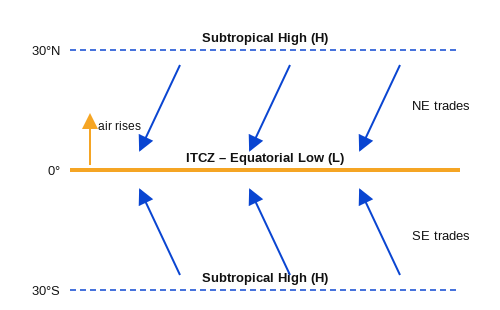
Q12812.
Which statement accurately explains the nature of the Inter Tropical Convergence Zone (ITCZ)?
कौन-सा कथन अंतर-उष्णकटिबंधीय अभिसरण क्षेत्र (ITCZ) की प्रकृति की सही व्याख्या करता है?
  1. AIt marks a westerly wind system close to the Tropic of Capricorn.यह मकर रेखा के निकट एक पछुआ पवन तंत्र को दर्शाता है।
  2. BIt forms a cold frontal region near the Himalayan ranges.यह हिमालय पर्वत श्रेणियों के निकट एक शीत वाताग्र क्षेत्र बनाता है।
  3. CIt is an equatorial low-pressure belt where trade winds meet.यह एक विषुवतीय निम्न दाब पेटी है जहाँ व्यापारिक पवनें मिलती हैं।
  4. DIt represents a zone of high pressure located near the poles.यह ध्रुवों के निकट स्थित उच्च दाब के क्षेत्र को दर्शाता है।
Show answer

Concept: The ITCZ is the low-pressure zone near the equator where the trade winds of both hemispheres converge.

  1. Strong heating near the equator makes air rise, creating the Equatorial Low (doldrums).
  2. NE trade winds (north) and SE trade winds (south) blow from the subtropical highs (30∘) and meet here.
  3. It shifts north–south with the sun; its northward shift over India helps draw in the monsoon.

Trick: ITCZ = 'Inter-tropical' + 'Convergence' → between the tropics, where winds converge = equatorial low.

Answer: (C) It is an equatorial low-pressure belt where trade winds meet.

अवधारणा: ITCZ भूमध्य रेखा के पास का निम्न-दाब क्षेत्र है जहाँ दोनों गोलार्धों की व्यापारिक पवनें (trade winds) मिलती हैं।

  1. भूमध्य रेखा पर तीव्र तापन से हवा ऊपर उठती है – विषुवतीय निम्न दाब (doldrums) बनता है।
  2. उत्तर से NE व्यापारिक पवनें और दक्षिण से SE व्यापारिक पवनें उपोष्ण उच्च दाब (30∘) से आकर यहाँ मिलती हैं।
  3. यह सूर्य के साथ उत्तर–दक्षिण खिसकता है; भारत के ऊपर इसका उत्तर की ओर खिसकना मानसून लाने में मदद करता है।

ट्रिक: ITCZ = 'Inter-tropical' + 'Convergence' → उष्णकटिबंधों के बीच, जहाँ पवनें मिलती हैं = विषुवतीय निम्न दाब।

उत्तर: (C) यह विषुवतीय निम्न-दाब पेटी है जहाँ व्यापारिक पवनें मिलती हैं

RRB NTPC Undergraduate CBT 1General AwarenessPressure belts – ITCZRRB NTPC Undergraduate CBT 1 2025 · 16 Jun Shift 2 →
Q12813.
Which Indian city, as of October 2025, holds the world’s second-largest collection of Art Deco buildings, including the UNESCO-recognized Oval Maidan precinct with 94 structures?
अक्टूबर 2025 तक की स्थिति के अनुसार, कौन-सा भारतीय शहर आर्ट डेको (Art Deco) भवनों के विश्व के दूसरे सबसे बड़े संग्रह वाला शहर है, जिसमें 94 संरचनाओं वाला UNESCO-मान्यता प्राप्त ओवल मैदान परिसर भी शामिल है?
  1. AMumbaiमुंबई
  2. BKolkataकोलकाता
  3. CIndoreइंदौर
  4. DJaipurजयपुर
Show answer

Concept: Mumbai has the world's second-largest collection of Art Deco buildings, after Miami (USA).

  1. The 'Victorian Gothic and Art Deco Ensembles of Mumbai' became a UNESCO World Heritage Site in 2018.
  2. The ensemble around the Oval Maidan – Victorian Gothic on one side, Art Deco along Marine Drive/Backbay on the other – includes 94 buildings.

Yaad rakhein: Oval Maidan + Marine Drive = Mumbai's Art Deco; first is Miami.

Answer: (A) Mumbai

अवधारणा: मुंबई में मियामी (USA) के बाद विश्व का दूसरा सबसे बड़ा आर्ट डेको भवन-संग्रह है।

  1. 'Victorian Gothic and Art Deco Ensembles of Mumbai' को 2018 में UNESCO विश्व धरोहर घोषित किया गया।
  2. ओवल मैदान के आसपास – एक ओर विक्टोरियन गोथिक, दूसरी ओर मरीन ड्राइव/बैकबे पर आर्ट डेको – इस समूह में 94 इमारतें हैं।

याद रखें: ओवल मैदान + मरीन ड्राइव = मुंबई का आर्ट डेको; पहला स्थान मियामी।

उत्तर: (A) मुंबई

RRB NTPC Undergraduate CBT 1General AwarenessHeritage – Art DecoRRB NTPC Undergraduate CBT 1 2025 · 16 Jun Shift 2 →
Q12814.
Which Amendment made written Cabinet advice mandatory for Emergency in India?
किस संशोधन ने भारत में आपातकाल के लिए मंत्रिमंडल की लिखित सलाह को अनिवार्य बनाया?
  1. A26th Amendment26वाँ संशोधन
  2. B24th Amendment24वाँ संशोधन
  3. C44th Amendment44वाँ संशोधन
  4. D42nd Amendment42वाँ संशोधन
Show answer

Concept: The 44th Amendment Act, 1978 added safeguards to Article 352 after the 1975 Emergency.

  1. The President can proclaim a National Emergency only on the written recommendation of the Union Cabinet.
  2. It also replaced 'internal disturbance' with 'armed rebellion'.
  3. The 42nd Amendment (1976) had instead widened the Centre's powers.

Yaad rakhein: 42nd = 'mini-Constitution' (more power); 44th = repair job (safeguards).

Answer: (C) 44th Amendment

अवधारणा: 44वें संशोधन अधिनियम, 1978 ने 1975 के आपातकाल के बाद अनुच्छेद 352 में सुरक्षा उपाय जोड़े।

  1. राष्ट्रपति राष्ट्रीय आपातकाल केवल केंद्रीय मंत्रिमंडल (Cabinet) की लिखित सिफारिश पर ही घोषित कर सकते हैं।
  2. 'आंतरिक अशांति' के स्थान पर 'सशस्त्र विद्रोह' शब्द रखा गया।
  3. 42वें संशोधन (1976) ने इसके विपरीत केंद्र की शक्तियाँ बढ़ाई थीं।

याद रखें: 42वाँ = 'लघु संविधान' (अधिक शक्ति); 44वाँ = सुधार (सुरक्षा उपाय)।

उत्तर: (C) 44वाँ संशोधन

RRB NTPC Undergraduate CBT 1General AwarenessEmergency provisionsRRB NTPC Undergraduate CBT 1 2025 · 16 Jun Shift 2 →
Q12815.
For Windows operating system, choose the correct option that shows the primary difference between Sleep and Hibernate power-saving modes with respect to memory and system state?
Windows ऑपरेटिंग सिस्टम के लिए, वह सही विकल्प चुनिए जो मेमोरी और सिस्टम स्थिति (system state) के संदर्भ में Sleep और Hibernate पावर-सेविंग मोड के बीच मुख्य अंतर को दर्शाता है।
  1. ASleep keeps data in RAM; Hibernate saves it to diskSleep डेटा को RAM में रखता है; Hibernate उसे डिस्क पर सेव करता है
  2. BHibernate keeps data in RAM; Sleep saves to diskHibernate डेटा को RAM में रखता है; Sleep डिस्क पर सेव करता है
  3. CSleep saves system state to disk; Hibernate uses RAMSleep सिस्टम स्थिति को डिस्क पर सेव करता है; Hibernate RAM का उपयोग करता है
  4. DBoth save data to RAMदोनों डेटा को RAM में सेव करते हैं
Show answer

Concept: Sleep and Hibernate differ in where the open work (system state) is stored.

  1. Sleep: the session stays in RAM, which keeps getting a small amount of power – resume is almost instant.
  2. Hibernate: the contents of RAM are written to the hard disk (file hiberfil.sys) and the PC switches off fully – resume is slower but no power is used.

Trick: Sleep = RAM (needs power); Hibernate = Hard disk (no power).

Answer: (A) Sleep keeps data in RAM; Hibernate saves it to disk

अवधारणा: Sleep और Hibernate का अंतर यह है कि खुला काम (system state) कहाँ रखा जाता है।

  1. Sleep: सत्र RAM में रहता है, जिसे थोड़ी बिजली मिलती रहती है – तुरंत resume होता है।
  2. Hibernate: RAM की सामग्री हार्ड डिस्क (फ़ाइल hiberfil.sys) पर लिखी जाती है और PC पूरी तरह बंद हो जाता है – resume धीमा पर बिजली खर्च नहीं।

ट्रिक: Sleep = RAM (बिजली चाहिए); Hibernate = Hard disk (बिजली नहीं)।

उत्तर: (A) Sleep डेटा RAM में रखता है; Hibernate डिस्क पर सहेजता है

RRB NTPC Undergraduate CBT 1General AwarenessComputer – power modesRRB NTPC Undergraduate CBT 1 2025 · 16 Jun Shift 2 →
Q12816.
In 2022, the President pardoned a woman jailed for a minor crime. Which Article of the Indian Constitution allows the President to grant pardons?
2022 में, राष्ट्रपति ने एक छोटे अपराध के लिए जेल में बंद एक महिला को क्षमादान दिया। भारतीय संविधान का कौन-सा अनुच्छेद राष्ट्रपति को क्षमादान देने की शक्ति प्रदान करता है?
  1. AArticle 75अनुच्छेद 75
  2. BArticle 74अनुच्छेद 74
  3. CArticle 72अनुच्छेद 72
  4. DArticle 53अनुच्छेद 53
Show answer

Concept: Article 72 gives the President power to grant pardons, reprieves, respites, remissions or to suspend, remit or commute sentences.

  1. It covers punishment by court-martial, offences against Union laws and death sentences.
  2. Governor's similar power is in Article 161; Article 53 vests executive power in the President, Article 74 deals with the Council of Ministers advising the President, Article 75 with appointment of Ministers.

Yaad rakhein: President – 72, Governor – 161 (both act on ministerial advice).

Answer: (C) Article 72

अवधारणा: अनुच्छेद 72 राष्ट्रपति को क्षमा, प्रविलंबन, विराम, परिहार देने या दंड को निलंबित, परिहार या लघुकरण (commute) करने की शक्ति देता है।

  1. यह सैन्य न्यायालय के दंड, संघ के कानूनों के विरुद्ध अपराध और मृत्युदंड पर लागू है।
  2. राज्यपाल की ऐसी शक्ति अनुच्छेद 161 में है; अनुच्छेद 53 – संघ की कार्यपालिका शक्ति, 74 – राष्ट्रपति को सलाह देने वाली मंत्रिपरिषद, 75 – मंत्रियों की नियुक्ति।

याद रखें: राष्ट्रपति – 72, राज्यपाल – 161।

उत्तर: (C) अनुच्छेद 72

RRB NTPC Undergraduate CBT 1General AwarenessPardoning powerRRB NTPC Undergraduate CBT 1 2025 · 16 Jun Shift 2 →
Q12817.
What is GII in the context of Human Development?
मानव विकास के संदर्भ में GII क्या है?
  1. AGender Inequality Indexलैंगिक असमानता सूचकांक (Gender Inequality Index)
  2. BGender Inability IndexGender Inability Index (लैंगिक अक्षमता सूचकांक)
  3. CGender Inequality InformationGender Inequality Information (लैंगिक असमानता सूचना)
  4. DGeneral Inequality IndexGeneral Inequality Index (सामान्य असमानता सूचकांक)
Show answer

Concept: GII stands for Gender Inequality Index, published by UNDP in its Human Development Report.

  1. Introduced in the 2010 Human Development Report.
  2. It measures inequality between women and men in three dimensions: reproductive health, empowerment and labour-market participation.
  3. A value of 0 means perfect equality, 1 means maximum inequality.

Yaad rakhein: UNDP family: HDI, IHDI, GDI, GII, MPI.

Answer: (A) Gender Inequality Index

अवधारणा: GII का अर्थ है लैंगिक असमानता सूचकांक (Gender Inequality Index), जिसे UNDP अपनी मानव विकास रिपोर्ट में प्रकाशित करता है।

  1. 2010 की मानव विकास रिपोर्ट में शुरू किया गया।
  2. यह तीन आयामों में स्त्री–पुरुष असमानता मापता है: प्रजनन स्वास्थ्य, सशक्तिकरण और श्रम बाज़ार भागीदारी।
  3. मान 0 = पूर्ण समानता, 1 = अधिकतम असमानता।

याद रखें: UNDP परिवार: HDI, IHDI, GDI, GII, MPI।

उत्तर: (A) Gender Inequality Index (लैंगिक असमानता सूचकांक)

RRB NTPC Undergraduate CBT 1General AwarenessHuman development indicesRRB NTPC Undergraduate CBT 1 2025 · 16 Jun Shift 2 →
Q12818.
Which feature of the Brahmo Samaj best reflects its reformist interpretation of Hindu religious practice?
ब्रह्म समाज की कौन-सी विशेषता हिंदू धार्मिक प्रथाओं की उसकी सुधारवादी व्याख्या को सबसे अच्छी तरह दर्शाती है?
  1. APromoting monotheistic worship and rejecting ritual sacrifices entirely.एकेश्वरवादी उपासना को बढ़ावा देना और कर्मकांडीय बलि को पूर्णतः अस्वीकार करना।
  2. BDefending priestly authority and supporting elaborate temple ceremonies.पुरोहित वर्ग के अधिकार का समर्थन करना और विस्तृत मंदिर अनुष्ठानों का समर्थन करना।
  3. CUpholding hereditary priesthood and strengthening caste divisions everywhere.वंशानुगत पुरोहिताई को बनाए रखना और हर जगह जातिगत विभाजन को सुदृढ़ करना।
  4. DReviving Vedic polytheism and encouraging ritual offerings across India.वैदिक बहुदेववाद को पुनर्जीवित करना और पूरे भारत में कर्मकांडीय चढ़ावों को प्रोत्साहित करना।
Show answer

Concept: Brahmo Samaj (founded 1828 by Raja Ram Mohan Roy as Brahmo Sabha) preached worship of one formless God.

  1. It rejected idol worship, priestly rituals and sacrifices, and based belief on reason and the Upanishads.
  2. It opposed caste rigidity and social evils like sati – so options praising priests, hereditary priesthood or polytheism are the opposite of its ideas.

Yaad rakhein: Brahmo Samaj = Monotheism + no idols + no rituals (Ram Mohan Roy, 1828).

Answer: (A) Promoting monotheistic worship and rejecting ritual sacrifices entirely.

अवधारणा: ब्रह्म समाज (राजा राममोहन राय द्वारा 1828 में ब्रह्म सभा के रूप में स्थापित) एक निराकार ईश्वर की उपासना का प्रचार करता था।

  1. इसने मूर्ति पूजा, पुरोहितों के कर्मकांड और बलि का विरोध किया तथा विश्वास को तर्क और उपनिषदों पर आधारित किया।
  2. इसने जाति की कठोरता और सती जैसी कुरीतियों का विरोध किया – अतः पुरोहित-सत्ता, वंशानुगत पुरोहिती या बहुदेववाद वाले विकल्प इसके विचारों के उलट हैं।

याद रखें: ब्रह्म समाज = एकेश्वरवाद + मूर्ति पूजा नहीं + कर्मकांड नहीं (राममोहन राय, 1828)।

उत्तर: (A) एकेश्वरवादी उपासना को बढ़ावा देना और कर्मकांडी बलि को पूरी तरह अस्वीकार करना

RRB NTPC Undergraduate CBT 1General AwarenessSocio-religious reformRRB NTPC Undergraduate CBT 1 2025 · 16 Jun Shift 2 →
Q12819.
The Indian Medical Association (IMA) recently appointed a new President. Who assumed charge as the IMA National President in December 2025?
भारतीय चिकित्सा संघ (IMA) ने हाल ही में एक नए अध्यक्ष की नियुक्ति की। दिसंबर 2025 में IMA के राष्ट्रीय अध्यक्ष के रूप में किसने पदभार ग्रहण किया?
  1. ADr. Ketan Desaiडॉ. केतन देसाई
  2. BDr. Amit Chakrabartyडॉ. अमित चक्रवर्ती
  3. CDr. Anil Nayakडॉ. अनिल नायक
  4. DDr. Dilip Bhanushaliडॉ. दिलीप भानुशाली
Show answer

Concept: The Indian Medical Association (IMA) is the national voluntary body of doctors of modern medicine; its President changes every year.

  1. Dr. Anil Nayak assumed charge as IMA National President in December 2025 (at the annual national conference), for the year 2026.
  2. He succeeded Dr. Dilip Bhanushali, who was IMA National President for 2025.

Yaad rakhein: IMA headquarters – New Delhi; President's term – one year, taken over each December.

Answer: (C) Dr. Anil Nayak

अवधारणा: भारतीय चिकित्सा संघ (IMA) आधुनिक चिकित्सा के डॉक्टरों का राष्ट्रीय स्वैच्छिक संगठन है; इसका अध्यक्ष हर वर्ष बदलता है।

  1. डॉ. अनिल नायक ने दिसंबर 2025 में (वार्षिक राष्ट्रीय सम्मेलन में) वर्ष 2026 के लिए IMA राष्ट्रीय अध्यक्ष का कार्यभार संभाला।
  2. उन्होंने डॉ. दिलीप भानुशाली का स्थान लिया, जो 2025 के IMA राष्ट्रीय अध्यक्ष थे।

याद रखें: IMA मुख्यालय – नई दिल्ली; अध्यक्ष का कार्यकाल – एक वर्ष, हर दिसंबर में बदलता है।

उत्तर: (C) डॉ. अनिल नायक

RRB NTPC Undergraduate CBT 1General AwarenessCurrent affairs – appointmentsRRB NTPC Undergraduate CBT 1 2025 · 16 Jun Shift 2 →
Q12820.
Which pigment is responsible for the green color of plants?
पौधों के हरे रंग के लिए कौन-सा वर्णक (pigment) उत्तरदायी है?
  1. AXanthophyllज़ैंथोफ़िल
  2. BChlorophyllक्लोरोफ़िल (पर्णहरित)
  3. CCaroteneकैरोटीन
  4. DAnthocyaninएंथोसायनिन
Show answer

Concept: Chlorophyll gives leaves their green colour and traps light for photosynthesis.

  1. It absorbs mainly red and blue light and reflects green light – so leaves look green.
  2. Carotene (orange), xanthophyll (yellow) and anthocyanin (red/purple, in vacuoles) give other colours, seen in autumn leaves, carrots and flowers.

Yaad rakhein: Chlorophyll has magnesium (Mg) at its centre; found in chloroplasts.

Answer: (B) Chlorophyll

अवधारणा: क्लोरोफिल पत्तियों को हरा रंग देता है और प्रकाश-संश्लेषण के लिए प्रकाश ग्रहण करता है।

  1. यह मुख्यतः लाल और नीला प्रकाश अवशोषित करता है और हरा प्रकाश परावर्तित करता है – इसलिए पत्तियाँ हरी दिखती हैं।
  2. कैरोटीन (नारंगी), ज़ैंथोफिल (पीला) और एंथोसायनिन (लाल/बैंगनी) अन्य रंग देते हैं – पतझड़ की पत्तियाँ, गाजर, फूल।

याद रखें: क्लोरोफिल के केंद्र में मैग्नीशियम (Mg) होता है; यह हरितलवक (chloroplast) में पाया जाता है।

उत्तर: (B) क्लोरोफिल (Chlorophyll)

RRB NTPC Undergraduate CBT 1General AwarenessPlant pigmentsRRB NTPC Undergraduate CBT 1 2025 · 16 Jun Shift 2 →