Question bank

Q&A: practice questions with answers

Search questions on any topic. Filter by exam category, exam, subject and topic, try the question, then open the answer and explanation.

Courses – airGurukul

20,719 questions found.

Q12821.
"Appellate jurisdiction of the Supreme Court in appeals from High Courts in regard to civil matters" is provided in which of the following provisions of the Constitution of India?
"सिविल मामलों के संबंध में उच्च न्यायालयों से अपीलों में उच्चतम न्यायालय की अपीलीय अधिकारिता" भारत के संविधान के निम्नलिखित में से किस प्रावधान में दी गई है?
  1. AArticle 133अनुच्छेद 133
  2. BArticle 132अनुच्छेद 132
  3. CArticle 131अनुच्छेद 131
  4. DArticle 134अनुच्छेद 134
Show answer

Concept: Appeals from High Courts to the Supreme Court are divided by subject in Articles 132–134.

  1. Article 133 – appeals in civil matters.
  2. Article 132 – appeals involving a substantial question of law on interpretation of the Constitution; Article 134 – criminal matters.
  3. Article 131 is the original jurisdiction (Centre–State disputes), not appellate.

Trick: Order 132-133-134 = Constitutional – Civil – Criminal (C-C-C).

Answer: (A) Article 133

अवधारणा: उच्च न्यायालयों से सर्वोच्च न्यायालय में अपीलें अनुच्छेद 132–134 में विषयवार बँटी हैं।

  1. अनुच्छेद 133 – दीवानी (civil) मामलों में अपील।
  2. अनुच्छेद 132 – संविधान की व्याख्या से जुड़े महत्वपूर्ण विधि-प्रश्न; अनुच्छेद 134 – आपराधिक (criminal) मामले।
  3. अनुच्छेद 131 मूल क्षेत्राधिकार (केंद्र–राज्य विवाद) है, अपीलीय नहीं।

ट्रिक: 132-133-134 = संवैधानिक – दीवानी – आपराधिक (C-C-C)।

उत्तर: (A) अनुच्छेद 133
RRB NTPC Undergraduate CBT 1General AwarenessSupreme Court jurisdictionRRB NTPC Undergraduate CBT 1 2025 · 16 Jun Shift 2 →
Q12822.
In which year was the first "Sanskrit Commission" constituted?
प्रथम "संस्कृत आयोग" का गठन किस वर्ष किया गया था?
  1. A1952
  2. B2013
  3. C2019
  4. D1956
Show answer

Concept: The first Sanskrit Commission was set up by the Government of India in 1956.

  1. It was chaired by Suniti Kumar Chatterji and submitted its report in 1957 on the state of Sanskrit education.
  2. The second Sanskrit Commission was formed much later, in 2013–14 (chaired by Satyavrat Shastri) – hence 2013 is the tempting wrong choice.

Yaad rakhein: Sanskrit Commission: first 1956 (S. K. Chatterji), second 2013–14.

Answer: (D) 1956

अवधारणा: पहला संस्कृत आयोग भारत सरकार ने 1956 में गठित किया था।

  1. इसकी अध्यक्षता सुनीति कुमार चटर्जी ने की और 1957 में संस्कृत शिक्षा की स्थिति पर रिपोर्ट दी।
  2. दूसरा संस्कृत आयोग बहुत बाद 2013–14 में बना (अध्यक्ष सत्यव्रत शास्त्री) – इसलिए 2013 भ्रामक विकल्प है।

याद रखें: संस्कृत आयोग: पहला 1956 (एस. के. चटर्जी), दूसरा 2013–14।

उत्तर: (D) 1956

RRB NTPC Undergraduate CBT 1General AwarenessCommissions – SanskritRRB NTPC Undergraduate CBT 1 2025 · 16 Jun Shift 2 →
Q12823.
Article 243ZI of the Indian Constitution empowers the State Legislature to make laws regarding co-operative societies. Which principle is NOT included in its scope?
भारतीय संविधान का अनुच्छेद 243ZI राज्य विधानमंडल को सहकारी समितियों के संबंध में कानून बनाने की शक्ति देता है। निम्नलिखित में से कौन-सा सिद्धांत इसके दायरे में शामिल नहीं है?
  1. ADemocratic member controlलोकतांत्रिक सदस्य नियंत्रण
  2. BAutonomous functioningस्वायत्त कार्यप्रणाली
  3. CVoluntary formationस्वैच्छिक गठन
  4. DCompulsory State supervisionअनिवार्य राज्य पर्यवेक्षण
Show answer

Concept: Article 243ZI (Part IXB, added by the 97th Amendment, 2011) lets the State make laws on co-operatives based on co-operative principles.

  1. Principles listed: voluntary formation, democratic member control, member-economic participation and autonomous functioning.
  2. 'Compulsory State supervision' goes against autonomy, so it is not part of the scope.

Yaad rakhein: 97th Amendment, 2011: co-operatives in Part IXB, right to form them in Article 19(1)(c), Article 43B in DPSP.

Answer: (D) Compulsory State supervision

अवधारणा: अनुच्छेद 243ZI (भाग IXB, 97वें संशोधन 2011 द्वारा जोड़ा गया) राज्य को सहकारी सिद्धांतों के आधार पर सहकारी समितियों पर कानून बनाने देता है।

  1. सूचीबद्ध सिद्धांत: स्वैच्छिक गठन, लोकतांत्रिक सदस्य नियंत्रण, सदस्यों की आर्थिक भागीदारी और स्वायत्त कार्यप्रणाली।
  2. 'अनिवार्य राज्य पर्यवेक्षण' स्वायत्तता के विपरीत है, अतः यह शामिल नहीं।

याद रखें: 97वाँ संशोधन, 2011: भाग IXB, अनुच्छेद 19(1)(c) में सहकारी समिति बनाने का अधिकार, DPSP में अनुच्छेद 43B।

उत्तर: (D) अनिवार्य राज्य पर्यवेक्षण

RRB NTPC Undergraduate CBT 1General AwarenessCo-operative societiesRRB NTPC Undergraduate CBT 1 2025 · 16 Jun Shift 2 →
Q12824.
The Morley-Minto Reforms were introduced by the British Government in India in ______.
मॉर्ले-मिंटो सुधार ब्रिटिश सरकार द्वारा भारत में ______ में लागू किए गए थे।
  1. A1919
  2. B1909
  3. C1905
  4. D1935
Show answer

Concept: The Morley-Minto Reforms are the Indian Councils Act of 1909.

  1. Named after John Morley (Secretary of State) and Lord Minto (Viceroy).
  2. They introduced separate electorates for Muslims and enlarged the legislative councils.
  3. 1919 = Montagu-Chelmsford Reforms; 1935 = Government of India Act; 1905 = Partition of Bengal.

Yaad rakhein: 1909 – Morley-Minto – separate electorate ('father of communal electorate': Minto).

Answer: (B) 1909

अवधारणा: मार्ले-मिंटो सुधार ही भारतीय परिषद अधिनियम, 1909 हैं।

  1. नाम जॉन मार्ले (भारत सचिव) और लॉर्ड मिंटो (वायसराय) पर।
  2. इनसे मुसलमानों के लिए पृथक निर्वाचन मंडल शुरू हुआ और विधान परिषदों का विस्तार हुआ।
  3. 1919 = मॉन्टेग्यू-चेम्सफोर्ड सुधार; 1935 = भारत शासन अधिनियम; 1905 = बंगाल विभाजन।

याद रखें: 1909 – मार्ले-मिंटो – पृथक निर्वाचन (मिंटो: 'सांप्रदायिक निर्वाचन का जनक')।

उत्तर: (B) 1909

RRB NTPC Undergraduate CBT 1General AwarenessConstitutional developmentRRB NTPC Undergraduate CBT 1 2025 · 16 Jun Shift 2 →
Q12825.
As of 1 March 2001, what was the population of India?
1 मार्च 2001 की स्थिति के अनुसार, भारत की जनसंख्या कितनी थी?
  1. A1,027 million1,027 मिलियन
  2. B1,210 million1,210 मिलियन
  3. C1,000 million1,000 मिलियन
  4. D950 million950 मिलियन
Show answer

Concept: Census 2001 had its reference date as 00:00 hours of 1 March 2001.

  1. The provisional population figure released was about 1,027 million (102.7 crore) – India crossed one billion.
  2. The final figure was revised to about 1,028.7 million; 1,210 million is the 2011 Census figure.

Yaad rakhein: Census 2001 ≈ 102.7 crore; Census 2011 ≈ 121 crore.

Answer: (A) 1,027 million

अवधारणा: जनगणना 2001 की संदर्भ तिथि 1 मार्च 2001 के 00:00 बजे थी।

  1. जारी अनंतिम (provisional) जनसंख्या लगभग 1,027 मिलियन (102.7 करोड़) थी – भारत एक अरब पार कर गया।
  2. अंतिम आँकड़ा लगभग 1,028.7 मिलियन हुआ; 1,210 मिलियन 2011 की जनगणना का आँकड़ा है।

याद रखें: जनगणना 2001 ≈ 102.7 करोड़; जनगणना 2011 ≈ 121 करोड़।

उत्तर: (A) 1,027 मिलियन

RRB NTPC Undergraduate CBT 1General AwarenessCensus of IndiaRRB NTPC Undergraduate CBT 1 2025 · 16 Jun Shift 2 →
Q12826.
Find the volume of a cylinder whose height is 21 cm and its radius is 35 of the radius of another cylinder with a volume of 317900 cm3 and a height of 14 cm. (Use π=227)
उस बेलन का आयतन ज्ञात कीजिए जिसकी ऊँचाई 21 cm है और जिसकी त्रिज्या, 317900 cm3 आयतन और 14 cm ऊँचाई वाले एक अन्य बेलन की त्रिज्या का 35 है। (π=227 का प्रयोग कीजिए)
  1. A171656 cm3
  2. B161666 cm3
  3. C171660 cm3
  4. D171666 cm3
Show answer

Concept: Volume of a cylinder V=πr2h. First find the radius of the second cylinder, then scale it by 35.

  1. Second cylinder: 227×r2×14=317900⇒44r2=317900⇒r2=7225, so r=85 cm.
  2. Required radius =35×85=51 cm.
  3. Volume =227×512×21=22×2601×3=171666 cm3.

Trick: h=21 cancels the 7 neatly: 227×21=66, so just compute 66×2601.

Answer: (D) 171666 cm3

अवधारणा: बेलन का आयतन V=πr2h। पहले दूसरे बेलन की त्रिज्या निकालें, फिर उसका 35 लें।

  1. दूसरा बेलन: 227×r2×14=317900⇒44r2=317900⇒r2=7225, अतः r=85 cm।
  2. अभीष्ट त्रिज्या =35×85=51 cm।
  3. आयतन =227×512×21=22×2601×3=171666 cm3।

ट्रिक: h=21 से 7 कट जाता है: 227×21=66, बस 66×2601 निकालें।

उत्तर: (D) 171666 cm3

RRB NTPC Undergraduate CBT 1MathematicsMensuration – CylinderRRB NTPC Undergraduate CBT 1 2025 · 16 Jun Shift 2 →
Q12827.
A recipe uses 2 cups of rice for every 3 cups of water. If you want to cook using 6 cups of rice, how much water will you need?
एक व्यंजन विधि में प्रत्येक 3 कप पानी के लिए 2 कप चावल का उपयोग होता है। यदि आप 6 कप चावल पकाना चाहते हैं, तो आपको कितने पानी की आवश्यकता होगी?
  1. A7 cups7 कप
  2. B9 cups9 कप
  3. C3 cups3 कप
  4. D6 cups6 कप
Show answer

Concept: Rice : water stays in the fixed ratio 2:3 (direct proportion).

  1. 23=6x.
  2. x=6×32=9 cups.

Trick: Rice is tripled (2→6), so triple the water too: 3×3=9.

Answer: (B) 9 cups

अवधारणा: चावल : पानी का अनुपात 2:3 स्थिर रहता है (सीधा समानुपात)।

  1. 23=6x।
  2. x=6×32=9 कप।

ट्रिक: चावल तीन गुना हुआ (2→6), पानी भी तीन गुना: 3×3=9।

उत्तर: (B) 9 cups

RRB NTPC Undergraduate CBT 1MathematicsRatio and ProportionRRB NTPC Undergraduate CBT 1 2025 · 16 Jun Shift 2 →
Q12828.
The sum of two positive numbers is 36 and their product is 180. The positive difference between them is:
दो धनात्मक संख्याओं का योग 36 है और उनका गुणनफल 180 है। उनके बीच का धनात्मक अंतर है:
  1. A24
  2. B34
  3. C37
  4. D32
Show answer

Concept: (a−b)2=(a+b)2−4ab.

  1. (a−b)2=362−4×180=1296−720=576.
  2. a−b=576=24.

Trick: Check: the numbers are 30 and 6 (30+6=36, 30×6=180), difference 24.

Answer: (A) 24

अवधारणा: (a−b)2=(a+b)2−4ab।

  1. (a−b)2=362−4×180=1296−720=576।
  2. a−b=576=24।

ट्रिक: जाँच: संख्याएँ 30 और 6 हैं (30+6=36, 30×6=180), अंतर 24।

उत्तर: (A) 24

RRB NTPC Undergraduate CBT 1MathematicsAlgebraic IdentitiesRRB NTPC Undergraduate CBT 1 2025 · 16 Jun Shift 2 →
Q12829.
Simplify: sin2A1−cosA+sin2A1+cosA
सरल कीजिए: sin2A1−cosA+sin2A1+cosA
  1. A3
  2. B2
  3. C4
  4. D1
Show answer

Concept: Take LCM; use 1−cos2A=sin2A.

  1. sin2A1−cosA+sin2A1+cosA=sin2A·(1+cosA)+(1−cosA)(1−cosA)(1+cosA).
  2. =sin2A·21−cos2A=sin2A·2sin2A=2.

Trick: 11−cosA+11+cosA=2sin2A=2csc2A – a standard pair worth remembering.

Answer: (B) 2

अवधारणा: LCM लें; 1−cos2A=sin2A का प्रयोग करें।

  1. sin2A1−cosA+sin2A1+cosA=sin2A·(1+cosA)+(1−cosA)(1−cosA)(1+cosA)।
  2. =sin2A·21−cos2A=sin2A·2sin2A=2।

ट्रिक: 11−cosA+11+cosA=2sin2A=2csc2A – यह जोड़ी याद रखें।

उत्तर: (B) 2

RRB NTPC Undergraduate CBT 1MathematicsTrigonometric IdentitiesRRB NTPC Undergraduate CBT 1 2025 · 16 Jun Shift 2 →
Q12830.
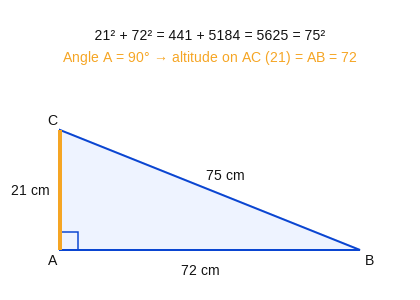
The sides of a triangle are 75 cm, 21 cm, and 72 cm. What is the length (in cm) of its altitude corresponding to the side with a length of 21 cm?
एक त्रिभुज की भुजाएँ 75 cm, 21 cm और 72 cm हैं। 21 cm लंबाई वाली भुजा के संगत उसके शीर्षलंब की लंबाई (cm में) क्या है?
  1. A107
  2. B65
  3. C90
  4. D72
Show answer

Concept: Check whether the triangle is right-angled; in a right triangle each leg is the altitude on the other leg.

  1. 212+722=441+5184=5625=752, so the triangle is right-angled with hypotenuse 75.
  2. The legs 21 and 72 are perpendicular, so the altitude on the side of 21 cm is the other leg =72 cm.
  3. Check via area: 12×21×72=756=12×21×h⇒h=72.

Trick: (21,72,75)=3×(7,24,25) – a Pythagorean triplet. Spotting it saves all the work.

Answer: (D) 72

अवधारणा: जाँचें कि त्रिभुज समकोण है या नहीं; समकोण त्रिभुज में एक भुजा दूसरी भुजा पर शीर्षलंब (altitude) होती है।

  1. 212+722=441+5184=5625=752, अतः त्रिभुज समकोण है, कर्ण 75।
  2. भुजाएँ 21 और 72 परस्पर लंब हैं, अतः 21 cm वाली भुजा पर शीर्षलंब =72 cm।
  3. क्षेत्रफल से जाँच: 12×21×72=756=12×21×h⇒h=72।

ट्रिक: (21,72,75)=3×(7,24,25) – पाइथागोरस त्रिक। इसे पहचानते ही उत्तर मिल जाता है।

उत्तर: (D) 72

RRB NTPC Undergraduate CBT 1MathematicsTriangles – AltitudeRRB NTPC Undergraduate CBT 1 2025 · 16 Jun Shift 2 →
Q12831.
A, B and C started a business, investing amounts of ₹1,960, ₹1,660, and ₹1,130 respectively. If B's share in the profit earned by them is ₹968, what is the difference in the profit (in ₹) earned by A and C?
A, B और C ने क्रमशः ₹1,960, ₹1,660 और ₹1,130 की राशि निवेश करके एक व्यवसाय शुरू किया। यदि उनके द्वारा अर्जित लाभ में B का हिस्सा ₹968 है, तो A और C द्वारा अर्जित लाभ (₹ में) का अंतर क्या है?
  1. A₹487
  2. B₹486
  3. C₹482
  4. D₹484
Show answer

Concept: Profit is shared in the ratio of investments (same time).

  1. Ratio =1960:1660:1130=196:166:113.
  2. B's 166 parts = ₹968, so 1 part =968166.
  3. A − C =196−113=83 parts =968166×83=9682=484.

Trick: 83 is exactly half of 166, so the answer is simply half of B's share: 9682=484.

Answer: (D) ₹484

अवधारणा: समान समय पर लाभ निवेश के अनुपात में बँटता है।

  1. अनुपात =1960:1660:1130=196:166:113।
  2. B के 166 भाग = ₹968, अतः 1 भाग =968166।
  3. A − C =196−113=83 भाग =968166×83=9682=484।

ट्रिक: 83, 166 का ठीक आधा है, इसलिए उत्तर B के हिस्से का आधा: 9682=484।

उत्तर: (D) ₹484

RRB NTPC Undergraduate CBT 1MathematicsPartnershipRRB NTPC Undergraduate CBT 1 2025 · 16 Jun Shift 2 →
Q12832.
What will be the total amount payable after 3 years on a principal of ₹4,000 at 5% per annum, compounded annually?
₹4,000 के मूलधन पर 5% वार्षिक दर से, वार्षिक रूप से चक्रवृद्धि होने पर, 3 वर्ष बाद देय कुल राशि कितनी होगी?
  1. A₹4,550.50
  2. B₹4,050.50
  3. C₹4,600.50
  4. D₹4,630.50
Show answer

Concept: A=P(1+r100)n.

  1. A=4000×(2120)3=4000×92618000.
  2. =92612=4630.50.

Trick: Effective 3-year rate at 5% =15.7625%; 4000×0.157625=630.5, add to 4000.

Answer: (D) ₹4,630.50

अवधारणा: A=P(1+r100)n।

  1. A=4000×(2120)3=4000×92618000।
  2. =92612=4630.50।

ट्रिक: 5% पर 3 वर्ष की प्रभावी दर =15.7625%; 4000×0.157625=630.5, इसे 4000 में जोड़ें।

उत्तर: (D) ₹4,630.50

RRB NTPC Undergraduate CBT 1MathematicsCompound InterestRRB NTPC Undergraduate CBT 1 2025 · 16 Jun Shift 2 →
Q12833.
What is the simplified value of the following expression?
{(33+52)×23−43}÷(7−3)
निम्नलिखित व्यंजक का सरलीकृत मान क्या है?
{(33+52)×23−43}÷(7−3)
  1. A88
  2. B95
  3. C44
  4. D84
Show answer

Concept: Solve brackets first, powers before × and −.

  1. 33+52=27+25=52; 52×23=52×8=416.
  2. 416−43=416−64=352.
  3. 352÷(7−3)=352÷4=88.

Trick: Keep small cubes handy: 23=8, 33=27, 43=64.

Answer: (A) 88

अवधारणा: पहले कोष्ठक, फिर घात, फिर × और −।

  1. 33+52=27+25=52; 52×23=52×8=416।
  2. 416−43=416−64=352।
  3. 352÷(7−3)=352÷4=88।

ट्रिक: छोटे घन याद रखें: 23=8, 33=27, 43=64।

उत्तर: (A) 88

RRB NTPC Undergraduate CBT 1MathematicsSimplification (BODMAS)RRB NTPC Undergraduate CBT 1 2025 · 16 Jun Shift 2 →
Q12834.
Chetan’s salary is ₹17,000 per month. He spends ₹4,000 on house rent, ₹2,500 on bills, and the rest of the amount is his monthly savings. Find his savings (in ₹) in a year, if in the month of his birthday, he spent his complete monthly savings for a birthday celebration.
चेतन का वेतन ₹17,000 प्रति माह है। वह ₹4,000 मकान किराए पर, ₹2,500 बिलों पर खर्च करता है, और शेष राशि उसकी मासिक बचत है। एक वर्ष में उसकी बचत (₹ में) ज्ञात कीजिए, यदि अपने जन्मदिन वाले महीने में उसने अपनी पूरी मासिक बचत जन्मदिन के उत्सव पर खर्च कर दी।
  1. A94,500
  2. B1,26,000
  3. C1,15,500
  4. D1,05,000
Show answer

Concept: Monthly savings = salary − expenses; count only the months he actually saved.

  1. Savings per month =17000−4000−2500=10500.
  2. In the birthday month the whole saving is spent, so savings happen in 11 months.
  3. Yearly savings =10500×11=1,15,500.

Trick: 10500×12=1,26,000 is the trap (option B); subtract one month's 10500.

Answer: (C) 1,15,500

अवधारणा: मासिक बचत = वेतन − खर्च; केवल उन महीनों को गिनें जिनमें बचत हुई।

  1. मासिक बचत =17000−4000−2500=10500।
  2. जन्मदिन वाले महीने में पूरी बचत खर्च हो गई, अतः 11 महीनों की बचत।
  3. वार्षिक बचत =10500×11=1,15,500।

ट्रिक: 10500×12=1,26,000 जाल है (विकल्प B); एक महीने का 10500 घटाएँ।

उत्तर: (C) 1,15,500

RRB NTPC Undergraduate CBT 1MathematicsArithmetic – SavingsRRB NTPC Undergraduate CBT 1 2025 · 16 Jun Shift 2 →
Q12835.
A trader buys 20 kg of rice for ₹1,000. He sells the rice at the rate of ₹60 per kg. What is the percentage profit made by the trader?
एक व्यापारी ₹1,000 में 20 kg चावल खरीदता है। वह चावल को ₹60 प्रति kg की दर से बेचता है। व्यापारी द्वारा अर्जित लाभ प्रतिशत कितना है?
  1. A20%
  2. B18%
  3. C15%
  4. D22%
Show answer

Concept: Profit% =SP−CPCP×100.

  1. CP = ₹1000; SP =20×60= ₹1200.
  2. Profit =200; Profit% =2001000×100=20%.

Trick: Per kg: CP ₹50, SP ₹60 → ₹10 on ₹50 =20%.

Answer: (A) 20%

अवधारणा: लाभ% =SP−CPCP×100।

  1. CP = ₹1000; SP =20×60= ₹1200।
  2. लाभ =200; लाभ% =2001000×100=20%।

ट्रिक: प्रति kg: CP ₹50, SP ₹60 → ₹50 पर ₹10 =20%।

उत्तर: (A) 20%

RRB NTPC Undergraduate CBT 1MathematicsProfit and LossRRB NTPC Undergraduate CBT 1 2025 · 16 Jun Shift 2 →
Q12836.
What is the smallest 5-digit number that is exactly divisible by 12, 15 and 20?
वह सबसे छोटी 5-अंकीय संख्या कौन-सी है जो 12, 15 और 20 से पूर्णतः विभाज्य है?
  1. A10080
  2. B10020
  3. C10200
  4. D10320
Show answer

Concept: The number must be a multiple of LCM(12, 15, 20).

  1. LCM =60.
  2. Smallest 5-digit number =10000; 10000÷60 leaves remainder 40.
  3. Required =10000+(60−40)=10020.

Trick: Only 10020 among the options is the first multiple of 60 after 10000 (60×167).

Answer: (B) 10020

अवधारणा: संख्या LCM(12, 15, 20) का गुणज होनी चाहिए।

  1. LCM =60।
  2. सबसे छोटी 5-अंकीय संख्या =10000; 10000÷60 पर शेष 40।
  3. अभीष्ट =10000+(60−40)=10020।

ट्रिक: 10000 के बाद 60 का पहला गुणज 60×167=10020।

उत्तर: (B) 10020

RRB NTPC Undergraduate CBT 1MathematicsLCM – DivisibilityRRB NTPC Undergraduate CBT 1 2025 · 16 Jun Shift 2 →
Q12837.
The average age of 7 students in a class is 17 years. When a new student join the class, the average age of the class becomes 18 years. Find the age of the new student.
एक कक्षा के 7 विद्यार्थियों की औसत आयु 17 वर्ष है। जब एक नया विद्यार्थी कक्षा में शामिल होता है, तो कक्षा की औसत आयु 18 वर्ष हो जाती है। नए विद्यार्थी की आयु ज्ञात कीजिए।
  1. A20 years20 वर्ष
  2. B26 years26 वर्ष
  3. C25 years25 वर्ष
  4. D23 years23 वर्ष
Show answer

Concept: New member's value = new total − old total.

  1. Old total =7×17=119; new total =8×18=144.
  2. New student =144−119=25 years.

Trick: New entrant = new average + (rise in average × old count) =18+1×7=25.

Answer: (C) 25 years

अवधारणा: नए सदस्य की आयु = नया योग − पुराना योग।

  1. पुराना योग =7×17=119; नया योग =8×18=144।
  2. नया छात्र =144−119=25 वर्ष।

ट्रिक: नया सदस्य = नया औसत + (औसत में वृद्धि × पुरानी संख्या) =18+1×7=25।

उत्तर: (C) 25 years

RRB NTPC Undergraduate CBT 1MathematicsAverageRRB NTPC Undergraduate CBT 1 2025 · 16 Jun Shift 2 →
Q12838.
A military camp has provisions for 360 soldiers for 50 days. After 10 days, 120 more soldiers arrive at the camp. Assuming the daily consumption per soldier remains constant, for how many more days will the remaining provisions last?
एक सैन्य शिविर में 360 सैनिकों के लिए 50 दिनों की रसद है। 10 दिनों के बाद, 120 और सैनिक शिविर में आ जाते हैं। यह मानते हुए कि प्रति सैनिक दैनिक खपत स्थिर रहती है, शेष रसद और कितने दिनों तक चलेगी?
  1. A30 days30 दिन
  2. B25 days25 दिन
  3. C32 days32 दिन
  4. D28 days28 दिन
Show answer

Concept: Total provision = men × days (inverse proportion).

  1. After 10 days, remaining food =360×40 soldier-days.
  2. Soldiers now =360+120=480.
  3. Days =360×40480=30.

Trick: Soldiers become 43 times, so days become 34 of 40 =30.

Answer: (A) 30 days

अवधारणा: कुल राशन = व्यक्ति × दिन (व्युत्क्रम समानुपात)।

  1. 10 दिन बाद बचा राशन =360×40 सैनिक-दिन।
  2. अब सैनिक =360+120=480।
  3. दिन =360×40480=30।

ट्रिक: सैनिक 43 गुना हुए, तो दिन 40 के 34 =30।

उत्तर: (A) 30 days

RRB NTPC Undergraduate CBT 1MathematicsChain Rule – ProvisionsRRB NTPC Undergraduate CBT 1 2025 · 16 Jun Shift 2 →
Q12839.
If 45% of a number exceeds 20% of it by 36, then the number is:
यदि किसी संख्या का 45%, उसी संख्या के 20% से 36 अधिक है, तो वह संख्या है:
  1. A124
  2. B144
  3. C184
  4. D164
Show answer

Concept: Difference of percentages of the same number.

  1. 45%x−20%x=25%x=36.
  2. x=36×4=144.

Trick: 25%=14, so the number is 4×36.

Answer: (B) 144

अवधारणा: एक ही संख्या के प्रतिशतों का अंतर।

  1. 45%x−20%x=25%x=36।
  2. x=36×4=144।

ट्रिक: 25%=14, अतः संख्या 4×36।

उत्तर: (B) 144

RRB NTPC Undergraduate CBT 1MathematicsPercentageRRB NTPC Undergraduate CBT 1 2025 · 16 Jun Shift 2 →
Q12840.
A car travels the first 60 km at 45 km/hr and the next 90 km at 60 km/hr. What is the average speed for the entire journey?
(Round off your answer to two decimal places.)
एक कार पहले 60 km की दूरी 45 km/hr की चाल से और अगले 90 km की दूरी 60 km/hr की चाल से तय करती है। संपूर्ण यात्रा की औसत चाल क्या है?
(अपने उत्तर को दशमलव के दो स्थानों तक पूर्णांकित कीजिए।)
  1. A50.78 km/hr
  2. B52.94 km/hr
  3. C54.56 km/hr
  4. D53.84 km/hr
Show answer

Concept: Average speed =total distancetotal time (not the average of speeds).

  1. Time1=6045=43 h; Time2=9060=32 h.
  2. Total time =43+32=176 h; distance =150 km.
  3. Average speed =150×617=90017≈52.94 km/h.

Trick: The answer must lie between 45 and 60; remember 90017 – dividing by 17 gives 52.94.

Answer: (B) 52.94 km/hr

अवधारणा: औसत चाल =कुल दूरीकुल समय (चालों का औसत नहीं)।

  1. समय1=6045=43 h; समय2=9060=32 h।
  2. कुल समय =43+32=176 h; दूरी =150 km।
  3. औसत चाल =150×617=90017≈52.94 km/h।

ट्रिक: उत्तर 45 और 60 के बीच होगा; 90017 याद रखें – 17 से भाग देकर 52.94 मिलता है।

उत्तर: (B) 52.94 km/hr

RRB NTPC Undergraduate CBT 1MathematicsAverage SpeedRRB NTPC Undergraduate CBT 1 2025 · 16 Jun Shift 2 →