Question bank

Q&A: practice questions with answers

Search questions on any topic. Filter by exam category, exam, subject and topic, try the question, then open the answer and explanation.

Courses – airGurukul

20,719 questions found.

Q12841.
If the sum of the ages of a father and son is 56 years and the father is 24 years older than his son, what is the son's age (in years)?
यदि एक पिता और पुत्र की आयु का योग 56 वर्ष है और पिता अपने पुत्र से 24 वर्ष बड़ा है, तो पुत्र की आयु (वर्षों में) क्या है?
  1. A16
  2. B32
  3. C24
  4. D20
Show answer

Concept: Sum and difference given → smaller =sum−difference2.

  1. Son =56−242=16 years.
  2. Father =16+24=40; check 40+16=56.

Trick: Larger =S+D2, smaller =S−D2 – apply directly.

Answer: (A) 16

अवधारणा: योग और अंतर दिए हों → छोटी =योग−अंतर2।

  1. पुत्र =56−242=16 वर्ष।
  2. पिता =16+24=40; जाँच 40+16=56।

ट्रिक: बड़ी =S+D2, छोटी =S−D2 – सीधे लगाएँ।

उत्तर: (A) 16

RRB NTPC Undergraduate CBT 1MathematicsAges – Linear EquationsRRB NTPC Undergraduate CBT 1 2025 · 16 Jun Shift 2 →
Q12842.
Two taps can fill a cistern in 4 hours and 9 hours, respectively. A third tap can empty it in 9 hours. How long (in hours) will it take to fill one-fourth of the empty cistern if all the taps are opened together?
दो नल एक टंकी को क्रमशः 4 घंटे और 9 घंटे में भर सकते हैं। एक तीसरा नल इसे 9 घंटे में खाली कर सकता है। यदि सभी नल एक साथ खोल दिए जाएँ, तो खाली टंकी का एक-चौथाई भाग भरने में कितना समय (घंटों में) लगेगा?
  1. A3
  2. B2
  3. C4
  4. D1
Show answer

Concept: Net work per hour = sum of filling rates − emptying rate.

  1. Net rate =14+19−19=14 per hour.
  2. Full cistern takes 4 h, so one-fourth takes 14×4=1 h.

Trick: The 9-hour filler and 9-hour emptier cancel exactly – only the 4-hour tap matters.

Answer: (D) 1

अवधारणा: प्रति घंटा शुद्ध कार्य = भरने की दरों का योग − खाली करने की दर।

  1. शुद्ध दर =14+19−19=14 प्रति घंटा।
  2. पूरी टंकी 4 h में, अतः एक-चौथाई 14×4=1 h में।

ट्रिक: 9 घंटे वाला भरने का नल और 9 घंटे वाला खाली करने का नल एक-दूसरे को काट देते हैं – केवल 4 घंटे वाला नल मायने रखता है।

उत्तर: (D) 1

RRB NTPC Undergraduate CBT 1MathematicsPipes and CisternsRRB NTPC Undergraduate CBT 1 2025 · 16 Jun Shift 2 →
Q12843.
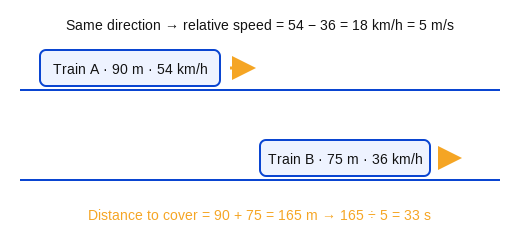
Two trains are running on parallel tracks in the same direction. Train A is 90 m long and moves at 54 km/h. Train B is 75 m long and moves at 36 km/h. How much time will Train A take to completely overtake Train B?
दो रेलगाड़ियाँ समानांतर पटरियों पर एक ही दिशा में चल रही हैं। रेलगाड़ी A 90 m लंबी है और 54 km/h की चाल से चलती है। रेलगाड़ी B 75 m लंबी है और 36 km/h की चाल से चलती है। रेलगाड़ी A को रेलगाड़ी B को पूरी तरह से पार करने में कितना समय लगेगा?
  1. A25 seconds25 सेकंड
  2. B30 seconds30 सेकंड
  3. C33 seconds33 सेकंड
  4. D22 seconds22 सेकंड
Show answer

Concept: Same direction → relative speed = difference; distance to overtake = sum of lengths.

  1. Relative speed =54−36=18 km/h =18×518=5 m/s.
  2. Distance =90+75=165 m.
  3. Time =1655=33 s.

Trick: km/h → m/s: multiply by 518; 18 km/h is exactly 5 m/s.

Answer: (C) 33 seconds

अवधारणा: एक ही दिशा → सापेक्ष चाल = अंतर; पार करने की दूरी = लंबाइयों का योग।

  1. सापेक्ष चाल =54−36=18 km/h =18×518=5 m/s।
  2. दूरी =90+75=165 m।
  3. समय =1655=33 s।

ट्रिक: km/h → m/s: 518 से गुणा; 18 km/h ठीक 5 m/s है।

उत्तर: (C) 33 seconds

RRB NTPC Undergraduate CBT 1MathematicsTrains – Relative SpeedRRB NTPC Undergraduate CBT 1 2025 · 16 Jun Shift 2 →
Q12844.
Simplify
256+144+(22)2+841×(2)2
सरल कीजिए
256+144+(22)2+841×(2)2
  1. A(32)2
  2. B(2)2
  3. C(22)2
  4. D(42)2
Show answer

Concept: Simplify from the innermost radical outward.

  1. 256=16, 144=12, (22)2=8 → inner sum =36, 36=6.
  2. 841×(2)2=29×2=58.
  3. 6+58=64=8=(22)2.

Trick: Options are all of the form (k2)2=2k2: 18, 2, 8, 32. Only 8 matches.

Answer: (C) (22)2

अवधारणा: सबसे भीतरी मूल से बाहर की ओर सरल करें।

  1. 256=16, 144=12, (22)2=8 → भीतरी योग =36, 36=6।
  2. 841×(2)2=29×2=58।
  3. 6+58=64=8=(22)2।

ट्रिक: सभी विकल्प (k2)2=2k2 रूप में हैं: 18, 2, 8, 32। केवल 8 मेल खाता है।

उत्तर: (C) (22)2

RRB NTPC Undergraduate CBT 1MathematicsSurds and Square RootsRRB NTPC Undergraduate CBT 1 2025 · 16 Jun Shift 2 →
Q12845.
A student's marks were incorrectly entered as 37 instead of 22. Due to this, the average marks of the class got increased by 54. What is the number of students in the class?
एक विद्यार्थी के अंक गलती से 22 के स्थान पर 37 दर्ज कर दिए गए। इसके कारण, कक्षा के औसत अंकों में 54 की वृद्धि हो गई। कक्षा में विद्यार्थियों की संख्या कितनी है?
  1. A4
  2. B11
  3. C12
  4. D21
Show answer

Concept: Rise in average × number of students = excess marks entered.

  1. Excess =37−22=15.
  2. n×54=15⇒n=15×45=12.

Trick: n=errorchange in average – one line.

Answer: (C) 12

अवधारणा: औसत में वृद्धि × छात्रों की संख्या = अधिक दर्ज किए गए अंक।

  1. अधिकता =37−22=15।
  2. n×54=15⇒n=15×45=12।

ट्रिक: n=त्रुटिऔसत में परिवर्तन – एक पंक्ति में।

उत्तर: (C) 12

RRB NTPC Undergraduate CBT 1MathematicsAverage – Wrong EntryRRB NTPC Undergraduate CBT 1 2025 · 16 Jun Shift 2 →
Q12846.
What is the mean proportional between 0.0009 and 0.25?
0.0009 और 0.25 के बीच मध्यानुपाती क्या है?
  1. A0.015
  2. B0.16
  3. C0.016
  4. D0.15
Show answer

Concept: Mean proportional between a and b is ab.

  1. 0.0009×0.25=0.0009×0.25.
  2. =0.03×0.5=0.015.

Trick: Take roots separately: 0.0009=(0.03)2, 0.25=(0.5)2.

Answer: (A) 0.015

अवधारणा: a और b का मध्यानुपाती ab होता है।

  1. 0.0009×0.25=0.0009×0.25।
  2. =0.03×0.5=0.015।

ट्रिक: अलग-अलग मूल लें: 0.0009=(0.03)2, 0.25=(0.5)2।

उत्तर: (A) 0.015

RRB NTPC Undergraduate CBT 1MathematicsMean ProportionalRRB NTPC Undergraduate CBT 1 2025 · 16 Jun Shift 2 →
Q12847.
A grocery store gives a Buy 5, Get 2 Free offer. The price of each item is ₹300. A customer needs a total of 21 items and procures the items under this scheme. What is the effective cost per item? (Round off your answer to two decimal places.)
एक किराना स्टोर '5 खरीदें, 2 मुफ़्त पाएँ' का ऑफ़र देता है। प्रत्येक वस्तु का मूल्य ₹300 है। एक ग्राहक को कुल 21 वस्तुओं की आवश्यकता है और वह इस योजना के अंतर्गत वस्तुएँ प्राप्त करता है। प्रति वस्तु प्रभावी लागत क्या है? (अपने उत्तर को दशमलव के दो स्थानों तक पूर्णांकित कीजिए।)
  1. A₹214.45
  2. B₹114.29
  3. C₹241.29
  4. D₹214.29
Show answer

Concept: In "Buy 5 Get 2 Free", 7 items cost the price of 5.

  1. 21=3×7, so the customer pays for 3×5=15 items.
  2. Total =15×300= ₹4500.
  3. Effective cost per item =450021=15007≈ ₹214.29.

Trick: Effective price =300×57 directly.

Answer: (D) ₹214.29

अवधारणा: "5 खरीदो 2 मुफ्त" में 7 वस्तुओं की कीमत 5 के बराबर।

  1. 21=3×7, अतः ग्राहक 3×5=15 वस्तुओं का भुगतान करता है।
  2. कुल =15×300= ₹4500।
  3. प्रभावी कीमत प्रति वस्तु =450021=15007≈ ₹214.29।

ट्रिक: प्रभावी कीमत =300×57 सीधे।

उत्तर: (D) ₹214.29

RRB NTPC Undergraduate CBT 1MathematicsDiscount – OffersRRB NTPC Undergraduate CBT 1 2025 · 16 Jun Shift 2 →
Q12848.
If the interest on a sum of ₹y at 2% per annum compounded annually for 2 years is ₹404, then the total amount payable at the end of the two-year period will be _________.
यदि ₹y की राशि पर 2% वार्षिक दर से, वार्षिक रूप से चक्रवृद्धि होने पर, 2 वर्षों का ब्याज ₹404 है, तो दो वर्ष की अवधि के अंत में देय कुल राशि _________ होगी।
  1. A₹10,404
  2. B₹10,604
  3. C₹10,704
  4. D₹10,504
Show answer

Concept: CI for 2 years =P[(1+r100)2−1].

  1. Effective 2-year rate at 2% =2+2+2×2100=4.04%.
  2. 4.04% of y=404⇒y=10000.
  3. Amount =10000+404= ₹10,404.

Trick: a+b+ab100 gives the 2-year CI rate instantly.

Answer: (A) ₹10,404

अवधारणा: 2 वर्ष का CI =P[(1+r100)2−1]।

  1. 2% पर 2 वर्ष की प्रभावी दर =2+2+2×2100=4.04%।
  2. y का 4.04%=404⇒y=10000।
  3. मिश्रधन =10000+404= ₹10,404।

ट्रिक: a+b+ab100 से 2 वर्ष की CI दर तुरंत मिलती है।

उत्तर: (A) ₹10,404

RRB NTPC Undergraduate CBT 1MathematicsCompound InterestRRB NTPC Undergraduate CBT 1 2025 · 16 Jun Shift 2 →
Q12849.
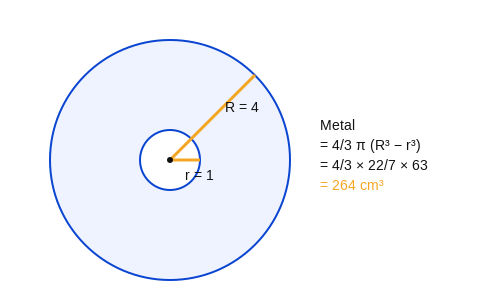
A hollow spherical shell is made of a metal of density 10 g/cm3. Its internal and external radius are 1 cm and 4 cm, respectively. What is the weight (in kg) of the shell?
(Use π=227 and Density=MassVolume)
एक खोखला गोलीय कोश 10 g/cm3 घनत्व वाली धातु से बना है। इसकी आंतरिक और बाहरी त्रिज्याएँ क्रमशः 1 cm और 4 cm हैं। कोश का भार (kg में) क्या है?
(π=227 और Density=MassVolume का प्रयोग कीजिए)
  1. A2.24
  2. B1.98
  3. C1.92
  4. D2.64
Show answer

Concept: Volume of metal =43π(R3−r3); mass = density × volume.

  1. R3−r3=64−1=63.
  2. Volume =43×227×63=4×22×3=264 cm3.
  3. Mass =10×264=2640 g =2.64 kg.

Trick: 63 is divisible by both 3 and 7, so 43×227×63 collapses to 4×22×3.

Answer: (D) 2.64

अवधारणा: धातु का आयतन =43π(R3−r3); द्रव्यमान = घनत्व × आयतन।

  1. R3−r3=64−1=63।
  2. आयतन =43×227×63=4×22×3=264 cm3।
  3. द्रव्यमान =10×264=2640 g =2.64 kg।

ट्रिक: 63, 3 और 7 दोनों से विभाज्य है, अतः 43×227×63=4×22×3।

उत्तर: (D) 2.64

RRB NTPC Undergraduate CBT 1MathematicsMensuration – Hollow SphereRRB NTPC Undergraduate CBT 1 2025 · 16 Jun Shift 2 →
Q12850.
Find the smallest natural number x, for which 2x + 1 is not a prime number.
वह सबसे छोटी प्राकृत संख्या x ज्ञात कीजिए, जिसके लिए 2x + 1 एक अभाज्य संख्या नहीं है।
  1. A3
  2. B2
  3. C4
  4. D5
Show answer

Concept: Test 2x+1 for small natural numbers x.

  1. x=1→3 (prime), x=2→5 (prime), x=3→7 (prime).
  2. x=4→9=3×3, not prime.

Trick: The first odd composite number is 9, so 2x+1=9⇒x=4.

Answer: (C) 4

अवधारणा: छोटी प्राकृत संख्याओं x के लिए 2x+1 जाँचें।

  1. x=1→3 (अभाज्य), x=2→5 (अभाज्य), x=3→7 (अभाज्य)।
  2. x=4→9=3×3, अभाज्य नहीं।

ट्रिक: पहली विषम भाज्य संख्या 9 है, अतः 2x+1=9⇒x=4।

उत्तर: (C) 4

RRB NTPC Undergraduate CBT 1MathematicsPrime NumbersRRB NTPC Undergraduate CBT 1 2025 · 16 Jun Shift 2 →
Q12851.
If on a sale, there is 40% discount on the marked price of ₹1,200, but the sale is done at ₹520 only, then how much additional discount did the customer get?
यदि एक सेल में ₹1,200 के अंकित मूल्य पर 40% की छूट है, परंतु बिक्री केवल ₹520 में की जाती है, तो ग्राहक को कितनी अतिरिक्त छूट मिली?
  1. A2579%
  2. B2779%
  3. C2679%
  4. D2879%
Show answer

Concept: The additional discount is calculated on the price after the first discount.

  1. After 40% discount: 1200×0.6= ₹720.
  2. Sold at ₹520, so extra discount =720−520= ₹200.
  3. Additional discount% =200720×100=2509=2779%.

Trick: 200720=518; 518×100=27.7―.

Answer: (B) 2779%

अवधारणा: अतिरिक्त छूट पहली छूट के बाद की कीमत पर निकाली जाती है।

  1. 40% छूट के बाद: 1200×0.6= ₹720।
  2. बिक्री ₹520 पर, अतः अतिरिक्त छूट =720−520= ₹200।
  3. अतिरिक्त छूट% =200720×100=2509=2779%।

ट्रिक: 200720=518; 518×100=27.7―।

उत्तर: (B) 2779%

RRB NTPC Undergraduate CBT 1MathematicsSuccessive DiscountRRB NTPC Undergraduate CBT 1 2025 · 16 Jun Shift 2 →
Q12852.
15 men and 19 women can complete a piece of work in 8 days, and 9 men and 4 women can complete the same work in 14 days. The work of how many women is equivalent to that of one man?
15 पुरुष और 19 महिलाएँ एक कार्य को 8 दिनों में पूरा कर सकते हैं, और 9 पुरुष और 4 महिलाएँ उसी कार्य को 14 दिनों में पूरा कर सकते हैं। कितनी महिलाओं का कार्य एक पुरुष के कार्य के बराबर है?
  1. A18
  2. B17
  3. C15
  4. D16
Show answer

Concept: Equate total work: (workers × days) in both cases.

  1. 8(15m+19w)=14(9m+4w).
  2. 120m+152w=126m+56w⇒96w=6m.
  3. m=16w: one man = 16 women.

Trick: Divide by 2 first: 4(15m+19w)=7(9m+4w) keeps numbers small.

Answer: (D) 16

अवधारणा: कुल कार्य बराबर करें: दोनों स्थितियों में (कर्मचारी × दिन)।

  1. 8(15m+19w)=14(9m+4w)।
  2. 120m+152w=126m+56w⇒96w=6m।
  3. m=16w: एक पुरुष = 16 महिलाएँ।

ट्रिक: पहले 2 से भाग दें: 4(15m+19w)=7(9m+4w) से संख्याएँ छोटी रहती हैं।

उत्तर: (D) 16

RRB NTPC Undergraduate CBT 1MathematicsTime and Work – EfficiencyRRB NTPC Undergraduate CBT 1 2025 · 16 Jun Shift 2 →
Q12853.
Two numbers differ by 8. If five times the smaller number is subtracted from twice the larger number, the result is 13. What is the larger number?
दो संख्याओं का अंतर 8 है। यदि बड़ी संख्या के दोगुने में से छोटी संख्या का पाँच गुना घटाया जाए, तो परिणाम 13 आता है। बड़ी संख्या क्या है?
  1. A12
  2. B10
  3. C8
  4. D9
Show answer

Concept: Form two equations in the larger (L) and smaller (S) numbers.

  1. L−S=8 and 2L−5S=13.
  2. Put L=S+8: 2S+16−5S=13⇒3S=3⇒S=1.
  3. L=9; check 2×9−5×1=13.

Trick: Test options: L=9,S=1 gives 18−5=13 – done.

Answer: (D) 9

अवधारणा: बड़ी (L) और छोटी (S) संख्या में दो समीकरण बनाएँ।

  1. L−S=8 और 2L−5S=13।
  2. L=S+8 रखें: 2S+16−5S=13⇒3S=3⇒S=1।
  3. L=9; जाँच 2×9−5×1=13।

ट्रिक: विकल्प जाँचें: L=9,S=1 से 18−5=13 – हो गया।

उत्तर: (D) 9

RRB NTPC Undergraduate CBT 1MathematicsLinear EquationsRRB NTPC Undergraduate CBT 1 2025 · 16 Jun Shift 2 →
Q12854.
A shopkeeper buys sugar at ₹48 per kg. While selling, he uses a faulty weighing scale that gives only 960 g instead of 1 kg. In addition, he marks the selling price at a profit of 20% on the cost price and then offers a discount of 10% on the marked price. Find the overall percentage profit or loss made by the shopkeeper.
एक दुकानदार ₹48 प्रति kg की दर से चीनी खरीदता है। बेचते समय, वह एक दोषपूर्ण तराज़ू का उपयोग करता है जो 1 kg के स्थान पर केवल 960 g तौलता है। इसके अतिरिक्त, वह क्रय मूल्य पर 20% लाभ जोड़कर विक्रय मूल्य अंकित करता है और फिर अंकित मूल्य पर 10% की छूट देता है। दुकानदार द्वारा अर्जित कुल लाभ या हानि प्रतिशत ज्ञात कीजिए।
  1. A4.5% loss4.5% हानि
  2. B11.4% profit11.4% लाभ
  3. C12.5% profit12.5% लाभ
  4. D10% profit10% लाभ
Show answer

Concept: Take 1 kg "sold": compare actual cost of goods given with money received.

  1. SP of 1 kg =48×1.2×0.9= ₹51.84.
  2. He actually gives 960 g, costing 48×0.96= ₹46.08.
  3. Profit% =51.84−46.0846.08×100=5.7646.08×100=12.5%.

Trick: Multiply factors: 1.2×0.90.96=1.080.96=1.125 → 12.5% profit.

Answer: (C) 12.5% profit

अवधारणा: 1 kg "बेचा" मानें: दिए गए माल की वास्तविक लागत और प्राप्त राशि की तुलना करें।

  1. 1 kg का SP =48×1.2×0.9= ₹51.84।
  2. वास्तव में 960 g देता है, लागत 48×0.96= ₹46.08।
  3. लाभ% =51.84−46.0846.08×100=5.7646.08×100=12.5%।

ट्रिक: गुणनखंड गुणा करें: 1.2×0.90.96=1.080.96=1.125 → 12.5% लाभ।

उत्तर: (C) 12.5% profit

RRB NTPC Undergraduate CBT 1MathematicsProfit – Faulty Weight & DiscountRRB NTPC Undergraduate CBT 1 2025 · 16 Jun Shift 2 →
Q12855.
Three numbers are in the ratio of 19 : 7 : 13, and their LCM is 8645. Their HCF is:
तीन संख्याएँ 19 : 7 : 13 के अनुपात में हैं, और उनका LCM (लघुत्तम समापवर्त्य) 8645 है। उनका HCF (महत्तम समापवर्तक) है:
  1. A25
  2. B5
  3. C15
  4. D30
Show answer

Concept: If numbers are 19x,7x,13x with 19, 7, 13 coprime, HCF =x and LCM =19×7×13×x.

  1. 19×7×13=1729.
  2. 1729x=8645⇒x=5.
  3. HCF =5.

Trick: 1729 (the Hardy–Ramanujan number) ×5=8645 – recognise it.

Answer: (B) 5

अवधारणा: संख्याएँ 19x,7x,13x हों और 19, 7, 13 सह-अभाज्य हों, तो HCF =x और LCM =19×7×13×x।

  1. 19×7×13=1729।
  2. 1729x=8645⇒x=5।
  3. HCF =5।

ट्रिक: 1729 (हार्डी–रामानुजन संख्या) ×5=8645 – पहचान लें।

उत्तर: (B) 5

RRB NTPC Undergraduate CBT 1MathematicsHCF and LCM – RatioRRB NTPC Undergraduate CBT 1 2025 · 16 Jun Shift 2 →
Q12856.
What should come in place of the ‘?’ in the given series?
19 36 59 94 147 ?
दी गई श्रृंखला में '?' के स्थान पर क्या आना चाहिए?
19 36 59 94 147 ?
  1. A220
  2. B224
  3. C228
  4. D226
Show answer

Concept: Check differences; if they are irregular, check the second differences.

  1. Differences: 36−19=17, 59−36=23, 94−59=35, 147−94=53.
  2. Second differences: 6,12,18 → next 24.
  3. Next difference =53+24=77, so ?=147+77=224.

Trick: When first differences grow unevenly, look for a pattern like +6,+12,+18 in the second level.

Answer: (B) 224

अवधारणा: अंतर देखें; अनियमित हों तो दूसरे स्तर के अंतर देखें।

  1. अंतर: 36−19=17, 59−36=23, 94−59=35, 147−94=53।
  2. दूसरे अंतर: 6,12,18 → अगला 24।
  3. अगला अंतर =53+24=77, अतः ?=147+77=224।

ट्रिक: पहले अंतर असमान बढ़ें तो दूसरे स्तर में +6,+12,+18 जैसा पैटर्न खोजें।

उत्तर: (B) 224

RRB NTPC Undergraduate CBT 1General Intelligence and ReasoningNumber seriesRRB NTPC Undergraduate CBT 1 2025 · 16 Jun Shift 2 →
Q12857.
Refer to the given letter series and answer the question that follows. Counting to be done from left to right only.
(Left) O E D F F B G F G I Y U I L V U Y T S V T (Right)
How many such consonants are there, each of which is immediately preceded by a consonant and also immediately followed by a vowel?
दी गई अक्षर श्रृंखला को देखिए और उसके बाद दिए गए प्रश्न का उत्तर दीजिए। गिनती केवल बाएँ से दाएँ की जानी है।
(बाएँ) O E D F F B G F G I Y U I L V U Y T S V T (दाएँ)
ऐसे कितने व्यंजन हैं, जिनमें से प्रत्येक के ठीक पहले एक व्यंजन है और ठीक बाद एक स्वर भी है?
  1. ANoneकोई नहीं
  2. BOneएक
  3. CTwoदो
  4. DThreeतीन
Show answer

Concept: Mark vowels (A, E, I, O, U); every other letter, including Y, is a consonant. Look for the pattern Consonant – Consonant – Vowel.

  1. Vowels are at positions 1 (O), 2 (E), 10 (I), 12 (U), 13 (I), 16 (U).
  2. Only letters just before a vowel can qualify: F G I → G ✓ (preceded by F); I Y U → Y ✗ (preceded by I); L V U → V ✓ (preceded by L).
  3. So the letters are G and V.

Trick: First find every vowel, then check only the two letters before each vowel – fastest way.

Answer: (C) Two

अवधारणा: स्वर (A, E, I, O, U) चिह्नित करें; Y सहित बाकी सब व्यंजन हैं। पैटर्न खोजें: व्यंजन – व्यंजन – स्वर।

  1. स्वर स्थान 1 (O), 2 (E), 10 (I), 12 (U), 13 (I), 16 (U) पर हैं।
  2. केवल स्वर से ठीक पहले वाले अक्षर योग्य हो सकते हैं: F G I → G ✓ (पहले F); I Y U → Y ✗ (पहले I स्वर); L V U → V ✓ (पहले L)।
  3. अतः अक्षर G और V हैं।

ट्रिक: पहले सभी स्वर खोजें, फिर हर स्वर से पहले के दो अक्षर ही जाँचें।

उत्तर: (C) दो

RRB NTPC Undergraduate CBT 1General Intelligence and ReasoningLetter series – countingRRB NTPC Undergraduate CBT 1 2025 · 16 Jun Shift 2 →
Q12858.
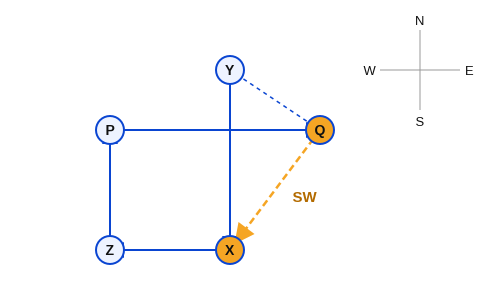
Town X is to the south of Town Y. Town Z is to the west of Town X. Town P is to the north of Town Z. Town Q is to the east of Town P. Town Y is to the north-west of Town Q. What is the position of Town X with respect to Town Q?
नगर X, नगर Y के दक्षिण में है। नगर Z, नगर X के पश्चिम में है। नगर P, नगर Z के उत्तर में है। नगर Q, नगर P के पूर्व में है। नगर Y, नगर Q के उत्तर-पश्चिम में है। नगर Q के सापेक्ष नगर X की स्थिति क्या है?
  1. ANorth-eastउत्तर-पूर्व
  2. BNorth-westउत्तर-पश्चिम
  3. CSouth-eastदक्षिण-पूर्व
  4. DSouth-westदक्षिण-पश्चिम
Show answer

Concept: Place the towns step by step on a grid with X as the origin.

  1. Y is north of X; Z is west of X; P is north of Z; Q is east of P (same level as P).
  2. Y is north-west of Q → Q lies east of the X–Y line and below Y.
  3. So Q is to the north-east of X, i.e. X is to the south-west of Q.

Trick: Find Q's position from X (NE) and reverse it: NE ↔ SW.

Answer: (D) South-west

अवधारणा: X को मूल बिंदु मानकर कस्बों को क्रम से ग्रिड पर रखें।

  1. Y, X के उत्तर में; Z, X के पश्चिम में; P, Z के उत्तर में; Q, P के पूर्व में (P के समान स्तर पर)।
  2. Y, Q के उत्तर-पश्चिम में → Q, X–Y रेखा के पूर्व में और Y से नीचे है।
  3. अतः Q, X के उत्तर-पूर्व में है, यानी X, Q के दक्षिण-पश्चिम में।

ट्रिक: X से Q की दिशा (NE) निकालें और उलट दें: NE ↔ SW।

उत्तर: (D) दक्षिण-पश्चिम

RRB NTPC Undergraduate CBT 1General Intelligence and ReasoningDirection senseRRB NTPC Undergraduate CBT 1 2025 · 16 Jun Shift 2 →
Q12859.
Which of the following letter-number clusters will replace the question mark (?) in the given series to make it logically complete?
XK253, UO236, RS219, ?
निम्नलिखित में से कौन-सा अक्षर-संख्या समूह दी गई श्रृंखला में प्रश्न चिह्न (?) के स्थान पर आकर उसे तार्किक रूप से पूर्ण करेगा?
XK253, UO236, RS219, ?
  1. AOW202
  2. BNW206
  3. COV204
  4. DMV208
Show answer

Concept: Treat the first letter, second letter and number as three separate series.

  1. First letter: X → U → R → O (each −3).
  2. Second letter: K → O → S → W (each +4).
  3. Number: 253→236→219→202 (each −17).

Trick: Check the number part first: only one option ends in 202.

Answer: (A) OW202

अवधारणा: पहला अक्षर, दूसरा अक्षर और संख्या – तीन अलग श्रृंखलाएँ मानें।

  1. पहला अक्षर: X → U → R → O (हर बार −3)।
  2. दूसरा अक्षर: K → O → S → W (हर बार +4)।
  3. संख्या: 253→236→219→202 (हर बार −17)।

ट्रिक: पहले संख्या जाँचें: केवल एक विकल्प 202 पर खत्म होता है।

उत्तर: (A) OW202

RRB NTPC Undergraduate CBT 1General Intelligence and ReasoningAlphanumeric seriesRRB NTPC Undergraduate CBT 1 2025 · 16 Jun Shift 2 →
Q12860.
Select the set in which the numbers are related in the same way as are the numbers of the following sets.
(NOTE: Operations should be performed on the whole numbers, without breaking down the numbers into their constituent digits. E.g. 13 – Operations on 13 such as
adding/subtracting/multiplying etc. to 13 can be performed. Breaking down 13 into 1 and 3 and then performing mathematical operations on 1 and 3 is not allowed.) 91, 184
88, 178
उस समुच्चय का चयन कीजिए जिसमें संख्याएँ उसी प्रकार संबंधित हैं जिस प्रकार निम्नलिखित समुच्चयों की संख्याएँ संबंधित हैं।
(ध्यान दें: संक्रियाएँ संख्याओं को उनके घटक अंकों में विभाजित किए बिना, पूर्ण संख्याओं पर की जानी चाहिए। उदाहरण के लिए, 13 – 13 पर संक्रियाएँ जैसे
13 में जोड़ना/घटाना/गुणा करना आदि किया जा सकता है। 13 को 1 और 3 में विभाजित करना और फिर 1 और 3 पर गणितीय संक्रियाएँ करना वर्जित है।) 91, 184
88, 178
  1. A99, 200
  2. B104, 218
  3. C76, 152
  4. D92, 184
Show answer

Concept: Find one rule that turns the first number into the second in both given pairs.

  1. 91×2+2=184 ✓; 88×2+2=178 ✓ → rule: second =2× first +2.
  2. 99×2+2=200 ✓.
  3. Others: 104×2+2=210≠218, 76×2+2=154≠152, 92×2+2=186≠184.

Trick: Second number is about double the first → test 'double plus/minus a small number'.

Answer: (A) 99, 200

अवधारणा: एक ऐसा नियम खोजें जो दोनों दिए युग्मों में पहली संख्या से दूसरी बनाए।

  1. 91×2+2=184 ✓; 88×2+2=178 ✓ → नियम: दूसरी =2× पहली +2।
  2. 99×2+2=200 ✓।
  3. अन्य: 104×2+2=210≠218, 76×2+2=154≠152, 92×2+2=186≠184।

ट्रिक: दूसरी संख्या लगभग दोगुनी है → 'दोगुना ± छोटी संख्या' जाँचें।

उत्तर: (A) 99, 200

RRB NTPC Undergraduate CBT 1General Intelligence and ReasoningNumber pair analogyRRB NTPC Undergraduate CBT 1 2025 · 16 Jun Shift 2 →