Question bank

Q&A: practice questions with answers

Search questions on any topic. Filter by exam category, exam, subject and topic, try the question, then open the answer and explanation.

Courses – airGurukul

20,719 questions found.

Q12961.
What should come in place of '?' in the given series based on the English alphabetical order?
KFS GBO CXK YTG ?
अंग्रेज़ी वर्णमाला क्रम के आधार पर दी गई श्रृंखला में '?' के स्थान पर क्या आना चाहिए?
KFS GBO CXK YTG ?
  1. AVSF
  2. BVWD
  3. CWDG
  4. DUPC
Show answer

Concept: Each of the three letter positions moves back by 4.

  1. 1st letters: K → G → C → Y → U
  2. 2nd letters: F → B → X → T → P
  3. 3rd letters: S → O → K → G → C

Trick: −4 cycling past A: C − 4 = Y (wraps around).

Answer: (D) UPC

अवधारणा: तीनों स्थानों के अक्षर हर बार 4 पीछे जाते हैं।

  1. पहले अक्षर: K → G → C → Y → U
  2. दूसरे अक्षर: F → B → X → T → P
  3. तीसरे अक्षर: S → O → K → G → C

ट्रिक: A के बाद पीछे जाने पर Z से गिनें: C − 4 = Y।

उत्तर: (D) UPC
RRB NTPC Undergraduate CBT 1General Intelligence and ReasoningLetter seriesRRB NTPC Undergraduate CBT 1 2025 · 16 Jun Shift 1 →
Q12962.
Read the given statement(s) and conclusions carefully. Assuming that the information given in the statements is true, even if it appears to be at variance with commonly known facts, decide which of the given conclusions logically follow(s) from the statement(s).
Statements: Some wings are toys. No toys are pens.
Conclusion (I): No pens are wings.
Conclusion (II): Some wings are not pens.
दिए गए कथन(नों) और निष्कर्षों को ध्यानपूर्वक पढ़िए। यह मानते हुए कि कथनों में दी गई जानकारी सत्य है, भले ही वह सामान्य रूप से ज्ञात तथ्यों से भिन्न प्रतीत होती हो, निर्णय कीजिए कि दिए गए निष्कर्षों में से कौन-सा/से निष्कर्ष कथन(नों) का तार्किक रूप से अनुसरण करता है/करते हैं।
कथन: कुछ पंख, खिलौने हैं। कोई खिलौना, कलम नहीं है।
निष्कर्ष (I): कोई कलम, पंख नहीं है।
निष्कर्ष (II): कुछ पंख, कलम नहीं हैं।
  1. AOnly conclusion (II) followsकेवल निष्कर्ष (II) अनुसरण करता है
  2. BOnly conclusion (I) followsकेवल निष्कर्ष (I) अनुसरण करता है
  3. CBoth conclusions (I) and (II) followनिष्कर्ष (I) और (II) दोनों अनुसरण करते हैं
  4. DNeither conclusion (I) nor (II) followsन तो निष्कर्ष (I) और न ही (II) अनुसरण करता है
Show answer

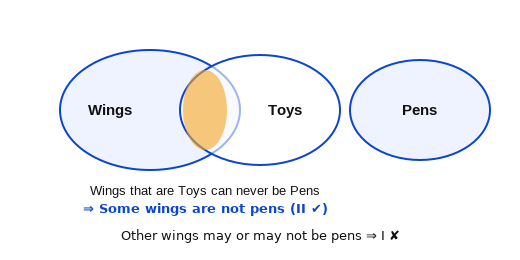
Concept: Some A are B + No B are C ⇒ Some A are not C (always true).

  1. The wings that are toys can never be pens ⇒ Some wings are not pens – II follows.
  2. Other wings may or may not be pens, so ‘No pens are wings’ is not certain – I does not follow.

Trick: Some + No = Some not (in that order).

Answer: (A) Only conclusion (II) follows

अवधारणा: कुछ A, B हैं + कोई B, C नहीं ⇒ कुछ A, C नहीं हैं (सदैव सत्य)।

  1. जो wings, toys हैं वे कभी pens नहीं हो सकते ⇒ कुछ wings, pens नहीं हैं – II अनुसरण करता है।
  2. बाक़ी wings pens हो भी सकते हैं, इसलिए ‘कोई pen, wing नहीं’ निश्चित नहीं – I अनुसरण नहीं करता।

ट्रिक: कुछ + कोई नहीं = कुछ नहीं (इसी क्रम में)।

उत्तर: (A) केवल निष्कर्ष (II) अनुसरण करता है

RRB NTPC Undergraduate CBT 1General Intelligence and ReasoningSyllogismRRB NTPC Undergraduate CBT 1 2025 · 16 Jun Shift 1 →
Q12963.
Refer to the following letter series and answer the question. (Counting to be done from left to right only)
(Left) D F T B M E Q Y O W G U S I K A R C X Z H (Right)
How many such vowels are there, each of which is immediately preceded by a consonant and also immediately followed by a consonant?
निम्नलिखित अक्षर श्रृंखला को देखिए और प्रश्न का उत्तर दीजिए। (गिनती केवल बाएँ से दाएँ की जानी है)
(बाएँ) D F T B M E Q Y O W G U S I K A R C X Z H (दाएँ)
ऐसे कितने स्वर हैं, जिनमें से प्रत्येक के ठीक पहले एक व्यंजन है और ठीक बाद भी एक व्यंजन है?
  1. A2
  2. B5
  3. C3
  4. D4
Show answer

Concept: Check each vowel (A, E, I, O, U) for consonants on both sides.

  1. E: M E Q ✓
  2. O: Y O W ✓; U: G U S ✓
  3. I: S I K ✓; A: K A R ✓
  4. Total =5.

Trick: List only vowels first, then check neighbours – faster than scanning every letter.

Answer: (B) 5

अवधारणा: हर स्वर (A, E, I, O, U) के दोनों ओर व्यंजन है या नहीं, जाँचें।

  1. E: M E Q ✓
  2. O: Y O W ✓; U: G U S ✓
  3. I: S I K ✓; A: K A R ✓
  4. कुल =5।

ट्रिक: पहले केवल स्वर ढूँढें, फिर पड़ोसी देखें – हर अक्षर जाँचने से तेज़।

उत्तर: (B) 5

RRB NTPC Undergraduate CBT 1General Intelligence and ReasoningLetter series – positionRRB NTPC Undergraduate CBT 1 2025 · 16 Jun Shift 1 →
Q12964.
Select the pair that follows the same pattern as that followed by the two pairs given below. Both pairs follow the same pattern.
CFG : GJK ;
KMP : OQT
उस युग्म का चयन कीजिए जो उसी पैटर्न का अनुसरण करता है जिसका अनुसरण नीचे दिए गए दो युग्म करते हैं। दोनों युग्म एक ही पैटर्न का अनुसरण करते हैं।
CFG : GJK ;
KMP : OQT
  1. AGNP : KRT
  2. BLMI : NOK
  3. CDJL : AGI
  4. DACH : BDI
Show answer

Concept: Each letter of the first cluster moves forward by 4.

  1. C+4=G, F+4=J, G+4=K; K+4=O, M+4=Q, P+4=T.
  2. GNP: G+4=K, N+4=R, P+4=T → KRT ✓
  3. LMI → NOK is +2; DJL → AGI is −3; ACH → BDI is +1.

Trick: Check only the first letter of each option first – usually eliminates the rest.

Answer: (A) GNP : KRT

अवधारणा: पहले समूह का हर अक्षर 4 आगे जाता है।

  1. C+4=G, F+4=J, G+4=K; K+4=O, M+4=Q, P+4=T।
  2. GNP: G+4=K, N+4=R, P+4=T → KRT ✓
  3. LMI → NOK में +2; DJL → AGI में −3; ACH → BDI में +1।

ट्रिक: पहले हर विकल्प का पहला अक्षर जाँचें – बाक़ी जल्दी हट जाते हैं।

उत्तर: (A) GNP : KRT

RRB NTPC Undergraduate CBT 1General Intelligence and ReasoningLetter analogyRRB NTPC Undergraduate CBT 1 2025 · 16 Jun Shift 1 →
Q12965.
Based on the English alphabetical order, three of the following four letter-cluster pairs are alike in a certain way and thus form a group. Which is the one that does not belong to that group?
(Note: The odd one out is not based on the number of consonants/vowels or their position in the letter cluster.)
अंग्रेज़ी वर्णमाला क्रम के आधार पर, निम्नलिखित चार अक्षर-समूह युग्मों में से तीन किसी निश्चित प्रकार से एकसमान हैं और इस प्रकार एक समूह बनाते हैं। कौन-सा युग्म उस समूह से संबंधित नहीं है?
(ध्यान दें: असंगत युग्म, व्यंजनों/स्वरों की संख्या या अक्षर-समूह में उनके स्थान पर आधारित नहीं है।)
  1. ATG - QE
  2. BZI - WF
  3. CUC -RA
  4. DXD - UB
Show answer

Concept: Find the shift from the first to the second cluster for each letter.

  1. TG – QE: T−3=Q, G−2=E
  2. UC – RA: U−3=R, C−2=A; XD – UB: X−3=U, D−2=B
  3. ZI – WF: Z−3=W, I−3=F ✗ (second letter shifts by 3, not 2).

Trick: Pattern (−3,−2) in three pairs; odd one breaks it.

Answer: (B) ZI - WF

अवधारणा: हर अक्षर का पहले से दूसरे समूह तक खिसकाव देखें।

  1. TG – QE: T−3=Q, G−2=E
  2. UC – RA: U−3=R, C−2=A; XD – UB: X−3=U, D−2=B
  3. ZI – WF: Z−3=W, I−3=F ✗ (दूसरा अक्षर 2 नहीं, 3 खिसका)।

ट्रिक: तीन युग्मों में (−3,−2); विषम उसे तोड़ता है।

उत्तर: (B) ZI - WF

RRB NTPC Undergraduate CBT 1General Intelligence and ReasoningOdd one out – letter pairsRRB NTPC Undergraduate CBT 1 2025 · 16 Jun Shift 1 →
Q12966.
If ‘A’ stands for ‘÷’, ‘B’ stands for ‘x’, ‘C’ stands for ‘+’ and ‘D’ stands for ‘-‘, what will be come in place of the question mark ‘?’ in the following equation?
2 B 32 A 1 D 1 C 45 = ?
यदि ‘A’ का अर्थ ‘÷’, ‘B’ का अर्थ ‘x’, ‘C’ का अर्थ ‘+’ और ‘D’ का अर्थ ‘-‘ है, तो निम्नलिखित समीकरण में प्रश्न चिह्न ‘?’ के स्थान पर क्या आएगा?
2 B 32 A 1 D 1 C 45 = ?
  1. A108
  2. B110
  3. C106
  4. D109
Show answer

Concept: Substitute signs (B = ×, A = ÷, D = −, C = +) and apply BODMAS.

  1. 2×32÷1−1+45
  2. =64−1+45
  3. =108

Trick: Do × and ÷ left to right, then + and −.

Answer: (A) 108

अवधारणा: चिह्न बदलें (B = ×, A = ÷, D = −, C = +) और BODMAS लगाएँ।

  1. 2×32÷1−1+45
  2. =64−1+45
  3. =108

ट्रिक: × और ÷ बाएँ से दाएँ, फिर + और −।

उत्तर: (A) 108

RRB NTPC Undergraduate CBT 1General Intelligence and ReasoningMathematical operationsRRB NTPC Undergraduate CBT 1 2025 · 16 Jun Shift 1 →
Q12967.
KEGJ is related to RLNQ in a certain way based on the English alphabetical order. In the same way, NHJM is related to UOQT. To which of the following is QKMP related, following the same logic?
अंग्रेज़ी वर्णमाला क्रम के आधार पर KEGJ एक निश्चित प्रकार से RLNQ से संबंधित है। उसी प्रकार NHJM, UOQT से संबंधित है। उसी तर्क का अनुसरण करते हुए QKMP निम्नलिखित में से किससे संबंधित है?
  1. ARXWT
  2. BRXTW
  3. CXRWT
  4. DXRTW
Show answer

Concept: Every letter moves forward by 7.

  1. K+7=R, E+7=L, G+7=N, J+7=Q (KEGJ → RLNQ)
  2. N+7=U, H+7=O, J+7=Q, M+7=T (NHJM → UOQT)
  3. Q+7=X, K+7=R, M+7=T, P+7=W → XRTW

Trick: Only the first letter is needed: Q+7=X leaves XRWT/XRTW; then K+7=R, M+7=T settles it.

Answer: (D) XRTW

अवधारणा: हर अक्षर 7 आगे जाता है।

  1. K+7=R, E+7=L, G+7=N, J+7=Q (KEGJ → RLNQ)
  2. N+7=U, H+7=O, J+7=Q, M+7=T (NHJM → UOQT)
  3. Q+7=X, K+7=R, M+7=T, P+7=W → XRTW

ट्रिक: Q+7=X से दो विकल्प बचते हैं; M+7=T (तीसरा अक्षर) से उत्तर तय।

उत्तर: (D) XRTW

RRB NTPC Undergraduate CBT 1General Intelligence and ReasoningLetter analogyRRB NTPC Undergraduate CBT 1 2025 · 16 Jun Shift 1 →
Q12968.
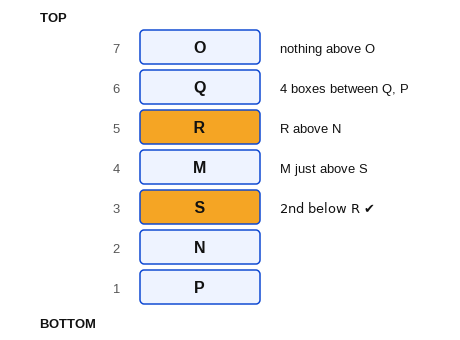
Seven boxes M, N, O, P, Q, R and S are kept one over the other but not necessarily in the same order. No box is kept above O. Only three boxes are kept between O and S. Only one box is kept between Q and M. M is kept immediately above S. Only four boxes are kept between Q and P. R is kept at some place above N. Which box is kept second below R?
सात बक्से M, N, O, P, Q, R और S एक के ऊपर एक रखे गए हैं, परंतु आवश्यक नहीं कि इसी क्रम में हों। O के ऊपर कोई बक्सा नहीं रखा है। O और S के बीच केवल तीन बक्से रखे हैं। Q और M के बीच केवल एक बक्सा रखा है। M, S के ठीक ऊपर रखा है। Q और P के बीच केवल चार बक्से रखे हैं। R, N के ऊपर किसी स्थान पर रखा है। R के नीचे दूसरे स्थान पर कौन-सा बक्सा रखा है?
  1. AQ
  2. BS
  3. CO
  4. DN
Show answer

Concept: Number positions 1 (bottom) to 7 (top) and place fixed clues first.

  1. Nothing above O ⇒ O =7; three between O and S ⇒ S =3; M just above S ⇒ M =4.
  2. One between Q and M ⇒ Q =2 or 6. Four between Q and P: Q =2 needs P =7 (taken) ⇒ Q =6, P =1.
  3. R above N in positions 2, 5 ⇒ R =5, N =2.
  4. Second below R (5) is position 3 = S.

Trick: Start with the box at an extreme (top/bottom) – it fixes the most clues.

Answer: (B) S

अवधारणा: स्थान 1 (नीचे) से 7 (ऊपर) मानें और निश्चित सूचनाएँ पहले लगाएँ।

  1. O के ऊपर कोई नहीं ⇒ O =7; O और S के बीच तीन ⇒ S =3; M, S के ठीक ऊपर ⇒ M =4।
  2. Q और M के बीच एक ⇒ Q =2 या 6। Q और P के बीच चार: Q =2 पर P =7 (भरा) ⇒ Q =6, P =1।
  3. बचे स्थान 2, 5 में R, N के ऊपर ⇒ R =5, N =2।
  4. R (5) से दूसरा नीचे स्थान 3 = S।

ट्रिक: सबसे ऊपर/नीचे वाले डिब्बे से शुरू करें – वह सबसे अधिक सूचनाएँ तय करता है।

उत्तर: (B) S

RRB NTPC Undergraduate CBT 1General Intelligence and ReasoningBox arrangementRRB NTPC Undergraduate CBT 1 2025 · 16 Jun Shift 1 →
Q12969.
Based on the English alphabetical order, three of the following four are alike in a certain way and thus form a group. Which is the one that does not belong to that group? (Note: The odd man out is not based on the number of consonants/vowels or their position in the letter cluster.)
अंग्रेज़ी वर्णमाला क्रम के आधार पर, निम्नलिखित चार में से तीन किसी निश्चित प्रकार से एकसमान हैं और इस प्रकार एक समूह बनाते हैं। कौन-सा उस समूह से संबंधित नहीं है? (ध्यान दें: असंगत, व्यंजनों/स्वरों की संख्या या अक्षर-समूह में उनके स्थान पर आधारित नहीं है।)
  1. AYAD
  2. BEHJ
  3. CMOR
  4. DSUX
Show answer

Concept: Check the gaps between consecutive letters.

  1. YAD: Y+2=A, A+3=D → (+2,+3)
  2. MOR: (+2,+3); SUX: (+2,+3)
  3. EHJ: E+3=H, H+2=J → (+3,+2) ✗

Trick: Same gaps but in reverse order is the classic odd one.

Answer: (B) EHJ

अवधारणा: लगातार अक्षरों के बीच का अंतर देखें।

  1. YAD: Y+2=A, A+3=D → (+2,+3)
  2. MOR: (+2,+3); SUX: (+2,+3)
  3. EHJ: E+3=H, H+2=J → (+3,+2) ✗

ट्रिक: अंतर वही पर उलटे क्रम में – यही विषम पद है।

उत्तर: (B) EHJ

RRB NTPC Undergraduate CBT 1General Intelligence and ReasoningOdd one out – letter clustersRRB NTPC Undergraduate CBT 1 2025 · 16 Jun Shift 1 →
Q12970.
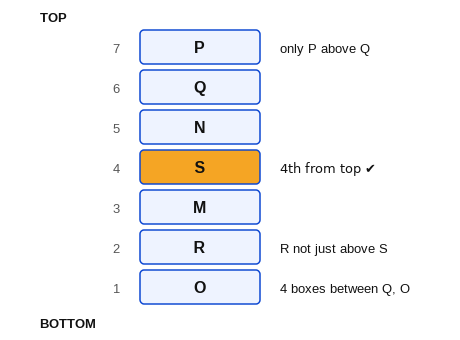
Seven boxes, M, N, O, P, Q, R and S, are kept one over the other, but not necessarily in the same order.
Only four boxes are kept between Q and O. Only P is kept above Q. Only two boxes are kept between N and R. S is kept immediately above M. R is not kept immediately above S.
Which box is kept fourth from the top?
सात बक्से, M, N, O, P, Q, R और S, एक के ऊपर एक रखे गए हैं, परंतु आवश्यक नहीं कि इसी क्रम में हों।
Q और O के बीच केवल चार बक्से रखे हैं। Q के ऊपर केवल P रखा है। N और R के बीच केवल दो बक्से रखे हैं। S, M के ठीक ऊपर रखा है। R, S के ठीक ऊपर नहीं रखा है।
ऊपर से चौथे स्थान पर कौन-सा बक्सा रखा है?
  1. AS
  2. BO
  3. CP
  4. DM
Show answer

Concept: Number positions from the top (1 = top, 7 = bottom).

  1. Only P above Q ⇒ P =1, Q =2. Four between Q and O ⇒ O =7.
  2. Positions 3–6 for N, R, S, M. Two between N and R ⇒ N, R at 3 and 6; so S, M at 4, 5 (S just above M).
  3. If R =3 it would be just above S – not allowed ⇒ N =3, R =6.
  4. Order: P, Q, N, S, M, R, O ⇒ 4th from top = S.

Trick: A ‘pair’ clue (S just above M) plus a ‘gap’ clue usually leaves only one fit.

Answer: (A) S

अवधारणा: ऊपर से स्थान गिनें (1 = सबसे ऊपर, 7 = सबसे नीचे)।

  1. केवल P, Q के ऊपर ⇒ P =1, Q =2। Q और O के बीच चार ⇒ O =7।
  2. स्थान 3–6 में N, R, S, M। N और R के बीच दो ⇒ N, R स्थान 3 और 6 पर; S, M स्थान 4, 5 पर (S, M के ठीक ऊपर)।
  3. R =3 हो तो वह S के ठीक ऊपर होगा – मना है ⇒ N =3, R =6।
  4. क्रम: P, Q, N, S, M, R, O ⇒ ऊपर से चौथा = S।

ट्रिक: ‘जोड़ी’ वाली सूचना + ‘अंतर’ वाली सूचना से प्रायः एक ही स्थिति बचती है।

उत्तर: (A) S

RRB NTPC Undergraduate CBT 1General Intelligence and ReasoningBox arrangementRRB NTPC Undergraduate CBT 1 2025 · 16 Jun Shift 1 →
Q12971.
In a certain code language,
A @ B means ‘A is the mother of B’,
A × B means ‘A is the wife of B’,
A + B means ‘A is the brother of B’ and
A ÷ B means ‘A is the father of B’.
How is S related to H if ‘S × D ÷ R + Y @ H’?
एक निश्चित कूट भाषा में,
A @ B का अर्थ है ‘A, B की माँ है’,
A × B का अर्थ है ‘A, B की पत्नी है’,
A + B का अर्थ है ‘A, B का भाई है’ और
A ÷ B का अर्थ है ‘A, B का पिता है’।
यदि ‘S × D ÷ R + Y @ H’ है, तो S का H से क्या संबंध है?
  1. AMother's sisterमाँ की बहन
  2. BSisterबहन
  3. CMother's motherमाँ की माँ
  4. DMotherमाँ
Show answer

Concept: Decode each symbol and build the family tree.

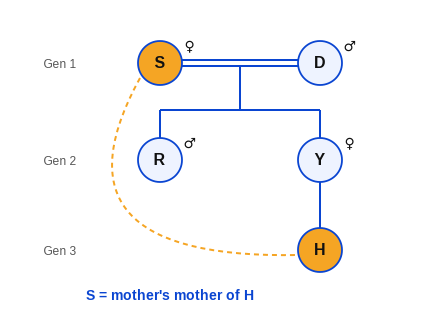
  1. S × D: S is the wife of D. D ÷ R: D is the father of R.
  2. R + Y: R is the brother of Y ⇒ S is the mother of R and Y.
  3. Y @ H: Y is the mother of H.
  4. So S is the mother of H’s mother.

Trick: Always mark gender (♂/♀) while decoding – it decides ‘mother’ vs ‘father’.

Answer: (C) Mother's mother

अवधारणा: हर चिह्न को डिकोड कर वंश-वृक्ष बनाएँ।

  1. S × D: S, D की पत्नी है। D ÷ R: D, R का पिता है।
  2. R + Y: R, Y का भाई है ⇒ S, R और Y की माँ है।
  3. Y @ H: Y, H की माँ है।
  4. अतः S, H की माँ की माँ (नानी) है।

ट्रिक: डिकोड करते समय लिंग (♂/♀) अवश्य लिखें।

उत्तर: (C) माँ की माँ (नानी)

RRB NTPC Undergraduate CBT 1General Intelligence and ReasoningBlood relations – codedRRB NTPC Undergraduate CBT 1 2025 · 16 Jun Shift 1 →
Q12972.
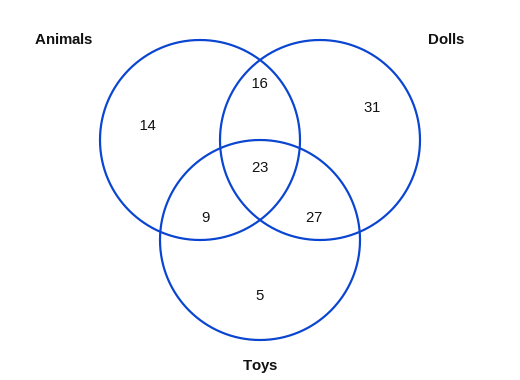
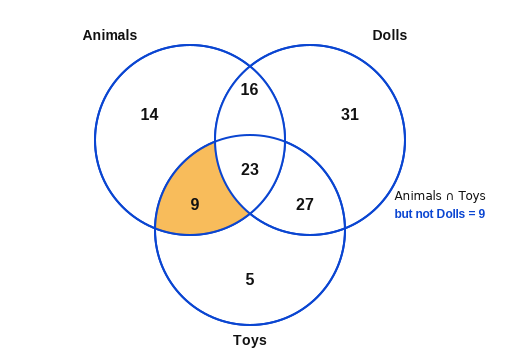
Study the given diagram carefully and answer the question. The numbers in different sections indicate the number of persons. (NOTE: You have to take the given data to be true even if it seems to be at variance from commonly known facts.)
How many such Animals are there which are also Toys but are not Dolls?
दिए गए आरेख का ध्यानपूर्वक अध्ययन कीजिए और प्रश्न का उत्तर दीजिए। विभिन्न खंडों में दी गई संख्याएँ व्यक्तियों की संख्या दर्शाती हैं। (ध्यान दें: आपको दिए गए आँकड़ों को सत्य मानना है, भले ही वे सामान्य रूप से ज्ञात तथ्यों से भिन्न प्रतीत होते हों।)
ऐसे कितने जानवर (Animals) हैं जो खिलौने (Toys) भी हैं परंतु गुड़िया (Dolls) नहीं हैं?
  1. A9
  2. B31
  3. C5
  4. D16
Show answer

Concept: ‘Animals and Toys but not Dolls’ = the region common to Animals and Toys, outside Dolls.

  1. Animals ∩ Toys contains 9 and 23.
  2. 23 is also inside Dolls, so exclude it.
  3. Required number =9.

Trick: Shade the ‘in’ circles, then remove every part touching the ‘not’ circle.

Answer: (A) 9

अवधारणा: ‘Animals और Toys पर Dolls नहीं’ = Animals और Toys का साझा भाग जो Dolls के बाहर है।

  1. Animals ∩ Toys में 9 और 23 हैं।
  2. 23, Dolls के अंदर भी है, इसलिए हटाएँ।
  3. अभीष्ट संख्या =9।

ट्रिक: ‘में’ वाले वृत्तों को छायांकित करें, फिर ‘नहीं’ वाले वृत्त का हिस्सा हटा दें।

उत्तर: (A) 9

RRB NTPC Undergraduate CBT 1General Intelligence and ReasoningVenn diagram – dataRRB NTPC Undergraduate CBT 1 2025 · 16 Jun Shift 1 →
Q12973.
In a certain code language,
A + B means ‘A is the sister of B’,
A - B means ‘A is the wife of B’,
A × B means ‘A is the father of B’, and
A ÷ B means ‘A is the mother of B’.
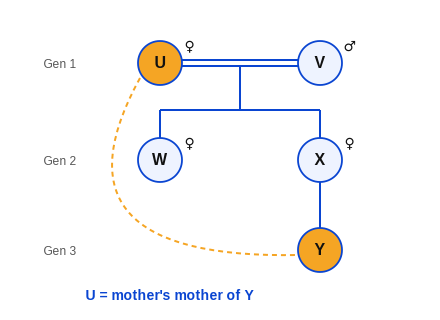
Based on the above, how is U related to Y if ‘U - V × W + X ÷ Y’?
एक निश्चित कूट भाषा में,
A + B का अर्थ है ‘A, B की बहन है’,
A - B का अर्थ है ‘A, B की पत्नी है’,
A × B का अर्थ है ‘A, B का पिता है’, और
A ÷ B का अर्थ है ‘A, B की माँ है’।
उपर्युक्त के आधार पर, यदि ‘U - V × W + X ÷ Y’ है, तो U का Y से क्या संबंध है?
  1. AMother’s motherमाँ की माँ
  2. BFather’s motherपिता की माँ
  3. CFather’s sisterपिता की बहन
  4. DMother’s sisterमाँ की बहन
Show answer

Concept: Decode each symbol and build the family tree.

  1. U − V: U is the wife of V. V × W: V is the father of W.
  2. W + X: W is the sister of X ⇒ U is the mother of W and X.
  3. X ÷ Y: X is the mother of Y.
  4. So U is Y’s mother’s mother.

Trick: Wife of the father = mother; go one generation at a time.

Answer: (A) Mother’s mother

अवधारणा: हर चिह्न को डिकोड कर वंश-वृक्ष बनाएँ।

  1. U − V: U, V की पत्नी है। V × W: V, W का पिता है।
  2. W + X: W, X की बहन है ⇒ U, W और X की माँ है।
  3. X ÷ Y: X, Y की माँ है।
  4. अतः U, Y की माँ की माँ (नानी) है।

ट्रिक: पिता की पत्नी = माँ; एक-एक पीढ़ी आगे बढ़ें।

उत्तर: (A) माँ की माँ (नानी)

RRB NTPC Undergraduate CBT 1General Intelligence and ReasoningBlood relations – codedRRB NTPC Undergraduate CBT 1 2025 · 16 Jun Shift 1 →
Q12974.
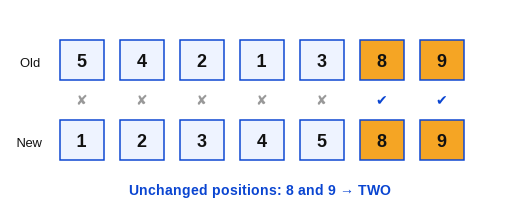
Each of the digits in the number 5421389 is arranged in ascending order from left to right. The position(s) of how many digits will remain unchanged as compared to that in the original number?
संख्या 5421389 के प्रत्येक अंक को बाएँ से दाएँ आरोही क्रम में व्यवस्थित किया जाता है। मूल संख्या की तुलना में कितने अंकों का/के स्थान अपरिवर्तित रहेगा/रहेंगे?
  1. ATHREEतीन
  2. BNONEकोई नहीं
  3. CTWOदो
  4. DONEएक
Show answer

Concept: Write the digits in ascending order and compare place by place.

  1. Original: 5 4 2 1 3 8 9
  2. Ascending: 1 2 3 4 5 8 9
  3. Same positions: 8 (6th) and 9 (7th) ⇒ two digits.

Trick: Digits already in the right place are usually at the ends – check them first.

Answer: (C) TWO

अवधारणा: अंकों को आरोही क्रम में लिखें और स्थान-दर-स्थान तुलना करें।

  1. मूल: 5 4 2 1 3 8 9
  2. आरोही: 1 2 3 4 5 8 9
  3. समान स्थान: 8 (छठा) और 9 (सातवाँ) ⇒ दो अंक।

ट्रिक: जो अंक पहले से सही जगह हों, वे प्रायः सिरों पर होते हैं – पहले वहीं देखें।

उत्तर: (C) दो (TWO)

RRB NTPC Undergraduate CBT 1General Intelligence and ReasoningNumber arrangementRRB NTPC Undergraduate CBT 1 2025 · 16 Jun Shift 1 →
Q12975.
Based on the alphabetical order, three of the following four are alike in a certain way and thus form a group. Which is the one that does not belong to that group?
(Note: The odd man out is not based on the number of consonants/vowels or their position in the letter cluster.)
वर्णमाला क्रम के आधार पर, निम्नलिखित चार में से तीन किसी निश्चित प्रकार से एकसमान हैं और इस प्रकार एक समूह बनाते हैं। कौन-सा उस समूह से संबंधित नहीं है?
(ध्यान दें: असंगत, व्यंजनों/स्वरों की संख्या या अक्षर-समूह में उनके स्थान पर आधारित नहीं है।)
  1. AXTW
  2. BIEH
  3. CGEF
  4. DNJM
Show answer

Concept: Check the gaps between consecutive letters.

  1. XTW: X−4=T, T+3=W → (−4,+3)
  2. IEH: (−4,+3); NJM: (−4,+3)
  3. GEF: G−2=E, E+1=F → (−2,+1) ✗

Trick: Same pattern in three; the cluster with different gaps is odd.

Answer: (C) GEF

अवधारणा: लगातार अक्षरों के बीच का अंतर देखें।

  1. XTW: X−4=T, T+3=W → (−4,+3)
  2. IEH: (−4,+3); NJM: (−4,+3)
  3. GEF: G−2=E, E+1=F → (−2,+1) ✗

ट्रिक: तीन में एक जैसा पैटर्न; अलग अंतर वाला विषम।

उत्तर: (C) GEF

RRB NTPC Undergraduate CBT 1General Intelligence and ReasoningOdd one out – letter clustersRRB NTPC Undergraduate CBT 1 2025 · 16 Jun Shift 1 →
Q12976.
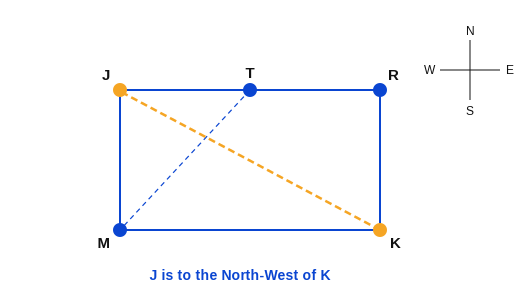
Town J is to the west of Town T. Town R is to the east of Town T. Town K is to the south of Town R. Town M is to the west of Town K. Town M is to the south-west of Town T. Town J is to the north of Town M. What is the position of Town J with respect to Town K?
नगर J, नगर T के पश्चिम में है। नगर R, नगर T के पूर्व में है। नगर K, नगर R के दक्षिण में है। नगर M, नगर K के पश्चिम में है। नगर M, नगर T के दक्षिण-पश्चिम में है। नगर J, नगर M के उत्तर में है। नगर K के सापेक्ष नगर J की स्थिति क्या है?
  1. ASouth-eastदक्षिण-पूर्व
  2. BSouth-westदक्षिण-पश्चिम
  3. CNorth-eastउत्तर-पूर्व
  4. DNorth-westउत्तर-पश्चिम
Show answer

Concept: Place towns on a grid step by step (N up, E right).

  1. J – T – R lie on one west-to-east line.
  2. K is south of R; M is west of K and south-west of T; J is north of M ⇒ J, T, R, K, M form a rectangle-like grid.
  3. K is east and south of J ⇒ J is to the north-west of K.

Trick: Asked ‘J w.r.t. K’ – stand at K and look at J.

Answer: (D) North-west

अवधारणा: नगरों को ग्रिड पर क्रम से रखें (ऊपर उत्तर, दाएँ पूर्व)।

  1. J – T – R एक ही पश्चिम-पूर्व रेखा पर हैं।
  2. K, R के दक्षिण में; M, K के पश्चिम और T के दक्षिण-पश्चिम में; J, M के उत्तर में।
  3. K, J से पूर्व और दक्षिण में है ⇒ J, K के उत्तर-पश्चिम में है।

ट्रिक: ‘K के सापेक्ष J’ – K पर खड़े होकर J को देखें।

उत्तर: (D) उत्तर-पश्चिम (North-west)

RRB NTPC Undergraduate CBT 1General Intelligence and ReasoningDirection senseRRB NTPC Undergraduate CBT 1 2025 · 16 Jun Shift 1 →
Q12977.
What should come in place of the ‘?’ in the given series?
8 22 64 134 232 ?
दी गई श्रृंखला में ‘?’ के स्थान पर क्या आना चाहिए?
8 22 64 134 232 ?
  1. A345
  2. B385
  3. C358
  4. D354
Show answer

Concept: Take first and second differences.

  1. Differences: 14,42,70,98
  2. Second differences: 28,28,28 ⇒ next difference =98+28=126.
  3. Next term =232+126=358.

Trick: When first differences grow evenly, add the constant second difference.

Answer: (C) 358

अवधारणा: पहला व दूसरा अंतर निकालें।

  1. अंतर: 14,42,70,98
  2. दूसरा अंतर: 28,28,28 ⇒ अगला अंतर =98+28=126।
  3. अगला पद =232+126=358।

ट्रिक: पहले अंतर बराबर बढ़ें तो स्थिर दूसरा अंतर जोड़ें।

उत्तर: (C) 358

RRB NTPC Undergraduate CBT 1General Intelligence and ReasoningNumber seriesRRB NTPC Undergraduate CBT 1 2025 · 16 Jun Shift 1 →
Q12978.
Select the pair which follows the same pattern as that followed by the two sets of pairs given below. Both pairs follow the same pattern.
JTT : OQS
NQS : SNR
उस युग्म का चयन कीजिए जो उसी पैटर्न का अनुसरण करता है जिसका अनुसरण नीचे दिए गए युग्मों के दो समुच्चय करते हैं। दोनों युग्म एक ही पैटर्न का अनुसरण करते हैं।
JTT : OQS
NQS : SNR
  1. AEOR : JLQ
  2. BVMK : QKJ
  3. CSGD : NDB
  4. DTUJ : ORK
Show answer

Concept: Find the shift for each position: (+5,−3,−1).

  1. JTT → OQS: J+5=O, T−3=Q, T−1=S
  2. NQS → SNR: N+5=S, Q−3=N, S−1=R
  3. EOR → JLQ: E+5=J, O−3=L, R−1=Q ✓

Trick: Options B, C, D start with −5 – reject them from the first letter itself.

Answer: (A) EOR : JLQ

अवधारणा: हर स्थान का खिसकाव निकालें: (+5,−3,−1)।

  1. JTT → OQS: J+5=O, T−3=Q, T−1=S
  2. NQS → SNR: N+5=S, Q−3=N, S−1=R
  3. EOR → JLQ: E+5=J, O−3=L, R−1=Q ✓

ट्रिक: विकल्प B, C, D में पहला अक्षर −5 खिसकता है – वहीं से हटा दें।

उत्तर: (A) EOR : JLQ

RRB NTPC Undergraduate CBT 1General Intelligence and ReasoningLetter analogyRRB NTPC Undergraduate CBT 1 2025 · 16 Jun Shift 1 →
Q12979.
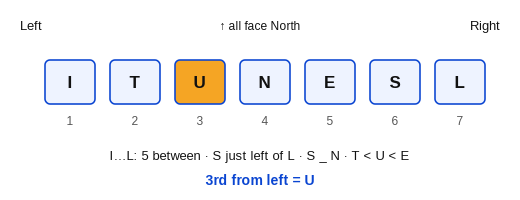
Seven people, U, T, E, N, S, I and L, are sitting in a row, facing the north.
Only five people sit between I and L. S sits to the immediate left of L. Only one person sits between S and N. U sits at some place to the left of E but at some place to the right of T.
Who sits third from the left end of the line?
सात व्यक्ति, U, T, E, N, S, I और L, उत्तर की ओर मुख करके एक पंक्ति में बैठे हैं।
I और L के बीच केवल पाँच व्यक्ति बैठे हैं। S, L के ठीक बाएँ बैठा है। S और N के बीच केवल एक व्यक्ति बैठा है। U, E के बाएँ किसी स्थान पर परंतु T के दाएँ किसी स्थान पर बैठा है।
पंक्ति के बाएँ छोर से तीसरे स्थान पर कौन बैठा है?
  1. AU
  2. BT
  3. CE
  4. DN
Show answer

Concept: Facing north, left/right are the solver’s left/right; 7 seats numbered from left.

  1. Five between I and L ⇒ they occupy seats 1 and 7. S is immediately left of L ⇒ L =7, S =6, I =1.
  2. One between S and N ⇒ N =4.
  3. T, U, E in seats 2, 3, 5 with T left of U left of E ⇒ T =2, U =3, E =5.
  4. Third from left = U.

Trick: ‘Five between’ in a row of 7 means the two people sit at the ends.

Answer: (A) U

अवधारणा: उत्तर की ओर मुख होने पर बायाँ/दायाँ हमारा ही बायाँ/दायाँ; 7 सीटें बाएँ से गिनें।

  1. I और L के बीच पाँच ⇒ दोनों सिरों (1 और 7) पर। S, L के ठीक बाएँ ⇒ L =7, S =6, I =1।
  2. S और N के बीच एक ⇒ N =4।
  3. T, U, E सीट 2, 3, 5 में, T, U के बाएँ और U, E के बाएँ ⇒ T =2, U =3, E =5।
  4. बाएँ से तीसरा = U।

ट्रिक: 7 की पंक्ति में ‘बीच में पाँच’ = दोनों सिरों पर।

उत्तर: (A) U

RRB NTPC Undergraduate CBT 1General Intelligence and ReasoningSeating – linear rowRRB NTPC Undergraduate CBT 1 2025 · 16 Jun Shift 1 →
Q12980.
Select the set in which the numbers are related in the same way as are the numbers of the following sets.
(NOTE: Operations should be performed on the whole numbers, without breaking down the numbers into their constituent digits. E.g. 13 – Operations on 13 such as
adding/subtracting/multiplying etc. to 13 can be performed. Breaking down 13 into 1 and 3 and then performing mathematical operations on 1 and 3 is not allowed.) 19, 229
22, 265
उस समुच्चय का चयन कीजिए जिसमें संख्याएँ उसी प्रकार संबंधित हैं जिस प्रकार निम्नलिखित समुच्चयों की संख्याएँ संबंधित हैं।
(ध्यान दें: संक्रियाएँ संख्याओं को उनके घटक अंकों में विभाजित किए बिना, पूर्ण संख्याओं पर की जानी चाहिए। उदाहरण के लिए 13 – 13 पर संक्रियाएँ जैसे 13 में
जोड़ना/घटाना/गुणा करना आदि किया जा सकता है। 13 को 1 और 3 में विभाजित करना और फिर 1 और 3 पर गणितीय संक्रियाएँ करना वर्जित है।) 19, 229
22, 265
  1. A24, 252
  2. B23, 278
  3. C28, 337
  4. D26, 314
Show answer

Concept: Find one rule linking the first number to the second.

  1. 19×12+1=229; 22×12+1=265
  2. Rule: second = first ×12+1.
  3. 28×12+1=337 ✓ (others: 24→289, 23→277, 26→313).

Trick: If the second number is about 12 times the first, test ×12± small number.

Answer: (C) 28, 337

अवधारणा: पहली संख्या को दूसरी से जोड़ने वाला नियम खोजें।

  1. 19×12+1=229; 22×12+1=265
  2. नियम: दूसरी = पहली ×12+1।
  3. 28×12+1=337 ✓ (अन्य: 24→289, 23→277, 26→313)।

ट्रिक: दूसरी संख्या पहली की लगभग 12 गुनी हो तो ×12± छोटी संख्या जाँचें।

उत्तर: (C) 28, 337

RRB NTPC Undergraduate CBT 1General Intelligence and ReasoningNumber relation (sets)RRB NTPC Undergraduate CBT 1 2025 · 16 Jun Shift 1 →