Question bank

Q&A: practice questions with answers

Search questions on any topic. Filter by exam category, exam, subject and topic, try the question, then open the answer and explanation.

Courses – airGurukul

20,719 questions found.

Q13141.
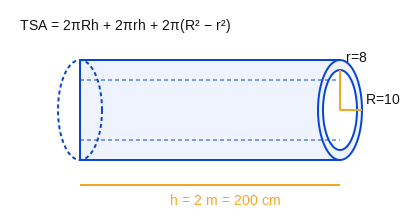
A water pipe is in the shape of a hollow cylinder with an outer radius of 10 cm and an inner radius of 8 cm. If the length of the pipe is 2 m, what is the total surface area (including both ends and the inner and outer curved surfaces) of the pipe in square centimeters? (Use π = 22/7 and rounded off to the nearest integer)
पानी का एक पाइप एक खोखले बेलन के आकार का है जिसकी बाह्य त्रिज्या 10 cm और आंतरिक त्रिज्या 8 cm है। यदि पाइप की लंबाई 2 m है, तो पाइप का कुल पृष्ठीय क्षेत्रफल (दोनों सिरों तथा आंतरिक और बाह्य वक्र पृष्ठों सहित) वर्ग सेंटीमीटर में कितना है? (π = 22/7 का प्रयोग कीजिए और निकटतम पूर्णांक तक पूर्णांकित कीजिए)
  1. A22855 cm2
  2. B25124 cm2
  3. C22848 cm2
  4. D18848 cm2
Show answer

Concept: TSA of a hollow cylinder =2πRh+2πrh+2π(R2−r2).

  1. R=10, r=8, h=200 cm.
  2. Outer CSA =2π×10×200=4000π; inner CSA =3200π.
  3. Two rings =2π(100−64)=72π.
  4. Total =7272π=7272×227≈22854.9≈22855cm2.

Trick: Factor 2π out: 2π[h(R+r)+(R2−r2)]=2π×3636.

Answer: (A) 22855 cm2

अवधारणा: खोखले बेलन का TSA =2πRh+2πrh+2π(R2−r2)।

  1. R=10, r=8, h=200 cm।
  2. बाहरी CSA =4000π; भीतरी CSA =3200π।
  3. दोनों सिरे (वलय) =2π(100−64)=72π।
  4. कुल =7272π=7272×227≈22855cm2।

ट्रिक: 2π बाहर निकालें: 2π[h(R+r)+(R2−r2)]=2π×3636।

उत्तर: (A) 22855 cm2

RRB NTPC Undergraduate CBT 1MathematicsMensuration – Hollow CylinderRRB NTPC Undergraduate CBT 1 2025 · 15 Jun Shift 2 →
Q13142.
If 40% of a number exceeds 25% of it by 42, then the number is:
यदि किसी संख्या का 40%, उसी संख्या के 25% से 42 अधिक है, तो वह संख्या है:
  1. A300
  2. B280
  3. C260
  4. D320
Show answer

Concept: Difference of two percentages of the same number is a percentage of that number.

  1. 40%−25%=15% of the number =42.
  2. Number =42×10015=280.

Trick: 15%=42⇒5%=14⇒100%=280.

Answer: (B) 280

अवधारणा: एक ही संख्या के दो प्रतिशतों का अंतर उसी संख्या का प्रतिशत होता है।

  1. 40%−25%=15% =42।
  2. संख्या =42×10015=280।

ट्रिक: 15%=42⇒5%=14⇒100%=280।

उत्तर: (B) 280

RRB NTPC Undergraduate CBT 1MathematicsPercentageRRB NTPC Undergraduate CBT 1 2025 · 15 Jun Shift 2 →
Q13143.
A and B can do a piece of work in 12 days and 30 days, respectively. Both work for 4 days and then A leaves. How long (in days) will B take to complete the remaining work?
A और B किसी काम को क्रमशः 12 दिन और 30 दिन में कर सकते हैं। दोनों 4 दिन तक काम करते हैं और फिर A काम छोड़ देता है। शेष काम को पूरा करने में B को कितना समय (दिनों में) लगेगा?
  1. A15
  2. B18
  3. C17
  4. D16
Show answer

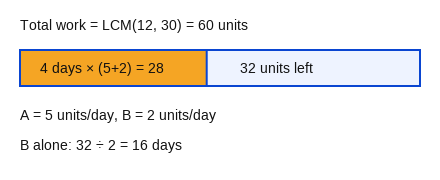
Concept: Take total work =LCM(12,30)=60 units.

  1. A =5 units/day, B =2 units/day.
  2. 4 days together: 4×7=28 units; remaining =32.
  3. B alone: 322=16 days.

Trick: Unit method avoids fractions – always take LCM as the total work.

Answer: (D) 16

अवधारणा: कुल कार्य =LCM(12,30)=60 इकाई लें।

  1. A =5 इकाई/दिन, B =2 इकाई/दिन।
  2. 4 दिन साथ: 4×7=28 इकाई; शेष =32।
  3. B अकेले: 322=16 दिन।

ट्रिक: इकाई विधि से भिन्न नहीं बनती – कुल कार्य हमेशा LCM लें।

उत्तर: (D) 16

RRB NTPC Undergraduate CBT 1MathematicsTime and WorkRRB NTPC Undergraduate CBT 1 2025 · 15 Jun Shift 2 →
Q13144.
The largest four-digit number which when divided by 11, 7 and 14 leaves the remainder 2 in each case, is:
चार अंकों की वह सबसे बड़ी संख्या, जिसे 11, 7 और 14 से विभाजित करने पर प्रत्येक स्थिति में शेषफल 2 प्राप्त होता है, है:
  1. A9972
  2. B9435
  3. C9858
  4. D9901
Show answer

Concept: Required number =(largest 4-digit multiple of LCM)+2.

  1. LCM(11,7,14)=154.
  2. 9999÷154=64 remainder 143 → largest multiple =9999−143=9856.
  3. Number =9856+2=9858.

Trick: Option minus 2 must be divisible by 154: 9858−2=9856=154×64 ✓.

Answer: (C) 9858

अवधारणा: अभीष्ट संख्या =(LCM का सबसे बड़ा 4-अंकीय गुणज)+2।

  1. LCM(11,7,14)=154।
  2. 9999÷154=64, शेष 143 → सबसे बड़ा गुणज =9856।
  3. संख्या =9856+2=9858।

ट्रिक: विकल्प −2 को 154 से विभाज्य होना चाहिए: 9856=154×64 ✓।

उत्तर: (C) 9858

RRB NTPC Undergraduate CBT 1MathematicsLCM – RemaindersRRB NTPC Undergraduate CBT 1 2025 · 15 Jun Shift 2 →
Q13145.
Evaluate 233 + (-19)3 + (-4)3
233 + (-19)3 + (-4)3 का मान ज्ञात कीजिए।
  1. A4958
  2. B5089
  3. C5244
  4. D4998
Show answer

Concept: If a+b+c=0 then a3+b3+c3=3abc.

  1. 23+(−19)+(−4)=0.
  2. Sum of cubes =3×23×(−19)×(−4)=3×1748=5244.

Trick: Whenever three numbers add to zero, never cube them – use 3abc.

Answer: (C) 5244

अवधारणा: यदि a+b+c=0 तो a3+b3+c3=3abc।

  1. 23+(−19)+(−4)=0।
  2. घनों का योग =3×23×(−19)×(−4)=5244।

ट्रिक: तीन संख्याओं का योग शून्य हो तो घन न करें – 3abc लगाएँ।

उत्तर: (C) 5244

RRB NTPC Undergraduate CBT 1MathematicsAlgebraic IdentitiesRRB NTPC Undergraduate CBT 1 2025 · 15 Jun Shift 2 →
Q13146.
Venu invested a certain sum of money at 10% per annum. After 2 years, he received ₹136.50 as compound interest, compounded annually. Find the corresponding simple interest (in ₹) for 2 years at the same rate.
वेणु ने एक निश्चित धनराशि 10% वार्षिक दर पर निवेश की। 2 वर्ष बाद, उसे वार्षिक रूप से संयोजित चक्रवृद्धि ब्याज के रूप में ₹136.50 प्राप्त हुए। समान दर पर 2 वर्ष के लिए संगत साधारण ब्याज (₹ में) ज्ञात कीजिए।
  1. A115
  2. B125
  3. C130
  4. D120
Show answer

Concept: For 2 years, CISI=200+R200.

  1. CI2=P[(1.1)2−1]=0.21P=136.50⇒P=650.
  2. SI=650×10×2100=₹130.

Trick: SI=CI×200200+R=136.5×200210=130.

Answer: (C) 130

अवधारणा: 2 वर्ष के लिए CISI=200+R200।

  1. CI2=0.21P=136.50⇒P=650।
  2. SI=650×10×2100=₹130।

ट्रिक: SI=CI×200200+R=136.5×200210=130।

उत्तर: (C) 130

RRB NTPC Undergraduate CBT 1MathematicsCompound InterestRRB NTPC Undergraduate CBT 1 2025 · 15 Jun Shift 2 →
Q13147.
The simplified value of the expression 0.5×0.125÷8−2 is ____.
व्यंजक 0.5×0.125÷8−2 का सरलीकृत मान ____ है।
  1. A2
  2. B1
  3. C4
  4. D8
Show answer

Concept: a−n=1an; dividing by 8−2 means multiplying by 64.

  1. 0.5×0.125=0.0625=116.
  2. 116÷164=116×64=4.

Trick: In powers of 2: 2−1×2−3÷2−6=2−1−3+6=22=4.

Answer: (C) 4

अवधारणा: a−n=1an; 8−2 से भाग = 64 से गुणा।

  1. 0.5×0.125=116।
  2. 116×64=4।

ट्रिक: 2 की घातों में: 2−1×2−3÷2−6=22=4।

उत्तर: (C) 4

RRB NTPC Undergraduate CBT 1MathematicsIndices and DecimalsRRB NTPC Undergraduate CBT 1 2025 · 15 Jun Shift 2 →
Q13148.
If 4x−4x−1=48, then the value of 2x−12x+3 is:
यदि 4x−4x−1=48 है, तो 2x−12x+3 का मान है:
  1. A59
  2. B58
  3. C511
  4. D54
Show answer

Concept: Factor out the smaller power: 4x−4x−1=4x−1(4−1).

  1. 3×4x−1=48⇒4x−1=16=42.
  2. x−1=2⇒x=3.
  3. 2x−12x+3=59.

Trick: an−an−1=an−1(a−1) – spot this pattern instantly in such questions.

Answer: (A) 59

अवधारणा: छोटी घात बाहर निकालें: 4x−4x−1=4x−1(4−1)।

  1. 3×4x−1=48⇒4x−1=16=42।
  2. x=3।
  3. 2x−12x+3=59।

ट्रिक: an−an−1=an−1(a−1) – यह पैटर्न तुरंत पहचानें।

उत्तर: (A) 59

RRB NTPC Undergraduate CBT 1MathematicsExponential EquationsRRB NTPC Undergraduate CBT 1 2025 · 15 Jun Shift 2 →
Q13149.
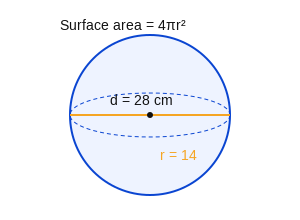
A spherical tank has a diameter of 28 cm. What is the total surface area of the tank? (Use π = 22/7)
एक गोलाकार टंकी का व्यास 28 cm है। टंकी का कुल पृष्ठीय क्षेत्रफल क्या है? (π = 22/7 का प्रयोग कीजिए)
  1. A2456 cm²
  2. B2458 cm²
  3. C2464 cm²
  4. D2460 cm²
Show answer

Concept: Surface area of a sphere =4πr2.

  1. r=282=14 cm.
  2. 4×227×14×14=4×22×28=2464cm2.

Yaad rakhein: With r a multiple of 7, cancel 7 first – no decimals at all.

Answer: (C) 2464 cm²

अवधारणा: गोले का पृष्ठीय क्षेत्रफल =4πr2।

  1. r=14 cm।
  2. 4×227×14×14=2464cm2।

याद रखें: r 7 का गुणज हो तो पहले 7 काटें – दशमलव नहीं आएगा।

उत्तर: (C) 2464 cm²

RRB NTPC Undergraduate CBT 1MathematicsMensuration – SphereRRB NTPC Undergraduate CBT 1 2025 · 15 Jun Shift 2 →
Q13150.
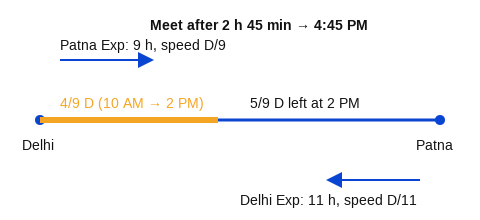
Patna Express leaves Delhi at 10:00 AM and reaches Patna at 7:00 PM the same day. Delhi Express leaves Patna at 2:00 PM and reaches Delhi at 1:00 AM on the next day. Both trains travel on the same route in opposite directions. At what time do they meet?
पटना एक्सप्रेस सुबह 10:00 AM पर दिल्ली से प्रस्थान करती है और उसी दिन शाम 7:00 PM पर पटना पहुँचती है। दिल्ली एक्सप्रेस दोपहर 2:00 PM पर पटना से प्रस्थान करती है और अगले दिन रात 1:00 AM पर दिल्ली पहुँचती है। दोनों ट्रेनें एक ही मार्ग पर विपरीत दिशाओं में चलती हैं। वे किस समय मिलेंगी?
  1. A04:45PM
  2. B04:30PM
  3. C03:45PM
  4. D04:15PM
Show answer

Concept: Take the route length =D; speeds are D9 and D11 (9 h and 11 h journeys).

  1. By 2:00 PM Patna Express has covered 4×D9=4D9; gap left =5D9.
  2. Relative speed =D9+D11=20D99.
  3. Time =5D9÷20D99=59×9920=2.75 h =2 h 45 min.
  4. 2:00+2:45=4:45 PM.

Trick: Take D=99 km: speeds 11 and 9 km/h, gap at 2 PM =55 km, time =5520=2.75 h.

Answer: (A) 04:45 PM

अवधारणा: मार्ग की लंबाई =D; चालें D9 और D11 (9 घंटे और 11 घंटे की यात्रा)।

  1. 2:00 PM तक Patna Express 4D9 चल चुकी; शेष दूरी =5D9।
  2. सापेक्ष चाल =D9+D11=20D99।
  3. समय =59×9920=2.75 घंटे =2 घंटे 45 मिनट।
  4. 2:00+2:45=4:45 PM।

ट्रिक: D=99 km लें: चालें 11 और 9 km/h, 2 PM पर दूरी 55 km, समय =5520=2.75 घंटे।

उत्तर: (A) 04:45 PM

RRB NTPC Undergraduate CBT 1MathematicsTrains – Meeting TimeRRB NTPC Undergraduate CBT 1 2025 · 15 Jun Shift 2 →
Q13151.
A trader marks his goods such that even after allowing a discount of 25%, he makes a profit of 10%. If he gives only 10% discount, then find the profit percentage.
एक व्यापारी अपने माल पर इस प्रकार मूल्य अंकित करता है कि 25% की छूट देने के बाद भी उसे 10% का लाभ होता है। यदि वह केवल 10% की छूट देता है, तो लाभ प्रतिशत ज्ञात कीजिए।
  1. A28%
  2. B30%
  3. C35%
  4. D32%
Show answer

Concept: MP×(1−d)=CP×(1+p); find MP in terms of CP, then apply the new discount.

  1. 0.75MP=1.1CP⇒MP=1.10.75CP=2215CP.
  2. With 10% discount: SP =0.9×2215CP=1.32CP.
  3. Profit =32%.

Trick: Take CP =75: MP =110; SP at 10% off =99; profit =24 on 75 =32%.

Answer: (D) 32%

अवधारणा: MP×(1−d)=CP×(1+p); MP को CP में लिखें, फिर नई छूट लगाएँ।

  1. 0.75MP=1.1CP⇒MP=2215CP।
  2. 10% छूट पर SP =0.9×2215CP=1.32CP।
  3. लाभ =32%।

ट्रिक: CP =75 लें: MP =110; 10% छूट पर SP =99; लाभ 24/75=32%।

उत्तर: (D) 32%

RRB NTPC Undergraduate CBT 1MathematicsMarked Price and DiscountRRB NTPC Undergraduate CBT 1 2025 · 15 Jun Shift 2 →
Q13152.
Ramu is 8 years older than Keeran. Seven years ago, Ramu's age was three times Keeran's age. Find the present age of Ramu.
रामू, कीरन से 8 वर्ष बड़ा है। सात वर्ष पहले, रामू की आयु कीरन की आयु की तीन गुनी थी। रामू की वर्तमान आयु ज्ञात कीजिए।
  1. A25 years25 वर्ष
  2. B23 years23 वर्ष
  3. C19 years19 वर्ष
  4. D16 years16 वर्ष
Show answer

Concept: Translate the two statements into equations.

  1. Keeran =k, Ramu =k+8.
  2. Seven years ago: k+1=3(k−7)⇒k+1=3k−21⇒k=11.
  3. Ramu =11+8=19 years.

Trick: Seven years ago the difference (8) was twice Keeran's age → Keeran was 4, Ramu 12; add 7 → 19.

Answer: (C) 19 years

अवधारणा: दोनों कथनों को समीकरण में बदलें।

  1. Keeran =k, Ramu =k+8।
  2. सात वर्ष पहले: k+1=3(k−7)⇒k=11।
  3. Ramu =19 वर्ष।

ट्रिक: सात वर्ष पहले अंतर (8) Keeran की आयु का दोगुना था → Keeran 4, Ramu 12; 7 जोड़ें → 19।

उत्तर: (C) 19 years

RRB NTPC Undergraduate CBT 1MathematicsAgesRRB NTPC Undergraduate CBT 1 2025 · 15 Jun Shift 2 →
Q13153.
A retailer has fixed the price of an article at 20% above the cost price. If he offers a discount of ₹2 for a purchase of ₹30, what is his gain or loss percentage?
एक खुदरा विक्रेता ने एक वस्तु का मूल्य क्रय मूल्य से 20% अधिक निर्धारित किया है। यदि वह ₹30 की खरीद पर ₹2 की छूट देता है, तो उसका लाभ या हानि प्रतिशत क्या है?
  1. A16% gain16% लाभ
  2. B11% loss11% हानि
  3. C14% gain14% लाभ
  4. D12% gain12% लाभ
Show answer

Concept: Discount of ₹2 on ₹30 is a 230=115 discount on the marked price.

  1. Let CP =100 → MP =120.
  2. SP =120×1415=112.
  3. Gain =12%.

Trick: Take CP =25: MP =30, pay 28 → gain 3 on 25 =12%.

Answer: (D) 12% gain

अवधारणा: ₹30 पर ₹2 की छूट = अंकित मूल्य पर 115 छूट।

  1. CP =100 → MP =120।
  2. SP =120×1415=112।
  3. लाभ =12%।

ट्रिक: CP =25 लें: MP =30, भुगतान 28 → 25 पर 3 लाभ =12%।

उत्तर: (D) 12% gain

RRB NTPC Undergraduate CBT 1MathematicsProfit and LossRRB NTPC Undergraduate CBT 1 2025 · 15 Jun Shift 2 →
Q13154.
A recipe requires 0.75 cups of sugar and 114 cups of flour. What is the total amount (in cups) of ingredients used, expressed as a decimal?
एक व्यंजन विधि (recipe) में 0.75 कप चीनी और 114 कप आटे की आवश्यकता होती है। दशमलव के रूप में व्यक्त, प्रयुक्त सामग्री की कुल मात्रा (कप में) कितनी है?
  1. A2.5
  2. B2.05
  3. C2.0
  4. D1.95
Show answer

Concept: Convert the mixed fraction to a decimal and add.

  1. 114=1.25.
  2. 0.75+1.25=2.00 cups.

Yaad rakhein: 14=0.25, 34=0.75 – they pair up to make 1.

Answer: (C) 2.0

अवधारणा: मिश्र भिन्न को दशमलव में बदलकर जोड़ें।

  1. 114=1.25।
  2. 0.75+1.25=2.00 कप।

याद रखें: 14=0.25, 34=0.75 – मिलकर 1 बनाते हैं।

उत्तर: (C) 2.0

RRB NTPC Undergraduate CBT 1MathematicsFractions and DecimalsRRB NTPC Undergraduate CBT 1 2025 · 15 Jun Shift 2 →
Q13155.
Find the value of (169)2×(2.56)2×(0.25)2(13)4×(1.6)4×(0.5)2.
(169)2×(2.56)2×(0.25)2(13)4×(1.6)4×(0.5)2 का मान ज्ञात कीजिए।
  1. A0.05
  2. B1.5
  3. C1.05
  4. D0.5
Show answer

Concept: 169=132 and 2.56=1.62, so numerator and denominator cancel neatly.

  1. (169)2=134, (2.56)2=1.64 → these cancel with the denominator.
  2. Left: (0.25)2(0.5)2=0.250.5=0.5.

Trick: Spot perfect squares (169, 2.56) before multiplying anything.

Answer: (D) 0.5

अवधारणा: 169=132 और 2.56=1.62, इसलिए अंश-हर आपस में कट जाते हैं।

  1. (169)2=134, (2.56)2=1.64 → हर से कट गए।
  2. शेष: (0.25)2(0.5)2=0.250.5=0.5।

ट्रिक: गुणा करने से पहले पूर्ण वर्ग (169, 2.56) पहचानें।

उत्तर: (D) 0.5

RRB NTPC Undergraduate CBT 1MathematicsSurds and IndicesRRB NTPC Undergraduate CBT 1 2025 · 15 Jun Shift 2 →
Q13156.
Based on the alphabetical order, three of the following four are alike in a certain way and thus form a group. Which is the one that does not belong to that group?
(Note: The odd man out is not based on the number of consonants/vowels or their position in the letter cluster.)
अंग्रेज़ी वर्णमाला क्रम के आधार पर, निम्नलिखित चार में से तीन किसी निश्चित प्रकार से एक समान हैं और इस प्रकार एक समूह बनाते हैं। वह कौन-सा है जो उस समूह से संबंधित नहीं है?
(ध्यान दें: असंगत का निर्धारण व्यंजनों/स्वरों की संख्या या अक्षर-समूह में उनके स्थान के आधार पर नहीं किया गया है।)
  1. AAWY
  2. BCYA
  3. COLM
  4. DEAC
Show answer

Concept: Find the letter gaps inside each cluster (A=1 … Z=26, wrap-around allowed).

  1. AWY: A−4=W, W+2=Y
  2. CYA: C−4=Y, Y+2=A; EAC: E−4=A, A+2=C
  3. OLM: O−4=K, but the second letter is L (O−3) → breaks the pattern.

Trick: Check the first gap of every option first – OLM fails at once.

Answer: (C) OLM

अवधारणा: हर समूह में अक्षरों का अंतर देखें (A=1 … Z=26, Z के बाद फिर A)।

  1. AWY: A−4=W, W+2=Y
  2. CYA: C−4=Y, Y+2=A; EAC: E−4=A, A+2=C
  3. OLM: O−4=K होना चाहिए, पर दूसरा अक्षर L (O−3) है → नियम टूटा।

ट्रिक: सबसे पहले हर विकल्प का पहला अंतर जाँचें – OLM तुरंत अलग।

उत्तर: (C) OLM

RRB NTPC Undergraduate CBT 1General Intelligence and ReasoningOdd one out – letter clustersRRB NTPC Undergraduate CBT 1 2025 · 15 Jun Shift 2 →
Q13157.
What should come in place of the question mark (?) in the given series based on the English alphabetical order?
CIF IOL OUR UAX ?
अंग्रेज़ी वर्णमाला क्रम के आधार पर दी गई श्रृंखला में प्रश्न चिह्न (?) के स्थान पर क्या आना चाहिए?
CIF IOL OUR UAX ?
  1. ASTH
  2. BAGD
  3. CFYH
  4. DMFY
Show answer

Concept: Track each letter position separately.

  1. 1st letters: C, I, O, U → +6 each → next U+6=A.
  2. 2nd letters: I, O, U, A → +6 → next G.
  3. 3rd letters: F, L, R, X → +6 → next D. So the term is AGD.

Trick: All three positions move by the same +6 – find one, apply to all.

Answer: (B) AGD

अवधारणा: हर स्थान के अक्षर को अलग-अलग देखें।

  1. पहले अक्षर: C, I, O, U → हर बार +6 → अगला U+6=A।
  2. दूसरे अक्षर: I, O, U, A → +6 → अगला G।
  3. तीसरे अक्षर: F, L, R, X → +6 → अगला D। अतः पद AGD।

ट्रिक: तीनों स्थान समान +6 से चलते हैं – एक खोजें, सब पर लगाएँ।

उत्तर: (B) AGD

RRB NTPC Undergraduate CBT 1General Intelligence and ReasoningLetter seriesRRB NTPC Undergraduate CBT 1 2025 · 15 Jun Shift 2 →
Q13158.
The position(s) of how many letters will remain unchanged if each letter in the word COMBINE is arranged in the English alphabetical order?
यदि शब्द COMBINE के प्रत्येक अक्षर को अंग्रेज़ी वर्णमाला क्रम में व्यवस्थित किया जाए, तो कितने अक्षरों का स्थान अपरिवर्तित रहेगा?
  1. A1
  2. B3
  3. C0
  4. D2
Show answer

Concept: Write the word and its alphabetical arrangement one below the other and compare position by position.

  1. COMBINE: C O M B I N E
  2. Alphabetical: B C E I M N O
  3. Only position 6 (N) matches; all other positions differ. So 1 letter stays unchanged.

Trick: Alphabetical order of COMBINE: B C E I M N O – compare column-wise.

Answer: (A) 1

अवधारणा: शब्द और उसका वर्णानुक्रम एक के नीचे एक लिखकर स्थान-दर-स्थान मिलाएँ।

  1. COMBINE: C O M B I N E
  2. वर्णानुक्रम: B C E I M N O
  3. केवल छठे स्थान (N) पर मेल है; बाकी सब बदलते हैं। अतः 1 अक्षर अपरिवर्तित।

ट्रिक: COMBINE का वर्णानुक्रम: B C E I M N O – स्तंभ-वार मिलाएँ।

उत्तर: (A) 1

RRB NTPC Undergraduate CBT 1General Intelligence and ReasoningLetter arrangementRRB NTPC Undergraduate CBT 1 2025 · 15 Jun Shift 2 →
Q13159.
DVUK is related to GZZQ in a certain way based on the English alphabetical order. In the same way, PLOI is related to SPTO. To which of the following options is YXDA related, following the same logic?
अंग्रेज़ी वर्णमाला क्रम के आधार पर DVUK एक निश्चित प्रकार से GZZQ से संबंधित है। उसी प्रकार, PLOI, SPTO से संबंधित है। समान तर्क का अनुसरण करते हुए, YXDA निम्नलिखित में से किस विकल्प से संबंधित है?
  1. ABGIG
  2. BBBIG
  3. CGBBI
  4. DBGIB
Show answer

Concept: Find the shift applied to each letter.

  1. DVUK → GZZQ: +3,+4,+5,+6
  2. PLOI → SPTO: +3,+4,+5,+6 (same rule)
  3. YXDA: Y+3=B, X+4=B, D+5=I, A+6=G → BBIG

Trick: Increasing shifts +3,+4,+5,+6; remember wrap-around after Z.

Answer: (B) BBIG

अवधारणा: हर अक्षर पर लगा अंतर खोजें।

  1. DVUK → GZZQ: +3,+4,+5,+6
  2. PLOI → SPTO: +3,+4,+5,+6 (समान नियम)
  3. YXDA: Y+3=B, X+4=B, D+5=I, A+6=G → BBIG

ट्रिक: बढ़ते अंतर +3,+4,+5,+6; Z के बाद फिर A से गिनें।

उत्तर: (B) BBIG

RRB NTPC Undergraduate CBT 1General Intelligence and ReasoningAnalogy – letter codingRRB NTPC Undergraduate CBT 1 2025 · 15 Jun Shift 2 →
Q13160.
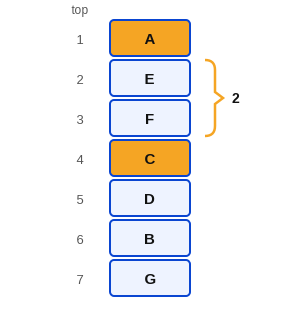
Seven boxes, A, B, C, D, E, F and G, are kept one over the other but not necessarily in the same order. Only two boxes are kept above F. Only three boxes are kept below C. B is kept above G but below D. E is kept immediately above F but below A. How many boxes are kept between A and C?
सात बक्से, A, B, C, D, E, F और G, एक के ऊपर एक रखे गए हैं, लेकिन आवश्यक नहीं कि इसी क्रम में हों। F के ऊपर केवल दो बक्से रखे गए हैं। C के नीचे केवल तीन बक्से रखे गए हैं। B, G के ऊपर लेकिन D के नीचे रखा गया है। E, F के ठीक ऊपर लेकिन A के नीचे रखा गया है। A और C के बीच कितने बक्से रखे गए हैं?
  1. AOneएक
  2. BTwoदो
  3. CThreeतीन
  4. DNoneकोई नहीं
Show answer

Concept: Fix boxes with exact positions first (1 = top, 7 = bottom).

  1. Two boxes above F → F = 3. Three boxes below C → C = 4.
  2. E immediately above F → E = 2; E below A → A = 1.
  3. B above G, below D, in 5–7 → D = 5, B = 6, G = 7.
  4. Between A (1) and C (4): E and F → two boxes.

Trick: Count 'above' clues from the top and 'below' clues from the bottom.

Answer: (B) Two

अवधारणा: पहले निश्चित स्थान वाले बॉक्स रखें (1 = सबसे ऊपर, 7 = सबसे नीचे)।

  1. F के ऊपर दो बॉक्स → F = 3। C के नीचे तीन → C = 4।
  2. E, F के ठीक ऊपर → E = 2; E, A के नीचे → A = 1।
  3. B, G के ऊपर और D के नीचे, स्थान 5–7 में → D = 5, B = 6, G = 7।
  4. A (1) और C (4) के बीच: E और F → दो बॉक्स।

ट्रिक: 'ऊपर' वाले सुराग ऊपर से, 'नीचे' वाले नीचे से गिनें।

उत्तर: (B) दो

RRB NTPC Undergraduate CBT 1General Intelligence and ReasoningBox stacking puzzleRRB NTPC Undergraduate CBT 1 2025 · 15 Jun Shift 2 →