Question bank

Q&A: practice questions with answers

Search questions on any topic. Filter by exam category, exam, subject and topic, try the question, then open the answer and explanation.

Courses – airGurukul

20,719 questions found.

Q13161.
All 195 people are standing in a row facing north. Rt is 143rd from the left end while Kl is 36th from the right end. How many people are there between Rt and Kl?
सभी 195 व्यक्ति उत्तर की ओर मुख करके एक पंक्ति में खड़े हैं। Rt बाएँ छोर से 143वें स्थान पर है जबकि Kl दाएँ छोर से 36वें स्थान पर है। Rt और Kl के बीच कितने व्यक्ति हैं?
  1. A14
  2. B12
  3. C13
  4. D16
Show answer

Concept: Convert both positions to the same end, then subtract.
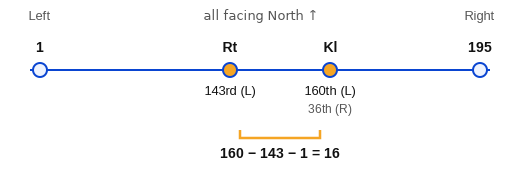
  1. Kl from the left =195−36+1=160th.
  2. Rt is 143rd from the left.
  3. People between =160−143−1=16.

Trick: Between two ranks from the same end = difference −1.

Answer: (D) 16

अवधारणा: दोनों स्थानों को एक ही छोर से बदलें, फिर घटाएँ।

  1. Kl बाएँ से =195−36+1=160वाँ।
  2. Rt बाएँ से 143वाँ।
  3. बीच के लोग =160−143−1=16।

ट्रिक: एक ही छोर से दो क्रमों के बीच = अंतर −1।

उत्तर: (D) 16

RRB NTPC Undergraduate CBT 1General Intelligence and ReasoningRanking in a rowRRB NTPC Undergraduate CBT 1 2025 · 15 Jun Shift 2 →
Q13162.
Based on the English alphabetical order, three of the following four letter-cluster pairs are alike in a certain way and thus form a group. Which is the one that does not belong to that group?
(Note: The odd one out is not based on the number of consonants/vowels or their position in the letter cluster.)
अंग्रेज़ी वर्णमाला क्रम के आधार पर, निम्नलिखित चार अक्षर-समूह युग्मों में से तीन किसी निश्चित प्रकार से एक समान हैं और इस प्रकार एक समूह बनाते हैं। वह कौन-सा है जो उस समूह से संबंधित नहीं है?
(ध्यान दें: असंगत का निर्धारण व्यंजनों/स्वरों की संख्या या अक्षर-समूह में उनके स्थान के आधार पर नहीं किया गया है।)
  1. AGY - FV
  2. BTL - SI
  3. CAI - ZF
  4. DQC - PY
Show answer

Concept: Compare each letter of the first cluster with the matching letter of the second.

  1. GY–FV: G−1=F, Y−3=V; TL–SI: T−1=S, L−3=I
  2. AI–ZF: A−1=Z, I−3=F (wrap-around)
  3. QC–PY: Q−1=P, but C−3=Z, not Y (C−4) → odd one.

Trick: Pattern (−1,−3); only QC–PY breaks it at the second letter.

Answer: (D) QC - PY

अवधारणा: पहले समूह के हर अक्षर की तुलना दूसरे समूह के संगत अक्षर से करें।

  1. GY–FV: G−1=F, Y−3=V; TL–SI: T−1=S, L−3=I
  2. AI–ZF: A−1=Z, I−3=F (Z के बाद चक्र)
  3. QC–PY: Q−1=P, पर C−3=Z होना चाहिए, Y (C−4) है → विषम।

ट्रिक: नियम (−1,−3); केवल QC–PY दूसरे अक्षर पर टूटता है।

उत्तर: (D) QC - PY

RRB NTPC Undergraduate CBT 1General Intelligence and ReasoningOdd pair – letter shiftsRRB NTPC Undergraduate CBT 1 2025 · 15 Jun Shift 2 →
Q13163.
In a certain code language, ‘MOPS’ is coded as ‘5863’ and ‘POEM’ is coded as ‘8765’. What is the code for ‘E’ in the given code language?
एक निश्चित कूट भाषा में, ‘MOPS’ को ‘5863’ और ‘POEM’ को ‘8765’ के रूप में कूटबद्ध किया जाता है। दी गई कूट भाषा में ‘E’ का कूट क्या है?
  1. A6
  2. B8
  3. C7
  4. D5
Show answer

Concept: Letters common to both words share the codes common to both codes.

  1. MOPS → 5863; POEM → 8765.
  2. Common letters M, O, P ↔ common digits 5, 6, 8.
  3. Leftover: S ↔ 3 in the first word, E ↔ 7 in the second.

Trick: Remove common letters/digits – the leftover pairs are fixed.

Answer: (C) 7

अवधारणा: दोनों शब्दों के उभयनिष्ठ अक्षरों के कोड भी दोनों कोडों में उभयनिष्ठ होते हैं।

  1. MOPS → 5863; POEM → 8765।
  2. उभयनिष्ठ अक्षर M, O, P ↔ उभयनिष्ठ अंक 5, 6, 8।
  3. बचे हुए: पहले में S ↔ 3, दूसरे में E ↔ 7।

ट्रिक: उभयनिष्ठ अक्षर/अंक हटाएँ – बचे हुए जोड़े तय हो जाते हैं।

उत्तर: (C) 7

RRB NTPC Undergraduate CBT 1General Intelligence and ReasoningCoding–decoding (common letters)RRB NTPC Undergraduate CBT 1 2025 · 15 Jun Shift 2 →
Q13164.
Each vowel in the word 'VOLUNTARY' is changed to the second letter immediately following it in the English alphabetical order and each consonant is changed to the letter immediately preceding it in the English alphabetical order. Which letter will appear exactly twice in the group of letters thus formed?
शब्द 'VOLUNTARY' के प्रत्येक स्वर को अंग्रेज़ी वर्णमाला क्रम में उसके ठीक बाद आने वाले दूसरे अक्षर से बदल दिया जाता है और प्रत्येक व्यंजन को अंग्रेज़ी वर्णमाला क्रम में उसके ठीक पहले आने वाले अक्षर से बदल दिया जाता है। इस प्रकार बने अक्षर-समूह में कौन-सा अक्षर ठीक दो बार आएगा?
  1. AM
  2. BQ
  3. CW
  4. DK
Show answer

Concept: Vowels → +2, consonants → −1.

  1. V O L U N T A R Y
  2. → U Q K W M S C Q X (O+2=Q, R−1=Q)
  3. Q appears twice; M, W, K appear once each.

Trick: Watch for a vowel and a consonant landing on the same letter (O and R both → Q).

Answer: (B) Q

अवधारणा: स्वर → +2, व्यंजन → −1।

  1. V O L U N T A R Y
  2. → U Q K W M S C Q X (O+2=Q, R−1=Q)
  3. Q दो बार आता है; M, W, K एक-एक बार।

ट्रिक: देखें कि कोई स्वर और व्यंजन एक ही अक्षर पर पहुँचें (O और R दोनों → Q)।

उत्तर: (B) Q

RRB NTPC Undergraduate CBT 1General Intelligence and ReasoningLetter transformationRRB NTPC Undergraduate CBT 1 2025 · 15 Jun Shift 2 →
Q13165.
What should come in place of '?' in the given series based on the English alphabetical order?
MAI PEN SIS VMX ?
अंग्रेज़ी वर्णमाला क्रम के आधार पर दी गई श्रृंखला में '?' के स्थान पर क्या आना चाहिए?
MAI PEN SIS VMX ?
  1. AYQC
  2. BZRD
  3. CZRC
  4. DAPD
Show answer

Concept: Each letter position follows its own constant jump.

  1. 1st: M, P, S, V → +3 → Y
  2. 2nd: A, E, I, M → +4 → Q
  3. 3rd: I, N, S, X → +5 → X+5=C (wrap-around). Term: YQC.

Trick: Jumps +3, +4, +5 for the three positions.

Answer: (A) YQC

अवधारणा: हर स्थान का अक्षर अपने स्थिर अंतर से चलता है।

  1. पहला: M, P, S, V → +3 → Y
  2. दूसरा: A, E, I, M → +4 → Q
  3. तीसरा: I, N, S, X → +5 → X+5=C (चक्र)। पद: YQC।

ट्रिक: तीनों स्थानों पर अंतर +3, +4, +5।

उत्तर: (A) YQC

RRB NTPC Undergraduate CBT 1General Intelligence and ReasoningLetter seriesRRB NTPC Undergraduate CBT 1 2025 · 15 Jun Shift 2 →
Q13166.
If + means −, − means ×, × means ÷, and ÷ means +, then what will come in place of the question mark (?) in the following equation?
9 − 4 + 45 × 5 ÷ 3 = ?
यदि + का अर्थ −, − का अर्थ ×, × का अर्थ ÷ और ÷ का अर्थ + है, तो निम्नलिखित समीकरण में प्रश्न चिह्न (?) के स्थान पर क्या आएगा?
9 − 4 + 45 × 5 ÷ 3 = ?
  1. A35
  2. B30
  3. C20
  4. D25
Show answer

Concept: Replace the symbols first, then apply BODMAS.

  1. 9−4+45×5÷3 becomes 9×4−45÷5+3
  2. =36−9+3
  3. =30

Trick: Write the new expression fully before calculating – avoids mixing old and new signs.

Answer: (B) 30

अवधारणा: पहले चिह्न बदलें, फिर BODMAS लगाएँ।

  1. 9−4+45×5÷3 बनता है 9×4−45÷5+3
  2. =36−9+3
  3. =30

ट्रिक: गणना से पहले नया व्यंजक पूरा लिख लें – पुराने/नए चिह्न नहीं मिलेंगे।

उत्तर: (B) 30

RRB NTPC Undergraduate CBT 1General Intelligence and ReasoningMathematical operationsRRB NTPC Undergraduate CBT 1 2025 · 15 Jun Shift 2 →
Q13167.
In a certain code language, ‘FAME’ is coded as ‘8341’ and ‘FEAL’ is coded as ‘6438’. What is the code for ‘L’ in the given code language?
एक निश्चित कूट भाषा में, ‘FAME’ को ‘8341’ और ‘FEAL’ को ‘6438’ के रूप में कूटबद्ध किया जाता है। दी गई कूट भाषा में ‘L’ का कूट क्या है?
  1. A6
  2. B8
  3. C3
  4. D4
Show answer

Concept: Common letters ↔ common digits.

  1. FAME → 8341; FEAL → 6438.
  2. Common letters F, A, E ↔ common digits 3, 4, 8.
  3. Leftover: M ↔ 1 and L ↔ 6.

Trick: Strike out the common part; the remaining letter takes the remaining digit.

Answer: (A) 6

अवधारणा: उभयनिष्ठ अक्षर ↔ उभयनिष्ठ अंक।

  1. FAME → 8341; FEAL → 6438।
  2. उभयनिष्ठ अक्षर F, A, E ↔ उभयनिष्ठ अंक 3, 4, 8।
  3. बचे: M ↔ 1 और L ↔ 6।

ट्रिक: उभयनिष्ठ भाग काट दें; बचा अक्षर बचा अंक लेता है।

उत्तर: (A) 6

RRB NTPC Undergraduate CBT 1General Intelligence and ReasoningCoding–decoding (common letters)RRB NTPC Undergraduate CBT 1 2025 · 15 Jun Shift 2 →
Q13168.
In a certain code language,
A × B means ‘A is the mother of B’,
A – B means ‘A is the brother of B’,
A + B means ‘A is the wife of B’ and
A * B means ‘A is the father of B’.
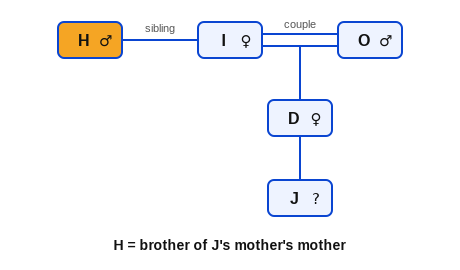
How is H related to J if ‘H – I + O * D × J’?
एक निश्चित कूट भाषा में,
A × B का अर्थ है ‘A, B की माता है’,
A – B का अर्थ है ‘A, B का भाई है’,
A + B का अर्थ है ‘A, B की पत्नी है’ और
A * B का अर्थ है ‘A, B का पिता है’।
यदि ‘H – I + O * D × J’ है, तो H, J से किस प्रकार संबंधित है?
  1. AMother's mother's brotherमाता की माता का भाई
  2. BMother's mother's fatherमाता की माता का पिता
  3. CSonपुत्र
  4. DHusbandपति
Show answer

Concept: Decode each symbol and draw the family tree.

  1. H – I: H is the brother of I. I + O: I is the wife of O.
  2. O * D: O is the father of D, so I is D's mother. D × J: D is the mother of J.
  3. So I is J's mother's mother, and H (her brother) is J's mother's mother's brother.

Trick: Go from J upwards: mother (D) → her mother (I) → her brother (H).

Answer: (A) Mother's mother's brother

अवधारणा: हर चिह्न का अर्थ लिखकर वंश-वृक्ष बनाएँ।

  1. H – I: H, I का भाई है। I + O: I, O की पत्नी है।
  2. O * D: O, D का पिता है, अतः I, D की माँ है। D × J: D, J की माँ है।
  3. अतः I, J की माँ की माँ है, और H (उसका भाई) J की माँ की माँ का भाई है।

ट्रिक: J से ऊपर चलें: माँ (D) → उसकी माँ (I) → उसका भाई (H)।

उत्तर: (A) माँ की माँ का भाई (Mother's mother's brother)

RRB NTPC Undergraduate CBT 1General Intelligence and ReasoningCoded blood relationRRB NTPC Undergraduate CBT 1 2025 · 15 Jun Shift 2 →
Q13169.
Based on the English alphabetical order, three of the following four letter-cluster pairs are alike in a certain way and thus form a group. Which letter-cluster pair DOES NOT belong to that group?
(Note: The odd one out is not based on the number of consonants/vowels or their position in the letter-cluster.)
अंग्रेज़ी वर्णमाला क्रम के आधार पर, निम्नलिखित चार अक्षर-समूह युग्मों में से तीन किसी निश्चित प्रकार से एक समान हैं और इस प्रकार एक समूह बनाते हैं। कौन-सा अक्षर-समूह युग्म उस समूह से संबंधित नहीं है?
(ध्यान दें: असंगत का निर्धारण व्यंजनों/स्वरों की संख्या या अक्षर-समूह में उनके स्थान के आधार पर नहीं किया गया है।)
  1. AOP - EA
  2. BUV - KG
  3. CJK - WV
  4. DMN - CY
Show answer

Concept: Find the backward shift from each letter of the first cluster to the second.

  1. OP–EA: O−10=E, P−15=A; UV–KG: U−10=K, V−15=G
  2. MN–CY: M−10=C, N−15=Y (wrap-around)
  3. JK–WV: J+13=W, K+11=V → does not follow (−10,−15).

Trick: First clusters are consecutive letters; the shifts −10 and −15 are fixed.

Answer: (C) JK - WV

अवधारणा: पहले समूह के हर अक्षर से दूसरे समूह तक का पीछे का अंतर खोजें।

  1. OP–EA: O−10=E, P−15=A; UV–KG: U−10=K, V−15=G
  2. MN–CY: M−10=C, N−15=Y (चक्र)
  3. JK–WV: J+13=W, K+11=V → (−10,−15) नियम नहीं।

ट्रिक: पहले समूह क्रमागत अक्षर हैं; अंतर −10 और −15 स्थिर हैं।

उत्तर: (C) JK - WV

RRB NTPC Undergraduate CBT 1General Intelligence and ReasoningOdd pair – letter shiftsRRB NTPC Undergraduate CBT 1 2025 · 15 Jun Shift 2 →
Q13170.
If + means -, - means ×, × means ÷, and ÷ means +, then what will come in place of the question mark (?) in the following equation?
38 - 25 ÷ 133 + 703 × 19 = ?
यदि + का अर्थ -, - का अर्थ ×, × का अर्थ ÷ और ÷ का अर्थ + है, तो निम्नलिखित समीकरण में प्रश्न चिह्न (?) के स्थान पर क्या आएगा?
38 - 25 ÷ 133 + 703 × 19 = ?
  1. A1046
  2. B1052
  3. C1191
  4. D1156
Show answer

Concept: Interchange symbols as told, then use BODMAS.

  1. 38−25÷133+703×19 becomes 38×25+133−703÷19
  2. 703÷19=37, 38×25=950
  3. 950+133−37=1046

Trick: 38×25=38004=950 – quick mental shortcut.

Answer: (A) 1046

अवधारणा: बताए अनुसार चिह्न बदलें, फिर BODMAS लगाएँ।

  1. 38−25÷133+703×19 बनता है 38×25+133−703÷19
  2. 703÷19=37, 38×25=950
  3. 950+133−37=1046

ट्रिक: 38×25=38004=950 – त्वरित मानसिक गणना।

उत्तर: (A) 1046

RRB NTPC Undergraduate CBT 1General Intelligence and ReasoningMathematical operationsRRB NTPC Undergraduate CBT 1 2025 · 15 Jun Shift 2 →
Q13171.
Read the given statement(s) and conclusions carefully. Assuming that the information given in the statements is true, even if it appears to be at variance with commonly known facts, decide which of the given conclusions logically follow(s) from the statement(s).
Statements:
Some cameras are pictures.
Some pictures are monkeys.
Conclusions:
(I) Some cameras are monkeys.
(II) All monkeys are pictures.
दिए गए कथन(नों) और निष्कर्षों को ध्यानपूर्वक पढ़िए। यह मानते हुए कि कथनों में दी गई जानकारी सत्य है, भले ही वह सामान्यतः ज्ञात तथ्यों से भिन्न प्रतीत होती हो, निर्णय लीजिए कि दिए गए निष्कर्षों में से कौन-सा/से निष्कर्ष तार्किक रूप से कथन(नों) का अनुसरण करता है/करते हैं।
कथन:
कुछ कैमरे, चित्र हैं।
कुछ चित्र, बंदर हैं।
निष्कर्ष:
(I) कुछ कैमरे, बंदर हैं।
(II) सभी बंदर, चित्र हैं।
  1. ABoth conclusions (I) and (II) followनिष्कर्ष (I) और (II) दोनों अनुसरण करते हैं
  2. BOnly conclusion (II) followsकेवल निष्कर्ष (II) अनुसरण करता है
  3. CNeither conclusion (I) nor (II) followsन तो निष्कर्ष (I) और न ही (II) अनुसरण करता है
  4. DOnly conclusion (I) followsकेवल निष्कर्ष (I) अनुसरण करता है
Show answer

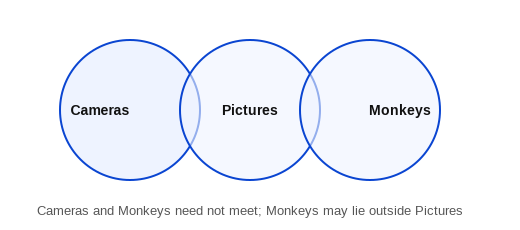
Concept: Draw the least-overlap Venn diagram; a conclusion follows only if it is true in every possible case.

  1. Cameras meet Pictures and Pictures meet Monkeys, but Cameras and Monkeys can be drawn apart → (I) 'Some cameras are monkeys' is not certain.
  2. Only 'some' monkeys are pictures; the rest can lie outside → (II) 'All monkeys are pictures' does not follow.
  3. Hence neither conclusion follows.

Trick: Some + Some → no definite conclusion between the end terms.

Answer: (C) Neither conclusion (I) nor (II) follows

अवधारणा: न्यूनतम ओवरलैप वाला वेन आरेख बनाएँ; निष्कर्ष तभी सही है जब हर संभावित स्थिति में सही हो।

  1. कैमरे-चित्र और चित्र-बंदर मिलते हैं, पर कैमरे और बंदर अलग रखे जा सकते हैं → (I) 'कुछ कैमरे बंदर हैं' निश्चित नहीं।
  2. केवल 'कुछ' बंदर चित्र हैं; बाकी बाहर हो सकते हैं → (II) 'सभी बंदर चित्र हैं' नहीं निकलता।
  3. अतः कोई निष्कर्ष नहीं निकलता।

ट्रिक: कुछ + कुछ → अंतिम पदों के बीच कोई निश्चित निष्कर्ष नहीं।

उत्तर: (C) न तो (I) न ही (II) निकलता है

RRB NTPC Undergraduate CBT 1General Intelligence and ReasoningSyllogismRRB NTPC Undergraduate CBT 1 2025 · 15 Jun Shift 2 →
Q13172.
Read the given statement(s) and conclusions carefully. Assuming that the information given in the statements is true, even if it appears to be at variance with commonly known facts, decide which of the given conclusions logically follow(s) from the statement(s).
Statements: All kings are buttons. No pants are kings.
Conclusion (I): All buttons are kings.
Conclusion (II): Some buttons are not pants.
दिए गए कथन(नों) और निष्कर्षों को ध्यानपूर्वक पढ़िए। यह मानते हुए कि कथनों में दी गई जानकारी सत्य है, भले ही वह सामान्यतः ज्ञात तथ्यों से भिन्न प्रतीत होती हो, निर्णय लीजिए कि दिए गए निष्कर्षों में से कौन-सा/से निष्कर्ष तार्किक रूप से कथन(नों) का अनुसरण करता है/करते हैं।
कथन: सभी राजा, बटन हैं। कोई भी पैंट, राजा नहीं है।
निष्कर्ष (I): सभी बटन, राजा हैं।
निष्कर्ष (II): कुछ बटन, पैंट नहीं हैं।
  1. ABoth conclusions (I) and (II) followनिष्कर्ष (I) और (II) दोनों अनुसरण करते हैं
  2. BOnly conclusion (I) followsकेवल निष्कर्ष (I) अनुसरण करता है
  3. COnly conclusion (II) followsकेवल निष्कर्ष (II) अनुसरण करता है
  4. DNeither conclusion (I) nor (II) followsन तो निष्कर्ष (I) और न ही (II) अनुसरण करता है
Show answer

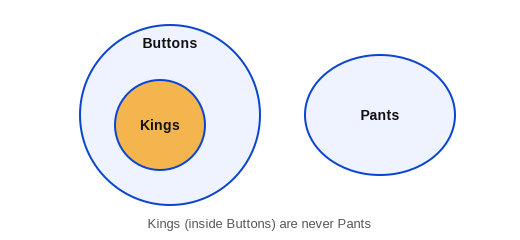
Concept: Place Kings inside Buttons and keep Pants away from Kings.

  1. (I) 'All buttons are kings' – Buttons may be larger than Kings, so it is not certain.
  2. (II) Every king is a button and no king is a pant, so those buttons that are kings are certainly not pants → 'Some buttons are not pants' follows.
  3. Hence only conclusion (II) follows.

Trick: All A are B + No C are A ⇒ Some B are not C (always).

Answer: (C) Only conclusion (II) follows

अवधारणा: राजाओं (Kings) को बटनों (Buttons) के अंदर रखें और पैंट (Pants) को राजाओं से अलग।

  1. (I) 'सभी बटन राजा हैं' – बटन, राजाओं से बड़े हो सकते हैं, अतः निश्चित नहीं।
  2. (II) हर राजा बटन है और कोई राजा पैंट नहीं, तो जो बटन राजा हैं वे निश्चित रूप से पैंट नहीं → 'कुछ बटन पैंट नहीं हैं' निकलता है।
  3. अतः केवल निष्कर्ष (II) निकलता है।

ट्रिक: सभी A, B हैं + कोई C, A नहीं ⇒ कुछ B, C नहीं (हमेशा)।

उत्तर: (C) केवल निष्कर्ष (II) निकलता है

RRB NTPC Undergraduate CBT 1General Intelligence and ReasoningSyllogismRRB NTPC Undergraduate CBT 1 2025 · 15 Jun Shift 2 →
Q13173.
What should come in place of ‘?’ in the given series?
486 441 401 366 336 ?
दी गई श्रृंखला में ‘?’ के स्थान पर क्या आना चाहिए?
486 441 401 366 336 ?
  1. A313
  2. B310
  3. C311
  4. D312
Show answer

Concept: Look at the differences between consecutive terms.

  1. 486−441=45, 441−401=40, 401−366=35, 366−336=30
  2. The differences fall by 5 each time, so the next is 25.
  3. 336−25=311

Trick: Differences 45,40,35,30,25 – a simple arithmetic pattern.

Answer: (C) 311

अवधारणा: क्रमागत पदों के अंतर देखें।

  1. 486−441=45, 441−401=40, 401−366=35, 366−336=30
  2. अंतर हर बार 5 घटता है, अतः अगला 25।
  3. 336−25=311

ट्रिक: अंतर 45,40,35,30,25 – सरल समांतर पैटर्न।

उत्तर: (C) 311

RRB NTPC Undergraduate CBT 1General Intelligence and ReasoningNumber seriesRRB NTPC Undergraduate CBT 1 2025 · 15 Jun Shift 2 →
Q13174.
A, B, C, D, S, T and U are sitting around a circular table, facing the centre of the table. Only three people sit between B and C, when counted from the left of B. Only three people sit between U and T, when counted from the right of T. D sits to the immediate right of U. A is an immediate neighbor of T as well as C. Who sits second to the left of S?
A, B, C, D, S, T और U एक वृत्ताकार मेज़ के चारों ओर मेज़ के केंद्र की ओर मुख करके बैठे हैं। B के बाएँ से गिनने पर B और C के बीच केवल तीन व्यक्ति बैठे हैं। T के दाएँ से गिनने पर U और T के बीच केवल तीन व्यक्ति बैठे हैं। D, U के ठीक दाएँ बैठा है। A, T और C दोनों का निकटतम पड़ोसी है। S के बाएँ से दूसरे स्थान पर कौन बैठा है?
  1. AA
  2. BC
  3. CT
  4. DU
Show answer

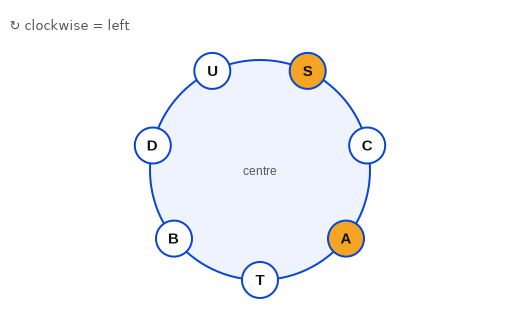
Concept: Facing the centre: left = clockwise, right = anticlockwise.

  1. Fix T. U is 4th to the right of T (three people between), and D is immediately right of U.
  2. A must touch both T and C; the only free pair of seats gives A next to T and C next to A.
  3. C is 4th to the left of B (three people between, counted from B's left) → B sits between T and D; S takes the last seat (between U and C).
  4. Clockwise order: T, B, D, U, S, C, A → second to the left of S is A.

Trick: Count 'left' clockwise when everyone faces the centre.

Answer: (A) A

अवधारणा: केंद्र की ओर मुख: बायाँ = दक्षिणावर्त (clockwise), दायाँ = वामावर्त।

  1. T को स्थिर करें। U, T के दाएँ चौथा है (बीच में तीन), D, U के ठीक दाएँ।
  2. A, T और C दोनों का पड़ोसी है; खाली सीटों में A, T के बगल और C, A के बगल ही बैठ सकते हैं।
  3. B के बाएँ से गिनने पर तीन लोगों के बाद C है → B, T और D के बीच; S बची सीट (U और C के बीच) लेता है।
  4. दक्षिणावर्त क्रम: T, B, D, U, S, C, A → S के बाएँ दूसरा A।

ट्रिक: केंद्र की ओर मुख हो तो 'बायाँ' दक्षिणावर्त गिनें।

उत्तर: (A) A

RRB NTPC Undergraduate CBT 1General Intelligence and ReasoningCircular seating arrangementRRB NTPC Undergraduate CBT 1 2025 · 15 Jun Shift 2 →
Q13175.
What will come in place of the question mark (?) in the following equation, if ‘+’ and ‘÷' are interchanged and ‘−’ and ‘×’ are interchanged?
14 − 2 × 48 + 3 ÷ 7 = ?
यदि ‘+’ और ‘÷' को आपस में बदल दिया जाए तथा ‘−’ और ‘×’ को आपस में बदल दिया जाए, तो निम्नलिखित समीकरण में प्रश्न चिह्न (?) के स्थान पर क्या आएगा?
14 − 2 × 48 + 3 ÷ 7 = ?
  1. A23
  2. B19
  3. C14
  4. D7
Show answer

Concept: Swap the signs as told, then use BODMAS.

  1. '+'↔'÷' and '−'↔'×': 14−2×48+3÷7 becomes 14×2−48÷3+7
  2. =28−16+7
  3. =19

Trick: Do the swap on paper sign by sign; then division and multiplication first.

Answer: (B) 19

अवधारणा: बताए अनुसार चिह्न बदलें, फिर BODMAS लगाएँ।

  1. '+'↔'÷' और '−'↔'×': 14−2×48+3÷7 बनता है 14×2−48÷3+7
  2. =28−16+7
  3. =19

ट्रिक: हर चिह्न एक-एक कर बदलें; फिर पहले भाग और गुणा।

उत्तर: (B) 19

RRB NTPC Undergraduate CBT 1General Intelligence and ReasoningMathematical operations (interchange)RRB NTPC Undergraduate CBT 1 2025 · 15 Jun Shift 2 →
Q13176.
What should come in place of the question mark (?) in the given series based on the English alphabetical order?
FOL ZIF TCZ NWT ?
अंग्रेज़ी वर्णमाला क्रम के आधार पर दी गई श्रृंखला में प्रश्न चिह्न (?) के स्थान पर क्या आना चाहिए?
FOL ZIF TCZ NWT ?
  1. AHQN
  2. BHNY
  3. CHNJ
  4. DHON
Show answer

Concept: Every position moves back by 6 letters.

  1. 1st: F, Z, T, N → −6 → H
  2. 2nd: O, I, C, W → −6 → Q
  3. 3rd: L, F, Z, T → −6 → N. Term: HQN.

Trick: −6 is the same as +20 on the 26-letter circle.

Answer: (A) HQN

अवधारणा: हर स्थान 6 अक्षर पीछे जाता है।

  1. पहला: F, Z, T, N → −6 → H
  2. दूसरा: O, I, C, W → −6 → Q
  3. तीसरा: L, F, Z, T → −6 → N। पद: HQN।

ट्रिक: 26 अक्षरों के चक्र में −6 और +20 समान हैं।

उत्तर: (A) HQN

RRB NTPC Undergraduate CBT 1General Intelligence and ReasoningLetter seriesRRB NTPC Undergraduate CBT 1 2025 · 15 Jun Shift 2 →
Q13177.
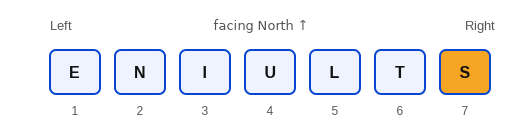
Seven people, U, T, E, N, S, I and L, are sitting in a row, facing the north.
Only E sits to the left of N. Only four people sit between E and T. Only U sits between I and L and I is not an immediate neighbor of T.
Who sits at the extreme right of the line?
सात व्यक्ति, U, T, E, N, S, I और L, उत्तर की ओर मुख करके एक पंक्ति में बैठे हैं।
N के बाएँ केवल E बैठा है। E और T के बीच केवल चार व्यक्ति बैठे हैं। I और L के बीच केवल U बैठा है और I, T का निकटतम पड़ोसी नहीं है।
पंक्ति के अंतिम दाएँ छोर पर कौन बैठा है?
  1. AU
  2. BL
  3. CS
  4. DN
Show answer

Concept: Seven seats, 1 = left end, all facing north.

  1. Only E is left of N → E = 1, N = 2. Four between E and T → T = 6.
  2. I, U, L are together with U in the middle, in seats 3–5 (seat 7 cannot hold the block).
  3. I not next to T (6) → I = 3, U = 4, L = 5; S = 7.
  4. Extreme right (seat 7) is S.

Trick: 'Only X to the left of Y' fixes both at seats 1 and 2 immediately.

Answer: (C) S

अवधारणा: सात सीटें, 1 = बायाँ सिरा, सभी उत्तर की ओर मुख।

  1. केवल E, N के बाएँ → E = 1, N = 2। E और T के बीच चार → T = 6।
  2. I, U, L साथ हैं, U बीच में; सीट 3–5 में (सीट 7 में यह समूह नहीं आता)।
  3. I, T (6) का पड़ोसी नहीं → I = 3, U = 4, L = 5; S = 7।
  4. सबसे दाएँ (सीट 7) S।

ट्रिक: 'केवल X, Y के बाएँ' से दोनों तुरंत सीट 1 और 2 पर तय।

उत्तर: (C) S

RRB NTPC Undergraduate CBT 1General Intelligence and ReasoningLinear seating arrangementRRB NTPC Undergraduate CBT 1 2025 · 15 Jun Shift 2 →
Q13178.
KG 13 is related to IC −2 in a certain way. In the same way, NH 20 is related to LD 5. To which of the following is NW 24 related, following the same logic?
KG 13 एक निश्चित प्रकार से IC −2 से संबंधित है। उसी प्रकार, NH 20, LD 5 से संबंधित है। समान तर्क का अनुसरण करते हुए, NW 24 निम्नलिखित में से किससे संबंधित है?
  1. ALS 9
  2. BMS 11
  3. CMR 11
  4. DLR 9
Show answer

Concept: Apply the same change to letters and number.

  1. KG 13 → IC −2: K−2=I, G−4=C, 13−15=−2
  2. NH 20 → LD 5: N−2=L, H−4=D, 20−15=5
  3. NW 24 → N−2=L, W−4=S, 24−15=9 → LS 9

Trick: Rule: (−2,−4,−15).

Answer: (A) LS 9

अवधारणा: अक्षरों और संख्या पर समान परिवर्तन लगाएँ।

  1. KG 13 → IC −2: K−2=I, G−4=C, 13−15=−2
  2. NH 20 → LD 5: N−2=L, H−4=D, 20−15=5
  3. NW 24 → N−2=L, W−4=S, 24−15=9 → LS 9

ट्रिक: नियम: (−2,−4,−15)।

उत्तर: (A) LS 9

RRB NTPC Undergraduate CBT 1General Intelligence and ReasoningAnalogy – letters and numbersRRB NTPC Undergraduate CBT 1 2025 · 15 Jun Shift 2 →
Q13179.
What should come in place of ‘?’ in the given series?
70 80 ? 106 122 140
दी गई श्रृंखला में ‘?’ के स्थान पर क्या आना चाहिए?
70 80 ? 106 122 140
  1. A100
  2. B94
  3. C96
  4. D92
Show answer

Concept: Differences increase by 2.

  1. 80−70=10, so the next differences are 12,14,16,18.
  2. 80+12=92
  3. Check: 92+14=106, 106+16=122, 122+18=140 ✓

Trick: When the last terms are known, check the differences backwards.

Answer: (D) 92

अवधारणा: अंतर 2-2 से बढ़ते हैं।

  1. 80−70=10, अतः अगले अंतर 12,14,16,18।
  2. 80+12=92
  3. जाँच: 92+14=106, 106+16=122, 122+18=140 ✓

ट्रिक: अंतिम पद ज्ञात हों तो अंतर पीछे से जाँचें।

उत्तर: (D) 92

RRB NTPC Undergraduate CBT 1General Intelligence and ReasoningNumber seriesRRB NTPC Undergraduate CBT 1 2025 · 15 Jun Shift 2 →
Q13180.
Select the set in which the numbers are related in the same way as are the numbers of the following sets.
(NOTE: Operations should be performed on the whole numbers, without breaking down the numbers into their constituent digits. E.g. 13 – Operations on 13 such as
adding/subtracting/multiplying etc. to 13 can be performed. Breaking down 13 into 1 and 3 and then performing mathematical operations on 1 and 3 is not allowed.) (2, 11, 31)
(13, 10, 41)
उस समुच्चय का चयन कीजिए जिसमें संख्याएँ उसी प्रकार संबंधित हैं जिस प्रकार निम्नलिखित समुच्चयों की संख्याएँ संबंधित हैं।
(ध्यान दें: संक्रियाएँ संख्याओं को उनके घटक अंकों में विभाजित किए बिना पूर्ण संख्याओं पर की जानी चाहिए। उदाहरण के लिए 13 – 13 पर संक्रियाएँ जैसे
13 में जोड़ना/घटाना/गुणा करना आदि की जा सकती हैं। 13 को 1 और 3 में विभाजित करना और फिर 1 और 3 पर गणितीय संक्रियाएँ करना वर्जित है।) (2, 11, 31)
(13, 10, 41)
  1. A(29, 19, 56)
  2. B(6, 1, 25)
  3. C(8, 22, 45)
  4. D(10, 20, 50)
Show answer

Concept: Find one rule linking the three numbers of each set.

  1. (2,11,31): 2+11+18=31; (13,10,41): 13+10+18=41 → third = first + second +18.
  2. (6,1,25): 6+1+18=25 ✓
  3. Others: 29+19+18=66≠56, 8+22+18=48≠45, 10+20+18=48≠50.

Trick: If the third number is just a little more than the sum, test 'sum + constant'.

Answer: (B) (6,1,25)

अवधारणा: हर समूह की तीनों संख्याओं को जोड़ने वाला एक नियम खोजें।

  1. (2,11,31): 2+11+18=31; (13,10,41): 13+10+18=41 → तीसरी = पहली + दूसरी +18।
  2. (6,1,25): 6+1+18=25 ✓
  3. अन्य: 29+19+18=66≠56, 8+22+18=48≠45, 10+20+18=48≠50।

ट्रिक: तीसरी संख्या योग से थोड़ी अधिक हो तो 'योग + स्थिरांक' जाँचें।

उत्तर: (B) (6,1,25)

RRB NTPC Undergraduate CBT 1General Intelligence and ReasoningNumber analogy (sets)RRB NTPC Undergraduate CBT 1 2025 · 15 Jun Shift 2 →