Question bank

Q&A: practice questions with answers

Search questions on any topic. Filter by exam category, exam, subject and topic, try the question, then open the answer and explanation.

Courses – airGurukul

20,719 questions found.

Q13241.
A team of 3 workers, P, Q, and R, is assigned to paint a large wall. P alone can finish the work in 14 days, Q alone in 21 days, and R alone in 42 days. If they start together but P leaves after 4 days, and the remaining work is completed by Q and R together, in how many total days is the wall completely painted?
3 श्रमिकों, P, Q और R, की एक टीम को एक बड़ी दीवार पेंट करने का कार्य सौंपा जाता है। P अकेले कार्य को 14 दिनों में, Q अकेले 21 दिनों में और R अकेले 42 दिनों में पूरा कर सकता है। यदि वे एक साथ कार्य आरंभ करते हैं परंतु P 4 दिनों के बाद कार्य छोड़ देता है, और शेष कार्य Q और R मिलकर पूरा करते हैं, तो दीवार कुल कितने दिनों में पूरी तरह पेंट हो जाती है?
  1. A10 days10 दिन
  2. B9 days9 दिन
  3. C11 days11 दिन
  4. D12 days12 दिन
Show answer

Concept: Total work = LCM of days; efficiency = units per day.
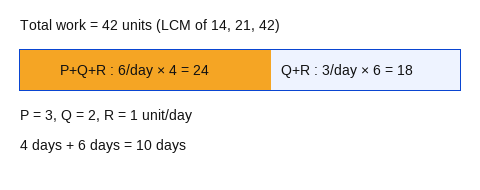
  1. LCM(14, 21, 42) =42 units. P =3, Q =2, R =1 unit/day.
  2. First 4 days (all three): 6×4=24 units; remaining =18.
  3. Q + R =3 units/day → 183=6 days.
  4. Total =4+6=10 days.

Trick: P's 4 days =12 units; the other 30 units are done by Q + R at 3/day = 10 days, which is the total time.

Answer: (A) 10 days

अवधारणा: कुल कार्य = दिनों का LCM; दक्षता = इकाई प्रति दिन।

  1. LCM(14, 21, 42) =42 इकाई; P =3, Q =2, R =1 इकाई/दिन।
  2. पहले 4 दिन तीनों: 24 इकाई; शेष 18।
  3. Q + R =3 इकाई/दिन → 6 दिन।
  4. कुल =4+6=10 दिन।

ट्रिक: Q + R पूरे समय काम करते हैं: 3×T+3×4=42⇒T=10 दिन।

उत्तर: (A) 10 days

RRB NTPC Undergraduate CBT 1MathematicsTime and workRRB NTPC Undergraduate CBT 1 2025 · 14 Jun Shift 3 →
Q13242.
A shopkeeper fixes the marked price of an item 150% above its cost price. What percentage of discount on marked price should be allowed to gain 110%?
एक दुकानदार किसी वस्तु का अंकित मूल्य उसके क्रय मूल्य से 150% अधिक निर्धारित करता है। 110% का लाभ प्राप्त करने के लिए अंकित मूल्य पर कितने प्रतिशत की छूट दी जानी चाहिए?
  1. A17%
  2. B16%
  3. C14%
  4. D15%
Show answer

Concept: SP = MP × (1 − discount); required SP comes from the desired profit on CP.

  1. Let CP =100. MP =250 (150% above CP).
  2. Required SP for 110% gain =210.
  3. Discount =250−210=40; 40250×100=16%.

Trick: SPMP=210250=0.84, so discount =16%.

Answer: (B) 16%

अवधारणा: SP = MP × (1 − छूट); अभीष्ट SP, CP पर वांछित लाभ से मिलता है।

  1. CP =100 मानें, MP =250।
  2. 110% लाभ के लिए SP =210।
  3. छूट =40; 40250×100=16%।

ट्रिक: SPMP=210250=0.84 → छूट 16%।

उत्तर: (B) 16%

RRB NTPC Undergraduate CBT 1MathematicsProfit, loss and discountRRB NTPC Undergraduate CBT 1 2025 · 14 Jun Shift 3 →
Q13243.
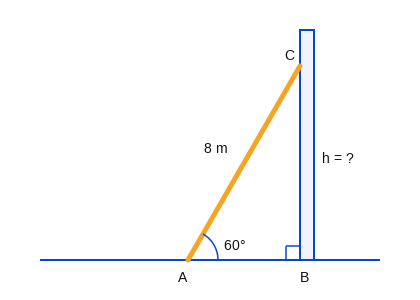
A ladder of length 8 m is placed against a vertical wall, making an angle of 60° with the ground. How high does the ladder reach up the wall?
8 m लंबी एक सीढ़ी एक ऊर्ध्वाधर दीवार के सहारे इस प्रकार रखी गई है कि वह भूमि के साथ 60° का कोण बनाती है। सीढ़ी दीवार पर कितनी ऊँचाई तक पहुँचती है?
  1. A43 m
  2. B63 m
  3. C33 m
  4. D53 m
Show answer

Concept: In a right triangle, sinθ=oppositehypotenuse; the ladder is the hypotenuse.

  1. Height h=8sin60∘=8×32.
  2. h=43 m ≈6.93 m.

Yaad rakhein: 30∘-60∘-90∘ triangle sides are 1:3:2; hypotenuse 8 → side opposite 60∘ is 43.

Answer: (A) 43 m

अवधारणा: समकोण त्रिभुज में sinθ=लंबकर्ण; सीढ़ी कर्ण है।

  1. ऊँचाई h=8sin60∘=8×32।
  2. h=43 m ≈6.93 m।

याद रखें: 30∘-60∘-90∘ त्रिभुज की भुजाएँ 1:3:2; कर्ण 8 → 60∘ के सामने की भुजा 43।

उत्तर: (A) 43 m

RRB NTPC Undergraduate CBT 1MathematicsHeights and distancesRRB NTPC Undergraduate CBT 1 2025 · 14 Jun Shift 3 →
Q13244.
Which of the following pairs of numbers is co-prime?
A) (15, 25)
B) (14, 35)
C) (9, 28)
D) (21, 49)
निम्नलिखित में से कौन-सा संख्या युग्म सह-अभाज्य (co-prime) है?
A) (15, 25)
B) (14, 35)
C) (9, 28)
D) (21, 49)
  1. AB
  2. BC
  3. CD
  4. DA
Show answer

Concept: Two numbers are co-prime when their HCF is 1.

  1. (15, 25): HCF 5; (14, 35): HCF 7; (21, 49): HCF 7 – not co-prime.
  2. (9, 28): 9=32, 28=22×7 – no common factor, HCF 1. So pair C is co-prime.
  3. Pair C corresponds to option (B).

Trick: Pairs with both numbers multiples of 5 or 7 are instantly out; 9 and 28 share nothing.

Answer: (B) C

अवधारणा: दो संख्याएँ सह-अभाज्य हैं जब उनका HCF 1 हो।

  1. (15, 25): HCF 5; (14, 35): HCF 7; (21, 49): HCF 7 – सह-अभाज्य नहीं।
  2. (9, 28): 9=32, 28=22×7 – HCF 1, अतः युग्म C सह-अभाज्य है।
  3. युग्म C विकल्प (B) है।

ट्रिक: जिन युग्मों में दोनों संख्याएँ 5 या 7 की गुणज हों, वे तुरंत बाहर।

उत्तर: (B) C

RRB NTPC Undergraduate CBT 1MathematicsCo-prime numbersRRB NTPC Undergraduate CBT 1 2025 · 14 Jun Shift 3 →
Q13245.
Three positive integers a, b, and c satisfy the following conditions: (i) a and b are coprime, (ii) b and c are coprime, (iii) a and c are not coprime, (iv) abc = 360. The minimum possible value of a + b + c is:
तीन धनात्मक पूर्णांक a, b और c निम्नलिखित शर्तों को संतुष्ट करते हैं: (i) a और b सह-अभाज्य हैं, (ii) b और c सह-अभाज्य हैं, (iii) a और c सह-अभाज्य नहीं हैं, (iv) abc = 360. a + b + c का न्यूनतम संभव मान कितना है?
  1. A95
  2. B27
  3. C23
  4. D33
Show answer

Concept: 360=23×32×5. b must share no prime with a or c, while a and c share a prime.

  1. Give b a prime of its own and split the rest between a and c so they share a factor.
  2. b=5, a×c=72 with a common factor: a=6,c=12 → 6×5×12=360.
  3. Check: gcd(6,5) = 1, gcd(5,12) = 1, gcd(6,12) = 6. Sum =6+5+12=23.
  4. Other splits (3,8,15 → 26; 2,45,4 → 51) give larger sums.

Trick: Keep the lone prime 5 as b and make a,c as balanced as possible (6 and 12) – balanced factors give the smallest sum.

Answer: (C) 23

अवधारणा: 360=23×32×5। b का a या c से कोई उभयनिष्ठ अभाज्य नहीं, जबकि a और c में एक उभयनिष्ठ अभाज्य हो।

  1. b को अलग अभाज्य दें, बाकी a और c में बाँटें ताकि वे एक गुणनखंड साझा करें।
  2. b=5, a=6, c=12 → 6×5×12=360।
  3. जाँच: gcd(6,5) = 1, gcd(5,12) = 1, gcd(6,12) = 6; योग =23।
  4. अन्य विभाजन (3,8,15 → 26) बड़े योग देते हैं।

ट्रिक: अकेले अभाज्य 5 को b रखें और a,c को यथासंभव संतुलित (6,12) बनाएँ – संतुलित गुणनखंडों का योग न्यूनतम होता है।

उत्तर: (C) 23

RRB NTPC Undergraduate CBT 1MathematicsNumber system – co-primesRRB NTPC Undergraduate CBT 1 2025 · 14 Jun Shift 3 →
Q13246.
The average of 6.5, 10.8, 20 and a is 13. The value of a is:
6.5, 10.8, 20 और a का औसत 13 है। a का मान कितना है?
  1. A15.7
  2. B16.7
  3. C14.7
  4. D13.7
Show answer

Concept: Sum = average × count.

  1. Sum of four numbers =13×4=52.
  2. 6.5+10.8+20=37.3.
  3. a=52−37.3=14.7.

Trick: Deviations from 13: −6.5,−2.2,+7 → total −1.7, so a must be 13+1.7=14.7.

Answer: (C) 14.7

अवधारणा: योग = औसत × संख्या।

  1. चारों का योग =13×4=52।
  2. 6.5+10.8+20=37.3।
  3. a=52−37.3=14.7।

ट्रिक: 13 से विचलन: −6.5,−2.2,+7 → कुल −1.7, अतः a=13+1.7=14.7।

उत्तर: (C) 14.7

RRB NTPC Undergraduate CBT 1MathematicsAverageRRB NTPC Undergraduate CBT 1 2025 · 14 Jun Shift 3 →
Q13247.
If 3x−3x−1=18, then the value of 2x−12x+3 is:
यदि 3x−3x−1=18 है, तो 2x−12x+3 का मान कितना है?
  1. A513
  2. B56
  3. C512
  4. D59
Show answer

Concept: 3x−1=3x3; factor out the common power.

  1. 3x−3x3=18⇒3x×23=18⇒3x=27, so x=3.
  2. 2x−12x+3=6−16+3=59.

Trick: 3x−3x−1=2×3x−1; so 3x−1=9⇒x=3.

Answer: (D) 59

अवधारणा: 3x−1=3x3; उभयनिष्ठ घात बाहर निकालें।

  1. 3x×23=18⇒3x=27⇒x=3।
  2. 2x−12x+3=59।

ट्रिक: 3x−3x−1=2×3x−1=18⇒3x−1=9⇒x=3।

उत्तर: (D) 59

RRB NTPC Undergraduate CBT 1MathematicsIndicesRRB NTPC Undergraduate CBT 1 2025 · 14 Jun Shift 3 →
Q13248.
If 45% of a number exceeds 20% of it by 30, then the number is:
यदि किसी संख्या का 45%, उसी संख्या के 20% से 30 अधिक है, तो वह संख्या कितनी है?
  1. A140
  2. B100
  3. C120
  4. D160
Show answer

Concept: Difference of two percentages of the same number is that percentage-difference of the number.

  1. 45%−20%=25% of the number =30.
  2. Number =3025×100=120.

Trick: 25%=14, so the number is 4×30=120.

Answer: (C) 120

अवधारणा: एक ही संख्या के दो प्रतिशतों का अंतर = प्रतिशत-अंतर × संख्या।

  1. 45%−20%=25% का मान =30।
  2. संख्या =30×4=120।

ट्रिक: 25%=14, अतः संख्या =4×30=120।

उत्तर: (C) 120

RRB NTPC Undergraduate CBT 1MathematicsPercentageRRB NTPC Undergraduate CBT 1 2025 · 14 Jun Shift 3 →
Q13249.
A product with marked price ₹3,000 is sold with successive discounts of 15% and 25%. What is the final selling price after these two discounts?
₹3,000 अंकित मूल्य वाले एक उत्पाद को 15% और 25% की क्रमिक छूट पर बेचा जाता है। इन दो छूटों के बाद अंतिम विक्रय मूल्य कितना है?
  1. A₹1,936.50
  2. B₹1,872
  3. C₹1,912.50
  4. D₹1,896
Show answer

Concept: Successive discounts multiply: SP =MP×(1−d1)(1−d2).

  1. 3000×0.85=2550.
  2. 2550×0.75=1912.50.

Trick: Single equivalent discount =15+25−15×25100=36.25%; 3000×0.6375=1912.5.

Answer: (C) ₹1,912.50

अवधारणा: क्रमिक छूटें गुणा होती हैं: SP =MP×(1−d1)(1−d2)।

  1. 3000×0.85=2550।
  2. 2550×0.75=1912.50।

ट्रिक: एकल समतुल्य छूट =15+25−15×25100=36.25%; 3000×0.6375=1912.5।

उत्तर: (C) ₹1,912.50

RRB NTPC Undergraduate CBT 1MathematicsSuccessive discountsRRB NTPC Undergraduate CBT 1 2025 · 14 Jun Shift 3 →
Q13250.
Two articles are sold at the same selling price. On one article, the trader makes a 25% profit, and on the other, he incurs a 25% loss. What is the overall percentage loss?
दो वस्तुएँ समान विक्रय मूल्य पर बेची जाती हैं। एक वस्तु पर व्यापारी को 25% लाभ होता है, और दूसरी पर उसे 25% हानि होती है। कुल प्रतिशत हानि कितनी है?
  1. A7.25%
  2. B6.25%
  3. C5.25%
  4. D8.25%
Show answer

Concept: Same SP, equal profit % and loss % → always a net loss of (x10)2%.

  1. Loss =(2510)2=6.25%.
  2. Check: SP =100 each; CPs =80 and 133.33, total CP =213.33, total SP =200; loss =13.33213.33=6.25%.

Yaad rakhein: Same SP, x% gain and x% loss → loss =x2100%, never a profit.

Answer: (B) 6.25%

अवधारणा: समान SP पर समान लाभ % और हानि % → सदैव (x10)2% की हानि।

  1. हानि =(2510)2=6.25%।
  2. जाँच: SP =100 प्रत्येक; CP =80 और 133.33; कुल CP 213.33, कुल SP 200 → हानि 6.25%।

याद रखें: समान SP, x% लाभ और x% हानि → हानि =x2100%।

उत्तर: (B) 6.25%

RRB NTPC Undergraduate CBT 1MathematicsProfit and loss – same SPRRB NTPC Undergraduate CBT 1 2025 · 14 Jun Shift 3 →
Q13251.
A merchant marks his products 30% above the cost price and provides a 10% discount on the marked price. What percent profit does he earn?
एक व्यापारी अपने उत्पादों पर क्रय मूल्य से 30% अधिक मूल्य अंकित करता है और अंकित मूल्य पर 10% की छूट देता है। वह कितने प्रतिशत लाभ अर्जित करता है?
  1. A17%
  2. B15%
  3. C16%
  4. D18%
Show answer

Concept: SP =CP×(1+markup)×(1−discount).

  1. CP =100, MP =130.
  2. SP =130×0.9=117.
  3. Profit =17%.

Trick: Net =30−10−30×10100=17%.

Answer: (A) 17%

अवधारणा: SP =CP×(1+मार्कअप)×(1−छूट)।

  1. CP =100, MP =130।
  2. SP =130×0.9=117।
  3. लाभ =17%।

ट्रिक: शुद्ध =30−10−30×10100=17%।

उत्तर: (A) 17%

RRB NTPC Undergraduate CBT 1MathematicsProfit, loss and discountRRB NTPC Undergraduate CBT 1 2025 · 14 Jun Shift 3 →
Q13252.
The sum of two numbers is 54. If three times the smaller number exceeds twice the larger number by 6, find the difference between the two numbers.
दो संख्याओं का योग 54 है। यदि छोटी संख्या का तीन गुना, बड़ी संख्या के दो गुने से 6 अधिक है, तो दोनों संख्याओं के बीच का अंतर ज्ञात कीजिए।
  1. A8.4
  2. B7.6
  3. C6.6
  4. D7.2
Show answer

Concept: Form two equations and solve.

  1. Let smaller =s, larger =54−s.
  2. 3s−2(54−s)=6⇒5s=114⇒s=22.8.
  3. Larger =31.2; difference =31.2−22.8=8.4.

Trick: 3s−2l=6 and 2s+2l=108 → add: 5s=114 directly.

Answer: (A) 8.4

अवधारणा: दो समीकरण बनाकर हल करें।

  1. छोटी =s, बड़ी =54−s।
  2. 3s−2(54−s)=6⇒5s=114⇒s=22.8।
  3. बड़ी =31.2; अंतर =8.4।

ट्रिक: 3s−2l=6 और 2s+2l=108 जोड़ें → 5s=114।

उत्तर: (A) 8.4

RRB NTPC Undergraduate CBT 1MathematicsLinear equationsRRB NTPC Undergraduate CBT 1 2025 · 14 Jun Shift 3 →
Q13253.
The price of an article is first increased by 30% and then decreased by 20%. Due to these successive changes, the final price becomes ₹40 more than the original price. What is the original price of the article?
एक वस्तु के मूल्य में पहले 30% की वृद्धि की जाती है और फिर 20% की कमी की जाती है। इन क्रमिक परिवर्तनों के कारण, अंतिम मूल्य मूल मूल्य से ₹40 अधिक हो जाता है। वस्तु का मूल मूल्य कितना है?
  1. A₹1,000
  2. B₹1,200
  3. C₹1,100
  4. D₹900
Show answer

Concept: Net change for +a% then −b% is a−b−ab100.

  1. Net =30−20−6=+4%.
  2. 4% of original =40⇒ original =1000.
  3. Check: 1000→1300→1040, which is ₹40 more.

Trick: 1.3×0.8=1.04 → a 4% rise; 40÷0.04=1000.

Answer: (A) ₹1,000

अवधारणा: +a% फिर −b% का शुद्ध परिवर्तन =a−b−ab100।

  1. शुद्ध =30−20−6=+4%।
  2. मूल का 4%=40⇒ मूल =1000।
  3. जाँच: 1000→1300→1040।

ट्रिक: 1.3×0.8=1.04 → 4% वृद्धि; 40÷0.04=1000।

उत्तर: (A) ₹1,000

RRB NTPC Undergraduate CBT 1MathematicsSuccessive percentage changeRRB NTPC Undergraduate CBT 1 2025 · 14 Jun Shift 3 →
Q13254.
Find the third proportional to 240 and 120.
240 और 120 का तृतीयानुपाती ज्ञात कीजिए।
  1. A40
  2. B50
  3. C60
  4. D80
Show answer

Concept: Third proportional to a,b is c with a:b=b:c, so c=b2a.

  1. c=1202240=14400240=60.
  2. Check: 240:120=120:60=2:1.

Trick: 120 is half of 240, so the next term is half of 120 = 60.

Answer: (C) 60

अवधारणा: a,b का तृतीयानुपाती c=b2a।

  1. c=1202240=60।
  2. जाँच: 240:120=120:60।

ट्रिक: 120, 240 का आधा है, अतः अगला पद 120 का आधा = 60।

उत्तर: (C) 60

RRB NTPC Undergraduate CBT 1MathematicsProportionRRB NTPC Undergraduate CBT 1 2025 · 14 Jun Shift 3 →
Q13255.
The value of 2723·9−123−1·8114 is
2723·9−123−1·8114 का मान कितना है?
  1. A1
  2. B3
  3. C6
  4. D9
Show answer

Concept: Write every base as a power of 3 and use (am)n=amn.

  1. 2723=(33)23=32=9; 9−12=13. Numerator =9×13=3.
  2. 8114=3; 3−1×3=1. Denominator =1.
  3. Value =31=3.

Trick: In powers of 3: numerator 32−1=31, denominator 3−1+1=30 → 31−0=3.

Answer: (B) 3

अवधारणा: हर आधार को 3 की घात में लिखें और (am)n=amn लगाएँ।

  1. 2723=9; 9−12=13; अंश =3।
  2. 8114=3; 3−1×3=1; हर =1।
  3. मान =3।

ट्रिक: 3 की घातों में: अंश 31, हर 30 → उत्तर 3।

उत्तर: (B) 3

RRB NTPC Undergraduate CBT 1MathematicsIndicesRRB NTPC Undergraduate CBT 1 2025 · 14 Jun Shift 3 →
Q13256.
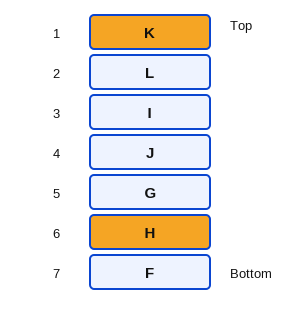
Seven boxes, F, G, H, I, J, K and L, are kept one over the other, but not necessarily in the same order.
Only one box is kept between G and F. J is kept at the fourth position from the top. Only one box is kept above L. I is kept immediately below L. K is kept at a position
somewhere above J.
How many boxes are kept between K and H?
सात बक्से, F, G, H, I, J, K और L, एक के ऊपर एक रखे गए हैं, परंतु आवश्यक नहीं कि इसी क्रम में हों।
G और F के बीच केवल एक बक्सा रखा है। J ऊपर से चौथे स्थान पर रखा है। L के ऊपर केवल एक बक्सा रखा है। I, L के ठीक नीचे रखा है। K, J के ऊपर किसी स्थान पर
रखा है।
K और H के बीच कितने बक्से रखे हैं?
  1. AOneएक
  2. BTwoदो
  3. CThreeतीन
  4. DFourचार
Show answer

Concept: Fix the definite positions first (counting from the top), then place the rest.

  1. J is 4th from top. Only one box above L → L = 2nd, I (immediately below L) = 3rd.
  2. K is above J → the only free place above J is 1st, so K = 1st.
  3. Positions 5, 6, 7 remain for F, G, H. Only one box between G and F → G, F at 5 and 7; H = 6th.
  4. K (1st) and H (6th): boxes between = L, I, J, G/F = 4.

Trick: “Only one above L” pins L at 2 – always start from such absolute clues.

Answer: (D) Four

अवधारणा: पहले निश्चित स्थान (ऊपर से गिनकर) तय करें, फिर बाकी रखें।

  1. J ऊपर से 4था। L के ऊपर केवल एक बॉक्स → L = 2रा, I (L के ठीक नीचे) = 3रा।
  2. K, J के ऊपर है → J के ऊपर एकमात्र खाली स्थान 1ला, अतः K = 1ला।
  3. स्थान 5, 6, 7 पर F, G, H। G और F के बीच केवल एक → G, F = 5 व 7; H = 6ठा।
  4. K (1) और H (6) के बीच: L, I, J, G/F = 4 बॉक्स।

ट्रिक: “L के ऊपर केवल एक” L को 2 पर जड़ देता है – ऐसे निश्चित संकेतों से शुरू करें।

उत्तर: (D) Four

RRB NTPC Undergraduate CBT 1General Intelligence and ReasoningPuzzle – Box arrangementRRB NTPC Undergraduate CBT 1 2025 · 14 Jun Shift 3 →
Q13257.
Each vowel in the word RADULAE is changed to the letter immediately following it in the English alphabetical order, and each consonant is changed to the letter immediately preceding it in the English alphabetical order. How many letters will appear exactly twice in the new group of letters thus formed?
शब्द RADULAE के प्रत्येक स्वर को अंग्रेज़ी वर्णमाला क्रम में उसके ठीक बाद वाले अक्षर से और प्रत्येक व्यंजन को अंग्रेज़ी वर्णमाला क्रम में उसके ठीक पहले वाले अक्षर से बदल दिया जाता है। इस प्रकार बने अक्षरों के नए समूह में कितने अक्षर ठीक दो बार आएँगे?
  1. AZeroशून्य
  2. BTwoदो
  3. COneएक
  4. DThreeतीन
Show answer

Concept: Vowels (A, E, I, O, U) move +1, consonants move −1 in the alphabet.

  1. R A D U L A E → R−1 = Q, A+1 = B, D−1 = C, U+1 = V, L−1 = K, A+1 = B, E+1 = F.
  2. New group: Q B C V K B F.
  3. Only B appears exactly twice (from the two A’s) → one letter.

Trick: Repeated letters in the original word (A, A) stay repeated after the shift – count them first.

Answer: (C) One

अवधारणा: स्वर (A, E, I, O, U) वर्णमाला में +1 और व्यंजन −1 खिसकते हैं।

  1. R A D U L A E → R−1 = Q, A+1 = B, D−1 = C, U+1 = V, L−1 = K, A+1 = B, E+1 = F।
  2. नया समूह: Q B C V K B F।
  3. केवल B ठीक दो बार आता है (दोनों A से) → एक अक्षर।

ट्रिक: मूल शब्द के दोहराए अक्षर (A, A) खिसकने के बाद भी दोहराए रहते हैं – पहले उन्हें गिनें।

उत्तर: (C) One

RRB NTPC Undergraduate CBT 1General Intelligence and ReasoningLetter manipulationRRB NTPC Undergraduate CBT 1 2025 · 14 Jun Shift 3 →
Q13258.
Select the set in which the numbers are related in the same way as are the numbers of the following sets.
(NOTE: Operations should be performed on the whole numbers, without breaking down the numbers into their constituent digits. E.g. 13 – Operations on 13 such as
adding/subtracting/multiplying etc. to 13 can be performed. Breaking down 13 into 1 and 3 and then performing mathematical operations on 1 and 3 is not allowed.) (2, 5, 7)
(3, 10, 13)
उस समुच्चय का चयन कीजिए जिसमें संख्याएँ उसी प्रकार संबंधित हैं जिस प्रकार निम्नलिखित समुच्चयों की संख्याएँ संबंधित हैं।
(ध्यान दें: संख्याओं को उनके घटक अंकों में विभाजित किए बिना, संक्रियाएँ पूर्ण संख्याओं पर की जानी चाहिए। उदाहरण के लिए 13 – 13 पर संक्रियाएँ जैसे
13 में जोड़ना/घटाना/गुणा करना आदि किया जा सकता है। 13 को 1 और 3 में विभाजित करना और फिर 1 और 3 पर गणितीय संक्रियाएँ करना वर्जित है।) (2, 5, 7)
(3, 10, 13)
  1. A(7, 49, 51)
  2. B(6, 37, 43)
  3. C(5, 26, 36)
  4. D(8, 63, 75)
Show answer

Concept: Find a rule linking the three numbers (a, b, c) that works for both given sets.

  1. (2, 5, 7): 22+1=5 and 5+2=7.
  2. (3, 10, 13): 32+1=10 and 10+3=13. Rule: b=a2+1,c=b+a.
  3. (6, 37, 43): 62+1=37 ✓, 37+6=43 ✓. Others fail: (7, 49, 51) needs 50; (5, 26, 36) needs 31; (8, 63, 75) needs 65.

Trick: Check the first pair rule (a2+1) on options – only (6, 37) survives.

Answer: (B) (6, 37, 43)

अवधारणा: तीनों संख्याओं (a, b, c) को जोड़ने वाला ऐसा नियम खोजें जो दोनों दिए सेटों पर लागू हो।

  1. (2, 5, 7): 22+1=5 और 5+2=7।
  2. (3, 10, 13): 32+1=10 और 10+3=13। नियम: b=a2+1,c=b+a।
  3. (6, 37, 43): 62+1=37 ✓, 37+6=43 ✓। बाकी असफल: (7, 49, 51) में 50 चाहिए; (5, 26, 36) में 31; (8, 63, 75) में 65।

ट्रिक: पहले जोड़े का नियम (a2+1) विकल्पों पर जाँचें – केवल (6, 37) बचता है।

उत्तर: (B) (6, 37, 43)

RRB NTPC Undergraduate CBT 1General Intelligence and ReasoningNumber analogy (triplets)RRB NTPC Undergraduate CBT 1 2025 · 14 Jun Shift 3 →
Q13259.
In a certain code language, ‘stage pig add’ is coded as ‘yv se kk’ and ‘third add bee’ is coded as ‘se ec wm’. How is ‘add’ coded in that language? (All codes are two-letter codes.)
एक निश्चित कूट भाषा में, ‘stage pig add’ को ‘yv se kk’ लिखा जाता है और ‘third add bee’ को ‘se ec wm’ लिखा जाता है। उसी भाषा में ‘add’ को कैसे लिखा जाएगा? (सभी कूट दो अक्षरों वाले कूट हैं।)
  1. Akk
  2. Byv
  3. Cec
  4. Dse
Show answer

Concept: A word common to two sentences has the code common to both.

  1. ‘stage pig add’ → ‘yv se kk’; ‘third add bee’ → ‘se ec wm’.
  2. Common word = add; common code = se.
  3. So add = se.

Trick: Match common words with common codes – no need to decode the rest.

Answer: (D) se

अवधारणा: दो वाक्यों में उभयनिष्ठ शब्द का कूट भी दोनों में उभयनिष्ठ होता है।

  1. ‘stage pig add’ → ‘yv se kk’; ‘third add bee’ → ‘se ec wm’।
  2. उभयनिष्ठ शब्द = add; उभयनिष्ठ कूट = se।
  3. अतः add = se।

ट्रिक: उभयनिष्ठ शब्द को उभयनिष्ठ कूट से मिलाएँ – बाकी डिकोड करने की ज़रूरत नहीं।

उत्तर: (D) se

RRB NTPC Undergraduate CBT 1General Intelligence and ReasoningCoding–decoding (common word)RRB NTPC Undergraduate CBT 1 2025 · 14 Jun Shift 3 →
Q13260.
Refer to the given letter series and answer the question that follows. Counting to be done from left to right only.
(Left) F M I H Y F Y E G K Y O N V K H Q T E K N (Right)
How many such vowels are there, each of which is immediately preceded by a consonant and also immediately followed by a vowel?
दी गई अक्षर श्रृंखला को देखिए और उसके बाद दिए गए प्रश्न का उत्तर दीजिए। गिनती केवल बाएँ से दाएँ की जानी है।
(बाएँ) F M I H Y F Y E G K Y O N V K H Q T E K N (दाएँ)
ऐसे कितने स्वर हैं, जिनमें से प्रत्येक के ठीक पहले एक व्यंजन है और ठीक बाद एक स्वर भी है?
  1. ANoneकोई नहीं
  2. BOneएक
  3. CTwoदो
  4. DThreeतीन
Show answer

Concept: Vowels are A, E, I, O, U; Y is a consonant. Check each vowel’s left and right neighbours.

  1. Series: F M I H Y F Y E G K Y O N V K H Q T E K N – vowels at positions 3, 8, 12, 19.
  2. I: M–I–H (followed by consonant ✗); E: Y–E–G ✗; O: Y–O–N ✗; E: T–E–K ✗.
  3. No vowel is followed by another vowel → none.

Trick: “Followed by a vowel” means two vowels together – scan for any adjacent vowel pair; there is none.

Answer: (A) None

अवधारणा: स्वर A, E, I, O, U हैं; Y व्यंजन है। हर स्वर के बाएँ-दाएँ पड़ोसी जाँचें।

  1. श्रृंखला: F M I H Y F Y E G K Y O N V K H Q T E K N – स्वर स्थान 3, 8, 12, 19 पर।
  2. I: M–I–H (बाद में व्यंजन ✗); E: Y–E–G ✗; O: Y–O–N ✗; E: T–E–K ✗।
  3. किसी स्वर के बाद स्वर नहीं → कोई नहीं।

ट्रिक: “बाद में स्वर” का अर्थ दो स्वर साथ-साथ – कोई भी सटा हुआ स्वर-जोड़ा खोजें; नहीं है।

उत्तर: (A) None

RRB NTPC Undergraduate CBT 1General Intelligence and ReasoningLetter series – countingRRB NTPC Undergraduate CBT 1 2025 · 14 Jun Shift 3 →