Question bank

Q&A: practice questions with answers

Search questions on any topic. Filter by exam category, exam, subject and topic, try the question, then open the answer and explanation.

Courses – airGurukul

20,719 questions found.

Q13261.
Seven people F, G, H, L, M, O and Q are sitting around a circular table, facing the centre of the table. Only two people sit between Q and L when counted from the right of Q. Only two people sit between L and O when counted from the left of O. Only three people sit between Q and F when counted from the right of Q. M sits to the immediate left of H. Who sits third to the left of G?
सात व्यक्ति F, G, H, L, M, O और Q एक वृत्ताकार मेज़ के चारों ओर मेज़ के केंद्र की ओर मुख करके बैठे हैं। Q के दाएँ से गिनने पर Q और L के बीच केवल दो व्यक्ति बैठे हैं। O के बाएँ से गिनने पर L और O के बीच केवल दो व्यक्ति बैठे हैं। Q के दाएँ से गिनने पर Q और F के बीच केवल तीन व्यक्ति बैठे हैं। M, H के ठीक बाएँ बैठा है। G के बाएँ से तीसरे स्थान पर कौन बैठा है?
  1. AH
  2. BL
  3. CF
  4. DM
Show answer

Concept: Facing the centre: left = clockwise, right = anticlockwise. Number the 7 seats clockwise with Q at seat 1.
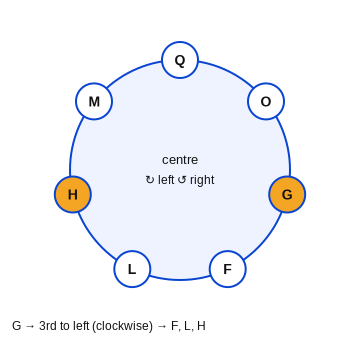
  1. Two between Q and L from Q’s right (anticlockwise) → L at seat 5.
  2. Two between L and O from O’s left (clockwise) → O is 3 seats anticlockwise of L → O at seat 2.
  3. Three between Q and F from Q’s right → F at seat 4.
  4. Seats 3, 6, 7 left for G, H, M. M immediately left (clockwise) of H → H = 6, M = 7; G = 3.
  5. Third to the left of G (clockwise): F, L, H.

Trick: Write “right = anticlockwise” on the diagram once; every clue then becomes a simple count.

Answer: (A) H

अवधारणा: केंद्र की ओर मुख: बायाँ = दक्षिणावर्त (clockwise), दायाँ = वामावर्त। Q को सीट 1 मानकर 7 सीटें clockwise क्रमांकित करें।

  1. Q के दाएँ (वामावर्त) से Q व L के बीच दो → L सीट 5 पर।
  2. O के बाएँ (clockwise) से L व O के बीच दो → O, L से 3 सीट वामावर्त → O सीट 2 पर।
  3. Q के दाएँ से Q व F के बीच तीन → F सीट 4 पर।
  4. सीट 3, 6, 7 पर G, H, M। M, H के ठीक बाएँ (clockwise) → H = 6, M = 7; G = 3।
  5. G के बाएँ तीसरा (clockwise): F, L, H।

ट्रिक: चित्र पर एक बार “दायाँ = वामावर्त” लिख लें; फिर हर संकेत सिर्फ़ गिनती है।

उत्तर: (A) H
RRB NTPC Undergraduate CBT 1General Intelligence and ReasoningCircular seating arrangementRRB NTPC Undergraduate CBT 1 2025 · 14 Jun Shift 3 →
Q13262.
Based on the English alphabetical order, three of the following four letter-cluster pairs are alike in a certain way and thus form a group. Which letter-cluster pair DOES NOT belong to that group? (Note: The odd one out is not based on the number of
consonants/vowels or their position in the letter-cluster.)
अंग्रेज़ी वर्णमाला क्रम के आधार पर, निम्नलिखित चार अक्षर-समूह युग्मों में से तीन किसी निश्चित प्रकार से एकसमान हैं और इस प्रकार एक समूह बनाते हैं। कौन-सा अक्षर-समूह युग्म उस समूह से संबंधित नहीं है? (ध्यान दें: असंगत युग्म, अक्षर-समूह में
व्यंजनों/स्वरों की संख्या या उनके स्थान पर आधारित नहीं है।)
  1. AST - YZ
  2. BCD - IJ
  3. CIJ - OP
  4. DMJ - LP
Show answer

Concept: Compare the alphabetical gap between corresponding letters of each pair.

  1. ST – YZ: S→Y = +6, T→Z = +6.
  2. CD – IJ: +6, +6. IJ – OP: +6, +6.
  3. MJ – LP: M→L = −1, J→P = +6 – breaks the pattern.

Trick: Use place values (A=1 … Z=26); three pairs differ by +6 for both letters.

Answer: (D) MJ - LP

अवधारणा: प्रत्येक जोड़े के संगत अक्षरों के बीच वर्णमाला अंतर की तुलना करें।

  1. ST – YZ: S→Y = +6, T→Z = +6।
  2. CD – IJ: +6, +6। IJ – OP: +6, +6।
  3. MJ – LP: M→L = −1, J→P = +6 – पैटर्न टूटता है।

ट्रिक: स्थान-मान (A=1 … Z=26) लें; तीन जोड़ों में दोनों अक्षर +6 बढ़ते हैं।

उत्तर: (D) MJ - LP

RRB NTPC Undergraduate CBT 1General Intelligence and ReasoningLetter-cluster classificationRRB NTPC Undergraduate CBT 1 2025 · 14 Jun Shift 3 →
Q13263.
What should come in place of the question mark (?) in the given series based on the English alphabetical order?
PRY WYF DFM KMT ?
अंग्रेज़ी वर्णमाला क्रम के आधार पर दी गई श्रृंखला में प्रश्न चिह्न (?) के स्थान पर क्या आना चाहिए?
PRY WYF DFM KMT ?
  1. ARTA
  2. BRAT
  3. CRTY
  4. DERT
Show answer

Concept: Track each position of the cluster separately across the series.

  1. 1st letters: P → W → D → K → ? : each +7 → K+7 = R.
  2. 2nd letters: R → Y → F → M → ? : +7 → T.
  3. 3rd letters: Y → F → M → T → ? : +7 → A.

Trick: +7 wraps around Z (K=11, 11+7=18=R; T=20, 20+7=27→1=A).

Answer: (A) RTA

अवधारणा: श्रृंखला में समूह की प्रत्येक स्थिति को अलग-अलग ट्रैक करें।

  1. पहले अक्षर: P → W → D → K → ? : हर बार +7 → K+7 = R।
  2. दूसरे अक्षर: R → Y → F → M → ? : +7 → T।
  3. तीसरे अक्षर: Y → F → M → T → ? : +7 → A।

ट्रिक: +7 में Z के बाद A से गिनती चलती है (K=11, 11+7=18=R; T=20, 20+7=27→1=A)।

उत्तर: (A) RTA

RRB NTPC Undergraduate CBT 1General Intelligence and ReasoningLetter-cluster seriesRRB NTPC Undergraduate CBT 1 2025 · 14 Jun Shift 3 →
Q13264.
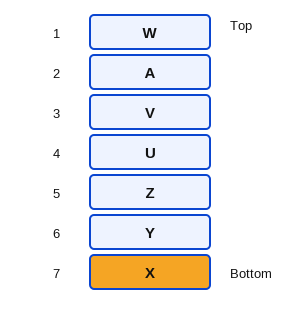
Seven boxes, A, U, V, W, X, Y and Z, are kept one over the other, but not necessarily in the same order.
Y is kept second from the bottom. Only two boxes are kept between Y and V. A is kept on one of the positions before V but on one of the positions after W. Only Z is kept between Y and U.
Which box is kept first from the bottom?
सात बक्से, A, U, V, W, X, Y और Z, एक के ऊपर एक रखे गए हैं, परंतु आवश्यक नहीं कि इसी क्रम में हों।
Y नीचे से दूसरे स्थान पर रखा है। Y और V के बीच केवल दो बक्से रखे हैं। A, V से पहले वाले स्थानों में से किसी एक पर परंतु W के बाद वाले स्थानों में से किसी एक पर रखा है। Y और U के बीच केवल Z रखा है।
नीचे से पहले स्थान पर कौन-सा बक्सा रखा है?
  1. AA
  2. BW
  3. CX
  4. DU
Show answer

Concept: Number positions 1 (top) to 7 (bottom); “before” = above, “after” = below.

  1. Y is 2nd from bottom → position 6. Two boxes between Y and V → V at 3.
  2. Only Z between Y and U → Z at 5, U at 4 (going upward; downward is impossible).
  3. A is above V but below W → W = 1, A = 2.
  4. Only X is left → X at 7, the bottom.

Trick: With 7 boxes, “second from bottom” = 6th from top; convert all clues to one direction.

Answer: (C) X

अवधारणा: स्थान 1 (ऊपर) से 7 (नीचे) क्रमांकित करें; “before” = ऊपर, “after” = नीचे।

  1. Y नीचे से 2रा → स्थान 6। Y और V के बीच दो बॉक्स → V स्थान 3 पर।
  2. Y और U के बीच केवल Z → Z = 5, U = 4 (ऊपर की ओर; नीचे संभव नहीं)।
  3. A, V के ऊपर पर W के नीचे → W = 1, A = 2।
  4. केवल X बचा → X स्थान 7 पर, सबसे नीचे।

ट्रिक: 7 बॉक्स में “नीचे से दूसरा” = ऊपर से 6ठा; सभी संकेत एक ही दिशा में बदलें।

उत्तर: (C) X

RRB NTPC Undergraduate CBT 1General Intelligence and ReasoningPuzzle – Box arrangementRRB NTPC Undergraduate CBT 1 2025 · 14 Jun Shift 3 →
Q13265.
Based on the alphabetical order, three of the following four are alike in a certain way and thus form a group. Which is the one that does not belong to that group?
(Note: The odd one out is not based on the number of consonants/vowels or their position in the letter cluster.)
वर्णमाला क्रम के आधार पर, निम्नलिखित चार में से तीन किसी निश्चित प्रकार से एकसमान हैं और इस प्रकार एक समूह बनाते हैं। कौन-सा विकल्प उस समूह से संबंधित नहीं है?
(ध्यान दें: असंगत विकल्प, अक्षर-समूह में व्यंजनों/स्वरों की संख्या या उनके स्थान पर आधारित नहीं है।)
  1. AOGY
  2. BQAI
  3. CKCU
  4. DPHZ
Show answer

Concept: Use place values and check the differences between consecutive letters in each cluster.

  1. OGY: O(15)→G(7) = −8, G(7)→Y(25) = +18.
  2. KCU: K(11)→C(3) = −8, C→U(21) = +18. PHZ: P(16)→H(8) = −8, H→Z(26) = +18.
  3. QAI: Q(17)→A(1) = −16, A→I(9) = +8 – different.

Trick: Pattern “−8, +18” in three clusters; QAI breaks it.

Answer: (B) QAI

अवधारणा: स्थान-मान लेकर प्रत्येक समूह में क्रमागत अक्षरों के अंतर जाँचें।

  1. OGY: O(15)→G(7) = −8, G(7)→Y(25) = +18।
  2. KCU: K(11)→C(3) = −8, C→U(21) = +18। PHZ: P(16)→H(8) = −8, H→Z(26) = +18।
  3. QAI: Q(17)→A(1) = −16, A→I(9) = +8 – अलग।

ट्रिक: तीन समूहों में पैटर्न “−8, +18”; QAI इसे तोड़ता है।

उत्तर: (B) QAI

RRB NTPC Undergraduate CBT 1General Intelligence and ReasoningLetter-cluster classificationRRB NTPC Undergraduate CBT 1 2025 · 14 Jun Shift 3 →
Q13266.
Each vowel in the word NOTFERN is changed to the letter immediately following it in the English alphabetical order, and each consonant is changed to the letter immediately preceding it in the English alphabetical order. How many letters will appear exactly twice in the new group of letters thus formed?
शब्द NOTFERN के प्रत्येक स्वर को अंग्रेज़ी वर्णमाला क्रम में उसके ठीक बाद वाले अक्षर से और प्रत्येक व्यंजन को अंग्रेज़ी वर्णमाला क्रम में उसके ठीक पहले वाले अक्षर से बदल दिया जाता है। इस प्रकार बने अक्षरों के नए समूह में कितने अक्षर ठीक दो बार आएँगे?
  1. ATwoदो
  2. BOneएक
  3. CThreeतीन
  4. DZeroशून्य
Show answer

Concept: Vowels move +1, consonants move −1 in the alphabet.

  1. N O T F E R N → N−1 = M, O+1 = P, T−1 = S, F−1 = E, E+1 = F, R−1 = Q, N−1 = M.
  2. New group: M P S E F Q M.
  3. Only M appears exactly twice → one letter.

Trick: The two N’s both become M; no other letter repeats.

Answer: (B) One

अवधारणा: स्वर +1, व्यंजन −1 खिसकते हैं।

  1. N O T F E R N → N−1 = M, O+1 = P, T−1 = S, F−1 = E, E+1 = F, R−1 = Q, N−1 = M।
  2. नया समूह: M P S E F Q M।
  3. केवल M ठीक दो बार → एक अक्षर।

ट्रिक: दोनों N, M बन जाते हैं; कोई और अक्षर नहीं दोहराता।

उत्तर: (B) One

RRB NTPC Undergraduate CBT 1General Intelligence and ReasoningLetter manipulationRRB NTPC Undergraduate CBT 1 2025 · 14 Jun Shift 3 →
Q13267.
In a certain code language, ‘LOTS’ is coded as ‘8439’ and ‘JOLS’ is coded as ‘4853’. What is the code for ‘J’ in the given code language?
एक निश्चित कूट भाषा में, ‘LOTS’ को ‘8439’ लिखा जाता है और ‘JOLS’ को ‘4853’ लिखा जाता है। दी गई कूट भाषा में ‘J’ का कूट क्या है?
  1. A4
  2. B3
  3. C5
  4. D8
Show answer

Concept: Letters common to both words get the common digits; the leftover letter gets the leftover digit.

  1. LOTS → 8 4 3 9; JOLS → 4 8 5 3.
  2. Common letters O, L, S ↔ common digits {8, 4, 3}.
  3. Leftover in JOLS is J ↔ leftover digit 5.

Trick: Digits need not be in letter order – just compare the sets.

Answer: (C) 5

अवधारणा: दोनों शब्दों के उभयनिष्ठ अक्षरों को उभयनिष्ठ अंक मिलते हैं; बचे अक्षर को बचा अंक।

  1. LOTS → 8 4 3 9; JOLS → 4 8 5 3।
  2. उभयनिष्ठ अक्षर O, L, S ↔ उभयनिष्ठ अंक {8, 4, 3}।
  3. JOLS में बचा J ↔ बचा अंक 5।

ट्रिक: अंक अक्षर-क्रम में होना ज़रूरी नहीं – बस सेट मिलाएँ।

उत्तर: (C) 5

RRB NTPC Undergraduate CBT 1General Intelligence and ReasoningCoding–decoding (letters to digits)RRB NTPC Undergraduate CBT 1 2025 · 14 Jun Shift 3 →
Q13268.
Based on the English alphabetical order, three of the following four letter-cluster pairs are alike in a certain way and thus form a group. Which is the one that does not belong to that group? (Note: The odd one out is not based on the number of
consonants/vowels or their position in the letter cluster.)
अंग्रेज़ी वर्णमाला क्रम के आधार पर, निम्नलिखित चार अक्षर-समूह युग्मों में से तीन किसी निश्चित प्रकार से एकसमान हैं और इस प्रकार एक समूह बनाते हैं। कौन-सा युग्म उस समूह से संबंधित नहीं है? (ध्यान दें: असंगत युग्म, अक्षर-समूह में
व्यंजनों/स्वरों की संख्या या उनके स्थान पर आधारित नहीं है।)
  1. AUS−OP
  2. BTR−OM
  3. CPN−KI
  4. DXV−SQ
Show answer

Concept: Compare the shift of each letter from the first cluster to the second.

  1. TR − OM: T→O = −5, R→M = −5.
  2. PN − KI: −5, −5. XV − SQ: −5, −5.
  3. US − OP: U→O = −6, S→P = −3 – odd one.

Trick: Three pairs have a uniform −5 shift; check the first option last if it looks different.

Answer: (A) US−OP

अवधारणा: पहले समूह से दूसरे तक प्रत्येक अक्षर के खिसकाव की तुलना करें।

  1. TR − OM: T→O = −5, R→M = −5।
  2. PN − KI: −5, −5। XV − SQ: −5, −5।
  3. US − OP: U→O = −6, S→P = −3 – विषम।

ट्रिक: तीन जोड़ों में समान −5 खिसकाव; US−OP अलग है।

उत्तर: (A) US−OP

RRB NTPC Undergraduate CBT 1General Intelligence and ReasoningLetter-cluster classificationRRB NTPC Undergraduate CBT 1 2025 · 14 Jun Shift 3 →
Q13269.
LOSM is related to QTXR in a certain way based on the English alphabetical order. In the same way, ILPJ is related to NQUO. To which of the following is FIMG related, following the same logic?
अंग्रेज़ी वर्णमाला क्रम के आधार पर LOSM एक निश्चित प्रकार से QTXR से संबंधित है। उसी प्रकार, ILPJ, NQUO से संबंधित है। समान तर्क का अनुसरण करते हुए, FIMG निम्नलिखित में से किससे संबंधित है?
  1. ANKLR
  2. BNKRL
  3. CKNRL
  4. DKNLR
Show answer

Concept: Find the letter-wise shift in the given pair and apply it to the new cluster.

  1. LOSM → QTXR: L+5 = Q, O+5 = T, S+5 = X, M+5 = R.
  2. ILPJ → NQUO: each letter +5 (confirms rule).
  3. FIMG: F+5 = K, I+5 = N, M+5 = R, G+5 = L → KNRL.

Trick: Uniform +5; options with the same letters in a different order (KNLR, NKRL) are traps.

Answer: (C) KNRL

अवधारणा: दिए जोड़े में अक्षर-वार खिसकाव खोजें और नए समूह पर लागू करें।

  1. LOSM → QTXR: L+5 = Q, O+5 = T, S+5 = X, M+5 = R।
  2. ILPJ → NQUO: हर अक्षर +5 (नियम की पुष्टि)।
  3. FIMG: F+5 = K, I+5 = N, M+5 = R, G+5 = L → KNRL।

ट्रिक: समान +5; वही अक्षर अलग क्रम में (KNLR, NKRL) जाल हैं।

उत्तर: (C) KNRL

RRB NTPC Undergraduate CBT 1General Intelligence and ReasoningLetter-cluster analogyRRB NTPC Undergraduate CBT 1 2025 · 14 Jun Shift 3 →
Q13270.
In a certain code language,
J + Q means ‘J is the mother of Q’,
J – Q means ‘J is the brother of Q’,
J x Q means ‘J is the husband of Q’ and
J ÷ Q means ‘J is the sister of Q’.
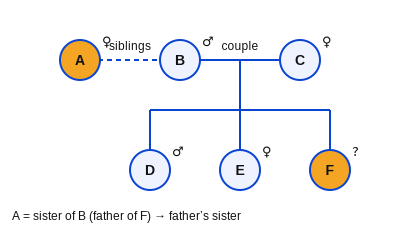
Based on the above, how is A related to F if ‘A ÷ B x C + D – E ÷ F’?
एक निश्चित कूट भाषा में,
J + Q का अर्थ है ‘J, Q की माँ है’,
J – Q का अर्थ है ‘J, Q का भाई है’,
J x Q का अर्थ है ‘J, Q का पति है’ और
J ÷ Q का अर्थ है ‘J, Q की बहन है’।
उपरोक्त के आधार पर, यदि ‘A ÷ B x C + D – E ÷ F’ है, तो A का F से क्या संबंध है?
  1. AFather's sisterपिता की बहन
  2. BSisterबहन
  3. CMotherमाँ
  4. DMother's sisterमाँ की बहन
Show answer

Concept: Decode left to right and draw the family tree.

  1. A ÷ B: A is sister of B. B × C: B is husband of C.
  2. C + D: C is mother of D; so B and C are parents of D.
  3. D – E: D is brother of E; E ÷ F: E is sister of F → D, E, F are siblings, children of B and C.
  4. A is the sister of B, F’s father → A is F’s father’s sister.

Trick: Siblings share parents – once B is D’s father, he is F’s father too.

Answer: (A) Father’s sister

अवधारणा: बाएँ से दाएँ डिकोड करें और वंश-वृक्ष बनाएँ।

  1. A ÷ B: A, B की बहन। B × C: B, C का पति।
  2. C + D: C, D की माँ; अतः B और C, D के माता-पिता।
  3. D – E: D, E का भाई; E ÷ F: E, F की बहन → D, E, F भाई-बहन, B व C की संतानें।
  4. A, F के पिता B की बहन → A, F की बुआ (father’s sister)।

ट्रिक: भाई-बहनों के माता-पिता एक ही होते हैं – B, D का पिता है तो F का भी।

उत्तर: (A) Father’s sister

RRB NTPC Undergraduate CBT 1General Intelligence and ReasoningBlood relations (coded)RRB NTPC Undergraduate CBT 1 2025 · 14 Jun Shift 3 →
Q13271.
What will come in place of ‘?’ in the following equation, if ‘+’ and ‘-‘ are interchanged and ‘x’ and ‘÷’ are interchanged?
12 ÷ 4 + 9 x 3 - 8 = ?
यदि ‘+’ और ‘-‘ को आपस में बदल दिया जाए तथा ‘x’ और ‘÷’ को आपस में बदल दिया जाए, तो निम्नलिखित समीकरण में ‘?’ के स्थान पर क्या आएगा?
12 ÷ 4 + 9 x 3 - 8 = ?
  1. A53
  2. B39
  3. C44
  4. D35
Show answer

Concept: Swap the signs as instructed, then apply BODMAS.

  1. Given: 12÷4+9×3−8. After swapping (+ ↔ −, × ↔ ÷): 12×4−9÷3+8.
  2. Division first: 9÷3=3; multiplication: 12×4=48.
  3. 48−3+8=53.

Trick: Rewrite the whole expression with new signs before calculating – avoids mixing old and new.

Answer: (A) 53

अवधारणा: निर्देशानुसार चिह्न बदलें, फिर BODMAS लगाएँ।

  1. दिया: 12÷4+9×3−8। बदलने पर (+ ↔ −, × ↔ ÷): 12×4−9÷3+8।
  2. पहले भाग: 9÷3=3; गुणा: 12×4=48।
  3. 48−3+8=53।

ट्रिक: गणना से पहले पूरा व्यंजक नए चिह्नों से लिख लें – पुराने-नए चिह्न मिलने की गलती नहीं होगी।

उत्तर: (A) 53

RRB NTPC Undergraduate CBT 1General Intelligence and ReasoningMathematical operations (interchange)RRB NTPC Undergraduate CBT 1 2025 · 14 Jun Shift 3 →
Q13272.
In a certain code language,
A x B means ‘A is the mother of B’,
A ≠ B means ‘A is the wife of B’,
A ÷ B means ‘A is the daughter of B’ and
A ₹ B means ‘A is the father of B’.
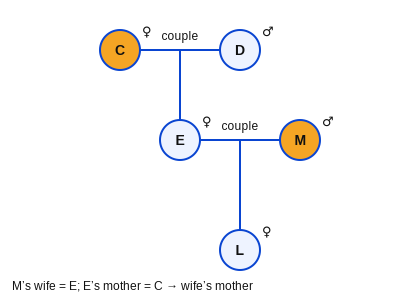
Based on the above, how is C related to M if 'C ≠ D ₹ E x L ÷ M'?
एक निश्चित कूट भाषा में,
A x B का अर्थ है ‘A, B की माँ है’,
A ≠ B का अर्थ है ‘A, B की पत्नी है’,
A ÷ B का अर्थ है ‘A, B की बेटी है’ और
A ₹ B का अर्थ है ‘A, B का पिता है’।
उपरोक्त के आधार पर, यदि 'C ≠ D ₹ E x L ÷ M' है, तो C का M से क्या संबंध है?
  1. ABrother's wifeभाई की पत्नी
  2. BHusband's motherपति की माँ
  3. CWife's motherपत्नी की माँ
  4. DWife's brother's wifeपत्नी के भाई की पत्नी
Show answer

Concept: Decode each symbol and build the tree generation by generation.

  1. C ≠ D: C is wife of D. D ₹ E: D is father of E → C is E’s mother.
  2. E × L: E is mother of L. L ÷ M: L is daughter of M → M is L’s father, i.e. E’s husband.
  3. C is the mother of E, and E is M’s wife → C is M’s wife’s mother.

Trick: Mother of L + father of L = couple; then C (E’s mother) is M’s mother-in-law.

Answer: (C) Wife’s mother

अवधारणा: हर प्रतीक डिकोड कर पीढ़ी-दर-पीढ़ी वृक्ष बनाएँ।

  1. C ≠ D: C, D की पत्नी। D ₹ E: D, E का पिता → C, E की माँ।
  2. E × L: E, L की माँ। L ÷ M: L, M की बेटी → M, L का पिता, अर्थात E का पति।
  3. C, E की माँ है और E, M की पत्नी → C, M की पत्नी की माँ (सास)।

ट्रिक: L की माँ + L का पिता = दंपति; फिर C (E की माँ) M की सास।

उत्तर: (C) Wife’s mother

RRB NTPC Undergraduate CBT 1General Intelligence and ReasoningBlood relations (coded)RRB NTPC Undergraduate CBT 1 2025 · 14 Jun Shift 3 →
Q13273.
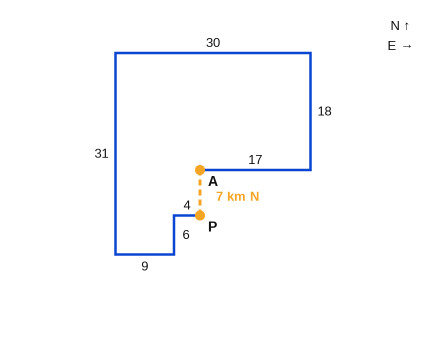
Mr. Yorly starts from Point A and drives 17 km towards East. He then takes a left turn, drives 18 km, turns left and drives 30 km. He then takes a left turn and drives 31 km. He then takes a left turn, drives 9 km, turns left and drives 6 km. He takes a final right turn, drives 4 km and stops at Point P. How far (shortest distance) and towards which direction should he drive in order to reach Point A again? (All turns are 90 degrees turns only unless specified.)
श्री Yorly बिंदु A से आरंभ करते हैं और पूर्व की ओर 17 km गाड़ी चलाते हैं। फिर वे बाएँ मुड़ते हैं, 18 km गाड़ी चलाते हैं, बाएँ मुड़ते हैं और 30 km गाड़ी चलाते हैं। फिर वे बाएँ मुड़ते हैं और 31 km गाड़ी चलाते हैं। फिर वे बाएँ मुड़ते हैं, 9 km गाड़ी चलाते हैं, बाएँ मुड़ते हैं और 6 km गाड़ी चलाते हैं। अंत में वे दाएँ मुड़ते हैं, 4 km गाड़ी चलाते हैं और बिंदु P पर रुक जाते हैं। बिंदु A पर पुनः पहुँचने के लिए उन्हें कितनी दूरी (न्यूनतम दूरी) तक और किस दिशा में गाड़ी चलानी चाहिए? (जब तक निर्दिष्ट न हो, सभी मोड़ केवल 90 डिग्री के मोड़ हैं।)
  1. A5 km to the Westपश्चिम की ओर 5 km
  2. B9 km to the Eastपूर्व की ओर 9 km
  3. C8 km to the Northउत्तर की ओर 8 km
  4. D7 km to the Northउत्तर की ओर 7 km
Show answer

Concept: Use coordinates: East = +x, North = +y; left turn rotates E→N→W→S→E.

  1. A (0, 0) → East 17 → (17, 0) → left (North) 18 → (17, 18) → left (West) 30 → (−13, 18).
  2. Left (South) 31 → (−13, −13) → left (East) 9 → (−4, −13) → left (North) 6 → (−4, −7).
  3. Right turn → East 4 → P (0, −7).
  4. P is 7 km directly south of A → he must drive 7 km North.

Trick: Net East–West: 17−30+9+4=0; net North–South: 18−31+6=−7 → 7 km due north.

Answer: (D) 7 km to the North

अवधारणा: निर्देशांक लें: पूर्व = +x, उत्तर = +y; बायाँ मोड़ E→N→W→S→E घुमाता है।

  1. A (0, 0) → पूर्व 17 → (17, 0) → बाएँ (उत्तर) 18 → (17, 18) → बाएँ (पश्चिम) 30 → (−13, 18)।
  2. बाएँ (दक्षिण) 31 → (−13, −13) → बाएँ (पूर्व) 9 → (−4, −13) → बाएँ (उत्तर) 6 → (−4, −7)।
  3. दायाँ मोड़ → पूर्व 4 → P (0, −7)।
  4. P, A से ठीक 7 km दक्षिण में → उसे 7 km उत्तर चलना होगा।

ट्रिक: शुद्ध पूर्व–पश्चिम: 17−30+9+4=0; शुद्ध उत्तर–दक्षिण: 18−31+6=−7 → 7 km ठीक उत्तर।

उत्तर: (D) 7 km to the North

RRB NTPC Undergraduate CBT 1General Intelligence and ReasoningDirection & distanceRRB NTPC Undergraduate CBT 1 2025 · 14 Jun Shift 3 →
Q13274.
Read the given statements and conclusions carefully. Assuming that the information given in the statements is true, even if it appears to be at variance with commonly known facts, decide which of the given conclusions logically follow(s) from the statements.
Statement: All Eagles are Seagulls. Some Seagulls are Peacocks.
Conclusion (I): Some Eagles are Peacocks.
Conclusion (II): No Peacocks are Eagles.
दिए गए कथन और निष्कर्षों को ध्यानपूर्वक पढ़िए। यह मानते हुए कि कथन में दी गई जानकारी सत्य है, भले ही वह सामान्यतः ज्ञात तथ्यों से भिन्न प्रतीत होती हो, निर्णय लीजिए कि दिए गए निष्कर्षों में से कौन-सा/कौन-से निष्कर्ष तार्किक रूप से कथन का अनुसरण करता है/करते हैं।
कथन: सभी चीलें, समुद्री बगुले हैं। कुछ समुद्री बगुले, मोर हैं।
निष्कर्ष (I): कुछ चीलें, मोर हैं।
निष्कर्ष (II): कोई मोर, चील नहीं है।
  1. AOnly conclusion (I) followsकेवल निष्कर्ष (I) अनुसरण करता है
  2. BBoth conclusions (I) and (II) followनिष्कर्ष (I) और (II) दोनों अनुसरण करते हैं
  3. COnly conclusion (II) followsकेवल निष्कर्ष (II) अनुसरण करता है
  4. DNeither conclusion (I) nor (II) followsन तो निष्कर्ष (I) और न ही (II) अनुसरण करता है
Show answer

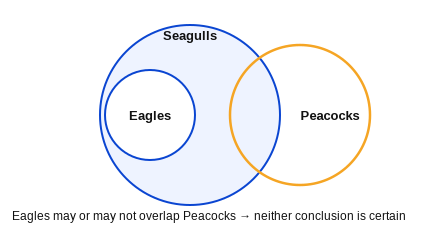
Concept: Draw the Venn diagram; a conclusion follows only if it is true in every possible diagram.

  1. All Eagles are Seagulls → Eagles circle inside Seagulls. Some Seagulls are Peacocks → Peacocks overlaps Seagulls somewhere.
  2. The overlap may or may not include Eagles → “Some Eagles are Peacocks” is not certain (I ✗).
  3. Equally, “No Peacocks are Eagles” is not certain (II ✗).

Trick: All + Some (through the middle term) → no definite conclusion between the end terms.

Answer: (D) Neither conclusion (I) nor (II) follows

अवधारणा: वेन आरेख बनाएँ; निष्कर्ष तभी निकलता है जब वह हर संभव आरेख में सत्य हो।

  1. All Eagles are Seagulls → Eagles का वृत्त Seagulls के अंदर। Some Seagulls are Peacocks → Peacocks कहीं Seagulls से ओवरलैप।
  2. यह ओवरलैप Eagles को छू भी सकता है, नहीं भी → “Some Eagles are Peacocks” निश्चित नहीं (I ✗)।
  3. इसी तरह “No Peacocks are Eagles” भी निश्चित नहीं (II ✗)।

ट्रिक: All + Some (मध्य पद से) → अंतिम पदों के बीच कोई निश्चित निष्कर्ष नहीं।

उत्तर: (D) Neither conclusion (I) nor (II) follows

RRB NTPC Undergraduate CBT 1General Intelligence and ReasoningSyllogismRRB NTPC Undergraduate CBT 1 2025 · 14 Jun Shift 3 →
Q13275.
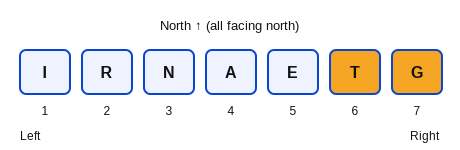
Seven people, T, E, A, R, I, N and G, are sitting in a row, facing north. Only two people sit to the left of N. Only three people sit between N and G. Only one person sits between G and E. I sits to the immediate left of R. A is not an immediate neighbor of G. How many people sit to the right of T?
सात व्यक्ति, T, E, A, R, I, N और G, एक पंक्ति में उत्तर की ओर मुख करके बैठे हैं। N के बाईं ओर केवल दो व्यक्ति बैठे हैं। N और G के बीच केवल तीन व्यक्ति बैठे हैं। G और E के बीच केवल एक व्यक्ति बैठा है। I, R के ठीक बाईं ओर बैठा है। A, G का निकटतम पड़ोसी नहीं है। T के दाईं ओर कितने व्यक्ति बैठे हैं?
  1. ATwoदो
  2. BFourचार
  3. COneएक
  4. DThreeतीन
Show answer

Concept: Facing north, left and right are the same as ours. Number seats 1–7 from the left.

  1. Two people to the left of N → N at 3. Three between N and G → G at 7.
  2. One between G and E → E at 5.
  3. I immediately left of R: free seats 1, 2, 4, 6 → only (1, 2) are adjacent → I = 1, R = 2.
  4. A is not next to G → A ≠ 6 → A = 4, T = 6.
  5. To the right of T (seat 6) there is only G → one person.

Trick: “Only two to the left of N” fixes N at seat 3 instantly – start there.

Answer: (C) One

अवधारणा: उत्तर की ओर मुख होने पर बायाँ-दायाँ हमारे जैसा ही। बाएँ से सीट 1–7 क्रमांकित करें।

  1. N के बाएँ दो लोग → N सीट 3 पर। N व G के बीच तीन → G सीट 7 पर।
  2. G व E के बीच एक → E सीट 5 पर।
  3. I, R के ठीक बाएँ: खाली सीटें 1, 2, 4, 6 → केवल (1, 2) सटी हैं → I = 1, R = 2।
  4. A, G का पड़ोसी नहीं → A ≠ 6 → A = 4, T = 6।
  5. T (सीट 6) के दाएँ केवल G → एक व्यक्ति।

ट्रिक: “N के बाएँ केवल दो” N को तुरंत सीट 3 पर तय करता है – वहीं से शुरू करें।

उत्तर: (C) One

RRB NTPC Undergraduate CBT 1General Intelligence and ReasoningLinear seating arrangementRRB NTPC Undergraduate CBT 1 2025 · 14 Jun Shift 3 →
Q13276.
KL 9 is related to IH −2 in a certain way. In the same way, PG 7 is related to NC −4. To which of the following is JQ 14 related, following the same logic?
KL 9 एक निश्चित प्रकार से IH −2 से संबंधित है। उसी प्रकार, PG 7, NC −4 से संबंधित है। समान तर्क का अनुसरण करते हुए, JQ 14 निम्नलिखित में से किससे संबंधित है?
  1. AHN 6
  2. BIM 3
  3. CIN 6
  4. DHM 3
Show answer

Concept: Apply the same operation to each letter and to the number.

  1. KL 9 → IH −2: K−2 = I, L−4 = H, 9−11=−2.
  2. PG 7 → NC −4: P−2 = N, G−4 = C, 7−11=−4 – rule confirmed.
  3. JQ 14: J−2 = H, Q−4 = M, 14−11=3 → HM 3.

Trick: First letter −2, second letter −4, number −11; eliminate options whose letters are wrong first.

Answer: (D) HM 3

अवधारणा: प्रत्येक अक्षर और संख्या पर वही संक्रिया लागू करें।

  1. KL 9 → IH −2: K−2 = I, L−4 = H, 9−11=−2।
  2. PG 7 → NC −4: P−2 = N, G−4 = C, 7−11=−4 – नियम पुष्ट।
  3. JQ 14: J−2 = H, Q−4 = M, 14−11=3 → HM 3।

ट्रिक: पहला अक्षर −2, दूसरा −4, संख्या −11; पहले गलत अक्षरों वाले विकल्प हटाएँ।

उत्तर: (D) HM 3

RRB NTPC Undergraduate CBT 1General Intelligence and ReasoningLetter–number analogyRRB NTPC Undergraduate CBT 1 2025 · 14 Jun Shift 3 →
Q13277.
What should come in place of ‘?’ in the given series?
135 150 180 225 285 ?
दी गई श्रृंखला में ‘?’ के स्थान पर क्या आना चाहिए?
135 150 180 225 285 ?
  1. A360
  2. B340
  3. C350
  4. D330
Show answer

Concept: Look at the differences between consecutive terms.

  1. 150−135=15,180−150=30,225−180=45,285−225=60.
  2. Differences are multiples of 15: 15, 30, 45, 60 → next 75.
  3. 285+75=360.

Trick: All terms are multiples of 15: 9,10,12,15,19,24×15 (gaps 1, 2, 3, 4, 5) → 24×15=360.

Answer: (A) 360

अवधारणा: क्रमागत पदों के अंतर देखें।

  1. 150−135=15,180−150=30,225−180=45,285−225=60।
  2. अंतर 15 के गुणज: 15, 30, 45, 60 → अगला 75।
  3. 285+75=360।

ट्रिक: सभी पद 15 के गुणज: 9,10,12,15,19,24×15 (अंतर 1, 2, 3, 4, 5) → 24×15=360।

उत्तर: (A) 360

RRB NTPC Undergraduate CBT 1General Intelligence and ReasoningNumber seriesRRB NTPC Undergraduate CBT 1 2025 · 14 Jun Shift 3 →
Q13278.
If ‘A’ stands for ‘÷’, ‘B’ stands for ‘×’, ‘C’ stands for ‘+’ and ‘D’ stands for ‘−’, then what will come in place of the question mark (?) in the following equation?
3 A 42 B 14 C 29 D 22 = ?
यदि ‘A’ का अर्थ ‘÷’, ‘B’ का अर्थ ‘×’, ‘C’ का अर्थ ‘+’ और ‘D’ का अर्थ ‘−’ है, तो निम्नलिखित समीकरण में प्रश्न चिह्न (?) के स्थान पर क्या आएगा?
3 A 42 B 14 C 29 D 22 = ?
  1. A11
  2. B10
  3. C8
  4. D9
Show answer

Concept: Replace the letters by their operators and apply BODMAS.

  1. 3 A 42 B 14 C 29 D 22 → 3÷42×14+29−22.
  2. 3÷42=114; 114×14=1.
  3. 1+29−22=8.

Trick: ÷ then × left to right: 3×1442=1 in one step.

Answer: (C) 8

अवधारणा: अक्षरों की जगह संक्रिया चिह्न रखें और BODMAS लगाएँ।

  1. 3 A 42 B 14 C 29 D 22 → 3÷42×14+29−22।
  2. 3÷42=114; 114×14=1।
  3. 1+29−22=8।

ट्रिक: ÷ फिर × बाएँ से दाएँ: 3×1442=1 एक ही कदम में।

उत्तर: (C) 8

RRB NTPC Undergraduate CBT 1General Intelligence and ReasoningMathematical operations (symbol substitution)RRB NTPC Undergraduate CBT 1 2025 · 14 Jun Shift 3 →
Q13279.
Read the given statement(s) and conclusions carefully. Assuming that the information given in the statements is true, even if it appears to be at variance with commonly known facts, decide which of the given conclusions logically follow(s) from the statement(s).
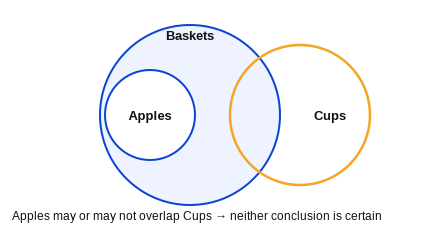
Statements: All apples are baskets. Some baskets are cups.
Conclusions:
(I) Some apples are cups.
(II) All cups are apples.
दिए गए कथन/कथनों और निष्कर्षों को ध्यानपूर्वक पढ़िए। यह मानते हुए कि कथनों में दी गई जानकारी सत्य है, भले ही वह सामान्यतः ज्ञात तथ्यों से भिन्न प्रतीत होती हो, निर्णय लीजिए कि दिए गए निष्कर्षों में से कौन-सा/कौन-से निष्कर्ष तार्किक रूप से कथन/कथनों का अनुसरण करता है/करते हैं।
कथन: सभी सेब, टोकरियाँ हैं। कुछ टोकरियाँ, कप हैं।
निष्कर्ष:
(I) कुछ सेब, कप हैं।
(II) सभी कप, सेब हैं।
  1. ANeither conclusion (I) nor (II) followsन तो निष्कर्ष (I) और न ही (II) अनुसरण करता है
  2. BOnly conclusion (II) followsकेवल निष्कर्ष (II) अनुसरण करता है
  3. COnly conclusion (I) followsकेवल निष्कर्ष (I) अनुसरण करता है
  4. DBoth conclusions (I) and (II) followनिष्कर्ष (I) और (II) दोनों अनुसरण करते हैं
Show answer

Concept: A conclusion follows only if it holds in every Venn diagram consistent with the statements.

  1. All apples are baskets → Apples inside Baskets. Some baskets are cups → Cups overlaps Baskets.
  2. The Cups overlap need not reach Apples → “Some apples are cups” is only possible, not definite (I ✗).
  3. “All cups are apples” is certainly not forced – cups may lie outside apples (II ✗).

Trick: “All A are B” + “Some B are C” never gives a definite A–C conclusion.

Answer: (A) Neither conclusion (I) nor (II) follows

अवधारणा: निष्कर्ष तभी निकलता है जब वह कथनों के अनुरूप हर वेन आरेख में सत्य हो।

  1. All apples are baskets → Apples, Baskets के अंदर। Some baskets are cups → Cups, Baskets से ओवरलैप।
  2. Cups का ओवरलैप Apples तक पहुँचे यह ज़रूरी नहीं → “Some apples are cups” केवल संभव, निश्चित नहीं (I ✗)।
  3. “All cups are apples” भी बाध्य नहीं – cups apples के बाहर हो सकते हैं (II ✗)।

ट्रिक: “All A are B” + “Some B are C” से A–C का कोई निश्चित निष्कर्ष कभी नहीं निकलता।

उत्तर: (A) Neither conclusion (I) nor (II) follows

RRB NTPC Undergraduate CBT 1General Intelligence and ReasoningSyllogismRRB NTPC Undergraduate CBT 1 2025 · 14 Jun Shift 3 →
Q13280.
What should come in place of the question mark (?) in the given series based on the English alphabetical order?
TUW XYA BCE FGI ?
अंग्रेज़ी वर्णमाला क्रम के आधार पर दी गई श्रृंखला में प्रश्न चिह्न (?) के स्थान पर क्या आना चाहिए?
TUW XYA BCE FGI ?
  1. AKJL
  2. BJKM
  3. CJLM
  4. DJMK
Show answer

Concept: Track each position separately; here every letter moves +4.

  1. 1st letters: T → X → B → F → ? : +4 → J.
  2. 2nd letters: U → Y → C → G → ? : +4 → K.
  3. 3rd letters: W → A → E → I → ? : +4 → M.

Trick: Within each cluster the pattern is (n, n+1, n+3) – JKM fits; JLM, JMK, KJL do not.

Answer: (B) JKM

अवधारणा: हर स्थिति अलग ट्रैक करें; यहाँ हर अक्षर +4 बढ़ता है।

  1. पहले अक्षर: T → X → B → F → ? : +4 → J।
  2. दूसरे अक्षर: U → Y → C → G → ? : +4 → K।
  3. तीसरे अक्षर: W → A → E → I → ? : +4 → M।

ट्रिक: हर समूह के भीतर पैटर्न (n, n+1, n+3) – JKM फिट; JLM, JMK, KJL नहीं।

उत्तर: (B) JKM

RRB NTPC Undergraduate CBT 1General Intelligence and ReasoningLetter-cluster seriesRRB NTPC Undergraduate CBT 1 2025 · 14 Jun Shift 3 →