Question bank

Q&A: practice questions with answers

Search questions on any topic. Filter by exam category, exam, subject and topic, try the question, then open the answer and explanation.

Courses – airGurukul

20,719 questions found.

Q13321.
Where did the Prime Minister of India chair the 7th National Board for Wildlife meeting in March 2025?
मार्च 2025 में भारत के प्रधानमंत्री ने राष्ट्रीय वन्यजीव बोर्ड की 7वीं बैठक की अध्यक्षता कहाँ की?
  1. APench National Parkपेंच राष्ट्रीय उद्यान
  2. BGir National Parkगिर राष्ट्रीय उद्यान
  3. CSatpura Tiger Reserveसतपुड़ा टाइगर रिज़र्व
  4. DSariska Tiger Reserveसरिस्का टाइगर रिज़र्व
Show answer

Concept: The 7th meeting of the National Board for Wildlife (NBWL), chaired by PM Narendra Modi, was held on 3 March 2025 (World Wildlife Day) at Gir National Park, Junagadh, Gujarat.

  1. At Gir the PM also announced a new National Referral Centre for Wildlife (Junagadh) and extension of Project Cheetah to Gandhi Sagar (MP) and Banni (Gujarat).
  2. Gir is the only natural home of the Asiatic lion – the previous (6th) NBWL meeting was at Pench in 2012.

Yaad rakhein: 2025 NBWL meet = Gir (lions), announced on World Wildlife Day, 3 March.

Answer: (B) Gir National Park

अवधारणा: प्रधानमंत्री नरेंद्र मोदी की अध्यक्षता में राष्ट्रीय वन्यजीव बोर्ड (NBWL) की 7वीं बैठक 3 मार्च 2025 (विश्व वन्यजीव दिवस) को गिर राष्ट्रीय उद्यान, जूनागढ़, गुजरात में हुई।

  1. गिर में PM ने जूनागढ़ में नए राष्ट्रीय वन्यजीव रेफ़रल केंद्र और प्रोजेक्ट चीता के गांधी सागर (MP) व बन्नी (गुजरात) तक विस्तार की घोषणा भी की।
  2. गिर एशियाई शेर का एकमात्र प्राकृतिक आवास है – पिछली (6वीं) NBWL बैठक 2012 में पेंच में हुई थी।

याद रखें: 2025 NBWL बैठक = गिर (शेर), विश्व वन्यजीव दिवस 3 मार्च को।

उत्तर: (B) Gir National Park (गिर राष्ट्रीय उद्यान)
RRB NTPC Undergraduate CBT 1General AwarenessCurrent affairs – EnvironmentRRB NTPC Undergraduate CBT 1 2025 · 14 Jun Shift 2 →
Q13322.
Who commissioned the Konark Sun Temple?
कोणार्क सूर्य मंदिर का निर्माण किसने करवाया था?
  1. AChandragupta IIचंद्रगुप्त द्वितीय
  2. BAshokaअशोक
  3. CNarasimhadeva Iनरसिंहदेव प्रथम
  4. DHarshavardhanaहर्षवर्धन
Show answer

Concept: The Konark Sun Temple (Odisha), a UNESCO World Heritage Site, was built around 1250 CE by King Narasimhadeva I of the Eastern Ganga dynasty.

  1. It is designed as a giant chariot of the Sun god with 24 carved wheels and seven horses; Europeans called it the "Black Pagoda".
  2. Chandragupta II and Harshavardhana are ancient rulers unrelated to Konark; Ashoka is linked to Kalinga war and stupas.

Yaad rakhein: Konark = Narasimhadeva I (Ganga dynasty); Lingaraj temple (Bhubaneswar) = Somavamshi kings.

Answer: (C) Narasimhadeva I

अवधारणा: कोणार्क सूर्य मंदिर (ओडिशा), एक UNESCO विश्व धरोहर स्थल, लगभग 1250 ई. में पूर्वी गंग वंश के राजा नरसिंहदेव प्रथम ने बनवाया।

  1. यह सूर्य देव के विशाल रथ के रूप में बना है जिसमें 24 नक्काशीदार पहिए और सात घोड़े हैं; यूरोपीय इसे "ब्लैक पैगोडा" कहते थे।
  2. चंद्रगुप्त द्वितीय और हर्षवर्धन प्राचीन शासक हैं, कोणार्क से असंबंधित; अशोक कलिंग युद्ध और स्तूपों से जुड़े हैं।

याद रखें: कोणार्क = नरसिंहदेव प्रथम (गंग वंश); लिंगराज मंदिर (भुवनेश्वर) = सोमवंशी राजा।

उत्तर: (C) Narasimhadeva I (नरसिंहदेव प्रथम)

RRB NTPC Undergraduate CBT 1General AwarenessMedieval history – TemplesRRB NTPC Undergraduate CBT 1 2025 · 14 Jun Shift 2 →
Q13323.
The First War of Independence (1857) began at which place?
प्रथम स्वतंत्रता संग्राम (1857) किस स्थान से आरंभ हुआ था?
  1. ADelhiदिल्ली
  2. BMeerutमेरठ
  3. CKanpurकानपुर
  4. DLucknowलखनऊ
Show answer

Concept: The Revolt of 1857 began at Meerut on 10 May 1857 when sepoys of the Bengal Army mutinied over the greased cartridges, then marched to Delhi and proclaimed Bahadur Shah Zafar as emperor.

  1. Mangal Pandey had fired at officers in Barrackpore on 29 March 1857, but the organised outbreak started at Meerut.
  2. Delhi was the centre the rebels captured next; Kanpur (Nana Saheb) and Lucknow (Begum Hazrat Mahal) rose later.

Yaad rakhein: "10 May, Meerut" – start; Barrackpore = Mangal Pandey (spark), Delhi = capital of revolt.

Answer: (B) Meerut

अवधारणा: 1857 का विद्रोह 10 मई 1857 को मेरठ से शुरू हुआ जब बंगाल सेना के सिपाहियों ने चर्बी वाले कारतूसों के विरोध में विद्रोह किया, फिर दिल्ली जाकर बहादुर शाह ज़फ़र को सम्राट घोषित किया।

  1. मंगल पांडे ने 29 मार्च 1857 को बैरकपुर में अधिकारियों पर गोली चलाई थी, पर संगठित विद्रोह मेरठ से शुरू हुआ।
  2. दिल्ली वह केंद्र था जिसे विद्रोहियों ने अगले दिन जीता; कानपुर (नाना साहेब) और लखनऊ (बेगम हज़रत महल) बाद में उठे।

याद रखें: "10 मई, मेरठ" – शुरुआत; बैरकपुर = मंगल पांडे (चिंगारी), दिल्ली = विद्रोह की राजधानी।

उत्तर: (B) Meerut (मेरठ)

RRB NTPC Undergraduate CBT 1General AwarenessModern history – Revolt of 1857RRB NTPC Undergraduate CBT 1 2025 · 14 Jun Shift 2 →
Q13324.
Which of the following is the most important port-based industrial region in India?
निम्नलिखित में से कौन-सा भारत का सबसे महत्वपूर्ण बंदरगाह-आधारित औद्योगिक क्षेत्र है?
  1. AChotanagpur plateau regionछोटानागपुर पठार क्षेत्र
  2. BAhmedabad–Vadodara regionअहमदाबाद–वडोदरा क्षेत्र
  3. CHooghly industrial beltहुगली औद्योगिक पेटी
  4. DHyderabad–Bengaluru corridorहैदराबाद–बेंगलुरु गलियारा
Show answer

Concept: The Hooghly industrial belt (West Bengal), stretching from Bansberia to Birlanagar along the Hooghly river, grew around the port of Kolkata and is India's most important port-based industrial region (jute, engineering, chemicals).

  1. Kolkata port + Hooghly navigation + coal from Raniganj and jute from the delta made this belt flourish from the 19th century.
  2. Chotanagpur is mineral-based (iron and steel); Ahmedabad–Vadodara is textile/petrochemical and inland; Hyderabad–Bengaluru is a modern IT/electronics corridor.

Yaad rakhein: Hooghly = "port + jute"; Chotanagpur = "coal + iron"; Mumbai–Pune = cotton textiles.

Answer: (C) Hooghly industrial belt

अवधारणा: हुगली औद्योगिक पट्टी (पश्चिम बंगाल), हुगली नदी के किनारे बांसबेड़िया से बिड़लानगर तक, कोलकाता बंदरगाह के चारों ओर विकसित हुई और भारत का सबसे महत्वपूर्ण बंदरगाह-आधारित औद्योगिक प्रदेश है (जूट, इंजीनियरिंग, रसायन)।

  1. कोलकाता बंदरगाह + हुगली जल-परिवहन + रानीगंज का कोयला + डेल्टा का जूट – इनसे यह पट्टी 19वीं सदी से फली-फूली।
  2. छोटानागपुर खनिज-आधारित (लोहा-इस्पात) है; अहमदाबाद–वडोदरा वस्त्र/पेट्रोरसायन और अंतर्देशीय है; हैदराबाद–बेंगलुरु आधुनिक IT/इलेक्ट्रॉनिक्स गलियारा है।

याद रखें: हुगली = "बंदरगाह + जूट"; छोटानागपुर = "कोयला + लोहा"; मुंबई–पुणे = सूती वस्त्र।

उत्तर: (C) Hooghly industrial belt (हुगली औद्योगिक पट्टी)

RRB NTPC Undergraduate CBT 1General AwarenessGeography – Industrial regions of IndiaRRB NTPC Undergraduate CBT 1 2025 · 14 Jun Shift 2 →
Q13325.
What is the first phase of Kerala's Motor Vehicle Department (MVD) child safety rule implementation conducted in October 2024?
अक्टूबर 2024 में संचालित केरल के मोटर वाहन विभाग (MVD) के बाल सुरक्षा नियम के कार्यान्वयन का पहला चरण क्या है?
  1. ASocial media awareness campaignसोशल मीडिया जागरूकता अभियान
  2. BEnforcement with penaltiesदंड सहित प्रवर्तन
  3. CDistribution of child restraint systemsबाल अवरोधक प्रणालियों (child restraint systems) का वितरण
  4. DStopping and warning violatorsउल्लंघनकर्ताओं को रोकना और चेतावनी देना
Show answer

Concept: In October 2024 Kerala's Motor Vehicles Department began enforcing child-safety rules (child restraint systems/seat-belts in cars, helmets for children on two-wheelers) in phases.

  1. Phase 1 (October 2024) was a social-media awareness campaign explaining the rules to parents.
  2. Only after awareness did later phases move to stopping and warning violators and then to penalties – so enforcement with fines (option B) was not the first step.

Yaad rakhein: Kerala MVD style: "first educate, then warn, then fine" – awareness always comes first.

Answer: (A) Social media awareness campaign

अवधारणा: अक्टूबर 2024 में केरल के मोटर वाहन विभाग ने बाल-सुरक्षा नियम (कारों में child restraint system/सीट-बेल्ट, दोपहिया पर बच्चों के लिए हेलमेट) चरणबद्ध रूप से लागू करना शुरू किया।

  1. चरण 1 (अक्टूबर 2024) सोशल मीडिया जागरूकता अभियान था जिसमें माता-पिता को नियम समझाए गए।
  2. जागरूकता के बाद ही अगले चरणों में उल्लंघनकर्ताओं को रोककर चेतावनी और फिर जुर्माना आया – अतः जुर्माने के साथ प्रवर्तन (विकल्प B) पहला कदम नहीं था।

याद रखें: केरल MVD का तरीका: "पहले शिक्षित करो, फिर चेतावनी, फिर जुर्माना" – जागरूकता हमेशा पहले।

उत्तर: (A) Social media awareness campaign (सोशल मीडिया जागरूकता अभियान)

RRB NTPC Undergraduate CBT 1General AwarenessCurrent affairs – Road safetyRRB NTPC Undergraduate CBT 1 2025 · 14 Jun Shift 2 →
Q13326.
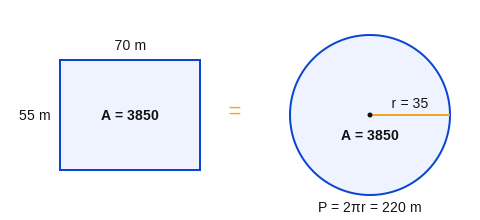
The sides of a rectangular field are 55 m and 70 m long. Its area is equal to the area of a circular field. What is the perimeter (in m) of the circular field?
(Take π=227)
एक आयताकार खेत की भुजाएँ 55 m और 70 m लंबी हैं। इसका क्षेत्रफल एक वृत्ताकार खेत के क्षेत्रफल के बराबर है। वृत्ताकार खेत का परिमाप (m में) कितना है?
(π=227 लीजिए)
  1. A197
  2. B174
  3. C220
  4. D181
Show answer

Concept: Equal areas: l×b=πr2, then perimeter of circle =2πr.

  1. Area of rectangle =55×70=3850m2.
  2. 227r2=3850⇒r2=3850×722=1225⇒r=35m.
  3. Circumference =2×227×35=220m.

Trick: 3850=22×175=22×7×25, so r2=72×52 and r=35 at a glance.

Answer: (C) 220

अवधारणा: समान क्षेत्रफल: l×b=πr2, फिर वृत्त की परिधि =2πr।

  1. आयत का क्षेत्रफल =55×70=3850m2।
  2. 227r2=3850⇒r2=3850×722=1225⇒r=35m।
  3. परिधि =2×227×35=220m।

ट्रिक: 3850=22×7×25, अतः r2=72×52 और r=35 तुरंत दिखता है।

उत्तर: (C) 220

RRB NTPC Undergraduate CBT 1MathematicsMensuration – CircleRRB NTPC Undergraduate CBT 1 2025 · 14 Jun Shift 2 →
Q13327.
Evaluate 223 + (-18)3 + (-4)3
223 + (-18)3 + (-4)3 का मान ज्ञात कीजिए।
  1. A4617
  2. B4800
  3. C4752
  4. D4819
Show answer

Concept: If a+b+c=0 then a3+b3+c3=3abc.

  1. Here 22+(−18)+(−4)=0.
  2. So the sum =3×22×(−18)×(−4)=3×22×72.
  3. =66×72=4752.

Trick: Whenever the three bases add to zero, never cube them – just multiply 3abc.

Answer: (C) 4752

अवधारणा: यदि a+b+c=0 तो a3+b3+c3=3abc।

  1. यहाँ 22+(−18)+(−4)=0।
  2. अतः योग =3×22×(−18)×(−4)=3×22×72।
  3. =66×72=4752।

ट्रिक: जब तीनों संख्याओं का योग शून्य हो, घन निकालने की ज़रूरत नहीं – सीधे 3abc करें।

उत्तर: (C) 4752

RRB NTPC Undergraduate CBT 1MathematicsAlgebraic IdentitiesRRB NTPC Undergraduate CBT 1 2025 · 14 Jun Shift 2 →
Q13328.
4 years ago, the age of Shyam was seven times the age of his son, Rajat. After 8 years, Shyam’s age will be three times the age of Rajat. Find the present age of Shyam .
4 वर्ष पहले, श्याम की आयु उसके पुत्र रजत की आयु की सात गुनी थी। 8 वर्ष बाद, श्याम की आयु रजत की आयु की तीन गुनी होगी। श्याम की वर्तमान आयु ज्ञात कीजिए।
  1. A46 years46 वर्ष
  2. B38 years38 वर्ष
  3. C45 years45 वर्ष
  4. D42 years42 वर्ष
Show answer

Concept: Form two linear equations from the two time points.

  1. Let present ages be S (Shyam) and R (Rajat). 4 years ago: S−4=7(R−4)⇒S=7R−24.
  2. After 8 years: S+8=3(R+8)⇒S=3R+16.
  3. 7R−24=3R+16⇒4R=40, R=10, so S=7×10−24=46.

Trick: Check: 4 years ago 42 and 6 (ratio 7:1); after 8 years 54 and 18 (ratio 3:1). Both fit.

Answer: (A) 46 years

अवधारणा: दो समयों से दो रैखिक समीकरण बनाइए।

  1. वर्तमान आयु S (श्याम) और R (रजत)। 4 वर्ष पहले: S−4=7(R−4)⇒S=7R−24।
  2. 8 वर्ष बाद: S+8=3(R+8)⇒S=3R+16।
  3. 7R−24=3R+16⇒4R=40, R=10, अतः S=46।

ट्रिक: जाँच: 4 वर्ष पहले 42 और 6 (7:1); 8 वर्ष बाद 54 और 18 (3:1)। दोनों सही।

उत्तर: (A) 46 वर्ष

RRB NTPC Undergraduate CBT 1MathematicsAgesRRB NTPC Undergraduate CBT 1 2025 · 14 Jun Shift 2 →
Q13329.
A delivery rider travels from Warehouse A to Store B, a distance of 48 km, at a speed of 32 km/hr. On the return journey along the same route, due to traffic, he travels at a speed of 24 km/hr. What is the rider’s average speed for the entire trip? (Round off up to two decimal places.)
एक डिलीवरी राइडर गोदाम A से स्टोर B तक, जो 48 km की दूरी पर है, 32 km/hr की चाल से यात्रा करता है। उसी मार्ग से वापसी यात्रा में, ट्रैफ़िक के कारण, वह 24 km/hr की चाल से यात्रा करता है। पूरी यात्रा के लिए राइडर की औसत चाल कितनी है? (दशमलव के दो स्थानों तक पूर्णांकित कीजिए।)
  1. A23.74 km/hr
  2. B24.56 km/hr
  3. C26.85 km/hr
  4. D27.43 km/hr
Show answer

Concept: Same distance both ways: average speed =2xyx+y.

  1. x=32, y=24.
  2. Average =2×32×2432+24=153656.
  3. =27.428…≈27.43km/h.

Trick: The 48 km distance is a distractor – for equal distances it cancels out.

Answer: (D) 27.43 km/hr

अवधारणा: दोनों ओर समान दूरी: औसत चाल =2xyx+y।

  1. x=32, y=24।
  2. औसत =2×32×2432+24=153656।
  3. =27.428…≈27.43km/h।

ट्रिक: 48 km की दूरी केवल भटकाने के लिए है – समान दूरी में यह कट जाती है।

उत्तर: (D) 27.43 km/hr

RRB NTPC Undergraduate CBT 1MathematicsAverage SpeedRRB NTPC Undergraduate CBT 1 2025 · 14 Jun Shift 2 →
Q13330.
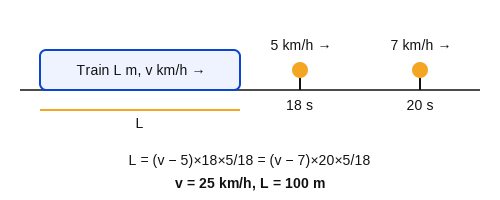
A train overtakes two runners moving in the same direction at speeds of 5 km/h and 7 km/h, passing them completely in 18 seconds and 20 seconds, respectively. What is the length of the train (in metres)?
एक रेलगाड़ी समान दिशा में 5 km/h और 7 km/h की चाल से चल रहे दो धावकों से आगे निकलती है, और उन्हें क्रमशः 18 सेकंड और 20 सेकंड में पूरी तरह पार कर लेती है। रेलगाड़ी की लंबाई (मीटर में) कितनी है?
  1. A90
  2. B70
  3. C80
  4. D100
Show answer

Concept: Length of train = relative speed × time; relative speed (same direction) =v−u.

  1. Let train speed be v km/h. L=(v−5)×518×18=5(v−5).
  2. Also L=(v−7)×518×20=50(v−7)9.
  3. 45(v−5)=50(v−7)⇒5v=125, v=25; L=5×20=100m.

Trick: Convert km/h to m/s with ×518 first; the 18 s cancels neatly.

Answer: (D) 100

अवधारणा: ट्रेन की लंबाई = सापेक्ष चाल × समय; एक ही दिशा में सापेक्ष चाल =v−u।

  1. ट्रेन की चाल v km/h। L=(v−5)×518×18=5(v−5)।
  2. तथा L=(v−7)×518×20=50(v−7)9।
  3. 45(v−5)=50(v−7)⇒5v=125, v=25; L=5×20=100m।

ट्रिक: पहले km/h को ×518 से m/s में बदलें; 18 s सीधे कट जाता है।

उत्तर: (D) 100

RRB NTPC Undergraduate CBT 1MathematicsTrainsRRB NTPC Undergraduate CBT 1 2025 · 14 Jun Shift 2 →
Q13331.
Which of the following is a pair of co-primes?
निम्नलिखित में से कौन-सा सह-अभाज्य संख्याओं (co-primes) का युग्म है?
  1. A44 and 9944 और 99
  2. B25 and 3625 और 36
  3. C42 and 5642 और 56
  4. D27 and 3627 और 36
Show answer

Concept: Two numbers are co-prime when their HCF is 1.

  1. 44 and 99: HCF 11. 42 and 56: HCF 14. 27 and 36: HCF 9.
  2. 25 =52 and 36 =22×32 share no prime factor, HCF =1.

Trick: Two consecutive numbers, or two perfect squares of different primes, are always co-prime.

Answer: (B) 25 and 36

अवधारणा: दो संख्याएँ सह-अभाज्य (co-prime) हैं यदि उनका HCF 1 हो।

  1. 44 और 99: HCF 11। 42 और 56: HCF 14। 27 और 36: HCF 9।
  2. 25 =52 और 36 =22×32 में कोई उभयनिष्ठ अभाज्य गुणनखंड नहीं, HCF =1।

ट्रिक: दो क्रमागत संख्याएँ, या अलग-अलग अभाज्यों के वर्ग, हमेशा सह-अभाज्य होते हैं।

उत्तर: (B) 25 और 36

RRB NTPC Undergraduate CBT 1MathematicsHCF – Co-primesRRB NTPC Undergraduate CBT 1 2025 · 14 Jun Shift 2 →
Q13332.
A tank is filled by two pipes, A and B, and emptied by a third pipe C. Pipe A fills the tank in 10 hours and pipe B in 15 hours. Pipe C empties it in 20 hours. If all three pipes are opened together, and pipe C is closed after 4 hours, how much total time will it take to fill the tank?
एक टंकी को दो पाइपों A और B द्वारा भरा जाता है और तीसरे पाइप C द्वारा खाली किया जाता है। पाइप A टंकी को 10 घंटे में और पाइप B 15 घंटे में भरता है। पाइप C इसे 20 घंटे में खाली करता है। यदि तीनों पाइप एक साथ खोले जाते हैं, और 4 घंटे बाद पाइप C को बंद कर दिया जाता है, तो टंकी को भरने में कुल कितना समय लगेगा?
  1. A8.2 hours8.2 घंटे
  2. B7.2 hours7.2 घंटे
  3. C8 hours8 घंटे
  4. D7.5 hours7.5 घंटे
Show answer

Concept: Take total work = LCM(10, 15, 20) = 60 units.

  1. A =+6, B =+4, C =−3 units/hour.
  2. All three for 4 hours: (6+4−3)×4=28 units. Remaining =32 units.
  3. A + B =10 units/hour ⇒3210=3.2 hours. Total =4+3.2=7.2 hours.

Trick: With LCM units the fractions vanish – work only with whole numbers till the last step.

Answer: (B) 7.2 hours

अवधारणा: कुल कार्य = LCM(10, 15, 20) = 60 इकाई।

  1. A =+6, B =+4, C =−3 इकाई/घंटा।
  2. तीनों 4 घंटे: (6+4−3)×4=28 इकाई। शेष =32 इकाई।
  3. A + B =10 इकाई/घंटा ⇒3210=3.2 घंटे। कुल =4+3.2=7.2 घंटे।

ट्रिक: LCM इकाई लेने से भिन्न गायब – अंतिम चरण तक पूर्णांकों में काम करें।

उत्तर: (B) 7.2 घंटे

RRB NTPC Undergraduate CBT 1MathematicsPipes and CisternsRRB NTPC Undergraduate CBT 1 2025 · 14 Jun Shift 2 →
Q13333.
The marked price of an article is ₹500. During a sale, its price is reduced to ₹450. What is the percentage decrease in price?
एक वस्तु का अंकित मूल्य ₹500 है। सेल के दौरान, इसका मूल्य घटाकर ₹450 कर दिया जाता है। मूल्य में प्रतिशत कमी कितनी है?
  1. A12%
  2. B10%
  3. C5%
  4. D8%
Show answer

Concept: % decrease=decreaseoriginal×100.

  1. Decrease =500−450=50.
  2. 50500×100=10%.

Trick: Always divide by the original (earlier) value, not the new one.

Answer: (B) 10%

अवधारणा: % कमी=कमीमूल मान×100।

  1. कमी =500−450=50।
  2. 50500×100=10%।

ट्रिक: हमेशा मूल (पहले वाले) मान से भाग दें, नए से नहीं।

उत्तर: (B) 10%

RRB NTPC Undergraduate CBT 1MathematicsPercentageRRB NTPC Undergraduate CBT 1 2025 · 14 Jun Shift 2 →
Q13334.
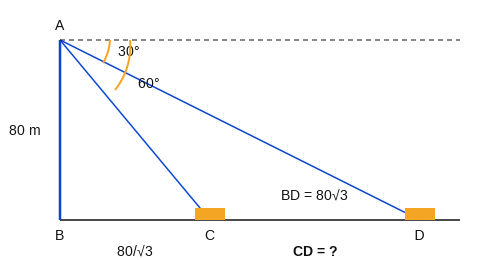
From the top of a cliff 80 meters high, the angles of depression of two ships in the same direction are 30° and 60°. Find the distance between the ships (rounded off to two decimal places).
80 मीटर ऊँची एक चट्टान के शिखर से, समान दिशा में स्थित दो जहाजों के अवनमन कोण 30° और 60° हैं। जहाजों के बीच की दूरी ज्ञात कीजिए (दशमलव के दो स्थानों तक पूर्णांकित)।
  1. A92.78 meters92.78 मीटर
  2. B92.18 meters92.18 मीटर
  3. C92.58 meters92.58 मीटर
  4. D92.38 meters92.38 मीटर
Show answer

Concept: In a right triangle, horizontal distance =heighttanθ; angle of depression = angle of elevation from the ship.

  1. Nearer ship (60°): BC=80tan60∘=803.
  2. Farther ship (30°): BD=80tan30∘=803.
  3. CD=803−803=80×23=1601.732≈92.38m.

Trick: For angles 30° and 60° the gap is always 2h3 – here 2×803.

Answer: (D) 92.38 meters

अवधारणा: समकोण त्रिभुज में क्षैतिज दूरी =ऊँचाईtanθ; अवनमन कोण = जहाज़ से उन्नयन कोण।

  1. पास वाला जहाज़ (60°): BC=80tan60∘=803।
  2. दूर वाला जहाज़ (30°): BD=80tan30∘=803।
  3. CD=803−803=1603=1601.732≈92.38m।

ट्रिक: 30° और 60° के लिए दोनों के बीच की दूरी हमेशा 2h3 होती है।

उत्तर: (D) 92.38 मीटर

RRB NTPC Undergraduate CBT 1MathematicsHeights and DistancesRRB NTPC Undergraduate CBT 1 2025 · 14 Jun Shift 2 →
Q13335.
A shopkeeper marks the price of sugar 24% above the cost price and gives a discount of 18%, but uses a weight of 800 grams instead of 1 kg. Find his overall profit
percentage.
एक दुकानदार चीनी का मूल्य क्रय मूल्य से 24% अधिक अंकित करता है और 18% की छूट देता है, लेकिन 1 kg के स्थान पर 800 ग्राम के बाट का उपयोग करता है। उसका कुल लाभ
प्रतिशत ज्ञात कीजिए।
  1. A25.4%
  2. B28%
  3. C26%
  4. D27.1%
Show answer

Concept: Compare what the customer pays with the cost of what he actually receives.

  1. Let CP = ₹100 per kg. MP =124, SP after 18% discount =124×0.82=101.68.
  2. He gives only 800 g, whose cost =80.
  3. Profit =101.68−8080×100=21.6880×100=27.1%.

Trick: Price multiplier 1.24×0.82=1.0168; weight multiplier 1000800=1.25; overall 1.0168×1.25=1.271⇒27.1%.

Answer: (D) 27.1%

अवधारणा: ग्राहक जो चुकाता है उसकी तुलना उसे वास्तव में मिले माल की लागत से करें।

  1. CP = ₹100 प्रति kg मानें। MP =124, 18% छूट के बाद SP =124×0.82=101.68।
  2. वह केवल 800 g देता है, जिसकी लागत =80।
  3. लाभ =101.68−8080×100=27.1%।

ट्रिक: मूल्य गुणक 1.24×0.82=1.0168; बाट गुणक 1000800=1.25; कुल 1.0168×1.25=1.271⇒27.1%।

उत्तर: (D) 27.1%

RRB NTPC Undergraduate CBT 1MathematicsProfit & Loss – False WeightRRB NTPC Undergraduate CBT 1 2025 · 14 Jun Shift 2 →
Q13336.
Find the value of {(3)−5×(8)5×(125)3×(36)3(100)4×256×216×(2)2}.
{(3)−5×(8)5×(125)3×(36)3(100)4×256×216×(2)2} का मान ज्ञात कीजिए।
  1. A27
  2. B59
  3. C38
  4. D45
Show answer

Concept: Write every number as a product of primes and cancel powers.

  1. Numerator: 3−5×215×59×(22·32)3=221×59×36−5=221×59×3.
  2. Denominator: (2252)4×28×2333×22=221×58×33.
  3. Ratio =59×358×33=59.

Trick: Count the powers of 2 first – they are equal (21 each), so only 3s and 5s survive.

Answer: (B) 59

अवधारणा: हर संख्या को अभाज्य गुणनखंडों में लिखें और घातें काटें।

  1. अंश: 3−5×215×59×(22·32)3=221×59×3।
  2. हर: (2252)4×28×2333×22=221×58×33।
  3. अनुपात =59×358×33=59।

ट्रिक: पहले 2 की घातें गिनें – दोनों ओर 21 हैं, अतः केवल 3 और 5 बचते हैं।

उत्तर: (B) 59

RRB NTPC Undergraduate CBT 1MathematicsIndicesRRB NTPC Undergraduate CBT 1 2025 · 14 Jun Shift 2 →
Q13337.
Find the mean proportional between (2+3) and (10−75).
(2+3) और (10−75) के बीच मध्यानुपाती ज्ञात कीजिए।
  1. A2+3
  2. B2
  3. C5
  4. D3
Show answer

Concept: Mean proportional between a and b is ab.

  1. 75=53, so the second number is 10−53=5(2−3).
  2. Product =(2+3)×5(2−3)=5(4−3)=5.
  3. Mean proportional =5.

Trick: Spot the conjugate pair (2+3)(2−3)=1 – the product collapses to 5 instantly.

Answer: (C) 5

अवधारणा: a और b का मध्यानुपाती (mean proportional) =ab।

  1. 75=53, अतः दूसरी संख्या 10−53=5(2−3)।
  2. गुणनफल =(2+3)×5(2−3)=5(4−3)=5।
  3. मध्यानुपाती =5।

ट्रिक: संयुग्मी जोड़ा (2+3)(2−3)=1 पहचानें – गुणनफल तुरंत 5 बन जाता है।

उत्तर: (C) 5

RRB NTPC Undergraduate CBT 1MathematicsMean Proportional – SurdsRRB NTPC Undergraduate CBT 1 2025 · 14 Jun Shift 2 →
Q13338.
Find the least value of (4K2+2M) for which the five digits number 7KM93 is divisible by 9.
(4K2+2M) का न्यूनतम मान ज्ञात कीजिए, जिसके लिए पाँच अंकों की संख्या 7KM93, 9 से विभाज्य है।
  1. A16
  2. B12
  3. C27
  4. D14
Show answer

Concept: A number is divisible by 9 if its digit sum is a multiple of 9.

  1. Digit sum of 7KM93 =7+K+M+9+3=19+K+M.
  2. Need 19+K+M=27 or 36⇒K+M=8 or 17.
  3. Minimise 4K2+2M: take K=0, M=8⇒0+16=16 (any K≥1 gives more).

Trick: K2 carries the big coefficient, so push K to 0 and load everything on M.

Answer: (A) 16

अवधारणा: कोई संख्या 9 से विभाज्य है यदि उसके अंकों का योग 9 का गुणज हो।

  1. 7KM93 का अंक-योग =7+K+M+9+3=19+K+M।
  2. 19+K+M=27 या 36⇒K+M=8 या 17।
  3. 4K2+2M न्यूनतम: K=0, M=8⇒16 (कोई भी K≥1 अधिक देता है)।

ट्रिक: K2 पर बड़ा गुणांक है, इसलिए K=0 रखें और सारा भार M पर डालें।

उत्तर: (A) 16

RRB NTPC Undergraduate CBT 1MathematicsDivisibility by 9RRB NTPC Undergraduate CBT 1 2025 · 14 Jun Shift 2 →
Q13339.
Nitin sells two articles for ₹2,973 each with no profit, no loss in the entire transaction. If one article was sold at a gain of 50%, then the other article is sold at a loss of:
नितिन दो वस्तुओं में से प्रत्येक को ₹2,973 में बेचता है और पूरे लेन-देन में न लाभ होता है, न हानि। यदि एक वस्तु 50% लाभ पर बेची गई थी, तो दूसरी वस्तु कितनी हानि पर बेची गई?
  1. A26%
  2. B22%
  3. C27%
  4. D25%
Show answer

Concept: No overall profit/loss ⇒ total CP = total SP.

  1. Total SP =2×2973=5946= total CP.
  2. CP of first (50% gain) =29731.5=1982.
  3. CP of second =5946−1982=3964; loss =3964−2973=991; 9913964×100=25%.

Trick: Gain 12 on CP₁ means CP₁ =23SP; the other must then lose the same rupee amount: 13SP on CP₂ =43SP ⇒25%.

Answer: (D) 25%

अवधारणा: कुल न लाभ न हानि ⇒ कुल CP = कुल SP।

  1. कुल SP =2×2973=5946= कुल CP।
  2. पहली वस्तु (50% लाभ) का CP =29731.5=1982।
  3. दूसरी का CP =5946−1982=3964; हानि =991; 9913964×100=25%।

ट्रिक: पहली पर लाभ =13SP; दूसरी पर उतनी ही रुपये की हानि, और उसका CP =43SP ⇒25%।

उत्तर: (D) 25%

RRB NTPC Undergraduate CBT 1MathematicsProfit & LossRRB NTPC Undergraduate CBT 1 2025 · 14 Jun Shift 2 →
Q13340.
Simplify: (40963100004)×548×186
सरल कीजिए: (40963100004)×548×186
  1. A36
  2. B30
  3. C29
  4. D31
Show answer

Concept: 40963=16 (since 163=4096) and 100004=10.

  1. 1610×548×186.
  2. 16×510×48=80480=16.
  3. 1866=31.

Trick: Remember 4096=212, so its cube root is 24=16 and its square root is 64.

Answer: (D) 31

अवधारणा: 40963=16 (163=4096) और 100004=10।

  1. 1610×548×186।
  2. 16×510×48=80480=16।
  3. 1866=31।

याद रखें: 4096=212, अतः घनमूल 24=16 और वर्गमूल 64।

उत्तर: (D) 31

RRB NTPC Undergraduate CBT 1MathematicsSimplification – RootsRRB NTPC Undergraduate CBT 1 2025 · 14 Jun Shift 2 →