Question bank

Q&A: practice questions with answers

Search questions on any topic. Filter by exam category, exam, subject and topic, try the question, then open the answer and explanation.

Courses – airGurukul

20,719 questions found.

Q13421.
Which case recognised judicial review as part of the basic structure?
किस मामले में न्यायिक पुनरावलोकन को मूल ढाँचे का भाग माना गया?
  1. AMinerva Mills caseमिनर्वा मिल्स मामला
  2. BIndra Sawhney caseइंद्रा साहनी मामला
  3. CMenaka Gandhi caseमेनका गांधी मामला
  4. DKeshavananda Bharati caseकेशवानंद भारती मामला
Show answer

Concept: The basic structure doctrine was laid down in Kesavananda Bharati v. State of Kerala (1973); judicial review was among the features the judges named as part of that unamendable core.

  1. In Kesavananda Bharati, Justices such as Khanna and Shelat listed supremacy of the Constitution, separation of powers and judicial review as basic features.
  2. Minerva Mills (1980) later reaffirmed judicial review and limited amending power, but the original recognition came in 1973.
  3. Indra Sawhney concerns OBC reservation; Maneka Gandhi concerns Article 21 and due process.

Yaad rakhein: 1973 Kesavananda – doctrine born; 1980 Minerva Mills – doctrine strengthened.

Answer: (D) Keshavananda Bharati case

अवधारणा: मूल संरचना सिद्धांत केशवानंद भारती बनाम केरल राज्य (1973) में स्थापित हुआ; न्यायिक समीक्षा (judicial review) उन विशेषताओं में थी जिन्हें न्यायाधीशों ने इस असंशोधनीय आधार का भाग बताया।

  1. केशवानंद भारती में न्यायमूर्ति खन्ना, शेलट आदि ने संविधान की सर्वोच्चता, शक्ति-पृथक्करण और न्यायिक समीक्षा को मूल विशेषताएँ बताया।
  2. मिनर्वा मिल्स (1980) ने बाद में न्यायिक समीक्षा की पुनः पुष्टि की और संशोधन शक्ति सीमित की, पर मूल मान्यता 1973 में मिली।
  3. इंद्रा साहनी OBC आरक्षण से और मेनका गांधी अनुच्छेद 21 व due process से संबंधित है।

याद रखें: 1973 केशवानंद – सिद्धांत का जन्म; 1980 मिनर्वा मिल्स – सिद्धांत की मज़बूती।

उत्तर: (D) Keshavananda Bharati case
RRB NTPC Undergraduate CBT 1General AwarenessPolity – Basic structure doctrineRRB NTPC Undergraduate CBT 1 2025 · 14 Jun Shift 1 →
Q13422.
Which of the following compositions in Hindustani music is especially associated with Sufi devotional music?
हिंदुस्तानी संगीत की निम्नलिखित में से कौन-सी रचना विशेष रूप से सूफ़ी भक्ति संगीत से जुड़ी है?
  1. ADhrupadध्रुपद
  2. BTappaटप्पा
  3. CTaranaतराना
  4. DQawwaliक़व्वाली
Show answer

Concept: Qawwali is the devotional music of Sufi shrines (dargahs), sung in praise of God, the Prophet and Sufi saints, with chorus, handclaps, harmonium and dholak.

  1. It is traditionally traced to Amir Khusrau (13th century) at the Chishti dargah of Nizamuddin Auliya, Delhi.
  2. Dhrupad is the oldest classical form (temple/court), Tappa comes from Punjab camel-drivers' songs, Tarana uses meaningless syllables – none is specifically Sufi.

Yaad rakhein: Sufi + dargah + Amir Khusrau = Qawwali.

Answer: (D) Qawwali

अवधारणा: कव्वाली सूफ़ी दरगाहों का भक्ति संगीत है, जो ईश्वर, पैगंबर और सूफ़ी संतों की स्तुति में समवेत स्वर, तालियों, हारमोनियम और ढोलक के साथ गाया जाता है।

  1. इसकी परंपरा अमीर खुसरो (13वीं सदी) से, दिल्ली में निज़ामुद्दीन औलिया की चिश्ती दरगाह से जोड़ी जाती है।
  2. ध्रुपद सबसे पुराना शास्त्रीय रूप (मंदिर/दरबार), टप्पा पंजाब के ऊँट-चालकों के गीतों से, तराना अर्थहीन अक्षरों पर आधारित – इनमें कोई विशेष रूप से सूफ़ी नहीं।

याद रखें: सूफ़ी + दरगाह + अमीर खुसरो = कव्वाली।

उत्तर: (D) Qawwali

RRB NTPC Undergraduate CBT 1General AwarenessArt & Culture – Hindustani musicRRB NTPC Undergraduate CBT 1 2025 · 14 Jun Shift 1 →
Q13423.
Which of the following is the correct full form of CD?
निम्नलिखित में से CD का सही पूर्ण रूप कौन-सा है?
  1. ACompact Diskकॉम्पैक्ट डिस्क (Compact Disk)
  2. BCentral Dataसेंट्रल डेटा (Central Data)
  3. CControl Diskकंट्रोल डिस्क (Control Disk)
  4. DComputer Driveकंप्यूटर ड्राइव (Computer Drive)
Show answer

Concept: CD stands for Compact Disc – an optical storage medium (about 700 MB) read by a laser, introduced by Philips and Sony in 1982.

  1. Variants: CD-ROM (read only), CD-R (recordable once), CD-RW (rewritable); successors are DVD and Blu-ray.
  2. The other expansions are made-up terms and are not standard computer abbreviations.

Yaad rakhein: CD = Compact Disc (700 MB) → DVD = Digital Versatile Disc (4.7 GB) → Blu-ray (25 GB).

Answer: (A) Compact Disk

अवधारणा: CD का पूरा रूप Compact Disc है – एक ऑप्टिकल भंडारण माध्यम (लगभग 700 MB) जिसे लेज़र से पढ़ा जाता है; इसे Philips और Sony ने 1982 में प्रस्तुत किया।

  1. प्रकार: CD-ROM (केवल पढ़ने योग्य), CD-R (एक बार लिखने योग्य), CD-RW (पुनः लिखने योग्य); आगे DVD और Blu-ray आए।
  2. बाकी विस्तार मनगढ़ंत हैं, मानक कंप्यूटर संक्षिप्तियाँ नहीं।

याद रखें: CD = Compact Disc (700 MB) → DVD = Digital Versatile Disc (4.7 GB) → Blu-ray (25 GB)।

उत्तर: (A) Compact Disk

RRB NTPC Undergraduate CBT 1General AwarenessComputer Awareness – AbbreviationsRRB NTPC Undergraduate CBT 1 2025 · 14 Jun Shift 1 →
Q13424.
According to the Constitution of India, the ‘Right to Equality’ is guaranteed under which exact set of five consecutive Articles?
भारत के संविधान के अनुसार, ‘समानता का अधिकार’ किन पाँच क्रमागत अनुच्छेदों के समूह के अंतर्गत प्रत्याभूत है?
  1. AArticles 12, 13, 14, 15 and 16अनुच्छेद 12, 13, 14, 15 और 16
  2. BArticles 23, 24, 25, 26 and 27अनुच्छेद 23, 24, 25, 26 और 27
  3. CArticles 19, 20, 21, 22 and 23अनुच्छेद 19, 20, 21, 22 और 23
  4. DArticles 14, 15, 16, 17 and 18अनुच्छेद 14, 15, 16, 17 और 18
Show answer

Concept: Part III of the Constitution groups the Right to Equality in Articles 14 to 18.

  1. Art. 14 – equality before law; Art. 15 – no discrimination on grounds of religion, race, caste, sex, birthplace; Art. 16 – equality of opportunity in public employment; Art. 17 – abolition of untouchability; Art. 18 – abolition of titles.
  2. Articles 12–13 are definitions/laws inconsistent with FRs, 19–22 are Right to Freedom, 23–24 Right against Exploitation, 25–28 Freedom of Religion.

Yaad rakhein: 14–18 Equality, 19–22 Freedom, 23–24 Exploitation, 25–28 Religion, 29–30 Culture & Education, 32 Remedies.

Answer: (D) Articles 14, 15, 16, 17 and 18

अवधारणा: संविधान का भाग III समता के अधिकार को अनुच्छेद 14 से 18 में रखता है।

  1. अनु. 14 – विधि के समक्ष समता; अनु. 15 – धर्म, मूल वंश, जाति, लिंग, जन्मस्थान पर भेदभाव निषेध; अनु. 16 – लोक नियोजन में अवसर की समता; अनु. 17 – अस्पृश्यता का अंत; अनु. 18 – उपाधियों का अंत।
  2. अनु. 12–13 परिभाषाएँ/FR से असंगत विधियाँ, 19–22 स्वतंत्रता का अधिकार, 23–24 शोषण के विरुद्ध अधिकार, 25–28 धार्मिक स्वतंत्रता।

याद रखें: 14–18 समता, 19–22 स्वतंत्रता, 23–24 शोषण, 25–28 धर्म, 29–30 संस्कृति व शिक्षा, 32 उपचार।

उत्तर: (D) Articles 14, 15, 16, 17 and 18

RRB NTPC Undergraduate CBT 1General AwarenessPolity – Fundamental RightsRRB NTPC Undergraduate CBT 1 2025 · 14 Jun Shift 1 →
Q13425.
Which computer application enables real-time inventory tracking using automated identification?
कौन-सा कंप्यूटर अनुप्रयोग स्वचालित पहचान का उपयोग करके वास्तविक समय (real-time) में इन्वेंटरी ट्रैकिंग को सक्षम बनाता है?
  1. APresentation softwareप्रेज़ेंटेशन सॉफ़्टवेयर
  2. BEmail-based notificationईमेल-आधारित अधिसूचना
  3. COCR-based text editingOCR-आधारित टेक्स्ट एडिटिंग
  4. DRFID-driven supply chain systemsRFID-संचालित आपूर्ति शृंखला प्रणालियाँ
Show answer

Concept: Automated identification (Auto-ID) technologies – barcodes and especially RFID (Radio Frequency Identification) tags – let a computer system read item identities without manual entry, giving real-time inventory visibility.

  1. RFID readers scan tagged goods as they move through warehouses and shops, updating stock counts instantly in the supply-chain software.
  2. Presentation software, e-mail alerts and OCR editing do not identify physical items automatically.

Yaad rakhein: Barcode needs line-of-sight; RFID reads many tags at once by radio – hence "real-time" tracking.

Answer: (D) RFID-driven supply chain systems

अवधारणा: स्वचालित पहचान (Auto-ID) तकनीकें – बारकोड और विशेषकर RFID (Radio Frequency Identification) टैग – कंप्यूटर सिस्टम को बिना हाथ से प्रविष्टि के वस्तुओं की पहचान पढ़ने देती हैं, जिससे वास्तविक समय में इन्वेंटरी दिखती है।

  1. RFID रीडर गोदामों व दुकानों में चलती टैग-युक्त वस्तुओं को स्कैन कर सप्लाई-चेन सॉफ़्टवेयर में स्टॉक तुरंत अपडेट करते हैं।
  2. प्रेज़ेंटेशन सॉफ़्टवेयर, ई-मेल अलर्ट और OCR संपादन भौतिक वस्तुओं की स्वतः पहचान नहीं करते।

याद रखें: बारकोड को सीधी दृष्टि चाहिए; RFID रेडियो से एक साथ कई टैग पढ़ता है – इसलिए "real-time" ट्रैकिंग।

उत्तर: (D) RFID-driven supply chain systems

RRB NTPC Undergraduate CBT 1General AwarenessComputer Awareness – ApplicationsRRB NTPC Undergraduate CBT 1 2025 · 14 Jun Shift 1 →
Q13426.
The price of an item is increased by 15% and then by 20%. Now the price of the item is decreased so that the overall effective increment in the price is 5%. The price is decreased approximately by ____%.
किसी वस्तु के मूल्य में 15% और फिर 20% की वृद्धि की जाती है। अब वस्तु के मूल्य में इस प्रकार कमी की जाती है कि मूल्य में कुल प्रभावी वृद्धि 5% हो। मूल्य में लगभग ____% की कमी की गई है।
  1. A23.19
  2. B21.93
  3. C23.91
  4. D21.39
Show answer

Concept: Successive changes multiply: take the original price as 100 and track the multipliers.

  1. After +15% and +20%: 100×1.15×1.20=138.
  2. Final price must be 105 (overall +5%).
  3. Decrease needed =138−105=33 on a base of 138.
  4. % decrease =33138×100≈23.91%.

Trick: Percentage decrease is always calculated on the current (higher) price, not on the original 100.

Answer: (C) 23.91

अवधारणा: क्रमिक परिवर्तन गुणा होते हैं; मूल कीमत 100 मानकर गुणक लगाइए।

  1. +15% और +20% के बाद: 100×1.15×1.20=138।
  2. अंतिम कीमत 105 होनी चाहिए (कुल +5%)।
  3. आवश्यक कमी =138−105=33, आधार 138।
  4. % कमी =33138×100≈23.91%।

ट्रिक: प्रतिशत कमी हमेशा वर्तमान (बढ़ी हुई) कीमत पर निकलती है, मूल 100 पर नहीं।

उत्तर: (C) 23.91

RRB NTPC Undergraduate CBT 1MathematicsSuccessive percentage changeRRB NTPC Undergraduate CBT 1 2025 · 14 Jun Shift 1 →
Q13427.
Arpit buys 3 bed sheets for ₹3,951. He sells the first at a profit of ₹300, the second at a loss of ₹50, and the third at a profit of ₹200. What is the overall profit or loss
percentage?
(Round off your result to two decimal places)
अर्पित 3 बेडशीट ₹3,951 में खरीदता है। वह पहली को ₹300 के लाभ पर, दूसरी को ₹50 की हानि पर और तीसरी को ₹200 के लाभ पर बेचता है। कुल लाभ या हानि
प्रतिशत क्या है?
(अपने परिणाम को दो दशमलव स्थानों तक पूर्णांकित कीजिए)
  1. A10.93% loss10.93% हानि
  2. B10.93% profit10.93% लाभ
  3. C11.39% loss11.39% हानि
  4. D11.39% profit11.39% लाभ
Show answer

Concept: Overall profit = sum of individual profits/losses; Profit%=ProfitTotal CP×100.

  1. Net gain =300−50+200=₹450 (positive, so profit).
  2. Total CP =₹3,951.
  3. Profit%=4503951×100≈11.39%.

Trick: Individual cost prices are not needed – only the total CP and the net rupee gain matter.

Answer: (D) 11.39% profit

अवधारणा: कुल लाभ = अलग-अलग लाभ/हानि का योग; लाभ%=लाभकुल क्रय मूल्य×100।

  1. शुद्ध लाभ =300−50+200=₹450 (धनात्मक, अतः लाभ)।
  2. कुल CP =₹3,951।
  3. लाभ%=4503951×100≈11.39%।

ट्रिक: अलग-अलग चादरों का CP नहीं चाहिए – केवल कुल CP और शुद्ध रुपये का लाभ चाहिए।

उत्तर: (D) 11.39% profit

RRB NTPC Undergraduate CBT 1MathematicsProfit and lossRRB NTPC Undergraduate CBT 1 2025 · 14 Jun Shift 1 →
Q13428.
₹9,520 is divided among X, Y, and Z in the ratio 12:14:516. What is the share of Y?
₹9,520 को X, Y और Z में 12:14:516 के अनुपात में बाँटा जाता है। Y का हिस्सा कितना है?
  1. A₹3,200
  2. B₹2,240
  3. C₹2,600
  4. D₹4,000
Show answer

Concept: Convert fractional ratios to whole numbers by multiplying with the LCM of denominators.

  1. 12:14:516 – multiply by 16: 8:4:5.
  2. Total parts =8+4+5=17; one part =952017=560.
  3. Share of Y =4×560=₹2,240.

Trick: Check: 9520 is divisible by 17 (17×560) – a quick sanity test for the ratio.

Answer: (B) ₹2,240

अवधारणा: भिन्न वाले अनुपात को हरों के LCM से गुणा करके पूर्णांक बनाइए।

  1. 12:14:516 – 16 से गुणा: 8:4:5।
  2. कुल भाग =17; एक भाग =952017=560।
  3. Y का हिस्सा =4×560=₹2,240।

ट्रिक: जाँच: 9520=17×560 – अनुपात सही होने का त्वरित परीक्षण।

उत्तर: (B) ₹2,240

RRB NTPC Undergraduate CBT 1MathematicsRatio and proportionRRB NTPC Undergraduate CBT 1 2025 · 14 Jun Shift 1 →
Q13429.
Find the value of (10.01)×{[(58)+(0.25)]×(45)}.
(10.01)×{[(58)+(0.25)]×(45)} का मान ज्ञात कीजिए।
  1. A70
  2. B0.7
  3. C0.8
  4. D80
Show answer

Concept: Solve innermost brackets first; convert decimals to fractions.

  1. 10.01=100.
  2. 58+0.25=58+28=78.
  3. 78×45=710.
  4. 100×710=70.

Trick: 0.25=14=28 – pick the denominator that matches the other fraction.

Answer: (A) 70

अवधारणा: पहले अंदर का कोष्ठक हल करें; दशमलव को भिन्न में बदलें।

  1. 10.01=100।
  2. 58+0.25=58+28=78।
  3. 78×45=710।
  4. 100×710=70।

ट्रिक: 0.25=14=28 – दूसरे भिन्न से मेल खाता हर चुनें।

उत्तर: (A) 70

RRB NTPC Undergraduate CBT 1MathematicsSimplification (BODMAS)RRB NTPC Undergraduate CBT 1 2025 · 14 Jun Shift 1 →
Q13430.
At a health club, 40% of the members are women and 60% of the members are men. If the average age of the men is 51 years and the average age of the women is 55 years, what is the average age (in years) of all the members?
एक हेल्थ क्लब में, 40% सदस्य महिलाएँ और 60% सदस्य पुरुष हैं। यदि पुरुषों की औसत आयु 51 वर्ष और महिलाओं की औसत आयु 55 वर्ष है, तो सभी सदस्यों की औसत आयु (वर्षों में) क्या है?
  1. A60.9
  2. B59.7
  3. C52.6
  4. D50.2
Show answer

Concept: Average of a mixed group = weighted mean =∑(fraction×average).

  1. Men: 0.60×51=30.6.
  2. Women: 0.40×55=22.0.
  3. Overall average =30.6+22=52.6 years.

Trick: Alligation: ages differ by 4; men are 60%, so the mean lies 25×4=1.6 above 51 ⇒52.6.

Answer: (C) 52.6

अवधारणा: मिश्रित समूह का औसत = भारित माध्य =∑(अंश×औसत)।

  1. पुरुष: 0.60×51=30.6।
  2. महिलाएँ: 0.40×55=22.0।
  3. कुल औसत =30.6+22=52.6 वर्ष।

ट्रिक: मिश्रण विधि (alligation): अंतर 4; पुरुष 60% हैं, तो माध्य 51 से 25×4=1.6 ऊपर ⇒52.6।

उत्तर: (C) 52.6

RRB NTPC Undergraduate CBT 1MathematicsWeighted averageRRB NTPC Undergraduate CBT 1 2025 · 14 Jun Shift 1 →
Q13431.
A bus covers 150 km at 60 km/hr, 120 km at 80 km/hr, and 180 km at 90 km/hr without any stops. What is the average speed of the bus for the entire journey?
एक बस बिना रुके 150 km की दूरी 60 km/hr से, 120 km की दूरी 80 km/hr से और 180 km की दूरी 90 km/hr से तय करती है। पूरी यात्रा के लिए बस की औसत चाल क्या है?
  1. A72 km/hr
  2. B70 km/hr
  3. C85 km/hr
  4. D75 km/hr
Show answer

Concept: Average speed=Total distanceTotal time (never the average of speeds).

  1. Times: 15060=2.5 h, 12080=1.5 h, 18090=2 h.
  2. Total time =6 h; total distance =150+120+180=450 km.
  3. Average speed =4506=75km/h.

Trick: Distances here are chosen so every time is clean – compute times first, then divide.

Answer: (D) 75 km/hr

अवधारणा: औसत चाल=कुल दूरीकुल समय (चालों का औसत कभी नहीं)।

  1. समय: 15060=2.5 h, 12080=1.5 h, 18090=2 h।
  2. कुल समय =6 h; कुल दूरी =450 km।
  3. औसत चाल =4506=75km/h।

ट्रिक: पहले हर भाग का समय निकालें, फिर कुल दूरी को कुल समय से भाग दें।

उत्तर: (D) 75 km/hr

RRB NTPC Undergraduate CBT 1MathematicsAverage speedRRB NTPC Undergraduate CBT 1 2025 · 14 Jun Shift 1 →
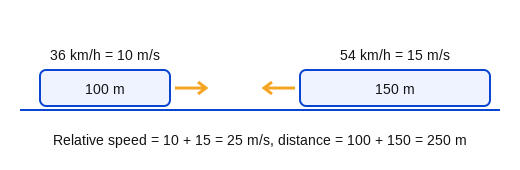
Q13432.
Two trains are moving in opposite directions at speeds of 36 km/h and 54 km/h. If their lengths are 100 m and 150 m, respectively, how much time will they take to cross each other completely?
दो रेलगाड़ियाँ 36 km/h और 54 km/h की चाल से विपरीत दिशाओं में चल रही हैं। यदि उनकी लंबाई क्रमशः 100 m और 150 m है, तो वे एक-दूसरे को पूरी तरह से पार करने में कितना समय लेंगी?
  1. A15 seconds15 सेकंड
  2. B12 seconds12 सेकंड
  3. C8 seconds8 सेकंड
  4. D10 seconds10 सेकंड
Show answer

Concept: Opposite directions ⇒ relative speed = sum; distance to cover = sum of lengths.

  1. Relative speed =36+54=90km/h=90×518=25m/s.
  2. Distance =100+150=250 m.
  3. Time =25025=10 s.

Trick: km/h → m/s: multiply by 518; 90km/h=25m/s is worth memorising.

Answer: (D) 10 seconds

अवधारणा: विपरीत दिशा ⇒ सापेक्ष चाल = योग; तय दूरी = दोनों लंबाइयों का योग।

  1. सापेक्ष चाल =36+54=90km/h=90×518=25m/s।
  2. दूरी =100+150=250 m।
  3. समय =25025=10 s।

ट्रिक: km/h से m/s: 518 से गुणा; 90km/h=25m/s याद रखें।

उत्तर: (D) 10 seconds

RRB NTPC Undergraduate CBT 1MathematicsTrains – crossing timeRRB NTPC Undergraduate CBT 1 2025 · 14 Jun Shift 1 →
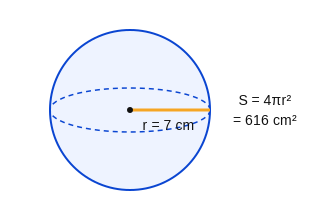
Q13433.
Find the surface area of a sphere of radius 7 cm. (Take π = 22/7)
7 cm त्रिज्या वाले एक गोले का पृष्ठीय क्षेत्रफल ज्ञात कीजिए। (π = 22/7 लीजिए)
  1. A484 sq cm484 वर्ग cm
  2. B616 sq cm616 वर्ग cm
  3. C588 sq cm588 वर्ग cm
  4. D704 sq cm704 वर्ग cm
Show answer

Concept: Surface area of a sphere =4πr2.

  1. r=7 cm, so r2=49.
  2. 4×227×49=4×22×7=616cm2.

Trick: With r=7, πr2=154; sphere surface =4×154=616.

Answer: (B) 616 sq cm

अवधारणा: गोले का पृष्ठीय क्षेत्रफल =4πr2।

  1. r=7 cm, अतः r2=49।
  2. 4×227×49=4×22×7=616cm2।

ट्रिक: r=7 पर πr2=154; गोले का पृष्ठ =4×154=616।

उत्तर: (B) 616 sq cm

RRB NTPC Undergraduate CBT 1MathematicsMensuration – sphereRRB NTPC Undergraduate CBT 1 2025 · 14 Jun Shift 1 →
Q13434.
The average of 6.5, 10.8, 19.9 and a is 18. The value of a is:
6.5, 10.8, 19.9 और a का औसत 18 है। a का मान है:
  1. A33.8
  2. B36.8
  3. C34.8
  4. D35.8
Show answer

Concept: Sum = average × number of terms.

  1. Required sum =18×4=72.
  2. Known sum =6.5+10.8+19.9=37.2.
  3. a=72−37.2=34.8.

Trick: Deviations from 18: −11.5,−7.2,+1.9 total −16.8, so a=18+16.8=34.8.

Answer: (C) 34.8

अवधारणा: योग = औसत × पदों की संख्या।

  1. आवश्यक योग =18×4=72।
  2. ज्ञात योग =6.5+10.8+19.9=37.2।
  3. a=72−37.2=34.8।

ट्रिक: 18 से विचलन: −11.5,−7.2,+1.9 कुल −16.8, अतः a=18+16.8=34.8।

उत्तर: (C) 34.8

RRB NTPC Undergraduate CBT 1MathematicsAverageRRB NTPC Undergraduate CBT 1 2025 · 14 Jun Shift 1 →
Q13435.
The price of sugar is increased by 3%. How much percent the consumption of sugar must be reduced so as not to increase the expenditure on sugar? (correct your answer to one decimal place)
चीनी के मूल्य में 3% की वृद्धि होती है। चीनी की खपत में कितने प्रतिशत की कमी की जानी चाहिए ताकि चीनी पर व्यय न बढ़े? (अपने उत्तर को एक दशमलव स्थान तक सही कीजिए)
  1. A1.7%
  2. B2.6%
  3. C2.9%
  4. D1.9%
Show answer

Concept: To keep expenditure same after a price rise of r%, reduce consumption by r100+r×100%.

  1. r=3: reduction =3103×100.
  2. =2.912…≈2.9%.

Trick: Price up by 3% means ₹103 now buys what ₹100 bought – you lose 3103 of the quantity.

Answer: (C) 2.9%

अवधारणा: कीमत r% बढ़ने पर खर्च समान रखने के लिए खपत r100+r×100% घटाएँ।

  1. r=3: कमी =3103×100।
  2. =2.912…≈2.9%।

ट्रिक: 3% वृद्धि का अर्थ – अब ₹103 में उतना मिलता है जितना पहले ₹100 में; मात्रा का 3103 भाग घटता है।

उत्तर: (C) 2.9%

RRB NTPC Undergraduate CBT 1MathematicsPercentage – price & consumptionRRB NTPC Undergraduate CBT 1 2025 · 14 Jun Shift 1 →
Q13436.
The ratio of the age of a father and his son at present is 6:1. After 5 years from now, the ratio will become 7:2. Find the present age of the son.
वर्तमान में एक पिता और उसके पुत्र की आयु का अनुपात 6:1 है। अब से 5 वर्ष बाद, यह अनुपात 7:2 हो जाएगा। पुत्र की वर्तमान आयु ज्ञात कीजिए।
  1. A4 years4 वर्ष
  2. B8 years8 वर्ष
  3. C7 years7 वर्ष
  4. D5 years5 वर्ष
Show answer

Concept: Let present ages be 6x and x; form the equation for the future ratio.

  1. After 5 years: 6x+5x+5=72.
  2. 12x+10=7x+35⇒5x=25⇒x=5.
  3. Son's present age =5 years (father 30; after 5 years 35:10=7:2 ✓).

Trick: Test options: son 5, father 30 → 35 and 10 →7:2 instantly.

Answer: (D) 5 years

अवधारणा: वर्तमान आयु 6x और x मानकर भविष्य के अनुपात का समीकरण बनाइए।

  1. 5 वर्ष बाद: 6x+5x+5=72।
  2. 12x+10=7x+35⇒x=5।
  3. पुत्र की वर्तमान आयु =5 वर्ष (पिता 30; 5 वर्ष बाद 35:10=7:2 ✓)।

ट्रिक: विकल्प जाँचें: पुत्र 5, पिता 30 → 35 और 10 →7:2।

उत्तर: (D) 5 years

RRB NTPC Undergraduate CBT 1MathematicsAgesRRB NTPC Undergraduate CBT 1 2025 · 14 Jun Shift 1 →
Q13437.
After successive discounts of 15% and 10%, a customer pays ₹3,672. What was the marked price?
15% और 10% की क्रमिक छूट के बाद, एक ग्राहक ₹3,672 का भुगतान करता है। अंकित मूल्य क्या था?
  1. A₹4,750
  2. B₹4,700
  3. C₹4,800
  4. D₹4,850
Show answer

Concept: SP=MP×(1−d1)(1−d2).

  1. Net multiplier =0.85×0.90=0.765.
  2. MP=36720.765=4800.

Trick: Successive 15% and 10% = single discount 23.5%; 76.5% of 4800 =3672.

Answer: (C) ₹4,800

अवधारणा: SP=MP×(1−d1)(1−d2)।

  1. शुद्ध गुणक =0.85×0.90=0.765।
  2. MP=36720.765=4800।

ट्रिक: क्रमिक 15% व 10% = एकल छूट 23.5%; 4800 का 76.5%=3672।

उत्तर: (C) ₹4,800

RRB NTPC Undergraduate CBT 1MathematicsSuccessive discountsRRB NTPC Undergraduate CBT 1 2025 · 14 Jun Shift 1 →
Q13438.
If 27 and 81 are the first two terms of a proportion and the third proportional to these numbers is used as the length of a rectangle whose width is 4 units, what is the numeric value of the area of the rectangle?
यदि 27 और 81 एक समानुपात के पहले दो पद हैं और इन संख्याओं के तृतीयानुपाती को एक आयत की लंबाई के रूप में उपयोग किया जाता है जिसकी चौड़ाई 4 इकाई है, तो आयत के क्षेत्रफल का संख्यात्मक मान क्या है?
  1. A972
  2. B6561
  3. C729
  4. D486
Show answer

Concept: Third proportional to a and b is c=b2a (since a:b=b:c).

  1. c=81227=656127=243.
  2. Area =length×width=243×4=972.

Trick: 27=33,81=34⇒c=35=243 – powers of 3 make it instant.

Answer: (A) 972

अवधारणा: a और b का तृतीयानुपाती c=b2a (a:b=b:c)।

  1. c=81227=243।
  2. क्षेत्रफल =243×4=972।

ट्रिक: 27=33,81=34⇒c=35=243।

उत्तर: (A) 972

RRB NTPC Undergraduate CBT 1MathematicsThird proportionalRRB NTPC Undergraduate CBT 1 2025 · 14 Jun Shift 1 →
Q13439.
If cosx−sinx=a and cosx+sinx=b, then the value of 1−tan2x1+tan2x is
यदि cosx−sinx=a और cosx+sinx=b है, तो 1−tan2x1+tan2x का मान है
  1. Aa2+b2
  2. Bab
  3. Ca2−b2
  4. D−ab
Show answer

Concept: 1−tan2x1+tan2x=cos2x−sin2x (divide numerator and denominator by sec2x).

  1. 1−tan2x1+tan2x=cos2x−sin2xcos2x+sin2x=cos2x−sin2x.
  2. cos2x−sin2x=(cosx−sinx)(cosx+sinx)=ab.

Trick: Both 1−tan2x1+tan2x and (cosx−sinx)(cosx+sinx) equal cos2x.

Answer: (B) ab

अवधारणा: 1−tan2x1+tan2x=cos2x−sin2x (अंश-हर को sec2x से भाग दें)।

  1. 1−tan2x1+tan2x=cos2x−sin2xcos2x+sin2x=cos2x−sin2x।
  2. cos2x−sin2x=(cosx−sinx)(cosx+sinx)=ab।

ट्रिक: 1−tan2x1+tan2x और (cosx−sinx)(cosx+sinx) दोनों =cos2x।

उत्तर: (B) ab

RRB NTPC Undergraduate CBT 1MathematicsTrigonometric identitiesRRB NTPC Undergraduate CBT 1 2025 · 14 Jun Shift 1 →
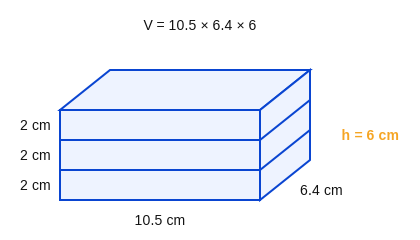
Q13440.
A new cuboid is formed by placing three cuboids of length 10.5 cm, breadth 6.4 cm, and height 2 cm, one on top of the other. What is the volume of the new cuboid?
10.5 cm लंबाई, 6.4 cm चौड़ाई और 2 cm ऊँचाई वाले तीन घनाभों को एक के ऊपर एक रखकर एक नया घनाभ बनाया जाता है। नए घनाभ का आयतन क्या है?
  1. A403.2 cm3
  2. B303.2 cm3
  3. C503.2 cm3
  4. D413.2 cm3
Show answer

Concept: Stacking one on top of another adds heights; length and breadth stay the same. V=l×b×h.

  1. New height =3×2=6 cm.
  2. V=10.5×6.4×6=10.5×38.4=403.2cm3.

Trick: Volume of stack =3× volume of one =3×134.4=403.2 – volumes simply add.

Answer: (A) 403.2 cm3

अवधारणा: एक के ऊपर एक रखने से ऊँचाइयाँ जुड़ती हैं; लंबाई-चौड़ाई वही रहती है। V=l×b×h।

  1. नई ऊँचाई =3×2=6 cm।
  2. V=10.5×6.4×6=403.2cm3।

ट्रिक: ढेर का आयतन =3× एक का आयतन =3×134.4=403.2 – आयतन सीधे जुड़ते हैं।

उत्तर: (A) 403.2 cm3

RRB NTPC Undergraduate CBT 1MathematicsMensuration – cuboidRRB NTPC Undergraduate CBT 1 2025 · 14 Jun Shift 1 →