Question bank

Q&A: practice questions with answers

Search questions on any topic. Filter by exam category, exam, subject and topic, try the question, then open the answer and explanation.

Courses – airGurukul

20,719 questions found.

Q13441.
The simple interest on a sum is 25% of the sum in 5 years. Find the rate of interest.
किसी राशि पर 5 वर्षों में साधारण ब्याज उस राशि का 25% है। ब्याज की दर ज्ञात कीजिए।
  1. A3%
  2. B5%
  3. C25%
  4. D4%
Show answer

Concept: SI=P×R×T100.

  1. SI =25% of P in 5 years ⇒R×5100=25100.
  2. R=255=5% per annum.

Trick: In SI, total % interest =R×T; so R=255.

Answer: (B) 5%

अवधारणा: SI=P×R×T100।

  1. 5 वर्ष में SI =P का 25%⇒R×5100=25100।
  2. R=255=5% वार्षिक।

ट्रिक: SI में कुल % ब्याज =R×T; अतः R=255।

उत्तर: (B) 5%

RRB NTPC Undergraduate CBT 1MathematicsSimple interestRRB NTPC Undergraduate CBT 1 2025 · 14 Jun Shift 1 →
Q13442.
A person sold an article at a loss of 10%. Had he sold it for ₹60 more, he would have gained 5%. Find the cost price of the article.
एक व्यक्ति ने एक वस्तु को 10% की हानि पर बेचा। यदि उसने इसे ₹60 अधिक में बेचा होता, तो उसे 5% का लाभ होता। वस्तु का क्रय मूल्य ज्ञात कीजिए।
  1. A₹400
  2. B₹480
  3. C₹420
  4. D₹440
Show answer

Concept: The difference between the two selling prices equals the difference in percentages of CP.

  1. Loss 10%→ SP =90% of CP; gain 5%→ SP =105% of CP.
  2. Difference =15% of CP =₹60.
  3. CP =6015×100=₹400.

Trick: CP=Difference in SP×100Gain%+Loss%=60×10015.

Answer: (A) ₹400

अवधारणा: दोनों विक्रय मूल्यों का अंतर = CP के प्रतिशतों का अंतर।

  1. 10% हानि → SP =90% CP; 5% लाभ → SP =105% CP।
  2. अंतर =15% CP =₹60।
  3. CP =6015×100=₹400।

ट्रिक: CP=SP का अंतर×100लाभ%+हानि%=60×10015।

उत्तर: (A) ₹400

RRB NTPC Undergraduate CBT 1MathematicsProfit and lossRRB NTPC Undergraduate CBT 1 2025 · 14 Jun Shift 1 →
Q13443.
A shopkeeper offers the following schemes on toys of the same marked price. (A) Successive discounts of 45% and 44% on any number of toys bought.
(B) Successive discounts of 36%, 41% and 45% on any number of toys bought. (C) 49% discount on the first 4 toys and 19% discount on each toy thereon.
(D) 7 toys free of cost on buying 10 toys.
A customer wants to buy 10 toys. Which of the above schemes is the least beneficial to her?
एक दुकानदार समान अंकित मूल्य वाले खिलौनों पर निम्नलिखित योजनाएँ प्रदान करता है। (A) कितने भी खिलौने खरीदने पर 45% और 44% की क्रमिक छूट।
(B) कितने भी खिलौने खरीदने पर 36%, 41% और 45% की क्रमिक छूट। (C) पहले 4 खिलौनों पर 49% छूट और उसके बाद प्रत्येक खिलौने पर 19% छूट।
(D) 10 खिलौने खरीदने पर 7 खिलौने निःशुल्क।
एक ग्राहक 10 खिलौने खरीदना चाहती है। उपर्युक्त में से कौन-सी योजना उसके लिए सबसे कम लाभदायक है?
  1. AB
  2. BD
  3. CC
  4. DA
Show answer

Concept: Compare the effective price paid per toy (MP =100) under each scheme; the highest is the least beneficial.

  1. (A) 100×0.55×0.56=30.8 per toy.
  2. (B) 100×0.64×0.59×0.55≈20.8 per toy.
  3. (C) 10 toys: 4×51+6×81=204+486=690⇒69 per toy.
  4. (D) Pay for 10, get 17: 100017≈58.8 per toy.
  5. Highest cost per toy is scheme C.

Trick: Big successive discounts (45% then 44%) are far stronger than one 49% on only a few items – always compute per-unit cost.

Answer: (C) C

अवधारणा: हर योजना में प्रति खिलौना प्रभावी कीमत (MP =100) निकालें; सबसे अधिक वाली योजना सबसे कम लाभकारी।

  1. (A) 100×0.55×0.56=30.8 प्रति खिलौना।
  2. (B) 100×0.64×0.59×0.55≈20.8।
  3. (C) 10 खिलौने: 4×51+6×81=690⇒69 प्रति खिलौना।
  4. (D) 10 का भुगतान, 17 मिले: 100017≈58.8।
  5. सबसे अधिक प्रति-खिलौना कीमत योजना C में।

ट्रिक: बड़ी क्रमिक छूट (45% फिर 44%) केवल कुछ वस्तुओं पर 49% से कहीं अधिक प्रभावी – हमेशा प्रति-इकाई कीमत निकालें।

उत्तर: (C) C

RRB NTPC Undergraduate CBT 1MathematicsDiscount schemes comparisonRRB NTPC Undergraduate CBT 1 2025 · 14 Jun Shift 1 →
Q13444.
What is the smallest number that must be added to 45873 so that the sum is divisible by 11?
45873 में कौन-सी सबसे छोटी संख्या जोड़ी जानी चाहिए ताकि योगफल 11 से विभाज्य हो?
  1. A4
  2. B6
  3. C8
  4. D9
Show answer

Concept: A number is divisible by 11 if (sum of digits at odd places) − (sum at even places) is 0 or a multiple of 11.

  1. 45873 from the right: 3−7+8−5+4=3.
  2. So 45873≡3(mod11) (check: 11×4170=45870, remainder 3).
  3. Add 11−3=8 to reach the next multiple: 45881=11×4171.

Trick: Number to add =11−remainder; number to subtract = remainder.

Answer: (C) 8

अवधारणा: विषम स्थानों के अंकों का योग − सम स्थानों का योग, 0 या 11 का गुणज हो तो संख्या 11 से विभाज्य।

  1. 45873 दाएँ से: 3−7+8−5+4=3।
  2. अतः शेषफल 3 (जाँच: 11×4170=45870)।
  3. जोड़ें 11−3=8: 45881=11×4171।

ट्रिक: जोड़ने वाली संख्या =11−शेष; घटाने वाली = शेष।

उत्तर: (C) 8

RRB NTPC Undergraduate CBT 1MathematicsDivisibility by 11RRB NTPC Undergraduate CBT 1 2025 · 14 Jun Shift 1 →
Q13445.
Two inlet pipes A and B can fill a cistern in 15 hours and 20 hours respectively. An outlet pipe C can empty the cistern in 30 hours. All three pipes are opened together, but the outlet pipe is closed after 5 hours. The total time (in hours) required to fill the cistern completely is
दो इनलेट पाइप A और B एक टंकी को क्रमशः 15 घंटे और 20 घंटे में भर सकते हैं। एक आउटलेट पाइप C टंकी को 30 घंटे में खाली कर सकता है। तीनों पाइप एक साथ खोले जाते हैं, लेकिन आउटलेट पाइप को 5 घंटे बाद बंद कर दिया जाता है। टंकी को पूरी तरह भरने में लगने वाला कुल समय (घंटों में) है
  1. A913
  2. B9
  3. C10
  4. D923
Show answer

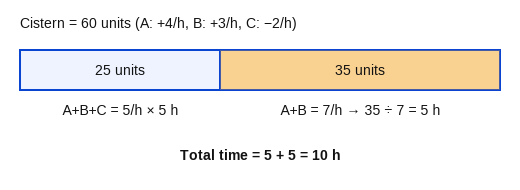
Concept: Take capacity =LCM(15,20,30)=60 units; inlets add, outlet subtracts.

  1. A =4, B =3, C =−2 units/h.
  2. First 5 h: (4+3−2)×5=25 units filled.
  3. Remaining 60−25=35 units with A+B =7/h: 357=5 h.
  4. Total =5+5=10 h.

Trick: Work in units of LCM – fractions vanish and the two phases become simple subtraction.

Answer: (C) 10

अवधारणा: क्षमता =LCM(15,20,30)=60 इकाई; इनलेट जोड़ते हैं, आउटलेट घटाता है।

  1. A =4, B =3, C =−2 इकाई/घंटा।
  2. पहले 5 h: (4+3−2)×5=25 इकाई।
  3. शेष 35 इकाई A+B =7/h से: 357=5 h।
  4. कुल =5+5=10 h।

ट्रिक: LCM इकाइयों में काम करें – भिन्न गायब, दोनों चरण सरल घटाव बन जाते हैं।

उत्तर: (C) 10

RRB NTPC Undergraduate CBT 1MathematicsPipes and cisternsRRB NTPC Undergraduate CBT 1 2025 · 14 Jun Shift 1 →
Q13446.
The sum of the digits of a two digit number is 11. If 27 is added to the number its digits are reversed. Find the ratio between the original number to the number obtained on reversing the digits.
दो अंकों वाली एक संख्या के अंकों का योग 11 है। यदि संख्या में 27 जोड़ दिया जाए, तो उसके अंक उलट जाते हैं। मूल संख्या और अंकों को उलटने पर प्राप्त संख्या का अनुपात ज्ञात कीजिए।
  1. A36:59
  2. B47:74
  3. C13:17
  4. D23:29
Show answer

Concept: Number =10a+b; reversing gives 10b+a; their difference =9(b−a).

  1. a+b=11 and (10b+a)−(10a+b)=27⇒9(b−a)=27⇒b−a=3.
  2. a=4,b=7: number =47, reversed =74.
  3. Ratio =47:74.

Trick: Adding 27 reverses digits ⇒ digits differ by 279=3; with sum 11 the digits are 4 and 7.

Answer: (B) 47:74

अवधारणा: संख्या =10a+b; उलटने पर 10b+a; अंतर =9(b−a)।

  1. a+b=11 और 9(b−a)=27⇒b−a=3।
  2. a=4,b=7: संख्या 47, उलटी 74।
  3. अनुपात =47:74।

ट्रिक: 27 जोड़ने पर अंक उलटें ⇒ अंकों का अंतर 279=3; योग 11 से अंक 4 और 7।

उत्तर: (B) 47:74

RRB NTPC Undergraduate CBT 1MathematicsTwo-digit numbersRRB NTPC Undergraduate CBT 1 2025 · 14 Jun Shift 1 →
Q13447.
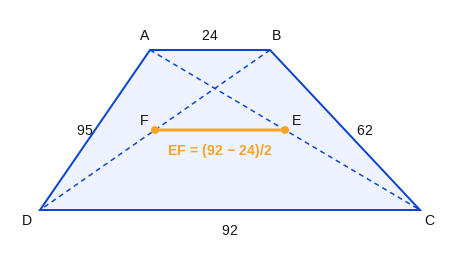
ABCD is a quadrilateral in which AB ∥ DC, and E and F are the mid points of the diagonals AC and BD, respectively. If AB = 24 cm, BC = 62 cm, DC = 92 cm, and AD = 95 cm, then what is the length (in cm) of EF?
ABCD एक चतुर्भुज है जिसमें AB ∥ DC है, और E तथा F क्रमशः विकर्णों AC और BD के मध्य-बिंदु हैं। यदि AB = 24 cm, BC = 62 cm, DC = 92 cm और AD = 95 cm है, तो EF की लंबाई (cm में) क्या है?
  1. A34
  2. B29
  3. C39
  4. D36
Show answer

Concept: In a trapezium, the segment joining the midpoints of the diagonals is parallel to the parallel sides and equals half their difference.

  1. EF=12(DC−AB).
  2. =12(92−24)=682=34 cm.
  3. The lengths BC=62 and AD=95 are not needed.

Trick: Midpoints of non-parallel sides →a+b2; midpoints of diagonals →a−b2.

Answer: (A) 34

अवधारणा: समलंब में विकर्णों के मध्य-बिंदुओं को मिलाने वाला खंड समांतर भुजाओं के समांतर होता है और उनके अंतर का आधा होता है।

  1. EF=12(DC−AB)।
  2. =12(92−24)=34 cm।
  3. BC=62 और AD=95 की आवश्यकता नहीं।

ट्रिक: असमांतर भुजाओं के मध्य-बिंदु →a+b2; विकर्णों के मध्य-बिंदु →a−b2।

उत्तर: (A) 34

RRB NTPC Undergraduate CBT 1MathematicsGeometry – trapezium midpointsRRB NTPC Undergraduate CBT 1 2025 · 14 Jun Shift 1 →
Q13448.
The simplified value of the expression 0.52×55×2−4×44×10−3÷a is 1, then the value of a is ______.
व्यंजक 0.52×55×2−4×44×10−3÷a का सरलीकृत मान 1 है, तो a का मान ______ है।
  1. A12.5
  2. B25
  3. C6.25
  4. D50
Show answer

Concept: Write every term as powers of 2 and 5, then simplify.

  1. 0.52=14, 55=3125, 2−4=116, 44=256, 10−3=11000.
  2. Product =14×3125×25616×11000=3125×41000=12.5.
  3. 12.5a=1⇒a=12.5.

Trick: In powers: 2−2·55·2−4·28·2−35−3=2−1·52=252.

Answer: (A) 12.5

अवधारणा: हर पद को 2 और 5 की घातों में लिखकर सरल करें।

  1. 0.52=14, 55=3125, 2−4=116, 44=256, 10−3=11000।
  2. गुणनफल =14×3125×16×11000=12.5।
  3. 12.5a=1⇒a=12.5।

ट्रिक: घातों में: 2−2·55·2−4·28·2−35−3=2−1·52=252।

उत्तर: (A) 12.5

RRB NTPC Undergraduate CBT 1MathematicsIndices (exponents)RRB NTPC Undergraduate CBT 1 2025 · 14 Jun Shift 1 →
Q13449.
Find the value of m which satisfies
(145)11×(514)17×(145)14=(514)3m+7
m का वह मान ज्ञात कीजिए जो निम्नलिखित को संतुष्ट करता है
(145)11×(514)17×(145)14=(514)3m+7
  1. A−25
  2. B−14
  3. C−7
  4. D−5
Show answer

Concept: (145)n=(514)−n; with the same base, equate exponents.

  1. LHS =(514)−11×(514)17×(514)−14=(514)−11+17−14=(514)−8.
  2. 3m+7=−8⇒3m=−15⇒m=−5.

Trick: Flip the fraction ⇒ change the sign of the exponent; then just add exponents.

Answer: (D) −5

अवधारणा: (145)n=(514)−n; समान आधार पर घातांक बराबर करें।

  1. LHS =(514)−11+17−14=(514)−8।
  2. 3m+7=−8⇒m=−5।

ट्रिक: भिन्न पलटें ⇒ घातांक का चिह्न बदलें; फिर घातांक जोड़ दें।

उत्तर: (D) −5

RRB NTPC Undergraduate CBT 1MathematicsLaws of exponentsRRB NTPC Undergraduate CBT 1 2025 · 14 Jun Shift 1 →
Q13450.
Three numbers are in the ratio 11 : 3 : 2, and their LCM is 2706. Their HCF is:
तीन संख्याएँ 11 : 3 : 2 के अनुपात में हैं, और उनका LCM 2706 है। उनका HCF है:
  1. A41
  2. B30
  3. C50
  4. D82
Show answer

Concept: Numbers in ratio a:b:c (co-prime) are ax,bx,cx; HCF =x and LCM =lcm(a,b,c)×x.

  1. Numbers =11x,3x,2x; lcm(11,3,2)=66.
  2. 66x=2706⇒x=41.
  3. HCF =x=41.

Trick: HCF=LCMLCM of ratio terms=270666.

Answer: (A) 41

अवधारणा: अनुपात a:b:c (सह-अभाज्य) वाली संख्याएँ ax,bx,cx; HCF =x, LCM =lcm(a,b,c)×x।

  1. संख्याएँ 11x,3x,2x; lcm(11,3,2)=66।
  2. 66x=2706⇒x=41।
  3. HCF =41।

ट्रिक: HCF=LCMअनुपात पदों का LCM=270666।

उत्तर: (A) 41

RRB NTPC Undergraduate CBT 1MathematicsLCM and HCF with ratioRRB NTPC Undergraduate CBT 1 2025 · 14 Jun Shift 1 →
Q13451.
A and B can do a piece of work in 12 days and 18 days, respectively. Both work for 2 days and then A leaves. How long (in days) will B take to complete the remaining work?
A और B किसी कार्य को क्रमशः 12 दिन और 18 दिन में कर सकते हैं। दोनों 2 दिन तक कार्य करते हैं और फिर A चला जाता है। शेष कार्य को पूरा करने में B कितना समय (दिनों में) लेगा?
  1. A15
  2. B14
  3. C13
  4. D12
Show answer

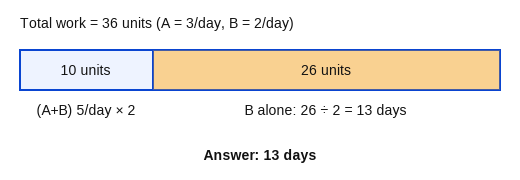
Concept: Total work =LCM(12,18)=36 units; efficiency = work per day.

  1. A =3 units/day, B =2 units/day.
  2. In 2 days together: 5×2=10 units; remaining 26.
  3. B alone: 262=13 days.

Trick: Fractions: done =2(112+118)=518; left 1318×18=13 days.

Answer: (C) 13

अवधारणा: कुल कार्य =LCM(12,18)=36 इकाई; दक्षता = प्रतिदिन कार्य।

  1. A =3, B =2 इकाई/दिन।
  2. 2 दिन साथ: 5×2=10 इकाई; शेष 26।
  3. B अकेला: 262=13 दिन।

ट्रिक: भिन्न से: हुआ =2(112+118)=518; शेष 1318×18=13 दिन।

उत्तर: (C) 13

RRB NTPC Undergraduate CBT 1MathematicsTime and workRRB NTPC Undergraduate CBT 1 2025 · 14 Jun Shift 1 →
Q13452.
What is the correct ascending order of the following ratios?
11:15, 23:55, 32:33, 4:11, 26:35
निम्नलिखित अनुपातों का सही आरोही क्रम क्या है?
11:15, 23:55, 32:33, 4:11, 26:35
  1. A4:11, 23:55, 11:15, 26:35, 32:33
  2. B4:11, 26:35, 11:15, 23:55, 32:33
  3. C4:11, 11:15, 23:55, 26:35, 32:33
  4. D4:11, 23:55, 26:35, 11:15, 32:33
Show answer

Concept: Convert each ratio to a decimal and arrange.

  1. 411≈0.364, 2355≈0.418, 1115≈0.733, 2635≈0.743, 3233≈0.970.
  2. Ascending: 4:11<23:55<11:15<26:35<32:33.

Trick: Only 11:15 vs 26:35 is close – cross-multiply: 11×35=385<26×15=390, so 11:15 is smaller.

Answer: (A) 4:11, 23:55, 11:15, 26:35, 32:33

अवधारणा: हर अनुपात को दशमलव में बदलकर क्रम लगाएँ।

  1. 411≈0.364, 2355≈0.418, 1115≈0.733, 2635≈0.743, 3233≈0.970।
  2. आरोही: 4:11<23:55<11:15<26:35<32:33।

ट्रिक: केवल 11:15 और 26:35 पास हैं – वज्र-गुणन: 11×35=385<26×15=390, अतः 11:15 छोटा।

उत्तर: (A) 4:11, 23:55, 11:15, 26:35, 32:33

RRB NTPC Undergraduate CBT 1MathematicsComparing ratiosRRB NTPC Undergraduate CBT 1 2025 · 14 Jun Shift 1 →
Q13453.
A sum of ₹10,000 is invested at a compound interest rate of 10% per annum for 2 years, compounded annually. What is the compound interest earned?
₹10,000 की राशि को 2 वर्षों के लिए 10% वार्षिक चक्रवृद्धि ब्याज दर पर निवेश किया जाता है, ब्याज वार्षिक रूप से संयोजित होता है। अर्जित चक्रवृद्धि ब्याज क्या है?
  1. A₹1,900
  2. B₹2,000
  3. C₹2,200
  4. D₹2,100
Show answer

Concept: A=P(1+R100)T; CI =A−P.

  1. A=10000×(1.1)2=10000×1.21=12100.
  2. CI =12100−10000=₹2,100.

Trick: 2-year CI rate =R+R+R2100=10+10+1=21% of 10,000 =2100.

Answer: (D) ₹2,100

अवधारणा: A=P(1+R100)T; CI =A−P।

  1. A=10000×(1.1)2=12100।
  2. CI =12100−10000=₹2,100।

ट्रिक: 2 वर्ष की प्रभावी CI दर =R+R+R2100=21%; 10,000 का 21%=2100।

उत्तर: (D) ₹2,100

RRB NTPC Undergraduate CBT 1MathematicsCompound interestRRB NTPC Undergraduate CBT 1 2025 · 14 Jun Shift 1 →
Q13454.
Evaluate 253 + (-20)3 + (-5)3
253 + (-20)3 + (-5)3 का मान ज्ञात कीजिए।
  1. A7244
  2. B7467
  3. C7500
  4. D7360
Show answer

Concept: If a+b+c=0, then a3+b3+c3=3abc.

  1. 25+(−20)+(−5)=0 ✓.
  2. 3abc=3×25×(−20)×(−5)=3×2500=7500.

Trick: Whenever three numbers sum to zero, skip the cubes and use 3abc.

Answer: (C) 7500

अवधारणा: यदि a+b+c=0, तो a3+b3+c3=3abc।

  1. 25+(−20)+(−5)=0 ✓।
  2. 3abc=3×25×(−20)×(−5)=7500।

ट्रिक: तीन संख्याओं का योग शून्य हो तो घन निकालने की जगह सीधे 3abc लगाएँ।

उत्तर: (C) 7500

RRB NTPC Undergraduate CBT 1MathematicsAlgebraic identity a³+b³+c³RRB NTPC Undergraduate CBT 1 2025 · 14 Jun Shift 1 →
Q13455.
Meena and her mother visit a shop. The shopkeeper tells them that the price of 5 identical dresses is ₹4,955. Meena buys 9 such dresses. Find the total cost of the 9 dresses.
मीना और उसकी माँ एक दुकान पर जाती हैं। दुकानदार उन्हें बताता है कि 5 एक जैसी पोशाकों का मूल्य ₹4,955 है। मीना ऐसी 9 पोशाकें खरीदती है। 9 पोशाकों का कुल मूल्य ज्ञात कीजिए।
  1. A₹8,919
  2. B₹8,199
  3. C₹8,099
  4. D₹8,991
Show answer

Concept: Find the cost of one unit, then multiply.

  1. Cost of 1 dress =49555=₹991.
  2. Cost of 9 dresses =991×9=₹8,919.

Trick: 991×9=(1000−9)×9=9000−81=8919.

Answer: (A) ₹8,919

अवधारणा: एक इकाई की कीमत निकालकर गुणा करें।

  1. 1 ड्रेस =49555=₹991।
  2. 9 ड्रेस =991×9=₹8,919।

ट्रिक: 991×9=(1000−9)×9=9000−81=8919।

उत्तर: (A) ₹8,919

RRB NTPC Undergraduate CBT 1MathematicsUnitary methodRRB NTPC Undergraduate CBT 1 2025 · 14 Jun Shift 1 →
Q13456.
If 2 is added to each odd digit and 2 is subtracted from each even digit in the number 7213546, what will be difference between the highest and lowest digits in the number thus formed?
यदि संख्या 7213546 में प्रत्येक विषम अंक में 2 जोड़ दिया जाए और प्रत्येक सम अंक में से 2 घटा दिया जाए, तो इस प्रकार बनी संख्या में सबसे बड़े और सबसे छोटे अंकों के बीच का अंतर क्या होगा?
  1. A9
  2. B6
  3. C8
  4. D7
Show answer

Concept: Apply the rule digit by digit: odd digit +2, even digit −2, then compare the digits of the new number.

  1. 7 2 1 3 5 4 6 → 7+2=9, 2−2=0, 1+2=3, 3+2=5, 5+2=7, 4−2=2, 6−2=4.
  2. New number: 9 0 3 5 7 2 4.
  3. Highest digit 9, lowest digit 0 → difference 9−0=9.

Trick: Write the new digits directly under the old ones – the lone even digit 2 becomes 0, which usually becomes the minimum.

Answer: (A) 9

अवधारणा: नियम हर अंक पर लगाएँ: विषम अंक +2, सम अंक −2, फिर नई संख्या के अंकों की तुलना करें।

  1. 7 2 1 3 5 4 6 → 7+2=9, 2−2=0, 1+2=3, 3+2=5, 5+2=7, 4−2=2, 6−2=4।
  2. नई संख्या: 9 0 3 5 7 2 4।
  3. सबसे बड़ा अंक 9, सबसे छोटा 0 → अंतर 9−0=9।

ट्रिक: नए अंक सीधे पुराने अंकों के नीचे लिखें – अकेला सम अंक 2 घटकर 0 बनता है, जो प्रायः न्यूनतम होता है।

उत्तर: (A) 9

RRB NTPC Undergraduate CBT 1General Intelligence and ReasoningNumber operationsRRB NTPC Undergraduate CBT 1 2025 · 14 Jun Shift 1 →
Q13457.
Each of the digits in the number 9342156 is arranged in ascending order from left to right. The position(s) of how many digits will remain unchanged as compared to that in the original number?
संख्या 9342156 के प्रत्येक अंक को बाएँ से दाएँ आरोही क्रम में व्यवस्थित किया जाता है। मूल संख्या की तुलना में कितने अंकों का/के स्थान अपरिवर्तित रहेगा/रहेंगे?
  1. ANoneएक भी नहीं
  2. BOneएक
  3. CThreeतीन
  4. DTwoदो
Show answer

Concept: Sort the digits in ascending order and compare position by position with the original.

  1. Original: 9 3 4 2 1 5 6; ascending: 1 2 3 4 5 6 9.
  2. Compare pairs (old, new): (9, 1), (3, 2), (4, 3), (2, 4), (1, 5), (5, 6), (6, 9) – no position has the same digit in both.
  3. Hence no digit keeps its place.

Trick: Write both numbers one below the other and tick only columns where the digits match.

Answer: (A) None

अवधारणा: अंकों को आरोही क्रम में लगाएँ और मूल संख्या से स्थान-दर-स्थान तुलना करें।

  1. मूल: 9 3 4 2 1 5 6; आरोही: 1 2 3 4 5 6 9।
  2. तुलना (पुराना, नया): (9, 1), (3, 2), (4, 3), (2, 4), (1, 5), (5, 6), (6, 9) – किसी भी स्थान पर दोनों अंक समान नहीं।
  3. अतः कोई अंक अपने स्थान पर नहीं रहता।

ट्रिक: दोनों संख्याएँ एक के नीचे एक लिखें और केवल उन्हीं स्तंभों पर निशान लगाएँ जहाँ अंक मिलते हैं।

उत्तर: (A) None

RRB NTPC Undergraduate CBT 1General Intelligence and ReasoningDigit arrangementRRB NTPC Undergraduate CBT 1 2025 · 14 Jun Shift 1 →
Q13458.
What should come in place of ‘?’ in the given series?
37 57 81 109 141 177 ?
दी गई शृंखला में ‘?’ के स्थान पर क्या आना चाहिए?
37 57 81 109 141 177 ?
  1. A205
  2. B211
  3. C217
  4. D214
Show answer

Concept: Take successive differences; if they grow by a constant, extend the pattern.

  1. 57−37=20, 81−57=24, 109−81=28, 141−109=32, 177−141=36.
  2. Differences increase by 4 each time, so the next difference is 40.
  3. 177+40=217.

Trick: Differences 20, 24, 28 … (multiples of 4) – a second-level arithmetic progression.

Answer: (C) 217

अवधारणा: क्रमागत अंतर निकालें; यदि वे समान मात्रा से बढ़ें तो पैटर्न आगे बढ़ाएँ।

  1. 57−37=20, 81−57=24, 109−81=28, 141−109=32, 177−141=36।
  2. अंतर हर बार 4 बढ़ता है, अतः अगला अंतर 40।
  3. 177+40=217।

ट्रिक: अंतर 20, 24, 28 … (4 के गुणज) – द्वितीय-स्तर की समांतर श्रेणी।

उत्तर: (C) 217

RRB NTPC Undergraduate CBT 1General Intelligence and ReasoningNumber seriesRRB NTPC Undergraduate CBT 1 2025 · 14 Jun Shift 1 →
Q13459.
Based on the English alphabetical order, three of the following four letter-cluster pairs are alike in a certain way and thus form a group. Which is the one that does not belong to that group?
(Note: The odd one out is not based on the number of consonants/vowels or their position in the letter-cluster.)
अंग्रेज़ी वर्णमाला क्रम के आधार पर, निम्नलिखित चार अक्षर-समूह युग्मों में से तीन किसी निश्चित प्रकार से एकसमान हैं और इस प्रकार एक समूह बनाते हैं। कौन-सा युग्म उस समूह से संबंधित नहीं है?
(नोट: असंगत युग्म, व्यंजनों/स्वरों की संख्या या अक्षर-समूह में उनके स्थान पर आधारित नहीं है।)
  1. AON - QP
  2. BUT - WX
  3. CSR - UT
  4. DLK - NM
Show answer

Concept: Compare corresponding letters of each pair using alphabet positions.

  1. ON → QP: O+2=Q, N+2=P.
  2. SR → UT: S+2=U, R+2=T; LK → NM: L+2=N, K+2=M.
  3. UT → WX: U+2=W but T+4=X – breaks the (+2,+2) pattern.

Trick: In the three alike pairs the second cluster is also two consecutive letters in reverse (QP, UT, NM); WX is forward order – spot it at a glance.

Answer: (B) UT - WX

अवधारणा: प्रत्येक जोड़ी के संगत अक्षरों की तुलना वर्णमाला स्थान से करें।

  1. ON → QP: O+2=Q, N+2=P।
  2. SR → UT: S+2=U, R+2=T; LK → NM: L+2=N, K+2=M।
  3. UT → WX: U+2=W पर T+4=X – (+2,+2) पैटर्न टूटता है।

ट्रिक: तीन समान जोड़ियों में दूसरा समूह भी उल्टे क्रम के दो क्रमागत अक्षर है (QP, UT, NM); WX सीधे क्रम में है – एक नज़र में पकड़ें।

उत्तर: (B) UT - WX

RRB NTPC Undergraduate CBT 1General Intelligence and ReasoningLetter-cluster classificationRRB NTPC Undergraduate CBT 1 2025 · 14 Jun Shift 1 →
Q13460.
Refer to the given letter series and answer the question that follows. Counting to be done from left to right only.
(Left) O K I Y C R L U K V I E H L Y V O N Q O S Z (Right)
How many such consonants are there, each of which is immediately preceded by a vowel and also immediately followed by a vowel?
दी गई अक्षर शृंखला को देखिए और उसके बाद आने वाले प्रश्न का उत्तर दीजिए। गिनती केवल बाएँ से दाएँ की जानी है।
(बाएँ) O K I Y C R L U K V I E H L Y V O N Q O S Z (दाएँ)
ऐसे कितने व्यंजन हैं, जिनमें से प्रत्येक के ठीक पहले एक स्वर है और ठीक बाद भी एक स्वर है?
  1. A3
  2. B2
  3. C4
  4. D1
Show answer

Concept: Look for the pattern vowel – consonant – vowel in the series (vowels: A, E, I, O, U).

  1. Series: O K I Y C R L U K V I E H L Y V O N Q O S Z.
  2. Vowel-consonant-vowel triplets: O-K-I ✓; I-Y-C ✗; U-K-V ✗; I-E-H (E is a vowel, H followed by L) ✗; O-N-Q ✗; O-S-Z ✗.
  3. Only K (2nd letter) qualifies.

Trick: Underline the vowels first; then check only the single letters sandwiched between two underlined ones.

Answer: (D) 1

अवधारणा: श्रृंखला में स्वर – व्यंजन – स्वर का पैटर्न खोजें (स्वर: A, E, I, O, U)।

  1. श्रृंखला: O K I Y C R L U K V I E H L Y V O N Q O S Z।
  2. स्वर-व्यंजन-स्वर तिकड़ी: O-K-I ✓; I-Y-C ✗; U-K-V ✗; I-E-H (E स्वर है, H के बाद L) ✗; O-N-Q ✗; O-S-Z ✗।
  3. केवल K (दूसरा अक्षर) शर्त पूरी करता है।

ट्रिक: पहले स्वरों को रेखांकित करें; फिर केवल उन अकेले अक्षरों को जाँचें जो दो रेखांकित अक्षरों के बीच हों।

उत्तर: (D) 1

RRB NTPC Undergraduate CBT 1General Intelligence and ReasoningLetter series countingRRB NTPC Undergraduate CBT 1 2025 · 14 Jun Shift 1 →