Question bank

Q&A: practice questions with answers

Search questions on any topic. Filter by exam category, exam, subject and topic, try the question, then open the answer and explanation.

Courses – airGurukul

20,719 questions found.

Q13521.
When the dimensions of electric charge are considered, which fundamental units must be combined to express it in terms of SI base quantities?
जब विद्युत आवेश की विमाओं पर विचार किया जाता है, तो SI मूल राशियों के संदर्भ में इसे व्यक्त करने के लिए किन मूल मात्रकों का संयोजन करना आवश्यक है?
  1. AElectric current and lengthविद्युत धारा और लंबाई
  2. BMass and electric currentद्रव्यमान और विद्युत धारा
  3. CElectric current and timeविद्युत धारा और समय
  4. DLength and timeलंबाई और समय
Show answer

Concept: Electric charge is not an SI base quantity; it is derived from current and time.

  1. Q=I×t, so the unit of charge coulomb (C) =1ampere×1second.
  2. Ampere (current) and second (time) are SI base units; hence charge needs the combination of electric current and time.
  3. Length or mass do not enter the dimension of charge [As].

Trick: 1 C = 1 A·s – "charge flows per second as current".

Answer: (C) 1

अवधारणा: ('Electric current and time', 'विद्युत धारा और समय')

  1. व
  2. ि
  3. द
  4. ्
  5. य
  6. ु
  7. त
  8. आ
  9. व
  10. े
  11. श
  12. S
  13. I
  14. क
  15. ी
  16. म
  17. ू
  18. ल
  19. र
  20. ा
  21. श
  22. ि
  23. न
  24. ह
  25. ी
  26. ं
  27. ह
  28. ै
  29. ;
  30. य
  31. ह
  32. ध
  33. ा
  34. र
  35. ा
  36. औ
  37. र
  38. स
  39. म
  40. य
  41. स
  42. े
  43. व
  44. ्
  45. य
  46. ु
  47. त
  48. ्
  49. प
  50. न
  51. ्
  52. न
  53. ह
  54. ै
  55. ।

ट्रिक: ['Q=Itimest, अतः आवेश का मात्रक कूलॉम (C) =1,textamperetimes1,textsecond।', 'ऐम्पियर (धारा) और सेकंड (समय) SI मूल मात्रक हैं; इसलिए आवेश के लिए विद्युत धारा और समय का संयोजन चाहिए।', 'आवेश की विमा [textA,texts] में लंबाई या द्रव्यमान नहीं आते।']

उत्तर: (C)
RRB NTPC Undergraduate CBT 1General AwarenessPhysics – UnitsRRB NTPC Undergraduate CBT 1 2025 · 9 May Shift 3 →
Q13522.
Which Mughal emperor strengthened imperial authority by introducing the Mansabdari system and a centralized bureaucracy?
किस मुग़ल बादशाह ने मनसबदारी प्रथा (Mansabdari system) और केंद्रीकृत नौकरशाही (centralized bureaucracy) लागू करके शाही सत्ता को सुदृढ़ किया था?
  1. AMuhammad Shahमुहम्मद शाह
  2. BHumayunहुमायूँ
  3. CShah Jahanशाहजहाँ
  4. DAkbarअकबर
Show answer

Concept: The Mansabdari system was the backbone of Mughal military-civil administration.

  1. Akbar introduced the Mansabdari system (1571–75) – every officer held a mansab (rank) with zat and sawar grades, directly appointed and paid by the emperor.
  2. With Todar Mal's revenue reforms and the division of the empire into subas, Akbar built a centralised bureaucracy.
  3. Shah Jahan and Muhammad Shah only modified or weakened it; Humayun had no stable administration.

Trick: Akbar = Mansabdari + Din-i-Ilahi + Sulh-i-Kul.

Answer: (D) अ

अवधारणा: ('Akbar', 'अकबर')

  1. म
  2. न
  3. स
  4. ब
  5. द
  6. ा
  7. र
  8. ी
  9. प
  10. ्
  11. र
  12. थ
  13. ा
  14. म
  15. ु
  16. ग
  17. ल
  18. स
  19. ै
  20. न
  21. ्
  22. य
  23. -
  24. न
  25. ा
  26. ग
  27. र
  28. ि
  29. क
  30. प
  31. ्
  32. र
  33. श
  34. ा
  35. स
  36. न
  37. क
  38. ी
  39. र
  40. ी
  41. ढ
  42. ़
  43. थ
  44. ी
  45. ।

ट्रिक: ['अकबर ने मनसबदारी प्रथा (1571–75) शुरू की – हर अधिकारी का एक मनसब (पद) होता था जिसमें जात और सवार श्रेणियाँ थीं, नियुक्ति और वेतन सीधे बादशाह से।', 'टोडरमल के राजस्व सुधारों और साम्राज्य को सूबों में बाँटकर अकबर ने केंद्रीकृत नौकरशाही बनाई।', 'शाहजहाँ और मुहम्मद शाह ने इसे केवल बदला या कमज़ोर किया; हुमायूँ का कोई स्थिर प्रशासन नहीं था।']

उत्तर: (D) क

RRB NTPC Undergraduate CBT 1General AwarenessHistory – Mughal administrationRRB NTPC Undergraduate CBT 1 2025 · 9 May Shift 3 →
Q13523.
According to Census 2011 data, what was the literacy rate of India?
जनगणना 2011 (Census 2011) के आँकड़ों के अनुसार भारत की साक्षरता दर कितनी थी?
  1. A64.83%
  2. B79.40%
  3. C70.00%
  4. D74.04%
Show answer

Concept: Literacy rate = literate persons aged 7+ as a percentage of population aged 7+.

  1. Census 2011: India's literacy rate was 74.04% (male 82.14%, female 65.46%).
  2. In 2001 it was 64.83% (option A); 79.40% and 70% are not census figures.
  3. Kerala (94%) was the most literate state, Bihar (61.8%) the least.

Trick: 2001 → 64.8%, 2011 → 74.04% (rise of about 9 points).

Answer: (D) 2

अवधारणा: ('74.04%', '74.04%')

  1. स
  2. ा
  3. क
  4. ्
  5. ष
  6. र
  7. त
  8. ा
  9. द
  10. र
  11. =
  12. 7
  13. +
  14. आ
  15. य
  16. ु
  17. क
  18. ी
  19. स
  20. ा
  21. क
  22. ्
  23. ष
  24. र
  25. ज
  26. न
  27. स
  28. ं
  29. ख
  30. ्
  31. य
  32. ा
  33. क
  34. ा
  35. 7
  36. +
  37. आ
  38. य
  39. ु
  40. क
  41. ी
  42. क
  43. ु
  44. ल
  45. ज
  46. न
  47. स
  48. ं
  49. ख
  50. ्
  51. य
  52. ा
  53. म
  54. े
  55. ं
  56. प
  57. ्
  58. र
  59. त
  60. ि
  61. श
  62. त
  63. ।

ट्रिक: ['जनगणना 2011: भारत की साक्षरता दर 74.04% थी (पुरुष 82.14%, महिला 65.46%)।', '2001 में यह 64.83% थी (विकल्प A); 79.40% और 70% जनगणना के आँकड़े नहीं हैं।', 'केरल (94%) सर्वाधिक साक्षर राज्य, बिहार (61.8%) न्यूनतम।']

उत्तर: (D) 0

RRB NTPC Undergraduate CBT 1General AwarenessCensus 2011 – LiteracyRRB NTPC Undergraduate CBT 1 2025 · 9 May Shift 3 →
Q13524.
In dicotyledonous plants, which type of root system has a main primary root from which lateral branches arise?
द्विबीजपत्री (Dicotyledonous) पौधों में, किस प्रकार की जड़ में एक मुख्य प्राथमिक जड़ होती है, जिससे पार्श्व शाखाएँ (lateral branches) निकलती हैं?
  1. ATap root systemमूसला जड़ तंत्र
  2. BFibrous root systemझकड़ा (रेशेदार) जड़ तंत्र
  3. CProp root systemस्तंभ जड़ तंत्र
  4. DAdventitious root systemअपस्थानिक जड़ तंत्र
Show answer

Concept: Dicots and monocots differ in root type.

  1. In dicotyledonous plants (mustard, gram, mango) the radicle grows into a main primary root from which lateral/secondary roots arise – the tap root system.
  2. Monocots (wheat, grass) have fibrous roots arising from the stem base; prop roots (banyan) and adventitious roots are not primary roots.

Trick: Dicot → Tap root (one main root); Monocot → Fibrous (bunch of thin roots).

Answer: (A) द

अवधारणा: ('Tap root system', 'मूसला जड़ तंत्र (Tap root system)')

  1. द
  2. ्
  3. व
  4. ि
  5. ब
  6. ी
  7. ज
  8. प
  9. त
  10. ्
  11. र
  12. ी
  13. औ
  14. र
  15. ए
  16. क
  17. ब
  18. ी
  19. ज
  20. प
  21. त
  22. ्
  23. र
  24. ी
  25. प
  26. ौ
  27. ध
  28. ो
  29. ं
  30. क
  31. ी
  32. ज
  33. ड
  34. ़
  35. े
  36. ं
  37. अ
  38. ल
  39. ग
  40. प
  41. ्
  42. र
  43. क
  44. ा
  45. र
  46. क
  47. ी
  48. ह
  49. ो
  50. त
  51. ी
  52. ह
  53. ै
  54. ं
  55. ।

ट्रिक: ['द्विबीजपत्री पौधों (सरसों, चना, आम) में मूलांकुर बढ़कर मुख्य प्राथमिक जड़ बनाता है जिससे पार्श्व शाखाएँ निकलती हैं – इसे मूसला जड़ तंत्र कहते हैं।', 'एकबीजपत्री (गेहूँ, घास) में तने के आधार से रेशेदार जड़ें निकलती हैं; स्तंभ जड़ (बरगद) और अपस्थानिक जड़ें प्राथमिक जड़ नहीं होतीं।']

उत्तर: (A) ्

RRB NTPC Undergraduate CBT 1General AwarenessBiology – Root systemsRRB NTPC Undergraduate CBT 1 2025 · 9 May Shift 3 →
Q13525.
What was the theme of World Leprosy Day 2025?
विश्व कुष्ठ रोग दिवस (World Leprosy Day) 2025 की थीम क्या थी?
  1. A“Unite for Dignity“गरिमा के लिए एकजुट हों
  2. B“Act Now. End Leprosy.”“अभी कार्य करें। कुष्ठ रोग का अंत करें।”
  3. C“Unite. Act. Eliminate.”“एक बनें। कार्य करें। उन्मूलन करें।”
  4. D“Beat Leprosy.”“कुष्ठ रोग को हराएँ।”
Show answer

Concept: World Leprosy Day is observed on the last Sunday of January.

  1. World Leprosy Day 2025 (26 January 2025) had the theme "Unite. Act. Eliminate." – a call for joint action to end leprosy (Hansen's disease).
  2. "Beat Leprosy" was the 2024 theme and "Act Now. End Leprosy." the 2023 theme; "United for Dignity" was 2022.

Trick: 2022 United for Dignity → 2023 Act Now → 2024 Beat Leprosy → 2025 Unite. Act. Eliminate.

Answer: (C) 2

अवधारणा: ('"Unite. Act. Eliminate."', '"Unite. Act. Eliminate." (एक बनो, कार्य करो, उन्मूलन करो)')

  1. व
  2. ि
  3. श
  4. ्
  5. व
  6. क
  7. ु
  8. ष
  9. ्
  10. ठ
  11. र
  12. ो
  13. ग
  14. द
  15. ि
  16. व
  17. स
  18. ज
  19. न
  20. व
  21. र
  22. ी
  23. क
  24. े
  25. अ
  26. ं
  27. त
  28. ि
  29. म
  30. र
  31. व
  32. ि
  33. व
  34. ा
  35. र
  36. क
  37. ो
  38. म
  39. न
  40. ा
  41. य
  42. ा
  43. ज
  44. ा
  45. त
  46. ा
  47. ह
  48. ै
  49. ।

ट्रिक: ['विश्व कुष्ठ दिवस 2025 (26 जनवरी 2025) की थीम थी "Unite. Act. Eliminate." – कुष्ठ (हैनसेन रोग) समाप्त करने के लिए संयुक्त कार्रवाई का आह्वान।', '"Beat Leprosy" 2024 की और "Act Now. End Leprosy." 2023 की थीम थी; "United for Dignity" 2022 की।']

उत्तर: (C) 0

RRB NTPC Undergraduate CBT 1General AwarenessImportant days – ThemesRRB NTPC Undergraduate CBT 1 2025 · 9 May Shift 3 →
Q13526.
An amount of ₹120 is paid using coins of ₹10, ₹5 and ₹2. If the numbers of ₹10 and ₹2 coins are interchanged, the amount will become ₹304. If the numbers of ₹5 and ₹2 coins are interchanged, the amount will become ₹165. How many ₹2 coins must have been used in the payment of ₹120?
₹10, ₹5 और ₹2 के सिक्कों का उपयोग करके ₹120 की राशि का भुगतान किया जाता है। यदि ₹10 और ₹2 के सिक्कों की संख्या आपस में बदल दी जाए, तो राशि ₹304 हो जाएगी। यदि ₹5 और ₹2 के सिक्कों की संख्या आपस में बदल दी जाए, तो राशि ₹165 हो जाएगी। तो ₹120 के भुगतान में ₹2 के कितने सिक्कों का उपयोग किया गया होगा?
  1. A20
  2. B10
  3. C25
  4. D15
Show answer

Concept: Form equations from the three situations and subtract them pairwise.

  1. Let the numbers of ₹10, ₹5, ₹2 coins be x,y,z: 10x+5y+2z=120 …(1)
  2. Swapping ₹10 and ₹2 counts: 2x+5y+10z=304 …(2); swapping ₹5 and ₹2: 10x+2y+5z=165 …(3)
  3. (2)−(1): 8z−8x=184⇒z−x=23. (1)−(3): 3y−3z=−45⇒z−y=15.
  4. Put x=z−23, y=z−15 in (1): 10(z−23)+5(z−15)+2z=120⇒17z=425⇒z=25.

Trick: When counts are swapped, subtracting the equations removes the unchanged coin at once — the difference depends only on the two swapped counts.

Answer: (C) 25

अवधारणा: तीनों स्थितियों से समीकरण बनाकर उन्हें जोड़े में घटाएँ।

  1. ₹10, ₹5, ₹2 के सिक्कों की संख्या x,y,z मानें: 10x+5y+2z=120 …(1)
  2. ₹10 और ₹2 की संख्या बदलने पर: 2x+5y+10z=304 …(2); ₹5 और ₹2 बदलने पर: 10x+2y+5z=165 …(3)
  3. (2)−(1): 8z−8x=184⇒z−x=23। (1)−(3): 3y−3z=−45⇒z−y=15।
  4. x=z−23, y=z−15 को (1) में रखें: 17z−305=120⇒z=25।

ट्रिक: संख्याएँ अदला-बदली होने पर समीकरण घटाने से बिना बदला सिक्का तुरंत कट जाता है — अंतर केवल बदले गए दो सिक्कों पर निर्भर करता है।

उत्तर: (C) 25

RRB NTPC Undergraduate CBT 1MathematicsLinear equations (coins)RRB NTPC Undergraduate CBT 1 2025 · 9 May Shift 3 →
Q13527.
If cosA=45, then find the value of sin2A−5cos2A+sec2Atan2A.
यदि cosA=45 हो, तो sin2A−5cos2A+sec2Atan2A का मान ज्ञात कीजिए।
  1. A−451225
  2. B−511225
  3. C109225
  4. D23225
Show answer

Concept: From cosA=45 (base 4, hypotenuse 5, perpendicular 3) write every ratio, then substitute.

  1. sinA=35, tanA=34, secA=54, so sin2A=925, cos2A=1625, sec2A=2516, tan2A=916.
  2. Numerator: 925−8025+2516=−7125+2516=−1136+625400=−511400.
  3. Divide by tan2A: −511400×169=−511225.

Trick: The 3-4-5 triple gives all six ratios instantly; keep denominators 25 and 16 separate and combine only at the end (LCM 400).

Answer: (B) −511225

अवधारणा: cosA=45 (आधार 4, कर्ण 5, लम्ब 3) से सभी अनुपात लिखकर मान रखें।

  1. sinA=35, tanA=34, secA=54, अतः sin2A=925, cos2A=1625, sec2A=2516, tan2A=916।
  2. अंश: 925−8025+2516=−1136+625400=−511400।
  3. tan2A से भाग: −511400×169=−511225।

ट्रिक: 3-4-5 त्रिक से छहों अनुपात तुरंत मिल जाते हैं; हर 25 और 16 को अलग रखें और अंत में LCM 400 पर जोड़ें।

उत्तर: (B) −511225

RRB NTPC Undergraduate CBT 1MathematicsTrigonometric ratiosRRB NTPC Undergraduate CBT 1 2025 · 9 May Shift 3 →
Q13528.
A dishonest shopkeeper claims to sell his goods at a 35% loss, but earns an 85% profit by using a false weighing scale (balance). Find the actual weight (correct to one decimal place) that he uses for 1 kg.
एक बेईमान दुकानदार अपने माल को 35% हानि पर बेचने का दावा करता है, परंतु गलत तौल वाले तराज़ू का उपयोग करके 85% लाभ कमाता है। 1 kg के लिए वह जिस वास्तविक भार (एक दशमलव स्थान तक) का उपयोग करता है, उसे ज्ञात कीजिए।
  1. A349.4 gm
  2. B347.2 gm
  3. C348.5 gm
  4. D351.4 gm
Show answer

Concept: Price charged =65% of the cost of 1 kg, yet the actual profit on goods given is 85%.

  1. Let cost of 1000 g = ₹1000 (₹1 per g). Selling price of a "kg" = ₹650.
  2. Let the true weight given be w g, costing ₹w. Profit 85%: 650=1.85w.
  3. w=6501.85=351.35≈351.4 g.

Trick: True weight=100−loss%100+profit%×1000=65185×1000.

Answer: (D) 351.4 gm

अवधारणा: वसूली गई कीमत 1 kg की लागत का 65% है, फिर भी दिए गए माल पर वास्तविक लाभ 85% है।

  1. 1000 g की लागत ₹1000 मानें (₹1 प्रति g)। एक "kg" का विक्रय मूल्य = ₹650।
  2. वास्तविक वज़न w g (लागत ₹w)। 85% लाभ: 650=1.85w।
  3. w=6501.85=351.35≈351.4 g।

ट्रिक: वास्तविक वज़न=100−हानि%100+लाभ%×1000=65185×1000।

उत्तर: (D) 351.4 gm

RRB NTPC Undergraduate CBT 1MathematicsDishonest dealer (false weight)RRB NTPC Undergraduate CBT 1 2025 · 9 May Shift 3 →
Q13529.
On what sum (in ₹) will a simple interest of ₹1,440 be obtained in 2 years at an interest rate of 12% per annum?
कितनी राशि (₹ में) पर 12% वार्षिक ब्याज दर से 2 वर्षों में ₹1,440 साधारण ब्याज प्राप्त होगा?
  1. A12,000
  2. B345.6
  3. C3,000
  4. D6,000
Show answer

Concept: SI=P×R×T100.

  1. 1440=P×12×2100=24P100.
  2. P=1440×10024=6000.

Trick: 12% for 2 years =24% of the sum; 24%→1440, so 1%→60 and 100%→6000.

Answer: (D) 6,000

अवधारणा: SI=P×R×T100।

  1. 1440=P×12×2100=24P100।
  2. P=1440×10024=6000।

ट्रिक: 2 वर्ष का 12% = मूलधन का 24%; 24%→1440 तो 1%→60 और 100%→6000।

उत्तर: (D) 6,000

RRB NTPC Undergraduate CBT 1MathematicsSimple interestRRB NTPC Undergraduate CBT 1 2025 · 9 May Shift 3 →
Q13530.
The ratio of three numbers is 4 : 3 : 13 and their LCM is 4524. Find their HCF.
तीन संख्याओं का अनुपात 4 : 3 : 13 है और उनका ल.स. 4524 है, तो उनका म.स. ज्ञात कीजिए।
  1. A21
  2. B29
  3. C45
  4. D49
Show answer

Concept: If numbers are 4k,3k,13k with 4,3,13 co-prime, then HCF =k and LCM =4×3×13×k=156k.

  1. 156k=4524⇒k=29.
  2. HCF =k=29.

Trick: For co-prime ratio terms, LCM=(product of ratio terms)×HCF.

Answer: (B) 29

अवधारणा: संख्याएँ 4k,3k,13k हों और 4,3,13 सह-अभाज्य हों, तो HCF =k और LCM =4×3×13×k=156k।

  1. 156k=4524⇒k=29।
  2. HCF =k=29।

ट्रिक: सह-अभाज्य अनुपात पदों के लिए LCM=(अनुपात पदों का गुणनफल)×HCF।

उत्तर: (B) 29

RRB NTPC Undergraduate CBT 1MathematicsLCM and HCF with ratioRRB NTPC Undergraduate CBT 1 2025 · 9 May Shift 3 →
Q13531.
A shopkeeper marks the price of an article 40% above its cost price and gives a discount of 25% on it. What will be his profit or loss percentage?
एक दुकानदार एक वस्तु पर उसके क्रय मूल्य से 40% अधिक मूल्य अंकित करता है और उस पर 25% की छूट देता है। तो उसे कितने प्रतिशत लाभ या हानि होगी?
  1. A15% loss15% हानि
  2. B15% profit15% लाभ
  3. C5% profit5% लाभ
  4. D5% loss5% हानि
Show answer

Concept: SP=CP×(1+mark-up)×(1−discount).

  1. Let CP=100. Marked price =140.
  2. SP=140×0.75=105.
  3. Profit =5%.

Trick: Net %=a−b−ab100=40−25−10=5% profit.

Answer: (C) 5% profit

अवधारणा: SP=CP×(1+मार्क-अप)×(1−छूट)।

  1. CP=100 मानें। अंकित मूल्य =140।
  2. SP=140×0.75=105।
  3. लाभ =5%।

ट्रिक: शुद्ध %=a−b−ab100=40−25−10=5% लाभ।

उत्तर: (C) 5% लाभ

RRB NTPC Undergraduate CBT 1MathematicsMark-up and discountRRB NTPC Undergraduate CBT 1 2025 · 9 May Shift 3 →
Q13532.
A shopkeeper offers the following schemes on toys of the same marked price.
(A) Successive discounts of 34% and 37% on toys bought in any quantity.
(B) Successive discounts of 36%, 15% and 14% on toys bought in any quantity.
(C) 33% discount on the first 6 toys and thereafter 9% discount on each toy.
(D) 3 toys free on the purchase of 9 toys.
A customer wants to buy 9 toys. Which of the above schemes is the least beneficial for him?
एक दुकानदार समान अंकित मूल्य वाले खिलौनों पर निम्नलिखित योजनाएँ प्रस्तुत करता है।
(A) किसी भी संख्या में खरीदे गए खिलौनों पर 34% और 37% की क्रमिक छूट।
(B) किसी भी संख्या में खरीदे गए खिलौनों पर 36%, 15% और 14% की क्रमिक छूट।
(C) पहले 6 खिलौनों पर 33% की छूट और उसके बाद प्रत्येक खिलौने पर 9% की छूट।
(D) 9 खिलौने खरीदने पर 3 खिलौने मुफ़्त।
एक ग्राहक 9 खिलौने खरीदना चाहता है। उपर्युक्त में से कौन-सी योजना उसके लिए सबसे कम लाभदायक है?
  1. AC
  2. BA
  3. CB
  4. DD
Show answer

Concept: Find what fraction of the marked price is actually paid for 9 toys under each scheme; the scheme with the highest payment is least beneficial.

  1. A: 0.66×0.63=0.4158⇒ pays 41.58%.
  2. B: 0.64×0.85×0.86=0.4678⇒ pays 46.78%.
  3. C: 6×0.67+3×0.91=4.02+2.73=6.75 toys' price for 9 ⇒ pays 75% and gets exactly 9 toys.
  4. D: pay for 9, get 12 — effective price per toy 75% plus 3 extra toys, so D is at least as good as C. Hence C is the least beneficial.

Trick: Convert every offer to "paid fraction of MP"; successive discounts multiply (1−d1)(1−d2)….

Answer: (A) C

अवधारणा: हर स्कीम में 9 खिलौनों के लिए अंकित मूल्य का कितना भाग देना पड़ता है, निकालें; सबसे अधिक भुगतान वाली स्कीम सबसे कम लाभदायक है।

  1. A: 0.66×0.63=0.4158⇒41.58% भुगतान।
  2. B: 0.64×0.85×0.86=0.4678⇒46.78% भुगतान।
  3. C: 6×0.67+3×0.91=6.75 खिलौनों की कीमत में 9 खिलौने ⇒75% भुगतान।
  4. D: 9 का भुगतान, 12 खिलौने — प्रति खिलौना प्रभावी 75% और 3 अतिरिक्त खिलौने भी, अतः D कम-से-कम C जितनी अच्छी है। इसलिए C सबसे कम लाभदायक।

ट्रिक: हर ऑफ़र को "MP का भुगतान-अंश" में बदलें; क्रमिक छूट गुणा होती है (1−d1)(1−d2)…।

उत्तर: (A) C

RRB NTPC Undergraduate CBT 1MathematicsSuccessive discounts (schemes)RRB NTPC Undergraduate CBT 1 2025 · 9 May Shift 3 →
Q13533.
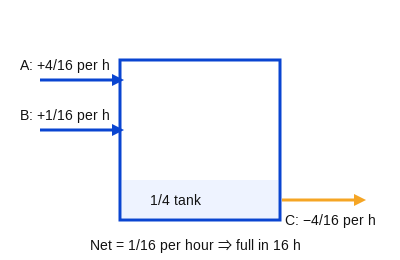
Two pipes can fill a tank in 4 hours and 16 hours, respectively. A third pipe can empty it in 4 hours. If all three pipes are opened together, how much time (in hours) will it take to fill one-fourth of the empty tank?
दो नल एक टंकी को क्रमशः 4 घंटे और 16 घंटे में भर सकते हैं। तीसरा नल उसे 4 घंटे में खाली कर सकता है। यदि तीनों नल एक साथ खोल दिए जाएँ, तो खाली टंकी का एक-चौथाई भाग भरने में कितना समय (घंटों में) लगेगा?
  1. A16
  2. B12
  3. C8
  4. D4
Show answer

Concept: Take tank =16 units (LCM of 4, 16, 4) and add the hourly rates with sign.

  1. Rates: A=+4, B=+1, C=−4 units/hour.
  2. Net =4+1−4=1 unit/hour.
  3. One-fourth of tank =4 units ⇒4 hours.

Trick: Here the emptying pipe exactly cancels the faster filler, so only the 16-hour pipe effectively works: 164=4 h.

Answer: (D) 4

अवधारणा: टंकी =16 इकाई (4, 16, 4 का LCM) मानकर प्रति घंटा दरें चिह्न सहित जोड़ें।

  1. दरें: A=+4, B=+1, C=−4 इकाई/घंटा।
  2. शुद्ध =4+1−4=1 इकाई/घंटा।
  3. टंकी का चौथाई =4 इकाई ⇒4 घंटे।

ट्रिक: खाली करने वाला नल तेज़ भरने वाले नल को पूरी तरह काट देता है, अतः केवल 16-घंटे वाला नल प्रभावी है: 164=4 घंटे।

उत्तर: (D) 4

RRB NTPC Undergraduate CBT 1MathematicsPipes and cisternsRRB NTPC Undergraduate CBT 1 2025 · 9 May Shift 3 →
Q13534.
A shopkeeper keeps the marked price of a jacket at ₹2,000. He gives a 20% discount on it, but charges 5% GST on the price after discount. What is the final price the customer has to pay for the jacket?
एक दुकानदार एक जैकेट का अंकित मूल्य ₹2,000 रखता है। वह उस पर 20% की छूट देता है, परंतु छूट के बाद के मूल्य पर 5% GST लगाता है। तो ग्राहक को जैकेट के लिए अंततः कितना मूल्य चुकाना होगा?
  1. A₹1,596
  2. B₹1,680
  3. C₹1,880
  4. D₹1,700
Show answer

Concept: Apply the discount first, then the tax on the discounted price.

  1. After 20% discount: 2000×0.8=1600.
  2. Add 5% GST: 1600×1.05=1680.

Trick: Net multiplier =0.8×1.05=0.84; 2000×0.84=1680.

Answer: (B) ₹1,680

अवधारणा: पहले छूट लगाएँ, फिर छूट वाले मूल्य पर कर जोड़ें।

  1. 20% छूट के बाद: 2000×0.8=1600।
  2. 5% GST जोड़ें: 1600×1.05=1680।

ट्रिक: शुद्ध गुणक =0.8×1.05=0.84; 2000×0.84=1680।

उत्तर: (B) ₹1,680

RRB NTPC Undergraduate CBT 1MathematicsDiscount and GSTRRB NTPC Undergraduate CBT 1 2025 · 9 May Shift 3 →
Q13535.
If the expression x3- 3x2- 7x - k is divisible by (x - 5), then find the value of k.
यदि व्यंजक x3- 3x2- 7x - k, (x - 5) से विभाज्य हो, तो k का मान ज्ञात कीजिए।
  1. A-5
  2. B15
  3. C-15
  4. D5
Show answer

Concept: If (x−a) divides p(x), then p(a)=0.

  1. p(5)=53−3(52)−7(5)−k=125−75−35−k=15−k.
  2. 15−k=0⇒k=15.

Trick: Never divide — just substitute the root and solve for the unknown.

Answer: (B) 15

अवधारणा: यदि (x−a), p(x) को विभाजित करे तो p(a)=0।

  1. p(5)=125−75−35−k=15−k।
  2. 15−k=0⇒k=15।

ट्रिक: भाग देने की ज़रूरत नहीं — मूल रखकर अज्ञात निकालें।

उत्तर: (B) 15

RRB NTPC Undergraduate CBT 1MathematicsFactor theoremRRB NTPC Undergraduate CBT 1 2025 · 9 May Shift 3 →
Q13536.
The arithmetic mean of 25 observations is 32.6. If the arithmetic mean of the first 24 observations is 30, then find the 25th observation.
25 प्रेक्षणों का समांतर माध्य 32.6 है। यदि पहले 24 प्रेक्षणों का समांतर माध्य 30 हो, तो 25वाँ प्रेक्षण ज्ञात कीजिए।
  1. A80
  2. B90
  3. C95
  4. D85
Show answer

Concept: Sum = mean × count.

  1. Sum of 25 =25×32.6=815.
  2. Sum of first 24 =24×30=720.
  3. 25th =815−720=95.

Trick: 25th observation =30+25×(32.6−30)=30+65=95 (it lifts all 25 by 2.6 above 30).

Answer: (C) 95

अवधारणा: योग = माध्य × संख्या।

  1. 25 का योग =25×32.6=815।
  2. पहले 24 का योग =24×30=720।
  3. 25वाँ =815−720=95।

ट्रिक: 25वाँ अवलोकन =30+25×(32.6−30)=95 (यह सभी 25 को 30 से 2.6 ऊपर उठाता है)।

उत्तर: (C) 95

RRB NTPC Undergraduate CBT 1MathematicsArithmetic meanRRB NTPC Undergraduate CBT 1 2025 · 9 May Shift 3 →
Q13537.
What is the third proportional to 0.25 and 0.15?
0.25 और 0.15 का तृतीयानुपाती क्या है?
  1. A0.02
  2. B0.09
  3. C0.15
  4. D0.04
Show answer

Concept: Third proportional of a and b is b2a.

  1. 0.1520.25=0.02250.25=0.09.

Trick: 0.25:0.15=5:3, so 0.15:x=5:3⇒x=0.15×35=0.09.

Answer: (B) 0.09

अवधारणा: a और b का तृतीयानुपाती =b2a।

  1. 0.1520.25=0.02250.25=0.09।

ट्रिक: 0.25:0.15=5:3, अतः 0.15:x=5:3⇒x=0.15×35=0.09।

उत्तर: (B) 0.09

RRB NTPC Undergraduate CBT 1MathematicsThird proportionalRRB NTPC Undergraduate CBT 1 2025 · 9 May Shift 3 →
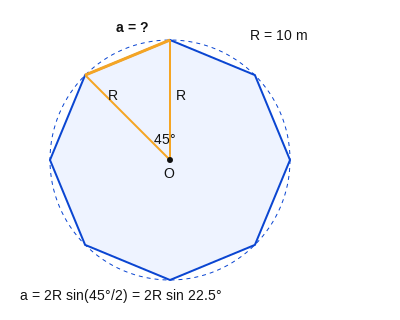
Q13538.
The circumradius of a regular octagonal fountain is 10 m. Find the approximate length of each of its sides.
एक सम अष्टभुजाकार फव्वारे की परित्रिज्या 10 m है। तो उसकी प्रत्येक भुजा की लगभग लंबाई ज्ञात कीजिए।
  1. A6.13 m
  2. B8.71 m
  3. C7.65 m
  4. D9.27 m
Show answer

Concept: Each side of a regular n-gon subtends 360∘n at the centre; side =2Rsin180∘n.

  1. For an octagon the central angle is 45∘, so side =2Rsin22.5∘.
  2. sin22.5∘≈0.3827⇒ side =20×0.3827≈7.65 m.

Yaad rakhein: Regular octagon: side≈0.765R; regular hexagon: side =R.

Answer: (C) 7.65 m

अवधारणा: सम n-भुज की हर भुजा केंद्र पर 360∘n कोण बनाती है; भुजा =2Rsin180∘n।

  1. अष्टभुज में केंद्रीय कोण 45∘, अतः भुजा =2Rsin22.5∘।
  2. sin22.5∘≈0.3827⇒ भुजा =20×0.3827≈7.65 m।

याद रखें: सम अष्टभुज: भुजा≈0.765R; सम षट्भुज: भुजा =R।

उत्तर: (C) 7.65 m

RRB NTPC Undergraduate CBT 1MathematicsRegular octagon (circumradius)RRB NTPC Undergraduate CBT 1 2025 · 9 May Shift 3 →
Q13539.
Simplify: {1542÷153}÷(310×209+514)+36÷4320 of 206
सरल कीजिए: {1542÷153}÷(310×209+514)+36÷4320 of 206
  1. A643
  2. B1447
  3. C437
  4. D1145
Show answer

Concept: Brackets first, then "of", then ÷ and ×, finally +.

  1. 1542÷153=1542×315=114.
  2. 310×209+514=23+514=4342; so 114÷4342=343.
  3. 4320 of 206=436; 36÷436=343.
  4. Total =343+343=643.

Trick: "of" binds tighter than ÷ — compute 4320 of 206 before dividing.

Answer: (A) 643

अवधारणा: पहले कोष्ठक, फिर "of", फिर ÷ व ×, अंत में +।

  1. 1542÷153=114।
  2. 310×209+514=23+514=4342; अतः 114÷4342=343।
  3. 4320 of 206=436; 36÷436=343।
  4. योग =343+343=643।

ट्रिक: "of" को ÷ से पहले हल करें — 4320 of 206 पहले निकालें।

उत्तर: (A) 643

RRB NTPC Undergraduate CBT 1MathematicsSimplification (BODMAS)RRB NTPC Undergraduate CBT 1 2025 · 9 May Shift 3 →
Q13540.
The HCF and LCM of two numbers are 25 and 500, respectively. If the first number is divided by 2, the quotient is 50 and the remainder is zero. Find the second number.
दो संख्याओं का म.स. और ल.स. क्रमशः 25 और 500 है। यदि पहली संख्या को 2 से भाग दिया जाए, तो भागफल 50 और शेषफल शून्य प्राप्त होता है। तो दूसरी संख्या ज्ञात कीजिए।
  1. A50
  2. B125
  3. C250
  4. D100
Show answer

Concept: For two numbers, HCF×LCM=a×b.

  1. First number =50×2=100.
  2. Second =25×500100=125.

Trick: Check: HCF(100,125)=25 and LCM=500 ✓.

Answer: (B) 125

अवधारणा: दो संख्याओं के लिए HCF×LCM=a×b।

  1. पहली संख्या =50×2=100।
  2. दूसरी =25×500100=125।

ट्रिक: जाँच: HCF(100,125)=25 और LCM=500 ✓।

उत्तर: (B) 125

RRB NTPC Undergraduate CBT 1MathematicsHCF × LCM = productRRB NTPC Undergraduate CBT 1 2025 · 9 May Shift 3 →