Question bank

Q&A: practice questions with answers

Search questions on any topic. Filter by exam category, exam, subject and topic, try the question, then open the answer and explanation.

Courses – airGurukul

20,719 questions found.

Q13541.
The fourth proportional to 4, 6 and 8 is m. The third proportional to 8 and m is n. Then, what is the value of n?
4, 6 और 8 का चतुर्थानुपाती m है। 8 और m का तृतीयानुपाती n है। तो, n का मान क्या है?
  1. A20
  2. B18
  3. C24
  4. D16
Show answer

Concept: Fourth proportional of a,b,c is bca; third proportional of a,b is b2a.

  1. m=6×84=12.
  2. n=1228=1448=18.

Trick: 8:12=2:3, so 12:n=2:3⇒n=18.

Answer: (B) 18

अवधारणा: a,b,c का चतुर्थानुपाती =bca; a,b का तृतीयानुपाती =b2a।

  1. m=6×84=12।
  2. n=1228=18।

ट्रिक: 8:12=2:3, अतः 12:n=2:3⇒n=18।

उत्तर: (B) 18

RRB NTPC Undergraduate CBT 1MathematicsFourth and third proportionalRRB NTPC Undergraduate CBT 1 2025 · 9 May Shift 3 →
Q13542.
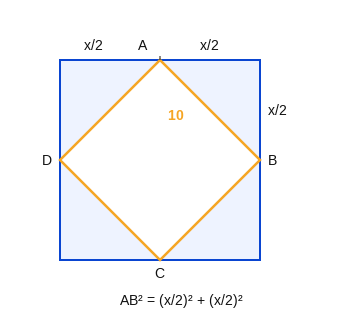
A square is drawn inside another square in such a way that each vertex of the inner square lies on the midpoint of a side of the outer square. If the perimeter of the inner square is 40 cm, find the perimeter of the outer square.
एक वर्ग के अंदर दूसरा वर्ग इस प्रकार बनाया जाता है कि अंदर वाले वर्ग का प्रत्येक शीर्ष बाहरी वर्ग की भुजा के मध्य-बिंदु पर स्थित हो। यदि अंदर वाले वर्ग का परिमाप 40 cm हो, तो बाहरी वर्ग का परिमाप ज्ञात कीजिए।
  1. A402 cm
  2. B40 cm
  3. C202 cm
  4. D802 cm
Show answer

Concept: Joining the midpoints of a square's sides gives an inner square whose side is the hypotenuse of a right triangle with legs x2,x2.

  1. Inner perimeter 40 cm ⇒ inner side =10 cm.
  2. 102=(x2)2+(x2)2=x22⇒x=102 cm.
  3. Outer perimeter =4×102=402 cm.

Yaad rakhein: Midpoint square has half the area of the outer square, so its side is 12 of the outer side — outer perimeter =2× inner perimeter.

Answer: (A) 402 cm

अवधारणा: वर्ग की भुजाओं के मध्यबिंदु जोड़ने पर बना भीतरी वर्ग, x2,x2 भुजाओं वाले समकोण त्रिभुज का कर्ण होता है।

  1. भीतरी परिमाप 40 cm ⇒ भीतरी भुजा =10 cm।
  2. 102=x24+x24=x22⇒x=102 cm।
  3. बाहरी परिमाप =4×102=402 cm।

याद रखें: मध्यबिंदु वर्ग का क्षेत्रफल बाहरी वर्ग का आधा होता है, अतः बाहरी परिमाप =2× भीतरी परिमाप।

उत्तर: (A) 402 cm

RRB NTPC Undergraduate CBT 1MathematicsSquare inscribed in a squareRRB NTPC Undergraduate CBT 1 2025 · 9 May Shift 3 →
Q13543.
Five friends participated in a cooking contest and scored 6, 8, 7, 9 and 5 marks out of 10, respectively. What is the arithmetic mean of their marks?
पाँच मित्रों ने एक पाक-कला प्रतियोगिता (Cooking contest) में भाग लिया और 10 में से क्रमशः 6, 8, 7, 9 और 5 अंक प्राप्त किए। तो उनके अंकों का समांतर माध्य क्या है?
  1. A6.5
  2. B7
  3. C8.5
  4. D8
Show answer

Concept: Mean =sumcount.

  1. Sum =6+8+7+9+5=35.
  2. Mean =355=7.

Trick: Deviations from 7 are −1,+1,0,+2,−2, which cancel — so the mean is 7.

Answer: (B) 7

अवधारणा: माध्य =योगसंख्या।

  1. योग =6+8+7+9+5=35।
  2. माध्य =355=7।

ट्रिक: 7 से विचलन −1,+1,0,+2,−2 आपस में कट जाते हैं — अतः माध्य 7।

उत्तर: (B) 7

RRB NTPC Undergraduate CBT 1MathematicsArithmetic meanRRB NTPC Undergraduate CBT 1 2025 · 9 May Shift 3 →
Q13544.
A can complete a work in 9 days, while each of B and C can complete it in 18 days. All three start working together and work for x days. Then A leaves the work, and B and C together complete the remaining work in x days. Find the value of x.
A एक कार्य को 9 दिनों में पूरा कर सकता है, जबकि B और C में से प्रत्येक उस कार्य को 18 दिनों में पूरा कर सकता है। तीनों मिलकर कार्य करना शुरू करते हैं और x दिनों तक कार्य करते हैं। उसके बाद A कार्य छोड़ देता है, B और C मिलकर शेष कार्य x दिनों में पूरा करते हैं। तो x का मान ज्ञात कीजिए।
  1. A4.5
  2. B4
  3. C3
  4. D3.5
Show answer

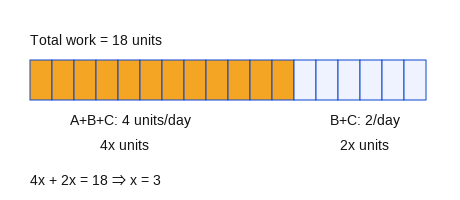
Concept: Take total work =18 units (LCM of 9 and 18) and count units done in each phase.

  1. Rates: A=2, B=1, C=1 units/day.
  2. All three for x days: 4x units; B and C for x days: 2x units.
  3. 4x+2x=18⇒x=3.

Trick: Both phases last x days, so the average rate is 4+22=3 units/day over 2x days: 2x=183=6.

Answer: (C) 3

अवधारणा: कुल कार्य =18 इकाई (9 और 18 का LCM) मानकर हर चरण की इकाइयाँ गिनें।

  1. दरें: A=2, B=1, C=1 इकाई/दिन।
  2. तीनों x दिन: 4x इकाई; B और C x दिन: 2x इकाई।
  3. 4x+2x=18⇒x=3।

ट्रिक: दोनों चरण x दिन के हैं, अतः औसत दर 4+22=3 इकाई/दिन, 2x दिनों में: 2x=183=6।

उत्तर: (C) 3

RRB NTPC Undergraduate CBT 1MathematicsTime and workRRB NTPC Undergraduate CBT 1 2025 · 9 May Shift 3 →
Q13545.
The price of fuel decreases by 55%, 35% and 45%, respectively, in three consecutive months, but increases by 40% in the fourth month. By what percentage will the price of fuel have decreased in the fourth month compared to its original price? (Round off the answer to 2 decimal places.)
ईंधन के मूल्य में लगातार तीन महीनों में क्रमशः 55%, 35% और 45% की कमी होती है, परंतु चौथे महीने में 40% की वृद्धि होती है। चौथे महीने में ईंधन के मूल्य में उसके मूल मूल्य की तुलना में कितने प्रतिशत की कमी हुई होगी? (उत्तर 2 दशमलव स्थानों तक दीजिए।)
  1. A81.67%
  2. B73.05%
  3. C77.48%
  4. D76.52%
Show answer

Concept: Multiply the successive multipliers: (1−0.55)(1−0.35)(1−0.45)(1+0.40).

  1. 0.45×0.65=0.2925.
  2. 0.2925×0.55=0.160875.
  3. 0.160875×1.4=0.225225⇒ price is 22.52% of original.
  4. Decrease =100−22.52=77.48%.

Trick: Pair them: 0.45×1.4=0.63 and 0.65×0.55=0.3575; 0.63×0.3575=0.2252.

Answer: (C) 77.48%

अवधारणा: क्रमिक गुणक गुणा करें: (1−0.55)(1−0.35)(1−0.45)(1+0.40)।

  1. 0.45×0.65=0.2925।
  2. 0.2925×0.55=0.160875।
  3. 0.160875×1.4=0.225225⇒ मूल्य मूल का 22.52%।
  4. कमी =100−22.52=77.48%।

ट्रिक: जोड़े बनाएँ: 0.45×1.4=0.63 और 0.65×0.55=0.3575; 0.63×0.3575=0.2252।

उत्तर: (C) 77.48%

RRB NTPC Undergraduate CBT 1MathematicsSuccessive percentage changeRRB NTPC Undergraduate CBT 1 2025 · 9 May Shift 3 →
Q13546.
A bus travels at a uniform speed of 54 km/hr. How many metres of distance will it cover in 1 minute?
एक बस 54 km/hr की एकसमान चाल से यात्रा करती है। तो वह 1 मिनट में कितने मीटर की दूरी तय करेगी?
  1. A800 metres800 मीटर
  2. B900 metres900 मीटर
  3. C600 metres600 मीटर
  4. D750 metres750 मीटर
Show answer

Concept: 1km/h=518m/s.

  1. 54×518=15m/s.
  2. In 60 s: 15×60=900 m.

Trick: 54 km in 60 min ⇒ 5400060=900 m per minute.

Answer: (B) 900 m

अवधारणा: 1km/h=518m/s।

  1. 54×518=15m/s।
  2. 60 s में: 15×60=900 m।

ट्रिक: 60 मिनट में 54 km ⇒5400060=900 m प्रति मिनट।

उत्तर: (B) 900 मीटर

RRB NTPC Undergraduate CBT 1MathematicsSpeed unit conversionRRB NTPC Undergraduate CBT 1 2025 · 9 May Shift 3 →
Q13547.
Evaluate: 223 + (-15)3 + (-7)3
मान ज्ञात कीजिए: 223 + (-15)3 + (-7)3
  1. A6981
  2. B6930
  3. C6929
  4. D6826
Show answer

Concept: If a+b+c=0 then a3+b3+c3=3abc.

  1. 22+(−15)+(−7)=0.
  2. Value =3×22×(−15)×(−7)=3×22×105=6930.

Trick: Always check whether the three bases add to zero before cubing anything.

Answer: (B) 6930

अवधारणा: यदि a+b+c=0 तो a3+b3+c3=3abc।

  1. 22+(−15)+(−7)=0।
  2. मान =3×22×(−15)×(−7)=6930।

ट्रिक: घन निकालने से पहले देखें कि तीनों आधारों का योग शून्य है या नहीं।

उत्तर: (B) 6930

RRB NTPC Undergraduate CBT 1MathematicsSum of cubes identityRRB NTPC Undergraduate CBT 1 2025 · 9 May Shift 3 →
Q13548.
If ₹2000 is invested for 2 years at a compound interest rate of 20% per annum and the interest is compounded annually, how much compound interest will be received at the end of 2 years?
₹2000 का निवेश 2 वर्षों के लिए 20% वार्षिक चक्रवृद्धि ब्याज की दर से किया जाता है और यदि ब्याज वार्षिक रूप से संयोजित होता है, तो 2 वर्षों के अंत में कितना चक्रवृद्धि ब्याज प्राप्त होगा?
  1. A₹1000
  2. B₹800
  3. C₹900
  4. D₹880
Show answer

Concept: A=P(1+R100)T.

  1. A=2000×1.22=2000×1.44=2880.
  2. CI=2880−2000=880.

Trick: 2-year CI rate =20+20+20×20100=44%; 44% of 2000 =880.

Answer: (D) ₹880

अवधारणा: A=P(1+R100)T।

  1. A=2000×1.22=2880।
  2. CI=2880−2000=880।

ट्रिक: 2 वर्ष की CI दर =20+20+20×20100=44%; 2000 का 44%=880।

उत्तर: (D) ₹880

RRB NTPC Undergraduate CBT 1MathematicsCompound interestRRB NTPC Undergraduate CBT 1 2025 · 9 May Shift 3 →
Q13549.
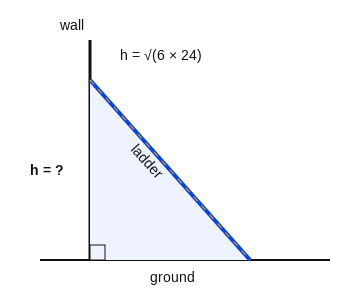
If the height at which a ladder touches a wall is the mean proportional between 6 metres and 24 metres, at what height does the ladder touch the wall?
यदि एक सीढ़ी दीवार को जिस ऊँचाई पर छूती है, वह 6 मीटर और 24 मीटर के बीच का मध्यानुपाती (mean proportional) हो, तो सीढ़ी दीवार को कितनी ऊँचाई पर छूती है?
  1. A18 metres18 मीटर
  2. B16 metres16 मीटर
  3. C14 metres14 मीटर
  4. D12 metres12 मीटर
Show answer

Concept: Mean proportional of a and b is ab.

  1. h=6×24=144=12 m.

Trick: 6×24=144=122 — spot the perfect square.

Answer: (D) 12 m

अवधारणा: a और b का मध्यानुपाती =ab।

  1. h=6×24=144=12 m।

ट्रिक: 6×24=144=122 — पूर्ण वर्ग पहचानें।

उत्तर: (D) 12 मीटर

RRB NTPC Undergraduate CBT 1MathematicsMean proportionalRRB NTPC Undergraduate CBT 1 2025 · 9 May Shift 3 →
Q13550.
Amit's present age is twice the age of his brother Sumit. Five years ago, the ratio of their ages was 5:2. What will be Sumit's present age?
अमित की वर्तमान आयु उसके भाई सुमित की आयु की दोगुनी है। पाँच वर्ष पहले, उनकी आयु का अनुपात 5:2 था। तो सुमित की वर्तमान आयु कितनी होगी?
  1. A8 years8 वर्ष
  2. B15 years15 वर्ष
  3. C10 years10 वर्ष
  4. D20 years20 वर्ष
Show answer

Concept: Let Sumit =S, Amit =2S; use the ratio five years ago.

  1. 2S−5S−5=52⇒4S−10=5S−25.
  2. S=15.

Trick: Check: 5 years ago ages 25 and 10 ⇒5:2 ✓.

Answer: (B) 15 years

अवधारणा: सुमित =S, अमित =2S; पाँच वर्ष पहले का अनुपात लगाएँ।

  1. 2S−5S−5=52⇒4S−10=5S−25।
  2. S=15।

ट्रिक: जाँच: 5 वर्ष पहले आयु 25 और 10 ⇒5:2 ✓।

उत्तर: (B) 15 वर्ष

RRB NTPC Undergraduate CBT 1MathematicsAgesRRB NTPC Undergraduate CBT 1 2025 · 9 May Shift 3 →
Q13551.
A motorist makes a certain journey in two stages. In the first stage, he travels at a speed of 30 km/hr for one-third of the total time. In the second stage, he travels at a speed of 60 km/hr for the remaining time. He returns to the starting point at a uniform speed of 75 km/hr. Find the average speed of the motorist during the entire onward and return journey.
एक मोटर चालक एक निश्चित यात्रा दो चरणों में करता है। पहले चरण में, वह कुल समय के एक-तिहाई समय में 30 km/hr की चाल से यात्रा करता है। दूसरे चरण में, वह शेष समय में 60 km/hr की चाल से यात्रा करता है। वह 75 km/hr की एकसमान चाल से प्रारंभिक स्थान पर वापस लौटता है। तो आने-जाने की संपूर्ण यात्रा के दौरान मोटर चालक की औसत चाल ज्ञात कीजिए।
  1. A58 km/hr
  2. B55 km/hr
  3. C60 km/hr
  4. D62 km/hr
Show answer

Concept: Average speed =total distancetotal time.

  1. Let onward time =3t. Distance =30t+60(2t)=150t.
  2. Return time =150t75=2t.
  3. Average =300t3t+2t=60km/h.

Trick: Onward average is 150t3t=50; for equal distances at 50 and 75, average =2×50×75125=60.

Answer: (C) 60 km/hr

अवधारणा: औसत चाल =कुल दूरीकुल समय।

  1. जाने का समय =3t। दूरी =30t+60(2t)=150t।
  2. लौटने का समय =150t75=2t।
  3. औसत =300t5t=60km/h।

ट्रिक: जाने की औसत चाल =50; समान दूरी 50 और 75 पर, औसत =2×50×75125=60।

उत्तर: (C) 60 km/hr

RRB NTPC Undergraduate CBT 1MathematicsAverage speedRRB NTPC Undergraduate CBT 1 2025 · 9 May Shift 3 →
Q13552.
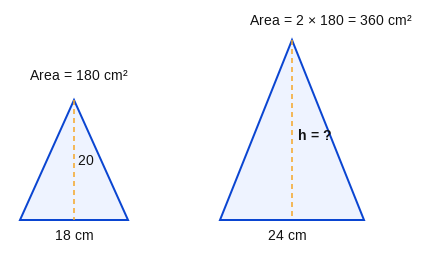
The base of a triangle is 18 cm and its height is 20 cm. Find the height of another triangle having twice its area and a base of 24 cm.
एक त्रिभुज का आधार 18 cm और ऊँचाई 20 cm है। उससे दोगुना क्षेत्रफल वाले और 24 cm आधार वाले दूसरे त्रिभुज की ऊँचाई ज्ञात कीजिए।
  1. A22 cm
  2. B20 cm
  3. C30 cm
  4. D24 cm
Show answer

Concept: Area =12×base×height.

  1. First area =12×18×20=180cm2; required area =360cm2.
  2. 12×24×h=360⇒h=30 cm.

Trick: b×h must double: 18×20=360→720; 72024=30.

Answer: (C) 30 cm

अवधारणा: क्षेत्रफल =12×आधार×ऊँचाई।

  1. पहला क्षेत्रफल =12×18×20=180cm2; अभीष्ट =360cm2।
  2. 12×24×h=360⇒h=30 cm।

ट्रिक: b×h दोगुना होना चाहिए: 18×20=360→720; 72024=30।

उत्तर: (C) 30 cm

RRB NTPC Undergraduate CBT 1MathematicsArea of triangleRRB NTPC Undergraduate CBT 1 2025 · 9 May Shift 3 →
Q13553.
The price of a shirt decreases from ₹200 to ₹180. What is the percentage decrease?
एक शर्ट का मूल्य ₹200 से घटकर ₹180 हो जाता है, तो कितने प्रतिशत की कमी होती है?
  1. A10%
  2. B20%
  3. C5%
  4. D15%
Show answer

Concept: % decrease=decreaseoriginal×100.

  1. Decrease =200−180=20.
  2. 20200×100=10%.

Trick: Always divide by the original (₹200), not the new price.

Answer: (A) 10%

अवधारणा: % कमी=कमीमूल×100।

  1. कमी =200−180=20।
  2. 20200×100=10%।

ट्रिक: हमेशा मूल मूल्य (₹200) से भाग दें, नए मूल्य से नहीं।

उत्तर: (A) 10%

RRB NTPC Undergraduate CBT 1MathematicsPercentage decreaseRRB NTPC Undergraduate CBT 1 2025 · 9 May Shift 3 →
Q13554.
Add 1116 and 0.4375. What will this sum be in decimal form?
1116 और 0.4375 का योग कीजिए। दशमलव रूप में यह योग कितना होगा?
  1. A0.958
  2. B0.975
  3. C1.125
  4. D1.208
Show answer

Concept: Convert the fraction to a decimal (denominator 16 terminates) and add.

  1. 1116=0.6875.
  2. 0.6875+0.4375=1.125.

Trick: 0.4375=716, so the sum is 1816=98=1.125.

Answer: (C) 1.125

अवधारणा: भिन्न को दशमलव में बदलें (हर 16 सांत दशमलव देता है) और जोड़ें।

  1. 1116=0.6875।
  2. 0.6875+0.4375=1.125।

ट्रिक: 0.4375=716, अतः योग =1816=98=1.125।

उत्तर: (C) 1.125

RRB NTPC Undergraduate CBT 1MathematicsFractions and decimalsRRB NTPC Undergraduate CBT 1 2025 · 9 May Shift 3 →
Q13555.
Simplify 30 + [{-9 × (26 - 13 + 5)}].
30 + [{-9 × (26 - 13 + 5)}] को सरल कीजिए।
  1. A-133
  2. B-132
  3. C-134
  4. D-135
Show answer

Concept: Solve the innermost bracket first.

  1. 26−13+5=18.
  2. −9×18=−162.
  3. 30+(−162)=−132.

Trick: Keep the sign of −9 with the product; only one sign change is needed.

Answer: (B) −132

अवधारणा: सबसे भीतरी कोष्ठक पहले हल करें।

  1. 26−13+5=18।
  2. −9×18=−162।
  3. 30+(−162)=−132।

ट्रिक: −9 का चिह्न गुणनफल के साथ रखें; केवल एक बार चिह्न बदलना है।

उत्तर: (B) −132

RRB NTPC Undergraduate CBT 1MathematicsSimplification (brackets)RRB NTPC Undergraduate CBT 1 2025 · 9 May Shift 3 →
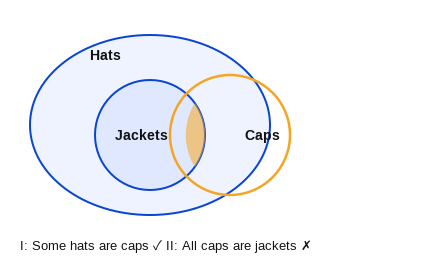
Q13556.
Read the given statements and conclusions carefully. Assuming that the information given in the statements is true, even if it appears to be at variance with commonly known facts, decide which of the given conclusion(s) logically follow(s) from the statements.
Statements:
All shackets are hats.
Some shackets are caps.
Conclusions:
(I) Some hats are caps.
(II) All caps are shackets.
दिए गए कथनों और निष्कर्षों को ध्यानपूर्वक पढ़िए। यह मानते हुए कि कथनों में दी गई जानकारी सत्य है, भले ही वह सामान्यतः ज्ञात तथ्यों से भिन्न प्रतीत होती हो, निर्णय कीजिए कि दिए गए निष्कर्षों में से कौन-सा/कौन-से निष्कर्ष कथनों का तार्किक रूप से अनुसरण करता है/करते हैं।
कथन:
सभी शॉकेट, हैट हैं।
कुछ शॉकेट, कैप हैं।
निष्कर्ष:
(I) कुछ हैट, कैप हैं।
(II) सभी कैप, शॉकेट हैं।
  1. AOnly conclusion (I) followsकेवल निष्कर्ष (I) अनुसरण करता है
  2. BNeither conclusion (I) nor conclusion (II) followsन तो निष्कर्ष (I) और न ही निष्कर्ष (II) अनुसरण करता है
  3. COnly conclusion (II) followsकेवल निष्कर्ष (II) अनुसरण करता है
  4. DBoth conclusion (I) and conclusion (II) followनिष्कर्ष (I) और निष्कर्ष (II) दोनों अनुसरण करते हैं
Show answer

Concept: Draw the Venn diagram: "All jackets are hats" puts the Jacket circle inside Hats; "Some jackets are caps" makes Caps overlap Jackets.

  1. The overlap of Caps and Jackets lies inside Hats, so some hats are definitely caps → Conclusion I follows.
  2. Caps may extend outside Jackets; "all caps are jackets" is not certain → Conclusion II does not follow.

Trick: All A are B + Some A are C ⇒ Some B are C (always true); the reverse "All C are A" is never guaranteed.

Answer: (A) A

अवधारणा: ('Only conclusion I follows', 'केवल निष्कर्ष (I) अनुसरण करता है')

  1. व
  2. े
  3. न
  4. आ
  5. र
  6. े
  7. ख
  8. ब
  9. न
  10. ा
  11. ए
  12. ँ
  13. :
  14. "
  15. स
  16. भ
  17. ी
  18. ज
  19. ै
  20. क
  21. े
  22. ट
  23. ह
  24. ै
  25. ट
  26. ह
  27. ै
  28. ं
  29. "
  30. स
  31. े
  32. ज
  33. ै
  34. क
  35. े
  36. ट
  37. व
  38. ृ
  39. त
  40. ्
  41. त
  42. ह
  43. ै
  44. ट
  45. क
  46. े
  47. अ
  48. ं
  49. द
  50. र
  51. ;
  52. "
  53. क
  54. ु
  55. छ
  56. ज
  57. ै
  58. क
  59. े
  60. ट
  61. क
  62. ै
  63. प
  64. ह
  65. ै
  66. ं
  67. "
  68. स
  69. े
  70. क
  71. ै
  72. प
  73. व
  74. ृ
  75. त
  76. ्
  77. त
  78. ज
  79. ै
  80. क
  81. े
  82. ट
  83. क
  84. ो
  85. क
  86. ा
  87. ट
  88. त
  89. ा
  90. ह
  91. ै
  92. ।

ट्रिक: ['कैप और जैकेट का उभयनिष्ठ भाग हैट के अंदर है, अतः कुछ हैट निश्चित रूप से कैप हैं → निष्कर्ष I अनुसरण करता है।', 'कैप जैकेट के बाहर भी हो सकते हैं; "सभी कैप जैकेट हैं" निश्चित नहीं → निष्कर्ष II अनुसरण नहीं करता।']

उत्तर: (A) l

RRB NTPC Undergraduate CBT 1General Intelligence and ReasoningSyllogismRRB NTPC Undergraduate CBT 1 2025 · 9 May Shift 3 →
Q13557.
What should come in place of the question mark (?) in the given series based on the English alphabetical order? YKQ QCI IUA AMS ?
अंग्रेज़ी वर्णमाला क्रम के आधार पर दी गई शृंखला में प्रश्नचिह्न (?) के स्थान पर क्या आना चाहिए? YKQ QCI IUA AMS ?
  1. ASEK
  2. BPEG
  3. CKFY
  4. DRAD
Show answer

Concept: Check each position of the three-letter groups separately, with wrap-around in the alphabet.

  1. 1st letters: Y(25) → Q(17) → I(9) → A(1) → ? : each time −8; 1−8=−7→26−7=19 = S.
  2. 2nd letters: K(11) → C(3) → U(21) → M(13) → E(5): again −8 with wrap-around.
  3. 3rd letters: Q(17) → I(9) → A(1) → S(19) → K(11): −8.
  4. So the next group is SEK.

Trick: When −8 goes below 1, add 26: −7+26=19 (S).

Answer: (A) ज

अवधारणा: ('SEK', 'SEK')

  1. त
  2. ी
  3. न
  4. -
  5. अ
  6. क
  7. ्
  8. ष
  9. र
  10. ी
  11. स
  12. म
  13. ू
  14. ह
  15. ो
  16. ं
  17. क
  18. े
  19. ह
  20. र
  21. स
  22. ्
  23. थ
  24. ा
  25. न
  26. क
  27. ो
  28. अ
  29. ल
  30. ग
  31. -
  32. अ
  33. ल
  34. ग
  35. ज
  36. ा
  37. ँ
  38. च
  39. े
  40. ं
  41. ,
  42. व
  43. र
  44. ्
  45. ण
  46. म
  47. ा
  48. ल
  49. ा
  50. म
  51. े
  52. ं
  53. w
  54. r
  55. a
  56. p
  57. -
  58. a
  59. r
  60. o
  61. u
  62. n
  63. d
  64. क
  65. े
  66. स
  67. ा
  68. थ
  69. ।

ट्रिक: ['पहले अक्षर: Y(25) → Q(17) → I(9) → A(1) → ? : हर बार −8; 1−8=−7to26−7=19 = S।', 'दूसरे अक्षर: K(11) → C(3) → U(21) → M(13) → E(5): फिर −8 (wrap-around सहित)।', 'तीसरे अक्षर: Q(17) → I(9) → A(1) → S(19) → K(11): −8।', 'अतः अगला समूह SEK।']

उत्तर: (A) ब

RRB NTPC Undergraduate CBT 1General Intelligence and ReasoningLetter seriesRRB NTPC Undergraduate CBT 1 2025 · 9 May Shift 3 →
Q13558.
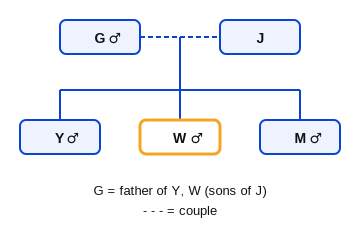
G is the father of Y. Y is the son of J. M is the brother of W. W is the son of J. How is G related to W?
G, Y का पिता है। Y, J का पुत्र है। M, W का भाई है। W, J का पुत्र है। तो G का W से क्या संबंध है?
  1. ABrotherभाई
  2. BFatherपिता
  3. CHusbandपति
  4. DSonपुत्र
Show answer

Concept: Build the family tree from each statement.

  1. G is the father of Y, and Y is the son of J → G and J are the parents (a couple).
  2. W is the son of J and M is the brother of W → W and M are also children of G and J.
  3. Therefore G is the father of W.

Trick: Same mother (J) ⇒ same father (G): once a couple is fixed, every child of one is a child of the other.

Answer: (B) ए

अवधारणा: ('Father', 'पिता')

  1. ह
  2. र
  3. क
  4. थ
  5. न
  6. स
  7. े
  8. व
  9. ं
  10. श
  11. -
  12. व
  13. ृ
  14. क
  15. ्
  16. ष
  17. ब
  18. न
  19. ा
  20. ए
  21. ँ
  22. ।

ट्रिक: ['G, Y का पिता है और Y, J का पुत्र है → G और J माता-पिता (दंपति) हैं।', 'W, J का पुत्र है और M, W का भाई है → W और M भी G और J की संतानें हैं।', 'अतः G, W का पिता है।']

उत्तर: (B) क

RRB NTPC Undergraduate CBT 1General Intelligence and ReasoningBlood relationsRRB NTPC Undergraduate CBT 1 2025 · 9 May Shift 3 →
Q13559.
In the following triad, each letter-cluster is related to the next (letter-cluster) by following a certain logic. Select the option that follows the same logic from among the given options.
DENY - DYNE - YNED
HUGE - HEGU - EGUH
निम्नलिखित त्रिक में, प्रत्येक अक्षर-समूह एक निश्चित तर्क का अनुसरण करते हुए अपने अगले (अक्षर-समूह) से संबंधित है। दिए गए विकल्पों में से वह विकल्प चुनिए जो समान तर्क का अनुसरण करता है।
DENY - DYNE - YNED
HUGE - HEGU - EGUH
  1. ALOST - LTSO - TSOL
  2. BGROW - GRWO - ROWG
  3. CTURN - TRUN - NRUT
  4. DCLOT - LCOT - TLOC
Show answer

Concept: Find the position rule for both steps and apply it to each option.

  1. DENY → DYNE: positions 1-2-3-4 become 1-4-3-2 (2nd and 4th letters swap). HUGE → HEGU follows the same.
  2. DYNE → YNED: positions become 2-3-4-1 (first letter goes to the end). HEGU → EGUH ✓.
  3. LOST → LTSO (swap 2nd & 4th ✓) → TSOL (first letter to end ✓).
  4. GROW → GRWO swaps 3rd/4th, TURN → TRUN swaps 2nd/3rd, CLOT → LCOT swaps 1st/2nd – all wrong.

Trick: Step 1: swap the 2nd and 4th letters; Step 2: move the first letter to the end.

Answer: (A) च

अवधारणा: ('LOST - LTSO - TSOL', 'LOST - LTSO - TSOL')

  1. द
  2. ो
  3. न
  4. ो
  5. ं
  6. च
  7. र
  8. ण
  9. ो
  10. ं
  11. क
  12. ा
  13. स
  14. ्
  15. थ
  16. ा
  17. न
  18. -
  19. न
  20. ि
  21. य
  22. म
  23. ख
  24. ो
  25. ज
  26. े
  27. ं
  28. औ
  29. र
  30. ह
  31. र
  32. व
  33. ि
  34. क
  35. ल
  36. ्
  37. प
  38. प
  39. र
  40. ल
  41. ा
  42. ग
  43. ू
  44. क
  45. र
  46. े
  47. ं
  48. ।

ट्रिक: ['DENY → DYNE: स्थान 1-2-3-4 → 1-4-3-2 (दूसरा और चौथा अक्षर आपस में बदलते हैं)। HUGE → HEGU भी यही।', 'DYNE → YNED: स्थान 2-3-4-1 (पहला अक्षर अंत में चला जाता है)। HEGU → EGUH ✓।', 'LOST → LTSO (दूसरा-चौथा बदलें ✓) → TSOL (पहला अक्षर अंत में ✓)।', 'GROW → GRWO में 3रा/4था, TURN → TRUN में 2रा/3रा, CLOT → LCOT में 1ला/2रा बदला है – सब गलत।']

उत्तर: (A) र

RRB NTPC Undergraduate CBT 1General Intelligence and ReasoningLetter analogyRRB NTPC Undergraduate CBT 1 2025 · 9 May Shift 3 →
Q13560.
What should come in place of the question mark (?) in the given series based on the English alphabetical order? MNO PQR STU VWX ?
अंग्रेज़ी वर्णमाला क्रम पर आधारित दी गई शृंखला में प्रश्नचिह्न (?) के स्थान पर क्या आना चाहिए? MNO PQR STU VWX ?
  1. AYZA
  2. BYZB
  3. CYYZ
  4. DYAZ
Show answer

Concept: Consecutive letters of the alphabet are grouped in threes, continuing cyclically after Z.

  1. MNO, PQR, STU, VWX – each group is the next three letters.
  2. After X come Y, Z and then the alphabet restarts with A → YZA.

Trick: Z is followed by A when a series wraps around.

Answer: (A) श

अवधारणा: ('YZA', 'YZA')

  1. व
  2. र
  3. ्
  4. ण
  5. म
  6. ा
  7. ल
  8. ा
  9. क
  10. े
  11. क
  12. ्
  13. र
  14. म
  15. ा
  16. ग
  17. त
  18. अ
  19. क
  20. ्
  21. ष
  22. र
  23. त
  24. ी
  25. न
  26. -
  27. त
  28. ी
  29. न
  30. क
  31. े
  32. स
  33. म
  34. ू
  35. ह
  36. म
  37. े
  38. ं
  39. ह
  40. ै
  41. ं
  42. ,
  43. Z
  44. क
  45. े
  46. ब
  47. ा
  48. द
  49. च
  50. क
  51. ्
  52. र
  53. फ
  54. ि
  55. र
  56. A
  57. स
  58. े
  59. ।

ट्रिक: ['MNO, PQR, STU, VWX – हर समूह अगले तीन अक्षर हैं।', 'X के बाद Y, Z और फिर वर्णमाला A से शुरू → YZA।']

उत्तर: (A) ्

RRB NTPC Undergraduate CBT 1General Intelligence and ReasoningLetter seriesRRB NTPC Undergraduate CBT 1 2025 · 9 May Shift 3 →