Question bank

Q&A: practice questions with answers

Search questions on any topic. Filter by exam category, exam, subject and topic, try the question, then open the answer and explanation.

Courses – airGurukul

20,719 questions found.

Q13561.
Seven boxes, A, B, C, D, E, F and G, are kept one over the other, but not necessarily in the same order. Only one box is kept above C. A is not the topmost box. Only two boxes are kept below D. G is below D but above F. E is kept below A. How many boxes are kept between A and E?
सात बक्से, A, B, C, D, E, F और G, एक-दूसरे के ऊपर रखे गए हैं, परंतु आवश्यक नहीं कि इसी क्रम में हों। C के ऊपर केवल एक बक्सा रखा गया है। A सबसे ऊपर का बक्सा नहीं है। D के नीचे केवल दो बक्से रखे गए हैं। G, D के नीचे है परंतु F के ऊपर है। E को A के नीचे रखा गया है। A और E के बीच कितने बक्से रखे गए हैं?
  1. AThreeतीन
  2. BNoneकोई नहीं
  3. COneएक
  4. DTwoदो
Show answer

Concept: Number the positions 1 (bottom) to 7 (top) and place the fixed boxes first.
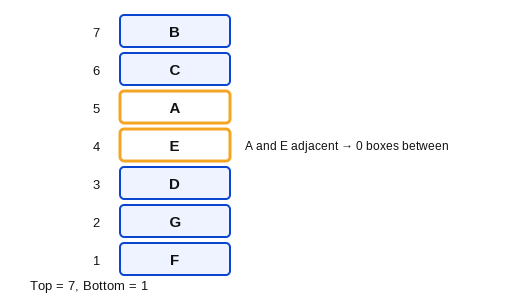
  1. Only one box above C → C at 6. Only two boxes below D → D at 3.
  2. G is below D but above F → G at 2, F at 1.
  3. Remaining positions 4, 5, 7. A is not the top box and E is below A → A at 5, E at 4; so B at 7.
  4. Stack (top→bottom): B, C, A, E, D, G, F. A and E are adjacent → no box between them.

Trick: Fill "only n above/below" clues first – they fix exact positions.

Answer: (B) "

अवधारणा: ('None', 'एक भी नहीं')

  1. स
  2. ्
  3. थ
  4. ा
  5. न
  6. ो
  7. ं
  8. क
  9. ो
  10. 1
  11. (
  12. न
  13. ी
  14. च
  15. े
  16. )
  17. स
  18. े
  19. 7
  20. (
  21. ऊ
  22. प
  23. र
  24. )
  25. त
  26. क
  27. क
  28. ्
  29. र
  30. म
  31. ा
  32. ं
  33. क
  34. ि
  35. त
  36. क
  37. र
  38. े
  39. ं
  40. औ
  41. र
  42. प
  43. ह
  44. ल
  45. े
  46. न
  47. ि
  48. श
  49. ्
  50. च
  51. ि
  52. त
  53. ब
  54. ॉ
  55. क
  56. ्
  57. स
  58. र
  59. ख
  60. े
  61. ं
  62. ।

ट्रिक: ['C के ऊपर केवल एक बॉक्स → C स्थान 6 पर। D के नीचे केवल दो बॉक्स → D स्थान 3 पर।', 'G, D के नीचे पर F के ऊपर → G स्थान 2, F स्थान 1।', 'शेष स्थान 4, 5, 7। A सबसे ऊपर नहीं और E, A के नीचे → A स्थान 5, E स्थान 4; अतः B स्थान 7।', 'ढेर (ऊपर→नीचे): B, C, A, E, D, G, F। A और E सटे हुए हैं → बीच में कोई बॉक्स नहीं।']

उत्तर: (B) क
RRB NTPC Undergraduate CBT 1General Intelligence and ReasoningBox arrangementRRB NTPC Undergraduate CBT 1 2025 · 9 May Shift 3 →
Q13562.
Select the set from the options in which the numbers are related in the same way as the numbers of the following sets.
(NOTE: Operations should be performed on the whole numbers, without breaking down the numbers into their constituent digits. E.g. 13 – Operations on 13 such as adding/subtracting/multiplying etc. to 13 can be performed. Breaking down 13 into 1 and 3 and then performing mathematical operations on 1 and 3 is not allowed.)
(12, 36, 3)
(15, 75, 5)
विकल्पों में से वह समुच्चय चुनिए जिसमें संख्याएँ उसी प्रकार संबंधित हों, जिस प्रकार नीचे दिए गए समुच्चयों की संख्याएँ संबंधित हैं।
(नोट: संख्याओं को उनके घटक अंकों में विभाजित किए बिना, पूर्ण संख्याओं पर संक्रियाएँ की जानी चाहिए। उदाहरण के लिए 13 लें। 13 पर संक्रियाएँ जैसे 13 में जोड़ना/घटाना/गुणा करना आदि पूर्ण 13 पर की जा सकती हैं। 13 को 1 और 3 में विभाजित करके फिर 1 और 3 पर गणितीय संक्रियाएँ करने की अनुमति नहीं है।)
(12, 36, 3)
(15, 75, 5)
  1. A(7, 72, 12)
  2. B(8, 56, 9)
  3. C(13, 188, 6)
  4. D(14, 56, 4)
Show answer

Concept: Find the relation among the three numbers of each given set.

  1. (12, 36, 3): 12×3=36. (15, 75, 5): 15×5=75. Rule: first × third = middle.
  2. Check options: 7×12=84≠72; 8×9=72≠56; 13×6=78≠188; 14×4=56 ✓.

Trick: Middle number = product of the two outer numbers.

Answer: (D) ब

अवधारणा: ('(14, 56, 4)', '(14, 56, 4)')

  1. द
  2. ि
  3. ए
  4. ग
  5. ए
  6. ह
  7. र
  8. स
  9. म
  10. ू
  11. ह
  12. क
  13. ी
  14. त
  15. ी
  16. न
  17. स
  18. ं
  19. ख
  20. ्
  21. य
  22. ा
  23. ओ
  24. ं
  25. क
  26. े
  27. ब
  28. ी
  29. च
  30. स
  31. ं
  32. ब
  33. ं
  34. ध
  35. ख
  36. ो
  37. ज
  38. े
  39. ं
  40. ।

ट्रिक: ['(12, 36, 3): 12times3=36। (15, 75, 5): 15times5=75। नियम: पहली × तीसरी = बीच वाली।', 'विकल्प जाँचें: 7times12=84ne72; 8times9=72ne56; 13times6=78ne188; 14times4=56 ✓।']

उत्तर: (D) ी

RRB NTPC Undergraduate CBT 1General Intelligence and ReasoningNumber analogyRRB NTPC Undergraduate CBT 1 2025 · 9 May Shift 3 →
Q13563.
Based on the English alphabetical order, three of the following four letter-clusters are alike in a certain way and thus form a group. Which letter-cluster does not belong to that group?
(NOTE: The odd letter-cluster is not based on the number of consonants/vowels or their position/place in the letter-cluster.)
अंग्रेज़ी वर्णमाला क्रम के आधार पर, नीचे दिए गए चार अक्षर-समूहों में से तीन किसी निश्चित प्रकार से समान हैं और इस प्रकार एक समूह बनाते हैं। कौन-सा अक्षर-समूह उस समूह से संबंधित नहीं है?
(नोट: भिन्न अक्षर-समूह व्यंजनों/स्वरों की संख्या अथवा अक्षर-समूह में उनकी स्थिति/स्थान पर आधारित नहीं है।)
  1. AEWO
  2. BMEO
  3. CASK
  4. DXPH
Show answer

Concept: Write the alphabetical positions and compare the gaps (with wrap-around).

  1. EWO: 5 → 23 → 15 : +18,−8. ASK: 1 → 19 → 11 : +18,−8. XPH: 24 → 16 → 8 : 24+18=42−26=16 (+18), then −8.
  2. MEO: 13 → 5 → 15 : −8,+10 – a different pattern.
  3. So MEO is the odd one out.

Trick: Pattern of the group: 1st +18 = 2nd, 2nd −8 = 3rd (equivalently 1st +10 = 3rd).

Answer: (B) स

अवधारणा: ('MEO', 'MEO')

  1. व
  2. र
  3. ्
  4. ण
  5. म
  6. ा
  7. ल
  8. ा
  9. स
  10. ्
  11. थ
  12. ा
  13. न
  14. ल
  15. ि
  16. ख
  17. क
  18. र
  19. अ
  20. ं
  21. त
  22. र
  23. (
  24. w
  25. r
  26. a
  27. p
  28. -
  29. a
  30. r
  31. o
  32. u
  33. n
  34. d
  35. स
  36. ह
  37. ि
  38. त
  39. )
  40. क
  41. ी
  42. त
  43. ु
  44. ल
  45. न
  46. ा
  47. क
  48. र
  49. े
  50. ं
  51. ।

ट्रिक: ['EWO: 5 → 23 → 15 : +18,−8। ASK: 1 → 19 → 11 : +18,−8। XPH: 24 → 16 → 8 : 24+18=42−26=16 (+18), फिर −8।', 'MEO: 13 → 5 → 15 : −8,+10 – अलग पैटर्न।', 'अतः MEO विषम है।']

उत्तर: (B) म

RRB NTPC Undergraduate CBT 1General Intelligence and ReasoningLetter-cluster classificationRRB NTPC Undergraduate CBT 1 2025 · 9 May Shift 3 →
Q13564.
Each letter of the word KNIFERS is arranged in English alphabetical order. In the new letter-cluster thus formed, how many letters in total are there in the English alphabetical order between the letter at the third place from the left and the letter at the third place from the right?
KNIFERS शब्द के प्रत्येक अक्षर को अंग्रेज़ी वर्णमाला क्रम में व्यवस्थित किया जाता है। इस प्रकार बने नए अक्षर-समूह में, अंग्रेज़ी वर्णमाला क्रम के अनुसार, बाईं ओर से तीसरे स्थान पर आने वाले अक्षर और दाईं ओर से तीसरे स्थान पर आने वाले अक्षर के बीच कुल कितने अक्षर आते हैं?
  1. A7
  2. B5
  3. C3
  4. D4
Show answer

Concept: Arrange the letters of the word alphabetically, then count letters between the required positions in the alphabet.

  1. KNIFERS → alphabetical order: E, F, I, K, N, R, S.
  2. 3rd from the left = I (9); 3rd from the right = N (14).
  3. Letters between I and N in the alphabet: J, K, L, M = 14−9−1=4.

Trick: Letters between two letters = difference of positions −1.

Answer: (D) द

अवधारणा: ('4', '4')

  1. श
  2. ब
  3. ्
  4. द
  5. क
  6. े
  7. अ
  8. क
  9. ्
  10. ष
  11. र
  12. ो
  13. ं
  14. क
  15. ो
  16. व
  17. र
  18. ्
  19. ण
  20. ा
  21. न
  22. ु
  23. क
  24. ्
  25. र
  26. म
  27. म
  28. े
  29. ं
  30. ल
  31. ग
  32. ा
  33. ए
  34. ँ
  35. ,
  36. फ
  37. ि
  38. र
  39. अ
  40. भ
  41. ी
  42. ष
  43. ्
  44. ट
  45. स
  46. ्
  47. थ
  48. ा
  49. न
  50. ो
  51. ं
  52. क
  53. े
  54. अ
  55. क
  56. ्
  57. ष
  58. र
  59. ो
  60. ं
  61. क
  62. े
  63. ब
  64. ी
  65. च
  66. व
  67. र
  68. ्
  69. ण
  70. म
  71. ा
  72. ल
  73. ा
  74. म
  75. े
  76. ं
  77. अ
  78. क
  79. ्
  80. ष
  81. र
  82. ग
  83. ि
  84. न
  85. े
  86. ं
  87. ।

ट्रिक: ['KNIFERS → वर्णानुक्रम: E, F, I, K, N, R, S।', 'बाएँ से तीसरा = I (9); दाएँ से तीसरा = N (14)।', 'वर्णमाला में I और N के बीच अक्षर: J, K, L, M = 14−9−1=4।']

उत्तर: (D) ो

RRB NTPC Undergraduate CBT 1General Intelligence and ReasoningAlphabetical arrangementRRB NTPC Undergraduate CBT 1 2025 · 9 May Shift 3 →
Q13565.
Based on the English alphabetical order, three of the following four letter-clusters are alike in a certain way and thus form a group. Which letter-cluster does not belong to that group?
(NOTE: The odd letter-cluster is not based on the number of consonants/vowels or their position/place in the letter-cluster)
अंग्रेज़ी वर्णमाला क्रम के आधार पर, नीचे दिए गए चार अक्षर-समूहों में से तीन किसी निश्चित प्रकार से समान हैं और इस प्रकार एक समूह बनाते हैं। कौन-सा अक्षर-समूह उस समूह से संबंधित नहीं है?
(नोट: भिन्न अक्षर-समूह व्यंजनों/स्वरों की संख्या अथवा अक्षर-समूह में उनकी स्थिति/स्थान पर आधारित नहीं है)
  1. AKHN
  2. BNKP
  3. CVSX
  4. DROT
Show answer

Concept: Compare the differences between consecutive letters in each cluster.

  1. NKP: 14 → 11 → 16 : −3,+5. VSX: 22 → 19 → 24 : −3,+5. ROT: 18 → 15 → 20 : −3,+5.
  2. KHN: 11 → 8 → 14 : −3,+6 – the second gap differs.
  3. Hence KHN does not belong to the group.

Trick: Write positions, then gaps; the cluster whose gaps differ is the odd one.

Answer: (A) स

अवधारणा: ('KHN', 'KHN')

  1. ह
  2. र
  3. स
  4. म
  5. ू
  6. ह
  7. म
  8. े
  9. ं
  10. क
  11. ्
  12. र
  13. म
  14. ा
  15. ग
  16. त
  17. अ
  18. क
  19. ्
  20. ष
  21. र
  22. ो
  23. ं
  24. क
  25. े
  26. अ
  27. ं
  28. त
  29. र
  30. क
  31. ी
  32. त
  33. ु
  34. ल
  35. न
  36. ा
  37. क
  38. र
  39. े
  40. ं
  41. ।

ट्रिक: ['NKP: 14 → 11 → 16 : −3,+5। VSX: 22 → 19 → 24 : −3,+5। ROT: 18 → 15 → 20 : −3,+5।', 'KHN: 11 → 8 → 14 : −3,+6 – दूसरा अंतर अलग है।', 'अतः KHN समूह में नहीं आता।']

उत्तर: (A) ्

RRB NTPC Undergraduate CBT 1General Intelligence and ReasoningLetter-cluster classificationRRB NTPC Undergraduate CBT 1 2025 · 9 May Shift 3 →
Q13566.
In the word WONDERLANDS, each vowel is changed to the letter immediately following it in the English alphabetical order and each consonant is changed to the letter immediately preceding it in the English alphabetical order. Which of the following letters will appear exactly twice in the new letter-cluster thus formed?
WONDERLANDS शब्द के प्रत्येक स्वर को अंग्रेज़ी वर्णमाला क्रम में उसके ठीक बाद वाले अक्षर से बदल दिया जाता है और प्रत्येक व्यंजन को अंग्रेज़ी वर्णमाला क्रम में उसके ठीक पहले वाले अक्षर से बदल दिया जाता है। इस प्रकार बने नए अक्षर-समूह में निम्नलिखित में से कौन-सा अक्षर ठीक दो बार आएगा?
  1. AF
  2. BM
  3. CQ
  4. DR
Show answer

Concept: Vowels (A, E, I, O, U) move one step forward, consonants one step backward.

  1. WONDERLANDS → W→V, O→P, N→M, D→C, E→F, R→Q, L→K, A→B, N→M, D→C, S→R.
  2. New cluster: V P M C F Q K B M C R.
  3. M appears twice (from the two N's); C also appears twice, but among the options only M qualifies. F, Q and R appear once.

Trick: Repeated source letters give repeated coded letters – WONDERLANDS has N twice and D twice.

Answer: (B) म

अवधारणा: ('M', 'M')

  1. स
  2. ्
  3. व
  4. र
  5. (
  6. A
  7. ,
  8. E
  9. ,
  10. I
  11. ,
  12. O
  13. ,
  14. U
  15. )
  16. ए
  17. क
  18. क
  19. द
  20. म
  21. आ
  22. ग
  23. े
  24. ,
  25. व
  26. ्
  27. य
  28. ं
  29. ज
  30. न
  31. ए
  32. क
  33. क
  34. द
  35. म
  36. प
  37. ी
  38. छ
  39. े
  40. ।

ट्रिक: ['WONDERLANDS → W→V, O→P, N→M, D→C, E→F, R→Q, L→K, A→B, N→M, D→C, S→R।', 'नया समूह: V P M C F Q K B M C R।', 'M दो बार आता है (दोनों N से); C भी दो बार, पर विकल्पों में केवल M है। F, Q और R एक-एक बार।']

उत्तर: (B) ू

RRB NTPC Undergraduate CBT 1General Intelligence and ReasoningLetter operationsRRB NTPC Undergraduate CBT 1 2025 · 9 May Shift 3 →
Q13567.
Read the given statements and conclusions carefully. Assuming that the information given in the statements is true, even if it appears to be at variance with commonly known facts, decide which of the given conclusion(s) logically follow(s) from the statements.
Statements:
All beads are chairs.
All beads are monks.
Conclusions:
(I) Some chairs are monks.
(II) All monks are beads.
दिए गए कथनों और निष्कर्षों को ध्यानपूर्वक पढ़िए। यह मानते हुए कि कथनों में दी गई जानकारी सत्य है, भले ही वह सामान्यतः ज्ञात तथ्यों से भिन्न प्रतीत होती हो, निर्णय कीजिए कि दिए गए निष्कर्षों में से कौन-सा/कौन-से निष्कर्ष कथनों का तार्किक रूप से अनुसरण करता है/करते हैं।
कथन:
सभी मनके कुर्सियाँ हैं।
सभी मनके साधु हैं।
निष्कर्ष:
(I) कुछ कुर्सियाँ साधु हैं।
(II) सभी साधु मनके हैं।
  1. AOnly conclusion (II) follows.केवल निष्कर्ष (II) अनुसरण करता है।
  2. BNeither conclusion (I) nor conclusion (II) follows.न तो निष्कर्ष (I) और न ही निष्कर्ष (II) अनुसरण करता है।
  3. COnly conclusion (I) follows.केवल निष्कर्ष (I) अनुसरण करता है।
  4. DBoth conclusions (I) and (II) follow.निष्कर्ष (I) और (II) दोनों अनुसरण करते हैं।
Show answer

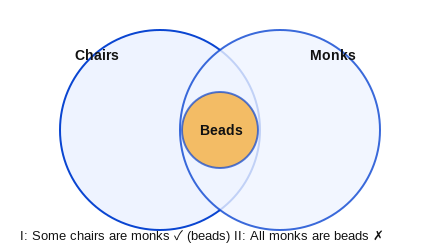
Concept: Both statements are universal with the same subject "beads", so Beads lies inside both Chairs and Monks.

  1. Beads are common to Chairs and Monks, so some chairs are monks → Conclusion I follows.
  2. "All monks are beads" reverses the second statement; monks may exist outside beads → Conclusion II does not follow.

Trick: All A are B, All A are C ⇒ Some B are C; a universal statement never reverses to another universal.

Answer: (C) A

अवधारणा: ('Only conclusion I follows', 'केवल निष्कर्ष (I) अनुसरण करता है')

  1. द
  2. ो
  3. न
  4. ो
  5. ं
  6. क
  7. थ
  8. न
  9. स
  10. ा
  11. र
  12. ्
  13. व
  14. भ
  15. ौ
  16. म
  17. ि
  18. क
  19. ह
  20. ै
  21. ं
  22. औ
  23. र
  24. उ
  25. द
  26. ्
  27. द
  28. े
  29. श
  30. ्
  31. य
  32. "
  33. म
  34. न
  35. क
  36. े
  37. "
  38. स
  39. म
  40. ा
  41. न
  42. ह
  43. ै
  44. ,
  45. अ
  46. त
  47. ः
  48. म
  49. न
  50. क
  51. े
  52. ,
  53. क
  54. ु
  55. र
  56. ्
  57. स
  58. ि
  59. य
  60. ो
  61. ं
  62. औ
  63. र
  64. स
  65. ा
  66. ध
  67. ु
  68. ओ
  69. ं
  70. द
  71. ो
  72. न
  73. ो
  74. ं
  75. क
  76. े
  77. अ
  78. ं
  79. द
  80. र
  81. ह
  82. ै
  83. ं
  84. ।

ट्रिक: ['मनके, कुर्सी और साधु दोनों में उभयनिष्ठ हैं, अतः कुछ कुर्सियाँ साधु हैं → निष्कर्ष I अनुसरण करता है।', '"सभी साधु मनके हैं" दूसरे कथन का उल्टा है; साधु मनकों के बाहर भी हो सकते हैं → निष्कर्ष II अनुसरण नहीं करता।']

उत्तर: (C) l

RRB NTPC Undergraduate CBT 1General Intelligence and ReasoningSyllogismRRB NTPC Undergraduate CBT 1 2025 · 9 May Shift 3 →
Q13568.
Following a certain logic, KR 19 is related to NM 6. Following the same logic, MV 11 is related to PQ -2. Following the same logic, to which of the following is CS 7 related?
एक निश्चित तर्क का अनुसरण करते हुए, KR 19, NM 6 से संबंधित है। उसी तर्क का अनुसरण करते हुए, MV 11, PQ -2 से संबंधित है। समान तर्क का अनुसरण करते हुए, CS 7 निम्नलिखित में से किससे संबंधित है?
  1. AFN -6
  2. BKL 7
  3. CGH 7
  4. DHJ -9
Show answer

Concept: Find how each letter and the number change from the first term to the second.

  1. KR 19 → NM 6: K +3 = N, R −5 = M, 19−13=6.
  2. MV 11 → PQ −2: M +3 = P, V −5 = Q, 11−13=−2 ✓ same rule.
  3. CS 7 → C +3 = F, S −5 = N, 7−13=−6 → FN −6.

Trick: Rule: (1st letter +3), (2nd letter −5), (number −13).

Answer: (A) न

अवधारणा: ('FN −6', 'FN −6')

  1. प
  2. ह
  3. ल
  4. े
  5. प
  6. द
  7. स
  8. े
  9. द
  10. ू
  11. स
  12. र
  13. े
  14. प
  15. द
  16. त
  17. क
  18. ह
  19. र
  20. अ
  21. क
  22. ्
  23. ष
  24. र
  25. औ
  26. र
  27. स
  28. ं
  29. ख
  30. ्
  31. य
  32. ा
  33. क
  34. ा
  35. प
  36. र
  37. ि
  38. व
  39. र
  40. ्
  41. त
  42. न
  43. ख
  44. ो
  45. ज
  46. े
  47. ं
  48. ।

ट्रिक: ['KR 19 → NM 6: K +3 = N, R −5 = M, 19−13=6।', 'MV 11 → PQ −2: M +3 = P, V −5 = Q, 11−13=−2 ✓ वही नियम।', 'CS 7 → C +3 = F, S −5 = N, 7−13=−6 → FN −6।']

उत्तर: (A) ि

RRB NTPC Undergraduate CBT 1General Intelligence and ReasoningLetter–number analogyRRB NTPC Undergraduate CBT 1 2025 · 9 May Shift 3 →
Q13569.
In a certain code language, "ZCKU" is coded as "94" and "SAPI" is coded as "126". What is the code for "GXRB" in this code language?
एक निश्चित कूट भाषा में, "ZCKU" को "94" के रूप में कूटबद्ध किया जाता है और "SAPI" को "126" के रूप में कूटबद्ध किया जाता है। तो इस कूट भाषा में "GXRB" के लिए कूट क्या है?
  1. A127
  2. B120
  3. C114
  4. D119
Show answer

Concept: Try the reverse alphabetical positions (A = 26 … Z = 1) when normal positions do not fit.

  1. ZCKU: reverse positions Z = 1, C = 24, K = 16, U = 6; sum =47; 47×2=94 ✓.
  2. SAPI: S = 8, A = 26, P = 11, I = 18; sum =63; 63×2=126 ✓.
  3. GXRB: G = 20, X = 3, R = 9, B = 25; sum =57; 57×2=114.

Trick: Reverse position =27−normal position. Code = 2 × (sum of reverse positions).

Answer: (C) उ

अवधारणा: ('114', '114')

  1. ज
  2. ब
  3. स
  4. ा
  5. म
  6. ा
  7. न
  8. ्
  9. य
  10. स
  11. ्
  12. थ
  13. ा
  14. न
  15. न
  16. म
  17. ि
  18. ल
  19. े
  20. ं
  21. त
  22. ो
  23. उ
  24. ल
  25. ्
  26. ट
  27. े
  28. व
  29. र
  30. ्
  31. ण
  32. म
  33. ा
  34. ल
  35. ा
  36. स
  37. ्
  38. थ
  39. ा
  40. न
  41. (
  42. A
  43. =
  44. 2
  45. 6
  46. …
  47. Z
  48. =
  49. 1
  50. )
  51. आ
  52. ज
  53. ़
  54. म
  55. ा
  56. ए
  57. ँ
  58. ।

ट्रिक: ['ZCKU: उल्टे स्थान Z = 1, C = 24, K = 16, U = 6; योग =47; 47times2=94 ✓।', 'SAPI: S = 8, A = 26, P = 11, I = 18; योग =63; 63times2=126 ✓।', 'GXRB: G = 20, X = 3, R = 9, B = 25; योग =57; 57times2=114।']

उत्तर: (C) ल

RRB NTPC Undergraduate CBT 1General Intelligence and ReasoningCoding–decodingRRB NTPC Undergraduate CBT 1 2025 · 9 May Shift 3 →
Q13570.
Seven people F, G, H, L, M, O and Q are sitting in a row facing north. No one is sitting to the right of Q. O is sitting immediately to the left of Q. Only three people are sitting between Q and H. F is sitting third to the left of L. G is sitting immediately to the right of L. How many people are sitting between M and O?
सात व्यक्ति F, G, H, L, M, O और Q उत्तर की ओर मुख करके एक पंक्ति में बैठे हैं। Q के दाईं ओर कोई नहीं बैठा है। O, Q के ठीक बाईं ओर बैठा है। Q और H के बीच केवल तीन व्यक्ति बैठे हैं। F, L के बाईं ओर तीसरे स्थान पर बैठा है। G, L के ठीक दाईं ओर बैठा है। तो M और O के बीच कितने व्यक्ति बैठे हैं?
  1. ATwoदो
  2. BOneएक
  3. CThreeतीन
  4. DFourचार
Show answer

Concept: Number the seats 1 to 7 from left to right (all face north, so left/right are as we see).

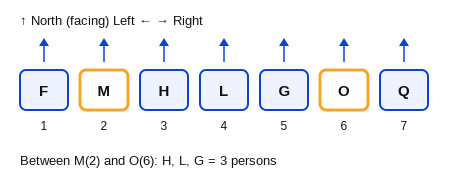
  1. No one is to the right of Q → Q at 7; O immediately left of Q → O at 6.
  2. Exactly three people between Q and H → H at 3.
  3. F is 3rd to the left of L and G is immediately right of L: free seats 1, 2, 4, 5 → L at 4, G at 5, F at 1; M takes seat 2.
  4. Row: F, M, H, L, G, O, Q. Between M (2) and O (6) sit H, L, G = three.

Trick: Start with the "end-seat" clue (nobody to the right) – it anchors the whole row.

Answer: (C) "

अवधारणा: ('Three', 'तीन')

  1. स
  2. ी
  3. ट
  4. ो
  5. ं
  6. क
  7. ो
  8. ब
  9. ा
  10. ए
  11. ँ
  12. स
  13. े
  14. द
  15. ा
  16. ए
  17. ँ
  18. 1
  19. स
  20. े
  21. 7
  22. त
  23. क
  24. क
  25. ्
  26. र
  27. म
  28. ा
  29. ं
  30. क
  31. ि
  32. त
  33. क
  34. र
  35. े
  36. ं
  37. (
  38. स
  39. भ
  40. ी
  41. उ
  42. त
  43. ्
  44. त
  45. र
  46. क
  47. ी
  48. ओ
  49. र
  50. ,
  51. अ
  52. त
  53. ः
  54. ब
  55. ा
  56. य
  57. ा
  58. ँ
  59. /
  60. द
  61. ा
  62. य
  63. ा
  64. ँ
  65. ह
  66. म
  67. ा
  68. र
  69. े
  70. ज
  71. ै
  72. स
  73. ा
  74. )
  75. ।

ट्रिक: ['Q के दाएँ कोई नहीं → Q सीट 7 पर; O, Q के तुरंत बाएँ → O सीट 6।', 'Q और H के बीच ठीक तीन व्यक्ति → H सीट 3।', 'F, L के बाएँ तीसरा और G, L के तुरंत दाएँ: खाली सीटें 1, 2, 4, 5 → L सीट 4, G सीट 5, F सीट 1; M सीट 2।', 'पंक्ति: F, M, H, L, G, O, Q। M (2) और O (6) के बीच H, L, G = तीन।']

उत्तर: (C) क

RRB NTPC Undergraduate CBT 1General Intelligence and ReasoningLinear seating arrangementRRB NTPC Undergraduate CBT 1 2025 · 9 May Shift 3 →
Q13571.
In the following triad, each letter-cluster is related to the next letter-cluster by following a certain logic. From the given options, select the option that follows the same logic.
LIES - ILSE - LSIE
FROG - RFGO - FGRO
निम्नलिखित त्रिक में, प्रत्येक अक्षर-समूह एक निश्चित तर्क का अनुसरण करते हुए अपने अगले अक्षर-समूह से संबंधित है। दिए गए विकल्पों में से, वह विकल्प चुनिए जो समान तर्क का अनुसरण करता है।
LIES - ILSE - LSIE
FROG - RFGO - FGRO
  1. APALE - ALEP - LEPA
  2. BSCAM - MSCA - AMSC
  3. CLUCK - UCLK - CLUK
  4. DCUPS - UCSP - CSUP
Show answer

Concept: Track the positions in both steps.

  1. LIES → ILSE: positions 1-2-3-4 become 2-1-4-3 (swap letters in pairs). FROG → RFGO ✓.
  2. ILSE → LSIE: positions become 2-3-1-4 (1st letter moves to 3rd place). RFGO → FGRO ✓.
  3. CUPS → UCSP (pairs swapped ✓) → CSUP (U-C-S-P → C-S-U-P: 2-3-1-4 ✓).
  4. PALE → ALEP, SCAM → MSCA, LUCK → UCLK do not follow the pair-swap in step 1.

Trick: Step 1: swap 1↔2 and 3↔4; Step 2: order 2-3-1-4.

Answer: (D) च

अवधारणा: ('CUPS - UCSP - CSUP', 'CUPS - UCSP - CSUP')

  1. द
  2. ो
  3. न
  4. ो
  5. ं
  6. च
  7. र
  8. ण
  9. ो
  10. ं
  11. म
  12. े
  13. ं
  14. स
  15. ्
  16. थ
  17. ा
  18. न
  19. ो
  20. ं
  21. क
  22. ो
  23. ट
  24. ्
  25. र
  26. ै
  27. क
  28. क
  29. र
  30. े
  31. ं
  32. ।

ट्रिक: ['LIES → ILSE: स्थान 1-2-3-4 → 2-1-4-3 (जोड़ों में अक्षर बदलें)। FROG → RFGO ✓।', 'ILSE → LSIE: स्थान 2-3-1-4 (पहला अक्षर तीसरे स्थान पर)। RFGO → FGRO ✓।', 'CUPS → UCSP (जोड़े बदले ✓) → CSUP (U-C-S-P → C-S-U-P: 2-3-1-4 ✓)।', 'PALE → ALEP, SCAM → MSCA, LUCK → UCLK पहले चरण के जोड़ा-बदल नियम पर खरे नहीं उतरते।']

उत्तर: (D) र

RRB NTPC Undergraduate CBT 1General Intelligence and ReasoningLetter analogyRRB NTPC Undergraduate CBT 1 2025 · 9 May Shift 3 →
Q13572.
In a certain code language,
A x B means 'A is the father of B',
A ≠ B means 'A is the son of B',
A ÷ B means 'A is the daughter of B' and
A ₹ B means 'A is the sister of B'
Based on the above, if 'C ÷ D ₹ E ≠ L x M', then how is C related to M?
एक निश्चित कूट भाषा में,
A x B का अर्थ है कि 'A, B का पिता है',
A ≠ B का अर्थ है कि 'A, B का पुत्र है',
A ÷ B का अर्थ है कि 'A, B की पुत्री है' और
A ₹ B का अर्थ है कि 'A, B की बहन है'
उपर्युक्त के आधार पर, यदि 'C ÷ D ₹ E ≠ L x M' हो, तो C का M से क्या संबंध है?
  1. AMother's motherमाता की माता
  2. BSisterबहन
  3. CSister's daughterबहन की पुत्री
  4. DDaughterपुत्री
Show answer

Concept: Decode each symbol and build the tree from the right end.

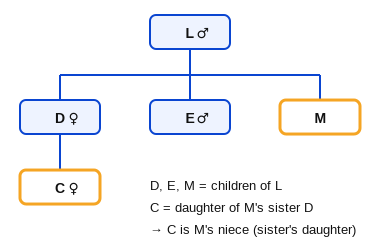
  1. L x M: L is the father of M. E ≠ L: E is the son of L → E and M are siblings.
  2. D ₹ E: D is the sister of E → D is also a sister of M.
  3. C ÷ D: C is the daughter of D → C is the daughter of M's sister, i.e. M's niece.

Trick: Children of the same father are siblings; a sibling's daughter = niece ("sister's daughter").

Answer: (C) ए

अवधारणा: ("Sister's daughter", 'बहन की पुत्री')

  1. ह
  2. र
  3. प
  4. ्
  5. र
  6. त
  7. ी
  8. क
  9. क
  10. ो
  11. ड
  12. ि
  13. क
  14. ो
  15. ड
  16. क
  17. र
  18. े
  19. ं
  20. औ
  21. र
  22. द
  23. ा
  24. ए
  25. ँ
  26. स
  27. ि
  28. र
  29. े
  30. स
  31. े
  32. व
  33. ृ
  34. क
  35. ्
  36. ष
  37. ब
  38. न
  39. ा
  40. ए
  41. ँ
  42. ।

ट्रिक: ['L x M: L, M का पिता है। E ≠ L: E, L का पुत्र है → E और M भाई-बहन हैं।', 'D ₹ E: D, E की बहन है → D, M की भी बहन है।', 'C ÷ D: C, D की पुत्री है → C, M की बहन की पुत्री अर्थात M की भांजी है।']

उत्तर: (C) क

RRB NTPC Undergraduate CBT 1General Intelligence and ReasoningCoded blood relationsRRB NTPC Undergraduate CBT 1 2025 · 9 May Shift 3 →
Q13573.
Dinesh starts from point A and drives 20 km towards the west. Then he takes a left turn and drives 18 km, takes a left turn and drives 21 km. Then he takes a left turn and drives 28 km, and finally he takes a left turn, drives 1 km and stops at point P. How far (shortest distance) and in which direction should he drive to reach point A again? (All turns are 90° turns only unless specified.)
दिनेश बिंदु A से शुरू करके पश्चिम की ओर 20 km गाड़ी चलाता है। फिर वह बाएँ मुड़ता है और 18 km गाड़ी चलाता है, बाएँ मुड़कर 21 km गाड़ी चलाता है। फिर वह बाएँ मुड़ता है और 28 km गाड़ी चलाता है, अंत में वह बाएँ मुड़कर 1 km गाड़ी चलाता है और बिंदु P पर रुकता है। तो बिंदु A पर वापस पहुँचने के लिए उसे कितनी दूर (न्यूनतम दूरी) और किस दिशा में गाड़ी चलानी होगी? (जब तक अन्यथा निर्दिष्ट न हो, सभी मोड़ केवल 90° के मोड़ हैं।)
  1. A11 km towards North11 km उत्तर की ओर
  2. B10 km towards North10 km उत्तर की ओर
  3. C10 km towards South10 km दक्षिण की ओर
  4. D11 km towards South11 km दक्षिण की ओर
Show answer

Concept: Take A as origin; a left turn rotates the direction anticlockwise: W → S → E → N → W.

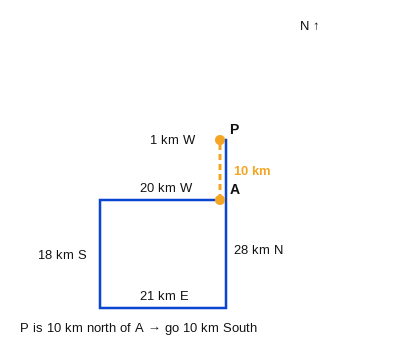
  1. West 20 km: (−20,0). Left (South) 18 km: (−20,−18). Left (East) 21 km: (1,−18).
  2. Left (North) 28 km: (1,10). Left (West) 1 km: P =(0,10).
  3. P is directly 10 km north of A, so to return he must drive 10 km towards the South.

Trick: Net east–west: −20+21−1=0; net north–south: −18+28=+10 (north).

Answer: (C) क

अवधारणा: ('10 km towards South', '10 km दक्षिण की ओर')

  1. A
  2. क
  3. ो
  4. म
  5. ू
  6. ल
  7. ब
  8. ि
  9. ं
  10. द
  11. ु
  12. म
  13. ा
  14. न
  15. े
  16. ं
  17. ;
  18. ब
  19. ा
  20. य
  21. ा
  22. ँ
  23. म
  24. ो
  25. ड
  26. ़
  27. द
  28. ि
  29. श
  30. ा
  31. क
  32. ो
  33. व
  34. ा
  35. म
  36. ा
  37. व
  38. र
  39. ्
  40. त
  41. घ
  42. ु
  43. म
  44. ा
  45. त
  46. ा
  47. ह
  48. ै
  49. :
  50. W
  51. →
  52. S
  53. →
  54. E
  55. →
  56. N
  57. →
  58. W
  59. ।

ट्रिक: ['पश्चिम 20 km: (−20,0)। बाएँ (दक्षिण) 18 km: (−20,−18)। बाएँ (पूर्व) 21 km: (1,−18)।', 'बाएँ (उत्तर) 28 km: (1,10)। बाएँ (पश्चिम) 1 km: P =(0,10)।', 'P, A के ठीक 10 km उत्तर में है, अतः लौटने के लिए उसे 10 km दक्षिण की ओर चलना होगा।']

उत्तर: (C) ु

RRB NTPC Undergraduate CBT 1General Intelligence and ReasoningDirection and distanceRRB NTPC Undergraduate CBT 1 2025 · 9 May Shift 3 →
Q13574.
If ‘+’ means ‘−’, ‘−’ means ‘×’, ‘×’ means ‘÷’ and ‘÷’ means ‘+’, then what will come in place of the question mark (?) in the following equation?
21 − 4 ÷ 10 + 36 × 4 = ?
यदि ‘+’ का अर्थ ‘−’, ‘−’ का अर्थ ‘×’, ‘×’ का अर्थ ‘÷’ और ‘÷’ का अर्थ ‘+’ हो, तो नीचे दिए गए समीकरण में प्रश्नचिह्न (?) के स्थान पर क्या आएगा?
21 − 4 ÷ 10 + 36 × 4 = ?
  1. A90
  2. B85
  3. C84
  4. D89
Show answer

Concept: Replace each symbol by its meaning, then apply BODMAS.

  1. Given: + → −, − → ×, × → ÷, ÷ → +.
  2. 21−4÷10+36×4 becomes 21×4+10−36÷4.
  3. =84+10−9=85.

Trick: Do ÷ and × before + and − even after substitution.

Answer: (B) प

अवधारणा: ('85', '85')

  1. ह
  2. र
  3. प
  4. ्
  5. र
  6. त
  7. ी
  8. क
  9. क
  10. ो
  11. उ
  12. स
  13. क
  14. े
  15. अ
  16. र
  17. ्
  18. थ
  19. स
  20. े
  21. ब
  22. द
  23. ल
  24. े
  25. ं
  26. ,
  27. फ
  28. ि
  29. र
  30. B
  31. O
  32. D
  33. M
  34. A
  35. S
  36. ल
  37. ग
  38. ा
  39. ए
  40. ँ
  41. ।

ट्रिक: ['दिया है: + → −, − → ×, × → ÷, ÷ → +।', '21−4div10+36times4 बन जाता है 21times4+10−36div4।', '=84+10−9=85।']

उत्तर: (B) ्

RRB NTPC Undergraduate CBT 1General Intelligence and ReasoningMathematical operationsRRB NTPC Undergraduate CBT 1 2025 · 9 May Shift 3 →
Q13575.
Seven persons F, G, H, L, M, O and Q are sitting in a row facing north. No one is sitting to the right of M. Only three persons are sitting between O and M. Only one person is sitting between M and L. H is sitting immediately to the left of G. Q is not sitting immediately next to M. How many people are sitting between F and H?
सात व्यक्ति F, G, H, L, M, O और Q एक पंक्ति में उत्तर की ओर मुख करके बैठे हैं। M के दाईं ओर कोई नहीं बैठा है। O और M के बीच केवल तीन व्यक्ति बैठे हैं। M और L के बीच केवल एक व्यक्ति बैठा है। H, G के ठीक बाईं ओर बैठा है। Q, M के ठीक बगल में नहीं बैठा है। तो F और H के बीच कितने व्यक्ति बैठे हैं?
  1. AThreeतीन
  2. BOneएक
  3. CTwoदो
  4. DFourचार
Show answer

Concept: Number the seats 1 to 7 from left to right; all face north.

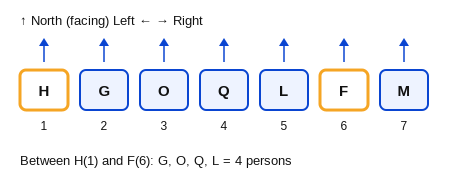
  1. No one is to the right of M → M at 7. Exactly three between O and M → O at 3. Exactly one between M and L → L at 5.
  2. H is immediately left of G: of the free seats 1, 2, 4, 6 only 1–2 are adjacent → H at 1, G at 2.
  3. Q is not next to M → Q not at 6 → Q at 4, F at 6.
  4. Row: H, G, O, Q, L, F, M. Between F (6) and H (1): G, O, Q, L = four.

Trick: Use the "immediately left/right" pair to fill the only adjacent free seats.

Answer: (D) "

अवधारणा: ('Four', 'चार')

  1. स
  2. ी
  3. ट
  4. ो
  5. ं
  6. क
  7. ो
  8. ब
  9. ा
  10. ए
  11. ँ
  12. स
  13. े
  14. द
  15. ा
  16. ए
  17. ँ
  18. 1
  19. स
  20. े
  21. 7
  22. त
  23. क
  24. क
  25. ्
  26. र
  27. म
  28. ा
  29. ं
  30. क
  31. ि
  32. त
  33. क
  34. र
  35. े
  36. ं
  37. ;
  38. स
  39. भ
  40. ी
  41. उ
  42. त
  43. ्
  44. त
  45. र
  46. क
  47. ी
  48. ओ
  49. र
  50. ।

ट्रिक: ['M के दाएँ कोई नहीं → M सीट 7। O और M के बीच ठीक तीन → O सीट 3। M और L के बीच ठीक एक → L सीट 5।', 'H, G के तुरंत बाएँ: खाली सीटों 1, 2, 4, 6 में केवल 1–2 सटी हैं → H सीट 1, G सीट 2।', 'Q, M के बगल में नहीं → Q सीट 6 पर नहीं → Q सीट 4, F सीट 6।', 'पंक्ति: H, G, O, Q, L, F, M। F (6) और H (1) के बीच: G, O, Q, L = चार।']

उत्तर: (D) त

RRB NTPC Undergraduate CBT 1General Intelligence and ReasoningLinear seating arrangementRRB NTPC Undergraduate CBT 1 2025 · 9 May Shift 3 →
Q13576.
Each of the seven boxes A, B, R, U, P, T and S is placed one over the other, but not necessarily in the same order. Only four boxes are placed above U. Only one box is placed above R. Only one box is placed between R and A. S is placed immediately above T. P is placed somewhere below B. How many boxes are placed between B and S?
सात बक्से A, B, R, U, P, T और S में से प्रत्येक को एक-दूसरे के ऊपर रखा गया है, परंतु आवश्यक नहीं कि इसी क्रम में हों। U के ऊपर केवल चार बक्से रखे गए हैं। R के ऊपर केवल एक बक्सा रखा गया है। R और A के बीच केवल एक बक्सा रखा गया है। S को T के ठीक ऊपर रखा गया है। P को B के नीचे किसी स्थान पर रखा गया है। तो B और S के बीच कितने बक्से रखे गए हैं?
  1. ATwoदो
  2. BOneएक
  3. CFourचार
  4. DThreeतीन
Show answer

Concept: Positions 1 (bottom) to 7 (top).

  1. Only four boxes above U → U at 3. Only one above R → R at 6.
  2. Exactly one box between R and A → A at 4 (position 8 does not exist).
  3. S immediately above T: free positions 1, 2, 5, 7 → T at 1, S at 2.
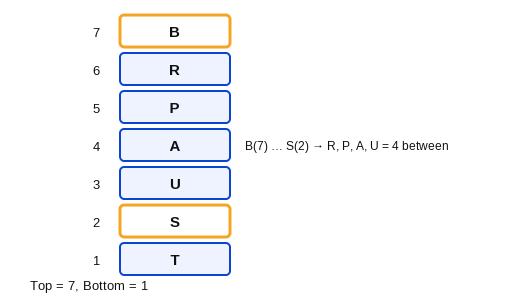
  4. P is below B → P at 5, B at 7. Stack: B, R, P, A, U, S, T. Between B (7) and S (2): R, P, A, U = four.

Trick: "Only n boxes above" ⇒ position =7−n.

Answer: (C) "

अवधारणा: ('Four', 'चार')

  1. स
  2. ्
  3. थ
  4. ा
  5. न
  6. 1
  7. (
  8. न
  9. ी
  10. च
  11. े
  12. )
  13. स
  14. े
  15. 7
  16. (
  17. ऊ
  18. प
  19. र
  20. )
  21. ।

ट्रिक: ['U के ऊपर केवल चार बॉक्स → U स्थान 3। R के ऊपर केवल एक → R स्थान 6।', 'R और A के बीच ठीक एक बॉक्स → A स्थान 4 (स्थान 8 नहीं है)।', 'S, T के तुरंत ऊपर: खाली स्थान 1, 2, 5, 7 → T स्थान 1, S स्थान 2।', 'P, B के नीचे → P स्थान 5, B स्थान 7। ढेर: B, R, P, A, U, S, T। B (7) और S (2) के बीच: R, P, A, U = चार।']

उत्तर: (C) ऊ

RRB NTPC Undergraduate CBT 1General Intelligence and ReasoningBox arrangementRRB NTPC Undergraduate CBT 1 2025 · 9 May Shift 3 →
Q13577.
Study the given letter series and answer the question that follows. (Counting is to be done from left to right only.)
(Left) K D A Z Z X L E L A R A E P E Y U Z F U Q P (Right)
How many such vowels are there, each of which is immediately preceded by a consonant and also immediately followed by a consonant?
दी गई अक्षर शृंखला का अध्ययन कीजिए और उसके नीचे दिए गए प्रश्न का उत्तर दीजिए। (गिनती केवल बाईं ओर से दाईं ओर की जानी है।)
(बाईं ओर) K D A Z Z X L E L A R A E P E Y U Z F U Q P (दाईं ओर)
ऐसे कितने स्वर हैं जिनमें से प्रत्येक के ठीक पहले एक व्यंजन आता है और ठीक बाद में भी एक व्यंजन आता है?
  1. A5
  2. B8
  3. C7
  4. D6
Show answer

Concept: Mark each vowel and check its immediate neighbours.

  1. Series: K D A Z Z X L E L A R A E P E Y U Z F U Q P.
  2. A(3): D–Z ✓; E(8): L–L ✓; A(10): L–R ✓; A(12): R–E ✗ (vowel after); E(13): A before ✗; E(15): P–Y ✓; U(17): Y–Z ✓; U(20): F–Q ✓.
  3. Count = 6.

Trick: Y is a consonant here; two adjacent vowels (A E) disqualify each other.

Answer: (D) Y

अवधारणा: ('6', '6')

  1. ह
  2. र
  3. स
  4. ्
  5. व
  6. र
  7. क
  8. ो
  9. च
  10. ि
  11. ह
  12. ्
  13. न
  14. ि
  15. त
  16. क
  17. र
  18. े
  19. ं
  20. औ
  21. र
  22. उ
  23. स
  24. क
  25. े
  26. द
  27. ो
  28. न
  29. ो
  30. ं
  31. प
  32. ड
  33. ़
  34. ो
  35. स
  36. ी
  37. ज
  38. ा
  39. ँ
  40. च
  41. े
  42. ं
  43. ।

ट्रिक: ['श्रृंखला: K D A Z Z X L E L A R A E P E Y U Z F U Q P।', 'A(3): D–Z ✓; E(8): L–L ✓; A(10): L–R ✓; A(12): R–E ✗ (बाद में स्वर); E(13): पहले A ✗; E(15): P–Y ✓; U(17): Y–Z ✓; U(20): F–Q ✓।', 'गिनती = 6।']

उत्तर: (D)

RRB NTPC Undergraduate CBT 1General Intelligence and ReasoningLetter series countingRRB NTPC Undergraduate CBT 1 2025 · 9 May Shift 3 →
Q13578.
What should come in place of the question mark ('?') in the following series?
45 ? 63 81 105 135
नीचे दी गई शृंखला में प्रश्नचिह्न ('?') के स्थान पर क्या आना चाहिए?
45 ? 63 81 105 135
  1. A54
  2. B51
  3. C53
  4. D52
Show answer

Concept: Look at the differences between known consecutive terms.

  1. 81−63=18, 105−81=24, 135−105=30 → differences increase by 6.
  2. Working backwards the differences are 6, 12, 18, 24, 30: 45+6=51 and 51+12=63 ✓.

Trick: Differences in A.P. (6, 12, 18, …) → fill the gap from the known pairs.

Answer: (B) अ

अवधारणा: ('51', '51')

  1. ज
  2. ्
  3. ञ
  4. ा
  5. त
  6. क
  7. ्
  8. र
  9. म
  10. ा
  11. ग
  12. त
  13. प
  14. द
  15. ो
  16. ं
  17. क
  18. े
  19. अ
  20. ं
  21. त
  22. र
  23. द
  24. े
  25. ख
  26. े
  27. ं
  28. ।

ट्रिक: ['81−63=18, 105−81=24, 135−105=30 → अंतर 6 से बढ़ते हैं।', 'पीछे चलने पर अंतर 6, 12, 18, 24, 30: 45+6=51 और 51+12=63 ✓।']

उत्तर: (B) ं

RRB NTPC Undergraduate CBT 1General Intelligence and ReasoningNumber seriesRRB NTPC Undergraduate CBT 1 2025 · 9 May Shift 3 →
Q13579.
If 2 is added to each odd digit and 1 is subtracted from each even digit in the number 7281654, which digit will be third from the left in the new number thus formed?
यदि संख्या 7281654 के प्रत्येक विषम अंक में 2 जोड़ा जाए और प्रत्येक सम अंक में से 1 घटाया जाए, तो इस प्रकार बनी नई संख्या में बाईं ओर से तीसरा अंक कौन-सा होगा?
  1. A3
  2. B9
  3. C7
  4. D1
Show answer

Concept: Apply the rule digit by digit, keeping the order.

  1. 7281654: 7 (odd) → 9, 2 (even) → 1, 8 → 7, 1 → 3, 6 → 5, 5 → 7, 4 → 3.
  2. New number: 9173573. Third digit from the left = 7.

Trick: Only the third digit matters: 8 is even → 8−1=7.

Answer: (C) क

अवधारणा: ('7', '7')

  1. क
  2. ्
  3. र
  4. म
  5. ब
  6. न
  7. ा
  8. ए
  9. र
  10. ख
  11. त
  12. े
  13. ह
  14. ु
  15. ए
  16. न
  17. ि
  18. य
  19. म
  20. ह
  21. र
  22. अ
  23. ं
  24. क
  25. प
  26. र
  27. ल
  28. ग
  29. ा
  30. ए
  31. ँ
  32. ।

ट्रिक: ['7281654: 7 (विषम) → 9, 2 (सम) → 1, 8 → 7, 1 → 3, 6 → 5, 5 → 7, 4 → 3।', 'नई संख्या: 9173573। बाएँ से तीसरा अंक = 7।']

उत्तर: (C) े

RRB NTPC Undergraduate CBT 1General Intelligence and ReasoningDigit operationsRRB NTPC Undergraduate CBT 1 2025 · 9 May Shift 3 →
Q13580.
Based on the English alphabetical order, three of the following four letter-clusters are alike in a certain way and thus form a group. Which option does not belong to that group?
(NOTE: The odd one out is not based on the number of consonants/vowels or their position in the letter cluster.)
अंग्रेज़ी वर्णमाला क्रम के आधार पर, नीचे दिए गए चार अक्षर-समूहों में से तीन किसी निश्चित प्रकार से समान हैं और इस प्रकार एक समूह बनाते हैं। कौन-सा विकल्प उस समूह में नहीं आता है?
(नोट: भिन्न विकल्प व्यंजनों/स्वरों की संख्या अथवा अक्षर-समूह में उनके स्थान पर आधारित नहीं है।)
  1. AHL-ZS
  2. BQU – IB
  3. CWA-OH
  4. DGK - YP
Show answer

Concept: Compare the gap inside each pair and between the two pairs.

  1. HL–ZS: H→L +4, Z→S −7. QU–IB: Q→U +4, I→B −7. WA–OH: W→A +4 (wrap), O→H −7.
  2. GK–YP: G→K +4 but Y→P =16−25=−9, not −7.
  3. Hence GK–YP is the odd one out.

Trick: First letter +18 gives the third letter in every option; only the last gap (−7 vs −9) breaks in D.

Answer: (D) ह

अवधारणा: ('GK - YP', 'GK - YP')

  1. ह
  2. र
  3. ज
  4. ो
  5. ड
  6. ़
  7. े
  8. क
  9. े
  10. अ
  11. ं
  12. द
  13. र
  14. औ
  15. र
  16. द
  17. ो
  18. न
  19. ो
  20. ं
  21. ज
  22. ो
  23. ड
  24. ़
  25. ो
  26. ं
  27. क
  28. े
  29. ब
  30. ी
  31. च
  32. क
  33. े
  34. अ
  35. ं
  36. त
  37. र
  38. क
  39. ी
  40. त
  41. ु
  42. ल
  43. न
  44. ा
  45. क
  46. र
  47. े
  48. ं
  49. ।

ट्रिक: ['HL–ZS: H→L +4, Z→S −7। QU–IB: Q→U +4, I→B −7। WA–OH: W→A +4 (wrap), O→H −7।', 'GK–YP: G→K +4 पर Y→P =16−25=−9, −7 नहीं।', 'अतः GK–YP विषम है।']

उत्तर: (D) र

RRB NTPC Undergraduate CBT 1General Intelligence and ReasoningLetter-pair classificationRRB NTPC Undergraduate CBT 1 2025 · 9 May Shift 3 →