Question bank

Q&A: practice questions with answers

Search questions on any topic. Filter by exam category, exam, subject and topic, try the question, then open the answer and explanation.

Courses – airGurukul

20,719 questions found.

Q13581.
If 'P' means ‘÷’, ‘Q’ means ‘×’, ‘R’ means ‘+’ and 'S' means ‘−’, then what will come in place of the question mark (?) in the following equation?
40 R 16 P 4 S 3 Q 5 = ?
यदि 'P' का अर्थ ‘÷’, ‘Q’ का अर्थ ‘×’, ‘R’ का अर्थ ‘+’ और 'S' का अर्थ ‘−’ हो, तो नीचे दिए गए समीकरण में प्रश्नचिह्न (?) के स्थान पर क्या आएगा?
40 R 16 P 4 S 3 Q 5 = ?
  1. A29
  2. B25
  3. C30
  4. D32
Show answer

Concept: Substitute the letters by operators and use BODMAS.

  1. P = ÷, Q = ×, R = +, S = −.
  2. 40 R 16 P 4 S 3 Q 5 =40+16÷4−3×5.
  3. =40+4−15=29.

Trick: Division and multiplication first: 16÷4=4, 3×5=15.

Answer: (A) प

अवधारणा: ('29', '29')

  1. अ
  2. क
  3. ्
  4. ष
  5. र
  6. ो
  7. ं
  8. क
  9. ी
  10. ज
  11. ग
  12. ह
  13. स
  14. ं
  15. क
  16. ्
  17. र
  18. ि
  19. य
  20. ा
  21. ए
  22. ँ
  23. र
  24. ख
  25. े
  26. ं
  27. औ
  28. र
  29. B
  30. O
  31. D
  32. M
  33. A
  34. S
  35. ल
  36. ग
  37. ा
  38. ए
  39. ँ
  40. ।

ट्रिक: ['P = ÷, Q = ×, R = +, S = −।', '40 R 16 P 4 S 3 Q 5 =40+16div4−3times5।', '=40+4−15=29।']

उत्तर: (A) ह

RRB NTPC Undergraduate CBT 1General Intelligence and ReasoningMathematical operationsRRB NTPC Undergraduate CBT 1 2025 · 9 May Shift 3 →
Q13582.
What should come in place of the question mark (?) in the given series?
92 109 143 194 262 ?
दी गई शृंखला में प्रश्नचिह्न (?) के स्थान पर क्या आना चाहिए?
92 109 143 194 262 ?
  1. A349
  2. B351
  3. C347
  4. D345
Show answer

Concept: Find the differences between consecutive terms.

  1. 109−92=17, 143−109=34, 194−143=51, 262−194=68.
  2. Differences are multiples of 17: 17, 34, 51, 68 → next 85.
  3. 262+85=347.

Trick: Differences =17×1,2,3,4,5.

Answer: (C) अ

अवधारणा: ('347', '347')

  1. क
  2. ्
  3. र
  4. म
  5. ा
  6. ग
  7. त
  8. प
  9. द
  10. ो
  11. ं
  12. क
  13. े
  14. अ
  15. ं
  16. त
  17. र
  18. न
  19. ि
  20. क
  21. ा
  22. ल
  23. े
  24. ं
  25. ।

ट्रिक: ['109−92=17, 143−109=34, 194−143=51, 262−194=68।', 'अंतर 17 के गुणज हैं: 17, 34, 51, 68 → अगला 85।', '262+85=347।']

उत्तर: (C) ं

RRB NTPC Undergraduate CBT 1General Intelligence and ReasoningNumber seriesRRB NTPC Undergraduate CBT 1 2025 · 9 May Shift 3 →
Q13583.
What should come in place of the question mark (?) in the given series based on the English alphabetical order? RNT KGM DZF WSY ?
अंग्रेज़ी वर्णमाला क्रम के आधार पर दी गई शृंखला में प्रश्नचिह्न (?) के स्थान पर क्या आना चाहिए? RNT KGM DZF WSY ?
  1. AFPR
  2. BYFT
  3. CWKF
  4. DPLR
Show answer

Concept: Each letter of the group moves by the same step with wrap-around.

  1. 1st letters: R(18) → K(11) → D(4) → W(23) → P(16): −7 each time (4−7=−3→23).
  2. 2nd letters: N(14) → G(7) → Z(26) → S(19) → L(12): −7.
  3. 3rd letters: T(20) → M(13) → F(6) → Y(25) → R(18): −7.
  4. Next group: PLR.

Trick: Every letter −7; below 1 add 26.

Answer: (D) ह

अवधारणा: ('PLR', 'PLR')

  1. स
  2. म
  3. ू
  4. ह
  5. क
  6. ा
  7. ह
  8. र
  9. अ
  10. क
  11. ्
  12. ष
  13. र
  14. स
  15. म
  16. ा
  17. न
  18. क
  19. द
  20. म
  21. स
  22. े
  23. w
  24. r
  25. a
  26. p
  27. -
  28. a
  29. r
  30. o
  31. u
  32. n
  33. d
  34. स
  35. ह
  36. ि
  37. त
  38. ब
  39. ढ
  40. ़
  41. त
  42. ा
  43. ह
  44. ै
  45. ।

ट्रिक: ['पहले अक्षर: R(18) → K(11) → D(4) → W(23) → P(16): हर बार −7 (4−7=−3to23)।', 'दूसरे अक्षर: N(14) → G(7) → Z(26) → S(19) → L(12): −7।', 'तीसरे अक्षर: T(20) → M(13) → F(6) → Y(25) → R(18): −7।', 'अगला समूह: PLR।']

उत्तर: (D) र

RRB NTPC Undergraduate CBT 1General Intelligence and ReasoningLetter seriesRRB NTPC Undergraduate CBT 1 2025 · 9 May Shift 3 →
Q13584.
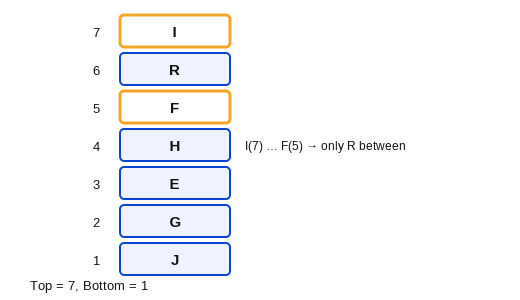
Each of the seven boxes, E, F, G, H, I, J and R, is kept one over the other, but not necessarily in the same order. Only two boxes are kept below E. Only one box is kept above R. Only one box is kept between R and H. G is kept immediately above J. F is kept at some position below I. How many boxes are kept between I and F?
सात बक्से, E, F, G, H, I, J और R में से प्रत्येक को एक-दूसरे के ऊपर रखा गया है, परंतु आवश्यक नहीं कि इसी क्रम में हों। E के नीचे केवल दो बक्से रखे गए हैं। R के ऊपर केवल एक बक्सा रखा गया है। R और H के बीच केवल एक बक्सा रखा गया है। G को J के ठीक ऊपर रखा गया है। F को I के नीचे किसी एक स्थान पर रखा गया है। I और F के बीच कितने बक्से रखे गए हैं?
  1. ATwoदो
  2. BOneएक
  3. CZeroशून्य
  4. DThreeतीन
Show answer

Concept: Positions 1 (bottom) to 7 (top).

  1. Only two boxes below E → E at 3. Only one above R → R at 6.
  2. Exactly one box between R and H → H at 4.
  3. G immediately above J: free positions 1, 2, 5, 7 → J at 1, G at 2.
  4. F is below I → F at 5, I at 7. Stack: I, R, F, H, E, G, J. Between I (7) and F (5): only R = one.

Trick: Fix the exact-position clues, then place the "immediately above" pair in the only adjacent gap.

Answer: (B) प

अवधारणा: ('One', 'एक')

  1. स
  2. ्
  3. थ
  4. ा
  5. न
  6. 1
  7. (
  8. न
  9. ी
  10. च
  11. े
  12. )
  13. स
  14. े
  15. 7
  16. (
  17. ऊ
  18. प
  19. र
  20. )
  21. ।

ट्रिक: ['E के नीचे केवल दो बॉक्स → E स्थान 3। R के ऊपर केवल एक → R स्थान 6।', 'R और H के बीच ठीक एक बॉक्स → H स्थान 4।', 'G, J के तुरंत ऊपर: खाली स्थान 1, 2, 5, 7 → J स्थान 1, G स्थान 2।', 'F, I के नीचे → F स्थान 5, I स्थान 7। ढेर: I, R, F, H, E, G, J। I (7) और F (5) के बीच: केवल R = एक।']

उत्तर: (B) ह

RRB NTPC Undergraduate CBT 1General Intelligence and ReasoningBox arrangementRRB NTPC Undergraduate CBT 1 2025 · 9 May Shift 3 →
Q13585.
In a certain code language, 'NHJCR' is coded as '77' and 'QETLO' is coded as '61'. What is the code for 'PHASJ' in the given code language?
एक निश्चित कूट भाषा में, 'NHJCR' को '77' के रूप में कूटबद्ध किया जाता है और 'QETLO' को '61' के रूप में कूटबद्ध किया जाता है। तो दी गई कूट भाषा में 'PHASJ' के लिए कूट क्या है?
  1. A70
  2. B52
  3. C76
  4. D55
Show answer

Concept: Try reverse alphabetical positions (A = 26 … Z = 1) when the normal sum does not match.

  1. NHJCR: reverse positions 13 + 19 + 17 + 24 + 9 =82; code 77 =82−5.
  2. QETLO: 10 + 22 + 7 + 15 + 12 =66; code 61 =66−5 ✓.
  3. PHASJ: 11 + 19 + 26 + 8 + 17 =81; code =81−5=76.

Trick: Code = (sum of reverse positions) − 5; reverse position =27− normal position.

Answer: (C) क

अवधारणा: ('76', '76')

  1. ज
  2. ब
  3. स
  4. ा
  5. म
  6. ा
  7. न
  8. ्
  9. य
  10. य
  11. ो
  12. ग
  13. न
  14. म
  15. ि
  16. ल
  17. े
  18. त
  19. ो
  20. उ
  21. ल
  22. ्
  23. ट
  24. े
  25. व
  26. र
  27. ्
  28. ण
  29. म
  30. ा
  31. ल
  32. ा
  33. स
  34. ्
  35. थ
  36. ा
  37. न
  38. (
  39. A
  40. =
  41. 2
  42. 6
  43. …
  44. Z
  45. =
  46. 1
  47. )
  48. आ
  49. ज
  50. ़
  51. म
  52. ा
  53. ए
  54. ँ
  55. ।

ट्रिक: ['NHJCR: उल्टे स्थान 13 + 19 + 17 + 24 + 9 =82; कोड 77 =82−5।', 'QETLO: 10 + 22 + 7 + 15 + 12 =66; कोड 61 =66−5 ✓।', 'PHASJ: 11 + 19 + 26 + 8 + 17 =81; कोड =81−5=76।']

उत्तर: (C) ो

RRB NTPC Undergraduate CBT 1General Intelligence and ReasoningCoding–decodingRRB NTPC Undergraduate CBT 1 2025 · 9 May Shift 3 →
Q13586.
The CPU retrieves the upcoming instruction for execution from which system component?
CPU निष्पादन के लिए अगला निर्देश (instruction) किस सिस्टम घटक से प्राप्त करता है?
  1. ASystem output registerसिस्टम आउटपुट रजिस्टर
  2. BSystem secondary memoryसिस्टम द्वितीयक मेमोरी (secondary memory)
  3. CSystem program counterसिस्टम प्रोग्राम काउंटर
  4. DSystem input buffer unitसिस्टम इनपुट बफर यूनिट
Show answer

Concept: The program counter (PC) is a CPU register that holds the memory address of the next instruction to be executed.

  1. During the fetch cycle the CPU reads the address from the PC, fetches that instruction and increments the PC.
  2. Secondary memory (hard disk) is too slow and is not accessed directly for instruction fetch; output registers and input buffers hold data, not addresses.

Yaad rakhein: PC = "pointer to the next instruction"; IR (instruction register) = holds the current instruction.

Answer: (C) System program counter

अवधारणा: प्रोग्राम काउंटर (PC) CPU का वह रजिस्टर है जिसमें अगले निष्पादित होने वाले निर्देश का मेमोरी पता रहता है।

  1. फ़ेच चक्र में CPU, PC से पता पढ़कर वह निर्देश लाता है और PC को बढ़ा देता है।
  2. द्वितीयक मेमोरी (हार्ड डिस्क) धीमी है, निर्देश सीधे वहाँ से नहीं लिए जाते; आउटपुट रजिस्टर/इनपुट बफ़र डेटा रखते हैं, पता नहीं।

याद रखें: PC = "अगले निर्देश का पॉइंटर"; IR (instruction register) = वर्तमान निर्देश रखता है।

उत्तर: (C) System program counter

RRB NTPC Undergraduate CBT 1General AwarenessComputer – CPU registersRRB NTPC Undergraduate CBT 1 2025 · 9 May Shift 2 →
Q13587.
Who among the following succeeded Raja Ram Mohan Roy as the leader of the Brahmo Samaj?
निम्नलिखित में से कौन ब्रह्म समाज के नेता के रूप में राजा राम मोहन राय का उत्तराधिकारी बना?
  1. ADebendra Nath Tagoreदेवेन्द्र नाथ टैगोर
  2. BSwami Vivekanandaस्वामी विवेकानंद
  3. CKeshub Chandra Senकेशव चंद्र सेन
  4. DDwarkanath Tagoreद्वारकानाथ टैगोर
Show answer

Concept: After Raja Ram Mohan Roy died in 1833, Debendranath Tagore (father of Rabindranath) revived and led the Brahmo Samaj; he had founded the Tattvabodhini Sabha in 1839 and joined the Samaj in 1843.

  1. Keshub Chandra Sen joined later (1857) and split away in 1866 to form the Brahmo Samaj of India.
  2. Dwarkanath Tagore was a business associate of Roy, not the Samaj's leader; Vivekananda belonged to the Ramakrishna movement.

Yaad rakhein: Brahmo leaders in order: Ram Mohan Roy → Debendranath Tagore → Keshub Chandra Sen.

Answer: (A) Debendra Nath Tagore

अवधारणा: 1833 में राजा राममोहन राय की मृत्यु के बाद देवेंद्रनाथ टैगोर (रवींद्रनाथ के पिता) ने ब्रह्म समाज को पुनर्जीवित कर उसका नेतृत्व किया; उन्होंने 1839 में तत्त्वबोधिनी सभा बनाई और 1843 में समाज से जुड़े।

  1. केशवचंद्र सेन बाद में (1857) जुड़े और 1866 में अलग होकर "भारतीय ब्रह्म समाज" बनाया।
  2. द्वारकानाथ टैगोर राय के व्यापारिक सहयोगी थे, समाज के नेता नहीं; विवेकानंद रामकृष्ण मिशन से जुड़े थे।

याद रखें: ब्रह्म समाज के नेता क्रम से: राममोहन राय → देवेंद्रनाथ टैगोर → केशवचंद्र सेन।

उत्तर: (A) देवेंद्रनाथ टैगोर

RRB NTPC Undergraduate CBT 1General AwarenessSocio-religious reforms – Brahmo SamajRRB NTPC Undergraduate CBT 1 2025 · 9 May Shift 2 →
Q13588.
The sports event Bastar Olympics 2025 was launched in October 2025 in which Indian state?
खेल आयोजन बस्तर ओलंपिक 2025 का शुभारंभ अक्टूबर 2025 में किस भारतीय राज्य में किया गया?
  1. AChhattisgarhछत्तीसगढ़
  2. BJharkhandझारखंड
  3. CMadhya Pradeshमध्य प्रदेश
  4. DOdishaओडिशा
Show answer

Concept: The Bastar Olympics is a mass sports event of the Bastar division of Chhattisgarh, started in 2024 to connect youth of the Maoist-affected region with the mainstream; its second edition was launched in October 2025.

  1. Bastar (Jagdalpur) is in southern Chhattisgarh; the games cover village, block, district and divisional levels.
  2. Jharkhand, Madhya Pradesh and Odisha have no "Bastar" region.

Yaad rakhein: Bastar = Chhattisgarh (Dussehra of Bastar, Chitrakote falls, Bastar Olympics).

Answer: (A) Chhattisgarh

अवधारणा: बस्तर ओलंपिक छत्तीसगढ़ के बस्तर संभाग का जन-खेल आयोजन है, जो 2024 में माओवाद-प्रभावित क्षेत्र के युवाओं को मुख्यधारा से जोड़ने के लिए शुरू हुआ; इसका दूसरा संस्करण अक्टूबर 2025 में लॉन्च हुआ।

  1. बस्तर (जगदलपुर) दक्षिणी छत्तीसगढ़ में है; खेल गाँव, ब्लॉक, ज़िला और संभाग स्तर पर होते हैं।
  2. झारखंड, मध्य प्रदेश और ओडिशा में कोई "बस्तर" क्षेत्र नहीं है।

याद रखें: बस्तर = छत्तीसगढ़ (बस्तर दशहरा, चित्रकोट जलप्रपात, बस्तर ओलंपिक)।

उत्तर: (A) छत्तीसगढ़

RRB NTPC Undergraduate CBT 1General AwarenessCurrent affairs – SportsRRB NTPC Undergraduate CBT 1 2025 · 9 May Shift 2 →
Q13589.
What happens to the speed of sound as the temperature of the air increases?
वायु का तापमान बढ़ने पर ध्वनि की चाल पर क्या प्रभाव पड़ता है?
  1. AIt remains the same, as the speed is constant in a given mediumयह समान रहती है, क्योंकि किसी दिए गए माध्यम में चाल नियत होती है
  2. BIt decreases rapidly because the air molecules move extremely slowerयह तेज़ी से घटती है, क्योंकि वायु के अणु अत्यधिक धीमी गति से चलते हैं
  3. CIt decreases, because the air becomes less denseयह घटती है, क्योंकि वायु कम सघन हो जाती है
  4. DIt increases, because the air molecules move fasterयह बढ़ती है, क्योंकि वायु के अणु तेज़ गति से चलते हैं
Show answer

Concept: Speed of sound in a gas v∝T (absolute temperature).

  1. At higher temperature molecules move faster and pass on the vibration more quickly, so sound travels faster – roughly 0.6m/s more per ∘C rise in air.
  2. Density falls with heating, but pressure falls in the same proportion, so density alone does not slow sound; option (C) is wrong.

Yaad rakhein: Sound in air: ≈331m/s at 0∘C, ≈343m/s at 20∘C.

Answer: (D) It increases, because the air molecules move faster

अवधारणा: गैस में ध्वनि की चाल v∝T (परम ताप)।

  1. अधिक ताप पर अणु तेज़ चलते हैं और कंपन जल्दी आगे बढ़ाते हैं, अतः ध्वनि तेज़ चलती है – वायु में प्रति ∘C लगभग 0.6m/s की वृद्धि।
  2. गर्म होने पर घनत्व घटता है पर दाब भी उसी अनुपात में घटता है, इसलिए केवल घनत्व से ध्वनि धीमी नहीं होती; विकल्प (C) गलत है।

याद रखें: वायु में ध्वनि: 0∘C पर ≈331m/s, 20∘C पर ≈343m/s।

उत्तर: (D) बढ़ती है, क्योंकि वायु के अणु तेज़ गति करते हैं

RRB NTPC Undergraduate CBT 1General AwarenessPhysics – SoundRRB NTPC Undergraduate CBT 1 2025 · 9 May Shift 2 →
Q13590.
The Hornbill Festival, celebrated to showcase tribal culture, music, dance, and sports, is associated with which Indian state?
जनजातीय संस्कृति, संगीत, नृत्य और खेलों को प्रदर्शित करने के लिए मनाया जाने वाला हॉर्नबिल महोत्सव किस भारतीय राज्य से संबंधित है?
  1. AAssamअसम
  2. BManipurमणिपुर
  3. CMeghalayaमेघालय
  4. DNagalandनागालैंड
Show answer

Concept: The Hornbill Festival, the "Festival of Festivals", is held every year from 1 to 10 December at Kisama Heritage Village near Kohima, Nagaland.

  1. It brings together all the Naga tribes with traditional dance, music, indigenous games and food; named after the hornbill bird revered in Naga folklore.
  2. Assam has Bihu, Manipur has Sangai Festival, Meghalaya has Wangala/Cherry Blossom festivals.

Yaad rakhein: Hornbill – Nagaland; Sangai – Manipur; Wangala – Meghalaya; Bihu – Assam.

Answer: (D) Nagaland

अवधारणा: हॉर्नबिल महोत्सव, "त्योहारों का त्योहार", हर वर्ष 1–10 दिसंबर को कोहिमा (नागालैंड) के पास किसामा हेरिटेज गाँव में मनाया जाता है।

  1. इसमें सभी नागा जनजातियाँ पारंपरिक नृत्य, संगीत, देशी खेल और भोजन के साथ जुटती हैं; नाम नागा लोककथाओं में पूज्य हॉर्नबिल पक्षी पर है।
  2. असम – बिहू, मणिपुर – संगाई महोत्सव, मेघालय – वांगला/चेरी ब्लॉसम।

याद रखें: हॉर्नबिल – नागालैंड; संगाई – मणिपुर; वांगला – मेघालय; बिहू – असम।

उत्तर: (D) नागालैंड

RRB NTPC Undergraduate CBT 1General AwarenessFestivals of IndiaRRB NTPC Undergraduate CBT 1 2025 · 9 May Shift 2 →
Q13591.
Which river rises west of the Rohtang pass in the Kullu hills of Himachal Pradesh and flows through the Chamba valley of the state?
कौन-सी नदी हिमाचल प्रदेश की कुल्लू पहाड़ियों में रोहतांग दर्रे के पश्चिम से निकलती है और राज्य की चंबा घाटी से होकर बहती है?
  1. AJhelam riverझेलम नदी
  2. BBeas riverब्यास नदी
  3. CChenab riverचिनाब नदी
  4. DRavi riverरावी नदी
Show answer

Concept: The Ravi rises west of the Rohtang Pass in the Kullu hills (Bara Bhangal area) of Himachal Pradesh and flows through the Chamba valley before entering Punjab and Pakistan.

  1. Beas rises at Beas Kund near Rohtang but flows through Kullu–Mandi–Kangra, not Chamba.
  2. Chenab is formed by Chandra and Bhaga at Tandi (Lahaul); Jhelum rises at Verinag in Kashmir.

Yaad rakhein: Chamba town stands on the Ravi; Kullu/Manali stand on the Beas.

Answer: (D) Ravi river

अवधारणा: रावी नदी हिमाचल प्रदेश की कुल्लू पहाड़ियों (बड़ा भंगाल क्षेत्र) में रोहतांग दर्रे के पश्चिम से निकलकर चंबा घाटी से होकर पंजाब और फिर पाकिस्तान जाती है।

  1. ब्यास रोहतांग के पास ब्यास कुंड से निकलती है पर कुल्लू–मंडी–कांगड़ा से बहती है, चंबा से नहीं।
  2. चिनाब चंद्रा और भागा के तांदी (लाहौल) में मिलने से बनती है; झेलम कश्मीर के वेरीनाग से निकलती है।

याद रखें: चंबा नगर रावी के किनारे; कुल्लू/मनाली ब्यास के किनारे।

उत्तर: (D) रावी नदी

RRB NTPC Undergraduate CBT 1General AwarenessIndian Geography – RiversRRB NTPC Undergraduate CBT 1 2025 · 9 May Shift 2 →
Q13592.
Which trophy is contested between the England and Scotland teams in the Rugby Six Nations Championship, 2025?
रग्बी सिक्स नेशंस चैंपियनशिप, 2025 में इंग्लैंड और स्कॉटलैंड की टीमों के बीच किस ट्रॉफी के लिए मुकाबला होता है?
  1. AEuropean Nations Trophyयूरोपियन नेशंस ट्रॉफी
  2. BCalcutta Cupकलकत्ता कप
  3. CMillennium Cupमिलेनियम कप
  4. DTriple Crown Trophyट्रिपल क्राउन ट्रॉफी
Show answer

Concept: The Calcutta Cup is the trophy awarded to the winner of the annual England vs Scotland rugby union match, now played as part of the Six Nations Championship.

  1. It dates from 1879 and was made from melted silver rupees of the disbanded Calcutta (Rugby) Football Club – hence the Indian name.
  2. The Triple Crown is for a Home Nation beating all three other Home Nations; "Millennium Trophy" is England vs Ireland.

Yaad rakhein: Calcutta Cup = England–Scotland; Millennium Trophy = England–Ireland; Centenary Quaich = Ireland–Scotland.

Answer: (B) Calcutta Cup

अवधारणा: कलकत्ता कप इंग्लैंड बनाम स्कॉटलैंड के वार्षिक रग्बी यूनियन मैच के विजेता को दी जाने वाली ट्रॉफी है, जो अब सिक्स नेशंस चैंपियनशिप के अंतर्गत खेला जाता है।

  1. यह 1879 से चली आ रही है और भंग हुए कलकत्ता (रग्बी) फुटबॉल क्लब के चाँदी के रुपये पिघलाकर बनाई गई थी – इसीलिए भारतीय नाम।
  2. ट्रिपल क्राउन किसी होम नेशन द्वारा बाकी तीनों को हराने पर मिलता है; "मिलेनियम ट्रॉफी" इंग्लैंड–आयरलैंड के बीच है।

याद रखें: कलकत्ता कप = इंग्लैंड–स्कॉटलैंड; मिलेनियम ट्रॉफी = इंग्लैंड–आयरलैंड; सेंटेनरी क्वेक = आयरलैंड–स्कॉटलैंड।

उत्तर: (B) कलकत्ता कप

RRB NTPC Undergraduate CBT 1General AwarenessSports – RugbyRRB NTPC Undergraduate CBT 1 2025 · 9 May Shift 2 →
Q13593.
In the reaction Na2SO4(aq) + BaCl2(aq) → BaSO4(*) + 2NaCl(aq), what will be the actual physical state that can replace (*)?
अभिक्रिया Na2SO4(aq) + BaCl2(aq) → BaSO4(*) + 2NaCl(aq) में, (*) के स्थान पर वास्तविक भौतिक अवस्था क्या होगी?
  1. A(g)
  2. B(aq)
  3. C(l)
  4. D(s)
Show answer

Concept: Na2SO4(aq) + BaCl2(aq) → BaSO4(s) + 2NaCl(aq) is a double displacement (precipitation) reaction.

  1. Barium sulphate is insoluble in water, so it separates as a white solid precipitate – state symbol (s).
  2. Sodium chloride stays dissolved (aq); no gas or pure liquid is formed.

Yaad rakhein: Sulphates of Ba, Pb and (less so) Ca are insoluble – BaSO4 white precipitate is the lab test for sulphate ions.

Answer: (D) (s)

अवधारणा: Na2SO4(aq) + BaCl2(aq) → BaSO4(s) + 2NaCl(aq) एक द्विविस्थापन (अवक्षेपण) अभिक्रिया है।

  1. बेरियम सल्फेट जल में अविलेय है, अतः सफेद ठोस अवक्षेप (precipitate) के रूप में अलग होता है – अवस्था संकेत (s)।
  2. सोडियम क्लोराइड घुला रहता है (aq); कोई गैस या शुद्ध द्रव नहीं बनता।

याद रखें: Ba, Pb (और कुछ हद तक Ca) के सल्फेट अविलेय हैं – BaSO4 का सफेद अवक्षेप सल्फेट आयन की प्रयोगशाला जाँच है।

उत्तर: (D) (s)

RRB NTPC Undergraduate CBT 1General AwarenessChemistry – Precipitation reactionRRB NTPC Undergraduate CBT 1 2025 · 9 May Shift 2 →
Q13594.
Who among the following won the 2024 Nobel Prize in literature?
निम्नलिखित में से किसने साहित्य का 2024 का नोबेल पुरस्कार जीता?
  1. AHaruki Murakamiहारुकी मुराकामी
  2. BGerald Murnaneजेराल्ड मर्नेन
  3. CHan Kangहान कांग
  4. DCan Xueकैन शुए
Show answer

Concept: The 2024 Nobel Prize in Literature was awarded to South Korean author Han Kang "for her intense poetic prose that confronts historical traumas and exposes the fragility of human life".

  1. She is the first South Korean and first Asian woman to win it; known for The Vegetarian (International Booker 2016) and Human Acts.
  2. Murakami, Murnane and Can Xue are perennial favourites who have not won.

Yaad rakhein: Literature Nobel: 2023 Jon Fosse (Norway), 2024 Han Kang (South Korea), 2025 László Krasznahorkai (Hungary).

Answer: (C) Han Kang

अवधारणा: साहित्य का 2024 नोबेल पुरस्कार दक्षिण कोरियाई लेखिका हान कांग को "ऐतिहासिक आघातों का सामना करने और मानव जीवन की नाज़ुकता उजागर करने वाले उनके सघन काव्यात्मक गद्य" के लिए मिला।

  1. वे यह पुरस्कार पाने वाली पहली दक्षिण कोरियाई और पहली एशियाई महिला हैं; प्रसिद्ध कृतियाँ The Vegetarian (अंतरराष्ट्रीय बुकर 2016) और Human Acts।
  2. मुराकामी, मर्नेन और कैन शुए बार-बार चर्चित नाम हैं पर जीते नहीं।

याद रखें: साहित्य नोबेल: 2023 यॉन फॉसे (नॉर्वे), 2024 हान कांग (दक्षिण कोरिया), 2025 लास्ज़लो क्रास्ज़्नाहोरकाई (हंगरी)।

उत्तर: (C) हान कांग

RRB NTPC Undergraduate CBT 1General AwarenessCurrent affairs – Nobel PrizeRRB NTPC Undergraduate CBT 1 2025 · 9 May Shift 2 →
Q13595.
In 2025, the AGILE Index was introduced to measure which of the following areas globally?
2025 में, AGILE सूचकांक (Index) को वैश्विक स्तर पर निम्नलिखित में से किस क्षेत्र को मापने के लिए प्रस्तुत किया गया?
  1. AAI governance evaluation across countriesविभिन्न देशों में AI शासन (governance) का मूल्यांकन
  2. BDigital infrastructure readinessडिजिटल अवसंरचना की तैयारी
  3. CGlobal economic competitivenessवैश्विक आर्थिक प्रतिस्पर्धात्मकता
  4. DEnvironmental policy performanceपर्यावरण नीति का प्रदर्शन
Show answer

Concept: AGILE stands for "AI Governance InternationaL Evaluation" Index – a global index that assesses and ranks countries on their artificial-intelligence governance (environment, capacity, policy and effectiveness).

  1. The 2025 edition evaluated 40 countries and was released by research institutes linked to the Chinese Academy of Sciences.
  2. Digital readiness, competitiveness and environmental performance are covered by other indices (e.g. Network Readiness Index, WEF GCI, EPI).

Yaad rakhein: AGILE → "AI Governance" is right in its name.

Answer: (A) AI governance evaluation across countries

अवधारणा: AGILE का अर्थ है "AI Governance InternationaL Evaluation" Index – एक वैश्विक सूचकांक जो देशों को उनके कृत्रिम बुद्धिमत्ता (AI) शासन (परिवेश, क्षमता, नीति और प्रभावशीलता) पर आँकता और रैंक करता है।

  1. 2025 संस्करण में 40 देशों का मूल्यांकन हुआ; इसे चीनी विज्ञान अकादमी से जुड़े शोध संस्थानों ने जारी किया।
  2. डिजिटल तैयारी, प्रतिस्पर्धा और पर्यावरण प्रदर्शन के लिए अन्य सूचकांक हैं (जैसे Network Readiness Index, WEF GCI, EPI)।

याद रखें: AGILE → नाम में ही "AI Governance" है।

उत्तर: (A) देशों में AI शासन का मूल्यांकन

RRB NTPC Undergraduate CBT 1General AwarenessCurrent affairs – IndicesRRB NTPC Undergraduate CBT 1 2025 · 9 May Shift 2 →
Q13596.
Service and trade fall under which type of economic activities?
सेवा और व्यापार किस प्रकार की आर्थिक गतिविधियों के अंतर्गत आते हैं?
  1. AQuaternaryचतुर्थक (Quaternary)
  2. BPrimaryप्राथमिक (Primary)
  3. CSecondaryद्वितीयक (Secondary)
  4. DTertiaryतृतीयक (Tertiary)
Show answer

Concept: Economic activities are classified as primary (extraction from nature), secondary (manufacturing) and tertiary (services).

  1. Trade, transport, banking, communication, tourism, teaching – all are services, hence tertiary sector activities.
  2. Quaternary refers to specialised knowledge/information activities (R&D, IT consultancy), a sub-division sometimes separated from tertiary.

Yaad rakhein: Farm → Factory → Shop/Service = Primary → Secondary → Tertiary.

Answer: (D) Tertiary

अवधारणा: आर्थिक गतिविधियाँ प्राथमिक (प्रकृति से निष्कर्षण), द्वितीयक (विनिर्माण) और तृतीयक (सेवाएँ) में बाँटी जाती हैं।

  1. व्यापार, परिवहन, बैंकिंग, संचार, पर्यटन, शिक्षण – सभी सेवाएँ हैं, अतः तृतीयक क्षेत्रक।
  2. चतुर्थक (quaternary) विशेष ज्ञान/सूचना गतिविधियों (R&D, IT परामर्श) के लिए है, जिसे कभी-कभी तृतीयक से अलग गिना जाता है।

याद रखें: खेत → कारखाना → दुकान/सेवा = प्राथमिक → द्वितीयक → तृतीयक।

उत्तर: (D) तृतीयक

RRB NTPC Undergraduate CBT 1General AwarenessEconomics – SectorsRRB NTPC Undergraduate CBT 1 2025 · 9 May Shift 2 →
Q13597.
Who became the Chief Minister of Delhi in February 2025, marking the Bharatiya Janata Party's return to power in the capital after 27 years?
फरवरी 2025 में दिल्ली का मुख्यमंत्री कौन बना, जिससे 27 वर्षों के बाद राजधानी में भारतीय जनता पार्टी की सत्ता में वापसी हुई?
  1. AManish Sisodiaमनीष सिसोदिया
  2. BRekha Guptaरेखा गुप्ता
  3. CParvesh Vermaप्रवेश वर्मा
  4. DAtishi Marlenaआतिशी मार्लेना
Show answer

Concept: Rekha Gupta (BJP, MLA from Shalimar Bagh) was sworn in as the 9th Chief Minister of Delhi on 20 February 2025 after the BJP won the February 2025 Delhi Assembly election.

  1. BJP had last governed Delhi in 1998 (Sushma Swaraj) – a return after about 27 years.
  2. Parvesh Verma became a minister (Deputy CM status in cabinet), Atishi was the outgoing AAP CM, Manish Sisodia lost his seat.

Yaad rakhein: Delhi women CMs: Sushma Swaraj, Sheila Dikshit, Atishi, Rekha Gupta.

Answer: (B) Rekha Gupta

अवधारणा: रेखा गुप्ता (भाजपा, शालीमार बाग से विधायक) ने फरवरी 2025 के दिल्ली विधानसभा चुनाव में भाजपा की जीत के बाद 20 फरवरी 2025 को दिल्ली की 9वीं मुख्यमंत्री के रूप में शपथ ली।

  1. भाजपा ने दिल्ली में अंतिम बार 1998 में (सुषमा स्वराज) शासन किया था – लगभग 27 वर्ष बाद वापसी।
  2. प्रवेश वर्मा मंत्री बने, आतिशी निवर्तमान AAP मुख्यमंत्री थीं, मनीष सिसोदिया चुनाव हार गए।

याद रखें: दिल्ली की महिला मुख्यमंत्री: सुषमा स्वराज, शीला दीक्षित, आतिशी, रेखा गुप्ता।

उत्तर: (B) रेखा गुप्ता

RRB NTPC Undergraduate CBT 1General AwarenessCurrent affairs – PolityRRB NTPC Undergraduate CBT 1 2025 · 9 May Shift 2 →
Q13598.
Which seismic waves are the fastest and travel through both solids and liquids inside the Earth?
कौन-सी भूकंपीय तरंगें सबसे तेज़ होती हैं और पृथ्वी के भीतर ठोस तथा द्रव दोनों में से होकर गुज़रती हैं?
  1. ARayleigh wavesरेले (Rayleigh) तरंगें
  2. BP wavesP तरंगें
  3. CS wavesS तरंगें
  4. DSurface wavesधरातलीय (Surface) तरंगें
Show answer

Concept: Body waves are of two types: P (primary) waves and S (secondary) waves; surface waves (Rayleigh, Love) travel only along the surface.

  1. P waves are longitudinal, fastest (≈6–8km/s in the crust) and travel through solids, liquids and gases – they arrive first at a seismograph.
  2. S waves are transverse and cannot pass through liquids (hence the S-wave shadow zone proves the outer core is liquid).

Yaad rakhein: P = Primary/Push–pull/Passes through everything; S = Secondary/Shake/Solids only.

Answer: (B) P waves

अवधारणा: भूगर्भिक (body) तरंगें दो प्रकार की हैं: P (प्राथमिक) और S (द्वितीयक); धरातलीय तरंगें (रेले, लव) केवल सतह पर चलती हैं।

  1. P तरंगें अनुदैर्ध्य, सबसे तेज़ (भूपर्पटी में ≈6–8km/s) हैं और ठोस, द्रव व गैस तीनों से गुज़रती हैं – सीस्मोग्राफ पर सबसे पहले पहुँचती हैं।
  2. S तरंगें अनुप्रस्थ हैं और द्रव से नहीं गुज़र सकतीं (इसी से S-तरंग छाया क्षेत्र बाह्य क्रोड के द्रव होने का प्रमाण है)।

याद रखें: P = Primary/Push–pull/हर माध्यम से; S = Secondary/Shake/केवल ठोस।

उत्तर: (B) P तरंगें

RRB NTPC Undergraduate CBT 1General AwarenessGeography – Earthquake wavesRRB NTPC Undergraduate CBT 1 2025 · 9 May Shift 2 →
Q13599.
How did the Swadeshi movement aim to counter British policies after 1905?
1905 के बाद स्वदेशी आंदोलन का उद्देश्य ब्रिटिश नीतियों का मुकाबला किस प्रकार करना था?
  1. ABy supporting colonial factory laws restricting local enterprises.स्थानीय उद्यमों को प्रतिबंधित करने वाले औपनिवेशिक कारखाना कानूनों का समर्थन करके।
  2. BBy promoting indigenous industries and rejecting foreign products.स्वदेशी उद्योगों को बढ़ावा देकर और विदेशी उत्पादों का बहिष्कार करके।
  3. CBy creating diplomatic councils to negotiate tariff concessions.शुल्क रियायतों पर बातचीत के लिए राजनयिक परिषदें बनाकर।
  4. DBy adopting military drills to train youth for organised defence.संगठित रक्षा के लिए युवाओं को प्रशिक्षित करने हेतु सैन्य अभ्यास अपनाकर।
Show answer

Concept: The Swadeshi Movement (1905) arose against the Partition of Bengal; its twin weapons were Swadeshi (use of Indian goods) and Boycott (rejection of British goods, schools, courts).

  1. Indigenous enterprises were promoted – Bengal Chemicals (P.C. Ray), swadeshi textile mills, national schools, Bengal National College.
  2. Options A, C and D describe cooperation, diplomacy or militarisation, none of which was the movement's method.

Yaad rakhein: Swadeshi + Boycott = economic self-reliance; formally adopted at the Calcutta Congress session, 1906.

Answer: (B) By promoting indigenous industries and rejecting foreign products.

अवधारणा: स्वदेशी आंदोलन (1905) बंगाल विभाजन के विरोध में उठा; इसके दो हथियार थे स्वदेशी (भारतीय वस्तुओं का उपयोग) और बहिष्कार (ब्रिटिश वस्तुओं, स्कूलों, अदालतों का त्याग)।

  1. देशी उद्योगों को बढ़ावा मिला – बंगाल केमिकल्स (पी.सी. राय), स्वदेशी कपड़ा मिलें, राष्ट्रीय विद्यालय, बंगाल नेशनल कॉलेज।
  2. विकल्प A, C और D सहयोग, कूटनीति या सैन्यीकरण बताते हैं – ये आंदोलन की पद्धति नहीं थे।

याद रखें: स्वदेशी + बहिष्कार = आर्थिक आत्मनिर्भरता; 1906 के कलकत्ता कांग्रेस अधिवेशन में औपचारिक रूप से अपनाया गया।

उत्तर: (B) देशी उद्योगों को बढ़ावा देकर और विदेशी वस्तुओं को अस्वीकार करके।

RRB NTPC Undergraduate CBT 1General AwarenessModern History – Swadeshi MovementRRB NTPC Undergraduate CBT 1 2025 · 9 May Shift 2 →
Q13600.
Which schedule contains the assigned functions of the Rural Local Self Government or the Panchayati Raj?
किस अनुसूची में ग्रामीण स्थानीय स्वशासन अर्थात् पंचायती राज के निर्धारित कार्य शामिल हैं?
  1. A10th Schedule10वीं अनुसूची
  2. B11th Schedule11वीं अनुसूची
  3. C12th Schedule12वीं अनुसूची
  4. D9th Schedule9वीं अनुसूची
Show answer

Concept: The 73rd Constitutional Amendment Act, 1992 added Part IX (Panchayats) and the Eleventh Schedule, which lists 29 subjects that may be devolved to Panchayats.

  1. The 74th Amendment added Part IX-A and the Twelfth Schedule (18 subjects for Municipalities).
  2. 10th Schedule – anti-defection; 9th Schedule – laws protected from judicial review (land reforms).

Yaad rakhein: 73rd → 11th Schedule → 29 subjects (rural); 74th → 12th Schedule → 18 subjects (urban).

Answer: (B) 11th Schedule

अवधारणा: 73वें संविधान संशोधन अधिनियम, 1992 ने भाग IX (पंचायतें) और ग्यारहवीं अनुसूची जोड़ी, जिसमें पंचायतों को सौंपे जा सकने वाले 29 विषय हैं।

  1. 74वें संशोधन ने भाग IX-A और बारहवीं अनुसूची (नगरपालिकाओं के 18 विषय) जोड़ी।
  2. 10वीं अनुसूची – दल-बदल विरोधी; 9वीं अनुसूची – न्यायिक समीक्षा से संरक्षित कानून (भूमि सुधार)।

याद रखें: 73वाँ → 11वीं अनुसूची → 29 विषय (ग्रामीण); 74वाँ → 12वीं अनुसूची → 18 विषय (शहरी)।

उत्तर: (B) 11वीं अनुसूची

RRB NTPC Undergraduate CBT 1General AwarenessPolity – SchedulesRRB NTPC Undergraduate CBT 1 2025 · 9 May Shift 2 →