Question bank

Q&A: practice questions with answers

Search questions on any topic. Filter by exam category, exam, subject and topic, try the question, then open the answer and explanation.

Courses – airGurukul

20,719 questions found.

Q13641.
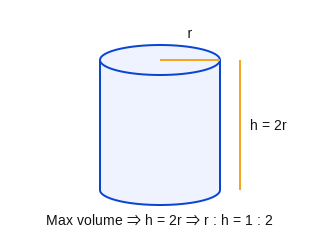
A solid right circular cylinder has curved surface area 1408πcm2. If the volume of the cylinder is maximum, then the ratio of radius to height is
एक ठोस लंब वृत्तीय बेलन का वक्र पृष्ठीय क्षेत्रफल 1408πcm2 है। यदि बेलन का आयतन अधिकतम है, तो त्रिज्या और ऊँचाई का अनुपात है
  1. A1:4
  2. B2:1
  3. C1:3
  4. D1:2
Show answer

Concept: For a closed right circular cylinder of fixed surface area, the volume is maximum when height = diameter, i.e. h=2r.

  1. Surface area S=2πrh+2πr2 fixed → V=πr2h=r(S−2πr2)2.
  2. dVdr=0⇒S=6πr2⇒2πrh=4πr2⇒h=2r.
  3. Hence r:h=1:2.

Yaad rakhein: Max-volume cylinder for given surface = "height equals diameter" (r:h=1:2); the given value 1408π is not needed for the ratio.

Answer: (D) 1:2

अवधारणा: नियत पृष्ठीय क्षेत्रफल वाले बंद लंब वृत्तीय बेलन का आयतन अधिकतम तब होता है जब ऊँचाई = व्यास, अर्थात h=2r।

  1. S=2πrh+2πr2 नियत → V=πr2h=r(S−2πr2)2।
  2. dVdr=0⇒S=6πr2⇒2πrh=4πr2⇒h=2r।
  3. अतः r:h=1:2।

याद रखें: दिए पृष्ठ पर अधिकतम आयतन वाला बेलन = "ऊँचाई बराबर व्यास" (r:h=1:2); अनुपात के लिए 1408π का मान चाहिए ही नहीं।

उत्तर: (D) 1:2
RRB NTPC Undergraduate CBT 1MathematicsMensuration – Cylinder (maximum volume)RRB NTPC Undergraduate CBT 1 2025 · 9 May Shift 2 →
Q13642.
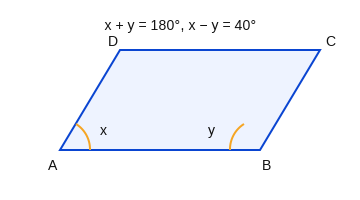
In a parallelogram, the difference of two adjacent angles is 40°. Find the measure of the smaller angle.
एक समांतर चतुर्भुज में, दो आसन्न कोणों का अंतर 40° है। छोटे कोण का माप ज्ञात कीजिए।
  1. A60°
  2. B80°
  3. C50°
  4. D70°
Show answer

Concept: Adjacent angles of a parallelogram are supplementary: x+y=180∘.

  1. x+y=180∘ and x−y=40∘.
  2. Adding: 2x=220∘⇒x=110∘; so y=70∘.

Trick: Smaller angle =180∘−difference2=140∘2=70∘.

Answer: (D) 70∘

अवधारणा: समांतर चतुर्भुज के आसन्न कोण संपूरक होते हैं: x+y=180∘।

  1. x+y=180∘ और x−y=40∘।
  2. जोड़ने पर 2x=220∘⇒x=110∘; अतः y=70∘।

ट्रिक: छोटा कोण =180∘−अंतर2=140∘2=70∘।

उत्तर: (D) 70∘

RRB NTPC Undergraduate CBT 1MathematicsParallelogram anglesRRB NTPC Undergraduate CBT 1 2025 · 9 May Shift 2 →
Q13643.
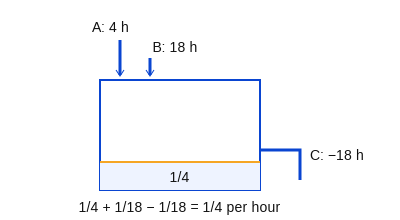
Two taps can fill a cistern in 4 hours and 18 hours, respectively. A third tap can empty it in 18 hours. How long (in hours) will it take to fill one-fourth of the empty cistern if all the taps are opened together?
दो नल एक टंकी को क्रमशः 4 घंटे और 18 घंटे में भर सकते हैं। एक तीसरा नल इसे 18 घंटे में खाली कर सकता है। यदि सभी नल एक साथ खोल दिए जाएँ, तो खाली टंकी के एक-चौथाई भाग को भरने में कितना समय (घंटों में) लगेगा?
  1. A2
  2. B3
  3. C4
  4. D1
Show answer

Concept: Net filling rate per hour = sum of inlet rates − outlet rate.

  1. Net rate =14+118−118=14 of the cistern per hour.
  2. Full cistern in 4 hours → one-fourth in 4×14=1 hour.

Trick: The 18-hour inlet and 18-hour outlet cancel exactly – only the 4-hour tap matters.

Answer: (D) 1

अवधारणा: प्रति घंटा शुद्ध भरने की दर = भरने वाले नलों की दरों का योग − खाली करने वाले की दर।

  1. शुद्ध दर =14+118−118=14 टंकी प्रति घंटा।
  2. पूरी टंकी 4 घंटे में → एक-चौथाई 4×14=1 घंटे में।

ट्रिक: 18 घंटे वाला भरने वाला और 18 घंटे वाला खाली करने वाला नल एक-दूसरे को काट देते हैं – केवल 4 घंटे वाला नल गिनें।

उत्तर: (D) 1

RRB NTPC Undergraduate CBT 1MathematicsPipes and CisternsRRB NTPC Undergraduate CBT 1 2025 · 9 May Shift 2 →
Q13644.
The price of an article increases and decreases alternately by 20% every year. If the difference between the prices at the end of the second year and third year is ₹1,920, find 40% of the price (in ₹) of the article at the end of the first year.
एक वस्तु की कीमत प्रत्येक वर्ष बारी-बारी से 20% बढ़ती और घटती है। यदि दूसरे वर्ष और तीसरे वर्ष के अंत की कीमतों का अंतर ₹1,920 है, तो पहले वर्ष के अंत में वस्तु की कीमत का 40% (₹ में) ज्ञात कीजिए।
  1. A₹4,800
  2. B₹3,200
  3. C₹2,400
  4. D₹3,600
Show answer

Concept: +20% means ×1.2, −20% means ×0.8.

  1. Let initial price =P. End of year 1: 1.2P; year 2: 0.96P; year 3: 1.152P.
  2. Difference =1.152P−0.96P=0.192P=1920⇒P=10000.
  3. Price at end of year 1 =12000; 40% of it =4800.

Trick: Year-3 price is 20% more than year-2 price, so year-2 price =19200.2=9600, year-1 price =96000.8=12000.

Answer: (A) ₹4,800

अवधारणा: +20% अर्थात ×1.2, −20% अर्थात ×0.8।

  1. माना प्रारंभिक मूल्य =P। वर्ष 1 के अंत में 1.2P; वर्ष 2: 0.96P; वर्ष 3: 1.152P।
  2. अंतर =1.152P−0.96P=0.192P=1920⇒P=10000।
  3. वर्ष 1 के अंत का मूल्य =12000; इसका 40% =4800।

ट्रिक: वर्ष-3 का मूल्य वर्ष-2 से 20% अधिक है, अतः वर्ष-2 मूल्य =19200.2=9600, वर्ष-1 मूल्य =96000.8=12000।

उत्तर: (A) ₹4,800

RRB NTPC Undergraduate CBT 1MathematicsSuccessive Percentage ChangeRRB NTPC Undergraduate CBT 1 2025 · 9 May Shift 2 →
Q13645.
A shopkeeper offers the following schemes on toys of the same marked price. (A) Successive discounts of 18% and 39% on any number of toys bought.
(B) Successive discounts of 29%, 45% and 4% on any number of toys bought. (C) 29% discount on the first 8 toys and 31% discount on each toy thereon.
(D) 7 toys free of cost on buying 8 toys.
A customer wants to buy 8 toys. Which of the above schemes is the least beneficial to her?
एक दुकानदार समान अंकित मूल्य वाले खिलौनों पर निम्नलिखित योजनाएँ प्रस्तुत करता है। (A) खरीदे गए किसी भी संख्या में खिलौनों पर 18% और 39% की क्रमिक छूट।
(B) खरीदे गए किसी भी संख्या में खिलौनों पर 29%, 45% और 4% की क्रमिक छूट। (C) पहले 8 खिलौनों पर 29% छूट और उसके बाद प्रत्येक खिलौने पर 31% छूट।
(D) 8 खिलौने खरीदने पर 7 खिलौने निःशुल्क।
एक ग्राहक 8 खिलौने खरीदना चाहती है। उपरोक्त योजनाओं में से कौन-सी उसके लिए सबसे कम लाभकारी है?
  1. AB
  2. BC
  3. CA
  4. DD
Show answer

Concept: Compare the amount paid for 8 toys (marked price ₹100 each, total ₹800).

  1. Scheme A: 800×0.82×0.61≈₹400 (≈50% off).
  2. Scheme B: 800×0.71×0.55×0.96≈₹300 (≈62.5% off).
  3. Scheme C: 29% on first 8 toys → 800×0.71=₹568 (29% off).
  4. Scheme D: pay for 8, get 15 → effective price per toy 80015≈53.3, i.e. ≈46.7% off.
  5. Highest payment / lowest discount: scheme C.

Trick: Convert every scheme into a single equivalent discount %; the smallest % is the least beneficial.

Answer: (B) C

अवधारणा: 8 खिलौनों (अंकित मूल्य ₹100 प्रत्येक, कुल ₹800) पर दी जाने वाली राशि की तुलना करें।

  1. योजना A: 800×0.82×0.61≈₹400 (≈50% छूट)।
  2. योजना B: 800×0.71×0.55×0.96≈₹300 (≈62.5% छूट)।
  3. योजना C: पहले 8 पर 29% → 800×0.71=₹568 (29% छूट)।
  4. योजना D: 8 का भुगतान, 15 मिलें → प्रति खिलौना 80015≈53.3, अर्थात ≈46.7% छूट।
  5. सबसे अधिक भुगतान / सबसे कम छूट: योजना C।

ट्रिक: हर योजना को एक समतुल्य छूट % में बदलें; सबसे छोटा % सबसे कम लाभदायक।

उत्तर: (B) C

RRB NTPC Undergraduate CBT 1MathematicsDiscount schemesRRB NTPC Undergraduate CBT 1 2025 · 9 May Shift 2 →
Q13646.
Simplify: 18−[6×2−(3+1)]+7
सरल कीजिए: 18−[6×2−(3+1)]+7
  1. A17
  2. B15
  3. C21
  4. D19
Show answer

Concept: Solve brackets innermost first: ( ), then [ ].

  1. (3+1)=4; 6×2=12; [12−4]=8.
  2. 18−8+7=17.

Trick: Inside a bracket, do multiplication before subtraction (BODMAS order).

Answer: (A) 17

अवधारणा: सबसे भीतरी कोष्ठक पहले हल करें: ( ), फिर [ ]।

  1. (3+1)=4; 6×2=12; [12−4]=8।
  2. 18−8+7=17।

ट्रिक: कोष्ठक के अंदर घटाने से पहले गुणा करें (BODMAS क्रम)।

उत्तर: (A) 17

RRB NTPC Undergraduate CBT 1MathematicsSimplification – BODMASRRB NTPC Undergraduate CBT 1 2025 · 9 May Shift 2 →
Q13647.
The price of an article is decreased by 24%, but the daily sale of the article is increased by 33%. Find the net effect on the daily sale receipts.
एक वस्तु की कीमत 24% घटा दी जाती है, लेकिन वस्तु की दैनिक बिक्री 33% बढ़ जाती है। दैनिक बिक्री प्राप्तियों पर शुद्ध प्रभाव ज्ञात कीजिए।
  1. A2.16% decrease2.16% की कमी
  2. B2.16% increase2.16% की वृद्धि
  3. C1.08% increase1.08% की वृद्धि
  4. D1.08% decrease1.08% की कमी
Show answer

Concept: Receipts = price × quantity; net % change =a+b+ab100.

  1. a=−24, b=+33: −24+33+(−24)(33)100=9−7.92=1.08.
  2. Positive → 1.08% increase in receipts.

Trick: Multiply the factors: 0.76×1.33=1.0108 → +1.08%.

Answer: (C) 1.08% increase

अवधारणा: प्राप्ति = मूल्य × मात्रा; शुद्ध % परिवर्तन =a+b+ab100।

  1. a=−24, b=+33: −24+33+(−24)(33)100=9−7.92=1.08।
  2. धनात्मक → प्राप्ति में 1.08% वृद्धि।

ट्रिक: गुणनखंड गुणा करें: 0.76×1.33=1.0108 → +1.08%।

उत्तर: (C) 1.08% वृद्धि

RRB NTPC Undergraduate CBT 1MathematicsPercentage – net effectRRB NTPC Undergraduate CBT 1 2025 · 9 May Shift 2 →
Q13648.
If 9 notebooks cost ₹135, how much will 20 notebooks of the same type cost?
यदि 9 नोटबुक की कीमत ₹135 है, तो उसी प्रकार की 20 नोटबुक की कीमत कितनी होगी?
  1. A₹270
  2. B₹300
  3. C₹280
  4. D₹320
Show answer

Concept: Cost is directly proportional to the number of notebooks.

  1. Cost of 1 notebook =1359=₹15.
  2. Cost of 20 =15×20=₹300.

Trick: 135÷9=15 – then just add a zero for 20 and double: 300.

Answer: (B) ₹300

अवधारणा: मूल्य नोटबुक की संख्या के अनुक्रमानुपाती है।

  1. 1 नोटबुक =1359=₹15।
  2. 20 नोटबुक =15×20=₹300।

ट्रिक: 135÷9=15 – फिर 20 से गुणा: 300।

उत्तर: (B) ₹300

RRB NTPC Undergraduate CBT 1MathematicsUnitary MethodRRB NTPC Undergraduate CBT 1 2025 · 9 May Shift 2 →
Q13649.
Three numbers are in the ratio 5 : 14 : 9, and their LCM is 7560. Their HCF is:
तीन संख्याएँ 5 : 14 : 9 के अनुपात में हैं और उनका LCM 7560 है। उनका HCF है:
  1. A11
  2. B12
  3. C53
  4. D32
Show answer

Concept: Numbers in ratio 5:14:9 with no common factor → numbers =5x,14x,9x and HCF =x.

  1. LCM of 5,14,9 =630, so LCM of numbers =630x.
  2. 630x=7560⇒x=12.
  3. HCF =x=12.

Trick: HCF =LCM of numbersLCM of ratio terms when the ratio is in lowest terms.

Answer: (B) 12

अवधारणा: अनुपात 5:14:9 (कोई उभयनिष्ठ गुणनखंड नहीं) → संख्याएँ 5x,14x,9x और HCF =x।

  1. 5,14,9 का LCM =630, अतः संख्याओं का LCM =630x।
  2. 630x=7560⇒x=12।
  3. HCF =x=12।

ट्रिक: न्यूनतम रूप के अनुपात में HCF =संख्याओं का LCMअनुपात पदों का LCM।

उत्तर: (B) 12

RRB NTPC Undergraduate CBT 1MathematicsHCF and LCMRRB NTPC Undergraduate CBT 1 2025 · 9 May Shift 2 →
Q13650.
A trader sells rice, claiming 1 kg but actually gives x grams. He marks the price 20% above the cost price and gives a 10% discount on the marked price. If his overall profit is 25%, find x.
एक व्यापारी चावल बेचते समय 1 kg देने का दावा करता है, लेकिन वास्तव में x ग्राम देता है। वह मूल्य को क्रय मूल्य से 20% अधिक अंकित करता है और अंकित मूल्य पर 10% की छूट देता है। यदि उसका कुल लाभ 25% है, तो x ज्ञात कीजिए।
  1. A864
  2. B856
  3. C825
  4. D870
Show answer

Concept: Overall profit =SPtrue CP of goods given.

  1. Take CP of 1000 g =100. SP of "1 kg" =100×1.2×0.9=108.
  2. Actual cost of x g =x10. Profit 25%: 108=1.25×x10.
  3. x=10801.25=864 g.

Trick: 1.081.25=0.864 → he gives 864 g for 1000 g price.

Answer: (A) 864

अवधारणा: कुल लाभ =SPदिए गए माल की वास्तविक CP।

  1. 1000 g की CP =100 लें। "1 kg" का SP =100×1.2×0.9=108।
  2. x g की वास्तविक लागत =x10। 25% लाभ: 108=1.25×x10।
  3. x=10801.25=864 g।

ट्रिक: 1.081.25=0.864 → 1000 g के दाम पर 864 g देता है।

उत्तर: (A) 864

RRB NTPC Undergraduate CBT 1MathematicsProfit with false weightRRB NTPC Undergraduate CBT 1 2025 · 9 May Shift 2 →
Q13651.
Find the value of m which satisfies
(235)13×(523)9×(235)5=(523)6m+9
m का वह मान ज्ञात कीजिए जो निम्नलिखित को संतुष्ट करता है
(235)13×(523)9×(235)5=(523)6m+9
  1. A11
  2. B4
  3. C5
  4. D−3
Show answer

Concept: (ab)−n=(ba)n; same base → add powers.

  1. (523)9=(235)−9.
  2. LHS =(235)13−9+5=(235)9=(523)−9.
  3. 6m+9=−9⇒m=−3.

Trick: Flip the fraction, flip the sign of the power – then just equate exponents.

Answer: (D) −3

अवधारणा: (ab)−n=(ba)n; समान आधार → घात जोड़ें।

  1. (523)9=(235)−9।
  2. LHS =(235)13−9+5=(235)9=(523)−9।
  3. 6m+9=−9⇒m=−3।

ट्रिक: भिन्न पलटें, घात का चिह्न पलटें – फिर घातांक बराबर रखें।

उत्तर: (D) −3

RRB NTPC Undergraduate CBT 1MathematicsIndicesRRB NTPC Undergraduate CBT 1 2025 · 9 May Shift 2 →
Q13652.
A shopkeeper sells a watch for ₹840 after giving a 30% discount. What was the marked price (in ₹) of the watch?
एक दुकानदार 30% की छूट देने के बाद एक घड़ी ₹840 में बेचता है। घड़ी का अंकित मूल्य (₹ में) क्या था?
  1. A1,100
  2. B1,050
  3. C1,200
  4. D1,000
Show answer

Concept: SP = MP ×(1−d100).

  1. 840=MP×0.7.
  2. MP =8400.7=1200.

Trick: 30% off → SP is 70% = 7 parts; 1 part =120, 10 parts =1200.

Answer: (C) 1,200

अवधारणा: SP = MP ×(1−d100)।

  1. 840=MP×0.7।
  2. MP =8400.7=1200।

ट्रिक: 30% छूट → SP 70% = 7 भाग; 1 भाग =120, 10 भाग =1200।

उत्तर: (C) 1,200

RRB NTPC Undergraduate CBT 1MathematicsDiscount – Marked PriceRRB NTPC Undergraduate CBT 1 2025 · 9 May Shift 2 →
Q13653.
Five years ago, the age of Kavita was one-third of the present age of her mother. After 5 years, the sum of their ages will be 75 years. What is Kavita’s present age?
पाँच वर्ष पहले, कविता की आयु उसकी माँ की वर्तमान आयु की एक-तिहाई थी। 5 वर्ष बाद, उनकी आयु का योग 75 वर्ष होगा। कविता की वर्तमान आयु क्या है?
  1. A21 years21 वर्ष
  2. B23 years23 वर्ष
  3. C22 years22 वर्ष
  4. D20 years20 वर्ष
Show answer

Concept: Let present ages be K (Kavita) and M (mother).

  1. K−5=M3⇒M=3K−15.
  2. (K+5)+(M+5)=75⇒K+M=65.
  3. K+3K−15=65⇒4K=80⇒K=20.

Trick: Present sum is 75−10=65; test option: K=20⇒M=45, and 45÷3=15=20−5 ✓.

Answer: (D) 20 years

अवधारणा: वर्तमान आयु K (कविता) और M (माँ) मानें।

  1. K−5=M3⇒M=3K−15।
  2. (K+5)+(M+5)=75⇒K+M=65।
  3. K+3K−15=65⇒4K=80⇒K=20।

ट्रिक: वर्तमान योग 75−10=65; विकल्प जाँचें: K=20⇒M=45, और 45÷3=15=20−5 ✓।

उत्तर: (D) 20 वर्ष

RRB NTPC Undergraduate CBT 1MathematicsProblems on AgesRRB NTPC Undergraduate CBT 1 2025 · 9 May Shift 2 →
Q13654.
Sarang invested a certain sum of money at 10% per annum. After 2 years, he received ₹178.5 as compound interest, compounded annually. Find the corresponding simple interest (in ₹) for 2 years at the same rate.
सारंग ने एक निश्चित धनराशि 10% वार्षिक दर पर निवेश की। 2 वर्षों के बाद, उसे वार्षिक रूप से चक्रवृद्धि होने वाले चक्रवृद्धि ब्याज के रूप में ₹178.5 प्राप्त हुए। समान दर पर 2 वर्षों के लिए संगत साधारण ब्याज (₹ में) ज्ञात कीजिए।
  1. A180
  2. B170
  3. C185
  4. D165
Show answer

Concept: For 2 years, CI =P[(1+r100)2−1] and SI =2Pr100.

  1. At 10%, 2-year CI =21% of P: 0.21P=178.5⇒P=850.
  2. SI =850×10×2100=170.

Trick: For 2 years, SICI=200200+r=200210 → SI =178.5×2021=170.

Answer: (B) 170

अवधारणा: 2 वर्ष के लिए CI =P[(1+r100)2−1] और SI =2Pr100।

  1. 10% पर 2 वर्ष का CI =P का 21%: 0.21P=178.5⇒P=850।
  2. SI =850×10×2100=170।

ट्रिक: 2 वर्ष के लिए SICI=200200+r=200210 → SI =178.5×2021=170।

उत्तर: (B) 170

RRB NTPC Undergraduate CBT 1MathematicsCI and SI relationRRB NTPC Undergraduate CBT 1 2025 · 9 May Shift 2 →
Q13655.
The sum of two positive numbers is 77 and their product is 1392. The positive difference between them is:
दो धनात्मक संख्याओं का योग 77 है और उनका गुणनफल 1392 है। उनके बीच का धनात्मक अंतर है:
  1. A21
  2. B19
  3. C37
  4. D24
Show answer

Concept: (a−b)2=(a+b)2−4ab.

  1. (a−b)2=772−4×1392=5929−5568=361.
  2. a−b=361=19.

Trick: The numbers are 48 and 29 (48×29=1392); difference 19.

Answer: (B) 19

अवधारणा: (a−b)2=(a+b)2−4ab।

  1. (a−b)2=772−4×1392=5929−5568=361।
  2. a−b=361=19।

ट्रिक: संख्याएँ 48 और 29 हैं (48×29=1392); अंतर 19।

उत्तर: (B) 19

RRB NTPC Undergraduate CBT 1MathematicsAlgebraic identitiesRRB NTPC Undergraduate CBT 1 2025 · 9 May Shift 2 →
Q13656.
In a certain code language, ‘DOLE’ is coded as ‘7348’ and ‘LEMO’ is coded as ‘2738’. What is the code for ‘M’ in the given code language?
एक निश्चित कूट भाषा में, ‘DOLE’ को ‘7348’ के रूप में कूटबद्ध किया जाता है और ‘LEMO’ को ‘2738’ के रूप में कूटबद्ध किया जाता है। दी गई कूट भाषा में ‘M’ का कूट क्या है?
  1. A3
  2. B7
  3. C8
  4. D2
Show answer

Concept: When two coded words share letters, the common letters share the common digits; the leftover letter takes the leftover digit.

  1. DOLE → 7 3 4 8 and LEMO → 2 7 3 8. Common letters: O, L, E; common digits: 7, 3, 8.
  2. So in DOLE the uncommon letter D = 4, and in LEMO the uncommon letter M = the leftover digit 2.

Trick: Strike out the common letters and common digits – what remains pairs up.

Answer: (D) 2

अवधारणा: जब दो कूट शब्दों में अक्षर समान हों, तो समान अक्षरों के अंक भी समान होते हैं; बचा अक्षर = बचा अंक।

  1. DOLE → 7 3 4 8 और LEMO → 2 7 3 8। समान अक्षर: O, L, E; समान अंक: 7, 3, 8।
  2. अतः DOLE का अलग अक्षर D = 4, और LEMO का अलग अक्षर M = बचा अंक 2।

ट्रिक: समान अक्षर और समान अंक काट दें – जो बचे वही जोड़ी है।

उत्तर: (D) 2

RRB NTPC Undergraduate CBT 1General Intelligence and ReasoningCoding–DecodingRRB NTPC Undergraduate CBT 1 2025 · 9 May Shift 2 →
Q13657.
Each vowel in the word WORTHLESSLY is changed to the second letter following it in the English alphabetical order AND each consonant is changed to the letter immediately preceding it in the English alphabetical order. How many letters will appear exactly twice in the group of letters thus formed?
शब्द WORTHLESSLY में प्रत्येक स्वर को अंग्रेज़ी वर्णमाला क्रम में उसके बाद आने वाले दूसरे अक्षर से बदल दिया जाता है तथा प्रत्येक व्यंजन को अंग्रेज़ी वर्णमाला क्रम में उसके ठीक पहले आने वाले अक्षर से बदल दिया जाता है। इस प्रकार बने अक्षरों के समूह में कितने अक्षर ठीक दो बार आएँगे?
  1. ATwoदो
  2. BOneएक
  3. CFourचार
  4. DThreeतीन
Show answer

Concept: Apply the rule letter by letter: vowel → +2, consonant → −1, then count repetitions.

  1. W O R T H L E S S L Y → V Q Q S G K G R R K X (O→Q, E→G; W→V, R→Q, T→S, H→G, L→K, S→R, Y→X).
  2. Frequencies: V1, Q2, S1, G2, K2, R2, X1.
  3. Letters appearing exactly twice: Q, G, K, R = Four.

Trick: Write the new word in a row and tick pairs; here Y is a consonant.

Answer: (C) Four

अवधारणा: नियम अक्षर-दर-अक्षर लगाएँ: स्वर → +2, व्यंजन → −1, फिर दोहराव गिनें।

  1. W O R T H L E S S L Y → V Q Q S G K G R R K X (O→Q, E→G; W→V, R→Q, T→S, H→G, L→K, S→R, Y→X)।
  2. आवृत्ति: V1, Q2, S1, G2, K2, R2, X1।
  3. ठीक दो बार आने वाले अक्षर: Q, G, K, R = चार।

ट्रिक: नया शब्द एक पंक्ति में लिखकर जोड़े टिक करें; यहाँ Y व्यंजन है।

उत्तर: (C) Four

RRB NTPC Undergraduate CBT 1General Intelligence and ReasoningLetter operationsRRB NTPC Undergraduate CBT 1 2025 · 9 May Shift 2 →
Q13658.
Each vowel in the word READING is changed to the letter immediately following it in the English alphabetical order and each consonant is changed to the letter immediately preceding it in the English alphabetical order. Which of the following letters will appear exactly twice in the group of letters thus formed?
शब्द READING में प्रत्येक स्वर को अंग्रेज़ी वर्णमाला क्रम में उसके ठीक बाद आने वाले अक्षर से बदल दिया जाता है और प्रत्येक व्यंजन को अंग्रेज़ी वर्णमाला क्रम में उसके ठीक पहले आने वाले अक्षर से बदल दिया जाता है। इस प्रकार बने अक्षरों के समूह में निम्नलिखित में से कौन-सा अक्षर ठीक दो बार आएगा?
  1. AM
  2. BQ
  3. CC
  4. DF
Show answer

Concept: Vowel → next letter (+1), consonant → previous letter (−1).

  1. R E A D I N G → Q F B C J M F.
  2. Only F appears twice (from E and from G); all others appear once.

Trick: Both E(+1) and G(−1) land on F – that is the designed repeat.

Answer: (D) F

अवधारणा: स्वर → अगला अक्षर (+1), व्यंजन → पिछला अक्षर (−1)।

  1. R E A D I N G → Q F B C J M F।
  2. केवल F दो बार आता है (E से और G से); बाकी एक-एक बार।

ट्रिक: E(+1) और G(−1) दोनों F पर पहुँचते हैं – यही दोहराव है।

उत्तर: (D) F

RRB NTPC Undergraduate CBT 1General Intelligence and ReasoningLetter operationsRRB NTPC Undergraduate CBT 1 2025 · 9 May Shift 2 →
Q13659.
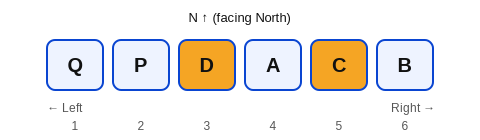
Six people A, B, P, Q, C and D are sitting in a straight line. They all are facing towards North. P is sitting immediately between Q and D. D is sitting third to the left of B. A sits second to the right of P. What is the position of C with respect to D?
छह व्यक्ति A, B, P, Q, C और D एक सीधी पंक्ति में बैठे हैं। वे सभी उत्तर की ओर मुख किए हुए हैं। P, Q और D के ठीक बीच में बैठा है। D, B के बाएँ तीसरे स्थान पर बैठा है। A, P के दाएँ दूसरे स्थान पर बैठा है। D के सापेक्ष C का स्थान क्या है?
  1. AImmediate leftठीक बाएँ
  2. BSecond to the leftबाएँ दूसरा
  3. CSecond to the rightदाएँ दूसरा
  4. DImmediate rightठीक दाएँ
Show answer

Concept: Facing north, "left" is our left. Fix the most restrictive clue first and test the two ways P can sit between Q and D.

  1. Let D be at position d; then B is at d+3 (third to the right of D). P is next to D with Q on the other side.
  2. If P is to the right of D, A (second right of P) would land on B's seat – impossible. So P is left of D, Q left of P, and A is just right of D.
  3. Q P D A _ B needs six seats: Q1, P2, D3, A4, B6 → C at 5. C is second to the right of D.

Trick: When "A is k-th right of P" collides with another fixed person, flip the side – only one case survives.

Answer: (C) Second to the right

अवधारणा: उत्तर की ओर मुख होने पर "बायाँ" हमारा बायाँ है। सबसे सख़्त सूचना पहले लगाएँ और P के दोनों संभावित स्थान जाँचें।

  1. माना D स्थान d पर है; तो B d+3 पर (D के दाएँ तीसरा)। P, D के बगल में और Q दूसरी ओर।
  2. यदि P, D के दाएँ हो तो A (P के दाएँ दूसरा) B की सीट पर आ जाएगा – असंभव। अतः P, D के बाएँ, Q उसके बाएँ और A, D के ठीक दाएँ।
  3. Q P D A _ B के लिए छह सीटें: Q1, P2, D3, A4, B6 → C 5 पर। C, D के दाएँ दूसरे स्थान पर है।

ट्रिक: जब "A, P के दाएँ k-वाँ" किसी तय व्यक्ति से टकराए, तो दिशा पलटें – केवल एक स्थिति बचती है।

उत्तर: (C) Second to the right

RRB NTPC Undergraduate CBT 1General Intelligence and ReasoningLinear seating arrangementRRB NTPC Undergraduate CBT 1 2025 · 9 May Shift 2 →
Q13660.
If 2 is added to each odd digit and 1 is subtracted from each even digit in the number 5718624, how many digits will appear more than once in the new number thus formed?
यदि संख्या 5718624 में प्रत्येक विषम अंक में 2 जोड़ा जाए और प्रत्येक सम अंक में से 1 घटाया जाए, तो इस प्रकार बनी नई संख्या में कितने अंक एक से अधिक बार आएँगे?
  1. AOneएक
  2. BThreeतीन
  3. CNoneकोई नहीं
  4. DTwoदो
Show answer

Concept: Change each digit by the rule, then count digits that repeat.

  1. 5 7 1 8 6 2 4: odd digits +2 → 5→7, 7→9, 1→3; even digits −1 → 8→7, 6→5, 2→1, 4→3.
  2. New number: 7 9 3 7 5 1 3. Digits 7 and 3 appear twice each → Two digits appear more than once.

Trick: Write the new digits directly below the old ones to avoid slips.

Answer: (D) Two

अवधारणा: नियम से हर अंक बदलें, फिर दोहराए गए अंक गिनें।

  1. 5 7 1 8 6 2 4: विषम +2 → 5→7, 7→9, 1→3; सम −1 → 8→7, 6→5, 2→1, 4→3।
  2. नई संख्या: 7 9 3 7 5 1 3। अंक 7 और 3 दो-दो बार → दो अंक एक से अधिक बार।

ट्रिक: नए अंक पुराने अंकों के ठीक नीचे लिखें, गलती नहीं होगी।

उत्तर: (D) Two

RRB NTPC Undergraduate CBT 1General Intelligence and ReasoningNumber operationsRRB NTPC Undergraduate CBT 1 2025 · 9 May Shift 2 →