Question bank

Q&A: practice questions with answers

Search questions on any topic. Filter by exam category, exam, subject and topic, try the question, then open the answer and explanation.

Courses – airGurukul

20,719 questions found.

Q13721.
Which policy decision of Lord Curzon directly provoked strong nationalist opposition in the early 1900s?
लॉर्ड कर्ज़न के किस नीतिगत निर्णय ने 1900 के दशक के प्रारंभ में प्रबल राष्ट्रवादी विरोध को सीधे भड़काया?
  1. AIssuing minor administrative regulations that changed routine procedures in provincial departments.प्रांतीय विभागों में नियमित प्रक्रियाओं को बदलने वाले छोटे प्रशासनिक नियम जारी करना।
  2. BRevising local body finances by making small adjustments to grants and supervisory rules.अनुदानों और पर्यवेक्षी नियमों में छोटे समायोजन करके स्थानीय निकायों के वित्त में संशोधन करना।
  3. CAltering advisory council arrangements without increasing Indian representation.भारतीय प्रतिनिधित्व बढ़ाए बिना सलाहकार परिषद की व्यवस्थाओं में परिवर्तन करना।
  4. DEnacting the Universities Act of 1904, which tightened official control over Indian higher education.1904 का विश्वविद्यालय अधिनियम लागू करना, जिसने भारतीय उच्च शिक्षा पर सरकारी नियंत्रण कड़ा कर दिया।
Show answer

Concept: Lord Curzon (Viceroy 1899–1905) passed several measures that Indians saw as attacks on their self-respect and institutions, fuelling early nationalism.

  1. The Indian Universities Act, 1904 (based on the Raleigh Commission, 1902) reduced elected senate members, increased government nominees and brought colleges under strict official control – nationalists condemned it as an attempt to curb growing political consciousness among educated Indians.
  2. Together with the Calcutta Corporation Act (1899), the Official Secrets Act (1904) and the Partition of Bengal (1905), it provoked intense opposition.
  3. The other options describe trivial routine changes that would not provoke a national movement.

Yaad rakhein: Curzon's "four blows": Calcutta Corporation 1899, Universities Act 1904, Official Secrets Act 1904, Bengal Partition 1905.

Answer: (D) Enacting the Universities Act of 1904, which tightened official control over Indian higher education.

अवधारणा: लॉर्ड कर्ज़न (वायसराय 1899–1905) ने ऐसे कई कदम उठाए जिन्हें भारतीयों ने अपने स्वाभिमान और संस्थाओं पर प्रहार माना; इनसे प्रारंभिक राष्ट्रवाद को बल मिला।

  1. भारतीय विश्वविद्यालय अधिनियम, 1904 (रैले आयोग, 1902 पर आधारित) ने सीनेट के निर्वाचित सदस्य घटाए, सरकारी मनोनीत सदस्य बढ़ाए और कॉलेजों पर कड़ा सरकारी नियंत्रण लगाया – राष्ट्रवादियों ने इसे शिक्षित भारतीयों की बढ़ती राजनीतिक चेतना दबाने का प्रयास बताया।
  2. कलकत्ता निगम अधिनियम (1899), शासकीय गोपनीयता अधिनियम (1904) और बंगाल विभाजन (1905) के साथ इसने तीव्र विरोध भड़काया।
  3. अन्य विकल्प मामूली प्रशासनिक बदलाव बताते हैं, जिनसे राष्ट्रीय आंदोलन नहीं उठता।

याद रखें: कर्ज़न के "चार प्रहार": कलकत्ता निगम 1899, विश्वविद्यालय अधिनियम 1904, गोपनीयता अधिनियम 1904, बंग-भंग 1905।

उत्तर: (D) 1904 का विश्वविद्यालय अधिनियम, जिसने भारतीय उच्च शिक्षा पर सरकारी नियंत्रण कड़ा किया
RRB NTPC Undergraduate CBT 1General AwarenessModern History – CurzonRRB NTPC Undergraduate CBT 1 2025 · 9 May Shift 1 →
Q13722.
What will be the resultant force if a body of mass 10 kg is moving with an acceleration of 5m/sec2?
यदि 10 kg द्रव्यमान का एक पिंड 5 m/sec2 के त्वरण से गति कर रहा है, तो परिणामी बल क्या होगा?
  1. A5 Newton5 न्यूटन
  2. B2 Joule2 जूल
  3. C2 Newton2 न्यूटन
  4. D50 Newton50 न्यूटन
Show answer

Concept: Newton's second law: resultant force F=m×a, with mass in kg and acceleration in m/s2 giving force in newton (N).

  1. m=10kg, a=5m/s2.
  2. F=10×5=50N.
  3. Joule is the unit of work/energy, so options in joule are wrong on units alone.

Trick: Check units first – force is always in newton; 1N=1kg·m/s2.

Answer: (D) 50 Newton

अवधारणा: न्यूटन का द्वितीय नियम: परिणामी बल F=m×a; द्रव्यमान kg में और त्वरण m/s2 में हो तो बल न्यूटन (N) में आता है।

  1. m=10kg, a=5m/s2।
  2. F=10×5=50N।
  3. जूल कार्य/ऊर्जा का मात्रक है, इसलिए जूल वाले विकल्प मात्रक के आधार पर ही गलत हैं।

ट्रिक: पहले मात्रक देखें – बल सदैव न्यूटन में; 1N=1kg·m/s2।

उत्तर: (D) 50 न्यूटन

RRB NTPC Undergraduate CBT 1General AwarenessNewton's Second LawRRB NTPC Undergraduate CBT 1 2025 · 9 May Shift 1 →
Q13723.
Which pancreatic hormone regulates blood glucose levels by stimulating the uptake of glucose by body cells?
अग्न्याशय (pancreas) का कौन-सा हार्मोन शरीर की कोशिकाओं द्वारा ग्लूकोज़ के अवशोषण को उत्तेजित करके रक्त ग्लूकोज़ के स्तर को नियंत्रित करता है?
  1. AThyroxineथायरॉक्सिन
  2. BGlucagonग्लूकागॉन
  3. CCortisolकॉर्टिसोल
  4. DInsulinइंसुलिन
Show answer

Concept: The pancreas (islets of Langerhans) secretes two hormones controlling blood sugar: insulin from beta cells and glucagon from alpha cells.

  1. Insulin lowers blood glucose by stimulating cells (muscle, fat, liver) to take up glucose and store it as glycogen; its deficiency causes diabetes mellitus.
  2. Glucagon does the opposite – raises blood glucose by breaking down glycogen.
  3. Thyroxine (thyroid) and cortisol (adrenal cortex) are not pancreatic hormones.

Yaad rakhein: Insulin = "in" – pushes glucose into cells (sugar down); Glucagon = "gone" – releases glucose (sugar up).

Answer: (D) Insulin

अवधारणा: अग्न्याशय (लैंगरहैंस की द्वीपिकाएँ) रक्त शर्करा नियंत्रित करने वाले दो हार्मोन स्रावित करता है: बीटा कोशिकाओं से इंसुलिन और अल्फा कोशिकाओं से ग्लूकागॉन।

  1. इंसुलिन कोशिकाओं (मांसपेशी, वसा, यकृत) को ग्लूकोज़ ग्रहण कर ग्लाइकोजन के रूप में संग्रहित करने के लिए प्रेरित कर रक्त शर्करा घटाता है; इसकी कमी से मधुमेह (diabetes) होता है।
  2. ग्लूकागॉन इसका विपरीत करता है – ग्लाइकोजन तोड़कर रक्त शर्करा बढ़ाता है।
  3. थायरॉक्सिन (थायरॉइड) और कॉर्टिसोल (अधिवृक्क) अग्न्याशय के हार्मोन नहीं हैं।

याद रखें: Insulin = "in" – ग्लूकोज़ कोशिका के अंदर (शर्करा कम); Glucagon = "gone" – ग्लूकोज़ बाहर (शर्करा अधिक)।

उत्तर: (D) इंसुलिन

RRB NTPC Undergraduate CBT 1General AwarenessHormones – PancreasRRB NTPC Undergraduate CBT 1 2025 · 9 May Shift 1 →
Q13724.
Which post-100th Amendment is the most recent and aims to reserve seats for women, with certain transitional and delimitation requirements before it becomes fully operational?
100वें संशोधन के बाद का कौन-सा संशोधन सबसे हाल का है और इसका उद्देश्य महिलाओं के लिए सीटें आरक्षित करना है, जिसके पूर्ण रूप से लागू होने से पहले कुछ संक्रमणकालीन और परिसीमन संबंधी आवश्यकताएँ हैं?
  1. A106th Amendment106वाँ संशोधन
  2. B105th Amendment105वाँ संशोधन
  3. C103rd Amendment103वाँ संशोधन
  4. D104th Amendment104वाँ संशोधन
Show answer

Concept: The Constitution (106th Amendment) Act, 2023 – the Nari Shakti Vandan Adhiniyam – reserves one-third of seats for women in the Lok Sabha, State Legislative Assemblies and the Delhi Assembly.

  1. It was passed in September 2023 in the new Parliament building; the reservation will take effect only after a census and the delimitation exercise based on it, and will last 15 years (extendable).
  2. 103rd (2019) – 10% EWS reservation; 104th (2020) – extended SC/ST reservation in legislatures, ended Anglo-Indian nomination; 105th (2021) – restored states' power to identify OBCs.

Yaad rakhein: 106 = Nari Shakti (women, 33%); 105 = OBC list; 104 = SC/ST extension; 103 = EWS.

Answer: (A) 106th Amendment

अवधारणा: संविधान (106वाँ संशोधन) अधिनियम, 2023 – नारी शक्ति वंदन अधिनियम – लोकसभा, राज्य विधानसभाओं और दिल्ली विधानसभा में महिलाओं के लिए एक-तिहाई सीटें आरक्षित करता है।

  1. यह सितंबर 2023 में नए संसद भवन में पारित हुआ; आरक्षण जनगणना और उस पर आधारित परिसीमन (delimitation) के बाद ही लागू होगा और 15 वर्ष (बढ़ाया जा सकता है) तक रहेगा।
  2. 103वाँ (2019) – EWS को 10% आरक्षण; 104वाँ (2020) – विधायिकाओं में SC/ST आरक्षण बढ़ाया, एंग्लो-इंडियन मनोनयन समाप्त; 105वाँ (2021) – राज्यों को OBC सूची बनाने की शक्ति बहाल।

याद रखें: 106 = नारी शक्ति (महिला 33%); 105 = OBC सूची; 104 = SC/ST विस्तार; 103 = EWS।

उत्तर: (A) 106वाँ संशोधन

RRB NTPC Undergraduate CBT 1General AwarenessConstitutional AmendmentsRRB NTPC Undergraduate CBT 1 2025 · 9 May Shift 1 →
Q13725.
Which declaration was NOT signed during PM Modi's visit to France in February 2025?
फरवरी 2025 में प्रधानमंत्री मोदी की फ्रांस यात्रा के दौरान किस घोषणा पर हस्ताक्षर नहीं किए गए थे?
  1. AIndia-France Innovation Treatyभारत-फ्रांस नवाचार संधि
  2. BIndia-France Declaration on Artificial Intelligenceकृत्रिम बुद्धिमत्ता पर भारत-फ्रांस घोषणा
  3. CIndia-France Cybersecurity Agreementभारत-फ्रांस साइबर सुरक्षा समझौता
  4. DIndia-France Infrastructure Pactभारत-फ्रांस अवसंरचना समझौता
Show answer

Concept: PM Modi visited France on 10–12 February 2025, co-chairing the AI Action Summit in Paris with President Macron and visiting Marseille and the ITER fusion project at Cadarache.

  1. Outcomes included the India-France Declaration on Artificial Intelligence, the launch of the India-France Year of Innovation 2026, a declaration of intent on cybersecurity/digital cooperation and the inauguration of India's consulate in Marseille.
  2. No "India-France Infrastructure Pact" was signed – that option is not part of the visit's outcomes.

Yaad rakhein: Feb 2025 Paris = AI Action Summit (India co-chair) + Innovation Year 2026 + Marseille consulate; the next AI summit is hosted by India (2026).

Answer: (D) India-France Infrastructure Pact

अवधारणा: प्रधानमंत्री मोदी ने 10–12 फरवरी 2025 को फ्रांस की यात्रा की, राष्ट्रपति मैक्रों के साथ पेरिस में AI Action Summit की सह-अध्यक्षता की तथा मार्सिले और कैडराश में ITER संलयन परियोजना का दौरा किया।

  1. परिणामों में भारत-फ्रांस कृत्रिम बुद्धिमत्ता घोषणा, भारत-फ्रांस नवाचार वर्ष 2026 का शुभारंभ, साइबर सुरक्षा/डिजिटल सहयोग पर आशय-घोषणा और मार्सिले में भारतीय वाणिज्य दूतावास का उद्घाटन शामिल थे।
  2. कोई "भारत-फ्रांस इन्फ्रास्ट्रक्चर पैक्ट" हस्ताक्षरित नहीं हुआ – यह विकल्प यात्रा के परिणामों में नहीं है।

याद रखें: फरवरी 2025 पेरिस = AI Action Summit (भारत सह-अध्यक्ष) + नवाचार वर्ष 2026 + मार्सिले दूतावास; अगला AI शिखर सम्मेलन भारत में (2026)।

उत्तर: (D) भारत-फ्रांस इन्फ्रास्ट्रक्चर पैक्ट

RRB NTPC Undergraduate CBT 1General AwarenessCurrent Affairs – India-FranceRRB NTPC Undergraduate CBT 1 2025 · 9 May Shift 1 →
Q13726.
During a sale, 50% of the goods are sold at 21% profit, 40% of the remaining goods are sold at 36% profit and the still remaining goods are sold at a loss of 29%. If there is an overall profit of x%, then what is the value of x?
एक सेल के दौरान, 50% वस्तुएँ 21% लाभ पर बेची जाती हैं, शेष वस्तुओं का 40% भाग 36% लाभ पर बेचा जाता है और फिर भी बची हुई वस्तुएँ 29% हानि पर बेची जाती हैं। यदि कुल मिलाकर x% का लाभ होता है, तो x का मान क्या है?
  1. A10
  2. B8.5
  3. C9
  4. D9.5
Show answer

Concept: When parts of the stock are sold at different profit/loss rates, the overall profit % is the weighted average of the rates (weights = fraction of goods, since cost per unit is the same).

  1. Fractions: first 50%, then 40% of the remaining 50% = 20%, the rest = 30%.
  2. Overall profit =0.5×21+0.2×36−0.3×29=10.5+7.2−8.7=9.

Trick: Think of total cost as ₹100: profit = 10.5+7.2−8.7=9 rupees = 9% directly.

Answer: (C) 9

अवधारणा: जब माल के अलग-अलग हिस्से अलग लाभ/हानि पर बिकें, तो कुल लाभ % उन दरों का भारित औसत (weighted average) होता है (भार = माल का अंश)।

  1. अंश: पहले 50%, फिर बचे 50% का 40% = 20%, शेष = 30%।
  2. कुल लाभ =0.5×21+0.2×36−0.3×29=10.5+7.2−8.7=9।

ट्रिक: कुल लागत ₹100 मानें: लाभ = 10.5+7.2−8.7=9 रुपये = सीधे 9%।

उत्तर: (C) 9

RRB NTPC Undergraduate CBT 1MathematicsProfit & Loss – mixed saleRRB NTPC Undergraduate CBT 1 2025 · 9 May Shift 1 →
Q13727.
The largest four-digit number which when divided by 6, 14 and 7 leaves remainder 5 in each case is:
चार अंकों की वह सबसे बड़ी संख्या, जिसे 6, 14 और 7 से विभाजित करने पर प्रत्येक स्थिति में शेषफल 5 बचता है, है:
  1. A9973
  2. B9959
  3. C9946
  4. D9998
Show answer

Concept: A number leaving the same remainder r on division by several numbers = (multiple of their LCM) +r.

  1. LCM(6,14,7)=42.
  2. Largest 4-digit multiple of 42: 9999=42×238+3, so 42×238=9996. But 9996+5=10001 is 5-digit, so take 42×237=9954.
  3. Required number =9954+5=9959.

Trick: Always check that adding the remainder does not push the number past 9999 – that is exactly the trap here.

Answer: (B) 9959

अवधारणा: कई संख्याओं से भाग देने पर समान शेष r देने वाली संख्या = (उनके ल.स. का गुणज) +r।

  1. LCM(6,14,7)=42।
  2. 42 का सबसे बड़ा 4-अंकीय गुणज: 9999=42×238+3, अतः 42×238=9996। पर 9996+5=10001 पाँच अंकों का है, इसलिए 42×237=9954 लें।
  3. अभीष्ट संख्या =9954+5=9959।

ट्रिक: शेष जोड़ने पर संख्या 9999 से आगे तो नहीं जा रही – यही इस प्रश्न का जाल है, हमेशा जाँचें।

उत्तर: (B) 9959

RRB NTPC Undergraduate CBT 1MathematicsLCM – same remainderRRB NTPC Undergraduate CBT 1 2025 · 9 May Shift 1 →
Q13728.
A shopkeeper marks an article 40% above its cost price. He then allows two successive discounts of 18% and 5% on the marked price. Find the profit percentage.
एक दुकानदार किसी वस्तु पर उसके क्रय मूल्य से 40% अधिक मूल्य अंकित करता है। फिर वह अंकित मूल्य पर 18% और 5% की दो क्रमिक छूट देता है। लाभ प्रतिशत ज्ञात कीजिए।
  1. A9.77%
  2. B8.96%
  3. C8.07%
  4. D9.06%
Show answer

Concept: SP = MP × (product of discount multipliers); compare SP with CP.

  1. Let CP =100, MP =140.
  2. SP =140×0.82×0.95=140×0.779=109.06.
  3. Profit =9.06%.

Trick: Combined discount of 18% and 5% =18+5−18×5100=22.1%; then 140×0.779.

Answer: (D) 9.06%

अवधारणा: SP = MP × (छूट गुणकों का गुणनफल); फिर SP की तुलना CP से करें।

  1. CP =100, MP =140 लें।
  2. SP =140×0.82×0.95=140×0.779=109.06।
  3. लाभ =9.06%।

ट्रिक: 18% और 5% की संयुक्त छूट =18+5−18×5100=22.1%; फिर 140×0.779।

उत्तर: (D) 9.06%

RRB NTPC Undergraduate CBT 1MathematicsSuccessive discounts & profitRRB NTPC Undergraduate CBT 1 2025 · 9 May Shift 1 →
Q13729.
A trader buys a chair for ₹200, sells it at a 10% profit, and then the buyer sells it again at a 15% profit. What is the final selling price?
एक व्यापारी ₹200 में एक कुर्सी खरीदता है, उसे 10% लाभ पर बेचता है, और फिर खरीदार उसे 15% लाभ पर पुनः बेच देता है। अंतिम विक्रय मूल्य क्या है?
  1. A₹253
  2. B₹242
  3. C₹260
  4. D₹230
Show answer

Concept: Successive profits multiply: final price =CP×(1+p1)(1+p2).

  1. First sale: 200×1.10=220.
  2. Second sale: 220×1.15=253.

Trick: Net % =10+15+10×15100=26.5% → 200×1.265=253.

Answer: (A) ₹253

अवधारणा: क्रमिक लाभ गुणा होते हैं: अंतिम मूल्य =CP×(1+p1)(1+p2)।

  1. पहली बिक्री: 200×1.10=220।
  2. दूसरी बिक्री: 220×1.15=253।

ट्रिक: कुल % =10+15+10×15100=26.5% → 200×1.265=253।

उत्तर: (A) ₹253

RRB NTPC Undergraduate CBT 1MathematicsSuccessive profitRRB NTPC Undergraduate CBT 1 2025 · 9 May Shift 1 →
Q13730.
What is the digit y if the number 6y512 is exactly divisible by both 8 and 9?
यदि संख्या 6y512, 8 और 9 दोनों से पूर्णतः विभाज्य है, तो अंक y क्या है?
  1. A6
  2. B2
  3. C4
  4. D8
Show answer

Concept: Divisible by 8 ⇔ last three digits divisible by 8; divisible by 9 ⇔ digit sum divisible by 9.

  1. Last three digits 512 =8×64 ✓ for any y.
  2. Digit sum =6+y+5+1+2=14+y; must be 18 → y=4.

Trick: The 8-test does not involve y here, so only the 9-test decides.

Answer: (C) 4

अवधारणा: 8 से विभाज्य ⇔ अंतिम तीन अंक 8 से विभाज्य; 9 से विभाज्य ⇔ अंकों का योग 9 से विभाज्य।

  1. अंतिम तीन अंक 512 =8×64 ✓ हर y के लिए।
  2. अंक-योग =6+y+5+1+2=14+y; यह 18 होना चाहिए → y=4।

ट्रिक: यहाँ 8 की जाँच में y शामिल ही नहीं, इसलिए केवल 9 की जाँच से उत्तर मिलता है।

उत्तर: (C) 4

RRB NTPC Undergraduate CBT 1MathematicsDivisibility by 8 and 9RRB NTPC Undergraduate CBT 1 2025 · 9 May Shift 1 →
Q13731.
Simplify: 15+12cot2A−12cos2A
सरल कीजिए: 15+12cot2A−12cos2A
  1. A4
  2. B3
  3. C5
  4. D7
Show answer

Concept: 1cot2A=tan2A, 1cos2A=sec2A and sec2A−tan2A=1.

  1. Expression =15+12tan2A−12sec2A.
  2. =15−12(sec2A−tan2A)=15−12=3.

Yaad rakhein: 1+tan2A=sec2A – whenever tan2 and sec2 appear with equal coefficients, they collapse to a constant.

Answer: (B) 3

अवधारणा: 1cot2A=tan2A, 1cos2A=sec2A तथा sec2A−tan2A=1।

  1. व्यंजक =15+12tan2A−12sec2A।
  2. =15−12(sec2A−tan2A)=15−12=3।

याद रखें: 1+tan2A=sec2A – जब tan2 और sec2 समान गुणांक के साथ आएँ, तो वे एक अचर में बदल जाते हैं।

उत्तर: (B) 3

RRB NTPC Undergraduate CBT 1MathematicsTrigonometric identityRRB NTPC Undergraduate CBT 1 2025 · 9 May Shift 1 →
Q13732.
The sum of two positive numbers is 35 and their product is 286. The positive difference between them is:
दो धनात्मक संख्याओं का योग 35 है और उनका गुणनफल 286 है। उनके बीच का धनात्मक अंतर है:
  1. A8
  2. B9
  3. C18
  4. D14
Show answer

Concept: (a−b)2=(a+b)2−4ab.

  1. (a−b)2=352−4×286=1225−1144=81.
  2. a−b=9 (numbers are 22 and 13).

Trick: Factor 286 =2×11×13 → pair 22×13 sums to 35, difference 9.

Answer: (B) 9

अवधारणा: (a−b)2=(a+b)2−4ab।

  1. (a−b)2=352−4×286=1225−1144=81।
  2. a−b=9 (संख्याएँ 22 और 13)।

ट्रिक: 286 =2×11×13 → जोड़ा 22×13 का योग 35, अंतर 9।

उत्तर: (B) 9

RRB NTPC Undergraduate CBT 1MathematicsSum, product & differenceRRB NTPC Undergraduate CBT 1 2025 · 9 May Shift 1 →
Q13733.
The average of five numbers 7, 11, 15, x, and 23 is 15. What is the value of x?
पाँच संख्याओं 7, 11, 15, x और 23 का औसत 15 है। x का मान क्या है?
  1. A19
  2. B17
  3. C23
  4. D21
Show answer

Concept: Sum = Average × count.

  1. Total =15×5=75.
  2. x=75−(7+11+15+23)=75−56=19.

Trick: Deviations from 15: −8,−4,0,+8 sum to −4, so x=15+4=19.

Answer: (A) 19

अवधारणा: योग = औसत × संख्याओं की गिनती।

  1. कुल =15×5=75।
  2. x=75−(7+11+15+23)=75−56=19।

ट्रिक: 15 से विचलन: −8,−4,0,+8 का योग −4, अतः x=15+4=19।

उत्तर: (A) 19

RRB NTPC Undergraduate CBT 1MathematicsAverage – missing numberRRB NTPC Undergraduate CBT 1 2025 · 9 May Shift 1 →
Q13734.
The average of 8 numbers is 45. If each number is decreased by 4, what will the new average be?
8 संख्याओं का औसत 45 है। यदि प्रत्येक संख्या में 4 की कमी कर दी जाए, तो नया औसत क्या होगा?
  1. A8
  2. B41
  3. C45
  4. D37
Show answer

Concept: If every observation changes by the same amount k, the average changes by exactly k.

  1. Each of the 8 numbers decreases by 4.
  2. New average =45−4=41.

Trick: No need of the count 8 – it is a distractor; average simply shifts by 4.

Answer: (B) 41

अवधारणा: यदि हर संख्या में समान परिवर्तन k हो, तो औसत में भी ठीक k का परिवर्तन होता है।

  1. 8 में से हर संख्या 4 घटती है।
  2. नया औसत =45−4=41।

ट्रिक: संख्या 8 की ज़रूरत ही नहीं – वह भटकाने के लिए है; औसत बस 4 घट जाता है।

उत्तर: (B) 41

RRB NTPC Undergraduate CBT 1MathematicsAverage – uniform changeRRB NTPC Undergraduate CBT 1 2025 · 9 May Shift 1 →
Q13735.
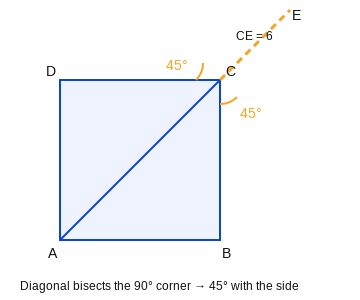
If a square’s diagonal is extended by 6 units beyond a vertex, forming a triangle outside the square, what is the angle between this extension and the adjacent side of the square?
यदि किसी वर्ग के विकर्ण को एक शीर्ष से आगे 6 इकाई बढ़ाया जाए, जिससे वर्ग के बाहर एक त्रिभुज बने, तो इस बढ़ाए गए भाग और वर्ग की आसन्न भुजा के बीच का कोण क्या होगा?
  1. A30 degrees30 डिग्री
  2. B45 degrees45 डिग्री
  3. C90 degrees90 डिग्री
  4. D60 degrees60 डिग्री
Show answer

Concept: The diagonal of a square bisects its right angles, so it makes 45∘ with each side. Extending the diagonal does not change the line, so the angle with the side-line stays 45∘ (acute angle).

  1. In square ABCD, diagonal AC makes ∠ACB=45∘.
  2. Extension CE is the same straight line; the acute angle between CE and side BC (produced) is also 45∘.
  3. The length 6 units does not matter – angles are independent of it.

Yaad rakhein: Diagonal of a square ↔ 45∘ with every side; diagonal of a rectangle ↔ not 45∘ in general.

Answer: (B) 45 degrees

अवधारणा: वर्ग का विकर्ण उसके समकोणों को समद्विभाजित करता है, अतः हर भुजा से 45∘ बनाता है। विकर्ण को बढ़ाने से रेखा नहीं बदलती, इसलिए भुजा-रेखा से कोण 45∘ (न्यून कोण) ही रहता है।

  1. वर्ग ABCD में विकर्ण AC से ∠ACB=45∘।
  2. विस्तार CE वही सीधी रेखा है; CE और भुजा BC (बढ़ाई गई) के बीच न्यून कोण भी 45∘।
  3. 6 इकाई की लंबाई का कोण पर कोई प्रभाव नहीं।

याद रखें: वर्ग का विकर्ण ↔ हर भुजा से 45∘; आयत के विकर्ण में ऐसा सामान्यतः नहीं होता।

उत्तर: (B) 45 degrees

RRB NTPC Undergraduate CBT 1MathematicsSquare – diagonal angleRRB NTPC Undergraduate CBT 1 2025 · 9 May Shift 1 →
Q13736.
The sum of the ages of a daughter and her mother is 76 years. After 4 years, the age of the mother will be three times that of the daughter. What is the present age (in years) of the mother?
एक पुत्री और उसकी माता की आयु का योग 76 वर्ष है। 4 वर्ष बाद, माता की आयु पुत्री की आयु की तीन गुनी होगी। माता की वर्तमान आयु (वर्षों में) क्या है?
  1. A17
  2. B18
  3. C57
  4. D59
Show answer

Concept: Form equations for present and future ages; both ages increase by the same number of years.

  1. Let daughter =d, mother =76−d.
  2. After 4 years: 80−d=3(d+4)⇒80−d=3d+12⇒d=17.
  3. Mother =76−17=59.

Trick: After 4 years total =84 in ratio 3:1 → mother =63, daughter =21; subtract 4 → 59 and 17.

Answer: (D) 59

अवधारणा: वर्तमान और भविष्य की आयु के समीकरण बनाएँ; दोनों की आयु समान वर्ष बढ़ती है।

  1. पुत्री =d, माता =76−d।
  2. 4 वर्ष बाद: 80−d=3(d+4)⇒80−d=3d+12⇒d=17।
  3. माता =76−17=59।

ट्रिक: 4 वर्ष बाद कुल =84, अनुपात 3:1 → माता =63, पुत्री =21; 4 घटाएँ → 59 और 17।

उत्तर: (D) 59

RRB NTPC Undergraduate CBT 1MathematicsAges – linear equationsRRB NTPC Undergraduate CBT 1 2025 · 9 May Shift 1 →
Q13737.
Two bags contain marbles in the ratio 5 : 7. If 12 marbles are transferred from the second bag to the first bag, the ratio of marbles in the two bags becomes 7 : 5. Find the original number of marbles in the second bag.
दो थैलों में कंचे 5 : 7 के अनुपात में हैं। यदि दूसरे थैले से 12 कंचे पहले थैले में स्थानांतरित कर दिए जाएँ, तो दोनों थैलों में कंचों का अनुपात 7 : 5 हो जाता है। दूसरे थैले में कंचों की मूल संख्या ज्ञात कीजिए।
  1. A68
  2. B42
  3. C63
  4. D72
Show answer

Concept: Let the quantities be 5x and 7x; the total stays the same after transfer.

  1. 5x+127x−12=75⇒25x+60=49x−84.
  2. 24x=144⇒x=6.
  3. Second bag originally =7×6=42.

Trick: Total =12 parts both times; the ratio flips 5:7→7:5, so 12 marbles =2 parts → 1 part =6.

Answer: (B) 42

अवधारणा: मात्राएँ 5x और 7x लें; स्थानांतरण के बाद कुल संख्या समान रहती है।

  1. 5x+127x−12=75⇒25x+60=49x−84।
  2. 24x=144⇒x=6।
  3. दूसरे थैले में मूलतः =7×6=42।

ट्रिक: कुल दोनों बार =12 भाग; अनुपात 5:7→7:5 पलटा, अतः 12 कंचे =2 भाग → 1 भाग =6।

उत्तर: (B) 42

RRB NTPC Undergraduate CBT 1MathematicsRatio – transfer problemRRB NTPC Undergraduate CBT 1 2025 · 9 May Shift 1 →
Q13738.
Girish scored 448 marks in an examination and was 64 marks short of 16% of maximum marks. In the same examination, his friend scored 672 marks. What is the percentage of marks scored by his friend?
गिरीश ने एक परीक्षा में 448 अंक प्राप्त किए और वह अधिकतम अंकों के 16% से 64 अंक कम रहा। उसी परीक्षा में, उसके मित्र ने 672 अंक प्राप्त किए। उसके मित्र द्वारा प्राप्त अंकों का प्रतिशत क्या है?
  1. A19%
  2. B24%
  3. C22%
  4. D21%
Show answer

Concept: First find the maximum marks from the given percentage condition.

  1. 16% of max =448+64=512⇒max=512×10016=3200.
  2. Friend: 6723200×100=21%.

Trick: 672=512+160; 512=16% and 160=5% of 3200 → 21%.

Answer: (D) 21%

अवधारणा: पहले दी गई प्रतिशत शर्त से अधिकतम अंक निकालें।

  1. अधिकतम का 16% =448+64=512⇒अधिकतम=512×10016=3200।
  2. मित्र: 6723200×100=21%।

ट्रिक: 672=512+160; 3200 का 512=16% और 160=5% → 21%।

उत्तर: (D) 21%

RRB NTPC Undergraduate CBT 1MathematicsPercentage – maximum marksRRB NTPC Undergraduate CBT 1 2025 · 9 May Shift 1 →
Q13739.
A and B can complete a task in 20 days and 25 days, respectively. They started working together, but B left after 5 days. How many more days will A take to finish the remaining work?
A और B एक कार्य को क्रमशः 20 दिनों और 25 दिनों में पूरा कर सकते हैं। उन्होंने एक साथ कार्य करना शुरू किया, लेकिन B ने 5 दिनों के बाद कार्य छोड़ दिया। शेष कार्य को पूरा करने में A को और कितने दिन लगेंगे?
  1. A12 days12 दिन
  2. B11 days11 दिन
  3. C10 days10 दिन
  4. D9 days9 दिन
Show answer

Concept: Take total work = LCM of days; work per day = efficiency.

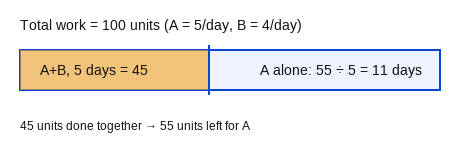
  1. Total work =LCM(20,25)=100 units; A =5/day, B =4/day.
  2. 5 days together: 9×5=45 units done; 55 remain.
  3. A alone: 555=11 days.

Trick: Remaining fraction =1−5(120+125)=1120 → A needs 1120×20=11 days.

Answer: (B) 11 days

अवधारणा: कुल कार्य = दिनों का ल.स. लें; प्रतिदिन कार्य = दक्षता।

  1. कुल कार्य =LCM(20,25)=100 इकाई; A =5/दिन, B =4/दिन।
  2. 5 दिन साथ: 9×5=45 इकाई हुआ; 55 शेष।
  3. A अकेला: 555=11 दिन।

ट्रिक: शेष अंश =1−5(120+125)=1120 → A को 1120×20=11 दिन।

उत्तर: (B) 11 days

RRB NTPC Undergraduate CBT 1MathematicsTime & Work – one leavesRRB NTPC Undergraduate CBT 1 2025 · 9 May Shift 1 →
Q13740.
The perimeter of a rectangle is 56 cm. Its length is 4 cm more than twice its breadth. Find the breadth.
एक आयत का परिमाप 56 cm है। इसकी लंबाई, इसकी चौड़ाई के दोगुने से 4 cm अधिक है। चौड़ाई ज्ञात कीजिए।
  1. A6 cm
  2. B12 cm
  3. C10 cm
  4. D8 cm
Show answer

Concept: Perimeter =2(l+b).

  1. l=2b+4, so 2(2b+4+b)=56⇒3b+4=28.
  2. b=8 cm (and l=20 cm).

Trick: l+b=28; check option (D): b=8⇒l=20, sum 28 ✓.

Answer: (D) 8 cm

अवधारणा: परिमाप =2(l+b)।

  1. l=2b+4, अतः 2(2b+4+b)=56⇒3b+4=28।
  2. b=8 cm (तथा l=20 cm)।

ट्रिक: l+b=28; विकल्प (D) जाँचें: b=8⇒l=20, योग 28 ✓।

उत्तर: (D) 8 cm

RRB NTPC Undergraduate CBT 1MathematicsRectangle – perimeterRRB NTPC Undergraduate CBT 1 2025 · 9 May Shift 1 →