Question bank

Q&A: practice questions with answers

Search questions on any topic. Filter by exam category, exam, subject and topic, try the question, then open the answer and explanation.

Courses – airGurukul

20,719 questions found.

Q13741.
A sum of ₹8,000 is invested at a compound interest rate of 12.5% per annum for 2 years, compounded annually. What is the compound interest earned?
₹8,000 की एक धनराशि 12.5% वार्षिक चक्रवृद्धि ब्याज की दर से 2 वर्षों के लिए निवेश की जाती है, जिसमें ब्याज वार्षिक रूप से संयोजित होता है। अर्जित चक्रवृद्धि ब्याज क्या है?
  1. A₹2,000
  2. B₹2,500
  3. C₹2,250
  4. D₹2,125
Show answer

Concept: 12.5%=18, so amount multiplies by 98 each year.

  1. Amount =8000×98×98=125×81=10125.
  2. CI =10125−8000=2125.

Trick: Effective 2-year rate =12.5+12.5+12.5×12.5100=26.5625% → 8000×0.265625=2125.

Answer: (D) ₹2,125

अवधारणा: 12.5%=18, अतः राशि हर वर्ष 98 गुना होती है।

  1. मिश्रधन =8000×98×98=125×81=10125।
  2. CI =10125−8000=2125।

ट्रिक: 2 वर्ष की प्रभावी दर =12.5+12.5+12.5×12.5100=26.5625% → 8000×0.265625=2125।

उत्तर: (D) ₹2,125

RRB NTPC Undergraduate CBT 1MathematicsCompound Interest – 2 yearsRRB NTPC Undergraduate CBT 1 2025 · 9 May Shift 1 →
Q13742.
If the compound interest on a sum for 2 years at 5% per annum is ₹102.50, what is the sum?
यदि किसी धनराशि पर 5% वार्षिक दर से 2 वर्षों का चक्रवृद्धि ब्याज ₹102.50 है, तो वह धनराशि क्या है?
  1. A₹1,000
  2. B₹1,025
  3. C₹950
  4. D₹1,100
Show answer

Concept: For 2 years, effective CI rate =2r+r2100.

  1. At 5%: 10+0.25=10.25%.
  2. P×10.25100=102.50⇒P=1000.

Yaad rakhein: 5% for 2 years =10.25%; 10% for 2 years =21% – memorise these.

Answer: (A) ₹1,000

अवधारणा: 2 वर्ष के लिए प्रभावी CI दर =2r+r2100।

  1. 5% पर: 10+0.25=10.25%।
  2. P×10.25100=102.50⇒P=1000।

याद रखें: 2 वर्ष में 5% =10.25%; 10% =21% – ये कंठस्थ रखें।

उत्तर: (A) ₹1,000

RRB NTPC Undergraduate CBT 1MathematicsCompound Interest – find principalRRB NTPC Undergraduate CBT 1 2025 · 9 May Shift 1 →
Q13743.
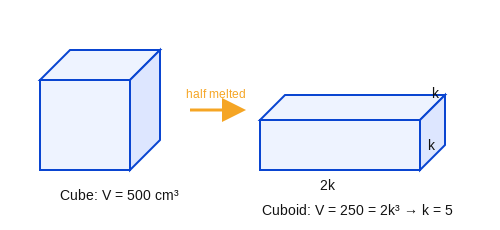
A solid cube is melted and half of its material is recast into a cuboid whose length, breadth, and height are in the ratio 2 : 1 : 1. The difference between the volume of the original cube and the cuboid formed is 250 cm3. Find the total surface area of the cuboid.
एक ठोस घन को पिघलाया जाता है और उसकी आधी सामग्री को एक ऐसे घनाभ में ढाला जाता है जिसकी लंबाई, चौड़ाई और ऊँचाई 2 : 1 : 1 के अनुपात में हैं। मूल घन के आयतन और बने हुए घनाभ के आयतन का अंतर 250 cm3 है। घनाभ का कुल पृष्ठीय क्षेत्रफल ज्ञात कीजिए।
  1. A100 cm2
  2. B120 cm2
  3. C80 cm2
  4. D250 cm2
Show answer

Concept: Melting preserves volume; TSA of cuboid =2(lb+bh+hl).

  1. Cuboid volume =V2, so V−V2=250⇒V=500, cuboid =250 cm3.
  2. Dimensions 2k,k,k: 2k3=250⇒k=5 → 10×5×5.
  3. TSA =2(50+25+50)=250 cm2.

Trick: For a 2k×k×k cuboid, TSA =10k2 and volume =2k3.

Answer: (D) 250 cm2

अवधारणा: पिघलाने पर आयतन समान रहता है; घनाभ का TSA =2(lb+bh+hl)।

  1. घनाभ का आयतन =V2, अतः V−V2=250⇒V=500, घनाभ =250 cm3।
  2. विमाएँ 2k,k,k: 2k3=250⇒k=5 → 10×5×5।
  3. TSA =2(50+25+50)=250 cm2।

ट्रिक: 2k×k×k घनाभ के लिए TSA =10k2 और आयतन =2k3।

उत्तर: (D) 250 cm2

RRB NTPC Undergraduate CBT 1MathematicsMensuration – cube to cuboidRRB NTPC Undergraduate CBT 1 2025 · 9 May Shift 1 →
Q13744.
A shopkeeper offers the following schemes on toys of the same marked price. (A) Successive discounts of 5% and 30% on any number of toys bought.
(B) Successive discounts of 18%, 15% and 5% on any number of toys bought. (C) 11% discount on the first 5 toys and 47% discount on each toy thereon.
(D) 2 toys free of cost on buying 5 toys.
A customer wants to buy 5 toys. Which of the above schemes is the least beneficial to her?
एक दुकानदार समान अंकित मूल्य वाले खिलौनों पर निम्नलिखित योजनाएँ प्रदान करता है। (A) खरीदे गए किसी भी संख्या के खिलौनों पर 5% और 30% की क्रमिक छूट।
(B) खरीदे गए किसी भी संख्या के खिलौनों पर 18%, 15% और 5% की क्रमिक छूट। (C) पहले 5 खिलौनों पर 11% छूट और उसके बाद प्रत्येक खिलौने पर 47% छूट।
(D) 5 खिलौने खरीदने पर 2 खिलौने निःशुल्क।
एक ग्राहक 5 खिलौने खरीदना चाहती है। उपरोक्त में से कौन-सी योजना उसके लिए सबसे कम लाभदायक है?
  1. AB
  2. BD
  3. CC
  4. DA
Show answer

Concept: Convert every scheme into an effective discount on 5 toys (MP ₹100 each, total ₹500).

  1. (A) 0.95×0.70=0.665 → pays ₹332.5 (discount 33.5%).
  2. (B) 0.82×0.85×0.95≈0.662 → pays ≈ ₹331 (discount ≈ 33.8%).
  3. (C) only 11% on all 5 toys → pays ₹445; the 47% part never applies.
  4. (D) 2 free with 5 → 7 toys for ₹500, effective discount 27≈28.6% per toy.

Trick: Scheme C's big 47% starts only from the 6th toy – for exactly 5 toys it is the weakest offer.

Answer: (C) C

अवधारणा: हर योजना को 5 खिलौनों (MP ₹100 प्रत्येक, कुल ₹500) पर प्रभावी छूट में बदलें।

  1. (A) 0.95×0.70=0.665 → ₹332.5 देने होंगे (छूट 33.5%)।
  2. (B) 0.82×0.85×0.95≈0.662 → ≈ ₹331 (छूट ≈ 33.8%)।
  3. (C) पाँचों पर केवल 11% → ₹445; 47% वाला भाग लागू ही नहीं होता।
  4. (D) 5 पर 2 मुफ्त → ₹500 में 7 खिलौने, प्रति खिलौना प्रभावी छूट 27≈28.6%।

ट्रिक: योजना C की 47% छूट छठे खिलौने से शुरू होती है – ठीक 5 खिलौनों पर यह सबसे कमज़ोर ऑफ़र है।

उत्तर: (C) C

RRB NTPC Undergraduate CBT 1MathematicsDiscount schemes comparisonRRB NTPC Undergraduate CBT 1 2025 · 9 May Shift 1 →
Q13745.
Simplify {(1424)÷(149)}÷(37×149+58)+910÷3124 of 2410
सरल कीजिए {(1424)÷(149)}÷(37×149+58)+910÷3124 of 2410
  1. A1337
  2. B1831
  3. C1433
  4. D1726
Show answer

Concept: Brackets first, then "of", then ÷ and ×, then + and −.

  1. 1424÷149=924=38.
  2. 37×149+58=23+58=3124; so 38÷3124=931.
  3. 3124 of 2410=3110; 910÷3110=931.
  4. Sum =931+931=1831.

Trick: Both halves give 931 – spotting the repeated 31 saves time.

Answer: (B) 1831

अवधारणा: पहले कोष्ठक, फिर "of", फिर ÷ और ×, फिर + और −।

  1. 1424÷149=924=38।
  2. 37×149+58=23+58=3124; अतः 38÷3124=931।
  3. 3124 of 2410=3110; 910÷3110=931।
  4. योग =931+931=1831।

ट्रिक: दोनों भाग 931 देते हैं – 31 की पुनरावृत्ति पहचानें, समय बचेगा।

उत्तर: (B) 1831

RRB NTPC Undergraduate CBT 1MathematicsSimplification – BODMAS fractionsRRB NTPC Undergraduate CBT 1 2025 · 9 May Shift 1 →
Q13746.
Simplify: 5.25+2.75−35−25×1020
सरल कीजिए: 5.25+2.75−35−25×1020
  1. A8.2
  2. B7.2
  3. C5.2
  4. D6.2
Show answer

Concept: Do multiplication before subtraction (BODMAS).

  1. 25×1020=15=0.2.
  2. 5.25+2.75=8; 8−0.6−0.2=7.2.

Trick: 5.25+2.75 is a neat 8; the rest is just 0.6+0.2.

Answer: (B) 7.2

अवधारणा: घटाने से पहले गुणा करें (BODMAS)।

  1. 25×1020=15=0.2।
  2. 5.25+2.75=8; 8−0.6−0.2=7.2।

ट्रिक: 5.25+2.75 सीधा 8 है; बाकी केवल 0.6+0.2।

उत्तर: (B) 7.2

RRB NTPC Undergraduate CBT 1MathematicsSimplification – decimals & fractionsRRB NTPC Undergraduate CBT 1 2025 · 9 May Shift 1 →
Q13747.
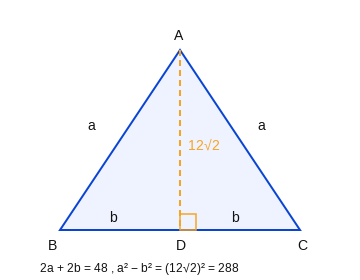
An altitude of 122 cm is drawn to the base of an isosceles triangle. The perimeter of this triangle is 48 cm. Find the area of the triangle.
एक समद्विबाहु त्रिभुज के आधार पर 122 cm का एक शीर्षलंब खींचा जाता है। इस त्रिभुज का परिमाप 48 cm है। त्रिभुज का क्षेत्रफल ज्ञात कीजिए।
  1. A602 cm2
  2. B362 cm2
  3. C122 cm2
  4. D722 cm2
Show answer

Concept: The altitude to the base of an isosceles triangle bisects the base; use Pythagoras and a2−b2=(a−b)(a+b).

  1. Equal side a, half-base b: 2a+2b=48⇒a+b=24.
  2. a2−b2=(122)2=288⇒a−b=28824=12 → a=18, b=6.
  3. Area =12×12×122=722 cm2.

Trick: a+b and a2−b2 known → a−b in one division; no need to solve quadratics.

Answer: (D) 722 cm2

अवधारणा: समद्विबाहु त्रिभुज में आधार पर शीर्षलंब आधार को समद्विभाजित करता है; पाइथागोरस और a2−b2=(a−b)(a+b) प्रयोग करें।

  1. समान भुजा a, आधा आधार b: 2a+2b=48⇒a+b=24।
  2. a2−b2=(122)2=288⇒a−b=28824=12 → a=18, b=6।
  3. क्षेत्रफल =12×12×122=722 cm2।

ट्रिक: a+b और a2−b2 ज्ञात → एक भाग से a−b; द्विघात हल करने की ज़रूरत नहीं।

उत्तर: (D) 722 cm2

RRB NTPC Undergraduate CBT 1MathematicsIsosceles triangle – areaRRB NTPC Undergraduate CBT 1 2025 · 9 May Shift 1 →
Q13748.
Find the third proportional to 6 and 12.
6 और 12 का तृतीयानुपाती ज्ञात कीजिए।
  1. A24
  2. B36
  3. C18
  4. D48
Show answer

Concept: Third proportional to a and b is c with a:b::b:c, i.e. c=b2a.

  1. c=1226=1446=24.

Yaad rakhein: Third proportional =b2a; mean proportional =ab – do not mix them.

Answer: (A) 24

अवधारणा: a और b का तृतीयानुपाती c है जहाँ a:b::b:c, अर्थात् c=b2a।

  1. c=1226=1446=24।

याद रखें: तृतीयानुपाती =b2a; मध्यानुपाती =ab – दोनों में भ्रम न करें।

उत्तर: (A) 24

RRB NTPC Undergraduate CBT 1MathematicsThird proportionalRRB NTPC Undergraduate CBT 1 2025 · 9 May Shift 1 →
Q13749.
Three numbers in the ratio 2 : 5 : 7 are taken as the first, second, and third terms, respectively. If their fourth proportional is 140, find the middle number.
2 : 5 : 7 के अनुपात में तीन संख्याओं को क्रमशः पहला, दूसरा और तीसरा पद लिया जाता है। यदि उनका चतुर्थानुपाती 140 है, तो बीच वाली संख्या ज्ञात कीजिए।
  1. A50
  2. B35
  3. C30
  4. D40
Show answer

Concept: Fourth proportional to a,b,c is d=bca.

  1. Numbers 2k,5k,7k: d=5k×7k2k=35k2.
  2. 35k2=140⇒k=8.
  3. Middle number =5k=40 (numbers are 16, 40, 56).

Trick: Check: 16:40=56:140 (both =2:5) ✓.

Answer: (D) 40

अवधारणा: a,b,c का चतुर्थानुपाती d=bca।

  1. संख्याएँ 2k,5k,7k: d=5k×7k2k=35k2।
  2. 35k2=140⇒k=8।
  3. मध्य संख्या =5k=40 (संख्याएँ 16, 40, 56)।

ट्रिक: जाँच: 16:40=56:140 (दोनों =2:5) ✓।

उत्तर: (D) 40

RRB NTPC Undergraduate CBT 1MathematicsFourth proportional with ratioRRB NTPC Undergraduate CBT 1 2025 · 9 May Shift 1 →
Q13750.
A bus covers 90 km in 3 hours. If the speed of the bus is increased by 5 kmph, find the time taken to cover a distance of 70 km?
एक बस 3 घंटे में 90 km की दूरी तय करती है। यदि बस की चाल 5 kmph बढ़ा दी जाए, तो 70 km की दूरी तय करने में लगने वाला समय ज्ञात कीजिए।
  1. A3 hours3 घंटे
  2. B2.5 hours2.5 घंटे
  3. C3.5 hours3.5 घंटे
  4. D2 hours2 घंटे
Show answer

Concept: Time =DistanceSpeed.

  1. Original speed =903=30km/h; new speed =35km/h.
  2. Time =7035=2 hours.

Trick: 70=2×35 – the numbers are chosen to cancel cleanly.

Answer: (D) 2 hours

अवधारणा: समय =दूरीचाल।

  1. मूल चाल =903=30km/h; नई चाल =35km/h।
  2. समय =7035=2 घंटे।

ट्रिक: 70=2×35 – संख्याएँ सीधे कट जाती हैं।

उत्तर: (D) 2 hours

RRB NTPC Undergraduate CBT 1MathematicsSpeed, time & distanceRRB NTPC Undergraduate CBT 1 2025 · 9 May Shift 1 →
Q13751.
The price of an article is increased by 25%. By what percentage should the increased price be reduced so that it becomes equal to the original price?
किसी वस्तु के मूल्य में 25% की वृद्धि की जाती है। बढ़े हुए मूल्य में कितने प्रतिशत की कमी की जानी चाहिए ताकि वह मूल मूल्य के बराबर हो जाए?
  1. A22%
  2. B20%
  3. C30%
  4. D25%
Show answer

Concept: To undo an increase of r%, reduce by r100+r×100%.

  1. 25125×100=20%.
  2. Check: 125×0.8=100 ✓.

Yaad rakhein: 25%=14 up → 15=20% down; 20% up → 1623% down.

Answer: (B) 20%

अवधारणा: r% की वृद्धि को निरस्त करने के लिए r100+r×100% की कमी करें।

  1. 25125×100=20%।
  2. जाँच: 125×0.8=100 ✓।

याद रखें: 25%=14 वृद्धि → 15=20% कमी; 20% वृद्धि → 1623% कमी।

उत्तर: (B) 20%

RRB NTPC Undergraduate CBT 1MathematicsPercentage – reverse changeRRB NTPC Undergraduate CBT 1 2025 · 9 May Shift 1 →
Q13752.
In a division sum, the divisor is 5 times the quotient and 4 times the remainder. If the remainder is 15, what is the dividend?
एक भाग के प्रश्न में, भाजक भागफल का 5 गुना और शेषफल का 4 गुना है। यदि शेषफल 15 है, तो भाज्य क्या है?
  1. A740
  2. B734
  3. C739
  4. D735
Show answer

Concept: Dividend = Divisor × Quotient + Remainder.

  1. Divisor =4×15=60; quotient =605=12.
  2. Dividend =60×12+15=735.

Trick: Remainder 15 must be less than the divisor 60 – a quick sanity check.

Answer: (D) 735

अवधारणा: भाज्य = भाजक × भागफल + शेषफल।

  1. भाजक =4×15=60; भागफल =605=12।
  2. भाज्य =60×12+15=735।

ट्रिक: शेष 15 भाजक 60 से छोटा होना चाहिए – त्वरित जाँच।

उत्तर: (D) 735

RRB NTPC Undergraduate CBT 1MathematicsDivision algorithmRRB NTPC Undergraduate CBT 1 2025 · 9 May Shift 1 →
Q13753.
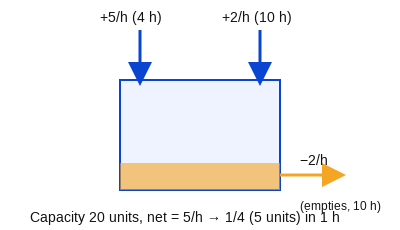
Two taps can fill a cistern in 4 hours and 10 hours, respectively. A third tap can empty it in 10 hours. How long (in hours) will it take to fill one-fourth of the empty cistern if all the taps are opened together?
दो नल एक टंकी को क्रमशः 4 घंटे और 10 घंटे में भर सकते हैं। एक तीसरा नल इसे 10 घंटे में खाली कर सकता है। यदि सभी नल एक साथ खोल दिए जाएँ, तो खाली टंकी के एक-चौथाई भाग को भरने में कितना समय (घंटों में) लगेगा?
  1. A2
  2. B3
  3. C1
  4. D4
Show answer

Concept: Take capacity = LCM of the times; add filling rates, subtract emptying rate.

  1. Capacity =LCM(4,10,10)=20 units; rates +5,+2,−2 per hour → net 5/h.
  2. One-fourth =5 units → time =55=1 hour.

Trick: The 10-h filler and 10-h emptier cancel, leaving just the 4-h tap: quarter of 4 h = 1 h.

Answer: (C) 1

अवधारणा: क्षमता = समयों का ल.स. लें; भरने की दरें जोड़ें, खाली करने की दर घटाएँ।

  1. क्षमता =LCM(4,10,10)=20 इकाई; दरें +5,+2,−2 प्रति घंटा → नेट 5/घंटा।
  2. एक-चौथाई =5 इकाई → समय =55=1 घंटा।

ट्रिक: 10 घंटे वाला भरने वाला और 10 घंटे वाला खाली करने वाला नल कट जाते हैं, बचा केवल 4 घंटे वाला: 4 का चौथाई = 1 घंटा।

उत्तर: (C) 1

RRB NTPC Undergraduate CBT 1MathematicsPipes & CisternsRRB NTPC Undergraduate CBT 1 2025 · 9 May Shift 1 →
Q13754.
If x2×x3=xa and x2xb=x1, what is the value of a+b?
यदि x2×x3=xa और x2xb=x1 है, तो a+b का मान क्या है?
  1. A7
  2. B6
  3. C4
  4. D5
Show answer

Concept: xm×xn=xm+n and xmxn=xm−n.

  1. x2×x3=x5⇒a=5.
  2. x2xb=x1⇒2−b=1⇒b=1.
  3. a+b=6.

Yaad rakhein: Multiply → add powers; divide → subtract powers.

Answer: (B) 6

अवधारणा: xm×xn=xm+n तथा xmxn=xm−n।

  1. x2×x3=x5⇒a=5।
  2. x2xb=x1⇒2−b=1⇒b=1।
  3. a+b=6।

याद रखें: गुणा → घात जोड़ें; भाग → घात घटाएँ।

उत्तर: (B) 6

RRB NTPC Undergraduate CBT 1MathematicsLaws of indicesRRB NTPC Undergraduate CBT 1 2025 · 9 May Shift 1 →
Q13755.
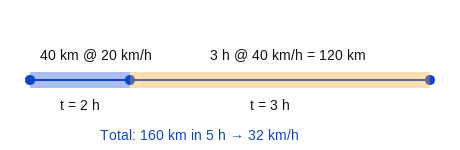
Ritu covers a distance of 40 km at 20 km/h and another distance at 40 km/h in 3 hours. Find the average speed for the whole journey.
रितु 40 km की दूरी 20 km/h की चाल से और एक अन्य दूरी 40 km/h की चाल से कुल 3 घंटे में तय करती है। पूरी यात्रा के लिए औसत चाल ज्ञात कीजिए।
  1. A32 km/h
  2. B26 km/h
  3. C31 km/h
  4. D38 km/h
Show answer

Concept: Average speed =Total distanceTotal time (never the average of speeds).

  1. Part 1: 40 km at 20 km/h → 2 h.
  2. Part 2: 3 h at 40 km/h → 120 km.
  3. Average =40+1202+3=1605=32km/h.

Trick: Time-weighted: 2×20+3×405=32.

Answer: (A) 32 km/h

अवधारणा: औसत चाल =कुल दूरीकुल समय (चालों का औसत कभी नहीं)।

  1. भाग 1: 40 km, 20 km/h → 2 घंटे।
  2. भाग 2: 3 घंटे, 40 km/h → 120 km।
  3. औसत =40+1202+3=1605=32km/h।

ट्रिक: समय-भारित: 2×20+3×405=32।

उत्तर: (A) 32 km/h

RRB NTPC Undergraduate CBT 1MathematicsAverage speedRRB NTPC Undergraduate CBT 1 2025 · 9 May Shift 1 →
Q13756.
What should come in place of ? in the given series based on the English alphabetical order?
FCZ YVS ROL KHE ?
अंग्रेज़ी वर्णमाला क्रम पर आधारित दी गई शृंखला में ? के स्थान पर क्या आना चाहिए?
FCZ YVS ROL KHE ?
  1. ADAX
  2. BDZW
  3. CDFG
  4. DDBW
Show answer

Concept: Compare corresponding letters of consecutive terms using positions A=1 … Z=26 (wrap around after A).

  1. F(6) → Y(25) → R(18) → K(11): each step −7 (6−7 = −1 → 25).
  2. C(3) → V(22) → O(15) → H(8): each −7. Z(26) → S(19) → L(12) → E(5): each −7.
  3. Next: K(11)−7 = D(4), H(8)−7 = A(1), E(5)−7 = −2 → 24 = X.

Trick: Going back 7 is the same as going forward 19; when the number goes below 1, add 26.

Answer: (A) DAX

अवधारणा: क्रमागत पदों के संगत अक्षरों की तुलना स्थान-संख्या A=1 … Z=26 से करें (A से पीछे जाने पर Z पर लौटें)।

  1. F(6) → Y(25) → R(18) → K(11): प्रत्येक चरण −7 (6−7 = −1 → 25)।
  2. C(3) → V(22) → O(15) → H(8): प्रत्येक −7। Z(26) → S(19) → L(12) → E(5): प्रत्येक −7।
  3. अगला: K(11)−7 = D(4), H(8)−7 = A(1), E(5)−7 = −2 → 24 = X।

ट्रिक: 7 पीछे जाना = 19 आगे जाना; संख्या 1 से कम हो जाए तो 26 जोड़ दें।

उत्तर: (A) DAX

RRB NTPC Undergraduate CBT 1General Intelligence and ReasoningLetter SeriesRRB NTPC Undergraduate CBT 1 2025 · 9 May Shift 1 →
Q13757.
BO 7 is related to EI -7 in a certain way. In the same way, CS 10 is related to FM -4. To which of the following is IJ 20 related, following the same logic?
BO 7, EI -7 से एक निश्चित प्रकार से संबंधित है। उसी प्रकार, CS 10, FM -4 से संबंधित है। समान तर्क का अनुसरण करते हुए, IJ 20 निम्नलिखित में से किससे संबंधित है?
  1. AGJ 9
  2. BOP -3
  3. CHT -6
  4. DLD 6
Show answer

Concept: Find the rule applied to each letter and the number separately, then apply it to the new term.

  1. BO 7 → EI −7: B(2)+3 = E(5); O(15)−6 = I(9); 7−14 = −7.
  2. Check: CS 10 → FM −4: C+3 = F; S(19)−6 = M(13); 10−14 = −4. ✓
  3. IJ 20: I(9)+3 = L(12); J(10)−6 = D(4); 20−14 = 6 → LD 6.

Trick: First letter +3, second letter −6, number −14 – verify with the second pair before applying.

Answer: (D) LD 6

अवधारणा: प्रत्येक अक्षर और संख्या पर अलग-अलग लागू नियम खोजें, फिर नए पद पर लागू करें।

  1. BO 7 → EI −7: B(2)+3 = E(5); O(15)−6 = I(9); 7−14 = −7।
  2. जाँच: CS 10 → FM −4: C+3 = F; S(19)−6 = M(13); 10−14 = −4। ✓
  3. IJ 20: I(9)+3 = L(12); J(10)−6 = D(4); 20−14 = 6 → LD 6।

ट्रिक: पहला अक्षर +3, दूसरा −6, संख्या −14 – लागू करने से पहले दूसरे युग्म से नियम पक्का करें।

उत्तर: (D) LD 6

RRB NTPC Undergraduate CBT 1General Intelligence and ReasoningLetter–Number AnalogyRRB NTPC Undergraduate CBT 1 2025 · 9 May Shift 1 →
Q13758.
What should come in place of '?' in the given series based on the English alphabetical order?
CGT FJW IMZ LPC ?
अंग्रेज़ी वर्णमाला क्रम पर आधारित दी गई शृंखला में '?' के स्थान पर क्या आना चाहिए?
CGT FJW IMZ LPC ?
  1. AOSF
  2. BORF
  3. CNRE
  4. DQTC
Show answer

Concept: Check the difference between corresponding letters of successive terms.

  1. C(3) → F(6) → I(9) → L(12): +3 each time.
  2. G(7) → J(10) → M(13) → P(16): +3. T(20) → W(23) → Z(26) → C(3): +3 (wrapping).
  3. Next term: L+3 = O, P+3 = S, C+3 = F → OSF.

Trick: When every letter moves by the same +3, just add 3 to the last term.

Answer: (A) OSF

अवधारणा: क्रमागत पदों के संगत अक्षरों का अंतर देखें।

  1. C(3) → F(6) → I(9) → L(12): हर बार +3।
  2. G(7) → J(10) → M(13) → P(16): +3। T(20) → W(23) → Z(26) → C(3): +3 (Z के बाद A से)।
  3. अगला पद: L+3 = O, P+3 = S, C+3 = F → OSF।

ट्रिक: जब हर अक्षर समान +3 से बढ़े, तो अंतिम पद में बस 3 जोड़ें।

उत्तर: (A) OSF

RRB NTPC Undergraduate CBT 1General Intelligence and ReasoningLetter SeriesRRB NTPC Undergraduate CBT 1 2025 · 9 May Shift 1 →
Q13759.
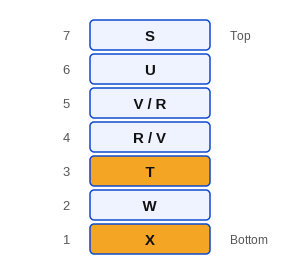
Seven boxes R, S, T, U, V, W and X are kept one over the other but not necessarily in the same order. V is kept neither at the top nor at the bottom. Only three boxes are kept between U and W. R is kept one of the positions between S and T. W is kept second from the bottom and immediately below T.
How many boxes are kept between X and T?
सात बक्से R, S, T, U, V, W और X एक के ऊपर एक रखे गए हैं, लेकिन आवश्यक नहीं कि इसी क्रम में हों। V न तो सबसे ऊपर और न ही सबसे नीचे रखा गया है। U और W के बीच केवल तीन बक्से रखे गए हैं। R, S और T के बीच की किसी एक स्थिति पर रखा गया है। W नीचे से दूसरे स्थान पर और T के ठीक नीचे रखा गया है।
X और T के बीच कितने बक्से रखे गए हैं?
  1. AFOURचार
  2. BTHREEतीन
  3. CONEएक
  4. DTWOदो
Show answer

Concept: Number the positions 1 (bottom) to 7 (top) and place the definite clues first.

  1. W is second from the bottom → W = 2; T is immediately above W → T = 3.
  2. Three boxes between U and W → U = 6.
  3. R lies between S and T, and V is neither at top nor bottom → R and V occupy 4 and 5 (in either order), S = 7, so X = 1 (bottom).
  4. Between X (1) and T (3) there is only W → one box.

Trick: Start with fixed-position clues ("second from bottom"), then "exactly n between" clues; the leftover box falls into the last empty slot.

Answer: (C) ONE

अवधारणा: स्थानों को 1 (नीचे) से 7 (ऊपर) तक क्रमांकित करें और पहले निश्चित संकेत रखें।

  1. W नीचे से दूसरा → W = 2; T, W के ठीक ऊपर → T = 3।
  2. U और W के बीच तीन बॉक्स → U = 6।
  3. R, S और T के बीच है और V न ऊपर न नीचे → R और V स्थान 4 और 5 पर (किसी भी क्रम में), S = 7, अतः X = 1 (सबसे नीचे)।
  4. X (1) और T (3) के बीच केवल W → एक बॉक्स।

ट्रिक: पहले निश्चित स्थान वाले संकेत ("नीचे से दूसरा"), फिर "बीच में n बॉक्स" वाले संकेत; बचा हुआ बॉक्स अंतिम खाली स्थान पर आता है।

उत्तर: (C) एक (ONE)

RRB NTPC Undergraduate CBT 1General Intelligence and ReasoningBox ArrangementRRB NTPC Undergraduate CBT 1 2025 · 9 May Shift 1 →
Q13760.
Refer to the following letter series and answer the question that follows. Counting to be done from left to right only.
(Left) S Z E C A O Q M D P U I J L N X K D (Right)
How many such vowels are there, each of which is immediately preceded by a consonant and also immediately followed by a vowel?
निम्नलिखित अक्षर शृंखला को देखिए और उसके बाद दिए गए प्रश्न का उत्तर दीजिए। गिनती केवल बाएँ से दाएँ की जानी है।
(बायाँ) S Z E C A O Q M D P U I J L N X K D (दायाँ)
ऐसे कितने स्वर हैं, जिनमें से प्रत्येक के ठीक पहले एक व्यंजन और ठीक बाद एक स्वर है?
  1. ATwoदो
  2. BNoneकोई नहीं
  3. CThreeतीन
  4. DOneएक
Show answer

Concept: Locate every vowel and check its immediate left (must be a consonant) and immediate right (must be a vowel).

  1. Series: S Z E C A O Q M D P U I J L N X K D. Vowels: E, A, O, U, I.
  2. E: Z before, C after (consonant) ✗. A: C before, O after ✓. O: A before (vowel) ✗.
  3. U: P before, I after ✓. I: U before (vowel) ✗.
  4. Pairs found: C-A-O and P-U-I → two.

Trick: Look only at adjacent vowel pairs (AO, UI); the first vowel of each such pair qualifies if a consonant precedes it.

Answer: (A) Two

अवधारणा: हर स्वर को खोजें और उसके ठीक बाएँ (व्यंजन होना चाहिए) तथा ठीक दाएँ (स्वर होना चाहिए) की जाँच करें।

  1. श्रृंखला: S Z E C A O Q M D P U I J L N X K D। स्वर: E, A, O, U, I।
  2. E: पहले Z, बाद C (व्यंजन) ✗। A: पहले C, बाद O ✓। O: पहले A (स्वर) ✗।
  3. U: पहले P, बाद I ✓। I: पहले U (स्वर) ✗।
  4. मिले युग्म: C-A-O और P-U-I → दो।

ट्रिक: केवल सटे हुए स्वर-युग्म (AO, UI) देखें; ऐसे युग्म का पहला स्वर तभी गिना जाएगा जब उससे पहले व्यंजन हो।

उत्तर: (A) दो (Two)

RRB NTPC Undergraduate CBT 1General Intelligence and ReasoningLetter Series – CountingRRB NTPC Undergraduate CBT 1 2025 · 9 May Shift 1 →