Question bank

Q&A: practice questions with answers

Search questions on any topic. Filter by exam category, exam, subject and topic, try the question, then open the answer and explanation.

Courses – airGurukul

20,719 questions found.

Q13761.
In a certain code language, "SFOR" is coded as "116" and "WILA" is coded as "90". What is the code for "GMVC" in that given language?
एक निश्चित कूट भाषा में, "SFOR" को "116" के रूप में कूटबद्ध किया जाता है और "WILA" को "90" के रूप में कूटबद्ध किया जाता है। उसी भाषा में "GMVC" का कूट क्या है?
  1. A120
  2. B95
  3. C110
  4. D90
Show answer

Concept: Add the alphabetical positions of the letters and see how the sum relates to the code.

  1. SFOR: S(19)+F(6)+O(15)+R(18) = 58; 58×2=116 ✓.
  2. WILA: W(23)+I(9)+L(12)+A(1) = 45; 45×2=90 ✓.
  3. GMVC: G(7)+M(13)+V(22)+C(3) = 45; 45×2=90.

Trick: Same letter-sum as WILA (45) → same code 90; no need to multiply again.

Answer: (D) 90

अवधारणा: अक्षरों की वर्णमाला स्थान-संख्याएँ जोड़ें और देखें कि योग का कोड से क्या संबंध है।

  1. SFOR: S(19)+F(6)+O(15)+R(18) = 58; 58×2=116 ✓।
  2. WILA: W(23)+I(9)+L(12)+A(1) = 45; 45×2=90 ✓।
  3. GMVC: G(7)+M(13)+V(22)+C(3) = 45; 45×2=90।

ट्रिक: WILA जैसा ही योग (45) → वही कोड 90; दोबारा गुणा करने की ज़रूरत नहीं।

उत्तर: (D) 90
RRB NTPC Undergraduate CBT 1General Intelligence and ReasoningCoding–DecodingRRB NTPC Undergraduate CBT 1 2025 · 9 May Shift 1 →
Q13762.
Select the set in which the numbers are related in the same way as are the numbers of the following sets.
(NOTE: Operations should be performed on the whole numbers, without breaking down the numbers into their constituent digits. E.g. 13 – Operations on 13 such as adding / subtracting /multiplying etc. to 13 can be performed. Breaking down 13 into 1 and 3 and then performing mathematical operations on 1 and 3 is not allowed.)
(5, 3, 16)
(6, 3, 19)
उस समुच्चय का चयन कीजिए जिसमें संख्याएँ उसी प्रकार संबंधित हैं जिस प्रकार निम्नलिखित समुच्चयों की संख्याएँ संबंधित हैं।
(नोट: संक्रियाएँ पूर्ण संख्याओं पर की जानी चाहिए, संख्याओं को उनके घटक अंकों में तोड़े बिना। उदाहरण के लिए 13 – 13 पर संक्रियाएँ जैसे 13 में जोड़ना / घटाना / गुणा करना आदि की जा सकती हैं। 13 को 1 और 3 में तोड़कर फिर 1 और 3 पर गणितीय संक्रियाएँ करने की अनुमति नहीं है।)
(5, 3, 16)
(6, 3, 19)
  1. A(3, 5, 15)
  2. B(1, 7, 8)
  3. C(7, 3, 20)
  4. D(4, 6, 21)
Show answer

Concept: Find one rule connecting the first two numbers to the third in both given sets.

  1. (5, 3, 16): 5×3+1=16. (6, 3, 19): 6×3+1=19. Rule: a×b+1=c.
  2. (3, 5, 15): 16≠15 ✗. (1, 7, 8): 1×7+1=8 ✓.
  3. (7, 3, 20): 22 ✗. (4, 6, 21): 25 ✗.

Trick: Third number is just one more than the product – test a×b+1 on each option.

Answer: (B) (1, 7, 8)

अवधारणा: दोनों दिए गए समुच्चयों में पहली दो संख्याओं को तीसरी से जोड़ने वाला एक नियम खोजें।

  1. (5, 3, 16): 5×3+1=16। (6, 3, 19): 6×3+1=19। नियम: a×b+1=c।
  2. (3, 5, 15): 16≠15 ✗। (1, 7, 8): 1×7+1=8 ✓।
  3. (7, 3, 20): 22 ✗। (4, 6, 21): 25 ✗।

ट्रिक: तीसरी संख्या = गुणनफल + 1 – हर विकल्प पर a×b+1 जाँचें।

उत्तर: (B) (1, 7, 8)

RRB NTPC Undergraduate CBT 1General Intelligence and ReasoningNumber AnalogyRRB NTPC Undergraduate CBT 1 2025 · 9 May Shift 1 →
Q13763.
In a certain code language,
A + B means ‘A is the husband of B’,
A - B means ‘A is the brother of B’,
A × B means ‘A is the mother of B’, and
A ÷ B means ‘A is the sister of B’.
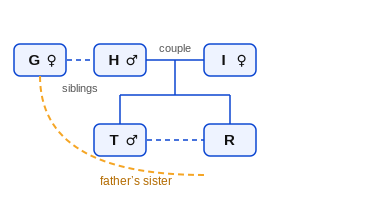
Based on the above, how is G related to R if ‘G ÷ H + I × T - R’?
एक निश्चित कूट भाषा में,
A + B का अर्थ है 'A, B का पति है',
A - B का अर्थ है 'A, B का भाई है',
A × B का अर्थ है 'A, B की माता है', और
A ÷ B का अर्थ है 'A, B की बहन है'।
उपरोक्त के आधार पर, यदि 'G ÷ H + I × T - R' है, तो G, R से किस प्रकार संबंधित है?
  1. ABrother’s wifeभाई की पत्नी
  2. BMother’s sisterमाता की बहन
  3. CFather’s motherपिता की माता
  4. DFather’s sisterपिता की बहन
Show answer

Concept: Decode the chain from left to right and build a family tree.

  1. G ÷ H: G is the sister of H. H + I: H is the husband of I.
  2. I × T: I is the mother of T, so H is T's father. T − R: T is the brother of R.
  3. Hence H is R's father and G, being H's sister, is R's father's sister.

Trick: Follow the chain: the person just before "mother/father" symbols is the parent; the sibling of a parent is an aunt/uncle.

Answer: (D) Father's sister

अवधारणा: श्रृंखला को बाएँ से दाएँ पढ़ें और परिवार-वृक्ष बनाएँ।

  1. G ÷ H: G, H की बहन है। H + I: H, I का पति है।
  2. I × T: I, T की माँ है, अतः H, T का पिता है। T − R: T, R का भाई है।
  3. इसलिए H, R का पिता है और G (H की बहन) R के पिता की बहन (बुआ) है।

ट्रिक: "माँ/पिता" चिह्न से ठीक पहले वाला व्यक्ति माता-पिता है; माता-पिता का भाई/बहन = मामा/बुआ।

उत्तर: (D) पिता की बहन (बुआ)

RRB NTPC Undergraduate CBT 1General Intelligence and ReasoningBlood RelationsRRB NTPC Undergraduate CBT 1 2025 · 9 May Shift 1 →
Q13764.
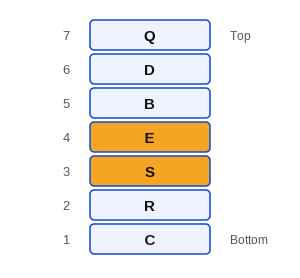
Seven boxes B, C, D, E, Q, R and S are kept one over the other but not necessarily in the same order. No box is kept below C. Only two boxes are kept between E and C. Only Q is kept above D. S is kept at some place below B but at some place above R. Which box is kept immediately above S?
सात बक्से B, C, D, E, Q, R और S एक के ऊपर एक रखे गए हैं, लेकिन आवश्यक नहीं कि इसी क्रम में हों। C के नीचे कोई बक्सा नहीं रखा गया है। E और C के बीच केवल दो बक्से रखे गए हैं। D के ऊपर केवल Q रखा गया है। S, B के नीचे किसी स्थान पर लेकिन R के ऊपर किसी स्थान पर रखा गया है। S के ठीक ऊपर कौन-सा बक्सा रखा गया है?
  1. AB
  2. BE
  3. CR
  4. DD
Show answer

Concept: Number positions 1 (bottom) to 7 (top); use the fixed clues first.

  1. No box below C → C = 1. Two boxes between E and C → E = 4.
  2. Only Q is above D → Q = 7, D = 6.
  3. Remaining 2, 3, 5 for B, S, R with B above S above R → B = 5, S = 3, R = 2.
  4. Immediately above S (3) is position 4 = E.

Trick: "Only X is above Y" fixes two slots at once (top and second from top).

Answer: (B) E

अवधारणा: स्थान 1 (नीचे) से 7 (ऊपर) तक क्रमांकित करें; पहले निश्चित संकेत लगाएँ।

  1. C के नीचे कोई बॉक्स नहीं → C = 1। E और C के बीच दो बॉक्स → E = 4।
  2. D के ऊपर केवल Q → Q = 7, D = 6।
  3. शेष 2, 3, 5 में B, S, R; B ऊपर, फिर S, फिर R → B = 5, S = 3, R = 2।
  4. S (3) के ठीक ऊपर स्थान 4 = E।

ट्रिक: "Y के ऊपर केवल X" से एक साथ दो स्थान तय हो जाते हैं (सबसे ऊपर और ऊपर से दूसरा)।

उत्तर: (B) E

RRB NTPC Undergraduate CBT 1General Intelligence and ReasoningBox ArrangementRRB NTPC Undergraduate CBT 1 2025 · 9 May Shift 1 →
Q13765.
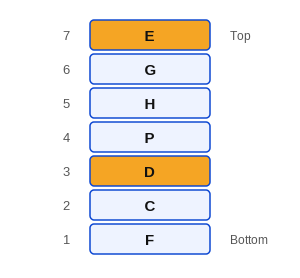
Seven boxes C,D,E,F,G,H and P are kept one over the other but not necessarily in the same order. C is kept second from the bottom. Only three boxes are kept between C and G. F is kept at one of the positions below C. Only H is kept between G and P. E is kept at one of the positions above G. How many boxes are kept between D and E?
सात बक्से C, D, E, F, G, H और P एक के ऊपर एक रखे गए हैं, लेकिन आवश्यक नहीं कि इसी क्रम में हों। C नीचे से दूसरे स्थान पर रखा गया है। C और G के बीच केवल तीन बक्से रखे गए हैं। F, C के नीचे की किसी एक स्थिति पर रखा गया है। G और P के बीच केवल H रखा गया है। E, G के ऊपर की किसी एक स्थिति पर रखा गया है। D और E के बीच कितने बक्से रखे गए हैं?
  1. AThreeतीन
  2. BFourचार
  3. CTwoदो
  4. DOneएक
Show answer

Concept: Number positions 1 (bottom) to 7 (top) and fill the definite clues first.

  1. C is second from the bottom → C = 2. Three boxes between C and G → G = 6.
  2. F is below C → F = 1.
  3. Only H between G and P → P = 4, H = 5 (P cannot be at 8).
  4. E is above G → E = 7; the last box D = 3.
  5. Between D (3) and E (7): P, H, G → three boxes.

Trick: Count boxes between positions as |p1−p2|−1; here 7−3−1=3.

Answer: (A) Three

अवधारणा: स्थान 1 (नीचे) से 7 (ऊपर) तक क्रमांकित करें और पहले निश्चित संकेत भरें।

  1. C नीचे से दूसरा → C = 2। C और G के बीच तीन बॉक्स → G = 6।
  2. F, C के नीचे → F = 1।
  3. G और P के बीच केवल H → P = 4, H = 5 (P स्थान 8 पर नहीं हो सकता)।
  4. E, G के ऊपर → E = 7; अंतिम बॉक्स D = 3।
  5. D (3) और E (7) के बीच: P, H, G → तीन बॉक्स।

ट्रिक: दो स्थानों के बीच बॉक्स = |p1−p2|−1; यहाँ 7−3−1=3।

उत्तर: (A) तीन (Three)

RRB NTPC Undergraduate CBT 1General Intelligence and ReasoningBox ArrangementRRB NTPC Undergraduate CBT 1 2025 · 9 May Shift 1 →
Q13766.
In a certain code language,
A @ B means ‘A is the mother of B’,
A & B means ‘A is the husband of B’,
A # B means ‘A is the father of B’,
A % B means ‘A is the son of B’ and
A * B means ‘A is the daughter of B’.
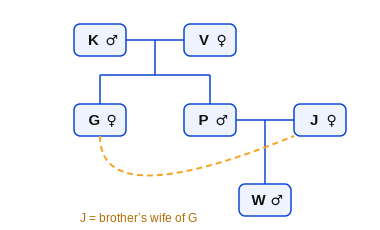
If G * K & V @ P # W % J, then how is J related to G?
एक निश्चित कूट भाषा में,
A @ B का अर्थ है 'A, B की माता है',
A & B का अर्थ है 'A, B का पति है',
A # B का अर्थ है 'A, B का पिता है',
A % B का अर्थ है 'A, B का पुत्र है' और
A * B का अर्थ है 'A, B की पुत्री है'।
यदि G * K & V @ P # W % J है, तो J, G से किस प्रकार संबंधित है?
  1. AMother’s brother’s sonमाता के भाई का पुत्र
  2. BBrother’s wifeभाई की पत्नी
  3. CBrother’s daughterभाई की पुत्री
  4. DSister’s sonबहन का पुत्र
Show answer

Concept: Decode each symbol step by step and draw the family tree.

  1. G * K: G is the daughter of K. K & V: K is the husband of V → G is the daughter of K and V.
  2. V @ P: V is the mother of P → P is G's brother (son of K and V).
  3. P # W: P is the father of W. W % J: W is the son of J → J is W's mother, i.e. P's wife.
  4. So J is the wife of G's brother → brother's wife.

Trick: Two parents named for the same child (P father of W, W son of J) ⇒ P and J are husband and wife.

Answer: (B) Brother's wife

अवधारणा: हर चिह्न को क्रम से समझें और परिवार-वृक्ष बनाएँ।

  1. G * K: G, K की बेटी है। K & V: K, V का पति है → G, K और V की बेटी।
  2. V @ P: V, P की माँ है → P, G का भाई है (K और V का बेटा)।
  3. P # W: P, W का पिता है। W % J: W, J का बेटा है → J, W की माँ यानी P की पत्नी।
  4. अतः J, G के भाई की पत्नी (भाभी) है।

ट्रिक: एक ही संतान के दो अभिभावक (P पिता, J माँ) ⇒ P और J पति-पत्नी।

उत्तर: (B) भाई की पत्नी (भाभी)

RRB NTPC Undergraduate CBT 1General Intelligence and ReasoningBlood RelationsRRB NTPC Undergraduate CBT 1 2025 · 9 May Shift 1 →
Q13767.
Based on the English alphabetical order, three of the following four letter-cluster pairs are alike in a certain way and thus form a group. Which is the one that does not belong to that group?
(Note: The odd one out is not based on the number of consonants/vowels or their position in the letter-cluster pairs.)
अंग्रेज़ी वर्णमाला क्रम के आधार पर, निम्नलिखित चार अक्षर-समूह युग्मों में से तीन एक निश्चित प्रकार से समान हैं और इस प्रकार एक समूह बनाते हैं। वह कौन-सा है जो उस समूह से संबंधित नहीं है?
(नोट: असंगत का निर्धारण व्यंजनों/स्वरों की संख्या या अक्षर-समूह युग्मों में उनकी स्थिति के आधार पर नहीं किया गया है।)
  1. ARL-IQ
  2. BOI – EN
  3. CVP – MU
  4. DCW-TB
Show answer

Concept: Find the position-shift from the first cluster to the second, letter by letter, in each pair.

  1. RL–IQ: R(18)→I(9) = −9; L(12)→Q(17) = +5.
  2. VP–MU: V(22)→M(13) = −9; P(16)→U(21) = +5. CW–TB: C(3)→T(20) = −9 (3−9 = −6 → 20); W(23)→B(2) = +5 (28 → 2).
  3. OI–EN: O(15)→E(5) = −10; I(9)→N(14) = +5. The first-letter shift differs.

Trick: Pattern (−9, +5) in three pairs; OI–EN breaks it with −10.

Answer: (B) OI – EN

अवधारणा: हर युग्म में पहले समूह से दूसरे समूह तक प्रत्येक अक्षर का स्थान-परिवर्तन देखें।

  1. RL–IQ: R(18)→I(9) = −9; L(12)→Q(17) = +5।
  2. VP–MU: V(22)→M(13) = −9; P(16)→U(21) = +5। CW–TB: C(3)→T(20) = −9 (3−9 = −6 → 20); W(23)→B(2) = +5 (28 → 2)।
  3. OI–EN: O(15)→E(5) = −10; I(9)→N(14) = +5। पहले अक्षर का परिवर्तन भिन्न है।

ट्रिक: तीन युग्मों में पैटर्न (−9, +5); OI–EN में −10 होने से यह विषम है।

उत्तर: (B) OI – EN

RRB NTPC Undergraduate CBT 1General Intelligence and ReasoningOdd One Out – Letter PairsRRB NTPC Undergraduate CBT 1 2025 · 9 May Shift 1 →
Q13768.
What should come in place of ‘?’ in the given series?
217 190 165 142 121 102 ?
दी गई शृंखला में '?' के स्थान पर क्या आना चाहिए?
217 190 165 142 121 102 ?
  1. A92
  2. B87
  3. C90
  4. D85
Show answer

Concept: Take successive differences and look for a pattern in them.

  1. 217 → 190 → 165 → 142 → 121 → 102: differences −27,−25,−23,−21,−19.
  2. Differences decrease by 2 each time, so the next difference is −17.
  3. 102−17=85.

Trick: Consecutive odd numbers subtracted (27, 25, 23 …) – a very common second-level pattern.

Answer: (D) 85

अवधारणा: क्रमागत अंतर निकालें और उनमें पैटर्न खोजें।

  1. 217 → 190 → 165 → 142 → 121 → 102: अंतर −27,−25,−23,−21,−19।
  2. अंतर हर बार 2 घटता है, अतः अगला अंतर −17।
  3. 102−17=85।

ट्रिक: क्रमागत विषम संख्याएँ (27, 25, 23 …) घटाई जा रही हैं – यह बहुत सामान्य द्वितीय-स्तर पैटर्न है।

उत्तर: (D) 85

RRB NTPC Undergraduate CBT 1General Intelligence and ReasoningNumber SeriesRRB NTPC Undergraduate CBT 1 2025 · 9 May Shift 1 →
Q13769.
What should come in place of the question mark (?) in the given series based on the English alphabetical order?
ACE DFH GIK JLN ?
अंग्रेज़ी वर्णमाला क्रम पर आधारित दी गई शृंखला में प्रश्नचिह्न (?) के स्थान पर क्या आना चाहिए?
ACE DFH GIK JLN ?
  1. AOQS
  2. BMPQ
  3. CMOQ
  4. DNQT
Show answer

Concept: Within each term the letters are alternate (A, C, E), and each term shifts by a fixed amount.

  1. A(1) → D(4) → G(7) → J(10): +3 each time.
  2. C → F → I → L: +3; E → H → K → N: +3.
  3. Next: J+3 = M, L+3 = O, N+3 = Q → MOQ.

Trick: The series is just ACE, DFH, GIK, JLN, MOQ – every letter +3; option MPQ is a trap (P breaks the +2 gap inside the term).

Answer: (C) MOQ

अवधारणा: हर पद में अक्षर एक-एक छोड़कर हैं (A, C, E), और हर पद निश्चित मात्रा से आगे बढ़ता है।

  1. A(1) → D(4) → G(7) → J(10): हर बार +3।
  2. C → F → I → L: +3; E → H → K → N: +3।
  3. अगला: J+3 = M, L+3 = O, N+3 = Q → MOQ।

ट्रिक: श्रृंखला ACE, DFH, GIK, JLN, MOQ – हर अक्षर +3; विकल्प MPQ जाल है (P पद के भीतर +2 के अंतर को तोड़ता है)।

उत्तर: (C) MOQ

RRB NTPC Undergraduate CBT 1General Intelligence and ReasoningLetter SeriesRRB NTPC Undergraduate CBT 1 2025 · 9 May Shift 1 →
Q13770.
BGKM is related to HKMN in a certain way based on the English alphabetical order. In the same way, FHNP is related to LLPQ .
To which of the following is NRTX related, following the same logic?
अंग्रेज़ी वर्णमाला क्रम के आधार पर BGKM, HKMN से एक निश्चित प्रकार से संबंधित है। उसी प्रकार, FHNP, LLPQ से संबंधित है।
समान तर्क का अनुसरण करते हुए, NRTX निम्नलिखित में से किससे संबंधित है?
  1. AGFLN
  2. BTVVY
  3. CSWYC
  4. DTXZD
Show answer

Concept: Find the shift applied to each letter position in the given pairs and apply the same shifts.

  1. BGKM → HKMN: B+6 = H, G+4 = K, K+2 = M, M+1 = N → shifts (+6, +4, +2, +1).
  2. Check FHNP → LLPQ: F+6 = L, H+4 = L, N+2 = P, P+1 = Q ✓.
  3. NRTX: N(14)+6 = T(20), R(18)+4 = V(22), T(20)+2 = V(22), X(24)+1 = Y(25) → TVVY.

Trick: Shifts need not be equal – write them as a list (+6, +4, +2, +1) and reuse.

Answer: (B) TVVY

अवधारणा: दिए गए युग्मों में हर अक्षर-स्थान पर लागू परिवर्तन खोजें और वही परिवर्तन लागू करें।

  1. BGKM → HKMN: B+6 = H, G+4 = K, K+2 = M, M+1 = N → परिवर्तन (+6, +4, +2, +1)।
  2. जाँच FHNP → LLPQ: F+6 = L, H+4 = L, N+2 = P, P+1 = Q ✓।
  3. NRTX: N(14)+6 = T(20), R(18)+4 = V(22), T(20)+2 = V(22), X(24)+1 = Y(25) → TVVY।

ट्रिक: परिवर्तन बराबर होना ज़रूरी नहीं – सूची (+6, +4, +2, +1) लिखें और दोहराएँ।

उत्तर: (B) TVVY

RRB NTPC Undergraduate CBT 1General Intelligence and ReasoningLetter Cluster AnalogyRRB NTPC Undergraduate CBT 1 2025 · 9 May Shift 1 →
Q13771.
Based on the English alphabetical order, three of the following four are alike in a certain way and thus form a group. Which is the one that does not belong to that group? (Note: The odd man out is not based on the number of consonants/vowels or their position in the letter cluster.)
अंग्रेज़ी वर्णमाला क्रम के आधार पर, निम्नलिखित चार में से तीन एक निश्चित प्रकार से समान हैं और इस प्रकार एक समूह बनाते हैं। वह कौन-सा है जो उस समूह से संबंधित नहीं है? (नोट: असंगत का निर्धारण व्यंजनों/स्वरों की संख्या या अक्षर-समूह में उनकी स्थिति के आधार पर नहीं किया गया है।)
  1. ACEH
  2. BPRU
  3. CUWX
  4. DJLO
Show answer

Concept: Look at the gaps between consecutive letters inside each cluster.

  1. CEH: C→E +2, E→H +3. PRU: P→R +2, R→U +3.
  2. JLO: J→L +2, L→O +3.
  3. UWX: U→W +2, W→X +1 – the second gap is different.

Trick: Pattern (+2, +3) in three clusters; UWX has (+2, +1), so it is the odd one.

Answer: (C) UWX

अवधारणा: हर समूह के भीतर क्रमागत अक्षरों के बीच का अंतर देखें।

  1. CEH: C→E +2, E→H +3। PRU: P→R +2, R→U +3।
  2. JLO: J→L +2, L→O +3।
  3. UWX: U→W +2, W→X +1 – दूसरा अंतर भिन्न है।

ट्रिक: तीन समूहों में पैटर्न (+2, +3); UWX में (+2, +1), अतः यही विषम है।

उत्तर: (C) UWX

RRB NTPC Undergraduate CBT 1General Intelligence and ReasoningOdd One Out – Letter ClustersRRB NTPC Undergraduate CBT 1 2025 · 9 May Shift 1 →
Q13772.
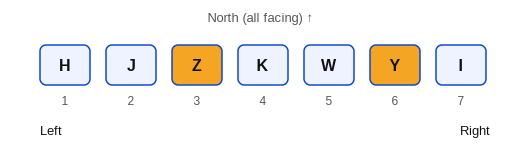
Seven people H, I, J, K, W, Y and Z are sitting in a row facing north. Only three people sit between H and W. K sits to the immediate left of W. No one sits to the right of I. Only two people sit between I and K. Z sits to the immediate right of J. How many people sit between Y and Z?
सात व्यक्ति H, I, J, K, W, Y और Z एक पंक्ति में उत्तर की ओर मुख करके बैठे हैं। H और W के बीच केवल तीन व्यक्ति बैठे हैं। K, W के ठीक बाएँ बैठा है। I के दाएँ कोई नहीं बैठा है। I और K के बीच केवल दो व्यक्ति बैठे हैं। Z, J के ठीक दाएँ बैठा है। Y और Z के बीच कितने व्यक्ति बैठे हैं?
  1. AOneएक
  2. BThreeतीन
  3. CFourचार
  4. DTwoदो
Show answer

Concept: All face north, so left and right are the same as ours. Number the seats 1 (left) to 7 (right).

  1. No one to the right of I → I = 7. Two people between I and K → K = 4.
  2. K is to the immediate left of W → W = 5. Three people between H and W → H = 1.
  3. Z is immediately right of J → J, Z need adjacent seats among 2, 3, 6 → J = 2, Z = 3; Y = 6.
  4. Between Y (6) and Z (3): K and W → two people.

Trick: Fix the end person first ("no one to the right of I"), then work inward with "n people between" clues.

Answer: (D) Two

अवधारणा: सभी उत्तर की ओर मुख किए हैं, अतः बाएँ-दाएँ हमारे जैसे ही हैं। सीटें 1 (बाएँ) से 7 (दाएँ) तक क्रमांकित करें।

  1. I के दाएँ कोई नहीं → I = 7। I और K के बीच दो लोग → K = 4।
  2. K, W के ठीक बाएँ → W = 5। H और W के बीच तीन लोग → H = 1।
  3. Z, J के ठीक दाएँ → J, Z के लिए 2, 3, 6 में सटी सीटें चाहिए → J = 2, Z = 3; Y = 6।
  4. Y (6) और Z (3) के बीच: K और W → दो लोग।

ट्रिक: पहले छोर वाले व्यक्ति को तय करें ("I के दाएँ कोई नहीं"), फिर "बीच में n लोग" संकेतों से अंदर की ओर बढ़ें।

उत्तर: (D) दो (Two)

RRB NTPC Undergraduate CBT 1General Intelligence and ReasoningLinear Seating ArrangementRRB NTPC Undergraduate CBT 1 2025 · 9 May Shift 1 →
Q13773.
What will come in place of the question mark (?) in the following equation if ‘+’ and ‘−’ are interchanged and ‘×’ and ‘÷’ are interchanged?
2814 × 7 − 3 ÷ 75 + 5 = ?
यदि '+' और '−' को आपस में बदल दिया जाए तथा '×' और '÷' को आपस में बदल दिया जाए, तो निम्नलिखित समीकरण में प्रश्नचिह्न (?) के स्थान पर क्या आएगा?
2814 × 7 − 3 ÷ 75 + 5 = ?
  1. A321
  2. B622
  3. C421
  4. D522
Show answer

Concept: Replace the signs as instructed, then apply BODMAS (÷ and × before + and −).

  1. After interchange: 2814÷7+3×75−5.
  2. 2814÷7=402; 3×75=225.
  3. 402+225−5=622.

Trick: Do the division and multiplication first; the big number divided by 7 gives a clean 402, which is the signal you are on track.

Answer: (B) 622

अवधारणा: निर्देशानुसार चिह्न बदलें, फिर BODMAS लागू करें (÷ और × पहले, + और − बाद में)।

  1. अदला-बदली के बाद: 2814÷7+3×75−5।
  2. 2814÷7=402; 3×75=225।
  3. 402+225−5=622।

ट्रिक: पहले भाग और गुणा करें; बड़ी संख्या का 7 से पूरा भाग (402) होना संकेत है कि आप सही रास्ते पर हैं।

उत्तर: (B) 622

RRB NTPC Undergraduate CBT 1General Intelligence and ReasoningMathematical OperationsRRB NTPC Undergraduate CBT 1 2025 · 9 May Shift 1 →
Q13774.
If 2 is added to each odd digit and 2 is subtracted from each even digit in the number 7213546, which of the following digits will be third from the left in the new number thus formed?
यदि संख्या 7213546 में प्रत्येक विषम अंक में 2 जोड़ा जाए और प्रत्येक सम अंक में से 2 घटाया जाए, तो इस प्रकार बनी नई संख्या में बाएँ से तीसरा अंक निम्नलिखित में से कौन-सा होगा?
  1. A7
  2. B9
  3. C5
  4. D3
Show answer

Concept: Apply the rule to each digit separately: odd digit +2, even digit −2.

  1. 7213546 → 7+2 = 9, 2−2 = 0, 1+2 = 3, 3+2 = 5, 5+2 = 7, 4−2 = 2, 6−2 = 4.
  2. New number: 9 0 3 5 7 2 4.
  3. Third digit from the left = 3.

Trick: Only the asked position matters – third digit is 1 (odd) → 1+2 = 3; no need to convert the whole number.

Answer: (D) 3

अवधारणा: नियम हर अंक पर अलग-अलग लागू करें: विषम अंक +2, सम अंक −2।

  1. 7213546 → 7+2 = 9, 2−2 = 0, 1+2 = 3, 3+2 = 5, 5+2 = 7, 4−2 = 2, 6−2 = 4।
  2. नई संख्या: 9 0 3 5 7 2 4।
  3. बाएँ से तीसरा अंक = 3।

ट्रिक: केवल पूछा गया स्थान देखें – तीसरा अंक 1 (विषम) → 1+2 = 3; पूरी संख्या बदलने की ज़रूरत नहीं।

उत्तर: (D) 3

RRB NTPC Undergraduate CBT 1General Intelligence and ReasoningNumber OperationsRRB NTPC Undergraduate CBT 1 2025 · 9 May Shift 1 →
Q13775.
Each letter in the word GUILDER is arranged in the English alphabetical order. How many letters are there in the English alphabetical order between the letter which is fourth from the left and the one which is second from the right in the new letter cluster thus formed?
शब्द GUILDER के प्रत्येक अक्षर को अंग्रेज़ी वर्णमाला क्रम में व्यवस्थित किया जाता है। इस प्रकार बने नए अक्षर-समूह में बाएँ से चौथे अक्षर और दाएँ से दूसरे अक्षर के बीच अंग्रेज़ी वर्णमाला क्रम में कितने अक्षर हैं?
  1. A8
  2. B11
  3. C9
  4. D7
Show answer

Concept: Arrange the letters alphabetically, pick the required letters and count the letters strictly between them in the alphabet.

  1. GUILDER → D, E, G, I, L, R, U.
  2. Fourth from left = I (9); second from right = R (18).
  3. Letters between I and R in the alphabet: J K L M N O P Q = 18−9−1=8.

Trick: Letters between two letters = difference of positions −1.

Answer: (A) 8

अवधारणा: अक्षरों को वर्णमाला क्रम में लगाएँ, माँगे गए अक्षर चुनें और वर्णमाला में उनके बीच के अक्षर गिनें।

  1. GUILDER → D, E, G, I, L, R, U।
  2. बाएँ से चौथा = I (9); दाएँ से दूसरा = R (18)।
  3. वर्णमाला में I और R के बीच: J K L M N O P Q = 18−9−1=8।

ट्रिक: दो अक्षरों के बीच के अक्षर = स्थानों का अंतर −1।

उत्तर: (A) 8

RRB NTPC Undergraduate CBT 1General Intelligence and ReasoningAlphabet TestRRB NTPC Undergraduate CBT 1 2025 · 9 May Shift 1 →
Q13776.
Read the given statement(s) and conclusions carefully. Assuming that the information given in the statements is true, even if it appears to be at variance with commonly known facts, decide which of the given conclusions logically follow(s) from the statement(s).
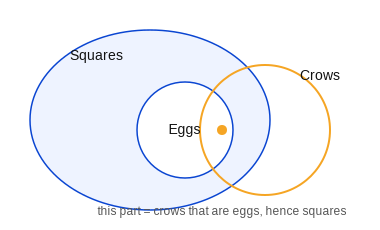
Statements: All eggs are squares. Some crows are eggs.
Conclusion (I): Some squares are crows.
Conclusion (II): All eggs are crows.
दिए गए कथन(नों) और निष्कर्षों को ध्यानपूर्वक पढ़िए। यह मानते हुए कि कथनों में दी गई जानकारी सत्य है, भले ही वह सामान्यतः ज्ञात तथ्यों से भिन्न प्रतीत होती हो, निर्णय कीजिए कि दिए गए निष्कर्षों में से कौन-सा/से निष्कर्ष कथन(नों) का तार्किक रूप से अनुसरण करता/करते है/हैं।
कथन: सभी अंडे वर्ग हैं। कुछ कौए अंडे हैं।
निष्कर्ष (I): कुछ वर्ग कौए हैं।
निष्कर्ष (II): सभी अंडे कौए हैं।
  1. ABoth conclusions (I) and (II) followनिष्कर्ष (I) और (II) दोनों अनुसरण करते हैं
  2. BOnly conclusion (I) followsकेवल निष्कर्ष (I) अनुसरण करता है
  3. CNeither conclusion (I) nor (II) followsन तो निष्कर्ष (I) और न ही (II) अनुसरण करता है
  4. DOnly conclusion (II) followsकेवल निष्कर्ष (II) अनुसरण करता है
Show answer

Concept: Draw a Venn diagram: 'All eggs are squares' puts the eggs circle inside squares; 'Some crows are eggs' makes crows overlap eggs.

  1. The crows that are eggs lie inside squares, so some squares are crows – Conclusion (I) follows.
  2. 'All eggs are crows' is not forced: eggs may exist outside the crows circle – Conclusion (II) does not follow.

Trick: All A are B + Some C are A ⇒ Some B are C (definite); a 'Some' statement never yields an 'All' conclusion.

Answer: (B) Only conclusion (I) follows

अवधारणा: वेन आरेख बनाएँ: 'सभी अंडे वर्ग हैं' → अंडे का वृत्त वर्ग के अंदर; 'कुछ कौवे अंडे हैं' → कौवे का वृत्त अंडे को काटता है।

  1. जो कौवे अंडे हैं वे वर्ग के अंदर हैं, अतः कुछ वर्ग कौवे हैं – निष्कर्ष (I) अनुसरण करता है।
  2. 'सभी अंडे कौवे हैं' आवश्यक नहीं: अंडे कौवे के वृत्त के बाहर भी हो सकते हैं – निष्कर्ष (II) अनुसरण नहीं करता।

ट्रिक: सभी A, B हैं + कुछ C, A हैं ⇒ कुछ B, C हैं (निश्चित); 'कुछ' कथन से कभी 'सभी' निष्कर्ष नहीं निकलता।

उत्तर: (B) केवल निष्कर्ष (I) अनुसरण करता है

RRB NTPC Undergraduate CBT 1General Intelligence and ReasoningSyllogismRRB NTPC Undergraduate CBT 1 2025 · 9 May Shift 1 →
Q13777.
In a certain code language, ‘eagle gum novel’ is coded as 'fq ko hz' and ‘novel fresh zebra’ is coded as ‘ko ef ni’. How is ‘novel’ coded in the given language?
एक निश्चित कूट भाषा में, 'eagle gum novel' को 'fq ko hz' के रूप में कूटबद्ध किया जाता है और 'novel fresh zebra' को 'ko ef ni' के रूप में कूटबद्ध किया जाता है। उसी भाषा में 'novel' को किस प्रकार कूटबद्ध किया जाएगा?
  1. Aef
  2. Bhz
  3. Cfq
  4. Dko
Show answer

Concept: In sentence coding, a word common to two sentences has the code common to both.

  1. 'eagle gum novel' → fq ko hz; 'novel fresh zebra' → ko ef ni.
  2. Common word: novel; common code: ko.
  3. Hence novel = ko.

Trick: Match the overlap of words with the overlap of codes – no other step needed.

Answer: (D) ko

अवधारणा: वाक्य कूट में दो वाक्यों में समान शब्द का कोड भी दोनों में समान होता है।

  1. 'eagle gum novel' → fq ko hz; 'novel fresh zebra' → ko ef ni।
  2. समान शब्द: novel; समान कोड: ko।
  3. अतः novel = ko।

ट्रिक: शब्दों के साझा भाग को कोड के साझा भाग से मिलाएँ – और कुछ करने की ज़रूरत नहीं।

उत्तर: (D) ko

RRB NTPC Undergraduate CBT 1General Intelligence and ReasoningCoding–DecodingRRB NTPC Undergraduate CBT 1 2025 · 9 May Shift 1 →
Q13778.
If ‘A’ stands for ‘÷’, ‘B’ stands for ‘×’, ‘C’ stands for ‘+’ and ‘D’ stands for ‘−’, then the resultant of which of the following will be 486?
यदि 'A' का अर्थ '÷', 'B' का अर्थ '×', 'C' का अर्थ '+' और 'D' का अर्थ '−' है, तो निम्नलिखित में से किसका परिणाम 486 होगा?
  1. A404 A 4 C 15 D 50 B 8
  2. B404 D 4 D 15 C 50 A 8
  3. C404 B 4 D 15 C 50 A 8
  4. D404 A 4 D 15 C 50 B 8
Show answer

Concept: Substitute A = ÷, B = ×, C = +, D = − and evaluate each option with BODMAS.

  1. Option D: 404÷4−15+50×8=101−15+400=486 ✓.
  2. Option A: 404÷4+15−50×8=101+15−400=−284.
  3. Option B: 404−4−15+50÷8=385+6.25=391.25; Option C: 404×4−15+50÷8=1607.25.

Trick: 404÷4=101 and 50×8=400 add up near 486 – test the option that has A with 4 and B with 8 first.

Answer: (D) 404 A 4 D 15 C 50 B 8

अवधारणा: A = ÷, B = ×, C = +, D = − रखें और हर विकल्प को BODMAS से हल करें।

  1. विकल्प D: 404÷4−15+50×8=101−15+400=486 ✓।
  2. विकल्प A: 404÷4+15−50×8=101+15−400=−284।
  3. विकल्प B: 404−4−15+50÷8=385+6.25=391.25; विकल्प C: 404×4−15+50÷8=1607.25।

ट्रिक: 404÷4=101 और 50×8=400 मिलकर 486 के पास आते हैं – पहले वही विकल्प जाँचें जिसमें 4 के साथ A और 8 के साथ B हो।

उत्तर: (D) 404 A 4 D 15 C 50 B 8

RRB NTPC Undergraduate CBT 1General Intelligence and ReasoningMathematical OperationsRRB NTPC Undergraduate CBT 1 2025 · 9 May Shift 1 →
Q13779.
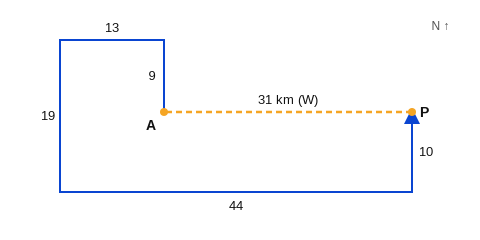
Mr. Yorly starts from Point A and drives 9 km towards North. He then takes a left turn, drives 13 km, turns left and drives 19 km. He then takes a left turn and drives 44 km. He takes a final left turn, drives 10 km and stops at Point P. How far (shortest distance) and towards which direction should he drive in order to reach Point A again?
(All turns are 90 degrees turns only unless specified.)
श्री योर्ली बिंदु A से चलना शुरू करते हैं और उत्तर की ओर 9 km गाड़ी चलाते हैं। फिर वे बाएँ मुड़ते हैं, 13 km गाड़ी चलाते हैं, बाएँ मुड़ते हैं और 19 km गाड़ी चलाते हैं। फिर वे बाएँ मुड़ते हैं और 44 km गाड़ी चलाते हैं। वे अंतिम बार बाएँ मुड़ते हैं, 10 km गाड़ी चलाते हैं और बिंदु P पर रुक जाते हैं। बिंदु A पर पुनः पहुँचने के लिए उन्हें कितनी दूर (न्यूनतम दूरी) और किस दिशा में गाड़ी चलानी चाहिए?
(जब तक अन्यथा निर्दिष्ट न हो, सभी मोड़ केवल 90 डिग्री के मोड़ हैं।)
  1. A35 km to the North35 km उत्तर की ओर
  2. B33 km to the South33 km दक्षिण की ओर
  3. C31 km to the West31 km पश्चिम की ओर
  4. D22 km to the East22 km पूर्व की ओर
Show answer

Concept: Track the position with coordinates, taking A as origin, North as +y and East as +x. A left turn rotates N → W → S → E → N.

  1. North 9: (0, 9). Left → West 13: (−13, 9). Left → South 19: (−13, −10).
  2. Left → East 44: (31, −10). Left → North 10: (31, 0) = P.
  3. P is 31 km due east of A, so he must drive 31 km towards the West to reach A.

Trick: Net N–S: 9−19+10=0; net E–W: −13+44=31 km east → go back 31 km west.

Answer: (C) 31 km to the West

अवधारणा: A को मूल बिंदु, उत्तर को +y और पूर्व को +x मानकर स्थिति निर्देशांकों से ट्रैक करें। बायाँ मोड़: N → W → S → E → N।

  1. उत्तर 9: (0, 9)। बाएँ → पश्चिम 13: (−13, 9)। बाएँ → दक्षिण 19: (−13, −10)।
  2. बाएँ → पूर्व 44: (31, −10)। बाएँ → उत्तर 10: (31, 0) = P।
  3. P, A से ठीक 31 km पूर्व में है, अतः A पहुँचने के लिए 31 km पश्चिम की ओर चलना होगा।

ट्रिक: शुद्ध N–S: 9−19+10=0; शुद्ध E–W: −13+44=31 km पूर्व → वापस 31 km पश्चिम।

उत्तर: (C) 31 km पश्चिम की ओर

RRB NTPC Undergraduate CBT 1General Intelligence and ReasoningDirection and DistanceRRB NTPC Undergraduate CBT 1 2025 · 9 May Shift 1 →
Q13780.
What should come in place of the ‘?’ in the given series?
43 ? 31 67 19 79
दी गई शृंखला में '?' के स्थान पर क्या आना चाहिए?
43 ? 31 67 19 79
  1. A50
  2. B52
  3. C60
  4. D55
Show answer

Concept: When neighbouring terms rise and fall alternately, split the series into two alternate sub-series.

  1. Odd places: 43, 31, 19 → each −12.
  2. Even places: ?, 67, 79 → each +12, so ? =67−12=55.
  3. Check: 43, 55, 31, 67, 19, 79 – alternate differences −12 and +12 hold.

Trick: Zig-zag series → read alternate terms; both chains here use the same step 12.

Answer: (D) 55

अवधारणा: जब पड़ोसी पद बारी-बारी से बढ़ें-घटें, तो श्रृंखला को दो एकांतर उप-श्रृंखलाओं में बाँटें।

  1. विषम स्थान: 43, 31, 19 → प्रत्येक −12।
  2. सम स्थान: ?, 67, 79 → प्रत्येक +12, अतः ? =67−12=55।
  3. जाँच: 43, 55, 31, 67, 19, 79 – एकांतर अंतर −12 और +12 सही बैठते हैं।

ट्रिक: ज़िग-ज़ैग श्रृंखला → एक छोड़कर पद पढ़ें; यहाँ दोनों शृंखलाओं में समान चरण 12 है।

उत्तर: (D) 55

RRB NTPC Undergraduate CBT 1General Intelligence and ReasoningNumber SeriesRRB NTPC Undergraduate CBT 1 2025 · 9 May Shift 1 →