Question bank

Q&A: practice questions with answers

Search questions on any topic. Filter by exam category, exam, subject and topic, try the question, then open the answer and explanation.

Courses – airGurukul

20,719 questions found.

Q13841.
In a division sum, the divisor is 14 times the quotient and 5 times the remainder. If the remainder is 56, what is the dividend?
एक भाग के प्रश्न में, भाजक भागफल का 14 गुना और शेषफल का 5 गुना है। यदि शेषफल 56 है, तो भाज्य क्या है?
  1. A5655
  2. B5656
  3. C5651
  4. D5653
Show answer

Concept: Dividend =Divisor×Quotient+Remainder.

  1. Divisor =5×56=280
  2. Quotient =28014=20
  3. Dividend =280×20+56=5656

Trick: Find the divisor from the remainder first – it links both given relations.

Answer: (B) 5656

अवधारणा: भाज्य =भाजक×भागफल+शेषफल।

  1. भाजक =5×56=280
  2. भागफल =28014=20
  3. भाज्य =280×20+56=5656

ट्रिक: पहले शेषफल से भाजक निकालें – यही दोनों संबंधों को जोड़ता है।

उत्तर: (B) 5656
RRB NTPC Undergraduate CBT 1MathematicsDivision AlgorithmRRB NTPC Undergraduate CBT 1 2025 · 8 May Shift 3 →
Q13842.
Sangeeta’s salary is revised twice in two consecutive years. In the first year, the salary is increased by 12%. In the second year, it is decreased by 10%. Despite this, her salary after the second revision is ₹1,584 more than the original salary. What is Sangeeta’s original monthly salary (in ₹)?
संगीता के वेतन में लगातार दो वर्षों में दो बार संशोधन किया जाता है। पहले वर्ष में वेतन में 12% की वृद्धि की जाती है। दूसरे वर्ष में इसमें 10% की कमी की जाती है। इसके बावजूद, दूसरे संशोधन के बाद उसका वेतन मूल वेतन से ₹1,584 अधिक है। संगीता का मूल मासिक वेतन (₹ में) कितना है?
  1. A1,75,000
  2. B1,89,000
  3. C2,00,000
  4. D1,98,000
Show answer

Concept: Net change for +a% then −b% =a−b−ab100.

  1. Net =12−10−120100=+0.8%
  2. 0.8% of salary =1584⇒ salary =1584×1000.8= ₹1,98,000

Trick: 1.12×0.9=1.008; the extra 0.008 part equals ₹1,584, so salary =1584÷0.008.

Answer: (D) 1,98,000

अवधारणा: +a% फिर −b% का शुद्ध परिवर्तन =a−b−ab100।

  1. शुद्ध =12−10−120100=+0.8%
  2. वेतन का 0.8%=1584⇒ वेतन =1584×1000.8= ₹1,98,000

ट्रिक: 1.12×0.9=1.008; अतिरिक्त 0.008 भाग = ₹1,584, अतः वेतन =1584÷0.008।

उत्तर: (D) 1,98,000

RRB NTPC Undergraduate CBT 1MathematicsSuccessive Percentage ChangeRRB NTPC Undergraduate CBT 1 2025 · 8 May Shift 3 →
Q13843.
A train covers a distance of 300 kilometers in 5 hours. If the same train takes 6 hours to cover the same distance, what is the change in its speed?
एक रेलगाड़ी 300 किलोमीटर की दूरी 5 घंटे में तय करती है। यदि वही रेलगाड़ी उतनी ही दूरी तय करने में 6 घंटे लेती है, तो उसकी चाल में क्या परिवर्तन होगा?
  1. A15 km/h decrease15 km/h की कमी
  2. B10 km/h increase10 km/h की वृद्धि
  3. C15 km/h increase15 km/h की वृद्धि
  4. D10 km/h decrease10 km/h की कमी
Show answer

Concept: Speed =DistanceTime.

  1. Original speed =3005=60km/h
  2. New speed =3006=50km/h
  3. Change =60−50=10km/h decrease

Trick: More time for the same distance always means lower speed – so only "decrease" options qualify.

Answer: (D) 10 km/h decrease

अवधारणा: चाल =दूरीसमय।

  1. मूल चाल =3005=60km/h
  2. नई चाल =3006=50km/h
  3. परिवर्तन =60−50=10km/h की कमी

ट्रिक: समान दूरी में अधिक समय = कम चाल, अतः केवल "कमी" वाले विकल्प संभव हैं।

उत्तर: (D) 10 km/h की कमी

RRB NTPC Undergraduate CBT 1MathematicsSpeed, Time and DistanceRRB NTPC Undergraduate CBT 1 2025 · 8 May Shift 3 →
Q13844.
Simplify: (0.25 × 1.6) ÷ (0.04 × 0.5)
सरल कीजिए: (0.25 × 1.6) ÷ (0.04 × 0.5)
  1. A20
  2. B2
  3. C10
  4. D8
Show answer

Concept: Multiply inside each bracket, then divide.

  1. 0.25×1.6=0.4
  2. 0.04×0.5=0.02
  3. 0.40.02=402=20

Trick: Remove decimals: 25×164×5×10−310−4=20×1=20… or simply note 0.250.5=0.5 and 1.60.04=40, product 20.

Answer: (A) 20

अवधारणा: पहले हर कोष्ठक में गुणा करें, फिर भाग दें।

  1. 0.25×1.6=0.4
  2. 0.04×0.5=0.02
  3. 0.40.02=402=20

ट्रिक: जोड़ी बनाकर देखें: 0.250.5=0.5 और 1.60.04=40, गुणनफल 20।

उत्तर: (A) 20

RRB NTPC Undergraduate CBT 1MathematicsDecimal SimplificationRRB NTPC Undergraduate CBT 1 2025 · 8 May Shift 3 →
Q13845.
A and B can do a piece of work in 12 days and 39 days, respectively. Both work for 4 days and then A leaves. How long (in days) will B take to complete the remaining work?
A और B एक कार्य को क्रमशः 12 दिनों और 39 दिनों में कर सकते हैं। दोनों 4 दिन कार्य करते हैं और फिर A कार्य छोड़ देता है। शेष कार्य पूरा करने में B को कितने दिन लगेंगे?
  1. A24
  2. B21
  3. C23
  4. D22
Show answer

Concept: Total work = LCM of days; efficiency = work per day.

  1. LCM(12,39) =156 units; A =13, B =4 units/day
  2. 4 days together: 4×17=68 units; remaining =88
  3. B alone: 884=22 days

Trick: In 4 days A does 412=13 of the work; B must do the rest alone, so B's remaining time =39×(1−13−439)=22.

Answer: (D) 22

अवधारणा: कुल कार्य = दिनों का LCM; दक्षता = प्रतिदिन कार्य।

  1. LCM(12,39) =156 इकाई; A =13, B =4 इकाई/दिन
  2. 4 दिन साथ: 4×17=68 इकाई; शेष =88
  3. B अकेला: 884=22 दिन

ट्रिक: 4 दिनों में A 13 काम करता है; B का शेष समय =39×(1−13−439)=22।

उत्तर: (D) 22

RRB NTPC Undergraduate CBT 1MathematicsTime and WorkRRB NTPC Undergraduate CBT 1 2025 · 8 May Shift 3 →
Q13846.
The amount under simple interest on a sum of ₹8,000 for 3 years at an interest rate of 7.5% per annum is
₹8,000 की राशि पर 7.5% वार्षिक ब्याज दर से 3 वर्षों के लिए साधारण ब्याज पर मिश्रधन है
  1. A₹9800
  2. B₹10000
  3. C₹9600
  4. D₹9400
Show answer

Concept: SI=P×R×T100; Amount =P+SI.

  1. SI=8000×7.5×3100=1800
  2. Amount =8000+1800= ₹9,800

Trick: 7.5%×3=22.5% of 8000 =1800 in one step.

Answer: (A) ₹9800

अवधारणा: SI=P×R×T100; मिश्रधन =P+SI।

  1. SI=8000×7.5×3100=1800
  2. मिश्रधन =8000+1800= ₹9,800

ट्रिक: 7.5%×3=22.5% of 8000 =1800 एक ही चरण में।

उत्तर: (A) ₹9800

RRB NTPC Undergraduate CBT 1MathematicsSimple InterestRRB NTPC Undergraduate CBT 1 2025 · 8 May Shift 3 →
Q13847.
If a man bought an article at 20% less than its marked price and sold it for ₹10 more than its marked price, his profit was 40%. What was the marked price (in ₹) of the article (correct to two decimal places)?
यदि एक व्यक्ति ने एक वस्तु को उसके अंकित मूल्य से 20% कम पर खरीदा और उसे अंकित मूल्य से ₹10 अधिक पर बेच दिया, तो उसका लाभ 40% था। वस्तु का अंकित मूल्य (₹ में) क्या था (दशमलव के दो स्थानों तक सही)?
  1. A₹83.33
  2. B₹76.66
  3. C₹86.66
  4. D₹73.33
Show answer

Concept: SP=CP×(1+profit%). Let marked price =M.

  1. CP=0.8M, SP=M+10
  2. M+10=1.4×0.8M=1.12M
  3. 0.12M=10⇒M=100.12=83.33

Trick: 1.4×0.8=1.12, so the ₹10 above MP is exactly 12% of MP.

Answer: (A) ₹83.33

अवधारणा: SP=CP×(1+लाभ%)। अंकित मूल्य =M मानें।

  1. CP=0.8M, SP=M+10
  2. M+10=1.4×0.8M=1.12M
  3. 0.12M=10⇒M=83.33

ट्रिक: 1.4×0.8=1.12, अतः MP से ऊपर के ₹10 ठीक MP का 12% हैं।

उत्तर: (A) ₹83.33

RRB NTPC Undergraduate CBT 1MathematicsProfit and LossRRB NTPC Undergraduate CBT 1 2025 · 8 May Shift 3 →
Q13848.
Evaluate 233 + (-14)3 + (-9)3
233 + (-14)3 + (-9)3 का मान ज्ञात कीजिए
  1. A8502
  2. B8694
  3. C8498
  4. D8581
Show answer

Concept: If a+b+c=0, then a3+b3+c3=3abc.

  1. 23+(−14)+(−9)=0
  2. Sum =3×23×(−14)×(−9)=3×23×126
  3. =69×126=8694

Trick: Whenever three cubes are added and the bases sum to zero, skip cubing – just use 3abc.

Answer: (B) 8694

अवधारणा: यदि a+b+c=0 तो a3+b3+c3=3abc।

  1. 23+(−14)+(−9)=0
  2. योग =3×23×(−14)×(−9)=3×23×126
  3. =69×126=8694

ट्रिक: तीन घनों का योग हो और आधार का योग शून्य हो तो घन न निकालें – सीधे 3abc।

उत्तर: (B) 8694

RRB NTPC Undergraduate CBT 1MathematicsAlgebraic IdentityRRB NTPC Undergraduate CBT 1 2025 · 8 May Shift 3 →
Q13849.
The present age of Person A is 5 years more than twice the age of Person B. If Person B is 15 years old, what is the present age (in years) of Person A?
व्यक्ति A की वर्तमान आयु व्यक्ति B की आयु के दोगुने से 5 वर्ष अधिक है। यदि व्यक्ति B की आयु 15 वर्ष है, तो व्यक्ति A की वर्तमान आयु (वर्षों में) क्या है?
  1. A35
  2. B33
  3. C34
  4. D32
Show answer

Concept: Translate words into an equation: A=2B+5.

  1. B=15⇒2B=30
  2. A=30+5=35 years

Trick: "5 more than twice" = double first, then add 5.

Answer: (A) 35

अवधारणा: शब्दों को समीकरण में बदलें: A=2B+5।

  1. B=15⇒2B=30
  2. A=30+5=35 वर्ष

ट्रिक: "दोगुने से 5 अधिक" = पहले दोगुना, फिर 5 जोड़ें।

उत्तर: (A) 35

RRB NTPC Undergraduate CBT 1MathematicsAgesRRB NTPC Undergraduate CBT 1 2025 · 8 May Shift 3 →
Q13850.
A trader buys a consignment of goods for ₹2400. He sells one-third​ of the goods at a 20% profit, and one-fourth​ of the goods at a 10% loss, and the remaining goods at cost price. What is the overall profit or loss percentage?
एक व्यापारी ₹2400 में माल की एक खेप खरीदता है। वह एक-तिहाई माल 20% लाभ पर, एक-चौथाई माल 10% हानि पर और शेष माल क्रय मूल्य पर बेचता है। कुल लाभ या हानि प्रतिशत क्या है?
  1. A416% profit416% लाभ
  2. B416% loss416% हानि
  3. C415% profit415% लाभ
  4. D415% loss415% हानि
Show answer

Concept: Overall %=net gaintotal CP×100.

  1. One-third: CP ₹800, profit 20%=+160
  2. One-fourth: CP ₹600, loss 10%=−60
  3. Rest at cost: 0. Net gain =100
  4. 1002400×100=256=416% profit

Trick: Weighted profit =13(20)+14(−10)+0=203−52=256% – no need to use ₹2400 at all.

Answer: (A) 416% profit

अवधारणा: कुल %=शुद्ध लाभकुल CP×100।

  1. एक-तिहाई: CP ₹800, लाभ 20%=+160
  2. एक-चौथाई: CP ₹600, हानि 10%=−60
  3. शेष क्रय मूल्य पर: 0। शुद्ध लाभ =100
  4. 1002400×100=256=416% लाभ

ट्रिक: भारित लाभ =13(20)+14(−10)=203−52=256% – ₹2400 की ज़रूरत ही नहीं।

उत्तर: (A) 416% लाभ

RRB NTPC Undergraduate CBT 1MathematicsProfit and Loss – Mixed SaleRRB NTPC Undergraduate CBT 1 2025 · 8 May Shift 3 →
Q13851.
A shopkeeper offers the following schemes on toys of the same marked price. (A) Successive discounts of 21% and 8% on any number of toys bought.
(B) Successive discounts of 38%, 42% and 30% on any number of toys bought. (C) 17% discount on the first 8 toys and 20% discount on each toy thereon.
(D) 7 toys free of cost on buying 10 toys.
A customer wants to buy 10 toys. Which of the above schemes is the least beneficial to her?
एक दुकानदार समान अंकित मूल्य वाले खिलौनों पर निम्नलिखित योजनाएँ प्रस्तुत करता है। (A) खरीदे गए किसी भी संख्या के खिलौनों पर 21% और 8% की क्रमिक छूट।
(B) खरीदे गए किसी भी संख्या के खिलौनों पर 38%, 42% और 30% की क्रमिक छूट। (C) पहले 8 खिलौनों पर 17% छूट और उसके बाद प्रत्येक खिलौने पर 20% छूट।
(D) 10 खिलौने खरीदने पर 7 खिलौने निःशुल्क।
एक ग्राहक 10 खिलौने खरीदना चाहती है। उपरोक्त में से कौन-सी योजना उसके लिए सबसे कम लाभदायक है?
  1. AA
  2. BD
  3. CC
  4. DB
Show answer

Concept: Compare the effective price paid per toy (take MP = ₹100 each).

  1. (A) 100×0.79×0.92= ₹72.68 per toy
  2. (B) 100×0.62×0.58×0.70≈ ₹25.17 per toy
  3. (C) 8×83+2×80=824 for 10, i.e. ₹82.40 per toy
  4. (D) Pay for 10, get 17: 100017≈ ₹58.82 per toy
  5. Highest effective price = scheme C → least beneficial.

Trick: Successive discounts always beat the plain sum; a scheme with only 17–20% off can never compete with 21%+8% or three big discounts.

Answer: (C) C

अवधारणा: प्रति खिलौना प्रभावी मूल्य की तुलना करें (MP = ₹100 मानें)।

  1. (A) 100×0.79×0.92= ₹72.68 प्रति खिलौना
  2. (B) 100×0.62×0.58×0.70≈ ₹25.17 प्रति खिलौना
  3. (C) 8×83+2×80=824 (10 के लिए), यानी ₹82.40 प्रति खिलौना
  4. (D) 10 का भुगतान, 17 मिले: 100017≈ ₹58.82 प्रति खिलौना
  5. सबसे अधिक प्रभावी मूल्य = योजना C → सबसे कम लाभकारी।

ट्रिक: केवल 17–20% छूट वाली योजना 21%+8% या तीन बड़ी छूटों का मुकाबला नहीं कर सकती।

उत्तर: (C) C

RRB NTPC Undergraduate CBT 1MathematicsSuccessive Discounts – ComparisonRRB NTPC Undergraduate CBT 1 2025 · 8 May Shift 3 →
Q13852.
Eight mangoes and five oranges cost ₹164, while five mangoes and eight oranges cost ₹148. Determine the cost of three mangoes and three oranges.
आठ आमों और पाँच संतरों की कीमत ₹164 है, जबकि पाँच आमों और आठ संतरों की कीमत ₹148 है। तीन आमों और तीन संतरों की कीमत ज्ञात कीजिए।
  1. A₹74
  2. B₹76
  3. C₹72
  4. D₹70
Show answer

Concept: Symmetric equations – add them to get m+o directly.

  1. 8m+5o=164, 5m+8o=148
  2. Adding: 13(m+o)=312⇒m+o=24
  3. 3(m+o)=72

Trick: When coefficients are swapped, adding gives the sum and subtracting gives the difference – no need to solve for each item.

Answer: (C) ₹72

अवधारणा: सममित समीकरण – जोड़कर सीधे m+o निकालें।

  1. 8m+5o=164, 5m+8o=148
  2. जोड़ने पर: 13(m+o)=312⇒m+o=24
  3. 3(m+o)=72

ट्रिक: गुणांक आपस में बदले हों तो जोड़ने से योग और घटाने से अंतर मिलता है – अलग-अलग हल करने की ज़रूरत नहीं।

उत्तर: (C) ₹72

RRB NTPC Undergraduate CBT 1MathematicsLinear EquationsRRB NTPC Undergraduate CBT 1 2025 · 8 May Shift 3 →
Q13853.
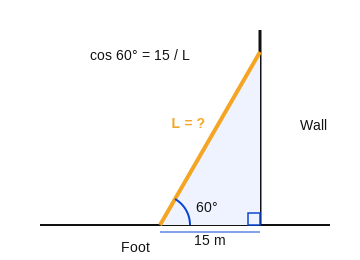
A ladder leans against a wall, making an angle of 60° with the ground. If the foot of the ladder is 15 metres from the wall, what is the length of the ladder?
एक सीढ़ी एक दीवार के सहारे टिकी है और ज़मीन के साथ 60° का कोण बनाती है। यदि सीढ़ी का पाद दीवार से 15 मीटर दूर है, तो सीढ़ी की लंबाई कितनी है?
  1. A32 m
  2. B30 m
  3. C42 m
  4. D36 m
Show answer

Concept: In the right triangle, cosθ=basehypotenuse.

  1. cos60∘=15L
  2. 12=15L⇒L=30 m

Trick: In a 30∘-60∘-90∘ triangle the hypotenuse is twice the side opposite 30∘ (the base here).

Answer: (B) 30 m

अवधारणा: समकोण त्रिभुज में cosθ=आधारकर्ण।

  1. cos60∘=15L
  2. 12=15L⇒L=30 m

ट्रिक: 30∘-60∘-90∘ त्रिभुज में कर्ण, 30∘ के सामने वाली भुजा (यहाँ आधार) का दोगुना होता है।

उत्तर: (B) 30 m

RRB NTPC Undergraduate CBT 1MathematicsHeights and DistancesRRB NTPC Undergraduate CBT 1 2025 · 8 May Shift 3 →
Q13854.
Simplify: 53x×(52)(x−1)54x−1
सरल कीजिए: 53x×(52)(x−1)54x−1
  1. A5x−1
  2. B51−x
  3. C5x−3
  4. D5x+1
Show answer

Concept: am×an=am+n, (am)n=amn, aman=am−n.

  1. Numerator: 53x×52(x−1)=53x+2x−2=55x−2
  2. Divide: 5(5x−2)−(4x−1)=5x−1

Trick: Put x=1: expression =53×153=1=50; only 5x−1 gives 50.

Answer: (A) 5x−1

अवधारणा: am×an=am+n, (am)n=amn, aman=am−n।

  1. अंश: 53x×52(x−1)=55x−2
  2. भाग: 5(5x−2)−(4x−1)=5x−1

ट्रिक: x=1 रखें: व्यंजक =53×153=1=50; केवल 5x−1 से 50 मिलता है।

उत्तर: (A) 5x−1

RRB NTPC Undergraduate CBT 1MathematicsLaws of ExponentsRRB NTPC Undergraduate CBT 1 2025 · 8 May Shift 3 →
Q13855.
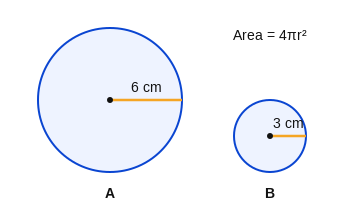
Sphere A has a radius of 6 cm and Sphere B has a radius of 3 cm. What is the ratio of the surface area of A to that of B?
गोले A की त्रिज्या 6 cm और गोले B की त्रिज्या 3 cm है। A के पृष्ठीय क्षेत्रफल का B के पृष्ठीय क्षेत्रफल से अनुपात क्या है?
  1. A4:1
  2. B3:1
  3. C2:1
  4. D6:1
Show answer

Concept: Surface area =4πr2, so the ratio of areas =(r1r2)2.

  1. rArB=63=2
  2. Area ratio =22=4:1

Trick: Double the radius → area ×4, volume ×8.

Answer: (A) 4:1

अवधारणा: पृष्ठीय क्षेत्रफल =4πr2, अतः क्षेत्रफलों का अनुपात =(r1r2)2।

  1. rArB=63=2
  2. क्षेत्रफल अनुपात =22=4:1

ट्रिक: त्रिज्या दोगुनी → क्षेत्रफल ×4, आयतन ×8।

उत्तर: (A) 4:1

RRB NTPC Undergraduate CBT 1MathematicsMensuration – SphereRRB NTPC Undergraduate CBT 1 2025 · 8 May Shift 3 →
Q13856.
Read the given statements and conclusions carefully. Assuming that the information given in the statements is true, even if it appears to be at variance with commonly known facts, decide which of the given conclusions logically follow(s) from the statements.
Statement: All Chickens are Quails. All Quails are Pigeons.
Conclusion (I): No Pigeons are Chickens.
Conclusion (II): Some Pigeons are Chickens.
दिए गए कथनों और निष्कर्षों को ध्यानपूर्वक पढ़िए। यह मानते हुए कि कथनों में दी गई जानकारी सत्य है, भले ही वह सामान्यतः ज्ञात तथ्यों से भिन्न प्रतीत होती हो, निर्णय कीजिए कि दिए गए निष्कर्षों में से कौन-सा/कौन-से निष्कर्ष कथनों का तार्किक रूप से अनुसरण करता है/करते हैं।
कथन: सभी मुर्गियाँ बटेर हैं। सभी बटेर कबूतर हैं।
निष्कर्ष (I): कोई कबूतर मुर्गी नहीं है।
निष्कर्ष (II): कुछ कबूतर मुर्गियाँ हैं।
  1. ABoth conclusions (I) and (II) followनिष्कर्ष (I) और (II) दोनों अनुसरण करते हैं
  2. BOnly conclusion (I) followsकेवल निष्कर्ष (I) अनुसरण करता है
  3. COnly conclusion (II) followsकेवल निष्कर्ष (II) अनुसरण करता है
  4. DNeither conclusion (I) nor (II) followsन तो निष्कर्ष (I) और न ही (II) अनुसरण करता है
Show answer

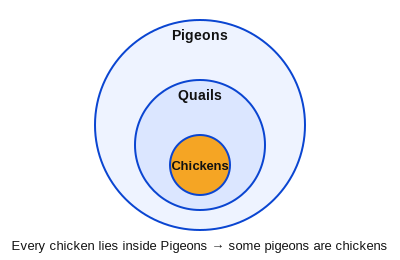
Concept: Draw the Venn diagram for two "All" statements – the sets nest inside each other.

  1. All Chickens are Quails and all Quails are Pigeons → Chickens ⊂ Quails ⊂ Pigeons, so all Chickens are Pigeons.
  2. Conclusion (I) "No Pigeons are Chickens" is the opposite of this – false.
  3. Conclusion (II) "Some Pigeons are Chickens" is the converse of "All Chickens are Pigeons" – it follows.

Trick: All A are B ⇒ Some B are A (always true); "No" can never follow from two "All" statements.

Answer: (C) Only conclusion (II) follows

अवधारणा: दो "All" कथनों का Venn चित्र बनाएँ – समूह एक-दूसरे के अंदर समा जाते हैं।

  1. सभी Chickens, Quails हैं और सभी Quails, Pigeons हैं → Chickens ⊂ Quails ⊂ Pigeons, अतः सभी Chickens, Pigeons हैं।
  2. निष्कर्ष (I) "कोई Pigeon, Chicken नहीं" इसके विपरीत है – गलत।
  3. निष्कर्ष (II) "कुछ Pigeons, Chickens हैं" – "सभी Chickens, Pigeons हैं" का converse है – सही।

ट्रिक: All A are B ⇒ Some B are A (हमेशा सही); दो "All" कथनों से "No" कभी नहीं निकलता।

उत्तर: (C) Only conclusion (II) follows

RRB NTPC Undergraduate CBT 1General Intelligence and ReasoningSyllogismRRB NTPC Undergraduate CBT 1 2025 · 8 May Shift 3 →
Q13857.
Which of the following letter-number clusters will replace the question mark (?) in the given series to make it logically complete?
EIJ 33 GKL 27 IMN 21 KOP 15 ?
निम्नलिखित में से कौन-सा अक्षर-संख्या समूह दी गई शृंखला में प्रश्नचिह्न (?) के स्थान पर आकर उसे तार्किक रूप से पूर्ण करेगा?
EIJ 33 GKL 27 IMN 21 KOP 15 ?
  1. AMQV 8
  2. BMRQ 9
  3. CMPQ 8
  4. DMQR 9
Show answer

Concept: Treat the letter part and the number part as two separate series.

  1. Letters: E→G→I→K (+2 each), I→K→M→O (+2), J→L→N→P (+2). Next: K+2 = M, O+2 = Q, P+2 = R → MQR.
  2. Numbers: 33→27→21→15, each −6 → 15−6=9.
  3. Required cluster: MQR 9.

Trick: Check the first letter and the number first – M and 9 together already point to option (D).

Answer: (D) MQR 9

अवधारणा: अक्षर भाग और संख्या भाग को दो अलग श्रृंखलाओं की तरह देखें।

  1. अक्षर: E→G→I→K (+2), I→K→M→O (+2), J→L→N→P (+2)। अगला: K+2 = M, O+2 = Q, P+2 = R → MQR।
  2. संख्याएँ: 33→27→21→15, हर बार −6 → 15−6=9।
  3. अभीष्ट पद: MQR 9।

ट्रिक: पहले अक्षर और संख्या को पहले जाँचें – M और 9 मिलकर सीधे विकल्प (D) बताते हैं।

उत्तर: (D) MQR 9

RRB NTPC Undergraduate CBT 1General Intelligence and ReasoningLetter-number seriesRRB NTPC Undergraduate CBT 1 2025 · 8 May Shift 3 →
Q13858.
In a certain code language, ‘jaw bush oven’ is coded as 'ht vq xe' and ‘zebra egg jaw’ is coded as ‘vq db ia’. How is ‘jaw’ coded in the given language?
एक निश्चित कूट भाषा में, ‘jaw bush oven’ को 'ht vq xe' के रूप में कूटबद्ध किया जाता है और ‘zebra egg jaw’ को ‘vq db ia’ के रूप में कूटबद्ध किया जाता है। दी गई भाषा में ‘jaw’ को किस प्रकार कूटबद्ध किया जाएगा?
  1. Avq
  2. Bht
  3. Cxe
  4. Ddb
Show answer

Concept: In sentence coding, a word common to two sentences has the code common to both.

  1. 'jaw bush oven' → ht vq xe; 'zebra egg jaw' → vq db ia.
  2. Common word: jaw; common code: vq.
  3. So jaw = vq. (ht/xe stand for bush/oven; db/ia for zebra/egg.)

Trick: Match the repeated word with the repeated code – no need to decode the rest.

Answer: (A) vq

अवधारणा: वाक्य कोडिंग में दो वाक्यों का साझा शब्द, साझा कोड का होता है।

  1. 'jaw bush oven' → ht vq xe; 'zebra egg jaw' → vq db ia।
  2. साझा शब्द: jaw; साझा कोड: vq।
  3. अतः jaw = vq। (ht/xe = bush/oven; db/ia = zebra/egg।)

ट्रिक: दोहराए गए शब्द को दोहराए गए कोड से मिलाएँ – बाकी decode करने की ज़रूरत नहीं।

उत्तर: (A) vq

RRB NTPC Undergraduate CBT 1General Intelligence and ReasoningCoding-decoding (sentence)RRB NTPC Undergraduate CBT 1 2025 · 8 May Shift 3 →
Q13859.
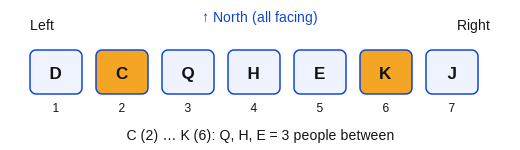
Seven people, J, K, C, D, E, Q and H, are sitting in a row, facing north.
Only four people sit to the right of Q. Only two people sit to the right of E. K is the immediate neighbour of J and E. H sits third to the right of D.
How many people sit between C and K?
सात व्यक्ति J, K, C, D, E, Q और H एक पंक्ति में उत्तर की ओर मुख करके बैठे हैं।
Q के दाईं ओर केवल चार व्यक्ति बैठे हैं। E के दाईं ओर केवल दो व्यक्ति बैठे हैं। K, J और E का निकटतम पड़ोसी है। H, D के दाईं ओर तीसरे स्थान पर बैठा है।
C और K के बीच कितने व्यक्ति बैठे हैं?
  1. AFiveपाँच
  2. BThreeतीन
  3. CTwoदो
  4. DFourचार
Show answer

Concept: Number the seats 1–7 from the left (all face north, so right = higher number).

  1. Only four people to the right of Q → Q at seat 3. Only two to the right of E → E at seat 5.
  2. K is a neighbour of both J and E. If K = 4, its neighbours are Q and E – no room for J. So K = 6, J = 7.
  3. H is third to the right of D: remaining seats 1, 2, 4 → D = 1, H = 4, and C = 2.
  4. Order: D C Q H E K J. Between C (2) and K (6) sit Q, H, E = three.

Trick: "Only n people to the right" fixes a seat instantly: seat = 7 − n.

Answer: (B) Three

अवधारणा: बाएँ से सीटें 1–7 मानें (सब उत्तर की ओर, इसलिए दाएँ = बड़ी संख्या)।

  1. Q के दाएँ केवल चार लोग → Q सीट 3 पर। E के दाएँ केवल दो → E सीट 5 पर।
  2. K, J और E दोनों का पड़ोसी है। K = 4 हो तो पड़ोसी Q और E हैं – J के लिए जगह नहीं। अतः K = 6, J = 7।
  3. H, D के दाएँ तीसरा: बची सीटें 1, 2, 4 → D = 1, H = 4, और C = 2।
  4. क्रम: D C Q H E K J। C (2) और K (6) के बीच Q, H, E = तीन।

ट्रिक: "दाएँ केवल n लोग" तुरंत सीट तय करता है: सीट = 7 − n।

उत्तर: (B) Three

RRB NTPC Undergraduate CBT 1General Intelligence and ReasoningLinear seating arrangementRRB NTPC Undergraduate CBT 1 2025 · 8 May Shift 3 →
Q13860.
Select the pair which follows the same pattern as that followed by the two sets of pairs given below. Both pairs follow the same pattern.
GFK : JAE
LGP : OBJ
उस युग्म का चयन कीजिए जो नीचे दिए गए दो युग्मों के समान पैटर्न का अनुसरण करता है। दोनों युग्म एक ही पैटर्न का अनुसरण करते हैं।
GFK : JAE
LGP : OBJ
  1. AFNP : IIK
  2. BGIM : JDH
  3. CJKH : MGB
  4. DCLW : FGQ
Show answer

Concept: Find the position shift of each letter separately.

  1. GFK : JAE → G(7)+3 = J(10), F(6)−5 = A(1), K(11)−6 = E(5). Pattern: +3, −5, −6.
  2. LGP : OBJ → L+3 = O, G−5 = B, P−6 = J. Same pattern confirmed.
  3. CLW → C+3 = F, L(12)−5 = G(7), W(23)−6 = Q(17) → FGQ.
  4. Check (B): G+3 = J, I−5 = D, M−6 = G ≠ H – fails.

Trick: Write the shift triplet (+3,−5,−6) once, then test each option quickly on the middle letter.

Answer: (D) CLW : FGQ

अवधारणा: हर अक्षर का स्थान-परिवर्तन अलग-अलग निकालें।

  1. GFK : JAE → G(7)+3 = J(10), F(6)−5 = A(1), K(11)−6 = E(5)। पैटर्न: +3, −5, −6।
  2. LGP : OBJ → L+3 = O, G−5 = B, P−6 = J। वही पैटर्न।
  3. CLW → C+3 = F, L(12)−5 = G(7), W(23)−6 = Q(17) → FGQ।
  4. जाँच (B): G+3 = J, I−5 = D, M−6 = G ≠ H – गलत।

ट्रिक: शिफ्ट (+3,−5,−6) एक बार लिखें, फिर हर विकल्प को बीच वाले अक्षर पर जल्दी जाँचें।

उत्तर: (D) CLW : FGQ

RRB NTPC Undergraduate CBT 1General Intelligence and ReasoningLetter analogyRRB NTPC Undergraduate CBT 1 2025 · 8 May Shift 3 →