Question bank

Q&A: practice questions with answers

Search questions on any topic. Filter by exam category, exam, subject and topic, try the question, then open the answer and explanation.

Courses – airGurukul

20,719 questions found.

Q13861.
FR 6 is related to JL 17 in a certain way. In the same way, EU 12 is related to IO 23. To which of the following is SL 3 related, following the same logic?
FR 6, JL 17 से एक निश्चित प्रकार से संबंधित है। उसी प्रकार, EU 12, IO 23 से संबंधित है। उसी तर्क का अनुसरण करते हुए, SL 3 निम्नलिखित में से किससे संबंधित है?
  1. AYT 9
  2. BWF 14
  3. CAK 11
  4. DOK 17
Show answer

Concept: Compare letters by position and numbers by difference.

  1. FR 6 → JL 17: F(6)+4 = J(10), R(18)−6 = L(12), 6+11=17.
  2. EU 12 → IO 23: E+4 = I, U(21)−6 = O(15), 12+11=23. Rule: (+4, −6, +11).
  3. SL 3 → S(19)+4 = W(23), L(12)−6 = F(6), 3+11=14 → WF 14.

Trick: The number rule (+11) alone eliminates (A), (C), (D).

Answer: (B) WF 14

अवधारणा: अक्षरों की स्थिति और संख्याओं के अंतर की तुलना करें।

  1. FR 6 → JL 17: F(6)+4 = J(10), R(18)−6 = L(12), 6+11=17।
  2. EU 12 → IO 23: E+4 = I, U(21)−6 = O(15), 12+11=23। नियम: (+4, −6, +11)।
  3. SL 3 → S(19)+4 = W(23), L(12)−6 = F(6), 3+11=14 → WF 14।

ट्रिक: केवल संख्या नियम (+11) से ही (A), (C), (D) कट जाते हैं।

उत्तर: (B) WF 14
RRB NTPC Undergraduate CBT 1General Intelligence and ReasoningLetter-number analogyRRB NTPC Undergraduate CBT 1 2025 · 8 May Shift 3 →
Q13862.
Refer to the given series and answer the question that follows. All numbers are single- digit numbers only. Counting to be done from left to right only.
(Left) 2 8 7 5 6 9 7 6 8 4 8 2 1 8 2 8 6 8 1 3 1 1 3 (Right)
How many such odd digits are there, each of which is immediately preceded by an odd digit and also immediately followed by an even digit?
दी गई शृंखला को देखिए और उसके बाद दिए गए प्रश्न का उत्तर दीजिए। सभी संख्याएँ केवल एक-अंकीय संख्याएँ हैं। गिनती केवल बाएँ से दाएँ की जानी है।
(बाएँ) 2 8 7 5 6 9 7 6 8 4 8 2 1 8 2 8 6 8 1 3 1 1 3 (दाएँ)
ऐसे कितने विषम अंक हैं, जिनमें से प्रत्येक के ठीक पहले एक विषम अंक और ठीक बाद एक सम अंक है?
  1. AOneएक
  2. BFourचार
  3. CThreeतीन
  4. DTwoदो
Show answer

Concept: We need the pattern odd – odd – even, and count the middle digit.

  1. Series: 2 8 7 5 6 9 7 6 8 4 8 2 1 8 2 8 6 8 1 3 1 1 3.
  2. Scan each odd digit: 7 (before it 8, even – no); 5 (7 before, 6 after – yes); 7 (9 before, 6 after – yes); 1 (2 before – no); 3, 1, 1 at the end are followed by odd digits – no; the last 3 has nothing after it.
  3. Count = 2.

Trick: Underline all odd digits first; then only check those whose left neighbour is also underlined.

Answer: (D) Two

अवधारणा: हमें विषम – विषम – सम का पैटर्न चाहिए और बीच वाला अंक गिनना है।

  1. श्रृंखला: 2 8 7 5 6 9 7 6 8 4 8 2 1 8 2 8 6 8 1 3 1 1 3।
  2. हर विषम अंक जाँचें: 7 (पहले 8, सम – नहीं); 5 (पहले 7, बाद 6 – हाँ); 7 (पहले 9, बाद 6 – हाँ); 1 (पहले 2 – नहीं); अंत के 3, 1, 1 के बाद विषम अंक हैं – नहीं; अंतिम 3 के बाद कुछ नहीं।
  3. गिनती = 2।

ट्रिक: पहले सभी विषम अंकों को रेखांकित करें; फिर केवल उन्हें देखें जिनका बायाँ पड़ोसी भी रेखांकित है।

उत्तर: (D) Two

RRB NTPC Undergraduate CBT 1General Intelligence and ReasoningNumber series countingRRB NTPC Undergraduate CBT 1 2025 · 8 May Shift 3 →
Q13863.
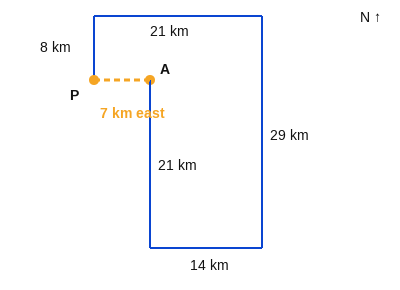
Moksh starts from Point A and drives 21 km towards the south. He then takes a left turn, drives 14 km, turns left and drives 29 km. He then takes a left turn and drives 21 km. He takes a final left turn, drives 8 km and stops at Point P. How far (shortest distance) and towards which direction should he drive in order to reach Point A again? (All turns are 90-degree turns only unless specified.)
मोक्ष बिंदु A से चलना शुरू करता है और दक्षिण की ओर 21 km गाड़ी चलाता है। फिर वह बाएँ मुड़ता है, 14 km गाड़ी चलाता है, बाएँ मुड़ता है और 29 km गाड़ी चलाता है। फिर वह बाएँ मुड़ता है और 21 km गाड़ी चलाता है। वह अंतिम बार बाएँ मुड़ता है, 8 km गाड़ी चलाता है और बिंदु P पर रुक जाता है। बिंदु A पर पुनः पहुँचने के लिए उसे कितनी दूर (न्यूनतम दूरी) और किस दिशा में गाड़ी चलानी चाहिए? (जब तक अन्यथा निर्दिष्ट न हो, सभी मोड़ केवल 90 डिग्री के मोड़ हैं।)
  1. A8 km to the westपश्चिम की ओर 8 km
  2. B7 km to the westपश्चिम की ओर 7 km
  3. C7 km to the eastपूर्व की ओर 7 km
  4. D8 km to the eastपूर्व की ओर 8 km
Show answer

Concept: Plot the path with coordinates; take A as origin, east = +x, north = +y. Every left turn rotates anticlockwise: S → E → N → W → S.

  1. 21 km south → (0,−21); left (east) 14 km → (14,−21).
  2. Left (north) 29 km → (14, 8); left (west) 21 km → (−7, 8).
  3. Left (south) 8 km → P =(−7, 0).
  4. P is 7 km due west of A, so he must drive 7 km east to reach A.

Trick: Net north–south: −21+29−8=0; net east–west: 14−21=−7 → 7 km west of start.

Answer: (C) 7 km to the east

अवधारणा: निर्देशांक से पथ बनाएँ; A मूल बिंदु, पूर्व = +x, उत्तर = +y। हर बायाँ मोड़ वामावर्त घुमाता है: S → E → N → W → S।

  1. 21 km दक्षिण → (0,−21); बाएँ (पूर्व) 14 km → (14,−21)।
  2. बाएँ (उत्तर) 29 km → (14, 8); बाएँ (पश्चिम) 21 km → (−7, 8)।
  3. बाएँ (दक्षिण) 8 km → P =(−7, 0)।
  4. P, A से ठीक 7 km पश्चिम में है, अतः A पहुँचने के लिए 7 km पूर्व चलना होगा।

ट्रिक: कुल उत्तर–दक्षिण: −21+29−8=0; कुल पूर्व–पश्चिम: 14−21=−7 → प्रारंभ से 7 km पश्चिम।

उत्तर: (C) 7 km to the east

RRB NTPC Undergraduate CBT 1General Intelligence and ReasoningDirection & distanceRRB NTPC Undergraduate CBT 1 2025 · 8 May Shift 3 →
Q13864.
If 1 is added to each odd digit and 2 is subtracted from each even digit in the number 5431786, what will be difference between the highest and lowest digits in the number thus formed?
यदि संख्या 5431786 के प्रत्येक विषम अंक में 1 जोड़ा जाए और प्रत्येक सम अंक में से 2 घटाया जाए, तो इस प्रकार बनी संख्या के सबसे बड़े और सबसे छोटे अंकों के बीच का अंतर क्या होगा?
  1. A6
  2. B8
  3. C2
  4. D5
Show answer

Concept: Apply the rule digit by digit: odd → +1, even → −2.

  1. 5431786 → 5+1 = 6, 4−2 = 2, 3+1 = 4, 1+1 = 2, 7+1 = 8, 8−2 = 6, 6−2 = 4.
  2. New number: 6242864.
  3. Highest digit 8, lowest digit 2 → difference 8−2=6.

Trick: Only the maximum and minimum are needed – the largest odd digit (7) becomes 8 and the smallest digits (1, 4) both become 2.

Answer: (A) 6

अवधारणा: नियम हर अंक पर लगाएँ: विषम → +1, सम → −2।

  1. 5431786 → 5+1 = 6, 4−2 = 2, 3+1 = 4, 1+1 = 2, 7+1 = 8, 8−2 = 6, 6−2 = 4।
  2. नई संख्या: 6242864।
  3. सबसे बड़ा अंक 8, सबसे छोटा 2 → अंतर 8−2=6।

ट्रिक: केवल अधिकतम और न्यूनतम चाहिए – सबसे बड़ा विषम अंक (7) 8 बनता है और सबसे छोटे अंक (1, 4) दोनों 2 बनते हैं।

उत्तर: (A) 6

RRB NTPC Undergraduate CBT 1General Intelligence and ReasoningDigit operationsRRB NTPC Undergraduate CBT 1 2025 · 8 May Shift 3 →
Q13865.
Each letter in the word MONKEYS is arranged in the English alphabetical order. How many letters are there in the English alphabetical order between the letter which is second from the left and the one which is fourth from the right in the new letter cluster thus formed?
शब्द MONKEYS के प्रत्येक अक्षर को अंग्रेज़ी वर्णमाला क्रम में व्यवस्थित किया जाता है। इस प्रकार बने नए अक्षर-समूह में बाएँ से दूसरे अक्षर और दाएँ से चौथे अक्षर के बीच अंग्रेज़ी वर्णमाला क्रम में कितने अक्षर हैं?
  1. A2
  2. B4
  3. C1
  4. D5
Show answer

Concept: Arrange the letters alphabetically, locate the two required letters, then count letters between them in the alphabet.

  1. MONKEYS → E K M N O S Y.
  2. Second from left = K; fourth from right = N (Y S O N).
  3. Between K(11) and N(14) in the alphabet: L, M → 14−11−1=2.

Trick: Letters between two letters = difference of positions − 1.

Answer: (A) 2

अवधारणा: अक्षरों को वर्णमाला क्रम में लगाएँ, दोनों अभीष्ट अक्षर पहचानें, फिर वर्णमाला में उनके बीच के अक्षर गिनें।

  1. MONKEYS → E K M N O S Y।
  2. बाएँ से दूसरा = K; दाएँ से चौथा = N (Y S O N)।
  3. वर्णमाला में K(11) और N(14) के बीच: L, M → 14−11−1=2।

ट्रिक: दो अक्षरों के बीच के अक्षर = स्थानों का अंतर − 1।

उत्तर: (A) 2

RRB NTPC Undergraduate CBT 1General Intelligence and ReasoningAlphabetical arrangementRRB NTPC Undergraduate CBT 1 2025 · 8 May Shift 3 →
Q13866.
If 2 is added to each odd digit and 1 is subtracted from each even digit in the number 2563174, then how many digits will appear more than once in the new number thus formed?
यदि संख्या 2563174 के प्रत्येक विषम अंक में 2 जोड़ा जाए और प्रत्येक सम अंक में से 1 घटाया जाए, तो इस प्रकार बनी नई संख्या में कितने अंक एक से अधिक बार आएँगे?
  1. ATwoदो
  2. BZeroशून्य
  3. CThreeतीन
  4. DOneएक
Show answer

Concept: Apply the rule to each digit: odd → +2, even → −1.

  1. 2563174 → 2−1 = 1, 5+2 = 7, 6−1 = 5, 3+2 = 5, 1+2 = 3, 7+2 = 9, 4−1 = 3.
  2. New number: 1755393.
  3. Repeated digits: 5 (twice) and 3 (twice) → two digits appear more than once.

Trick: Write the new digits in a row and tick repeats – 1, 7, 5, 5, 3, 9, 3.

Answer: (A) Two

अवधारणा: हर अंक पर नियम लगाएँ: विषम → +2, सम → −1।

  1. 2563174 → 2−1 = 1, 5+2 = 7, 6−1 = 5, 3+2 = 5, 1+2 = 3, 7+2 = 9, 4−1 = 3।
  2. नई संख्या: 1755393।
  3. दोहराए गए अंक: 5 (दो बार) और 3 (दो बार) → दो अंक एक से अधिक बार आते हैं।

ट्रिक: नए अंक एक पंक्ति में लिखकर दोहराव पर निशान लगाएँ – 1, 7, 5, 5, 3, 9, 3।

उत्तर: (A) Two

RRB NTPC Undergraduate CBT 1General Intelligence and ReasoningDigit operationsRRB NTPC Undergraduate CBT 1 2025 · 8 May Shift 3 →
Q13867.
If ‘+’ means ‘−’, ‘−’ means ‘×’, ‘×’ means ‘÷’, ‘÷’ means ‘+’, then what will come in place of the question mark (?) in the following equation?
17 − 3 ÷ 8 + 21 × 3 = ?
यदि ‘+’ का अर्थ ‘−’, ‘−’ का अर्थ ‘×’, ‘×’ का अर्थ ‘÷’ और ‘÷’ का अर्थ ‘+’ है, तो निम्नलिखित समीकरण में प्रश्नचिह्न (?) के स्थान पर क्या आएगा?
17 − 3 ÷ 8 + 21 × 3 = ?
  1. A49
  2. B52
  3. C50
  4. D51
Show answer

Concept: Replace every symbol by its real meaning, then apply BODMAS.

  1. 17−3÷8+21×3 becomes 17×3+8−21÷3.
  2. Division and multiplication first: 17×3=51, 21÷3=7.
  3. 51+8−7=52.

Trick: Rewrite the whole expression with new symbols before calculating – never substitute "on the fly".

Answer: (B) 52

अवधारणा: हर प्रतीक को उसके वास्तविक अर्थ से बदलें, फिर BODMAS लगाएँ।

  1. 17−3÷8+21×3 बन जाता है 17×3+8−21÷3।
  2. पहले भाग और गुणा: 17×3=51, 21÷3=7।
  3. 51+8−7=52।

ट्रिक: गणना से पहले पूरा व्यंजक नए प्रतीकों में लिख लें – बीच-बीच में बदलने से गलती होती है।

उत्तर: (B) 52

RRB NTPC Undergraduate CBT 1General Intelligence and ReasoningMathematical operations (symbol substitution)RRB NTPC Undergraduate CBT 1 2025 · 8 May Shift 3 →
Q13868.
In a certain code language, "WIAO" is coded as "40" and "TNCR" is coded as "47". What is the code for "FXAJ" in that given language?
एक निश्चित कूट भाषा में, "WIAO" को "40" के रूप में और "TNCR" को "47" के रूप में कूटबद्ध किया जाता है। उसी भाषा में "FXAJ" का कूट क्या होगा?
  1. A30
  2. B33
  3. C39
  4. D41
Show answer

Concept: Add the alphabetical positions of the letters and compare with the code.

  1. WIAO: 23+9+1+15=48; code 40 → 48−8.
  2. TNCR: 20+14+3+18=55; code 47 → 55−8. Rule: sum − 8.
  3. FXAJ: 6+24+1+10=41 → 41−8=33.

Trick: When the code is close to the letter-sum, test "sum ± constant" first.

Answer: (B) 33

अवधारणा: अक्षरों के वर्णमाला स्थानों का योग निकालकर कोड से तुलना करें।

  1. WIAO: 23+9+1+15=48; कोड 40 → 48−8।
  2. TNCR: 20+14+3+18=55; कोड 47 → 55−8। नियम: योग − 8।
  3. FXAJ: 6+24+1+10=41 → 41−8=33।

ट्रिक: जब कोड अक्षर-योग के पास हो, पहले "योग ± स्थिरांक" जाँचें।

उत्तर: (B) 33

RRB NTPC Undergraduate CBT 1General Intelligence and ReasoningCoding-decoding (number code)RRB NTPC Undergraduate CBT 1 2025 · 8 May Shift 3 →
Q13869.
Based on the English alphabetical order, three of the following four letter-cluster pairs are alike in a certain way and thus form a group. Which is the one that does not belong to that group?
(Note: The odd one out is not based on the number of consonants/vowels or their position in the letter-cluster.)
अंग्रेज़ी वर्णमाला क्रम के आधार पर, निम्नलिखित चार अक्षर-समूह युग्मों में से तीन एक निश्चित प्रकार से समान हैं और इस प्रकार एक समूह बनाते हैं। वह कौन-सा है जो उस समूह से संबंधित नहीं है?
(नोट: असंगत युग्म व्यंजनों/स्वरों की संख्या या अक्षर-समूह में उनकी स्थिति पर आधारित नहीं है।)
  1. AUQ - SP
  2. BNJ - LH
  3. CQM - OK
  4. DWS - UQ
Show answer

Concept: Find how the second cluster is obtained from the first in each pair.

  1. NJ – LH: N−2 = L, J−2 = H. QM – OK: Q−2 = O, M−2 = K. WS – UQ: W−2 = U, S−2 = Q. All are (−2,−2).
  2. UQ – SP: U−2 = S, but Q−1 = P → (−2,−1) – different.

Trick: Check the second letters only: J→H, M→K, S→Q are all −2; Q→P is −1.

Answer: (A) UQ - SP

अवधारणा: हर युग्म में पहले समूह से दूसरा कैसे बना, यह देखें।

  1. NJ – LH: N−2 = L, J−2 = H। QM – OK: Q−2 = O, M−2 = K। WS – UQ: W−2 = U, S−2 = Q। सभी (−2,−2)।
  2. UQ – SP: U−2 = S, पर Q−1 = P → (−2,−1) – भिन्न।

ट्रिक: केवल दूसरे अक्षर देखें: J→H, M→K, S→Q सब −2; Q→P −1।

उत्तर: (A) UQ - SP

RRB NTPC Undergraduate CBT 1General Intelligence and ReasoningOdd one out (letter pairs)RRB NTPC Undergraduate CBT 1 2025 · 8 May Shift 3 →
Q13870.
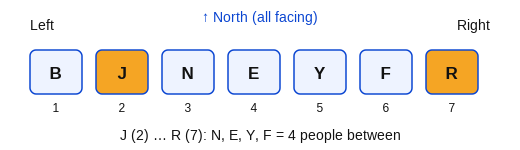
Seven people, R, B, Y, J, E, F and N, are sitting in a row, facing north.
Y sits third from the right end. Only three people sit between B and Y. N is the immediate neighbour of E and J. F sits second to the right of E.
How many people sit between R and J?
सात व्यक्ति R, B, Y, J, E, F और N एक पंक्ति में उत्तर की ओर मुख करके बैठे हैं।
Y दाएँ छोर से तीसरे स्थान पर बैठा है। B और Y के बीच केवल तीन व्यक्ति बैठे हैं। N, E और J का निकटतम पड़ोसी है। F, E के दाईं ओर दूसरे स्थान पर बैठा है।
R और J के बीच कितने व्यक्ति बैठे हैं?
  1. AFiveपाँच
  2. BThreeतीन
  3. CFourचार
  4. DTwoदो
Show answer

Concept: Number seats 1–7 from the left; all face north, so right = higher number.

  1. Y third from the right → seat 5. Only three between B and Y → B at seat 1.
  2. N is a neighbour of both E and J, so E and J are on either side of N. N cannot be 6 (seat 5 is Y), hence N = 3 with E, J at 2 and 4.
  3. F is second to the right of E: E = 2 gives F = 4 (clash with J), so E = 4, F = 6, J = 2. R takes seat 7.
  4. Order: B J N E Y F R. Between J (2) and R (7): N, E, Y, F = four.

Trick: Place the fixed people (end/position clues) first, then the "neighbour of two" person – it has only one possible slot.

Answer: (C) Four

अवधारणा: बाएँ से सीटें 1–7; सब उत्तर की ओर, अतः दाएँ = बड़ी संख्या।

  1. Y दाएँ से तीसरा → सीट 5। B और Y के बीच केवल तीन → B सीट 1 पर।
  2. N, E और J दोनों का पड़ोसी है, अतः E और J, N के दोनों ओर। N = 6 नहीं हो सकता (सीट 5 पर Y), इसलिए N = 3 और E, J सीट 2 व 4 पर।
  3. F, E के दाएँ दूसरा: E = 2 से F = 4 (J से टकराव), अतः E = 4, F = 6, J = 2। R सीट 7 पर।
  4. क्रम: B J N E Y F R। J (2) और R (7) के बीच: N, E, Y, F = चार।

ट्रिक: पहले निश्चित स्थान वाले लोग रखें, फिर "दो का पड़ोसी" वाला – उसकी एक ही जगह बनती है।

उत्तर: (C) Four

RRB NTPC Undergraduate CBT 1General Intelligence and ReasoningLinear seating arrangementRRB NTPC Undergraduate CBT 1 2025 · 8 May Shift 3 →
Q13871.
Anil ranked 27th from the top and 19th from the bottom in his class. How many students are there in his class?
अनिल अपनी कक्षा में ऊपर से 27वें और नीचे से 19वें स्थान पर है। उसकी कक्षा में कुल कितने विद्यार्थी हैं?
  1. A43
  2. B44
  3. C45
  4. D46
Show answer

Concept: When a person's rank is known from both ends, total = rank from top + rank from bottom − 1 (the person is counted twice).

  1. Total =27+19−1=45.
  2. Check: 26 students above Anil, 18 below him, plus Anil → 26+18+1=45.

Trick: Add the two ranks and subtract 1.

Answer: (C) 45

अवधारणा: जब किसी का स्थान दोनों सिरों से पता हो, कुल = ऊपर से स्थान + नीचे से स्थान − 1 (व्यक्ति दो बार गिना जाता है)।

  1. कुल =27+19−1=45।
  2. जाँच: अनिल से ऊपर 26, नीचे 18, और अनिल स्वयं → 26+18+1=45।

ट्रिक: दोनों स्थान जोड़ें और 1 घटाएँ।

उत्तर: (C) 45

RRB NTPC Undergraduate CBT 1General Intelligence and ReasoningRankingRRB NTPC Undergraduate CBT 1 2025 · 8 May Shift 3 →
Q13872.
Based on the English alphabetical order, three of the following four letter-cluster pairs are alike in a certain way and thus form a group. Which is the one that does not belong to that group?
(Note: The odd one out is not based on the number of consonants/vowels or their position in the letter-cluster.)
अंग्रेज़ी वर्णमाला क्रम के आधार पर, निम्नलिखित चार अक्षर-समूह युग्मों में से तीन एक निश्चित प्रकार से समान हैं और इस प्रकार एक समूह बनाते हैं। वह कौन-सा है जो उस समूह से संबंधित नहीं है?
(नोट: असंगत युग्म व्यंजनों/स्वरों की संख्या या अक्षर-समूह में उनकी स्थिति पर आधारित नहीं है।)
  1. AOH-KM
  2. BQJ-MO
  3. CLE-HJ
  4. DJC-FG
Show answer

Concept: Compare the shift of each letter from the first cluster to the second.

  1. OH–KM: O−4 = K, H+5 = M. QJ–MO: Q−4 = M, J+5 = O. LE–HJ: L−4 = H, E+5 = J. Pattern (−4,+5).
  2. JC–FG: J−4 = F, but C+4 = G → (−4,+4) – odd one.

Trick: The first letters all follow −4, so decide using the second letters: H→M, J→O, E→J are +5; C→G is +4.

Answer: (D) JC-FG

अवधारणा: पहले समूह से दूसरे समूह तक हर अक्षर का परिवर्तन देखें।

  1. OH–KM: O−4 = K, H+5 = M। QJ–MO: Q−4 = M, J+5 = O। LE–HJ: L−4 = H, E+5 = J। पैटर्न (−4,+5)।
  2. JC–FG: J−4 = F, पर C+4 = G → (−4,+4) – विषम।

ट्रिक: पहले अक्षर सबमें −4 हैं, इसलिए दूसरे अक्षर से तय करें: H→M, J→O, E→J +5; C→G +4।

उत्तर: (D) JC-FG

RRB NTPC Undergraduate CBT 1General Intelligence and ReasoningOdd one out (letter pairs)RRB NTPC Undergraduate CBT 1 2025 · 8 May Shift 3 →
Q13873.
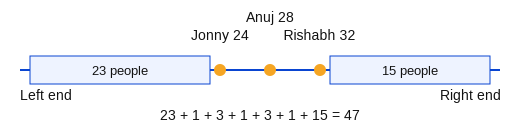
In a row of people all facing the north, Jonny is 24th from the left end. Anuj is 28th from the left end. Anuj is exactly between Jonny and Rishabh. If Rishabh is 16th from the right end of the line, how many people are there in the row?
उत्तर की ओर मुख किए हुए व्यक्तियों की एक पंक्ति में, जॉनी बाएँ छोर से 24वें स्थान पर है। अनुज बाएँ छोर से 28वें स्थान पर है। अनुज, जॉनी और ऋषभ के ठीक बीच में है। यदि ऋषभ पंक्ति के दाएँ छोर से 16वें स्थान पर है, तो पंक्ति में कुल कितने व्यक्ति हैं?
  1. A45
  2. B47
  3. C44
  4. D46
Show answer

Concept: Convert every position to "from the left", then use total = left rank + right rank − 1.

  1. Jonny = 24th, Anuj = 28th from the left. Anuj is exactly midway, so Rishabh is 28+(28−24)=32nd from the left.
  2. Rishabh is 16th from the right → total =32+16−1=47.

Trick: "Exactly between" ⇒ equal gaps: Jonny→Anuj = 4, so Anuj→Rishabh = 4.

Answer: (B) 47

अवधारणा: हर स्थान को "बाएँ से" में बदलें, फिर कुल = बाएँ से स्थान + दाएँ से स्थान − 1।

  1. जॉनी = 24वाँ, अनुज = 28वाँ बाएँ से। अनुज ठीक बीच में है, अतः ऋषभ बाएँ से 28+(28−24)=32वाँ।
  2. ऋषभ दाएँ से 16वाँ → कुल =32+16−1=47।

ट्रिक: "ठीक बीच में" ⇒ बराबर अंतर: जॉनी→अनुज = 4, तो अनुज→ऋषभ = 4।

उत्तर: (B) 47

RRB NTPC Undergraduate CBT 1General Intelligence and ReasoningRanking in a rowRRB NTPC Undergraduate CBT 1 2025 · 8 May Shift 3 →
Q13874.
In a certain code language,
A ≤ B means ‘A is the son of B’
A ¥ B means ‘A is the father of B’
A @ B means ‘A is the brother of B’
A - B means ‘A is the wife of B’
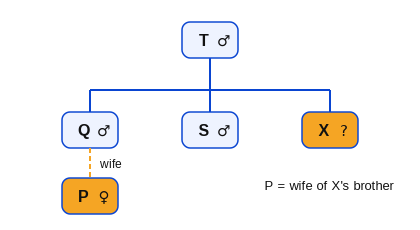
Based on the above, how is P related to X if 'P - Q @ S ≤ T ¥ X'?
एक निश्चित कूट भाषा में,
A ≤ B का अर्थ है ‘A, B का पुत्र है’
A ¥ B का अर्थ है ‘A, B का पिता है’
A @ B का अर्थ है ‘A, B का भाई है’
A - B का अर्थ है ‘A, B की पत्नी है’
उपरोक्त के आधार पर, यदि 'P - Q @ S ≤ T ¥ X' है, तो P, X से किस प्रकार संबंधित है?
  1. ASon's wifeपुत्र की पत्नी
  2. BFather's motherपिता की माता
  3. CFather's sisterपिता की बहन
  4. DBrother's wifeभाई की पत्नी
Show answer

Concept: Decode from the right end and build the family tree.

  1. T ¥ X → T is the father of X. S ≤ T → S is the son of T, so S and X are siblings.
  2. Q @ S → Q is the brother of S, hence Q is also X's brother.
  3. P − Q → P is the wife of Q.
  4. So P is the wife of X's brother → brother's wife (sister-in-law).

Trick: Siblings of a sibling are your siblings – Q, S and X are all children of T.

Answer: (D) Brother's wife

अवधारणा: दाएँ सिरे से decode करके वंश-वृक्ष बनाएँ।

  1. T ¥ X → T, X का पिता। S ≤ T → S, T का पुत्र, अतः S और X भाई-बहन।
  2. Q @ S → Q, S का भाई, इसलिए Q, X का भी भाई।
  3. P − Q → P, Q की पत्नी।
  4. अतः P, X के भाई की पत्नी → भाई की पत्नी (भाभी)।

ट्रिक: भाई-बहन के भाई-बहन आपके भी भाई-बहन – Q, S और X सब T की संतान हैं।

उत्तर: (D) Brother's wife

RRB NTPC Undergraduate CBT 1General Intelligence and ReasoningBlood relations (coded)RRB NTPC Undergraduate CBT 1 2025 · 8 May Shift 3 →
Q13875.
What should come in place of ‘?’ in the given series?
23 32 42 53 65 78 ?
दी गई शृंखला में ‘?’ के स्थान पर क्या आना चाहिए?
23 32 42 53 65 78 ?
  1. A90
  2. B85
  3. C87
  4. D92
Show answer

Concept: Look at the successive differences.

  1. 23→32→42→53→65→78: differences 9,10,11,12,13.
  2. Next difference is 14 → 78+14=92.

Trick: Differences increasing by 1 – the classic "second-level AP" series.

Answer: (D) 92

अवधारणा: क्रमागत अंतर देखें।

  1. 23→32→42→53→65→78: अंतर 9,10,11,12,13।
  2. अगला अंतर 14 → 78+14=92।

ट्रिक: अंतर 1-1 बढ़ रहे हैं – क्लासिक "दूसरे स्तर की AP" श्रृंखला।

उत्तर: (D) 92

RRB NTPC Undergraduate CBT 1General Intelligence and ReasoningNumber seriesRRB NTPC Undergraduate CBT 1 2025 · 8 May Shift 3 →
Q13876.
Which of the following letter-number clusters will replace the question mark (?) in the given series to make it logically complete?
ICX 9, LFZ 16, OIB 25, RLD 36, ?
निम्नलिखित में से कौन-सा अक्षर-संख्या समूह दी गई शृंखला में प्रश्नचिह्न (?) के स्थान पर आकर उसे तार्किक रूप से पूर्ण करेगा?
ICX 9, LFZ 16, OIB 25, RLD 36, ?
  1. AVOJ 48
  2. BUPI 48
  3. CVPJ 49
  4. DUOF 49
Show answer

Concept: Separate the three letter positions and the number.

  1. 1st letters: I→L→O→R (+3) → U. 2nd letters: C→F→I→L (+3) → O. 3rd letters: X→Z→B→D (+2) → F.
  2. Numbers: 9,16,25,36=32,42,52,62 → next 72=49.
  3. Required term: UOF 49.

Trick: The numbers are perfect squares → 49, which leaves (C) and (D); the third letter D+2 = F settles it.

Answer: (D) UOF 49

अवधारणा: तीनों अक्षर-स्थानों और संख्या को अलग-अलग देखें।

  1. पहले अक्षर: I→L→O→R (+3) → U। दूसरे: C→F→I→L (+3) → O। तीसरे: X→Z→B→D (+2) → F।
  2. संख्याएँ: 9,16,25,36=32,42,52,62 → अगली 72=49।
  3. अभीष्ट पद: UOF 49।

ट्रिक: संख्याएँ पूर्ण वर्ग हैं → 49, जिससे (C) और (D) बचते हैं; तीसरा अक्षर D+2 = F निर्णय कर देता है।

उत्तर: (D) UOF 49

RRB NTPC Undergraduate CBT 1General Intelligence and ReasoningLetter-number seriesRRB NTPC Undergraduate CBT 1 2025 · 8 May Shift 3 →
Q13877.
In a certain code language,
A x B means ‘A is the father of B’,
A ≠ B means ‘A is the son of B’,
A ÷ B means ‘A is the daughter of B’ and
A ₹ B means ‘A is the sister of B’.
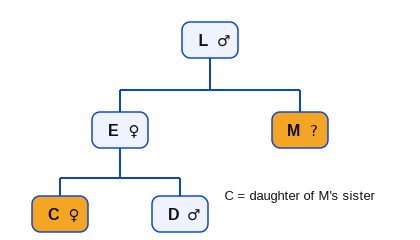
Based on the above, how is C related to M if 'C ₹ D ≠ E ÷ L x M'?
एक निश्चित कूट भाषा में,
A x B का अर्थ है ‘A, B का पिता है’,
A ≠ B का अर्थ है ‘A, B का पुत्र है’,
A ÷ B का अर्थ है ‘A, B की पुत्री है’ और
A ₹ B का अर्थ है ‘A, B की बहन है’।
उपरोक्त के आधार पर, यदि 'C ₹ D ≠ E ÷ L x M' है, तो C, M से किस प्रकार संबंधित है?
  1. ADaughterपुत्री
  2. BSister's daughterबहन की पुत्री
  3. CMother's motherमाता की माता
  4. DSisterबहन
Show answer

Concept: Decode each symbol and draw the generations.

  1. L x M → L is the father of M. E ÷ L → E is the daughter of L, so E is M's sister.
  2. D ≠ E → D is the son of E. C ₹ D → C is the sister of D, so C is also E's daughter.
  3. Hence C is the daughter of M's sister → sister's daughter (niece).

Trick: Find the common ancestor (L): M and E are in one generation, C and D one generation below.

Answer: (B) Sister's daughter

अवधारणा: हर प्रतीक decode करके पीढ़ियाँ बनाएँ।

  1. L x M → L, M का पिता। E ÷ L → E, L की पुत्री, अतः E, M की बहन।
  2. D ≠ E → D, E का पुत्र। C ₹ D → C, D की बहन, अतः C भी E की पुत्री।
  3. इसलिए C, M की बहन की पुत्री → बहन की बेटी (भांजी)।

ट्रिक: साझा पूर्वज (L) खोजें: M और E एक पीढ़ी में, C और D एक पीढ़ी नीचे।

उत्तर: (B) Sister's daughter

RRB NTPC Undergraduate CBT 1General Intelligence and ReasoningBlood relations (coded)RRB NTPC Undergraduate CBT 1 2025 · 8 May Shift 3 →
Q13878.
Select the set in which the numbers are related in the same way as are the numbers of the following sets.
(NOTE: Operations should be performed on the whole numbers, without breaking down the numbers into their constituent digits. E.g. 13 – Operations on 13 such as
adding/subtracting/multiplying to 13 can be performed. Breaking down 13 into 1 and 3 and then performing mathematical operations on 1 and 3 is not allowed.)
(5, 120, 12)
(3, 84, 14)
उस समुच्चय का चयन कीजिए जिसमें संख्याएँ उसी प्रकार संबंधित हैं जिस प्रकार निम्नलिखित समुच्चयों की संख्याएँ संबंधित हैं।
(नोट: संक्रियाएँ पूर्ण संख्याओं पर की जानी चाहिए, संख्याओं को उनके घटक अंकों में तोड़े बिना। उदाहरण के लिए 13 – 13 पर संक्रियाएँ जैसे
13 में जोड़ना/घटाना/गुणा करना किया जा सकता है। 13 को 1 और 3 में तोड़कर फिर 1 और 3 पर गणितीय संक्रियाएँ करने की अनुमति नहीं है।)
(5, 120, 12)
(3, 84, 14)
  1. A(7, 155, 11)
  2. B(2, 78, 13)
  3. C(4, 150, 19)
  4. D(6, 216, 18)
Show answer

Concept: Find one operation linking the outer numbers to the middle number.

  1. (5, 120, 12): 5×12×2=120. (3, 84, 14): 3×14×2=84. Rule: middle =2× (first × third).
  2. (6, 216, 18): 6×18×2=216 ✓.
  3. Others: 7×11×2=154≠155; 2×13×2=52≠78; 4×19×2=152≠150.

Trick: Divide the middle by the product of the ends – if the quotient is the same (here 2) for both given sets, that is the rule.

Answer: (D) (6, 216, 18)

अवधारणा: बाहरी संख्याओं को बीच की संख्या से जोड़ने वाली एक संक्रिया खोजें।

  1. (5, 120, 12): 5×12×2=120। (3, 84, 14): 3×14×2=84। नियम: बीच =2× (पहली × तीसरी)।
  2. (6, 216, 18): 6×18×2=216 ✓।
  3. अन्य: 7×11×2=154≠155; 2×13×2=52≠78; 4×19×2=152≠150।

ट्रिक: बीच की संख्या को सिरों के गुणनफल से भाग दें – दोनों दिए सेटों में भागफल समान (यहाँ 2) हो तो वही नियम है।

उत्तर: (D) (6, 216, 18)

RRB NTPC Undergraduate CBT 1General Intelligence and ReasoningNumber analogy (triplets)RRB NTPC Undergraduate CBT 1 2025 · 8 May Shift 3 →
Q13879.
Each letter in the word JUMBLED is arranged in the English alphabetical order. How many letters are there in the English alphabetical order between the letter which is fourth from the left and the one which is first from the right in the new letter cluster thus formed?
शब्द JUMBLED के प्रत्येक अक्षर को अंग्रेज़ी वर्णमाला क्रम में व्यवस्थित किया जाता है। इस प्रकार बने नए अक्षर-समूह में बाएँ से चौथे अक्षर और दाएँ से पहले अक्षर के बीच अंग्रेज़ी वर्णमाला क्रम में कितने अक्षर हैं?
  1. A9
  2. B11
  3. C13
  4. D10
Show answer

Concept: Sort the letters, pick the two required letters, count the alphabet letters between them.

  1. JUMBLED → B D E J L M U.
  2. Fourth from left = J; first from right = U.
  3. Between J(10) and U(21): 21−10−1=10 letters (K to T).

Trick: Letters between = position difference − 1.

Answer: (D) 10

अवधारणा: अक्षर क्रम में लगाएँ, दोनों अभीष्ट अक्षर चुनें, वर्णमाला में उनके बीच के अक्षर गिनें।

  1. JUMBLED → B D E J L M U।
  2. बाएँ से चौथा = J; दाएँ से पहला = U।
  3. J(10) और U(21) के बीच: 21−10−1=10 अक्षर (K से T)।

ट्रिक: बीच के अक्षर = स्थानों का अंतर − 1।

उत्तर: (D) 10

RRB NTPC Undergraduate CBT 1General Intelligence and ReasoningAlphabetical arrangementRRB NTPC Undergraduate CBT 1 2025 · 8 May Shift 3 →
Q13880.
What should come in place of ‘?’ in the given series?
65 ? 24 15 11 10
दी गई शृंखला में ‘?’ के स्थान पर क्या आना चाहिए?
65 ? 24 15 11 10
  1. A38
  2. B40
  3. C42
  4. D44
Show answer

Concept: The series decreases; read it from the right to spot the pattern.

  1. 10→11 (+1), 11→15 (+4), 15→24 (+9) – the differences are 12,22,32.
  2. Next: 24+42=40, and check 40+52=65 ✓.

Trick: Differences 1,4,9,16,25 = perfect squares.

Answer: (B) 40

अवधारणा: श्रृंखला घट रही है; पैटर्न देखने के लिए दाएँ से पढ़ें।

  1. 10→11 (+1), 11→15 (+4), 15→24 (+9) – अंतर 12,22,32।
  2. अगला: 24+42=40, और जाँच 40+52=65 ✓।

ट्रिक: अंतर 1,4,9,16,25 = पूर्ण वर्ग।

उत्तर: (B) 40

RRB NTPC Undergraduate CBT 1General Intelligence and ReasoningNumber seriesRRB NTPC Undergraduate CBT 1 2025 · 8 May Shift 3 →