Question bank

Q&A: practice questions with answers

Search questions on any topic. Filter by exam category, exam, subject and topic, try the question, then open the answer and explanation.

Courses – airGurukul

20,719 questions found.

Q13941.
If the third proportional to 4 and 6 is used as the base of a rectangle, and the first number (4) is its height, what is the area of the rectangle?
यदि 4 और 6 के तृतीयानुपाती (third proportional) को एक आयत के आधार के रूप में प्रयोग किया जाए, और पहली संख्या (4) उसकी ऊँचाई हो, तो आयत का क्षेत्रफल क्या है?
  1. A30 unit2
  2. B48 unit2
  3. C24 unit2
  4. D36 unit2
Show answer

Concept: Third proportional to a and b is b2a.

  1. Third proportional to 4, 6 =364=9 (base).
  2. Height =4 ⇒ area =9×4=36unit2.

Yaad rakhein: a:b::b:c⇒c=b2a; mean proportional is ab.

Answer: (D) 36unit2

अवधारणा: a और b का तृतीयानुपाती (third proportional) =b2a.

  1. 4, 6 का तृतीयानुपाती =364=9 (आधार)।
  2. ऊँचाई =4 ⇒ क्षेत्रफल =9×4=36unit2.

याद रखें: a:b::b:c⇒c=b2a; मध्यानुपाती =ab.

उत्तर: (D) 36unit2

RRB NTPC Undergraduate CBT 1MathematicsThird proportionalRRB NTPC Undergraduate CBT 1 2025 · 8 May Shift 2 →
Q13942.
Three numbers are in the ratio 17 : 13 : 8, and their LCM is 7072. Their HCF is:
तीन संख्याएँ 17 : 13 : 8 के अनुपात में हैं, और उनका LCM 7072 है। उनका HCF है:
  1. A12
  2. B3
  3. C4
  4. D23
Show answer

Concept: Numbers 17k,13k,8k (co-prime ratio terms) have HCF =k and LCM =17×13×8×k.

  1. 1768k=7072⇒k=4.
  2. HCF =k=4.

Trick: When ratio terms are pairwise co-prime, HCF =LCMproduct of ratio terms.

Answer: (C) 4

अवधारणा: संख्याएँ 17k,13k,8k (अनुपात के पद सह-अभाज्य) ⇒ HCF =k, LCM =17×13×8×k.

  1. 1768k=7072⇒k=4.
  2. HCF =k=4.

ट्रिक: अनुपात के पद सह-अभाज्य हों तो HCF =LCMअनुपात पदों का गुणनफल.

उत्तर: (C) 4

RRB NTPC Undergraduate CBT 1MathematicsLCM and HCF with ratioRRB NTPC Undergraduate CBT 1 2025 · 8 May Shift 2 →
Q13943.
In a science experiment, chemicals X, Y, and Z are mixed in the ratio 5:2:3. If the total weight of the mixture is 100 grams, how much of chemical Y is present?
एक विज्ञान प्रयोग में, रसायन X, Y और Z को 5:2:3 के अनुपात में मिलाया जाता है। यदि मिश्रण का कुल भार 100 ग्राम है, तो रसायन Y की कितनी मात्रा उपस्थित है?
  1. A20 grams20 ग्राम
  2. B30 grams30 ग्राम
  3. C50 grams50 ग्राम
  4. D10 grams10 ग्राम
Show answer

Concept: Each share =ratio partsum of parts×total.

  1. Sum of parts =5+2+3=10.
  2. Y =210×100=20 grams.

Trick: Total 100 with sum 10 ⇒ each part is 10 g; Y has 2 parts.

Answer: (A) 20 grams

अवधारणा: प्रत्येक हिस्सा =अनुपात का भागभागों का योग×कुल.

  1. भागों का योग =5+2+3=10.
  2. Y =210×100=20 ग्राम।

ट्रिक: कुल 100 और योग 10 ⇒ हर भाग 10 g; Y के 2 भाग।

उत्तर: (A) 20 ग्राम

RRB NTPC Undergraduate CBT 1MathematicsRatioRRB NTPC Undergraduate CBT 1 2025 · 8 May Shift 2 →
Q13944.
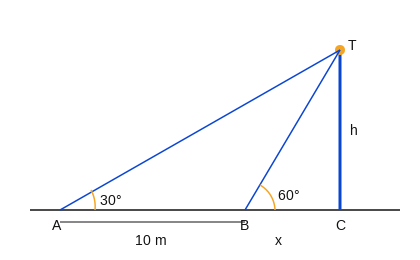
The angle of elevation of the top of a tree from a point on the ground is 30°. After moving 10 m towards the tree, the angle of elevation becomes 60°. Find the height of the tree.
ज़मीन पर स्थित एक बिंदु से एक पेड़ के शीर्ष का उन्नयन कोण 30° है। पेड़ की ओर 10 m चलने के बाद, उन्नयन कोण 60° हो जाता है। पेड़ की ऊँचाई ज्ञात कीजिए।
  1. A63m
  2. B43m
  3. C33m
  4. D53m
Show answer

Concept: Use tan in the two right triangles; with angles 30∘ and 60∘, h=d23 where d is the distance walked.

  1. From B: tan60∘=hx⇒x=h3.
  2. From A: tan30∘=hx+10⇒x+10=h3.
  3. h3−h3=10⇒2h3=10⇒h=53m.

Trick: For 30∘→60∘, height =32× distance moved =32×10.

Answer: (D) 53m

अवधारणा: दोनों समकोण त्रिभुजों में tan लगाएँ; 30∘ व 60∘ के लिए h=d23, जहाँ d चली गई दूरी है।

  1. B से: tan60∘=hx⇒x=h3.
  2. A से: tan30∘=hx+10⇒x+10=h3.
  3. h3−h3=10⇒2h3=10⇒h=53m.

ट्रिक: 30∘→60∘ के लिए ऊँचाई =32× चली दूरी =32×10.

उत्तर: (D) 53m

RRB NTPC Undergraduate CBT 1MathematicsHeights and distancesRRB NTPC Undergraduate CBT 1 2025 · 8 May Shift 2 →
Q13945.
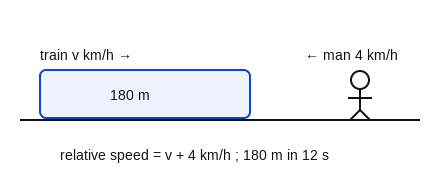
A man is walking at 4 km/hr. A 180 m long train crosses him in 12 seconds while coming from the opposite direction. What is the speed of the train (in km/hr)?
एक व्यक्ति 4 km/hr की चाल से चल रहा है। विपरीत दिशा से आती हुई 180 m लंबी एक रेलगाड़ी उसे 12 सेकंड में पार करती है। रेलगाड़ी की चाल (km/hr में) क्या है?
  1. A61
  2. B50
  3. C32
  4. D45
Show answer

Concept: Opposite directions ⇒ relative speed =v+4; the train covers its own length in the crossing time.

  1. Relative speed =18012=15m/s=15×185=54km/h.
  2. v+4=54⇒v=50km/h.

Trick: m/s → km/h: multiply by 185. Opposite ⇒ add, same direction ⇒ subtract.

Answer: (B) 50

अवधारणा: विपरीत दिशा ⇒ सापेक्ष चाल =v+4; पार करने के समय में ट्रेन अपनी लंबाई तय करती है।

  1. सापेक्ष चाल =18012=15m/s=15×185=54km/h.
  2. v+4=54⇒v=50km/h.

ट्रिक: m/s → km/h: 185 से गुणा। विपरीत ⇒ जोड़ें, समान दिशा ⇒ घटाएँ।

उत्तर: (B) 50

RRB NTPC Undergraduate CBT 1MathematicsTrains (relative speed)RRB NTPC Undergraduate CBT 1 2025 · 8 May Shift 2 →
Q13946.
A keg is fitted with three taps A, B and C. If opened together, all the three taps will drain the full keg in 112 minutes. Taps A and B together take 3 minutes to drain the keg while taps B and C together take 412 minutes to drain it. How long (in minutes) taps A and C together take to drain the keg?
एक पीपे (keg) में तीन नल A, B और C लगे हैं। यदि एक साथ खोले जाएँ, तो तीनों नल भरे हुए पीपे को 112 मिनट में खाली कर देंगे। नल A और B एक साथ पीपे को खाली करने में 3 मिनट लेते हैं जबकि नल B और C एक साथ इसे खाली करने में 412 मिनट लेते हैं। नल A और C एक साथ पीपे को खाली करने में कितना समय (मिनट में) लेंगे?
  1. A49
  2. B57
  3. C97
  4. D47
Show answer

Concept: (A+C)=2(A+B+C)−(A+B)−(B+C) in terms of per-minute rates.

  1. A+B+C=11.5=23, A+B=13, B+C=14.5=29.
  2. A+C=43−13−29=1−29=79 keg/min.
  3. Time =97 minutes.

Trick: Take LCM 9 units: all three drain 6/min, A+B 3/min, B+C 2/min ⇒ A+C =12−3−2=7/min ⇒ 97 min.

Answer: (C) 97

अवधारणा: प्रति मिनट दरों में (A+C)=2(A+B+C)−(A+B)−(B+C).

  1. A+B+C=11.5=23, A+B=13, B+C=14.5=29.
  2. A+C=43−13−29=1−29=79 केग/मिनट।
  3. समय =97 मिनट।

ट्रिक: LCM 9 इकाई लें: तीनों 6/मिनट, A+B 3/मिनट, B+C 2/मिनट ⇒ A+C =12−3−2=7/मिनट ⇒ 97 मिनट।

उत्तर: (C) 97

RRB NTPC Undergraduate CBT 1MathematicsPipes and cisterns (pair rates)RRB NTPC Undergraduate CBT 1 2025 · 8 May Shift 2 →
Q13947.
What is the arithmetic mean of the dataset {12, 25, 37, 48, 56, 61, 73, 85, 92, 104}?
डेटासेट {12, 25, 37, 48, 56, 61, 73, 85, 92, 104} का समांतर माध्य क्या है?
  1. A59.3
  2. B56.3
  3. C57.3
  4. D58.3
Show answer

Concept: Mean =sum of observationsn.

  1. Sum =12+25+37+48+56+61+73+85+92+104=593.
  2. Mean =59310=59.3.

Trick: Pair for quick adding: (12+85)+(25+73)+(37+61)+(48+56)+92+104=97+98+98+104+196=593.

Answer: (A) 59.3

अवधारणा: माध्य =प्रेक्षणों का योगn.

  1. योग =12+25+37+48+56+61+73+85+92+104=593.
  2. माध्य =59310=59.3.

ट्रिक: जोड़ी बनाकर जोड़ें: (12+85)+(25+73)+(37+61)+(48+56)+92+104=593.

उत्तर: (A) 59.3

RRB NTPC Undergraduate CBT 1MathematicsArithmetic meanRRB NTPC Undergraduate CBT 1 2025 · 8 May Shift 2 →
Q13948.
A shopkeeper offers the following schemes on toys of the same marked price. (A) Successive discounts of 35% and 4% on any number of toys bought.
(B) Successive discounts of 45%, 46% and 50% on any number of toys bought. (C) 15% discount on the first 3 toys and 5% discount on each toy thereon.
(D) 2 toys free of cost on buying 9 toys.
A customer wants to buy 9 toys. Which of the above schemes is the least beneficial to her?
एक दुकानदार समान अंकित मूल्य वाले खिलौनों पर निम्नलिखित योजनाएँ प्रस्तुत करता है। (A) खरीदे गए किसी भी संख्या के खिलौनों पर 35% और 4% की क्रमिक छूट।
(B) खरीदे गए किसी भी संख्या के खिलौनों पर 45%, 46% और 50% की क्रमिक छूट। (C) पहले 3 खिलौनों पर 15% छूट और उसके बाद प्रत्येक खिलौने पर 5% छूट।
(D) 9 खिलौने खरीदने पर 2 खिलौने निःशुल्क।
एक ग्राहक 9 खिलौने खरीदना चाहती है। उपरोक्त योजनाओं में से कौन-सी उसके लिए सबसे कम लाभदायक है?
  1. AC
  2. BD
  3. CA
  4. DB
Show answer

Concept: Take MP = ₹100 per toy (₹900 for 9) and compute the amount paid under each scheme; the least beneficial is the one costing the most.

  1. (A) 900×0.65×0.96=561.6.
  2. (B) 900×0.55×0.54×0.50=133.65.
  3. (C) 3×85+6×95=255+570=825.
  4. (D) pay for 7 only =700.
  5. Highest payment is scheme C ⇒ least beneficial.

Trick: "2 free on 9" =29≈22% off; scheme C is barely 8.3% off overall.

Answer: (A) C

अवधारणा: प्रति खिलौना MP = ₹100 (9 के ₹900) मानकर हर योजना में भुगतान निकालें; सबसे कम लाभकारी वह है जिसमें भुगतान सबसे अधिक हो।

  1. (A) 900×0.65×0.96=561.6.
  2. (B) 900×0.55×0.54×0.50=133.65.
  3. (C) 3×85+6×95=255+570=825.
  4. (D) केवल 7 का भुगतान =700.
  5. सबसे अधिक भुगतान योजना C में ⇒ सबसे कम लाभकारी।

ट्रिक: "9 पर 2 मुफ़्त" =29≈22% छूट; योजना C में कुल छूट मात्र 8.3% है।

उत्तर: (A) C

RRB NTPC Undergraduate CBT 1MathematicsComparing discount schemesRRB NTPC Undergraduate CBT 1 2025 · 8 May Shift 2 →
Q13949.
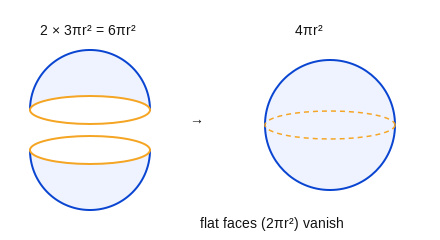
Two solid hemispheres are joined together to make a sphere. The total surface area of solids reduced by approximately ___%.
दो ठोस अर्धगोलों को जोड़कर एक गोला बनाया जाता है। ठोसों का कुल पृष्ठीय क्षेत्रफल लगभग ___% कम हो जाता है।
  1. A33.33
  2. B66.67
  3. C50
  4. D25
Show answer

Concept: TSA of a solid hemisphere =3πr2; surface area of sphere =4πr2.

  1. Two hemispheres: 2×3πr2=6πr2.
  2. Sphere formed: 4πr2; reduction =2πr2 (the two flat faces).
  3. Percentage =2πr26πr2×100=33.33%.

Trick: Joining hides 2 of the 6 units of area ⇒ 13 reduction.

Answer: (A) 33.33

अवधारणा: ठोस अर्धगोले का TSA =3πr2; गोले का पृष्ठीय क्षेत्रफल =4πr2.

  1. दो अर्धगोले: 2×3πr2=6πr2.
  2. बना गोला: 4πr2; कमी =2πr2 (दोनों समतल फलक)।
  3. प्रतिशत =2πr26πr2×100=33.33%.

ट्रिक: जोड़ने पर 6 में से 2 इकाई क्षेत्रफल छिप जाता है ⇒ 13 कमी।

उत्तर: (A) 33.33

RRB NTPC Undergraduate CBT 1MathematicsSurface area (hemisphere, sphere)RRB NTPC Undergraduate CBT 1 2025 · 8 May Shift 2 →
Q13950.
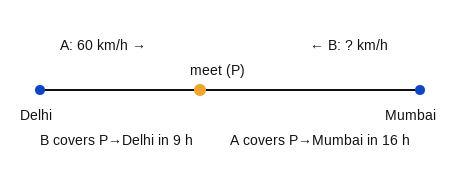
Two trains, A and B, start simultaneously from stations Delhi and Mumbai respectively towards each other on parallel tracks. After meeting, train A takes 16 hours to reach Mumbai, and train B takes 9 hours to reach Delhi. If train A’s speed is 60 km/h, what is the length of train B (in meters), given that it crosses a pole in 18 seconds?
दो रेलगाड़ियाँ, A और B, क्रमशः दिल्ली और मुंबई स्टेशनों से एक साथ समांतर पटरियों पर एक-दूसरे की ओर चलना शुरू करती हैं। मिलने के बाद, रेलगाड़ी A को मुंबई पहुँचने में 16 घंटे और रेलगाड़ी B को दिल्ली पहुँचने में 9 घंटे लगते हैं। यदि रेलगाड़ी A की चाल 60 km/h है, तो रेलगाड़ी B की लंबाई (मीटर में) क्या है, यदि यह एक खंभे को 18 सेकंड में पार करती है?
  1. A420
  2. B400
  3. C300
  4. D280
Show answer

Concept: If after meeting the trains take t1 and t2 hours to finish, SASB=t2t1.

  1. SASB=916=34⇒SB=43×60=80km/h.
  2. 80km/h=80×518=2009m/s.
  3. Length =2009×18=400m.

Yaad rakhein: Speed ratio is the inverse square root of the post-meeting times: 16:9→3:4.

Answer: (B) 400

अवधारणा: मिलने के बाद यदि ट्रेनें t1 और t2 घंटे लें, तो SASB=t2t1.

  1. SASB=916=34⇒SB=43×60=80km/h.
  2. 80km/h=80×518=2009m/s.
  3. लंबाई =2009×18=400m.

याद रखें: चाल का अनुपात = मिलने के बाद के समयों का व्युत्क्रम वर्गमूल: 16:9→3:4.

उत्तर: (B) 400

RRB NTPC Undergraduate CBT 1MathematicsTrains meeting (speed ratio)RRB NTPC Undergraduate CBT 1 2025 · 8 May Shift 2 →
Q13951.
The expenditures of R are 65% of his salary. If his salary increased by 10% and his savings are ₹3,150 more than previous savings, his expenditures are now 60% of his salary. His present salary is ₹______.
R का व्यय उसके वेतन का 65% है। यदि उसका वेतन 10% बढ़ जाता है और उसकी बचत पिछली बचत से ₹3,150 अधिक है, तो उसका व्यय अब उसके वेतन का 60% है। उसका वर्तमान वेतन ₹______ है।
  1. A39,000
  2. B37,500
  3. C38,500
  4. D35,000
Show answer

Concept: Savings = salary − expenditure; write both savings in terms of the old salary S.

  1. Old savings =35% of S=0.35S.
  2. New salary =1.1S, savings =40% of 1.1S=0.44S.
  3. 0.44S−0.35S=0.09S=3150⇒S=35000.
  4. Present salary =1.1×35000= ₹38,500.

Trick: The question asks the present salary – not the old ₹35,000 (option D is the trap).

Answer: (C) 38,500

अवधारणा: बचत = वेतन − व्यय; दोनों बचतों को पुराने वेतन S में लिखें।

  1. पुरानी बचत =S का 35%=0.35S.
  2. नया वेतन =1.1S, बचत =1.1S का 40%=0.44S.
  3. 0.44S−0.35S=0.09S=3150⇒S=35000.
  4. वर्तमान वेतन =1.1×35000= ₹38,500.

ट्रिक: प्रश्न वर्तमान वेतन पूछता है – पुराना ₹35,000 नहीं (विकल्प D जाल है)।

उत्तर: (C) 38,500

RRB NTPC Undergraduate CBT 1MathematicsPercentage (income and savings)RRB NTPC Undergraduate CBT 1 2025 · 8 May Shift 2 →
Q13952.
The 5-digit number 7a35b is divisible by 45, where a and b are positive integers. What is the value of (a + b)?
5-अंकीय संख्या 7a35b, 45 से विभाज्य है, जहाँ a और b धनात्मक पूर्णांक हैं। (a + b) का मान क्या है?
  1. A7
  2. B5
  3. C12
  4. D14
Show answer

Concept: Divisible by 45 ⇔ divisible by both 5 (last digit 0 or 5) and 9 (digit sum multiple of 9).

  1. b is a positive integer ⇒ b=5 (not 0).
  2. Digit sum =7+a+3+5+5=20+a ⇒ a=7 (sum 27).
  3. a+b=7+5=12.

Trick: "Positive" rules out b=0; then only one a in 0–9 makes the sum a multiple of 9.

Answer: (C) 12

अवधारणा: 45 से विभाज्य ⇔ 5 (अंतिम अंक 0 या 5) और 9 (अंकों का योग 9 का गुणज) दोनों से विभाज्य।

  1. b धनात्मक पूर्णांक ⇒ b=5 (0 नहीं)।
  2. अंकों का योग =7+a+3+5+5=20+a ⇒ a=7 (योग 27)।
  3. a+b=7+5=12.

ट्रिक: "धनात्मक" से b=0 बाहर; फिर 0–9 में केवल एक a योग को 9 का गुणज बनाता है।

उत्तर: (C) 12

RRB NTPC Undergraduate CBT 1MathematicsDivisibility (45 = 5 × 9)RRB NTPC Undergraduate CBT 1 2025 · 8 May Shift 2 →
Q13953.
Lekhraj sells an article at a profit of 25%. If the cost price is increased by 20% and the selling price is reduced by 10%, what percentage loss will Lekhraj incur?
लेखराज एक वस्तु को 25% लाभ पर बेचता है। यदि क्रय मूल्य 20% बढ़ा दिया जाए और विक्रय मूल्य 10% घटा दिया जाए, तो लेखराज को कितने प्रतिशत हानि होगी?
  1. A6.25%
  2. B7.5%
  3. C6.5%
  4. D7.25%
Show answer

Concept: Assume CP = 100; loss% is always on the (new) cost price.

  1. CP =100, SP =125.
  2. New CP =120, new SP =125×0.9=112.5.
  3. Loss =7.5; loss% =7.5120×100=6.25%.

Trick: New SP/CP =1.25×0.91.2=0.9375 ⇒ 6.25% loss.

Answer: (A) 6.25%

अवधारणा: CP = 100 मानें; हानि% हमेशा (नए) क्रय मूल्य पर निकलता है।

  1. CP =100, SP =125.
  2. नया CP =120, नया SP =125×0.9=112.5.
  3. हानि =7.5; हानि% =7.5120×100=6.25%.

ट्रिक: नया SP/CP =1.25×0.91.2=0.9375 ⇒ 6.25% हानि।

उत्तर: (A) 6.25%

RRB NTPC Undergraduate CBT 1MathematicsProfit and lossRRB NTPC Undergraduate CBT 1 2025 · 8 May Shift 2 →
Q13954.
The average of 5 consecutive integers is 10. What is the smallest integer?
5 क्रमागत पूर्णांकों का औसत 10 है। सबसे छोटा पूर्णांक क्या है?
  1. A9
  2. B6
  3. C8
  4. D7
Show answer

Concept: For an odd count of consecutive integers the average is the middle term.

  1. Middle (3rd) integer =10 ⇒ numbers are 8,9,10,11,12.
  2. Smallest =8.

Trick: Smallest =average−n−12=10−2=8.

Answer: (C) 8

अवधारणा: विषम संख्या में क्रमागत पूर्णांकों का औसत बीच वाला पद होता है।

  1. बीच का (तीसरा) पूर्णांक =10 ⇒ संख्याएँ 8,9,10,11,12.
  2. सबसे छोटा =8.

ट्रिक: सबसे छोटा =औसत−n−12=10−2=8.

उत्तर: (C) 8

RRB NTPC Undergraduate CBT 1MathematicsAverage of consecutive integersRRB NTPC Undergraduate CBT 1 2025 · 8 May Shift 2 →
Q13955.
If x is the mean proportional between (a+b) and (a-b), then find the value of x.
यदि x, (a+b) और (a-b) के बीच मध्यानुपाती (mean proportional) है, तो x का मान ज्ञात कीजिए।
  1. Aa−b
  2. Ba2+b2
  3. Ca+b
  4. Da2−b2
Show answer

Concept: Mean proportional between p and q is pq.

  1. x=(a+b)(a−b).
  2. (a+b)(a−b)=a2−b2⇒x=a2−b2.

Yaad rakhein: (a+b)(a−b)=a2−b2 – never a2+b2 (option B is the trap).

Answer: (D) a2−b2

अवधारणा: p और q का मध्यानुपाती (mean proportional) =pq.

  1. x=(a+b)(a−b).
  2. (a+b)(a−b)=a2−b2⇒x=a2−b2.

याद रखें: (a+b)(a−b)=a2−b2 – कभी a2+b2 नहीं (विकल्प B जाल है)।

उत्तर: (D) a2−b2

RRB NTPC Undergraduate CBT 1MathematicsMean proportionalRRB NTPC Undergraduate CBT 1 2025 · 8 May Shift 2 →
Q13956.
Which of the following letter-number clusters will replace the question mark (?) in the given series to make it logically complete?
HDK 10, LIO 15, PNS 20, TSW 25, ?
दी गई शृंखला में प्रश्नचिह्न (?) के स्थान पर निम्नलिखित में से कौन-सा अक्षर-संख्या समूह आएगा जिससे शृंखला तार्किक रूप से पूर्ण हो जाए?
HDK 10, LIO 15, PNS 20, TSW 25, ?
  1. AXYB 30
  2. BYYB 30
  3. CYXA 28
  4. DXXA 30
Show answer

Concept: Check each position of the letter cluster and the number separately.

  1. 1st letters H(8), L(12), P(16), T(20): +4 → X(24).
  2. 2nd letters D(4), I(9), N(14), S(19): +5 → 19+5=24 = X.
  3. 3rd letters K(11), O(15), S(19), W(23): +4 → 23+4=27→1 = A (wrap after Z).
  4. Numbers 10, 15, 20, 25: +5 → 30. Term = XXA 30.

Trick: Write positions A=1…Z=26 and count beyond 26 cyclically (27→1).

Answer: (D) XXA 30

अवधारणा: अक्षर-समूह की हर स्थिति और संख्या को अलग-अलग जाँचें।

  1. पहले अक्षर H(8), L(12), P(16), T(20): +4 → X(24)।
  2. दूसरे अक्षर D(4), I(9), N(14), S(19): +5 → 19+5=24 = X।
  3. तीसरे अक्षर K(11), O(15), S(19), W(23): +4 → 23+4=27→1 = A (Z के बाद फिर A)।
  4. संख्याएँ 10, 15, 20, 25: +5 → 30। पद = XXA 30।

ट्रिक: A=1…Z=26 लिखें और 26 के बाद चक्रीय गिनें (27→1)।

उत्तर: (D) XXA 30

RRB NTPC Undergraduate CBT 1General Intelligence and ReasoningAlphanumeric SeriesRRB NTPC Undergraduate CBT 1 2025 · 8 May Shift 2 →
Q13957.
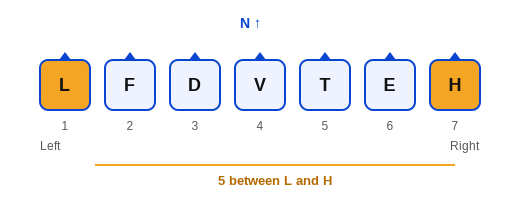
Seven people, L, V, H, D, E, F and T, are sitting in a row, facing north.
Only four people sit to the right of D. V sits fourth from the left end. E is the immediate neighbour of H and T. F sits third to the left of T.
How many people sit between L and H?
सात व्यक्ति, L, V, H, D, E, F और T, एक पंक्ति में उत्तर की ओर मुख करके बैठे हैं।
D के दाईं ओर केवल चार व्यक्ति बैठे हैं। V बाएँ छोर से चौथे स्थान पर बैठा है। E, H और T का निकटतम पड़ोसी है। F, T के बाईं ओर तीसरे स्थान पर बैठा है।
L और H के बीच कितने व्यक्ति बैठे हैं?
  1. AFiveपाँच
  2. BThreeतीन
  3. CTwoदो
  4. DFourचार
Show answer

Concept: Fix the definite positions first (D and V), then place the rest using the remaining clues.

  1. Four people right of D → D is 3rd from left; V is 4th.
  2. F is 3rd to the left of T: T cannot be at 4, 6 or 7 (F would land on V/D), so T = 5, F = 2.
  3. E is neighbour of both H and T → E = 6, H = 7; L takes seat 1.
  4. Row: L F D V T E H. Between L(1) and H(7) there are 5 people.

Trick: 'Only n people to the right' pins a seat exactly: position =7−n from the left.

Answer: (A) Five

अवधारणा: पहले निश्चित स्थान (D और V) तय करें, फिर बाकी सुरागों से शेष लोग बैठाएँ।

  1. D के दाएँ चार लोग → D बाएँ से तीसरा; V चौथा।
  2. F, T के बाएँ तीसरा: T 4, 6 या 7 पर नहीं हो सकता (F, V/D पर आ जाता), अतः T = 5, F = 2।
  3. E, H और T दोनों का पड़ोसी → E = 6, H = 7; L सीट 1 पर।
  4. पंक्ति: L F D V T E H। L(1) और H(7) के बीच 5 लोग।

ट्रिक: 'दाएँ केवल n लोग' सीट पक्की कर देता है: बाएँ से स्थान =7−n।

उत्तर: (A) Five (पाँच)

RRB NTPC Undergraduate CBT 1General Intelligence and ReasoningLinear Seating ArrangementRRB NTPC Undergraduate CBT 1 2025 · 8 May Shift 2 →
Q13958.
Select the option that represents the correct order of the given words as they would appear in an English dictionary.
1. Mistake
2. Mild
3. Mist
4. Migrate
5. Milk
उस विकल्प का चयन कीजिए जो दिए गए शब्दों के उस सही क्रम को दर्शाता है जिस क्रम में वे अंग्रेज़ी शब्दकोश में आएँगे।
1. Mistake
2. Mild
3. Mist
4. Migrate
5. Milk
  1. A4, 2, 5, 3, 1
  2. B5, 3, 1, 2, 4
  3. C4, 2, 1, 5, 3
  4. D2, 3, 5, 4, 1
Show answer

Concept: Compare words letter by letter; a shorter word comes before its extension (Mist before Mistake).

  1. All start with 'Mi'; 3rd letters: g (Migrate), l (Mild, Milk), s (Mist, Mistake) → g < l < s.
  2. Mild vs Milk: 4th letter d < k → Mild, Milk.
  3. Mist vs Mistake: Mist is a prefix → Mist first.
  4. Order: Migrate(4), Mild(2), Milk(5), Mist(3), Mistake(1).

Trick: Prefix rule: the shorter word always comes first (Mist → Mistake).

Answer: (A) 4, 2, 5, 3, 1

अवधारणा: शब्दों की तुलना अक्षर-दर-अक्षर करें; छोटा शब्द अपने विस्तार से पहले आता है (Mist, Mistake से पहले)।

  1. सब 'Mi' से शुरू; तीसरे अक्षर: g (Migrate), l (Mild, Milk), s (Mist, Mistake) → g < l < s।
  2. Mild बनाम Milk: चौथा अक्षर d < k → Mild, Milk।
  3. Mist बनाम Mistake: Mist उपसर्ग है → Mist पहले।
  4. क्रम: Migrate(4), Mild(2), Milk(5), Mist(3), Mistake(1)।

ट्रिक: उपसर्ग नियम: छोटा शब्द हमेशा पहले (Mist → Mistake)।

उत्तर: (A) 4, 2, 5, 3, 1

RRB NTPC Undergraduate CBT 1General Intelligence and ReasoningDictionary OrderRRB NTPC Undergraduate CBT 1 2025 · 8 May Shift 2 →
Q13959.
In a certain code language,
A % B means ‘A is the father of B’,
A € B means ‘A is the wife of B’,
A = B means ‘A is the brother of B’, and
A ? B means ‘A is the daughter of B’.
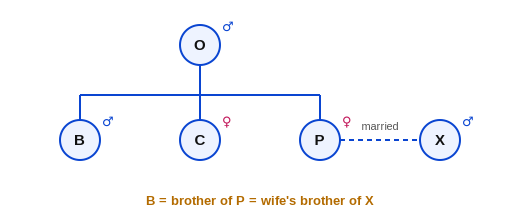
Based on the above, how is B related to X if 'B = C ? O % P € X'?
एक निश्चित कूट भाषा में,
A % B का अर्थ है 'A, B का पिता है',
A € B का अर्थ है 'A, B की पत्नी है',
A = B का अर्थ है 'A, B का भाई है', और
A ? B का अर्थ है 'A, B की पुत्री है'।
उपरोक्त के आधार पर, यदि 'B = C ? O % P € X' है, तो B, X से किस प्रकार संबंधित है?
  1. ABrotherभाई
  2. BWife's fatherपत्नी का पिता
  3. CWife's brotherपत्नी का भाई
  4. DFatherपिता
Show answer

Concept: Decode each symbol from left to right and build the family tree.

  1. B = C → B is brother of C; C ? O → C is daughter of O; so O is father of B and C.
  2. O % P → O is father of P; hence B, C, P are siblings.
  3. P € X → P is wife of X.
  4. B is the brother of X's wife → wife's brother (brother-in-law).

Trick: Trace generation first (O on top, B/C/P below), then attach spouses with a dashed line.

Answer: (C) Wife's brother

अवधारणा: हर प्रतीक को बाएँ से दाएँ डिकोड कर परिवार-वृक्ष बनाएँ।

  1. B = C → B, C का भाई; C ? O → C, O की बेटी; अतः O, B और C का पिता।
  2. O % P → O, P का पिता; अतः B, C, P भाई-बहन।
  3. P € X → P, X की पत्नी।
  4. B, X की पत्नी का भाई → साला (wife's brother)।

ट्रिक: पहले पीढ़ी (O ऊपर, B/C/P नीचे) बनाएँ, फिर जीवनसाथी को बिंदीदार रेखा से जोड़ें।

उत्तर: (C) Wife's brother (साला)

RRB NTPC Undergraduate CBT 1General Intelligence and ReasoningBlood Relations (Coded)RRB NTPC Undergraduate CBT 1 2025 · 8 May Shift 2 →
Q13960.
In a certain code language, ‘PINS’ is coded as ‘3247’ and ‘HIPS’ is coded as ‘4627’. What is the code for ‘H’ in the given code language?
एक निश्चित कूट भाषा में, 'PINS' को '3247' के रूप में कूटबद्ध किया जाता है और 'HIPS' को '4627' के रूप में कूटबद्ध किया जाता है। दी गई कूट भाषा में 'H' का कूट क्या है?
  1. A6
  2. B4
  3. C2
  4. D7
Show answer

Concept: Letters common to both words get the common digits; the leftover letter gets the leftover digit.

  1. PINS → 3 2 4 7; HIPS → 4 6 2 7.
  2. Common letters I, P, S ↔ common digits 2, 4, 7.
  3. Leftover: N ↔ 3 (in PINS) and H ↔ 6 (in HIPS).

Trick: Code questions with two words: 'uncommon letter = uncommon digit'.

Answer: (A) 6

अवधारणा: दोनों शब्दों के साझा अक्षरों को साझा अंक मिलते हैं; बचा अक्षर = बचा अंक।

  1. PINS → 3 2 4 7; HIPS → 4 6 2 7।
  2. साझा अक्षर I, P, S ↔ साझा अंक 2, 4, 7।
  3. बचे: N ↔ 3 (PINS में) और H ↔ 6 (HIPS में)।

ट्रिक: दो शब्दों वाले कोड: 'असाझा अक्षर = असाझा अंक'।

उत्तर: (A) 6

RRB NTPC Undergraduate CBT 1General Intelligence and ReasoningCoding–DecodingRRB NTPC Undergraduate CBT 1 2025 · 8 May Shift 2 →