Question bank

Q&A: practice questions with answers

Search questions on any topic. Filter by exam category, exam, subject and topic, try the question, then open the answer and explanation.

Courses – airGurukul

20,719 questions found.

Q14021.
Which of the following is included among the water-soluble vitamins collectively grouped together in a specific vitamin class known as vitamin B complex?
निम्नलिखित में से कौन-सा उन जल में घुलनशील विटामिनों में शामिल है जिन्हें सामूहिक रूप से विटामिन B कॉम्प्लेक्स नामक एक विशिष्ट विटामिन वर्ग में समूहित किया गया है?
  1. ATocopherolटोकोफेरॉल
  2. BCalciferolकैल्सिफेरॉल
  3. CThiaminथायमिन
  4. DRetinolरेटिनॉल
Show answer

Concept: Vitamins are of two kinds: fat-soluble (A, D, E, K) and water-soluble (B-complex and C). Thiamin is vitamin B1, the first member of the B complex.

  1. Retinol = vitamin A, Calciferol = vitamin D, Tocopherol = vitamin E – all fat-soluble.
  2. Thiamin deficiency causes beri-beri; other B vitamins are riboflavin (B2), niacin (B3), pyridoxine (B6), cobalamin (B12).

Yaad rakhein: Fat-soluble = "ADEK"; everything else (B, C) dissolves in water.

Answer: (C) Thiamin

अवधारणा: विटामिन दो प्रकार के होते हैं: वसा-विलेय (A, D, E, K) और जल-विलेय (B-complex और C)। थायमिन (Thiamin) विटामिन B1 है, B कॉम्प्लेक्स का पहला सदस्य।

  1. रेटिनॉल = विटामिन A, कैल्सिफेरॉल = विटामिन D, टोकोफेरॉल = विटामिन E – सभी वसा-विलेय।
  2. थायमिन की कमी से बेरी-बेरी होता है; अन्य B विटामिन – राइबोफ्लेविन (B2), नियासिन (B3), पाइरिडॉक्सिन (B6), कोबालामिन (B12)।

याद रखें: वसा-विलेय = "ADEK"; बाकी (B, C) जल में घुलते हैं।

उत्तर: (C) थायमिन (Thiamin)
RRB NTPC Undergraduate CBT 1General AwarenessVitaminsRRB NTPC Undergraduate CBT 1 2025 · 8 May Shift 1 →
Q14022.
Directive Principles collectively aim to achieve which ideals prominently declared in the Constitution’s Preamble?
राज्य के नीति निदेशक तत्व सामूहिक रूप से संविधान की प्रस्तावना में प्रमुखता से घोषित किन आदर्शों को प्राप्त करने का लक्ष्य रखते हैं?
  1. AJustice, liberty, equality, fraternityन्याय, स्वतंत्रता, समानता, बंधुत्व
  2. BUnity, diversity and fraternityएकता, विविधता और बंधुत्व
  3. CSovereignty, security and hierarchyसंप्रभुता, सुरक्षा और पदानुक्रम
  4. DProperty, privilege, hierarchyसंपत्ति, विशेषाधिकार, पदानुक्रम
Show answer

Concept: The Directive Principles of State Policy (Part IV, Articles 36–51) aim to establish a welfare state by securing the ideals of justice (social, economic, political), liberty, equality and fraternity promised in the Preamble.

  1. Article 38 directly asks the State to promote a social order based on justice, and the DPSPs translate the Preamble's goals into policy directions.
  2. Options with "hierarchy", "privilege" or "property" run opposite to the Constitution's egalitarian spirit.

Yaad rakhein: Preamble ideals J-L-E-F → DPSPs are the road map to reach them.

Answer: (A) Justice, liberty, equality, fraternity

अवधारणा: राज्य के नीति निदेशक तत्व (भाग IV, अनुच्छेद 36–51) का उद्देश्य प्रस्तावना में वर्णित न्याय (सामाजिक, आर्थिक, राजनीतिक), स्वतंत्रता, समता और बंधुता के आदर्शों को प्राप्त कर कल्याणकारी राज्य बनाना है।

  1. अनुच्छेद 38 सीधे राज्य से न्याय-आधारित सामाजिक व्यवस्था बनाने को कहता है; DPSP प्रस्तावना के लक्ष्यों को नीति-दिशा में बदलते हैं।
  2. "hierarchy", "privilege", "property" वाले विकल्प संविधान की समतावादी भावना के विपरीत हैं।

याद रखें: प्रस्तावना के आदर्श न्याय-स्वतंत्रता-समता-बंधुता → DPSP उन तक पहुँचने का मार्ग।

उत्तर: (A) न्याय, स्वतंत्रता, समता, बंधुता

RRB NTPC Undergraduate CBT 1General AwarenessDirective PrinciplesRRB NTPC Undergraduate CBT 1 2025 · 8 May Shift 1 →
Q14023.
In the search box of File Explorer, which search pattern finds all Word documents in the current folder whose names start with “Unit”?
File Explorer के सर्च बॉक्स में, कौन-सा सर्च पैटर्न वर्तमान फ़ोल्डर के उन सभी Word दस्तावेज़ों को खोजता है जिनके नाम "Unit" से शुरू होते हैं?
  1. AUnit?.txt
  2. B*Unit.docx
  3. CUnit* .docx
  4. DUnit*.docx
Show answer

Concept: In Windows search, the wildcard * stands for any number of characters and ? for exactly one character. Word documents have the extension .docx.

  1. Names starting with "Unit" followed by anything → Unit*; Word files → .docx; together: Unit*.docx.
  2. Unit?.txt finds text files with one extra character; *Unit.docx finds names ending in Unit; "Unit* .docx" has a stray space.

Yaad rakhein: * = many characters, ? = one character.

Answer: (D) Unit*.docx

अवधारणा: Windows search में वाइल्डकार्ड * का अर्थ कितने भी अक्षर और ? का अर्थ ठीक एक अक्षर है। Word दस्तावेज़ों का extension .docx होता है।

  1. "Unit" से शुरू होने वाले नाम → Unit*; Word फ़ाइलें → .docx; मिलाकर: Unit*.docx।
  2. Unit?.txt एक अतिरिक्त अक्षर वाली text फ़ाइलें खोजेगा; *Unit.docx वे नाम जो Unit पर समाप्त हों; "Unit* .docx" में बीच में गलत space है।

याद रखें: * = अनेक अक्षर, ? = एक अक्षर।

उत्तर: (D) Unit*.docx

RRB NTPC Undergraduate CBT 1General AwarenessWildcards in File ExplorerRRB NTPC Undergraduate CBT 1 2025 · 8 May Shift 1 →
Q14024.
In the context of Indian classical music, the term "Khayal" literally signifies which of the following?
भारतीय शास्त्रीय संगीत के संदर्भ में, "ख़याल" शब्द का शाब्दिक अर्थ निम्नलिखित में से क्या है?
  1. AImagination or reflective thoughtकल्पना या चिंतनशील विचार
  2. BAn expression of devotional sentimentभक्ति भाव की अभिव्यक्ति
  3. CA melodic frameworkएक स्वरात्मक ढाँचा
  4. DA structured rhythmic patternएक संरचित लयात्मक पैटर्न
Show answer

Concept: Khayal is a Persian/Arabic word meaning "imagination" or "thought/idea". It is the most popular vocal form of Hindustani classical music, allowing great freedom for improvisation.

  1. It is credited to Amir Khusrau and was popularised by Sultan Mohammad Shah Rangila's court musicians Sadarang and Adarang (18th century).
  2. Devotional sentiment describes bhajan/kirtan, melodic framework is raga, rhythmic pattern is tala.

Yaad rakhein: Khayal = "khayal" (thought/imagination) – the singer imagines freely within the raga.

Answer: (A) Imagination or reflective thought

अवधारणा: ख़याल फ़ारसी/अरबी शब्द है जिसका अर्थ "कल्पना" या "विचार" है। यह हिंदुस्तानी शास्त्रीय संगीत की सबसे लोकप्रिय गायन शैली है जिसमें improvisation (तत्काल रचना) की पूरी स्वतंत्रता होती है।

  1. इसका श्रेय अमीर खुसरो को दिया जाता है; मोहम्मद शाह रंगीला के दरबारी सदारंग और अदारंग (18वीं सदी) ने इसे लोकप्रिय बनाया।
  2. भक्ति भाव = भजन/कीर्तन, स्वर-ढाँचा = राग, लयबद्ध ढाँचा = ताल।

याद रखें: ख़याल = "ख़याल" (विचार/कल्पना) – गायक राग के भीतर स्वतंत्र कल्पना करता है।

उत्तर: (A) कल्पना या चिंतनशील विचार

RRB NTPC Undergraduate CBT 1General AwarenessHindustani classical musicRRB NTPC Undergraduate CBT 1 2025 · 8 May Shift 1 →
Q14025.
Which of the following coastal plains is correctly matched with its state?
निम्नलिखित में से कौन-सा तटीय मैदान अपने राज्य से सही सुमेलित है?
  1. AMalabar Plain – Gujaratमालाबार मैदान – गुजरात
  2. BUtkal Plain – Odishaउत्कल मैदान – ओडिशा
  3. CCoromandel Plain – Keralaकोरोमंडल मैदान – केरल
  4. DKonkan Plain – Tamil Naduकोंकण मैदान – तमिलनाडु
Show answer

Concept: The western coastal plain is divided into Kachchh & Kathiawar (Gujarat), Konkan (Maharashtra–Goa), Kanara/Karnataka coast and Malabar (Kerala). The eastern plain is Utkal (Odisha), Andhra coast and Coromandel (Tamil Nadu).

  1. Only Utkal Plain – Odisha is matched correctly (it includes the Mahanadi delta and Chilika lake).
  2. Malabar belongs to Kerala, Coromandel to Tamil Nadu and Konkan to Maharashtra/Goa – the other three pairs are swapped.

Yaad rakhein: West: Gujarat → Konkan → Kanara → Malabar; East: Utkal → Andhra → Coromandel.

Answer: (B) Utkal Plain – Odisha

अवधारणा: पश्चिमी तटीय मैदान – कच्छ व काठियावाड़ (गुजरात), कोंकण (महाराष्ट्र–गोवा), कन्नड़/कर्नाटक तट और मालाबार (केरल)। पूर्वी मैदान – उत्कल (ओडिशा), आंध्र तट और कोरोमंडल (तमिलनाडु)।

  1. केवल उत्कल मैदान – ओडिशा सही सुमेलित है (इसमें महानदी डेल्टा और चिल्का झील शामिल हैं)।
  2. मालाबार केरल का, कोरोमंडल तमिलनाडु का और कोंकण महाराष्ट्र/गोवा का है – बाकी तीन जोड़े उलटे हैं।

याद रखें: पश्चिम: गुजरात → कोंकण → कन्नड़ → मालाबार; पूर्व: उत्कल → आंध्र → कोरोमंडल।

उत्तर: (B) उत्कल मैदान – ओडिशा

RRB NTPC Undergraduate CBT 1General AwarenessCoastal plains of IndiaRRB NTPC Undergraduate CBT 1 2025 · 8 May Shift 1 →
Q14026.
If the salary of a person is first increased by 15% and thereafter decreased by 12%, what is the net change in his salary?
यदि किसी व्यक्ति के वेतन में पहले 15% की वृद्धि की जाती है और उसके बाद 12% की कमी की जाती है, तो उसके वेतन में कुल (शुद्ध) परिवर्तन क्या है?
  1. A1.4% decrease1.4% कमी
  2. B1.2% increase1.2% वृद्धि
  3. C1.32% decrease1.32% कमी
  4. D1.2% decrease1.2% कमी
Show answer

Concept: Net change for successive changes a% and b% is a+b+ab100.

  1. a=+15, b=−12.
  2. Net =15−12+15×(−12)100=3−1.8=1.2.
  3. Positive sign means an increase of 1.2%.

Trick: Multiply factors: 1.15×0.88=1.012, i.e. +1.2%.

Answer: (B) 1.2% increase

अवधारणा: क्रमिक परिवर्तन a% और b% का शुद्ध परिवर्तन a+b+ab100 होता है।

  1. a=+15, b=−12।
  2. शुद्ध =15−12+15×(−12)100=3−1.8=1.2।
  3. धनात्मक चिह्न यानी 1.2% की वृद्धि।

ट्रिक: गुणनखंड गुणा करें: 1.15×0.88=1.012, यानी +1.2%।

उत्तर: (B) 1.2% वृद्धि

RRB NTPC Undergraduate CBT 1MathematicsSuccessive percentage changeRRB NTPC Undergraduate CBT 1 2025 · 8 May Shift 1 →
Q14027.
Evaluate 213 + (-2)3 + (-19)3
213 + (-2)3 + (-19)3 का मान ज्ञात कीजिए।
  1. A2397
  2. B2468
  3. C2394
  4. D2354
Show answer

Concept: If a+b+c=0 then a3+b3+c3=3abc.

  1. 21+(−2)+(−19)=0, so the identity applies.
  2. 3abc=3×21×(−2)×(−19).
  3. =3×21×38=2394.

Trick: Whenever the three bases add to zero, never cube them – just find 3abc.

Answer: (C) 2394

अवधारणा: यदि a+b+c=0 तो a3+b3+c3=3abc।

  1. 21+(−2)+(−19)=0, अतः सर्वसमिका लागू होगी।
  2. 3abc=3×21×(−2)×(−19)।
  3. =3×21×38=2394।

ट्रिक: जब तीनों आधारों का योग शून्य हो, घन मत निकालिए – सीधे 3abc निकालें।

उत्तर: (C) 2394

RRB NTPC Undergraduate CBT 1MathematicsAlgebraic identity (a³+b³+c³)RRB NTPC Undergraduate CBT 1 2025 · 8 May Shift 1 →
Q14028.
Which of the following numbers is not divisible by 88?
निम्नलिखित में से कौन-सी संख्या 88 से विभाज्य नहीं है?
  1. A1232
  2. B1144
  3. C968
  4. D1058
Show answer

Concept: 88=8×11; a number divisible by 88 must be divisible by both 8 and 11.

  1. 1232=88×14, 1144=88×13, 968=88×11 – all divisible.
  2. 1058: last three digits 058 → 58÷8 leaves remainder 2, so not divisible by 8.
  3. Hence 1058 is not divisible by 88.

Trick: Check divisibility by 8 (last 3 digits) first – it eliminates quickly.

Answer: (D) 1058

अवधारणा: 88=8×11; 88 से विभाज्य संख्या 8 और 11 दोनों से विभाज्य होनी चाहिए।

  1. 1232=88×14, 1144=88×13, 968=88×11 – सभी विभाज्य।
  2. 1058: अंतिम तीन अंक 058 → 58÷8 में शेष 2, अतः 8 से विभाज्य नहीं।
  3. इसलिए 1058, 88 से विभाज्य नहीं है।

ट्रिक: पहले 8 की विभाज्यता (अंतिम 3 अंक) जाँचें – जल्दी छँटनी हो जाती है।

उत्तर: (D) 1058

RRB NTPC Undergraduate CBT 1MathematicsDivisibilityRRB NTPC Undergraduate CBT 1 2025 · 8 May Shift 1 →
Q14029.
The average of 5 numbers is 18.5. If one number is removed, the average of the remaining 4 numbers becomes 16. Find the number that was removed.
5 संख्याओं का औसत 18.5 है। यदि एक संख्या हटा दी जाए, तो शेष 4 संख्याओं का औसत 16 हो जाता है। हटाई गई संख्या ज्ञात कीजिए।
  1. A28
  2. B29.5
  3. C28.5
  4. D29
Show answer

Concept: Sum = average × count; removed number = old sum − new sum.

  1. Sum of 5 numbers =5×18.5=92.5.
  2. Sum of remaining 4 =4×16=64.
  3. Removed number =92.5−64=28.5.

Trick: Removed number = new average + (drop in average) × old count =16+2.5×5=28.5.

Answer: (C) 28.5

अवधारणा: योग = औसत × संख्या; हटाई गई संख्या = पुराना योग − नया योग।

  1. 5 संख्याओं का योग =5×18.5=92.5।
  2. शेष 4 का योग =4×16=64।
  3. हटाई गई संख्या =92.5−64=28.5।

ट्रिक: हटाई संख्या = नया औसत + (औसत में गिरावट) × पुरानी संख्या =16+2.5×5=28.5।

उत्तर: (C) 28.5

RRB NTPC Undergraduate CBT 1MathematicsAverageRRB NTPC Undergraduate CBT 1 2025 · 8 May Shift 1 →
Q14030.
The ages of a mother and daughter are 36 years and 12 years, respectively. In how many years will the mother be twice the age of the daughter?
एक माँ और बेटी की आयु क्रमशः 36 वर्ष और 12 वर्ष है। कितने वर्षों में माँ की आयु बेटी की आयु की दोगुनी हो जाएगी?
  1. A15 years15 वर्ष
  2. B8 years8 वर्ष
  3. C10 years10 वर्ष
  4. D12 years12 वर्ष
Show answer

Concept: Add the same x years to both ages and form the equation.

  1. 36+x=2(12+x).
  2. 36+x=24+2x⇒x=12.
  3. Check: after 12 years, mother 48, daughter 24 – exactly double.

Trick: Difference of ages (24) is constant; when mother is twice, difference = daughter's age, so daughter must be 24 → after 12 years.

Answer: (D) 12 years

अवधारणा: दोनों आयु में समान x वर्ष जोड़कर समीकरण बनाएँ।

  1. 36+x=2(12+x)।
  2. 36+x=24+2x⇒x=12।
  3. जाँच: 12 वर्ष बाद माँ 48, बेटी 24 – ठीक दोगुना।

ट्रिक: आयु का अंतर (24) स्थिर है; जब माँ दोगुनी होगी, अंतर = बेटी की आयु, अतः बेटी 24 की होगी → 12 वर्ष बाद।

उत्तर: (D) 12 वर्ष

RRB NTPC Undergraduate CBT 1MathematicsAgesRRB NTPC Undergraduate CBT 1 2025 · 8 May Shift 1 →
Q14031.
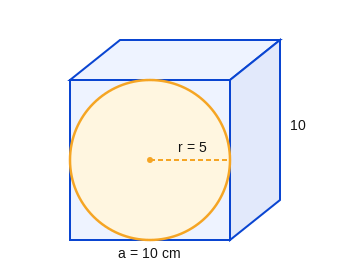
The length of each edge of a cube is 10 cm. If a sphere is inscribed inside the cube, what is the ratio of the surface area of the sphere to the outer surface area of the cube?
एक घन के प्रत्येक किनारे की लंबाई 10 cm है। यदि घन के अंदर एक गोला अंतर्निहित किया जाए, तो गोले के पृष्ठीय क्षेत्रफल और घन के बाह्य पृष्ठीय क्षेत्रफल का अनुपात क्या है?
  1. Aπ:3
  2. Bπ:6
  3. C6:π
  4. D3:π
Show answer

Concept: A sphere inscribed in a cube of edge a has diameter a, so radius r=a2.

  1. a=10cm⇒r=5cm.
  2. Surface area of sphere =4πr2=4π×25=100π.
  3. Surface area of cube =6a2=600.
  4. Ratio =100π:600=π:6.

Trick: For any inscribed sphere, 4π(a/2)26a2=π6 – independent of the edge length.

Answer: (B) π:6

अवधारणा: भुजा a के घन में अंतर्गत गोले का व्यास a होता है, अतः त्रिज्या r=a2।

  1. a=10cm⇒r=5cm।
  2. गोले का पृष्ठीय क्षेत्रफल =4πr2=4π×25=100π।
  3. घन का पृष्ठीय क्षेत्रफल =6a2=600।
  4. अनुपात =100π:600=π:6।

ट्रिक: किसी भी अंतर्गत गोले के लिए 4π(a/2)26a2=π6 – भुजा पर निर्भर नहीं।

उत्तर: (B) π:6

RRB NTPC Undergraduate CBT 1MathematicsSphere inscribed in cubeRRB NTPC Undergraduate CBT 1 2025 · 8 May Shift 1 →
Q14032.
Pipe A can fill a cistern in 12 hours and another pipe B can empty it in 18 hours. Pipe A is opened first and after 4 hours, pipe B is also opened. In how much total time will the cistern be filled?
पाइप A एक टंकी को 12 घंटे में भर सकता है और दूसरा पाइप B उसे 18 घंटे में खाली कर सकता है। पहले पाइप A खोला जाता है और 4 घंटे बाद पाइप B भी खोल दिया जाता है। टंकी कुल कितने समय में भर जाएगी?
  1. A36 hours36 घंटे
  2. B32 hours32 घंटे
  3. C28 hours28 घंटे
  4. D24 hours24 घंटे
Show answer

Concept: Take capacity =LCM(12,18)=36 units. A fills 3 units/h, B empties 2 units/h.

  1. First 4 hours (only A): 4×3=12 units filled.
  2. Remaining 36−12=24 units; net rate with both =3−2=1 unit/h.
  3. Time for remaining =24 h; total =4+24=28 hours.

Trick: Fractions: A alone does 412=13; remaining 23 at net 136/h takes 24 h.

Answer: (C) 28 hours

अवधारणा: क्षमता =LCM(12,18)=36 इकाई लें। A भरता है 3 इकाई/घंटा, B खाली करता है 2 इकाई/घंटा।

  1. पहले 4 घंटे (केवल A): 4×3=12 इकाई भरी।
  2. शेष 36−12=24 इकाई; दोनों के साथ शुद्ध दर =3−2=1 इकाई/घंटा।
  3. शेष का समय =24 घंटे; कुल =4+24=28 घंटे।

ट्रिक: भिन्न से: A अकेले 412=13 भरता है; शेष 23 शुद्ध दर 136/घंटा से 24 घंटे में।

उत्तर: (C) 28 घंटे

RRB NTPC Undergraduate CBT 1MathematicsPipes and cisternsRRB NTPC Undergraduate CBT 1 2025 · 8 May Shift 1 →
Q14033.
Which of the following ratios is the greatest?
a) 7 : 11
b) 9 : 14
c) 11 : 18
d) 13 : 21
निम्नलिखित में से कौन-सा अनुपात सबसे बड़ा है?
a) 7 : 11
b) 9 : 14
c) 11 : 18
d) 13 : 21
  1. A9 : 14
  2. B11 : 18
  3. C7 : 11
  4. D13 : 21
Show answer

Concept: Convert each ratio to a decimal (or compare with a common benchmark) to find the greatest.

  1. 711≈0.636, 914≈0.643.
  2. 1118≈0.611, 1321≈0.619.
  3. Greatest is 914, i.e. 9:14.

Trick: Compare with 23: 914 is short of it by only 142, the smallest gap among all four.

Answer: (A) 9 : 14

अवधारणा: प्रत्येक अनुपात को दशमलव में बदलकर (या एक साझा मानक से तुलना कर) सबसे बड़ा ज्ञात करें।

  1. 711≈0.636, 914≈0.643।
  2. 1118≈0.611, 1321≈0.619।
  3. सबसे बड़ा 914 है, यानी 9:14।

ट्रिक: 23 से तुलना करें: 914 उससे केवल 142 कम है – चारों में सबसे छोटा अंतर।

उत्तर: (A) 9 : 14

RRB NTPC Undergraduate CBT 1MathematicsComparison of ratiosRRB NTPC Undergraduate CBT 1 2025 · 8 May Shift 1 →
Q14034.
Find the value of m which satisfies
(146)8×(614)3×(146)10=(614)9m+9.
m का वह मान ज्ञात कीजिए जो
(146)8×(614)3×(146)10=(614)9m+9 को संतुष्ट करता है।
  1. A−289
  2. B−329
  3. C−83
  4. D−259
Show answer

Concept: (614)k=(146)−k; with equal bases, equate the exponents.

  1. LHS =(146)8×(146)−3×(146)10=(146)15.
  2. RHS =(614)9m+9=(146)−(9m+9).
  3. 15=−(9m+9)⇒9m=−24⇒m=−83.

Trick: Flip every reciprocal base to a single base first, then just add the powers.

Answer: (C) −83

अवधारणा: (614)k=(146)−k; आधार समान होने पर घातांक बराबर रखें।

  1. LHS =(146)8×(146)−3×(146)10=(146)15।
  2. RHS =(614)9m+9=(146)−(9m+9)।
  3. 15=−(9m+9)⇒9m=−24⇒m=−83।

ट्रिक: पहले हर व्युत्क्रम आधार को एक ही आधार में बदलें, फिर केवल घात जोड़ें।

उत्तर: (C) −83

RRB NTPC Undergraduate CBT 1MathematicsLaws of exponentsRRB NTPC Undergraduate CBT 1 2025 · 8 May Shift 1 →
Q14035.
If sinA=57, find the value of 5cosecA−7sinA26secA+7cos2A.
यदि sinA=57 है, तो 5cosecA−7sinA26secA+7cos2A का मान ज्ञात कीजिए।
  1. A923
  2. B1473
  3. C319
  4. D1146
Show answer

Concept: From sinA=57: cosA=1−2549=267, cosecA=75, secA=726.

  1. Numerator: 5×75−7×57=7−5=2.
  2. Denominator: 26×726+7×2449=7+247=737.
  3. Value =2÷737=1473.

Trick: The coefficients are chosen so that 5cosecA and 26secA become whole numbers (7 each) – look for such cancellations.

Answer: (B) 1473

अवधारणा: sinA=57 से: cosA=1−2549=267, cosecA=75, secA=726।

  1. अंश: 5×75−7×57=7−5=2।
  2. हर: 26×726+7×2449=7+247=737।
  3. मान =2÷737=1473।

ट्रिक: गुणांक ऐसे चुने हैं कि 5cosecA और 26secA पूर्ण संख्या (7-7) बन जाएँ – ऐसे कटान पहचानें।

उत्तर: (B) 1473

RRB NTPC Undergraduate CBT 1MathematicsTrigonometric ratiosRRB NTPC Undergraduate CBT 1 2025 · 8 May Shift 1 →
Q14036.
A sum of money amounts to ₹4,600 in 3 years at 5% simple interest per annum. What is the sum?
कोई धनराशि 5% वार्षिक साधारण ब्याज की दर से 3 वर्षों में ₹4,600 हो जाती है। वह धनराशि क्या है?
  1. A₹4,200
  2. B₹3,800
  3. C₹3,500
  4. D₹4,000
Show answer

Concept: Amount =P(1+RT100).

  1. 1+5×3100=1.15.
  2. P=46001.15=4000.
  3. Check: SI on ₹4,000 for 3 years at 5% =600; amount =4600.

Trick: 3 years at 5% =15%; so amount =115% of P → P=4600×100115.

Answer: (D) ₹4,000

अवधारणा: मिश्रधन =P(1+RT100)।

  1. 1+5×3100=1.15।
  2. P=46001.15=4000।
  3. जाँच: ₹4,000 पर 3 वर्ष, 5% का SI =600; मिश्रधन =4600।

ट्रिक: 3 वर्ष × 5% =15%; अतः मिश्रधन =P का 115% → P=4600×100115।

उत्तर: (D) ₹4,000

RRB NTPC Undergraduate CBT 1MathematicsSimple interestRRB NTPC Undergraduate CBT 1 2025 · 8 May Shift 1 →
Q14037.
Which of the following pairs of numbers is not coprime?
निम्नलिखित में से कौन-सा संख्या-युग्म सह-अभाज्य (coprime) नहीं है?
  1. A(127, 257)
  2. B(173, 351)
  3. C(177, 827)
  4. D(171, 273)
Show answer

Concept: Two numbers are co-prime when their HCF is 1.

  1. 171=32×19 and 273=3×7×13 – common factor 3, so not co-prime.
  2. 127, 257, 173 and 827 are primes; 351=33×13, 177=3×59 – no common factor in those pairs.

Trick: Use the digit-sum test: 1+7+1=9 and 2+7+3=12 are both multiples of 3 – spot the common factor instantly.

Answer: (D) (171, 273)

अवधारणा: दो संख्याएँ सह-अभाज्य (co-prime) होती हैं जब उनका HCF 1 हो।

  1. 171=32×19 और 273=3×7×13 – उभयनिष्ठ गुणनखंड 3, अतः सह-अभाज्य नहीं।
  2. 127, 257, 173 और 827 अभाज्य हैं; 351=33×13, 177=3×59 – उन युग्मों में कोई उभयनिष्ठ गुणनखंड नहीं।

ट्रिक: अंक-योग जाँच: 1+7+1=9 और 2+7+3=12 दोनों 3 के गुणज – उभयनिष्ठ गुणनखंड तुरंत दिखता है।

उत्तर: (D) (171, 273)

RRB NTPC Undergraduate CBT 1MathematicsCo-prime numbersRRB NTPC Undergraduate CBT 1 2025 · 8 May Shift 1 →
Q14038.
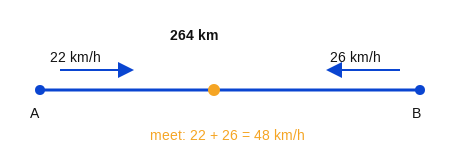
Two buses start at the same time from two towns that are 264 km apart and travel towards each other along the same highway. The first bus travels at a speed of 22 km/h, while the second bus travels at a speed of 26 km/h. After how much time will they meet?
दो बसें एक ही समय पर 264 km की दूरी पर स्थित दो कस्बों से चलती हैं और एक ही राजमार्ग पर एक-दूसरे की ओर यात्रा करती हैं। पहली बस 22 km/h की चाल से चलती है, जबकि दूसरी बस 26 km/h की चाल से चलती है। वे कितने समय बाद मिलेंगी?
  1. A6.25 hours6.25 घंटे
  2. B6.5 hours6.5 घंटे
  3. C5.5 hours5.5 घंटे
  4. D5 hours5 घंटे
Show answer

Concept: For objects moving towards each other, relative speed = sum of speeds.

  1. Relative speed =22+26=48km/h.
  2. Time =26448=5.5 hours.

Trick: 48×5=240, remaining 24 km is half an hour more → 5.5 h.

Answer: (C) 5.5 hours

अवधारणा: एक-दूसरे की ओर चलने पर सापेक्ष चाल = चालों का योग।

  1. सापेक्ष चाल =22+26=48km/h।
  2. समय =26448=5.5 घंटे।

ट्रिक: 48×5=240, शेष 24 km आधे घंटे में → 5.5 घंटे।

उत्तर: (C) 5.5 घंटे

RRB NTPC Undergraduate CBT 1MathematicsRelative speedRRB NTPC Undergraduate CBT 1 2025 · 8 May Shift 1 →
Q14039.
If the simple interest on ₹5,000 for T years at 6% p.a. equals the simple interest on ₹7,500 for 4 years at 4% per annum, then find the value of T.
यदि ₹5,000 पर T वर्षों के लिए 6% वार्षिक दर से साधारण ब्याज, ₹7,500 पर 4 वर्षों के लिए 4% वार्षिक दर से साधारण ब्याज के बराबर है, तो T का मान ज्ञात कीजिए।
  1. A4
  2. B2
  3. C1
  4. D3
Show answer

Concept: SI=PRT100; equate the two interests.

  1. 5000×6×T100=7500×4×4100.
  2. 300T=1200⇒T=4.

Trick: Compare P×R×T products: 5000×6×T=7500×16 → T=12000030000=4.

Answer: (A) 4

अवधारणा: SI=PRT100; दोनों ब्याज बराबर रखें।

  1. 5000×6×T100=7500×4×4100।
  2. 300T=1200⇒T=4।

ट्रिक: P×R×T गुणनफल की तुलना करें: 5000×6×T=7500×16 → T=12000030000=4।

उत्तर: (A) 4

RRB NTPC Undergraduate CBT 1MathematicsSimple interestRRB NTPC Undergraduate CBT 1 2025 · 8 May Shift 1 →
Q14040.
Chitra gets a discount of 40% on a water cooler whose marked price is ₹2,200. Since she pays by credit card, she gets an additional 20% discount. How much does she pay (in ₹)?
चित्रा को एक वाटर कूलर पर 40% की छूट मिलती है जिसका अंकित मूल्य ₹2,200 है। चूँकि वह क्रेडिट कार्ड से भुगतान करती है, इसलिए उसे 20% की अतिरिक्त छूट मिलती है। वह कितना भुगतान करती है (₹ में)?
  1. A1,055
  2. B1,059
  3. C1,058
  4. D1,056
Show answer

Concept: Successive discounts multiply: price =MP×(1−d1)(1−d2).

  1. After 40%: 2200×0.6=1320.
  2. After further 20%: 1320×0.8=1056.

Trick: Combined discount =40+20−40×20100=52%; pay 48% of 2200 =1056.

Answer: (D) 1,056

अवधारणा: क्रमिक छूट गुणा होती हैं: मूल्य =MP×(1−d1)(1−d2)।

  1. 40% के बाद: 2200×0.6=1320।
  2. आगे 20% के बाद: 1320×0.8=1056।

ट्रिक: संयुक्त छूट =40+20−40×20100=52%; 2200 का 48% =1056 देना होगा।

उत्तर: (D) 1,056

RRB NTPC Undergraduate CBT 1MathematicsSuccessive discountsRRB NTPC Undergraduate CBT 1 2025 · 8 May Shift 1 →