Question bank

Q&A: practice questions with answers

Search questions on any topic. Filter by exam category, exam, subject and topic, try the question, then open the answer and explanation.

Courses – airGurukul

20,719 questions found.

Q14041.
A student initially scored equal marks in Mathematics and Physics. Later, the marks in Mathematics increase by 20% of the original Mathematics marks, while the marks in Physics decrease by 10% of the original Physics marks. Taking the initial total marks as the base, what is the overall percentage change in the total marks?
एक विद्यार्थी ने प्रारंभ में गणित और भौतिकी में समान अंक प्राप्त किए। बाद में, गणित के अंक मूल गणित अंकों के 20% से बढ़ जाते हैं, जबकि भौतिकी के अंक मूल भौतिकी अंकों के 10% से घट जाते हैं। प्रारंभिक कुल अंकों को आधार मानते हुए, कुल अंकों में समग्र प्रतिशत परिवर्तन क्या है?
  1. A10% increase10% वृद्धि
  2. B5% decrease5% कमी
  3. C5% increase5% वृद्धि
  4. DNo changeकोई परिवर्तन नहीं
Show answer

Concept: Assume equal marks of 100 each; compute the new total.

  1. Maths: 100→120; Physics: 100→90.
  2. New total =210 against original 200.
  3. Change =10200×100=5% increase.

Trick: Equal weights → overall change is the simple average of +20% and −10%, i.e. +5%.

Answer: (C) 5% increase

अवधारणा: दोनों के 100-100 अंक मानकर नया योग निकालें।

  1. गणित: 100→120; भौतिकी: 100→90।
  2. नया योग =210, मूल 200।
  3. परिवर्तन =10200×100=5% वृद्धि।

ट्रिक: समान भार → कुल परिवर्तन +20% और −10% का साधारण औसत, यानी +5%।

उत्तर: (C) 5% वृद्धि

RRB NTPC Undergraduate CBT 1MathematicsPercentage changeRRB NTPC Undergraduate CBT 1 2025 · 8 May Shift 1 →
Q14042.
Simplify: 3+653−212−32+50
सरल कीजिए: 3+653−212−32+50
  1. A3
  2. B5
  3. C2
  4. D6
Show answer

Concept: Reduce each surd to its simplest form, then factorise the numerator.

  1. 212=43, 32=42, 50=52.
  2. Denominator =53−43−42+52=3+2.
  3. Numerator 3+6=3(3+2).
  4. Fraction =3.

Trick: Take 3 common from 3+6 – the bracket matches the denominator, no rationalisation needed.

Answer: (A) 3

अवधारणा: हर करणी को सरलतम रूप में लाएँ, फिर अंश का गुणनखंड करें।

  1. 212=43, 32=42, 50=52।
  2. हर =53−43−42+52=3+2।
  3. अंश 3+6=3(3+2)।
  4. भिन्न =3।

ट्रिक: 3+6 से 3 उभयनिष्ठ लें – कोष्ठक हर से मेल खाता है, परिमेयकरण की ज़रूरत नहीं।

उत्तर: (A) 3

RRB NTPC Undergraduate CBT 1MathematicsSurds simplificationRRB NTPC Undergraduate CBT 1 2025 · 8 May Shift 1 →
Q14043.
The largest four-digit number which when divided by 15, 12 and 14 leaves remainder 5 in each case is:
चार अंकों की वह सबसे बड़ी संख्या, जिसे 15, 12 और 14 से विभाजित करने पर प्रत्येक स्थिति में शेषफल 5 बचता है, है:
  1. A9595
  2. B9192
  3. C9665
  4. D9988
Show answer

Concept: Required number = (largest 4-digit multiple of LCM) + remainder.

  1. LCM(15,12,14)=420.
  2. 9999÷420=23 remainder 339 → largest multiple =9999−339=9660.
  3. Number =9660+5=9665.

Trick: Options check: 9665−5=9660=420×23 – divisible by 15, 12 and 14.

Answer: (C) 9665

अवधारणा: अभीष्ट संख्या = (LCM का सबसे बड़ा 4-अंकीय गुणज) + शेषफल।

  1. LCM(15,12,14)=420।
  2. 9999÷420=23 शेष 339 → सबसे बड़ा गुणज =9999−339=9660।
  3. संख्या =9660+5=9665।

ट्रिक: विकल्प जाँच: 9665−5=9660=420×23 – 15, 12 और 14 से विभाज्य।

उत्तर: (C) 9665

RRB NTPC Undergraduate CBT 1MathematicsLCM with common remainderRRB NTPC Undergraduate CBT 1 2025 · 8 May Shift 1 →
Q14044.
Three friends Arshdeep, Sandeep and Avtar are on a trip by a car. Arshdeep drives during the first 3 hours at an average speed of 52 km/hr. Sandeep drives during the next 4 hours at an average speed of 65 km/hr. Avtar drives for the next 3 hours at an average speed of 76 km/hr. They reached their destination after exactly 10 hours. Their average speed during the journey was:
तीन मित्र अर्शदीप, संदीप और अवतार कार से यात्रा पर हैं। अर्शदीप पहले 3 घंटे 52 km/hr की औसत चाल से गाड़ी चलाता है। संदीप अगले 4 घंटे 65 km/hr की औसत चाल से गाड़ी चलाता है। अवतार अगले 3 घंटे 76 km/hr की औसत चाल से गाड़ी चलाता है। वे ठीक 10 घंटे बाद अपने गंतव्य पर पहुँचे। यात्रा के दौरान उनकी औसत चाल थी:
  1. A64.4 km/hr
  2. B60.2 km/hr
  3. C56.4 km/hr
  4. D65.2 km/hr
Show answer

Concept: Average speed =total distancetotal time.

  1. Distances: 3×52=156, 4×65=260, 3×76=228 km.
  2. Total =644 km in 10 hours.
  3. Average speed =64410=64.4km/h.

Trick: This is a time-weighted average: 3(52)+4(65)+3(76)10 – never average the three speeds directly.

Answer: (A) 64.4 km/hr

अवधारणा: औसत चाल =कुल दूरीकुल समय।

  1. दूरियाँ: 3×52=156, 4×65=260, 3×76=228 km।
  2. कुल =644 km, 10 घंटे में।
  3. औसत चाल =64410=64.4km/h।

ट्रिक: यह समय-भारित औसत है: 3(52)+4(65)+3(76)10 – तीनों चालों का सीधा औसत कभी न लें।

उत्तर: (A) 64.4 km/hr

RRB NTPC Undergraduate CBT 1MathematicsAverage speedRRB NTPC Undergraduate CBT 1 2025 · 8 May Shift 1 →
Q14045.
The present ages of two sisters are in the ratio 5:7. After 4 years, their ages will be in the ratio 6:8. Find the present age of the younger sister.
दो बहनों की वर्तमान आयु का अनुपात 5:7 है। 4 वर्ष बाद, उनकी आयु का अनुपात 6:8 हो जाएगा। छोटी बहन की वर्तमान आयु ज्ञात कीजिए।
  1. A22 years22 वर्ष
  2. B20 years20 वर्ष
  3. C18 years18 वर्ष
  4. D24 years24 वर्ष
Show answer

Concept: Let present ages be 5x and 7x; add 4 years and use the new ratio.

  1. 5x+47x+4=68=34.
  2. 20x+16=21x+12⇒x=4.
  3. Younger sister =5×4=20 years.

Trick: Check: 24:32=6:8 ✓.

Answer: (B) 20 years

अवधारणा: वर्तमान आयु 5x और 7x लें; 4 वर्ष जोड़कर नया अनुपात लगाएँ।

  1. 5x+47x+4=68=34।
  2. 20x+16=21x+12⇒x=4।
  3. छोटी बहन =5×4=20 वर्ष।

ट्रिक: जाँच: 24:32=6:8 ✓।

उत्तर: (B) 20 वर्ष

RRB NTPC Undergraduate CBT 1MathematicsRatio of agesRRB NTPC Undergraduate CBT 1 2025 · 8 May Shift 1 →
Q14046.
A cricketer has scored an average of 55 runs in 9 matches. In the 10th match, he scores 85 runs. What is his new average?
एक क्रिकेटर ने 9 मैचों में औसतन 55 रन बनाए हैं। 10वें मैच में वह 85 रन बनाता है। उसका नया औसत क्या है?
  1. A57
  2. B58
  3. C56
  4. D55
Show answer

Concept: New average =old total+new scorenew count.

  1. Runs in 9 matches =9×55=495.
  2. Total after 10th match =495+85=580.
  3. New average =58010=58.

Trick: Excess over old average =85−55=30, spread over 10 matches =+3 → 55+3=58.

Answer: (B) 58

अवधारणा: नया औसत =पुराना योग+नया स्कोरनई संख्या।

  1. 9 मैचों के रन =9×55=495।
  2. 10वें मैच के बाद कुल =495+85=580।
  3. नया औसत =58010=58।

ट्रिक: पुराने औसत से अधिकता =85−55=30, 10 मैचों में बँटकर +3 → 55+3=58।

उत्तर: (B) 58

RRB NTPC Undergraduate CBT 1MathematicsAverageRRB NTPC Undergraduate CBT 1 2025 · 8 May Shift 1 →
Q14047.
A bookseller bought 7 identical sets of books at ₹375 each. He sold 3 sets at a profit of 16% per set and the remaining sets at a profit of 24% per set. What was his total profit (in ₹) from selling all the sets?
एक पुस्तक विक्रेता ने ₹375 प्रति सेट की दर से पुस्तकों के 7 एक जैसे सेट खरीदे। उसने 3 सेट प्रति सेट 16% के लाभ पर और शेष सेट प्रति सेट 24% के लाभ पर बेचे। सभी सेट बेचने पर उसका कुल लाभ (₹ में) कितना था?
  1. A₹504
  2. B₹588
  3. C₹540
  4. D₹572
Show answer

Concept: Profit = cost × profit%, computed separately for each lot.

  1. 3 sets: 3×375×16100=180.
  2. 4 sets: 4×375×24100=360.
  3. Total profit =180+360=540.

Trick: Profit per set: 16% of 375 =60, 24% of 375 =90 → 3(60)+4(90)=540.

Answer: (C) ₹540

अवधारणा: लाभ = लागत × लाभ%, दोनों समूहों के लिए अलग-अलग।

  1. 3 सेट: 3×375×16100=180।
  2. 4 सेट: 4×375×24100=360।
  3. कुल लाभ =180+360=540।

ट्रिक: प्रति सेट लाभ: 375 का 16% =60, 24% =90 → 3(60)+4(90)=540।

उत्तर: (C) ₹540

RRB NTPC Undergraduate CBT 1MathematicsProfit and lossRRB NTPC Undergraduate CBT 1 2025 · 8 May Shift 1 →
Q14048.
A group of 3 adults and 4 children pay ₹380 for movie tickets. Another group of 2 adults and 3 children pay ₹270 for the same tickets. What is the price of one adult ticket?
3 वयस्कों और 4 बच्चों का एक समूह फ़िल्म के टिकटों के लिए ₹380 का भुगतान करता है। 2 वयस्कों और 3 बच्चों का दूसरा समूह उन्हीं टिकटों के लिए ₹270 का भुगतान करता है। एक वयस्क टिकट का मूल्य क्या है?
  1. A₹80
  2. B₹50
  3. C₹60
  4. D₹70
Show answer

Concept: Form two equations in adult price a and child price c and eliminate.

  1. 3a+4c=380 and 2a+3c=270.
  2. Multiply by 2 and 3: 6a+8c=760, 6a+9c=810 → c=50.
  3. 3a+200=380⇒a=60.

Trick: Subtract the equations: a+c=110; then 2(a+c)+c=270 gives c=50 directly.

Answer: (C) ₹60

अवधारणा: वयस्क मूल्य a और बच्चे का मूल्य c में दो समीकरण बनाकर विलोपन करें।

  1. 3a+4c=380 और 2a+3c=270।
  2. 2 और 3 से गुणा: 6a+8c=760, 6a+9c=810 → c=50।
  3. 3a+200=380⇒a=60।

ट्रिक: समीकरण घटाएँ: a+c=110; फिर 2(a+c)+c=270 से सीधे c=50।

उत्तर: (C) ₹60

RRB NTPC Undergraduate CBT 1MathematicsLinear equationsRRB NTPC Undergraduate CBT 1 2025 · 8 May Shift 1 →
Q14049.
A Company produces 1,520 packets of noodles in 5 hours. How many packets will it produce in 17 hours at the same rate?
एक कंपनी 5 घंटे में नूडल्स के 1,520 पैकेट बनाती है। समान दर से वह 17 घंटे में कितने पैकेट बनाएगी?
  1. A5,861
  2. B5,816
  3. C5,168
  4. D5,618
Show answer

Concept: Direct proportion – packets per hour stay constant.

  1. Rate =15205=304 packets/hour.
  2. In 17 hours: 304×17=5168.

Trick: 304×17=304×10+304×7=3040+2128=5168.

Answer: (C) 5,168

अवधारणा: सीधा अनुपात – प्रति घंटा पैकेट स्थिर रहते हैं।

  1. दर =15205=304 पैकेट/घंटा।
  2. 17 घंटे में: 304×17=5168।

ट्रिक: 304×17=304×10+304×7=3040+2128=5168।

उत्तर: (C) 5,168

RRB NTPC Undergraduate CBT 1MathematicsUnitary methodRRB NTPC Undergraduate CBT 1 2025 · 8 May Shift 1 →
Q14050.
The sum of all interior angles of a regular polygon is 1800°. How many diagonals does the polygon have?
एक सम बहुभुज के सभी अंतः कोणों का योग 1800° है। उस बहुभुज में कितने विकर्ण हैं?
  1. A51
  2. B50
  3. C53
  4. D54
Show answer

Concept: Sum of interior angles =(n−2)×180∘; diagonals =n(n−3)2.

  1. (n−2)×180=1800⇒n−2=10⇒n=12.
  2. Diagonals =12×92=54.

Yaad rakhein: Each vertex joins n−3 others by a diagonal; divide by 2 to avoid double counting.

Answer: (D) 54

अवधारणा: अंतःकोणों का योग =(n−2)×180∘; विकर्ण =n(n−3)2।

  1. (n−2)×180=1800⇒n−2=10⇒n=12।
  2. विकर्ण =12×92=54।

याद रखें: हर शीर्ष से n−3 विकर्ण निकलते हैं; दोहरी गिनती से बचने के लिए 2 से भाग दें।

उत्तर: (D) 54

RRB NTPC Undergraduate CBT 1MathematicsPolygon diagonalsRRB NTPC Undergraduate CBT 1 2025 · 8 May Shift 1 →
Q14051.
A, B, and C start a business by investing ₹60,000, ₹80,000, and ₹1,20,000, respectively. After one year, the total profit earned is ₹78,000. By how much does C’s share exceed B’s share?
A, B और C क्रमशः ₹60,000, ₹80,000 और ₹1,20,000 का निवेश करके एक व्यवसाय शुरू करते हैं। एक वर्ष बाद, अर्जित कुल लाभ ₹78,000 है। C का हिस्सा B के हिस्से से कितना अधिक है?
  1. A₹9,800
  2. B₹12,000
  3. C₹9,400
  4. D₹10,600
Show answer

Concept: Profit is shared in the ratio of investments (equal time).

  1. Ratio 60000:80000:120000=3:4:6 (total 13 parts).
  2. One part =7800013=6000.
  3. C − B =(6−4)×6000=12000.

Trick: Only the difference of parts matters: 2 parts × ₹6,000.

Answer: (B) ₹12,000

अवधारणा: समान समय पर लाभ निवेश के अनुपात में बँटता है।

  1. अनुपात 60000:80000:120000=3:4:6 (कुल 13 भाग)।
  2. एक भाग =7800013=6000।
  3. C − B =(6−4)×6000=12000।

ट्रिक: केवल भागों का अंतर चाहिए: 2 भाग × ₹6,000।

उत्तर: (B) ₹12,000

RRB NTPC Undergraduate CBT 1MathematicsPartnershipRRB NTPC Undergraduate CBT 1 2025 · 8 May Shift 1 →
Q14052.
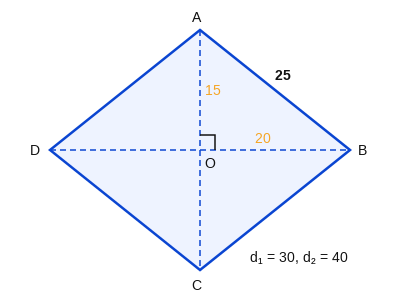
The diagonals of a rhombus are mutually perpendicular and bisect each other. One diagonal is 10 cm longer than the other. If the area of the rhombus is 600 cm², the perimeter (in cm) of the rhombus is:
एक समचतुर्भुज के विकर्ण परस्पर लंबवत होते हैं और एक-दूसरे को समद्विभाजित करते हैं। एक विकर्ण दूसरे से 10 cm लंबा है। यदि समचतुर्भुज का क्षेत्रफल 600 cm² है, तो समचतुर्भुज का परिमाप (cm में) है:
  1. A96 cm
  2. B84 cm
  3. C100 cm
  4. D120 cm
Show answer

Concept: Area =12d1d2; half-diagonals and a side form a right triangle.

  1. Let diagonals be d and d+10: 12d(d+10)=600⇒d2+10d−1200=0⇒d=30.
  2. Diagonals 30 cm and 40 cm; half-diagonals 15 and 20.
  3. Side =152+202=25 cm.
  4. Perimeter =4×25=100 cm.

Trick: Half-diagonals 15, 20 → the 3-4-5 triple scaled by 5 → side 25.

Answer: (C) 100 cm

अवधारणा: क्षेत्रफल =12d1d2; अर्ध-विकर्ण और भुजा समकोण त्रिभुज बनाते हैं।

  1. विकर्ण d और d+10 लें: 12d(d+10)=600⇒d2+10d−1200=0⇒d=30।
  2. विकर्ण 30 cm और 40 cm; अर्ध-विकर्ण 15 और 20।
  3. भुजा =152+202=25 cm।
  4. परिमाप =4×25=100 cm।

ट्रिक: अर्ध-विकर्ण 15, 20 → 3-4-5 त्रिक का 5 गुना → भुजा 25।

उत्तर: (C) 100 cm

RRB NTPC Undergraduate CBT 1MathematicsRhombusRRB NTPC Undergraduate CBT 1 2025 · 8 May Shift 1 →
Q14053.
A shopkeeper offers two successive discounts of 18% and 15% on a frock whose marked price is ₹1,000. What is the final selling price (in ₹) of the frock?
एक दुकानदार ₹1,000 अंकित मूल्य वाली एक फ्रॉक पर 18% और 15% की दो क्रमिक छूट देता है। फ्रॉक का अंतिम विक्रय मूल्य (₹ में) क्या है?
  1. A679
  2. B796
  3. C769
  4. D697
Show answer

Concept: Selling price =MP×(1−d1)(1−d2).

  1. After 18%: 1000×0.82=820.
  2. After 15%: 820×0.85=697.

Trick: Single equivalent discount =18+15−18×15100=30.3% → pay 69.7% of 1000.

Answer: (D) 697

अवधारणा: विक्रय मूल्य =MP×(1−d1)(1−d2)।

  1. 18% के बाद: 1000×0.82=820।
  2. 15% के बाद: 820×0.85=697।

ट्रिक: एकल समतुल्य छूट =18+15−18×15100=30.3% → 1000 का 69.7% देना होगा।

उत्तर: (D) 697

RRB NTPC Undergraduate CBT 1MathematicsSuccessive discountsRRB NTPC Undergraduate CBT 1 2025 · 8 May Shift 1 →
Q14054.
A shopkeeper offers the following schemes on toys of the same marked price. (A) Successive discounts of 43% and 19% on any number of toys bought.
(B) Successive discounts of 41%, 21% and 49% on any number of toys bought. (C) 35% discount on the first 5 toys and 3% discount on each toy thereon.
(D) 4 toys free of cost on buying 5 toys.
A customer wants to buy 5 toys. Which of the above schemes is the least beneficial to her?
एक दुकानदार समान अंकित मूल्य वाले खिलौनों पर निम्नलिखित योजनाएँ देता है। (A) खरीदे गए किसी भी संख्या के खिलौनों पर 43% और 19% की क्रमिक छूट।
(B) खरीदे गए किसी भी संख्या के खिलौनों पर 41%, 21% और 49% की क्रमिक छूट। (C) पहले 5 खिलौनों पर 35% छूट और उसके बाद प्रत्येक खिलौने पर 3% छूट।
(D) 5 खिलौने खरीदने पर 4 खिलौने निःशुल्क।
एक ग्राहक 5 खिलौने खरीदना चाहती है। उपरोक्त में से कौन-सी योजना उसके लिए सबसे कम लाभदायक है?
  1. AD
  2. BA
  3. CB
  4. DC
Show answer

Concept: Compare the effective price paid per toy (marked price =100) under each scheme.

  1. (A) 100×0.57×0.81=46.17 per toy.
  2. (B) 100×0.59×0.79×0.51≈23.77 per toy.
  3. (C) First 5 toys at 35% off → 65 per toy.
  4. (D) 9 toys for the price of 5 → 5009≈55.56 per toy.
  5. Highest effective price =65 → scheme (C) is least beneficial.

Trick: Convert every offer to "price per toy"; the largest number is the worst deal.

Answer: (D) C

अवधारणा: हर योजना में प्रति खिलौना प्रभावी मूल्य (अंकित मूल्य =100) की तुलना करें।

  1. (A) 100×0.57×0.81=46.17 प्रति खिलौना।
  2. (B) 100×0.59×0.79×0.51≈23.77 प्रति खिलौना।
  3. (C) पहले 5 खिलौनों पर 35% छूट → 65 प्रति खिलौना।
  4. (D) 5 के दाम में 9 खिलौने → 5009≈55.56 प्रति खिलौना।
  5. सबसे अधिक प्रभावी मूल्य =65 → योजना (C) सबसे कम लाभदायक।

ट्रिक: हर ऑफर को "प्रति खिलौना मूल्य" में बदलें; सबसे बड़ा अंक सबसे खराब सौदा।

उत्तर: (D) C

RRB NTPC Undergraduate CBT 1MathematicsComparing discount schemesRRB NTPC Undergraduate CBT 1 2025 · 8 May Shift 1 →
Q14055.
A tank can be filled by pipe P in 8 hours and by pipe Q in 4 hours. If they open alternately for one hour each with Q starting first, what is the total time taken to fill the tank?
एक टंकी को पाइप P द्वारा 8 घंटे में और पाइप Q द्वारा 4 घंटे में भरा जा सकता है। यदि उन्हें एक-एक घंटे के लिए बारी-बारी से खोला जाए और Q पहले शुरू हो, तो टंकी को भरने में कुल कितना समय लगेगा?
  1. A5 hours5 घंटे
  2. B4 hours and 40 minutes4 घंटे 40 मिनट
  3. C6 hours6 घंटे
  4. D5 hours and 20 minutes5 घंटे 20 मिनट
Show answer

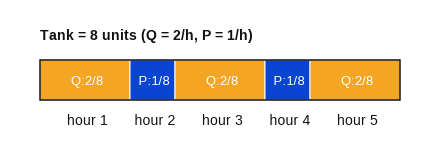
Concept: Take tank =LCM(8,4)=8 units; P fills 1 unit/h, Q fills 2 units/h.

  1. One cycle (Q then P) of 2 hours fills 2+1=3 units.
  2. After 2 cycles (4 h): 6 units; remaining 2 units.
  3. 5th hour is Q's turn: it fills exactly 2 units.
  4. Total time =5 hours.

Trick: In alternate-pipe problems, stop cycling when the remainder is less than one cycle and check whose turn it is.

Answer: (A) 5 hours

अवधारणा: टंकी =LCM(8,4)=8 इकाई लें; P 1 इकाई/घंटा, Q 2 इकाई/घंटा भरता है।

  1. एक चक्र (Q फिर P) 2 घंटे में 2+1=3 इकाई भरता है।
  2. 2 चक्र (4 घंटे) बाद: 6 इकाई; शेष 2 इकाई।
  3. 5वाँ घंटा Q की बारी: वह ठीक 2 इकाई भर देता है।
  4. कुल समय =5 घंटे।

ट्रिक: बारी-बारी वाले प्रश्नों में जब शेष एक चक्र से कम हो, चक्र रोककर देखें किसकी बारी है।

उत्तर: (A) 5 घंटे

RRB NTPC Undergraduate CBT 1MathematicsPipes – alternate fillingRRB NTPC Undergraduate CBT 1 2025 · 8 May Shift 1 →
Q14056.
What should come in place of '?' in the given series based on the English alphabetical order?
GJE ZCX SVQ LOJ ?
अंग्रेज़ी वर्णमाला क्रम के आधार पर दी गई शृंखला में '?' के स्थान पर क्या आना चाहिए?
GJE ZCX SVQ LOJ ?
  1. AEHC
  2. BBFU
  3. CLNJ
  4. DPRN
Show answer

Concept: Check each position of the clusters separately for a constant jump in the alphabet (A=1 … Z=26, cyclic).

  1. 1st letters: G → Z → S → L : each −7 (G(7)−7 = 0 → Z(26)). Next: L(12)−7 = 5 → E.
  2. 2nd letters: J → C → V → O : each −7. Next: O(15)−7 = 8 → H.
  3. 3rd letters: E → X → Q → J : each −7. Next: J(10)−7 = 3 → C.

Trick: Subtracting 7 is the same as adding 19; when you go below A, add 26 and continue.

Answer: (A) EHC

अवधारणा: क्लस्टर के प्रत्येक स्थान के अक्षर को अलग-अलग देखें और वर्णमाला में स्थिर अंतर (A=1 … Z=26, चक्रीय) खोजें।

  1. पहले अक्षर: G → Z → S → L : हर बार −7 (G(7)−7 = 0 → Z(26))। अगला: L(12)−7 = 5 → E।
  2. दूसरे अक्षर: J → C → V → O : हर बार −7। अगला: O(15)−7 = 8 → H।
  3. तीसरे अक्षर: E → X → Q → J : हर बार −7। अगला: J(10)−7 = 3 → C।

ट्रिक: 7 घटाना = 19 जोड़ना; A से नीचे जाने पर 26 जोड़कर आगे बढ़ें।

उत्तर: (A) EHC

RRB NTPC Undergraduate CBT 1General Intelligence and ReasoningLetter seriesRRB NTPC Undergraduate CBT 1 2025 · 8 May Shift 1 →
Q14057.
In a certain code language, ‘steak tooth badge’ is coded as ‘qj hc sv’ and ‘badge poet lemon’ is coded as ‘tz qj wv’. How is ‘badge’ coded in that language? (All codes are two- letter codes.)
एक निश्चित कूट भाषा में, 'steak tooth badge' को 'qj hc sv' के रूप में कूटबद्ध किया जाता है और 'badge poet lemon' को 'tz qj wv' के रूप में कूटबद्ध किया जाता है। उस भाषा में 'badge' को किस प्रकार कूटबद्ध किया जाएगा? (सभी कूट दो-अक्षर वाले कूट हैं।)
  1. Asv
  2. Btz
  3. Cqj
  4. Dhc
Show answer

Concept: When two coded sentences share exactly one word, the code common to both sentences is the code of that word.

  1. Sentence 1: steak tooth badge → qj hc sv.
  2. Sentence 2: badge poet lemon → tz qj wv.
  3. Only "badge" is common and only "qj" is common → badge = qj.

Trick: Match the common word with the common code; order of codes in a sentence does not matter.

Answer: (C) qj

अवधारणा: जब दो कूट वाक्यों में ठीक एक शब्द समान हो, तो दोनों वाक्यों में समान कोड उसी शब्द का कोड होता है।

  1. वाक्य 1: steak tooth badge → qj hc sv।
  2. वाक्य 2: badge poet lemon → tz qj wv।
  3. केवल "badge" समान है और केवल "qj" समान है → badge = qj।

ट्रिक: समान शब्द = समान कोड; वाक्य में कोड का क्रम मायने नहीं रखता।

उत्तर: (C) qj

RRB NTPC Undergraduate CBT 1General Intelligence and ReasoningCoding–decoding (common word)RRB NTPC Undergraduate CBT 1 2025 · 8 May Shift 1 →
Q14058.
In a certain code language,
A @ B means ‘A is the son of B’,
A ≤ B means ‘A is the wife of B’,
A £ B means ‘A is the father of B’ and
A ≠ B means ‘A is the brother of B’.
How is A related to P if ‘A @ D £ J ≠ L ≤ P’?
एक निश्चित कूट भाषा में,
A @ B का अर्थ है 'A, B का पुत्र है',
A ≤ B का अर्थ है 'A, B की पत्नी है',
A £ B का अर्थ है 'A, B का पिता है' और
A ≠ B का अर्थ है 'A, B का भाई है'।
यदि 'A @ D £ J ≠ L ≤ P' है, तो A, P से किस प्रकार संबंधित है?
  1. AWife’s mother’s motherपत्नी की माँ की माँ
  2. BWife’s brotherपत्नी का भाई
  3. CWife’s sisterपत्नी की बहन
  4. DWife’s motherपत्नी की माँ
Show answer

Concept: Decode each symbol step by step and build the family tree, then read the relation from P's side.

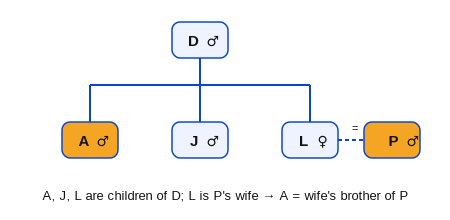
  1. A @ D : A is the son of D. D £ J : D is the father of J → A and J are brothers.
  2. J ≠ L : J is the brother of L → L is also a child of D, hence A's sister.
  3. L ≤ P : L is the wife of P → A is the brother of P's wife.

Trick: Children of the same father are siblings; the sister's husband sees you as "wife's brother" (saala).

Answer: (B) Wife's brother

अवधारणा: हर प्रतीक को क्रम से डिकोड कर परिवार वृक्ष बनाएँ, फिर P की ओर से संबंध पढ़ें।

  1. A @ D : A, D का पुत्र है। D £ J : D, J का पिता है → A और J भाई हैं।
  2. J ≠ L : J, L का भाई है → L भी D की संतान है, अत: A की बहन।
  3. L ≤ P : L, P की पत्नी है → A, P की पत्नी का भाई है।

ट्रिक: एक ही पिता की संतानें भाई-बहन हैं; बहन का पति आपको "पत्नी का भाई" (साला) मानेगा।

उत्तर: (B) पत्नी का भाई

RRB NTPC Undergraduate CBT 1General Intelligence and ReasoningBlood relations (coded)RRB NTPC Undergraduate CBT 1 2025 · 8 May Shift 1 →
Q14059.
Tuv ranked 27th from the top and 64th from the bottom in his class. How many students are there in his class?
तुव अपनी कक्षा में ऊपर से 27वें और नीचे से 64वें स्थान पर है। उसकी कक्षा में कितने विद्यार्थी हैं?
  1. A91
  2. B92
  3. C90
  4. D89
Show answer

Concept: If a person is mth from the top and nth from the bottom, total students =m+n−1 (the person is counted twice).

  1. m=27, n=64.
  2. Total =27+64−1=90.

Trick: Top rank + bottom rank − 1 = total (subtract 1 for the double-counted person).

Answer: (C) 90

अवधारणा: यदि कोई व्यक्ति ऊपर से mवाँ और नीचे से nवाँ है, तो कुल छात्र =m+n−1 (व्यक्ति दो बार गिना गया)।

  1. m=27, n=64।
  2. कुल =27+64−1=90।

ट्रिक: ऊपर से रैंक + नीचे से रैंक − 1 = कुल (दो बार गिने व्यक्ति के लिए 1 घटाएँ)।

उत्तर: (C) 90

RRB NTPC Undergraduate CBT 1General Intelligence and ReasoningRankingRRB NTPC Undergraduate CBT 1 2025 · 8 May Shift 1 →
Q14060.
Seven people, Q, M, B, L, E, F and G, are sitting in a row, facing north.
Only six people sit to the right of E. Only five people sit to the left of Q. Only three people sit between M and Q. B is the immediate neighbour of L and G. Only three people sit between F and L.
How many people sit between G and F?
सात व्यक्ति Q, M, B, L, E, F और G एक पंक्ति में उत्तर की ओर मुख करके बैठे हैं।
E के दाईं ओर केवल छह व्यक्ति बैठे हैं। Q के बाईं ओर केवल पाँच व्यक्ति बैठे हैं। M और Q के बीच केवल तीन व्यक्ति बैठे हैं। B, L और G का निकटतम पड़ोसी है। F और L के बीच केवल तीन व्यक्ति बैठे हैं।
G और F के बीच कितने व्यक्ति बैठे हैं?
  1. AOneएक
  2. BFourचार
  3. CThreeतीन
  4. DTwoदो
Show answer

Concept: Number the seats 1–7 from left to right (facing north, left = west). Place the people with fixed positions first.

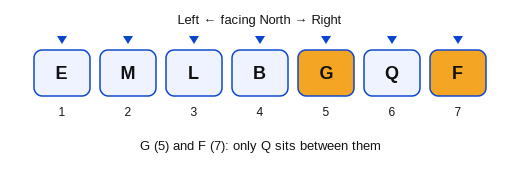
  1. Six people right of E → E at 1. Five people left of Q → Q at 6. Three between M and Q → M at 2.
  2. Seats 3, 4, 5, 7 remain for B, L, G, F. B is between L and G, so B at 4 with L, G at 3 and 5; F takes 7.
  3. Three between F(7) and L → L at 3, so G at 5. Order: E M L B G Q F.
  4. Between G(5) and F(7) sits only Q → one person.

Trick: "Only n people sit to the right/left" pins a person to an exact seat – start from such clues.

Answer: (A) One

अवधारणा: बाएँ से दाएँ सीटों को 1–7 नंबर दें (उत्तर की ओर मुख, बायाँ = पश्चिम)। पहले निश्चित स्थान वालों को बैठाएँ।

  1. E के दाएँ छह लोग → E सीट 1 पर। Q के बाएँ पाँच लोग → Q सीट 6 पर। M और Q के बीच तीन → M सीट 2 पर।
  2. सीट 3, 4, 5, 7 बची हैं B, L, G, F के लिए। B, L और G के बीच है → B सीट 4 पर, L और G सीट 3 व 5 पर; F सीट 7 पर।
  3. F(7) और L के बीच तीन → L सीट 3 पर, अत: G सीट 5 पर। क्रम: E M L B G Q F।
  4. G(5) और F(7) के बीच केवल Q → एक व्यक्ति।

ट्रिक: "केवल n लोग दाएँ/बाएँ बैठे हैं" व्यक्ति की सटीक सीट तय कर देता है – ऐसे सुराग से शुरू करें।

उत्तर: (A) एक

RRB NTPC Undergraduate CBT 1General Intelligence and ReasoningLinear seating arrangementRRB NTPC Undergraduate CBT 1 2025 · 8 May Shift 1 →